


close
Choose Your Site
Global
Social Media
Views: 277 Author: HLun PACK Publish Time: 2026-09-01 Origin: Site


Content Menu
● Why Liquid Packaging Matters
● Main Types of Liquid Packaging
>> Bottles
>> Cartons
● How to Match a Liquid With the Right Filling Machine
>> Start With Product Characteristics
>> Select the Filling Principle
● The Complete Liquid Packaging Line
● Choosing Liquid Packaging Equipment
● Food Safety, Hygiene, and Package Integrity
● Trends Shaping Liquid Packaging
● Build a Liquid Packaging Solution With HLun Pack
>> 1. What is liquid packaging?
>> 2. Which liquid packaging machine is best for thick products?
>> 3. What is the difference between a liquid filling machine and a liquid packaging line?
>> 4. How can manufacturers reduce liquid product waste during filling?
>> 5. What packaging is best for liquid detergents?
>> 6. Why is leak testing important in liquid packaging?
>> 7. Can one liquid packaging line handle different bottle sizes?
Liquid packaging is the engineered process of filling, closing, protecting, inspecting, and preparing liquid products for distribution. For manufacturers, it is not simply a choice of bottle or pouch—it is a complete system that must protect product quality, prevent leakage, meet hygiene requirements, support target output, and deliver a convenient experience for the end user.
At HLun Pack, we view liquid packaging equipment as part of an integrated production solution. The right filling machine, package format, closure, inspection system, and downstream automation must work together. Whether you package drinking water, edible oil, sauces, dairy products, detergents, cosmetics, chemical liquids, or pharmaceutical formulations, the goal is the same: consistent fills, dependable seals, low waste, and scalable production.
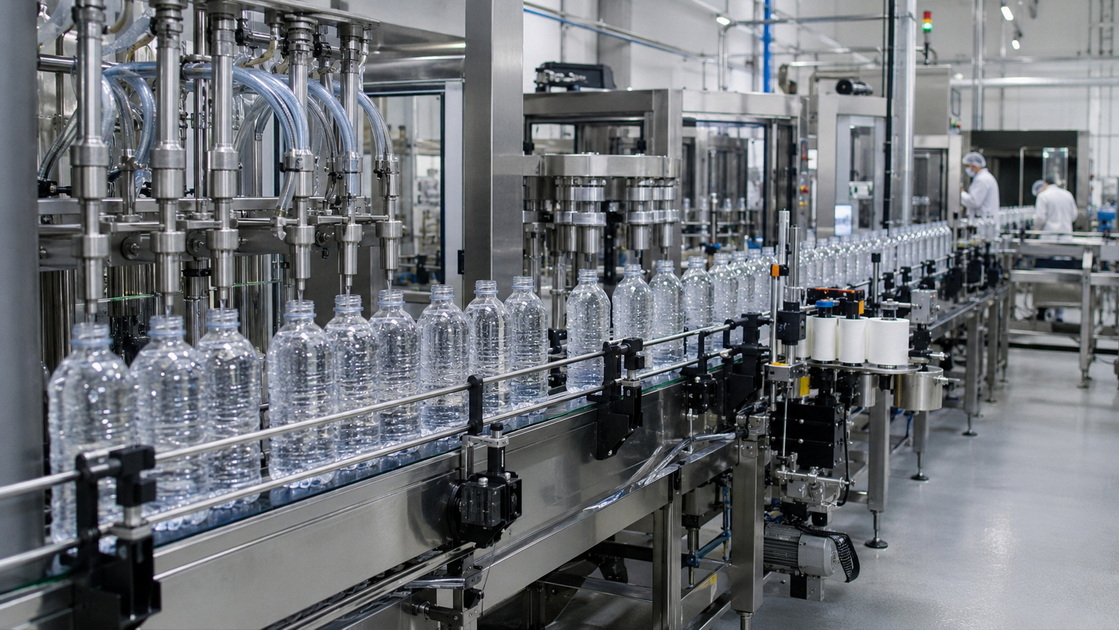
Liquid packaging is the process of placing a liquid, semi-liquid, gel, or viscous product into a suitable container and then sealing it for storage, transport, retail display, and use. The process may include product preparation, container feeding, filling, capping or heat sealing, coding, labeling, inspection, case packing, and palletizing.
A successful liquid packaging system must do more than move product into a container. It must control several critical risks:
- Leakage caused by weak seals, poor cap torque, damaged containers, or incorrect filling settings
- Contamination from unclean equipment, unsuitable materials, or poor production controls
- Overfill and underfill that increase giveaway, create compliance issues, or harm customer trust
- Oxidation, light exposure, and moisture transfer that can affect product stability and shelf life
- Downtime caused by difficult changeovers, cleaning requirements, or incompatible packaging materials
- Transport damage caused by insufficient package strength or poor secondary packaging design
For food and beverage applications, packaging materials that contact food are subject to safety considerations. The U.S. Food and Drug Administration explains that food-contact substances include materials used in packaging, processing, storage, and handling, and such substances must be authorized for their intended use where required.
Liquid products are more complex to package than many dry products. They can splash, foam, drip, separate, react with materials, change viscosity with temperature, or require a controlled hygienic environment. A package and machine combination that works well for water may be unsuitable for ketchup, shampoo, disinfectant, or a hot-filled beverage.
The right solution influences both operational performance and brand outcomes.
| Packaging objective | Why it matters | Equipment implication |
|---|---|---|
| Product protection | Helps preserve quality, safety, and shelf life | Appropriate material, hygienic filling design, dependable sealing |
| Accurate dosing | Reduces product giveaway and supports consistent pack weight or volume | Suitable volumetric, piston, flowmeter, gravity, or net-weight filling system |
| Package integrity | Prevents leakage during warehousing and transportation | Capper, sealer, torque control, leak detection, vision inspection |
| Production efficiency | Supports higher output with fewer interruptions | Automated conveyors, container handling, quick change parts, integrated controls |
| Brand presentation | Improves shelf appeal and customer confidence | Stable filling level, clean containers, accurate labeling, coding and inspection |
| Sustainability goals | Can reduce material use, freight weight, and unnecessary waste | Flexible packaging capability, optimized containers, efficient line design |
For many producers, the package is also a commercial decision. A premium glass bottle may support brand positioning for specialty oil or cosmetics. A refill pouch may reduce packaging material and logistics weight. A single-use sachet can create a convenient trial-size or foodservice format. The best answer depends on the product, market, filling method, distribution channel, and business model.
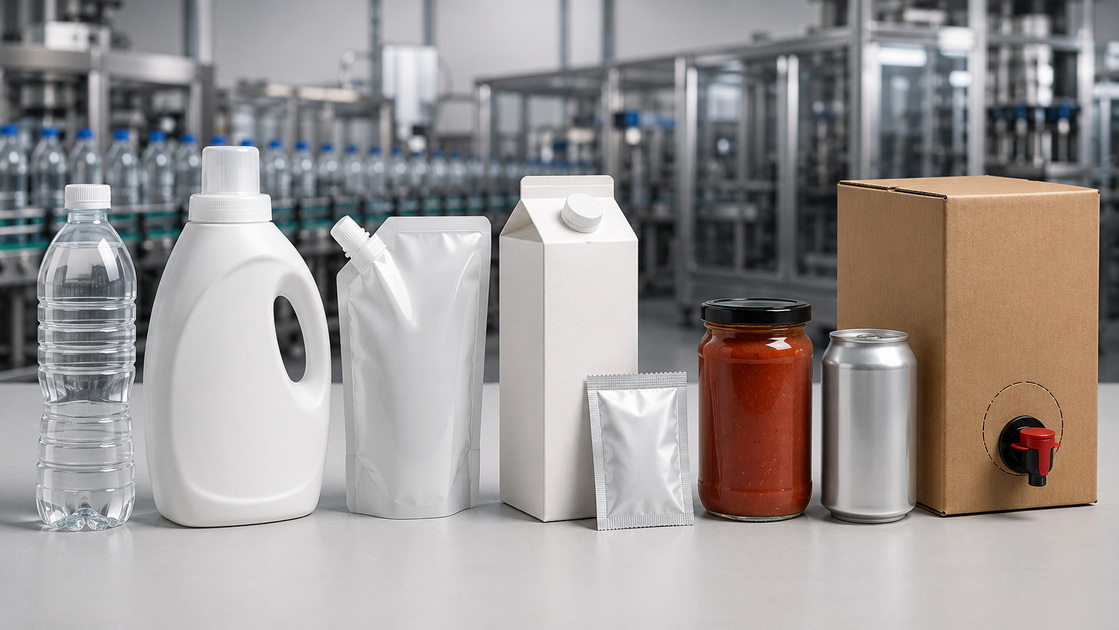
Bottles remain one of the most widely used forms of liquid packaging. They are commonly made from PET, HDPE, glass, PP, or other materials selected for the product's compatibility and market position.
Common bottle applications include:
- Bottled water, juice, tea, and functional beverages
- Edible oil, vinegar, sauces, and condiments
- Milk, dairy drinks, and plant-based beverages
- Shampoo, body wash, lotions, and cosmetic liquids
- Detergents, disinfectants, cleaners, and industrial chemicals
Bottle filling lines usually combine bottle rinsing or air cleaning, filling, capping, labeling, date coding, inspection, shrink wrapping or case packing, and palletizing. The appropriate filling principle depends on the product. Thin, free-flowing liquids may use gravity or flowmeter filling, while thick sauces, creams, and gels often require piston filling.
Flexible pouches are increasingly important for sauces, detergents, baby food, liquid concentrates, personal-care refills, and portable beverages. Compared with rigid containers, pouches can lower material consumption and shipping weight, while also providing convenient dispensing and a large printable branding surface.
Common pouch formats include:
- Stand-up pouches
- Spouted pouches
- Flat pouches
- Three-side-seal and four-side-seal pouches
- Refill pouches
- Retort pouches
- Single-serve liquid packs
A pouch filling and sealing machine may use premade pouches or form packages from roll film. For high-volume, cost-sensitive applications, a liquid vertical form-fill-seal machine can form the bag, fill the product, and create the seals in one continuous process.
Sachets and stick packs are small, portion-controlled packages commonly used for condiments, shampoo, serum, drink concentrates, gels, sample products, and pharmaceutical liquids.
They are especially useful when brands need:
- Single-use convenience
- Controlled dosage
- Trial-size retail packs
- Hotel and travel-size products
- Foodservice portions
- Lower post-opening waste
The machine must control fill accuracy and seal quality carefully because small-format packaging has limited tolerance for leakage or visual defects.
Liquid cartons are common for milk, juice, soups, plant-based beverages, and other shelf-stable or refrigerated products. Their broad printable panels support strong shelf communication, while certain carton structures provide barrier protection against light, oxygen, and external contamination.
Aseptic carton filling is a specialized process. It requires validated sterilization, hygienic equipment design, controlled operating conditions, and packaging materials appropriate to the product and process. It should never be treated as a simple extension of ordinary bottle filling.
Cups, jars, and trays are useful for yogurt, dairy desserts, honey, sauces, dips, creams, gels, and semi-liquid foods. Wide-mouth containers can be advantageous for products that are thick, particulate, scoopable, or difficult to dispense through narrow openings.
Typical line equipment may include:
- Container denesting
- Volumetric or piston filling
- Lidding or heat sealing
- Overcap application where required
- Date coding and label application
- Vision inspection and final packing
Aluminum cans are widely used for carbonated beverages, energy drinks, ready-to-drink products, and other products requiring strong protection from light and oxygen. Bag-in-box systems are often selected for larger-volume products such as wine, juice, edible oil, syrups, foodservice sauces, and cleaning liquids.
Bag-in-box formats can improve bulk dispensing and reduce the weight associated with rigid containers. However, the fitment, bag film structure, filling process, and dispensing method must be evaluated together to avoid leakage, oxidation, or poor user experience.
The most common mistake in liquid packaging projects is choosing equipment based only on desired speed or package appearance. In practice, the liquid itself should drive the technical specification.
Before selecting a liquid filling machine, define the product's actual processing behavior:
1. Viscosity: Is the product thin like water, medium-bodied like oil, or thick like ketchup, cream, or honey?
2. Foaming behavior: Does the product create foam during filling, such as shampoo, detergents, or certain beverages?
3. Temperature: Will the liquid be filled cold, at ambient temperature, hot, or after thermal treatment?
4. Particulates: Does it contain pulp, herbs, fruit pieces, seeds, or other suspended solids?
5. Chemical compatibility: Can the liquid react with stainless steel grades, elastomers, plastic components, or package materials?
6. Hygiene sensitivity: Does the application require sanitary, hygienic, aseptic, or pharmaceutical-grade controls?
7. Fill volume and tolerance: What are the acceptable volume limits, and how much product giveaway can the operation afford?
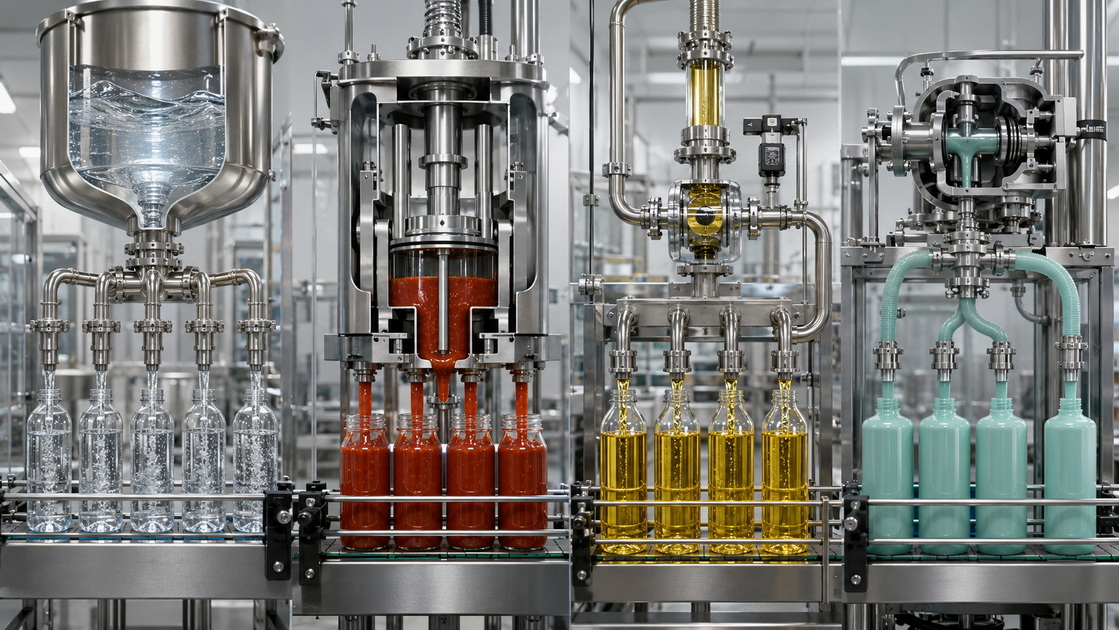
| Filling technology | Best suited for | Key advantage | Important consideration |
|---|---|---|---|
| Gravity filling | Water-like, free-flowing liquids | Simple and efficient for thin liquids | Not ideal for highly viscous products |
| Overflow filling | Products requiring uniform visual fill level | Creates a consistent fill appearance in transparent containers | Product recirculation and foam behavior require attention |
| Piston filling | Thick sauces, creams, pastes, gels, and viscous liquids | Strong accuracy across a wide viscosity range | Requires proper cleaning and product-contact design |
| Flowmeter filling | Beverages, oils, and many low- to medium-viscosity products | Accurate non-contact measurement options | Requires stable flow properties and correct calibration |
| Net-weight filling | Higher-value liquids and larger containers | Measures by weight and can reduce giveaway | Throughput and integration requirements vary |
| Pump filling | Products with variable viscosity or specialized handling needs | Flexible for many liquid applications | Pump selection must match product properties |
A trusted liquid packaging equipment supplier should not recommend a filler until product samples, container drawings, output targets, sanitation expectations, and downstream requirements have been reviewed.
A liquid packaging line is a connected system, not a collection of standalone machines. Weak performance in one station can reduce overall line efficiency, even if the filler itself operates at high speed.
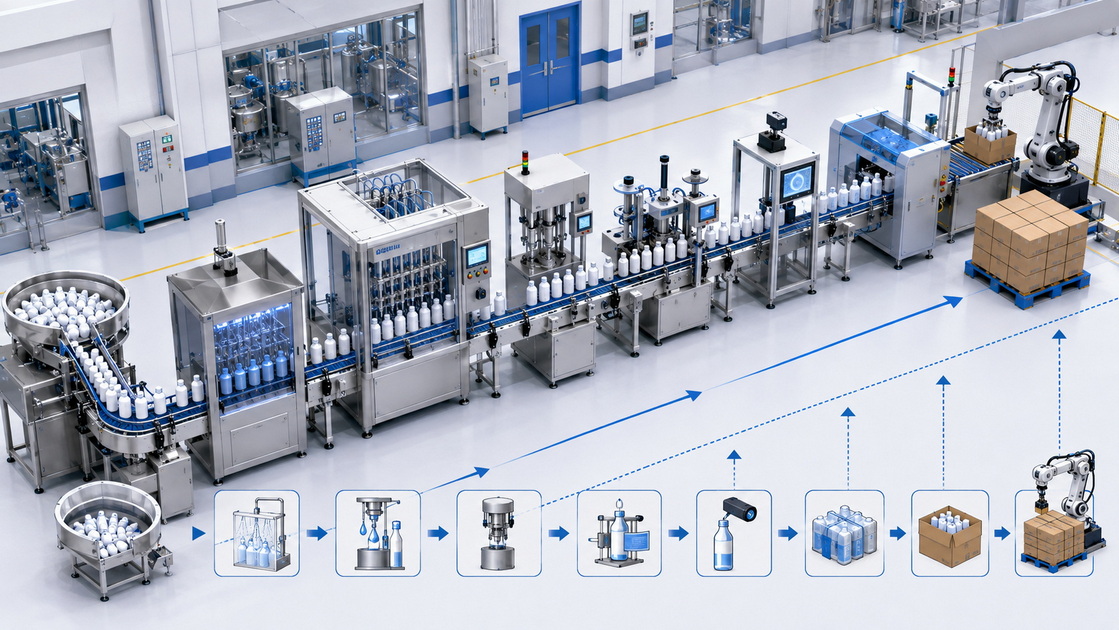
A typical automated liquid packaging line may include:
1. Container handling — bottle unscrambling, pouch feeding, cup denesting, or conveyor integration
2. Cleaning or rinsing — air rinsing, water rinsing, or container preparation where applicable
3. Liquid filling — accurate dosing into the selected package
4. Sealing or capping — screw capping, snap capping, heat sealing, induction sealing, or can seaming
5. Coding and marking — batch, production date, expiry date, QR code, or traceability information
6. Labeling — pressure-sensitive labels, shrink sleeves, wrap-around labels, or printed films
7. Quality inspection — fill-level checks, cap inspection, leak testing, vision systems, metal detection, or checkweighing
8. Secondary packaging — shrink wrapping, tray packing, case packing, or cartoning
9. End-of-line automation — palletizing, stretch wrapping, and warehouse-ready handling
This integrated approach matters because filling accuracy alone does not guarantee a saleable product. A correct fill can still fail due to a loose cap, missing label, unreadable code, poor seal, or damaged outer case.
At HLun Pack, we recommend evaluating a liquid packaging project through total line performance rather than only the purchase price of one machine.
Ask these questions before finalizing equipment:
- What product range must the line handle now and in the next three years?
- How many container sizes, cap types, and package formats are required?
- What target output is needed per minute, hour, and shift?
- What fill accuracy is required for compliance and margin control?
- Is the product sensitive to oxygen, light, microbial contamination, or temperature?
- Does the product foam, drip, splash, or contain particulates?
- What cleaning process is required between product runs?
- How quickly must operators complete format changeovers?
- Which quality inspections are essential before shipping?
- What utilities are available, including compressed air, electricity, water, steam, and CIP connections?
- Is there enough floor space for safe operation, maintenance access, and future expansion?
- Does the supplier provide commissioning, operator training, spare-parts support, and remote technical assistance?
Consider a company launching a 500 mL liquid detergent in both an HDPE bottle and a refill pouch.
A bottle-only line might appear cheaper at first. But if the brand plans to introduce refill packs within 12 months, it may be more economical to design the facility around modular equipment, shared product handling, and compatible coding and inspection systems from the beginning.
The decision is not simply "bottle versus pouch." It is about:
- Product compatibility
- Consumer convenience
- Material use
- Filling accuracy
- Format flexibility
- Future SKU expansion
- Total cost of ownership
This is why a complete packaging solution should be engineered around the manufacturer's operating plan, not just today's package design.
For food, beverages, cosmetics, pharmaceuticals, and sensitive chemical products, hygienic equipment design is fundamental. Equipment surfaces, seals, transfer lines, valves, and filling nozzles should be selected to support cleaning, maintenance, and contamination control.
The FDA notes that manufacturers have responsibilities to implement current good manufacturing practices and preventive controls as necessary to minimize or prevent contamination exposure. For cosmetics, FDA guidance also emphasizes clean, properly maintained processing and filling equipment, as well as packaging materials that are stored and handled to prevent mix-ups, contamination, or degradation.
In practical terms, this means your liquid packaging line should consider:
- Food-grade or application-appropriate product-contact materials
- Cleanable piping and sanitary fittings
- CIP-compatible design where required
- Minimal dead zones where product can accumulate
- Controlled filling environments for sensitive products
- Correct closure torque or seal parameters
- Leak detection and fill-level verification
- Batch coding and traceability systems
- Documented cleaning, maintenance, and inspection procedures
For aseptic applications, manufacturers should conduct a deeper engineering and validation review. Sterilization performance, packaging material compatibility, product treatment, environmental control, and process monitoring all affect final product safety and shelf life.
Liquid packaging is moving toward more flexible, automated, and material-efficient production systems. Producers increasingly need lines that can handle more SKUs, shorter production runs, changing material formats, and stricter quality expectations without sacrificing output.
Industry research cited by BeverageDaily reports that 68% of beverage companies expect moderate to significant increases in packaging machinery investment over the next two to three years. The same report identifies filling, capping, and closing equipment as a leading investment priority, while paper-based packaging, flexible packaging, and liquid cartons are projected to increase in use.
For liquid product manufacturers, the practical implications are clear:
- Flexible equipment matters. Quick changeovers can support new container sizes and product launches.
- Inspection is becoming essential. Automated checks can reduce the risk of leaking, underfilled, or incorrectly labeled packs.
- Sustainability requires engineering. A lighter package is not automatically a better package if it fails in transport or cannot run reliably at line speed.
- Data improves decisions. Production dashboards, fill-volume monitoring, and reject tracking can reveal waste and downtime patterns.
- Hygienic design protects uptime. Easier cleaning and maintenance can reduce operational disruption while supporting quality objectives.
The best liquid packaging solution is one that fits your product, production targets, package design, hygiene requirements, and growth plans. A machine that looks impressive on paper is not enough—it must run your specific liquid, container, closure, and label reliably in real production conditions.
HLun Pack provides liquid packaging equipment and integrated packaging solutions for manufacturers seeking dependable filling, sealing, capping, labeling, inspection, and end-of-line automation. We help evaluate the full process so your line can achieve accurate filling, secure packaging, efficient operation, and scalable capacity.
Contact HLun Pack today to discuss your liquid product, packaging format, required output, and automation goals. Our team can help you identify a practical liquid packaging machine configuration built around your production needs.
Liquid packaging is the process of filling a liquid product into a bottle, pouch, carton, can, cup, jar, sachet, or other container, then sealing and preparing it for storage, distribution, and sale. A complete system may also include capping, labeling, coding, inspection, and final packing.
Piston filling machines are often suitable for thick products such as sauces, creams, gels, honey, shampoo, and pastes because they can provide controlled volumetric dosing. The correct selection still depends on viscosity, particulates, temperature, fill volume, and cleaning requirements.
A liquid filling machine performs the dosing and filling step. A liquid packaging line is a broader system that can include container feeding, rinsing, filling, capping or sealing, labeling, coding, inspection, case packing, and palletizing.
Manufacturers can reduce waste by selecting the right filling method, calibrating fill volumes, controlling nozzle design, minimizing dripping and foaming, maintaining stable product conditions, and using checkweighers or fill-level inspection systems to identify deviations early.
HDPE bottles, PET bottles, refill pouches, and larger containers are commonly used for liquid detergents. The best format depends on chemical compatibility, product viscosity, dispensing needs, retail positioning, transport conditions, and sustainability objectives.
Leak testing helps identify packages with poor seals, damaged containers, loose caps, or other defects before they reach customers. It can reduce returns, transport losses, product contamination risks, and damage to brand reputation.
Yes, many liquid packaging lines can be designed to handle multiple bottle sizes or container formats through adjustable guides, recipe settings, and change parts. However, the number of formats, changeover time, and production-speed requirements should be defined before equipment is specified.
1. Pallas. "[What Is Liquid Packaging? Types & Guide](https://www.pallasmt.com/what-is-liquid-packaging/)." Accessed August 31, 2026. Used as the baseline competitor article for packaging formats, liquid product categories, machine categories, and buying factors. [pallasmt](https://www.pallasmt.com/what-is-liquid-packaging/)
2. U.S. Food and Drug Administration. "[Food Chemical Safety](https://www.fda.gov/food/food-ingredients-packaging/food-chemical-safety)." Updated May 12, 2026. Used for food-contact substance context and manufacturer responsibilities relating to good manufacturing practices and preventive controls. [fda](https://www.fda.gov/food/food-ingredients-packaging/food-chemical-safety)
3. U.S. Food and Drug Administration. "[GMP Guidelines/Inspection Checklist for Cosmetics](https://www.fda.gov/cosmetics/cosmetics-guidance-documents/good-manufacturing-practice-gmp-guidelinesinspection-checklist-cosmetics)." Updated November 18, 2025. Used for hygiene, equipment maintenance, sanitation, and packaging-material handling considerations in cosmetic production. [fda](https://www.fda.gov/cosmetics/cosmetics-guidance-documents/good-manufacturing-practice-gmp-guidelinesinspection-checklist-cosmetics)
4. BeverageDaily. "[Sustainability Drives Change in Beverage Packaging Operations](https://www.beveragedaily.com/Article/2025/09/04/sustainability-drives-change-in-beverage-packaging-operations/)." September 4, 2025. Used for cited PMMI-linked investment and packaging-material trend figures. [beveragedaily](https://www.beveragedaily.com/Article/2025/09/04/sustainability-drives-change-in-beverage-packaging-operations/)


