


close
Choose Your Site
Global
Social Media
Views: 266 Author: HLun PACK Publish Time: 2026-10-30 Origin: Site


Content Menu
● Spout Pouch vs. Glass Bottles
● Barrier Performance and Shelf Life
>> Glass Bottles Provide an Excellent Container-Wall Barrier
>> Spout Pouches Require a Whole-Package Assessment
● Food Safety: Match the Package to the Preservation Process
>> Acidity Does Not Automatically Make a Sauce Shelf-Stable
>> Hot Filling and Retorting Are Different Requirements
● Liquid Packaging Equipment: What Changes on the Filling Line?
>> Spout Pouch Filling Requires Controlled Package Handling
>> Glass Bottle Filling Requires Stable Bottle and Closure Control
>> Spout Pouches Can Suit Foodservice Refilling
>> Glass Bottles Offer Familiar Pouring and Presentation
● Total Cost: Compare Delivered Condiment, Not Empty Containers
>> An Illustrative Packaging-Weight Calculation
● Sustainability: Separate Material Efficiency from Recyclability
● A Practical Validation Plan Before Switching Formats
>> 1: Define the Product and Operating Window
>> 2: Confirm the Package Specification
>> 3: Run Representative Filling Trials
>> 4: Challenge Distribution and Dispensing
>> 5: Confirm Shelf Life and Commercial Readiness
● Which Format Fits Your Condiment Business?
● Plan Your Packaging Project with HLun Pack
>> Are spout pouches suitable for acidic liquid condiments?
>> Do glass bottles always provide longer shelf life?
>> Can thick sauces containing particles use spout pouches?
>> Can one filling machine handle both pouches and glass bottles?
>> Are mono-material spout pouches recyclable everywhere?
>> What information is needed for an equipment quotation?
Choosing between a spout pouch vs. glass bottles for bulk liquid condiment packaging solutions means balancing product protection, filling performance, distribution costs, and customer experience. A lightweight pouch can simplify foodservice dispensing and reduce packaging weight. A glass bottle offers an excellent barrier and a familiar presentation for premium sauces. Neither format wins every application.
My recommendation is to start with the condiment and its processing requirements—not the container's appearance. A packaging decision that works for thin vinegar may fail with particulate chili sauce or an oxygen-sensitive dressing.
For HLun Pack, a manufacturer focused on liquid packaging equipment and integrated packaging solutions, the useful comparison is therefore broader than materials. It connects the container, closure, filling machine, preservation process, and distribution environment.
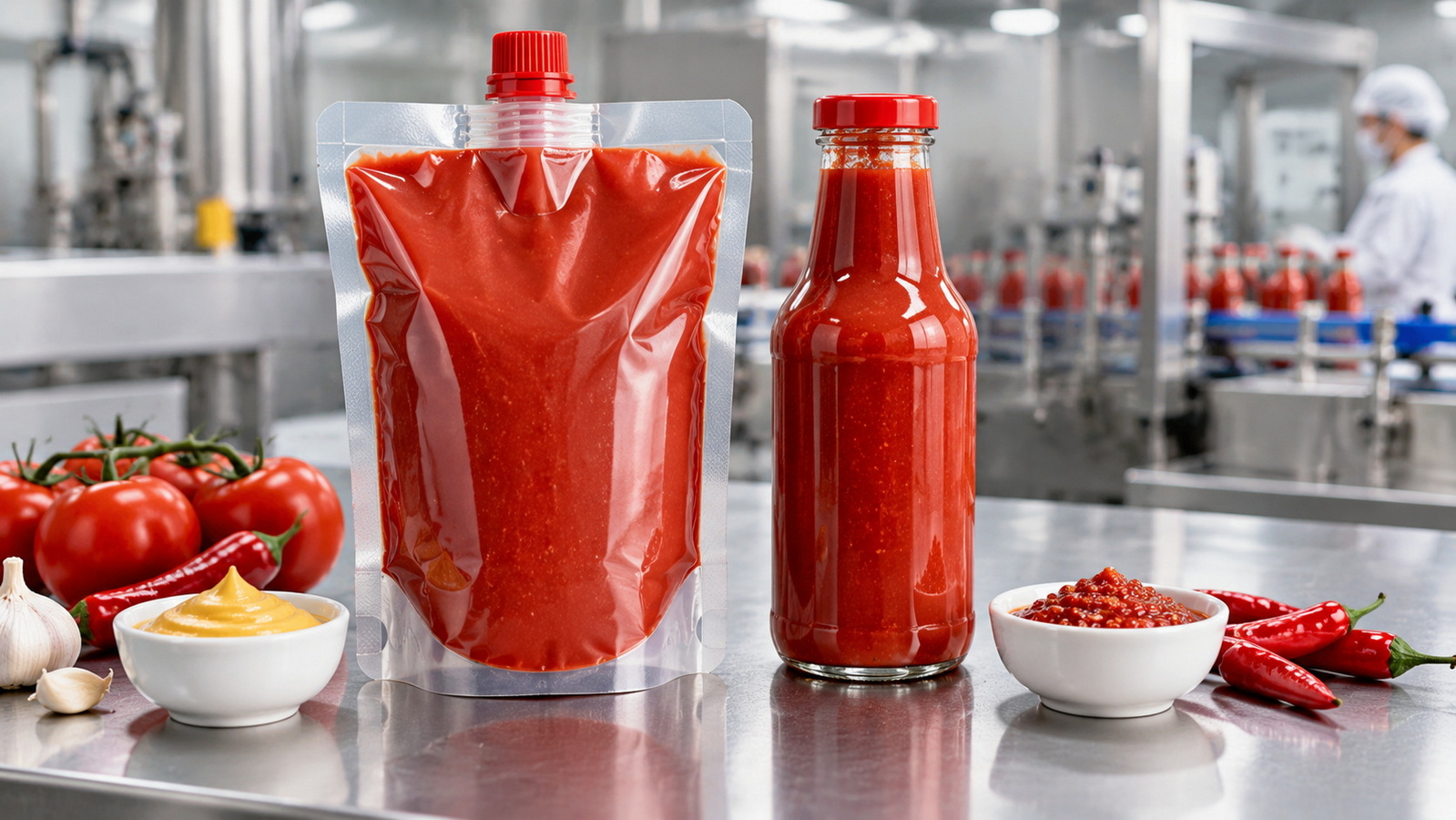
Here, "bulk" means larger foodservice, refill, and institutional packs—not drums or intermediate bulk containers. Exact capacities must be confirmed with packaging and equipment suppliers.
| Decision factor | Spout pouch | Glass bottle |
|---|---|---|
| Empty packaging weight | Generally lighter | Generally heavier |
| Product protection | Depends on film, fitment, closure, and seals | Excellent glass-wall barrier; closure remains critical |
| Handling risks | Punctures, flex damage, and seal leaks | Breakage, chips, and impact damage |
| Dispensing | Squeezable; spout geometry affects control | Rigid pouring; neck geometry affects flow |
| Filling requirements | Pouch support, fitment handling, and closure control | Bottle handling, neck alignment, and capping |
| Thermal processing | Requires a compatible pouch construction | Requires suitable glass and controlled temperature changes |
| Positioning | Practical for refills and foodservice | Often selected for visible, premium presentation |
| Recycling | Highly dependent on structure and local collection | Depends on local collection and processing |
| Best evaluation basis | Delivered cost and validated performance | Delivered cost and validated performance |
Glass is nonporous and impermeable. This makes the container wall a strong barrier against gas and moisture transmission and supports flavor and aroma preservation.
However, a glass bottle is not a complete preservation system by itself. Oxygen can remain in the headspace, while closure liners and imperfect seals can affect package performance.
Clear glass also exposes the product to light. Light-sensitive sauces may need colored glass, a protective label, or secondary packaging.
A spouted pouch can combine structural, sealing, and barrier functions within its film construction. Performance varies substantially between specifications.
Ask suppliers for:
- Oxygen transmission rate under stated test conditions.
- Water vapor transmission rate.
- Light-barrier characteristics.
- Resistance to flexing and distribution damage.
- Compatibility with the spout, cap, and product.
- Performance after the intended thermal treatment.
Do not compare film data alone. The fitment connection, pouch seals, and cap also influence protection.
Neither format guarantees a particular shelf life. Validate the actual condiment in its final package through microbiological, sensory, and package-integrity testing.
For the United States, acidified foods generally involve low-acid ingredients to which acid or acid foods are added, with a finished equilibrium pH of 4.6 or below and water activity above 0.85. Not every naturally acidic condiment belongs to this regulatory category.
That distinction matters. Product classification, formulation, processing, and container specifications determine the applicable requirements.
Commercial processors of covered shelf-stable acidified and low-acid foods must meet relevant registration and scheduled-process filing requirements. A qualified processing authority should evaluate the product and preservation process.
A standard spout pouch should not be assumed suitable for hot filling, retorting, or aseptic processing. Each requires a specifically compatible construction and validated package system.
Glass also needs verification. Bottle design, closure selection, and temperature transitions must suit the process.
Food-contact suitability depends on intended use, including food type, contact temperature, and duration. Request documentation covering the actual application—not simply a general "food-grade" statement.
Changing from glass to a pouch can alter heating and cooling behavior. Treat the conversion as a process-validation project, not merely a container substitution.
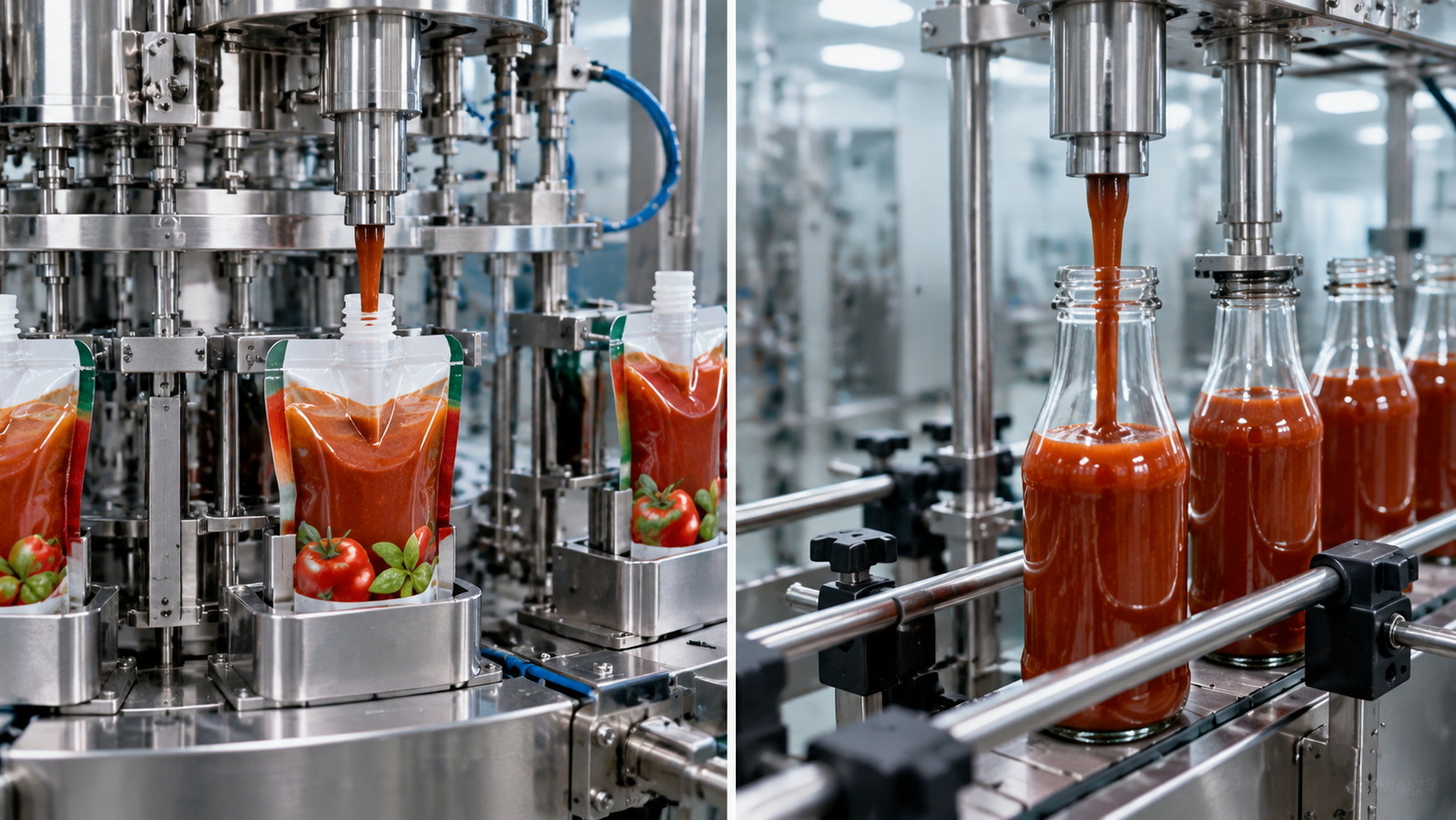
A spout pouch filling machine may fill through a pre-attached spout or through an open pouch before final sealing. These are different machine configurations.
Important selection points include:
- Pouch dimensions and fitment position.
- Spout opening and maximum particle size.
- Product viscosity at filling temperature.
- Foam generation and air entrainment.
- Cap feeding, tightening, and verification.
- Pouch support during filling and discharge.
For thick condiments, the dosing system must control flow without excessive dripping or product damage. The most suitable pump or filling principle depends on the recipe and operating conditions.
Glass bottles provide a rigid filling target, but they need suitable conveying, spacing, and handling.
The line may require bottle inspection, controlled nozzle positioning, cap application, and rejection of incorrectly closed containers.
A narrow neck can restrict particulate sauces. A wide-mouth design may improve filling and pouring, but it also changes closure requirements.
In both formats, request a trial using the real product. Water trials cannot establish how mayonnaise, mustard, or chili sauce will behave.
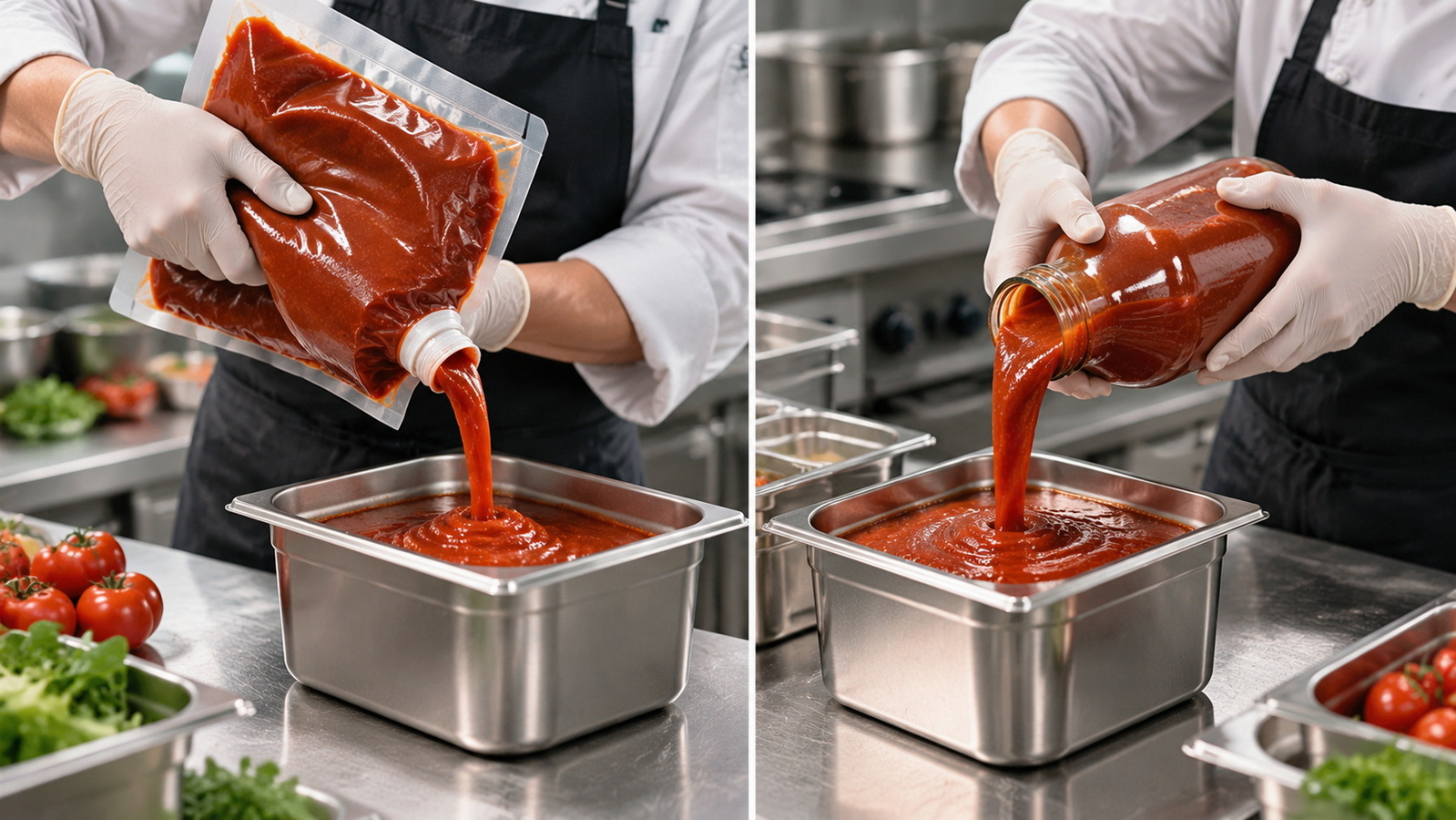
A squeezable pouch can help operators direct sauce into dispensers or preparation containers. Its collapsing shape may also help product evacuation.
However, evacuation is not automatically better. Thick sauce can remain in corners, and a small spout may slow emptying.
Test dispensing with realistic product temperature, operator technique, and holding time.
Glass can suit table service, premium retail, and applications where customers value seeing the product.
For larger containers, assess lifting effort and pouring control. A slippery exterior, heavy filled bottle, or poorly positioned grip can make refilling awkward.
The useful comparison is not "Which looks better?" It is:
1. How quickly can the operator dispense?
2. How much product remains?
3. How often do spills occur?
4. Can the package be securely reclosed?
An inexpensive container can become expensive after freight, downtime, leakage, and product waste.
Build the comparison around the same delivered product volume and service requirement.
Include:
- Container, closure, label, and secondary packaging.
- Incoming freight and empty-pack storage.
- Filling labor, utilities, and changeover time.
- Equipment investment and maintenance.
- Finished-goods pallet configuration.
- Transport damage and customer complaints.
- Residual condiment left after dispensing.
Suppose a 2-liter glass package weighs 800 grams empty, while an equivalent pouch weighs 60 grams.
Across 10,000 packs, the packaging-weight difference is:
10,000×(0.800−0.060)=7,400 kg
These are hypothetical inputs, not supplier specifications or measured industry averages.
The calculation shows why buyers should request actual package weights. It does not establish freight savings: shipment limits, pallet stability, case dimensions, and whether transport is weight- or volume-constrained also matter.
Spout pouches generally use less packaging mass than comparable glass containers. That can be an important advantage, but lower weight does not prove superiority in every environmental category.
A United Nations Environment Programme review of food-packaging life-cycle assessments reported favorable results for multilayer stand-up pouches compared with glass jars in specific reviewed scenarios. Those findings should not be treated as a universal result for every condiment, package size, or delivery route.
Glass can be recycled where suitable collection and processing exist. Refillable systems introduce additional variables, including return distances, washing, and achieved reuse cycles.
Flexible packaging requires equally careful claims. CEFLEX recommends moving toward mono-material structures where functional requirements allow. Nevertheless, a package designed for recycling is not necessarily collected or recycled in every market.
Evaluate:
- Local collection and sorting access.
- Film, spout, and cap compatibility.
- Product residue.
- Distribution distance.
- Product losses.
- Return logistics, where applicable.
Avoid calling either format universally "eco-friendly" without a defined comparison.
A well-run packaging trial can reveal more than a long list of supplier promises.
Record pH, water activity where relevant, viscosity at filling temperature, particle dimensions, oil content, and target shelf life.
Include formulation variation. A line must handle production tolerances, not just one ideal laboratory sample.
Obtain drawings, material details, closure specifications, food-contact documentation, and processing limits.
For pouches, include seal and fitment requirements. For glass, include bottle-finish and closure compatibility.
Measure fill accuracy, closure performance, stoppages, rejects, and cleaning time.
Test startup, steady production, and restart after interruptions. Agree acceptance limits before the trial.
Use tests appropriate to the expected shipping route and handling environment.
Evaluate leakage, pouch puncture, glass breakage, case damage, and customer dispensing. Weigh residual product rather than estimating it visually.
Complete the required safety and shelf-life work before commercial release.
Retain traceable samples and document acceptance criteria. A successful filling demonstration does not establish long-term package performance.
Choose a spout pouch when foodservice refilling, lower packaging weight, and dispensing convenience are major priorities—and the pouch can meet the product's protection and processing requirements.
Choose glass bottles when premium presentation, a rigid container, and strong container-wall barrier performance carry greater value—and handling weight and breakage risks are acceptable.
Consider a dual-format strategy when different channels need different benefits. A brand might use glass for table presentation and pouches for back-of-house refills.
That approach still requires separate package validation. The same sauce does not automatically behave identically in both systems.
A productive equipment discussion begins with a defined application.
Share your condiment formulation characteristics, target pack size, preservation method, production capacity, and destination market with HLun Pack. Include current bottlenecks such as dripping, slow changeovers, closure failures, or excessive product residue.
Ask for a proposal that connects package specifications with filling, closing, inspection, cleaning, and downstream handling. Require confirmation of the proposed configuration and product-trial criteria before purchasing.
The objective is a complete liquid packaging solution that performs consistently—not simply a machine with an attractive headline speed.
They can be, provided the complete pouch, fitment, and closure system is suitable for the formulation and processing conditions. Confirm food-contact compliance, material compatibility, seal integrity, and validated shelf life.
No. Glass offers an excellent container-wall barrier, but shelf life also depends on processing, closure integrity, headspace oxygen, light exposure, and storage conditions. Compare validated finished packages.
Potentially. Particle dimensions, sauce viscosity, spout diameter, and filling-system design must work together. Trials should check blockages, dosing consistency, particle damage, and dispensing performance.
Some systems may share dosing equipment, but package handling and closing usually differ. Confirm change parts, automation requirements, hygienic design, achievable output, and conversion time with the equipment supplier.
No. Material design is only one requirement. Collection access, sorting capability, fitment compatibility, and local reprocessing infrastructure determine whether a particular package can enter a recycling system.
Provide product characteristics, filling temperature, particle size, package drawings, closure details, required output, cleaning expectations, available utilities, and preservation method. These inputs support a more realistic technical proposal.
The article's decision frameworks and trial recommendations are editorial analysis, not claims of completed HLun Pack customer projects. The weight calculation uses explicitly hypothetical inputs. Technical and regulatory foundations are listed below; the Glass Packaging Institute is an industry association representing glass-container interests.
1. U.S. Food and Drug Administration. "Acidified & Low-Acid Canned Foods Guidance Documents & Regulatory Information." Definitions, establishment registration, and scheduled-process requirements for applicable products. [fda]
2. Electronic Code of Federal Regulations. "21 CFR Part 114—Acidified Foods." Requirements concerning scheduled processes, equilibrium pH, manufacturing controls, and container protection. [ecfr]
3. U.S. Food and Drug Administration. "Food Types & Conditions of Use for Food Contact Substances." Food-contact use categories, including thermal processing and refrigerated storage. [fda]
4. U.S. Food and Drug Administration. "Guidance for Industry: Preparation of Premarket Submissions for Food Contact Substances—Chemistry Recommendations." Intended food types, contact temperatures, durations, and migration-testing considerations. [fda]
5. Glass Packaging Institute. "Facts About Glass." Glass-wall impermeability, nonporosity, and interaction with packaged foods and beverages. [gpi]
6. United Nations Environment Programme. "Single-Use Supermarket Food Packaging and Its Alternatives: Recommendations from Life Cycle Assessments." Comparative environmental findings and their life-cycle context. [lifecycleinitiative]
7. CEFLEX. "How to (Re)Design Flexible Packaging for Circular Prosperity." Mono-material design recommendations and the role of barrier materials, adhesives, and inks. [ceflex]


