


close
Choose Your Site
Global
Social Media
Views: 289 Author: HLun PACK Publish Time: 2026-10-23 Origin: Site


Content Menu
● Mini Doypack Machine vs. Multi-Lane Liquid Packaging Machine: The Main Differences
● How Each Sauce Packaging System Works
>> Mini Doypack Machine: Filling Premade Stand-Up Pouches
>> Multi-Lane Liquid Packaging Machine: Making Several Packs Together
● Start With the Sales Channel, Not Machine Speed
>> When a Mini Doypack Machine Makes More Sense
>> When Multi-Lane Sauce Packaging Makes More Sense
● Sauce Characteristics Can Decide the Winner
>> Viscosity Must Be Tested at Filling Temperature
>> Particles Need More Than a Maximum Size Measurement
>> Product Quality Includes More Than Fill Accuracy
● Seal Integrity and Food Safety Come Before Output
● Calculate Saleable Output Instead of Quoted Speed
● Compare Total Cost per Saleable Pack
>> Build the Cost Model Around Real Production
>> Avoid Unsupported Sustainability Claims
● A Practical Factory Acceptance Test for Boutique Sauces
● An Illustrative Growth Strategy: Separate Retail From Portion Packs
● Build Your HLun Pack Equipment Brief
>> Is a mini doypack machine better for a new sauce brand?
>> Can a multi-lane liquid packaging machine fill thick sauces?
>> Can one machine produce stand-up pouches and stick packs?
>> Which machine has the lower packaging cost?
>> Does hot filling make sauce pouches shelf-stable?
>> What should I send for an accurate equipment quotation?
Choosing a mini doypack machine vs. multi-lane liquid packaging machine starts with a commercial question: how will customers buy and use your sauce? A premium stand-up pouch and a single-serving sachet serve different purposes. Their filling systems, production economics, and operating requirements differ accordingly.
For boutique sauce brands, my starting recommendation is fit: match the machine to the package, recipe, and confirmed demand before comparing maximum output.
A mini doypack machine is generally worth evaluating for retail pouches, frequent flavor changes, and smaller production runs. A multi-lane liquid packaging machine deserves attention when consistent, portion-controlled sachets or sticks support a repeatable sales channel.
For HLun Pack, a manufacturer focused on liquid packaging equipment and integrated packaging solutions, this comparison should extend beyond the filler. Product preparation, packaging materials, inspection, and downstream handling all influence the final investment.
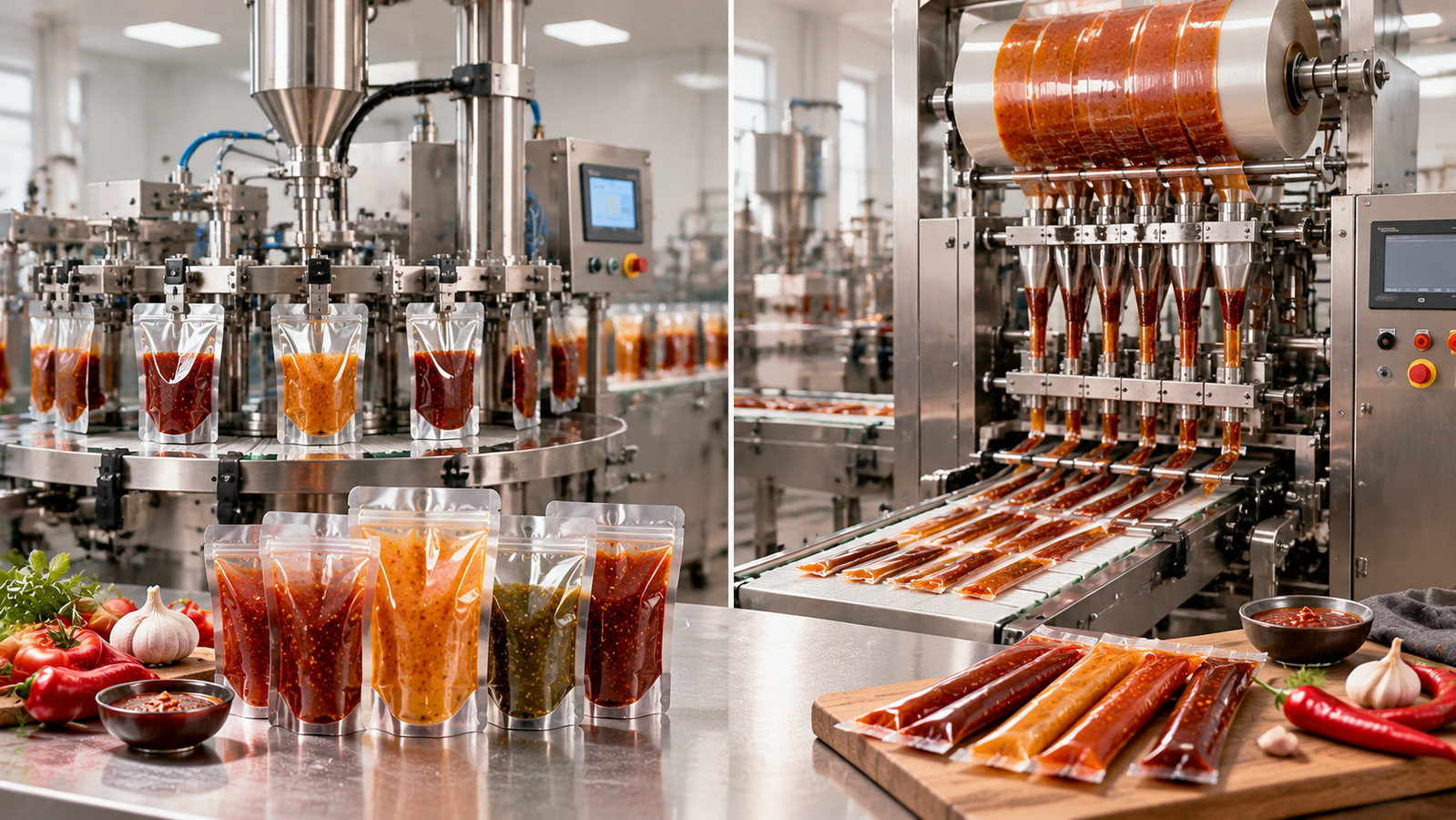
"Mini" is a commercial description, not a standardized capacity class. This article uses "mini doypack machine" to mean a compact machine that fills and seals premade stand-up pouches.
"Multi-lane liquid packaging machine" refers here to equipment that forms, fills, seals, and cuts multiple sachets or stick packs from rollstock. Individual configurations vary.
| Comparison | Mini doypack machine | Multi-lane liquid packaging machine |
|---|---|---|
| Typical package | Premade stand-up pouch | Rollstock sachet or stick pack |
| Strongest commercial fit | Retail, refills, varied small batches | Portion control, meal kits, foodservice |
| Packaging workflow | Opens, fills, and seals existing pouches | Forms, fills, seals, and cuts packages |
| Output structure | Usually evaluated by pouch cycles | Evaluated by lanes and cycles |
| Changeover considerations | Pouch dimensions, grippers, filler settings | Film, forming parts, lane setup, dosing |
| Main purchasing risk | Buying features unnecessary for the pouch | Buying capacity without repeat demand |
| Essential trial | Actual sauce in the intended pouch | Actual sauce and film across every lane |
Neither platform is automatically cheaper, cleaner, or better for thick sauces. Those outcomes depend on the specified machine and application.
A typical premade pouch filling process includes:
1. Loading and presenting empty pouches.
2. Gripping and opening each pouch.
3. Checking pouch presence or opening, where equipped.
4. Dosing sauce through a filling nozzle.
5. Sealing the pouch opening.
6. Discharging the finished package.
The pouch arrives with much of its structure already manufactured. Depending on the machine, compatible formats may include zipper pouches or other specialized constructions.
Do not assume that a standard open-mouth pouch machine also handles spouted pouches. Spout filling, cap application, and closure inspection may require a different configuration.
A multi-lane system processes packaging film through parallel forming and filling positions. Stick-pack and four-side-seal sachet systems use different forming arrangements, but both can produce several packages during each cycle.
The workflow generally combines film handling, package formation, dosing, sealing, coding, cutting, and discharge.
More lanes increase theoretical output. However, they also create more dosing positions and package streams to control. Published machine specifications demonstrate that multi-lane equipment covers different production scales; it is not exclusively a solution for the largest factories.
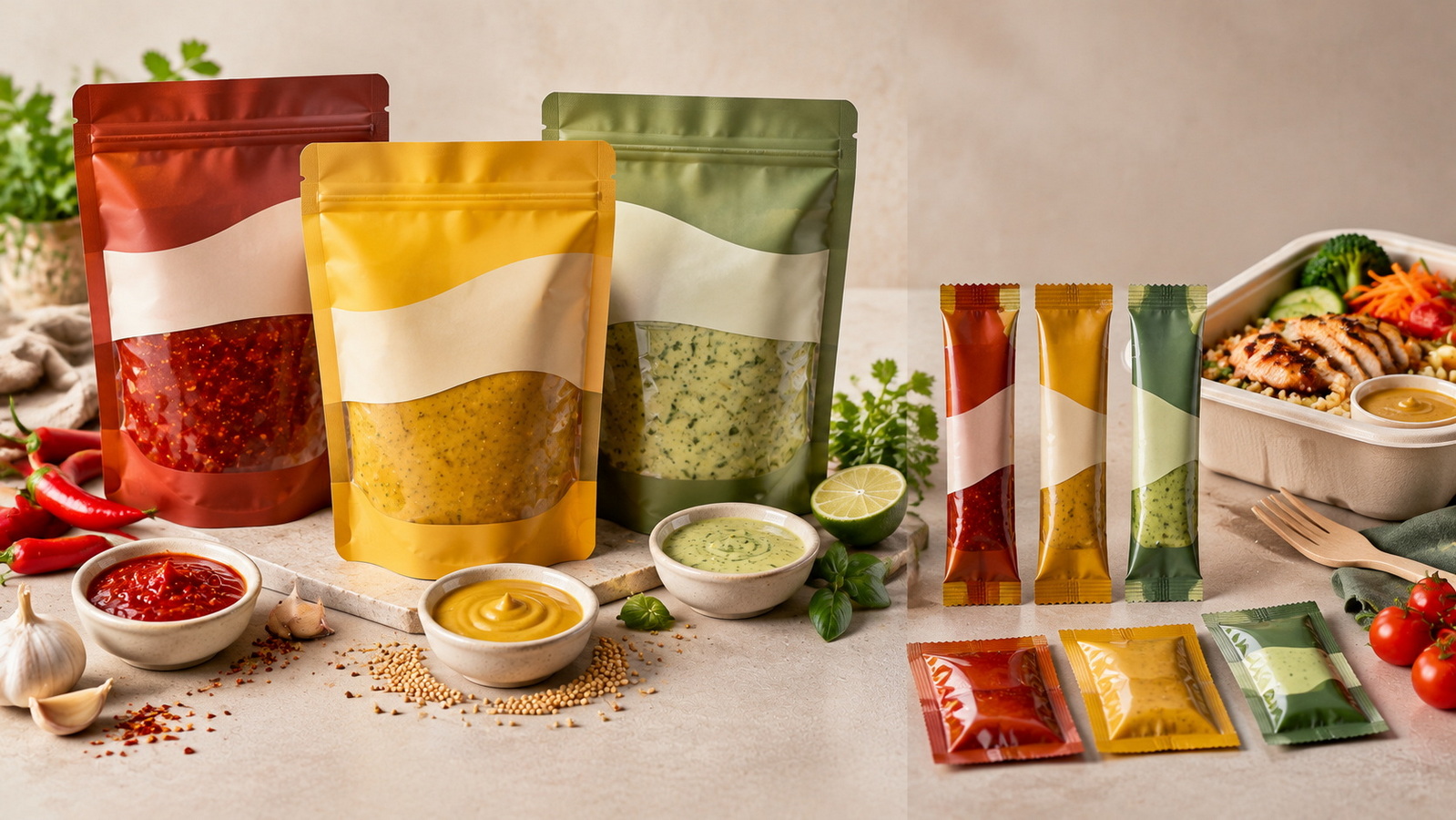
Consider a compact stand-up pouch filling machine when your business depends on:
- Premium retail presentation.
- Multiple recipes or seasonal launches.
- Larger consumer portions or refill products.
- Frequent changes in pouch design.
- Smaller orders with uncertain repeat demand.
A stand-up pouch can provide substantial printable space. Depending on its construction, it may also support reclosure and convenient storage.
The trade-off is that preformed packaging can carry a different unit-cost structure from rollstock. Compare actual quotations, minimum order quantities, and unused packaging inventory rather than assuming a universal cost difference.
A multi-lane sauce sachet machine becomes attractive when the product needs repeatable, single-use portions.
Examples include meal-kit components, takeaway condiments, hotel breakfast portions, and promotional samples.
The strongest investment case combines stable recipes, standardized package sizes, and recurring orders. A large theoretical capacity offers little value when production stops repeatedly for tiny batches or when finished sachets lack a dependable buyer.
"Thick sauce" is not a sufficient equipment specification.
A sauce may behave differently after heating, cooling, agitation, or standing in a hopper. Ask suppliers to evaluate the actual product under the intended filling conditions.
Potential dosing options include piston and other positive-displacement systems. Selection should account for:
- Target fill weight.
- Product flow behavior.
- Temperature variation.
- Dripping and stringing.
- Cleaning requirements.
- Ingredient sensitivity.
Anti-drip or positive-shutoff nozzles may help keep the sealing area clean, but suitability must be demonstrated with the recipe.
Chili flakes, garlic, seeds, and soft vegetable pieces can affect dosing and product distribution.
Document particle size, concentration, firmness, and settling behavior. Then evaluate the complete product path: hopper outlet, valves, hoses, pump, and nozzle.
A wide pouch opening does not guarantee particle compatibility if an upstream valve creates a restriction. Likewise, a small sachet may be unsuitable even when the filler can physically pass the ingredients.
A packaging trial should also examine whether pumping and holding change the sauce.
Watch for separation, excessive aeration, damaged particulates, and inconsistent ingredient distribution. For a boutique brand, maintaining the intended texture can matter as much as achieving the target weight.
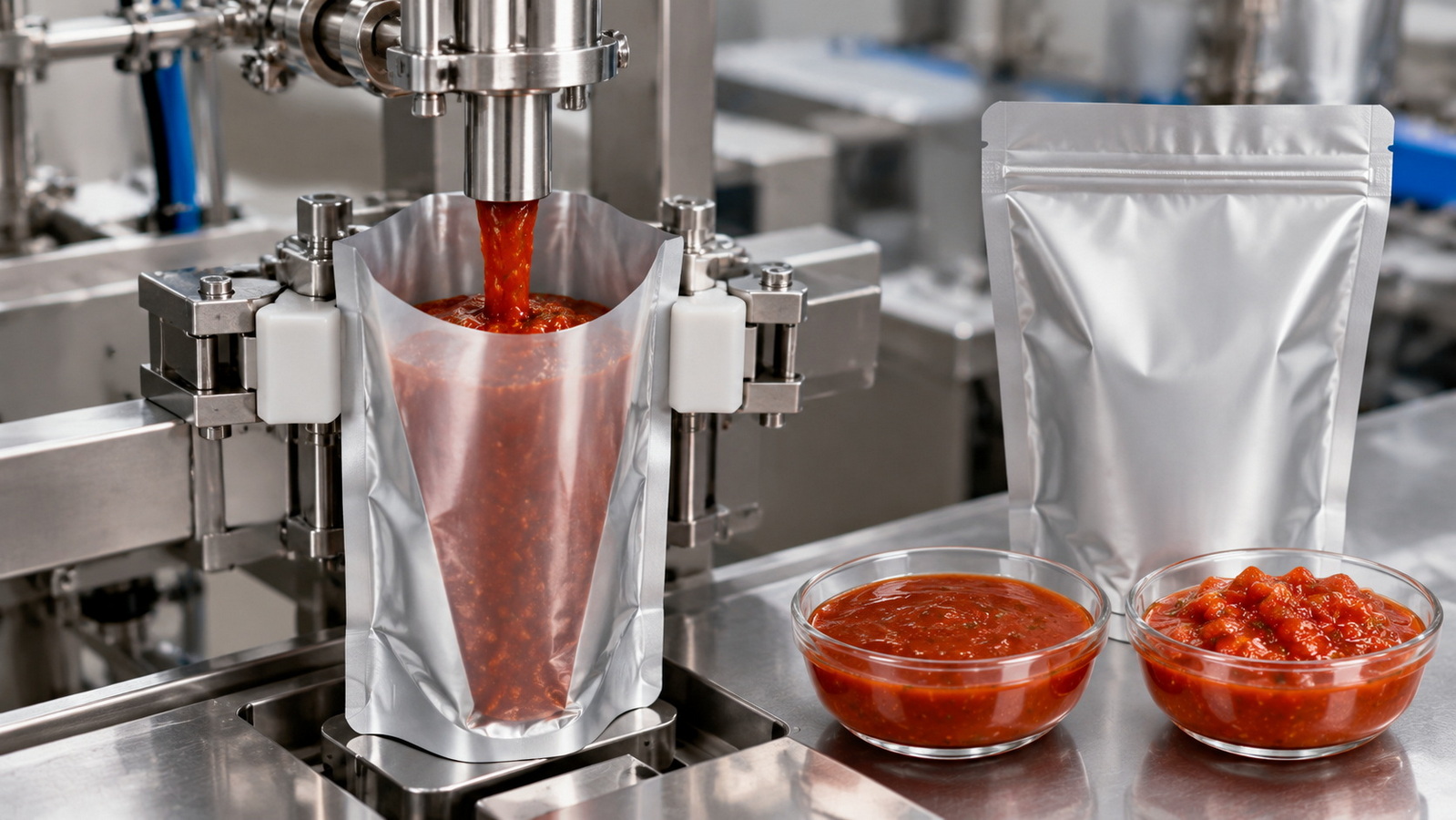
Sauce contamination in the sealing area can undermine package integrity. Filling control, nozzle movement, pouch positioning, and sealing settings must work together.
For premade pouches, verify opening reliability and seal-area cleanliness. For multi-lane equipment, check film tracking and sealing consistency across the complete machine width.
Neither equipment type independently makes a sauce shelf-stable.
For U.S. sales, acidified-food classification involves more than a low pH reading. Applicable definitions include finished equilibrium pH, water activity, formulation, and exclusions. Certain commercial shelf-stable products also require establishment registration and scheduled-process filing.
Have a qualified process authority establish the appropriate preservation process. Hot filling, refrigerated distribution, retorting, and aseptic processing are not interchangeable. The product, package, closure, and process must be assessed together.
A useful planning equation is:
Saleable packs = lanes × cycles per minute × scheduled minutes × availability × performance × quality yield.
For a single-pouch-per-cycle machine, use one lane in this simplified model. Availability captures downtime; performance captures operation below the reference speed; quality yield excludes rejected packs.
Consider these hypothetical assumptions—not HLun Pack specifications:
| Planning assumption | Compact pouch line | Six-lane portion-pack line |
|---|---|---|
| Packs per cycle | 1 | 6 |
| Reference cycles per minute | 20 | 30 |
| Scheduled minutes | 420 | 420 |
| Combined operating factor | 65% | 65% |
| Calculated saleable packs | 5,460 | 49,140 |
These figures do not represent equivalent sauce volumes. At 200 grams per pouch, the first example packages 1,092 kilograms. At 15 grams per sachet, the second packages approximately 737 kilograms.
The lesson is straightforward: compare packages, kilograms, labor, and channel demand together. Pack count alone can give a misleading picture.
Divide total relevant production costs by accepted finished packs. Include:
- Packaging materials and incoming freight.
- Sauce giveaway above the required fill.
- Operators and supervision.
- Cleaning labor and utilities.
- Start-up scrap and rejected packages.
- Maintenance, wear parts, and financing.
- Coding, inspection, and secondary packaging.
A low machinery quotation can become expensive if it creates excessive giveaway or requires substantial manual downstream work.
Frequent recipe changes can reverse an apparent speed advantage.
Record the full interval between the last acceptable pack of one recipe and the first acceptable pack of the next. Include draining, cleaning, reassembly, adjustments, checks, and approval.
For multi-lane equipment, inspect every dosing position after changeover. For premade pouch systems, confirm opening, gripping, filling, and sealing after format adjustments.
Do not assume that either format is automatically more sustainable.
Compare packaging weight per delivered kilogram, product residue, spoilage, transport, and locally available collection systems. Material compatibility and recovery infrastructure matter more than a broad "eco-friendly" label.
Before approving a purchase, establish a written test protocol using the intended sauce and packaging.
1. Select a demanding recipe. Include realistic viscosity variation or particulates.
2. Define operating conditions. Record temperature, fill target, package dimensions, and material construction.
3. Run long enough to expose instability. Include replenishment and planned interruptions.
4. Measure filling results. Record average weight, variation, rejects, and giveaway.
5. Test package integrity. Agree on suitable methods and acceptance limits beforehand.
6. Check each lane separately. An acceptable overall average can conceal a weak lane.
7. Perform a complete changeover. Time cleaning, setup, and return to acceptable production.
8. Review downstream handling. Confirm counting, collection, inspection, and packing requirements.
Request a report with raw measurements, settings, photographs, and exceptions—not simply a video of the equipment running.
This approach turns broad promises about accuracy and convenience into evidence relevant to your product.
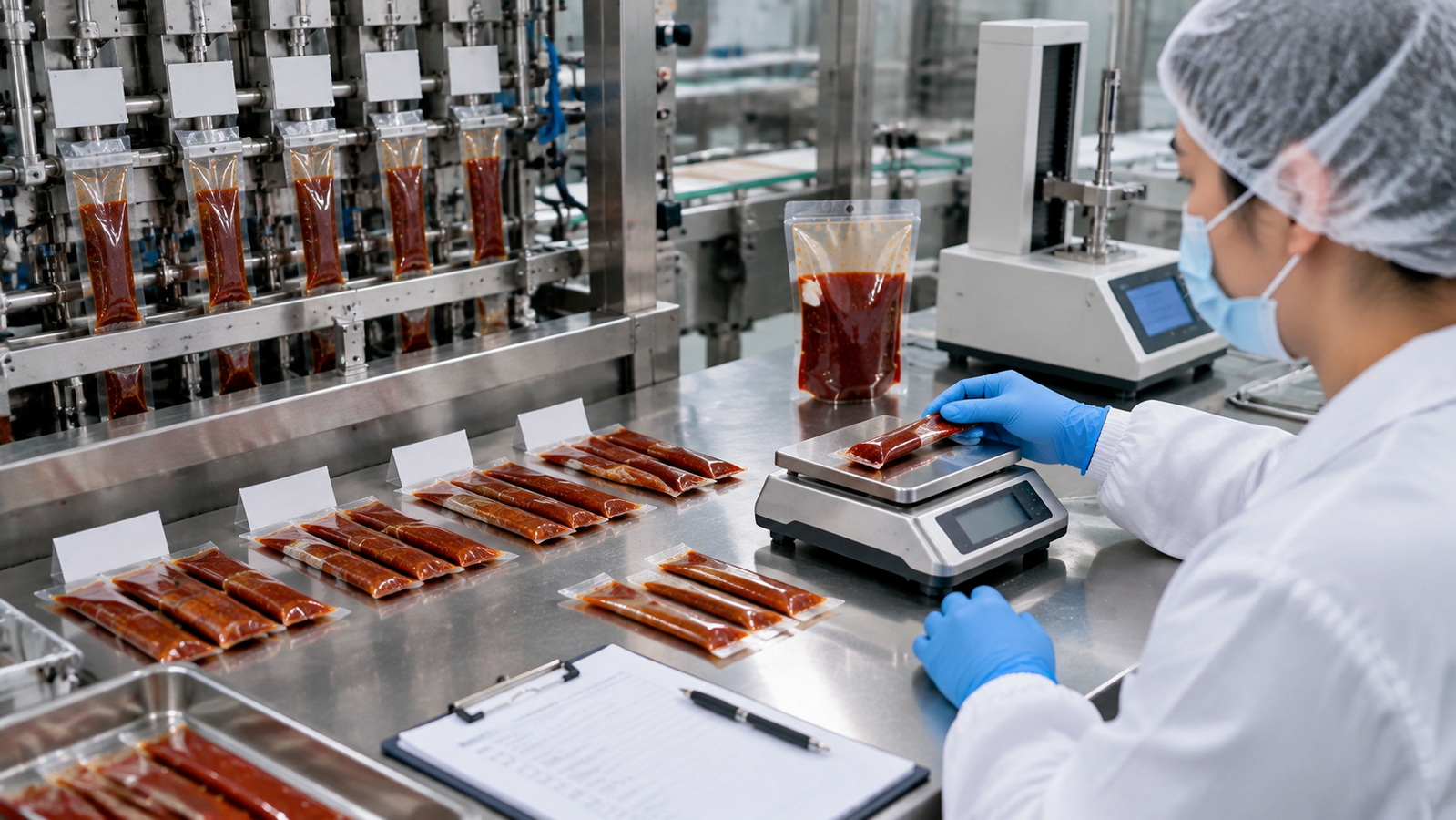
Consider a hypothetical boutique brand selling three sauces in retail pouches. It later receives interest from a meal-kit company for one recipe in small portions.
Immediately purchasing a high-output multi-lane line may be premature. The retail business still needs flexibility, while the portion-pack opportunity may not yet have a firm volume commitment.
A more disciplined sequence is to:
- Validate the portion-pack recipe and film.
- Confirm order frequency and minimum volumes.
- Compare outsourced packing with ownership.
- Add dedicated capacity when repeat demand justifies it.
The eventual answer may be two complementary production routes rather than one machine replacing the other.
Before requesting a recommendation, prepare a concise application brief:
- Sauce composition, viscosity information, and filling temperature.
- Particle dimensions and concentration.
- Target fill weights and package drawings.
- Expected daily demand by recipe.
- Preservation method and cleaning requirements.
- Available floor space, utilities, and staffing.
- Required coding, inspection, and secondary packaging.
Send this information to HLun Pack and request a configuration proposal covering the complete workflow, with clearly stated inclusions, exclusions, and trial requirements.
The right proposal should explain how the sauce reaches the filler, how acceptable packages are verified, and how production resumes after cleaning—not just list a headline speed.
It can be a strong starting point when retail pouches, smaller batches, and recipe variety define the business. Confirm minimum practical runs, cleaning effort, and pouch compatibility before deciding.
Yes, appropriately configured systems can handle liquid and pasty products. Actual suitability depends on flow behavior, temperature, particles, dosing components, and the package opening.
Generally, these formats require different machinery architectures. A shared upstream sauce supply may be possible, but do not assume one standard machine converts between both formats.
There is no universal winner. Compare materials, giveaway, labor, rejects, changeovers, maintenance, and secondary packaging at your expected annual production volume.
Not automatically. Shelf stability requires an appropriate validated product-and-package process. Have a qualified process authority determine the necessary conditions and controls.
Provide sauce samples, target weights, package specifications, filling temperature, required output, cleaning expectations, and preservation requirements. Clear application information reduces quotation gaps and unsuitable recommendations.
1- Viking Masek. "How Do Pouch Filling and Sealing Machines Work?" Technical overview of premade pouch handling, liquid filling, and sealing stages. [vikingmasek]
2- Viking Masek. "Liquid Packaging Essentials: 3 Important Details You Must Know." Application background covering liquid products, stand-up pouches, and single-serving formats. [vikingmasek]
3- Mespack. "MS600: Compact and Reliable Stick Pack Solutions for Low and Medium Productions." Manufacturer specifications illustrating multi-lane configurations and liquid/pasty product compatibility. Published output figures are model-specific, not HLun Pack performance guarantees. [mespack]
4- Mespack. "ML Series: Multilanes Vertical FFS Machine for Sachets." Manufacturer description of multi-lane sachet machinery and supported product categories. [mespack]
5- U.S. Food and Drug Administration. "Acidified & Low-Acid Canned Foods Guidance Documents & Regulatory Information." Definitions and registration/process-filing requirements for applicable U.S. products. [fda]
6- Electronic Code of Federal Regulations. "21 CFR Part 114—Acidified Foods." Regulatory provisions addressing scope, equilibrium pH, processing controls, and container examinations. [ecfr]
7- Editorial methodology: the production calculations, acceptance-test framework, cost checklist, and growth scenario are illustrative analysis developed for this article. They are not customer case studies, independently measured industry averages, or verified HLun Pack machine specifications.


