


close
Choose Your Site
Global
Social Media
Views: 237 Author: HLun PACK Publish Time: 2026-11-11 Origin: Site


Content Menu
● Start with the Pickle Product and Preservation Process
>> Establish Safety Requirements Before Selecting Machinery
● Compare the Main Pickle Packaging Formats
● Select Food-Contact Materials for Actual Operating Conditions
>> Specify Equipment Materials Beyond the Stainless-Steel Grade
● How to Configure a Pickle Filling and Packaging Line
>> Separate Vegetable Dosing from Brine Filling
>> Choose the Brine Filler Around the Recipe
>> Match Closure Equipment to the Package
● Pickle Pouch Packaging Machines: Premade Pouches or Rollstock?
>> Premade Pouch Filling Machines
>> Vertical Form-Fill-Seal Machines
● Hygienic Design: Evaluate the Cleaning Task, Not the Label
● A Practical Factory Acceptance Test for Pickle Packaging Equipment
>> Test Representative and Difficult Products
>> Agree on Measurable Acceptance Criteria
● Calculate Packaging Cost per Accepted Pack
● Plan Your Pickle Packaging Project with HLun Pack
>> What Is the Best Packaging for Pickles?
>> Can One Machine Fill Both Pickles and Brine?
>> Are Pickle Pouches Suitable for Shelf-Stable Products?
>> Does Vacuum Packaging Make Pickles Safe?
>> How Should a Pickle Filling Machine Be Tested?
>> What Determines Pickle Shelf Life?
Pickle packaging requires more than an attractive container and a reliable cap. The right pickle packaging system must handle irregular vegetables, acidic brine, consistent portions, and dependable closures without compromising product quality.
For manufacturers comparing jars, pouches, or complete pickle filling lines, the most useful starting point is the product itself—not the machine catalogue.
At HLun Pack, our focus is liquid packaging equipment and integrated packaging solutions. This guide takes a practical equipment-selection perspective: connect the product, preservation process, container, and production target before specifying individual machines.
A packaging line for refrigerated cucumber spears may differ substantially from one handling shelf-stable relish. Similar-looking containers do not necessarily require the same filling or preservation process.
Before requesting a quotation, document:
- Product format: whole vegetables, spears, slices, or relish.
- Minimum and maximum piece dimensions.
- Target vegetable weight and brine quantity.
- Brine composition, including salt, vinegar, oil, and spices.
- Filling temperature and subsequent processing conditions.
- Refrigerated or ambient distribution.
- Container dimensions, closure specifications, and target output.
For products covered by U.S. acidified-food regulations, the finished equilibrium pH must reach 4.6 or below within the scheduled process and remain within that limit. Applicable thermal processing and other critical factors must also be controlled.
Equilibrium pH means the finished product has reached its acid balance. Measuring freshly prepared brine alone does not establish the equilibrium pH of the vegetables and liquid together.
Refrigerated products fall outside the coverage of that particular regulation, but still require appropriate safety controls and cold-chain management. Other markets have their own requirements.
Validation must come before a shelf-life claim. A sealed package, low-oxygen headspace, or acidic recipe cannot independently establish that a product is safe for ambient storage.
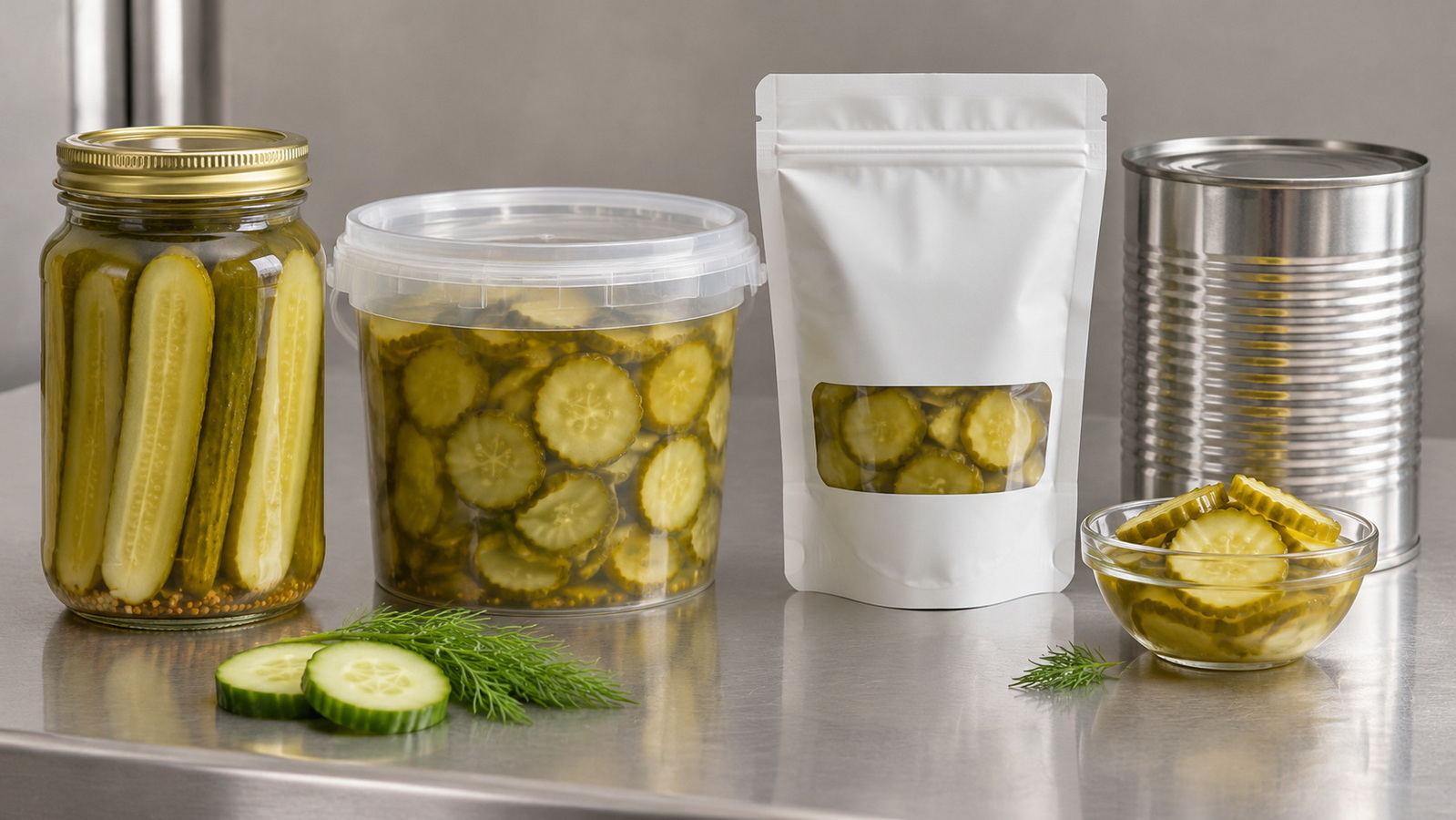
Choose packaging around the intended market, distribution conditions, and processing requirements.
| Format | Typical application | Main advantage | Critical selection check |
|---|---|---|---|
| Glass jars | Retail whole pickles, spears, premium ranges | Product visibility and a rigid container | Closure compatibility, breakage, thermal handling |
| Plastic jars or tubs | Refrigerated retail and foodservice | Low weight and convenient handling | Acid compatibility and permitted temperature conditions |
| Flexible pouches | Portions, slices, snack products | Low empty-pack weight and compact storage | Puncture resistance and reliable sealing |
| Lined metal cans | Selected industrial or foodservice applications | Robust opaque packaging | Coating suitability and double-seam integrity |
Glass provides product visibility and a barrier that does not depend on a multilayer film structure. Wide-mouth jars can also simplify loading larger vegetables.
However, the jar is only one component. Its finish, cap, liner, and processing conditions must form a compatible system.
Include glass handling, breakage procedures, closure application, and controlled heating or cooling in the line assessment.
PET, HDPE, and PP are potential options, but the resin name alone does not establish suitability.
Request documentation covering the actual food, contact duration, and processing temperature. A container intended for refrigerated filling should not automatically be used for hot filling.
Check the closure and liner separately. A suitable container body does not compensate for an incompatible lid.
Pouches can work well for slices, small portions, and convenient snack formats. Whole pickles introduce additional challenges because irregular pieces can stress the film.
Specify the complete film structure rather than simply requesting "food-grade laminate." Trials should assess puncture resistance, sealing performance, processing compatibility, and transport durability.
For any format, compare the complete pack—not just the purchase price of the empty container.
"Food grade" is a starting point, not a complete material specification.
Food-contact suitability depends on the substance, intended food, and conditions of use. Acidic aqueous foods, refrigerated storage, hot filling, and high-temperature processing represent different exposure conditions.
Ask packaging suppliers for documentation addressing:
- The intended destination market.
- Contact with acidic, salty food.
- Maximum contact temperature and duration.
- Container, coating, adhesive, liner, and sealant suitability.
- Any restrictions on the proposed application.
A stainless-steel frame does not establish that every product-contact component is suitable.
Review tanks, valves, pumps, welds, seals, and filling nozzles against the recipe and cleaning chemicals. Material selection should account for operating temperature and exposure time as well as acidity.
Request a product-contact materials list. This makes technical comparisons more meaningful than a general description such as "stainless-steel construction."
A useful starting layout is container preparation, vegetable loading, brine filling, closure application, inspection, and secondary packaging. Thermal processing, cooling, or refrigeration stages must follow the validated product requirements.
For many products, vegetables and liquid need different dosing methods.
Whole pickles may require guided loading or assisted placement. Slices may suit a weighing system after trials confirm acceptable handling. Relish requires equipment capable of passing its particles without excessive damage or blockage.
The brine can then be added through a separate liquid-filling station.
This separation makes it easier to adjust the vegetable-to-liquid balance. It also avoids treating an irregular solid-liquid mixture as though it were a uniform liquid.
A consistent total package weight does not necessarily mean a consistent vegetable portion. Evaluate both measures where relevant to the product specification and labeling requirements.
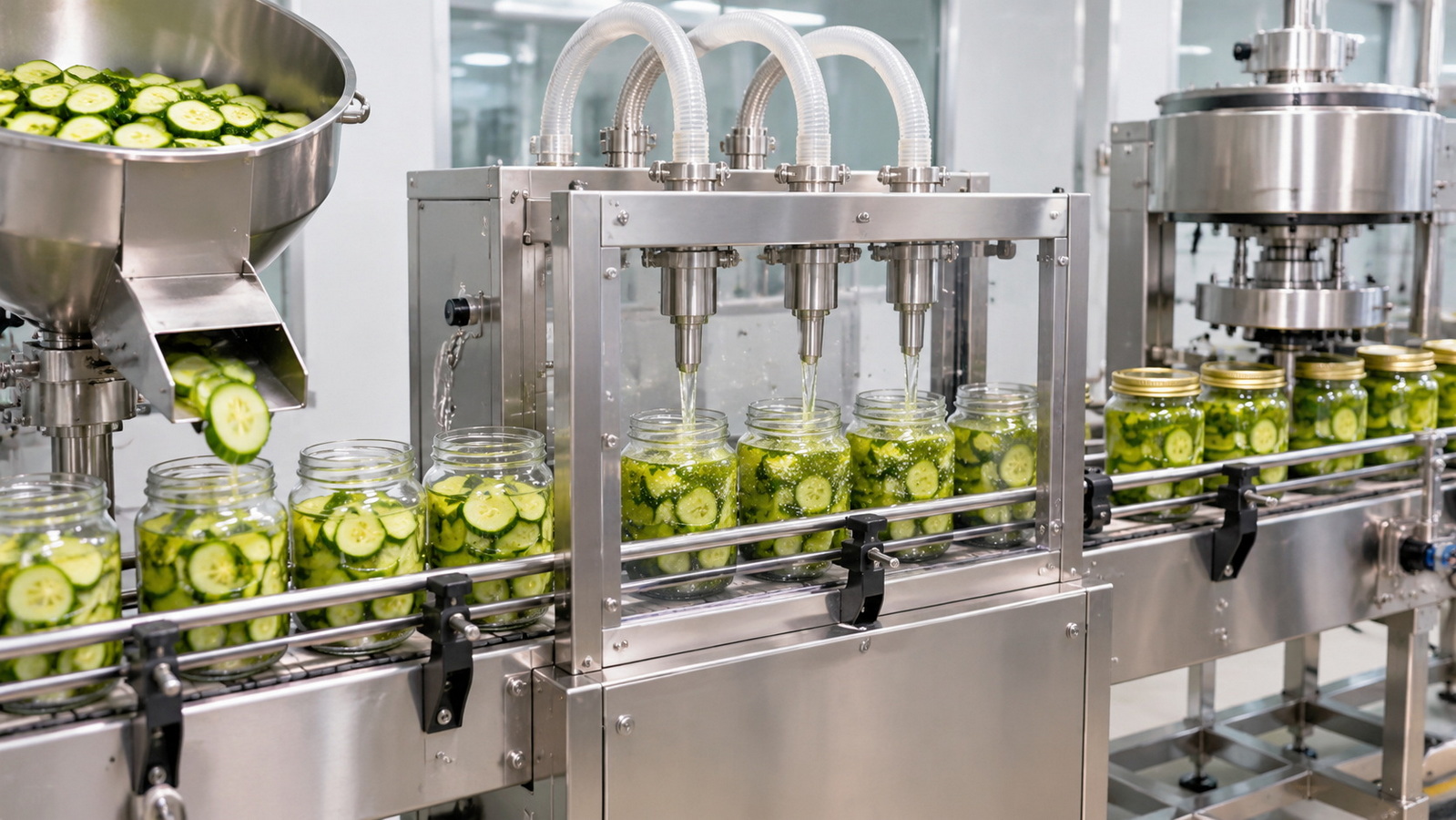
Test the proposed filler with representative brine, including the expected spices and suspended ingredients.
During trials, inspect:
- Fill repeatability across consecutive containers.
- Dripping after nozzle withdrawal.
- Splashing onto container rims.
- Spice settling or nozzle blockage.
- Performance at the intended filling temperature.
Do not accept an accuracy claim based only on water trials when the commercial recipe behaves differently.
Jar cappers, can seamers, and pouch sealers perform different functions.
A jar capper must apply the specified closure correctly. A can seamer must produce an acceptable double seam. A pouch sealer must create a continuous seal within a demonstrated operating window.
Induction sealing, where compatible with the package, bonds an appropriate liner to the container opening. It should not be treated as synonymous with vacuum formation or as a replacement for the preservation process.
A pickle pouch packaging machine should be evaluated around product handling and seal consistency, not just advertised speed.
Premade pouch systems open an existing pouch, receive the product and liquid, and seal the opening.
They are worth evaluating when the project involves stand-up formats, particular pouch features, or a filling sequence requiring separate vegetable and brine stations.
Confirm reliable pouch opening, controlled product placement, and adequate clearance above the fill.
Vertical form-fill-seal equipment forms bags from rollstock before filling and sealing them.
The product must pass through the forming and filling arrangement without unacceptable damage or bridging. Trial the largest pieces and the most difficult recipe, not only the easiest product.
For either approach, watch the sealing zone closely. Brine, oil, spices, or vegetable fragments near the seal can undermine consistency.
Vacuum or gas flushing may serve specific quality objectives, but neither establishes product safety or shelf life on its own.
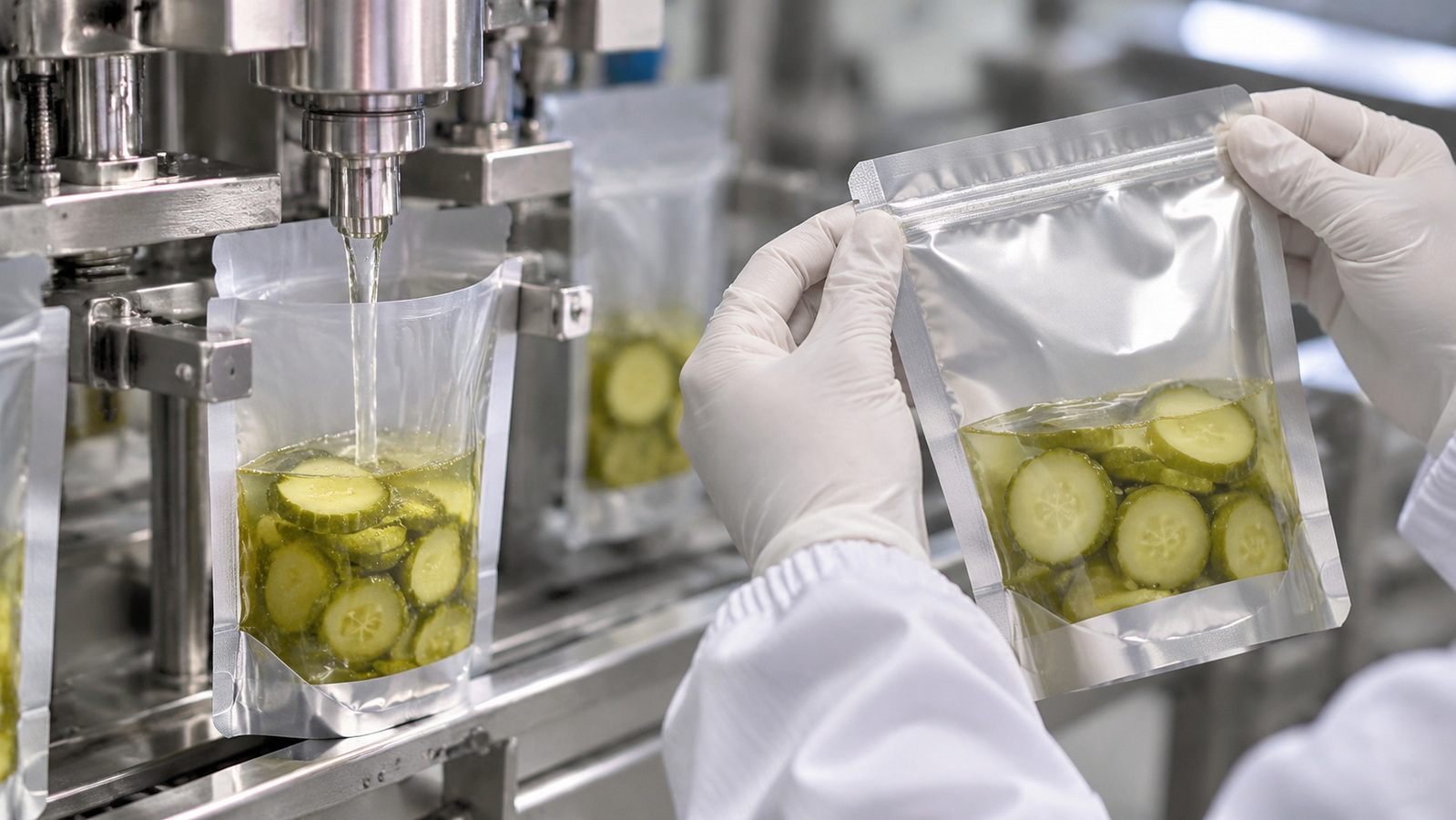
Pickle packaging equipment must be cleanable under actual factory conditions.
A clean-in-place designation does not mean every component will be effectively cleaned by every cleaning cycle. Product residues, component geometry, and cleaning parameters all matter.
Ask the supplier to demonstrate:
1. How product-contact components are accessed.
2. Which parts require removal.
3. How tanks and pipework drain.
4. Where seeds, spices, or vegetable fragments could collect.
5. How seals and wear parts are inspected.
6. How cleaning effectiveness will be verified.
Accessible surfaces, suitable materials, smooth joints, and effective drainage support hygienic operation. They also make maintenance and inspection more practical.
Include cleaning time in the production assessment. A fast filler that requires lengthy disassembly may offer less usable capacity than expected.
A factory acceptance test should demonstrate performance using agreed products, containers, and operating conditions.
The following is a proposed buyer checklist, not a report of completed HLun Pack testing.
Supply samples covering the expected operating range:
- The largest vegetable pieces.
- The recipe with the most suspended ingredients.
- The smallest and largest containers.
- The most demanding pouch or closure.
- The intended filling temperature.
A single convenient sample cannot establish performance across every planned product.
| Test area | What to record |
|---|---|
| Portion control | Vegetable quantity and total fill against agreed limits |
| Product handling | Broken pieces, jams, and manual intervention |
| Closure quality | Applicable cap, seam, or pouch-seal inspection results |
| Sustained output | Accepted packs during a defined run |
| Changeover | Time, adjustments, tools, and start-up rejects |
| Cleaning | Disassembly steps, access, drainage, and verification method |
Set acceptance limits before the test. Distinguish between a brief maximum-speed demonstration and sustained production of acceptable packs.
Repeat relevant checks after installation because utilities, upstream feeding, and downstream equipment can affect line performance.
The lowest machine price does not necessarily produce the lowest operating cost.
Compare complete systems using accepted output rather than theoretical speed.
A practical calculation is:
Cost per accepted pack = relevant operating costs ÷ saleable packs produced.
Include packaging materials, labor, utilities, maintenance, product giveaway, rejects, and cleaning time.
Overfilling deserves attention. Small excess quantities accumulate across production, while inconsistent vegetable portions can create quality complaints even when total pack weight appears acceptable.
Also identify the line bottleneck. Increasing filler capacity provides little benefit if closure application, cooling, or case packing limits finished output.
HLun Pack focuses on packaging machinery and integrated packaging solutions for liquid-handling applications.
For a pickle packaging project, the most productive discussion starts with representative samples and a clear process brief—not an isolated request for machine speed.
Send HLun Pack your:
- Product photographs, dimensions, and recipe characteristics.
- Container and closure drawings or samples.
- Target vegetable weight and brine fill.
- Required accepted output per hour.
- Filling and preservation process requirements.
- Factory layout and available utilities.
Request a configuration review covering product loading, liquid filling, sealing, inspection, and line integration. Any proposed performance should be confirmed through application-specific trials.
There is no universal best format. Glass, plastic, pouches, and lined cans serve different applications. Select the package around product dimensions, preservation conditions, distribution, and customer use.
Some systems combine these operations, but separate solid and liquid dosing often provides clearer control. Confirm suitability through trials with the actual product.
They can be, provided the pouch structure, seal, formulation, and preservation process are suitable and validated. A pouch material alone does not establish shelf stability.
No. Removing air does not replace acidification control, required processing, hygienic operation, or refrigeration where applicable.
Use representative products and packaging. Measure portion consistency, product damage, closure quality, sustained accepted output, changeover time, and cleaning requirements against agreed criteria.
Shelf life depends on formulation, processing, package integrity, storage, and distribution conditions. Establish it through appropriate safety assessment and product testing, not a generic equipment claim.
1. [Yundu — "Pickle Packaging: Formats, Materials, Machinery, and Selection Criteria"], January 27, 2026. Original article reviewed for topic coverage and restructuring; its supplier-specific performance statements are not presented as HLun Pack capabilities. [yundufillingmachine]
2. [Electronic Code of Federal Regulations — 21 CFR § 114.3: Definitions]. Basis for the acidified-food definition, scheduled-process terminology, and refrigerated-food exclusion discussed above. [ecfr]
3. [Electronic Code of Federal Regulations — 21 CFR § 114.80: Processes and Controls]. Basis for equilibrium pH, processing controls, testing, and container examinations. [ecfr]
4. [U.S. Food and Drug Administration — Food Types & Conditions of Use for Food Contact Substances]. Basis for distinguishing acidic-food contact and different filling, processing, and storage conditions. [fda]
5. [U.S. Food and Drug Administration — Determining the Regulatory Status of Components of a Food Contact Material]. Background for assessing packaging components and their permitted uses. [fda]
6. [U.S. Food and Drug Administration — Good Manufacturing Practices for the 21st Century for Food Processing: Appendix, Annotated Bibliography]. Technical background for material compatibility, cleanability, inspection access, drainage, and cleaning verification. [fda]
7. [U.S. Food and Drug Administration — Current Good Manufacturing Practices for Food and Dietary Supplements]. Background for equipment, sanitation, maintenance, and process-control considerations. The proposed purchasing checklist and cost-comparison framework are editorial recommendations, not quoted regulatory requirements. [fda]


