


close
Choose Your Site
Global
Social Media
Views: 278 Author: HLun PACK Publish Time: 2026-09-29 Origin: Site


Content Menu
● How Each Biscuit Wrapper Works
>> Horizontal flow wrapping: arrange, convey, and seal
● Product Protection and Line Speed
>> Which format better protects fragile biscuits?
>> Which machine is faster at production speed?
● Seals, Film, and Operating Cost
>> What determines biscuit-pack integrity?
>> What changes the total cost of ownership?
>> A fair biscuit-line acceptance trial
>> Two products, two likely starting points
>> What should HLun Pack receive with an inquiry?
>> Is a horizontal flow wrapper always faster for biscuits?
>> Can a vertical wrapper pack whole biscuits?
>> Which system suits loose mini cookies?
>> Does horizontal biscuit wrapping require trays?
>> Does a strong seal prove the pack will not leak?
>> How should we compare supplier quotations?
For a high-speed biscuit packaging line, choosing between a vertical wrapper and a horizontal flow wrapper starts with the retail pack. Should biscuits fall into a bag as loose pieces, or stay in a controlled arrangement until sealed? Horizontal flow wrapping is usually the stronger starting point for individual biscuits, counted stacks, and on-edge groups. Vertical form-fill-seal (VFFS) is usually better suited to loose mini cookies or biscuit pieces sold by weight. Neither orientation guarantees higher output: the feeder, product fragility, film, seals, and downstream equipment determine how many saleable packs the line produces.
This comparison is for bakery operations and procurement teams evaluating complete flexible-packaging systems, not isolated machine speeds. The selection scenarios and trial protocol below are engineering guidance—not accounts of an HLun Pack customer installation or claims of verified HLun Pack performance.
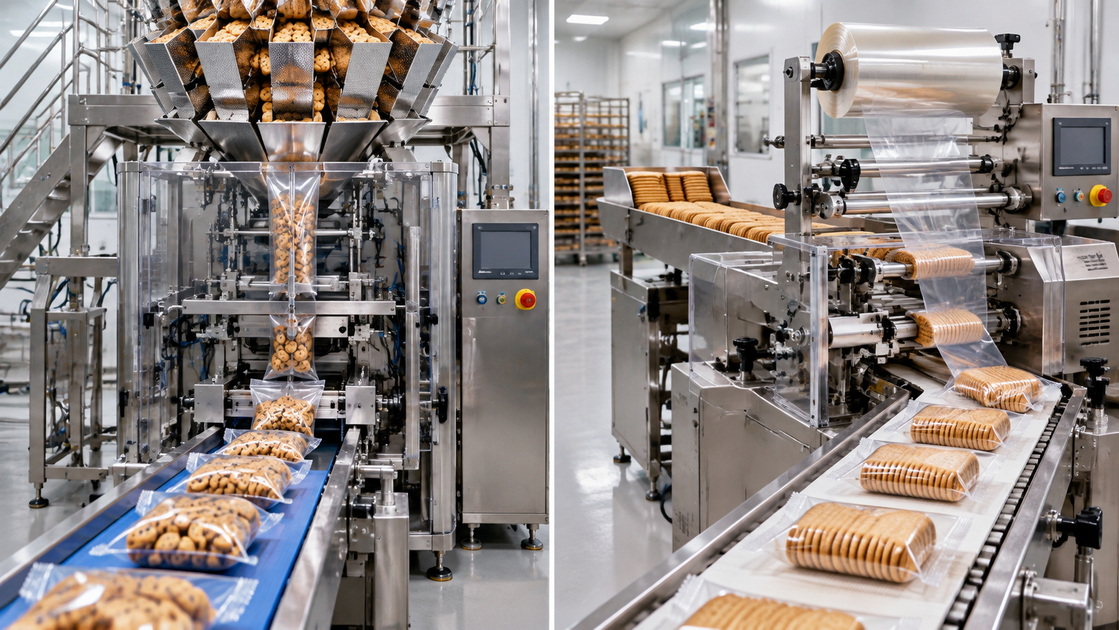
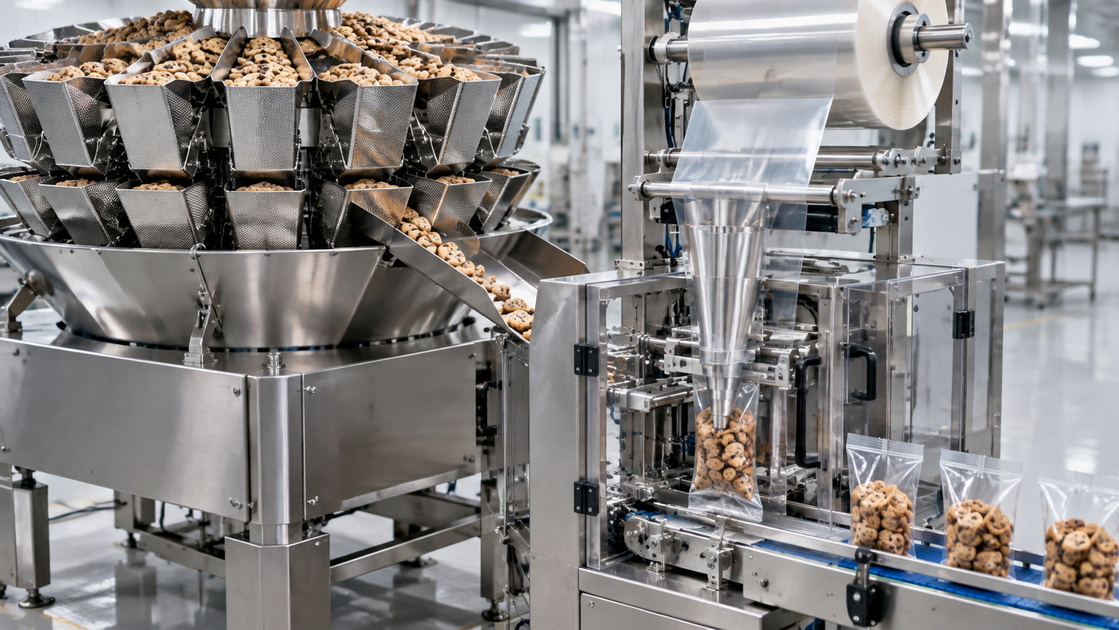
A vertical wrapper draws film around a forming tube, forms a bag, dispenses product from above, and closes the transverse seal. For loose snack products, a multihead weigher can work with the bagmaker to portion each pack. That makes VFFS a logical candidate when the selling unit is a specified net weight, rather than an ordered row or stack.
The product's journey into the bag matters. A brittle biscuit may chip on impact, while small crumbs can reach the sealing area. In a trial, assess the complete path—from dosing and discharge to the finished case—not just whether the wrapper can make a bag at the requested speed.
A horizontal flow wrapper conveys a product or prepared group into film, forms a longitudinal seal, and closes the pack at both ends. For biscuit lines, the upstream system may count, stack, turn, or load biscuits on edge before they reach the wrapper. Syntegon describes systems that place counted cookies into a flow-wrapper infeed and configure biscuits as flat stacks or on-edge groups.
Here, horizontal flow wrapper means the bakery flow-wrap machine—not every type of horizontal pouch-making equipment. Its key advantage is control of the product arrangement. A six-cracker stack is primarily a counting-and-handling challenge; a 150 g assortment of small cookie pieces is primarily a portioning challenge.
| Decision factor | Vertical form-fill-seal wrapper | Horizontal flow wrapper |
|---|---|---|
| Natural starting format | Loose mini cookies, bites, or mixed pieces | Singles, counted stacks, on-edge groups |
| Feeding task | Measure a portion and release it into a bag | Count, arrange, space, and convey a product unit |
| Typical pack objective | Consistent net weight in a flexible bag | Consistent count and presentation in a flow pack |
| Fragility risk to test | Drop height and landing impact | Transfers, stacking, and infeed contact |
| Seal risk to test | Product or crumbs near the transverse jaws | Mis-timed product at the end jaws; residue at seals |
| Layout constraint | Wrapper may use less floor area, but needs headroom for feeding equipment | Infeed and product-handling equipment may require more line length |
| Most useful output measure | Accepted bags at target weight | Accepted packs at target count and arrangement |
These are application tendencies, not promises. Product dimensions, pack design, and the chosen feeding system can change the result.
For a retail pack of intact, counted biscuits, horizontal feeding keeps the arrangement under control as it enters the wrapper. Depending on the biscuit and pack design, the line may use a flat stack, an on-edge group, or a supporting tray. Syntegon's biscuit systems illustrate why gentle feeding is as important as the wrapper itself: they pair flow wrapping with dedicated counting, loading, and transfer equipment for delicate products.
VFFS deserves serious consideration when the product is intentionally sold as loose small pieces. It is less obvious for full-size biscuits that must arrive unbroken and neatly stacked. If a vertical option is proposed, test the actual drop, landing, bag fill, and subsequent case packing. A successful empty-bag demonstration says little about finished-product damage.
A useful trial measures breakage at two points:
- Before packaging: Whole-piece yield and fines leaving cooling or accumulation.
- After packaging: Whole-piece yield, visible chips, and fines in finished cases.
That comparison helps identify whether losses begin upstream or inside the packaging cell. It also prevents a supplier from being judged for damage the wrapper did not cause—or credited for solving damage it did not address.
Do not compare two headline packs-per-minute figures without checking what each figure includes. Syntegon describes biscuit and cracker flow-wrap configurations rated at up to 95 on-edge group packs per minute in one arrangement and up to 400 group packs per minute in another. It also lists a flexible configuration rated at up to 270 flat-stacked packs or 145 on-edge packs per minute. Those are different system configurations, not universal horizontal-wrapper speeds—and they are not HLun Pack specifications.
Vertical lines can also be designed for high-speed snack packaging. Ishida describes high-speed vertical filling integrated with multihead weighers, but its bagmaker overview does not provide a single biscuit-packaging rate that would make a fair universal comparison.
The buying metric is accepted finished packs per shift at the specified weight or count. As a simple illustration, a line sealing 240 packs per minute with 95% acceptance produces 228 accepted packs per minute while running. A line sealing 210 with 99% acceptance produces about 208. Neither calculation accounts for stops, changeovers, or film changes. For a shift-level decision, record those losses too.
Trace the bottleneck from the cooling conveyor through accumulation, portioning or collation, wrapping, inspection, and case packing. A faster wrapper will not improve finished output if the count feeder cannot supply it consistently.
The machine type alone cannot establish shelf life. Specify packaging film against the biscuit's moisture sensitivity, the intended storage conditions, the target shelf life, and the destination market. Then prove the proposed film-and-seal combination at production speed. Syntegon identifies temperature, pressure, sealing time, and packaging material as interacting factors in reliable flow-wrap seals.
Both architectures have practical contamination risks. In VFFS, crumbs or product can reach a transverse seal as the bag closes. In horizontal wrapping, an incorrectly spaced biscuit can enter the end-seal area. Those are reasons to examine feeding and timing during trials—not reasons to assume one orientation always makes a better seal.
Where appropriate, use an agreed seal-strength method. ASTM F88/F88M measures the force needed to separate a seal in flexible barrier material; a seal-strength result alone does not prove that every pack is leak-free. Pair it with suitable integrity checks and product-specific shelf-life validation. For products entering the EU, request documentation relevant to the applicable food-contact rules rather than relying on an unsupported "food grade" description.
A horizontal line for counted packs may need distribution, accumulation, counting, loading, and transfer modules. They can deliver the required presentation, but add adjustment and cleaning points. A vertical line may need a weigher, elevator, access platform, and sufficient ceiling height. Comparing only the two wrapper bodies can therefore produce a misleading space or price estimate. Syntegon's integrated horizontal systems and Ishida's bagmaker-plus-weigher approach both show why line scope matters.
For each quotation, compare:
- Cost per accepted pack: Include rejected product and film, not just nominal output.
- Changeover time: Measure from the last accepted pack of one SKU to the first accepted pack of the next.
- Consumables: Include film, optional trays, and other pack-format materials.
- Operating needs: Include cleaning, staffing, utilities, maintenance, and spare parts.
- Film flexibility: Test every proposed film at the intended speed and pack size.
- Site fit: Check total layout, operator access, and headroom.
Run the difficult SKU during evaluation, not only the easiest bestseller. A line that performs well on uniform plain biscuits may behave differently with a thin, brittle product or a format that needs frequent changeovers.
An effective factory acceptance test starts with the same written brief for every candidate. Supply actual biscuits, target pack formats, film requirements, production conditions, and acceptance thresholds. Agree in advance who will collect samples and how breakage, short counts, underweights, and seal defects will be recorded.
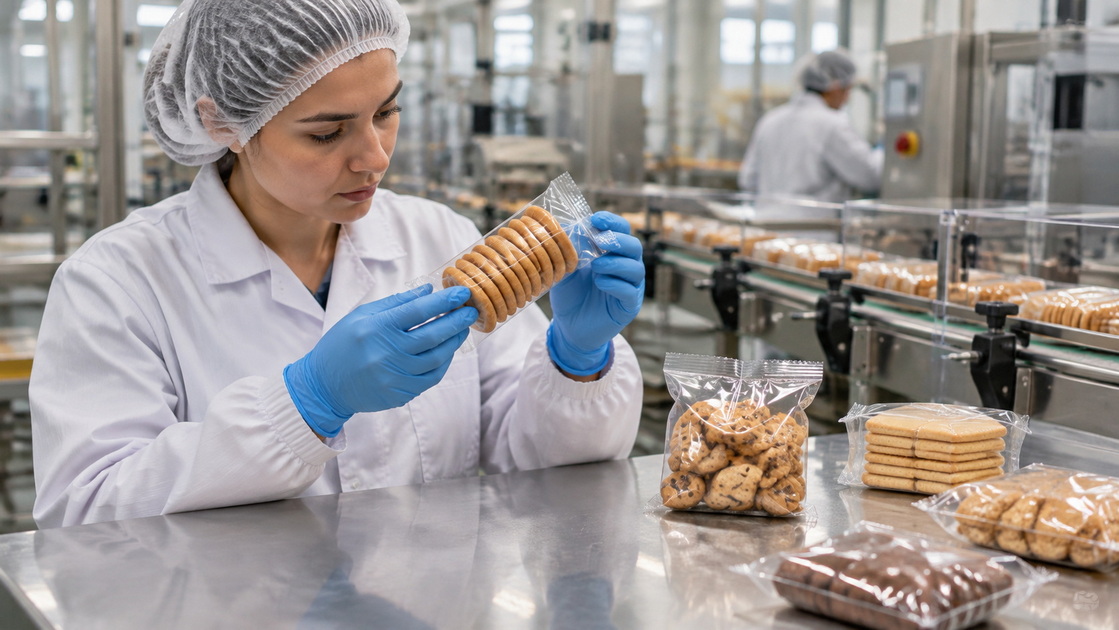
1. Select representative SKUs. Include the most common product, the most fragile product, and the hardest format change. Set target count or weight and acceptable damage limits.
2. Replicate the intended feed. Record product size variation, temperature, feed rate, and whether a buffer or manual intervention is allowed.
3. Measure steady-state production. Log finished accepted packs, film consumption, breakage, weight or count errors, seal rejects, and stops by cause.
4. Test disturbances. Include a film splice, brief product-feed interruption, restart, and planned changeover—not only an uninterrupted demonstration.
5. Inspect finished cases. Check product and pack quality after inspection and secondary packaging, then compare results with the agreed thresholds.
For management reporting, overall equipment effectiveness (OEE) combines availability × performance × quality. PMMI's 2026 OEE survey highlights downtime and output measurement among packaging-equipment priorities. Keep seal integrity and biscuit damage visible as separate quality measures, however; a single OEE percentage will not tell a buyer *why* packs were rejected.
Imagine a bakery launching both a six-biscuit stack and a 150 g bag of mini biscuit pieces. For the stack, trial counted feeding and horizontal flow wrapping first: count, arrangement, and gentle transfer drive the pack design. For the bag, trial a weigher-fed VFFS system first: portion weight drives the format. These are illustrative selection paths, not documented customer results.
Now make the stack unusually brittle and the mini pieces especially crumb-prone. The horizontal concept may need a gentler loader or additional pack support. The vertical concept may need better discharge control and cleaner seal timing. Neither initial choice should be approved until finished packs meet the written specification.
Send product samples or drawings; the biscuit size range; required count or weight; target accepted packs per minute; pack dimensions; permissible breakage; preferred film and barrier requirements; plant layout and ceiling height; sanitation needs; destination market; and downstream case configuration.
Ready to specify your biscuit packaging line? Ask HLun Pack for a product-specific comparison of vertical form-fill-seal and horizontal flow wrapping. Request a complete line concept, proposed film-and-feeding arrangement, and a documented trial plan based on finished, saleable packs—not nameplate speed alone.
No. It is a strong candidate for arranged, counted products, but completed output depends on feeding, transfers, sealing, inspection, and downtime. Compare accepted packs per shift for the same SKU and pack specification, not unrelated brochure ratings.
It may be possible, but feasibility is not the same as a good retail result. Test whether the drop damages the product and whether the finished bag meets the required presentation. Inspect finished cases, not only packs immediately after sealing.
A weigher-fed VFFS line is a sensible first option when the pieces are sold by net weight. Validate weight control, drop damage, crumb generation, and seal cleanliness with the actual product.
No. Horizontal systems can wrap suitably handled stacks or on-edge groups; a tray is an optional form of support when the product and pack design warrant it. Make the decision from handling trials and finished-pack results.
No. Seal strength measures resistance to separation under specified test conditions. Define separate, suitable checks for package integrity and validate performance against the intended shelf life.
Normalize the complete line scope, then compare cost per accepted pack. Include feeding equipment, inspection, secondary packaging, changeovers, consumables, service, and documented trial results.
1. Syntegon. "[Flexible on-edge packaging for cookies and crackers]." Examples of biscuit feeding arrangements and configuration-specific flow-wrap outputs. [syntegon]
2. Syntegon. "[Horizontal flow wrapper]." Bakery applications, sealing variables, and integrated line considerations. [syntegon]
3. Ishida Europe. "[Bagmakers: Vertical Form Fill Seal machines]." Vertical snack-packaging and multihead-weigher integration context. [ishidaeurope]
4. PMMI. "[Overall Equipment Effectiveness QS 2026]." Packaging-equipment survey on operational measurement priorities; not a biscuit-specific speed benchmark. [pmmi]
5. ASTM International. "[ASTM F88/F88M-21: Standard Test Method for Seal Strength of Flexible Barrier Materials]." Scope and use of seal-strength testing. [astm]
6. European Commission. "[Food Contact Materials: Legislation]." EU framework and material-specific food-contact requirements. [food.ec.europa]
7. Innova Maquinaria. "[How to improve the production efficiency of your packaging line with OEE]." Explanation of the availability, performance, and quality calculation. [en.innovamaquinaria]


