


close
Choose Your Site
Global
Social Media
Views: 217 Author: Tom Publish Time: 2026-09-07 Origin: Hlunpack


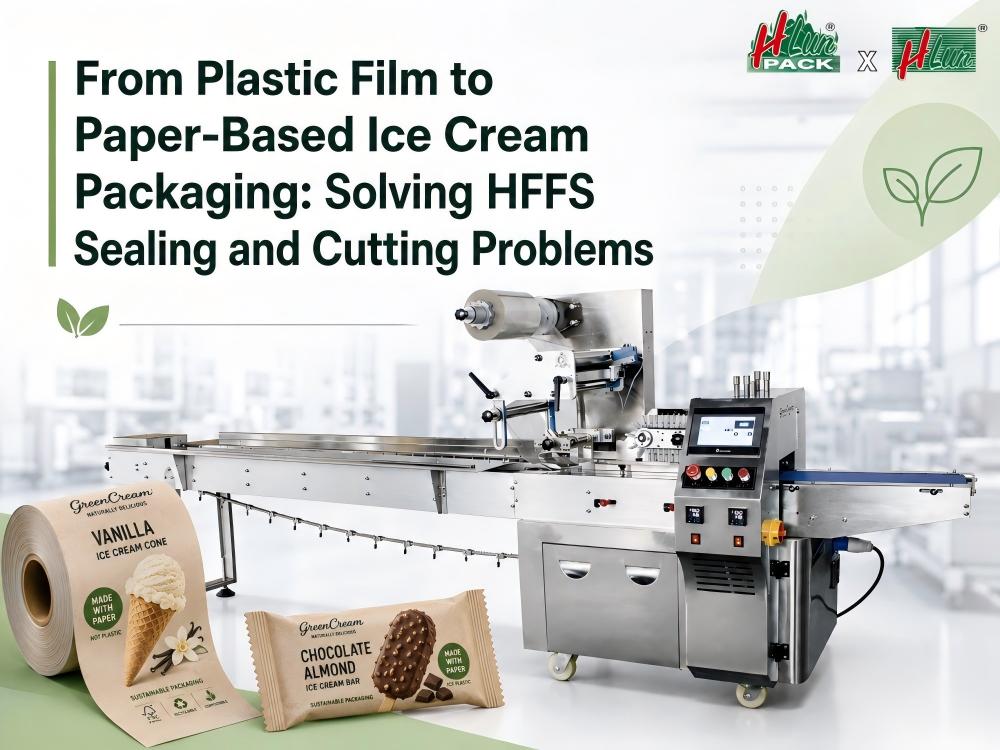
PRODUCT Ice Cream | MARKET Australia | ORIGINAL FILM OPP / VMPET / CPP | NEW DIRECTION Paper-Based High-Barrier Rollstock | MACHINE HFFS Horizontal Flow Wrapper |
Switching from a conventional plastic laminate to paper-based packaging is not simply a matter of replacing one roll of film with another. On an automated HFFS horizontal flow wrapping line, a material change can directly affect sealing, cutting, film tension and production stability.
An Australian ice cream manufacturer approached HLunPACK while evaluating a transition away from its conventional multilayer plastic packaging. The existing production line used OPP / VMPET / CPP printed roll film on a horizontal flow wrapper. The structure had provided reliable sealing, light protection and stable machinability under the customer’s established production conditions.
As sustainability requirements and retailer expectations continued to evolve, the customer began evaluating packaging structures with less dependence on conventional multilayer plastic laminates. Two directions were considered: mono-material flexible packaging and paper-based high-barrier packaging.
The engineering question
Could the new packaging material protect the frozen product and still run reliably through continuous HFFS sealing and cutting?
Ice cream packaging must perform through production, freezing, cold storage, transport and retail handling. The material therefore needs to be assessed beyond appearance or sustainability positioning.
· Frozen-storage performance and resistance to temperature fluctuations
· Moisture and condensation resistance
· Compatibility with oils and fats
· Required light and barrier protection according to product formulation and shelf life
· Stable printing, forming, sealing and cutting on an automated HFFS line
Barrier requirements vary by formulation, fat content, light sensitivity, distribution conditions and expected shelf life, so the final structure must be selected for the actual product rather than from a generic material rule.
Mono-material flexible packaging can support recyclable-packaging design, but no single mono-material structure is automatically the best choice for every frozen-food application.
For this project, the mono-material options evaluated did not provide the customer’s required balance of light protection, barrier performance, frozen-storage performance, print quality, film stiffness, sealing performance and HFFS machinability. This was a project-specific conclusion, not a claim that mono-material films cannot deliver high barrier performance.
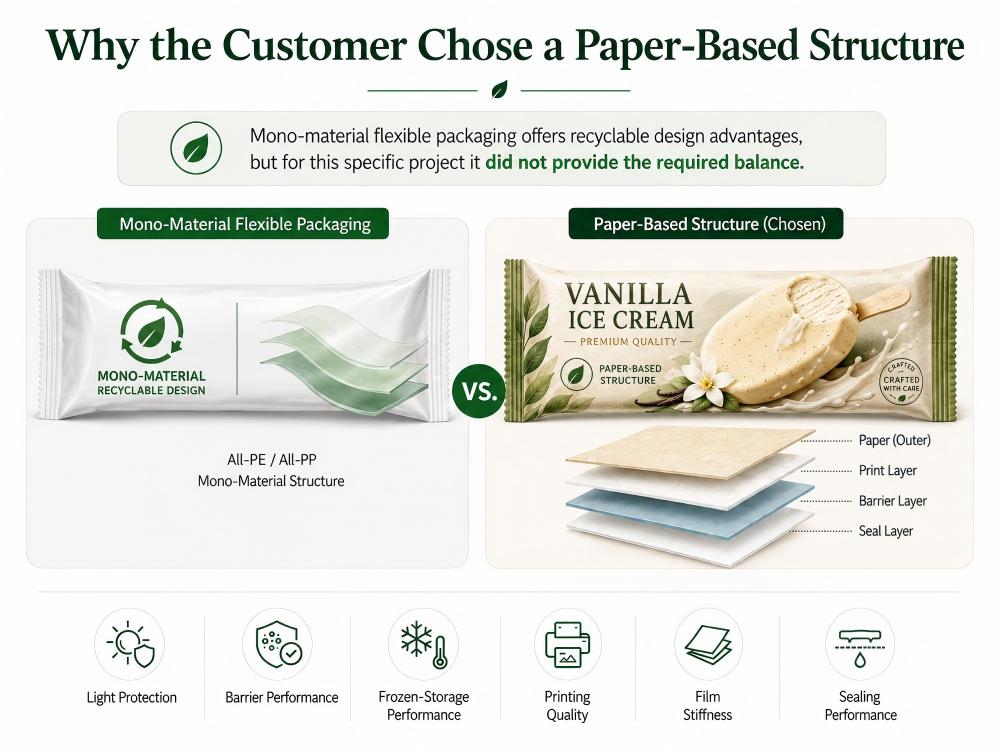
Material-selection concept: the final choice was based on the balance required by this application.
The selected direction used three functional elements: a paper-based substrate, a high-barrier layer and an inner heat-seal layer. The specific barrier system should be selected according to shelf-life, light-protection, moisture-barrier and machine-performance requirements.
When the customer introduced the new paper-based rollstock on the existing flow wrapper, the line did not reproduce the same stable operating window achieved with OPP / VMPET / CPP.
· Seal sticking at the cross-seal area
· Incomplete or weak sealing
· Loss of seal integrity
· Material adhesion around the sealing jaws
· Poor or inconsistent cutting
· Packages remaining partially connected after cut-off
The issue was not simply that the paper-based film was 'wrong'. The original machine setup had been established around a flexible plastic laminate with different stiffness, surface friction, heat-transfer characteristics, thermal response and cutting behavior.
Weak or incomplete seals can be influenced by seal initiation temperature, actual jaw temperature, pressure, dwell time, sealant-layer behavior and contamination in the seal area.
Sticking may be caused by excessive heat, sealant transfer, uneven heat distribution, jaw-surface conditions or the response of the coating and sealant layer. Increasing temperature alone can therefore make the problem worse.
Paper fibres, higher stiffness and laminate thickness can change how the web reacts to a knife. Knife geometry, cutting pressure and jaw alignment therefore become particularly important.
Instead of treating the problem as a simple temperature-setting issue, we adapted the HFFS sealing and cutting system to the characteristics of the new material. The solution focused on four areas.
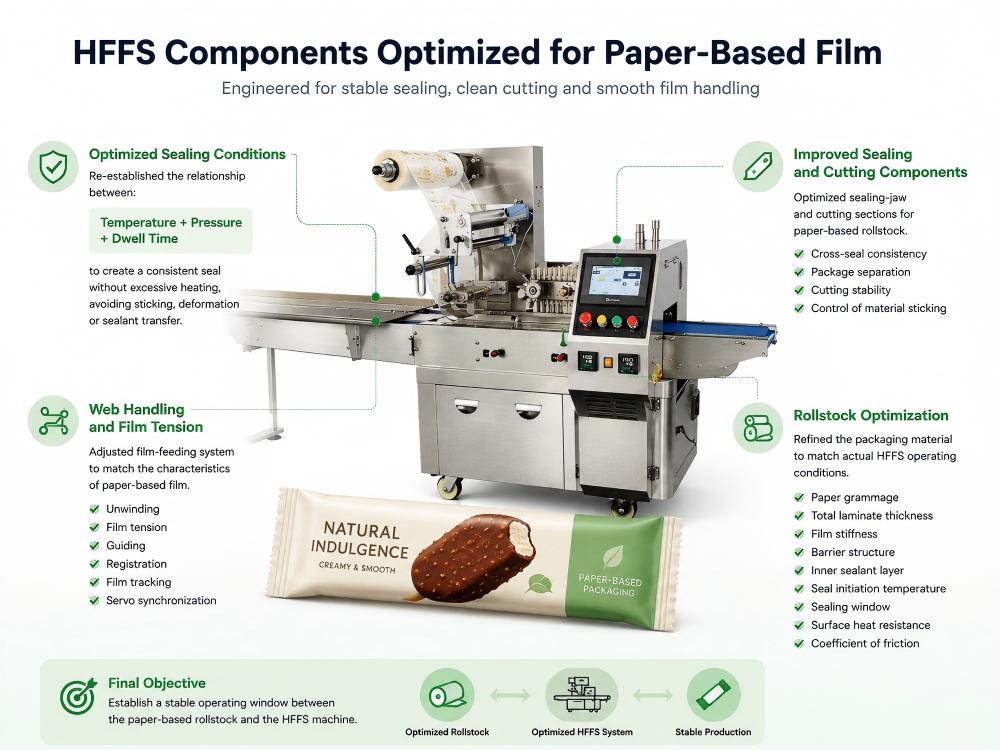
HFFS optimization concept for paper-based rollstock: sealing, cutting, web handling and material parameters must work within one operating window.
We re-established the relationship between temperature, pressure and dwell time for the paper-based laminate. The target was a consistent seal without excessive heating that could lead to sticking, deformation or sealant transfer.
The sealing-jaw and cutting sections were optimized for the higher stiffness and different cutting behavior of paper-based rollstock, with the objective of improving cross-seal consistency, package separation and cutting stability while controlling material sticking.
The film-feeding system was adjusted for the material’s different stiffness and friction characteristics. Unwinding, tension, guiding, registration, film tracking and servo synchronization all affect the position and repeatability of the cross seal and cut.
The paper-based ice cream rollstock also needed to be refined according to actual HFFS operating conditions. Important parameters included paper grammage, total laminate thickness, film stiffness, barrier structure, inner sealant layer, seal initiation temperature, sealing window, surface heat resistance and coefficient of friction.
The project moved from:
Original system Conventional HFFS machine + OPP / VMPET / CPP plastic laminate |
to:
New system Paper-based high-barrier rollstock + paper-compatible HFFS sealing/cutting system + optimized web handling and sealing parameters |
The objective of the new configuration was to establish a stable operating window for the paper-based material and address the sealing, sticking and package-separation problems observed on the original machine setup. For scale-up, final acceptance should be based on actual continuous-run, seal-integrity, cutting and frozen-storage validation data.
For ice cream and other frozen foods, a seal that looks acceptable immediately after packaging is only the first step. The finished pack must continue to perform through freezing, cold storage, transportation and retail distribution.
· Seal integrity after freezing
· Moisture and condensation resistance
· Low-temperature durability
· Barrier stability
· Flex-crack resistance where relevant
· Package appearance and structural integrity after cold-chain handling
A packaging material may support a company’s sustainability strategy, but it still needs to work efficiently in production. If a transition causes frequent machine stops, higher reject rates, seal failures, cutting problems or a substantial loss of packaging speed, the system has not yet been fully optimized.
Project principle
Sustainability + Product Protection + Production Stability
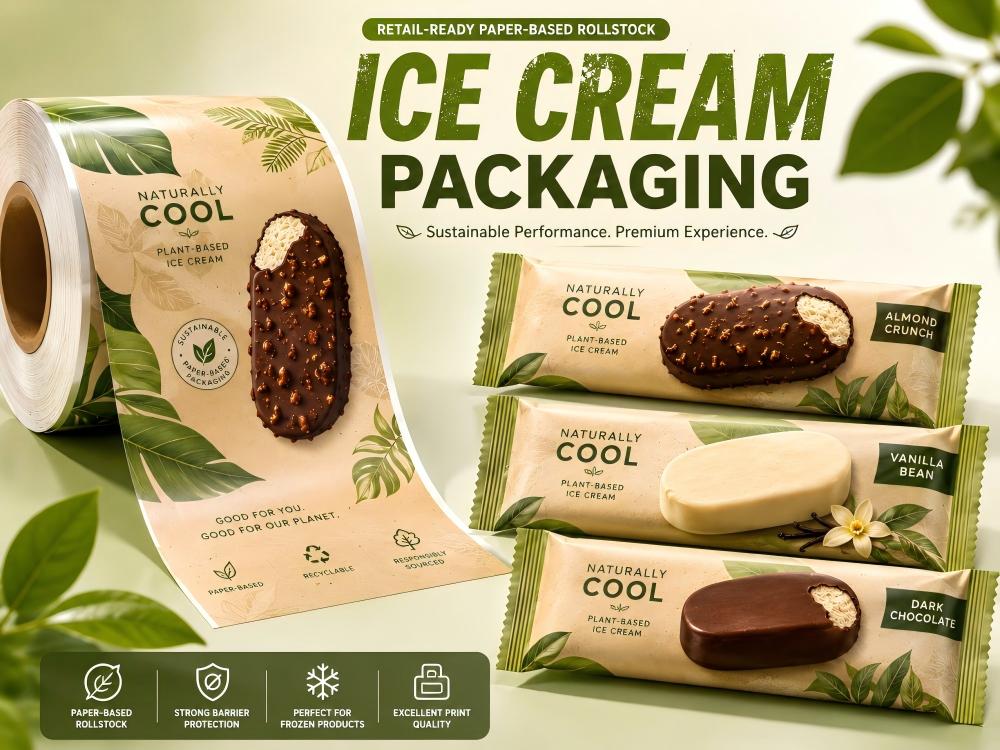
Retail-style concept for paper-based ice cream rollstock and long-form flow-wrap packs.
Product | Ice Cream |
Market | Australia |
Packaging Method | HFFS Horizontal Flow Wrapping |
Original Film Structure | OPP / VMPET / CPP |
Packaging Transition | Conventional multilayer plastic laminate to paper-based high-barrier packaging |
Alternative Evaluated | Mono-material flexible packaging |
Selected Material Direction | Paper-based substrate + high-barrier layer + inner heat-seal layer |
Main Problems | Seal sticking; incomplete sealing; loss of seal integrity; cutting adhesion; inconsistent package separation |
Machine Optimization | Sealing conditions; sealing-jaw/cutting system; film tension; web handling |
Material Optimization | Paper grammage; laminate thickness; barrier structure; sealant layer; sealing window; stiffness; COF |
Complete Solution | Paper-based ice cream rollstock + paper-compatible HFFS flow wrapping machine |
Sometimes, but not always. Paper-based laminates may have different stiffness, friction, heat-transfer and cutting characteristics from conventional plastic films, so the sealing jaws, cutting system, film tension and machine parameters may require adjustment.
Possible causes include excessive sealing temperature, unsuitable sealant behavior, uneven heat distribution, jaw-surface conditions or an incorrect sealing window. The cause should be evaluated using the complete film structure and machine configuration.
Paper fibres, higher stiffness and laminate thickness can change cutting behavior. Knife geometry, cutting pressure and jaw alignment therefore become particularly important.
Yes. Some mono-material structures can provide strong barrier performance. The correct choice depends on the product, shelf-life target, light and moisture protection, machine configuration and the material technologies available for the project.
No. Recyclability depends on the complete structure, including paper content, polymers, barrier layers, coatings, adhesives and the recycling infrastructure available in the target market.
This ice cream project shows why a packaging-material transition must be evaluated at production-line level. Changing from OPP / VMPET / CPP to a paper-based high-barrier laminate affected sealing behavior, cutting performance, film tension and web handling.
For food manufacturers evaluating paper-based, mono-material or other new flexible packaging structures, the key question is not only whether a material supports the sustainability target. It must also protect the product and run reliably on the packaging line.
HLunPACK approach
Custom printed flexible packaging materials and packaging machinery are evaluated together as one production solution.


