


close
Choose Your Site
Global
Social Media
Views: 238 Author: Hlunpack Publish Time: 2026-08-25 Origin: Hlunpack


The customer in this project is a toy manufacturer with long-term exports to Europe and North America. They approached us for an integrated packaging solution including paper-based rollstock, VFFS vertical packaging equipment and printed outer paper cartons.
Because the products are regularly exported to Western markets, the customer was highly focused on packaging reduction, paper-based materials and environmental compliance from the beginning of the project.
Initial material proposal: 40g PE-coated paper. Production objective: increase capacity without losing packaging stability.
From a lightweighting perspective, 40g paper appeared attractive because it reduced paper consumption per pack. But once the project moved toward continuous high-speed VFFS operation, the material had to withstand repeated pulling, forming, stopping, sealing and cutting cycles.
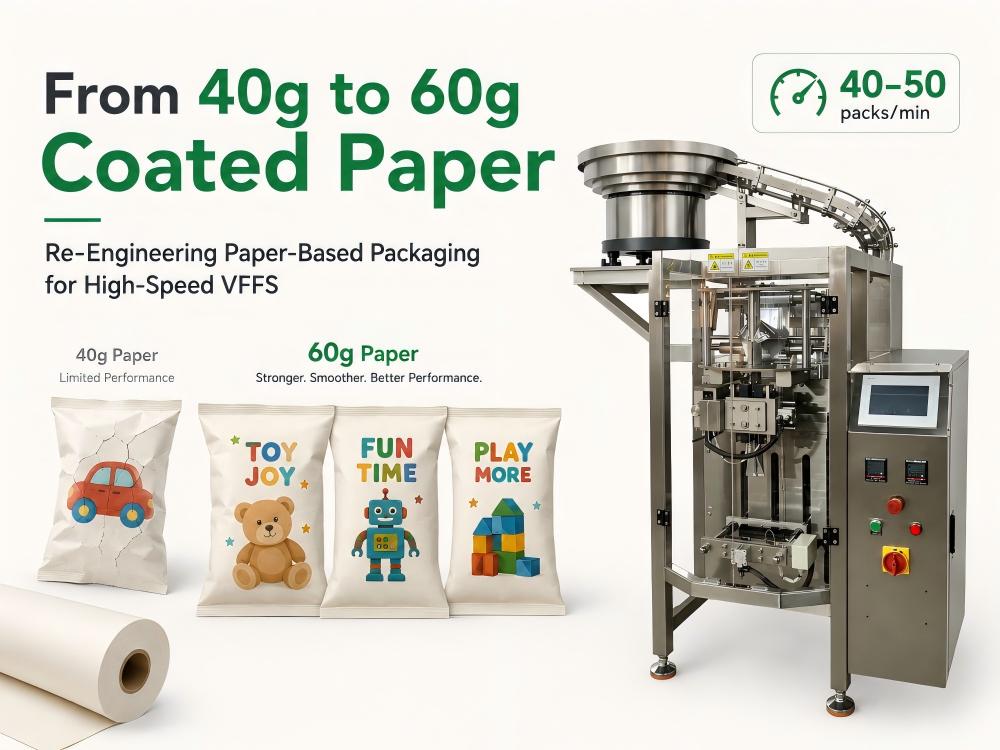
At lower production speeds, the 40g coated-paper concept showed reasonable potential. The natural paper surface also delivered the sustainability-oriented retail appearance the customer wanted for toy packaging.
· Lower paper consumption per pack
· Lightweight finished packaging
· Natural paper-based retail appearance
· Potential fit for lower-speed packaging conditions
As machine speed increased, the 40g rollstock began to crack or tear during continuous film pulling. Typical symptoms included edge cracking, web breaks around the pulling zone, damage before sealing and reduced production stability.
The problem was not simply the paper itself. It was a mismatch between material mechanical properties and machine motion.
Conventional plastic film normally provides more elongation and can absorb part of a short tension shock. Paper-based rollstock generally has much lower elongation. When the paper is also relatively light, a sudden pulling peak becomes more critical.
Sudden Pulling Force + Low Material Elongation + Low Paper Grammage = Higher Risk of Cracking or Tearing
The most critical moments were not necessarily during constant-speed transport. Start-up, acceleration, deceleration and stopping could create short-duration peak tension loads that the 40g structure struggled to tolerate.
In high-speed automatic packaging, paper grammage cannot be treated only as a cost or lightweighting parameter. It also influences tensile strength, tear resistance, stiffness, folding behavior, web stability and resistance to sudden pulling loads.
As the target production speed increased, the key question became: what is the lowest practical paper grammage that can still operate reliably at the required production speed?
Evaluation Item | 40g Coated Paper | 60g Coated Paper |
Material lightweighting | Better | Slightly higher material use |
Material stiffness | Lower | More stable |
Resistance to pulling shock | More sensitive | Improved |
High-speed web stability | More prone to cracking | More stable |
Edge-tear risk | Higher | Lower |
Continuous high-speed production | Requires significant motion reduction | Better suited |
40-50 packs/min in this project | Not preferred | Final selected solution |
After multiple rounds of testing, we upgraded the paper grade from 40g to 60g. The 60g material provided a more stable paper base and handled repeated VFFS mechanical stresses more effectively.
The improvement was especially noticeable at higher production speeds, where the edges and pulling zones of the material showed better stability during repeated film pulling, acceleration, deceleration, bag forming and packaging cycles.
Paper grammage cannot be evaluated separately from machine speed.
Changing the paper from 40g to 60g was only part of the solution. The material still needed to form and heat seal consistently, so we also increased the PE coating weight to improve the balance between flexibility, sealing performance and surface protection.
· Improved flexibility of the paper-based structure
· A more stable heat-sealing window at production speed
· Better surface protection during repeated folding and forming
· More consistent seal performance between consecutive packs
The final material solution was not simply 40g -> 60g. It was Paper Grammage + PE Coating + Machine Motion Optimization.
Increasing PE can improve flexibility and heat sealing, but excessive coating creates a different set of trade-offs. More coating means more material consumption, higher cost, a lower paper-content percentage and additional recyclability considerations depending on the destination market.
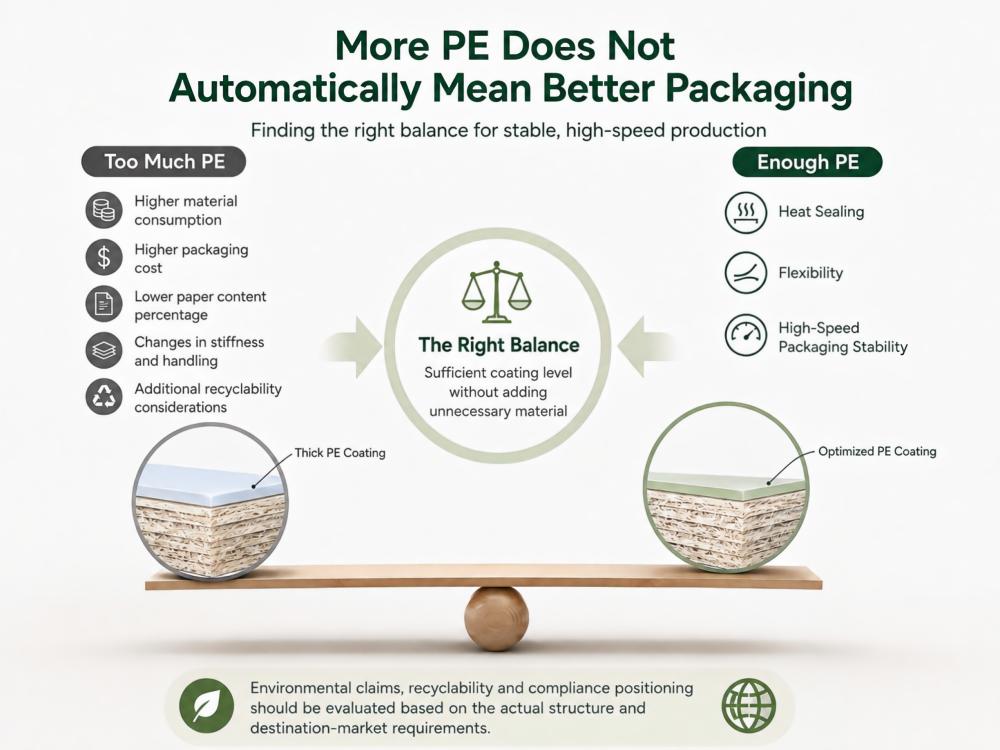
Our objective was therefore not maximum PE. It was enough PE for stable production - sufficient to support heat sealing, flexibility and high-speed packaging stability without adding unnecessary material.
For export-oriented packaging, environmental claims, recyclability statements and compliance positioning should still be evaluated against the actual material structure and the requirements of the destination market.
Even after strengthening the paper structure, aggressive machine motion could still increase the long-term risk of tearing and fatigue. We therefore optimized the VFFS pulling and sealing behavior instead of expecting the packaging material to solve every problem by itself.
During each film-pulling cycle, the drive system must rapidly move the rollstock. If the motion changes too quickly from stationary to full pulling speed, the paper experiences a peak tension load.
For conventional plastic film this peak may be manageable. For paper-based rollstock the same peak can trigger cracking or a web break.
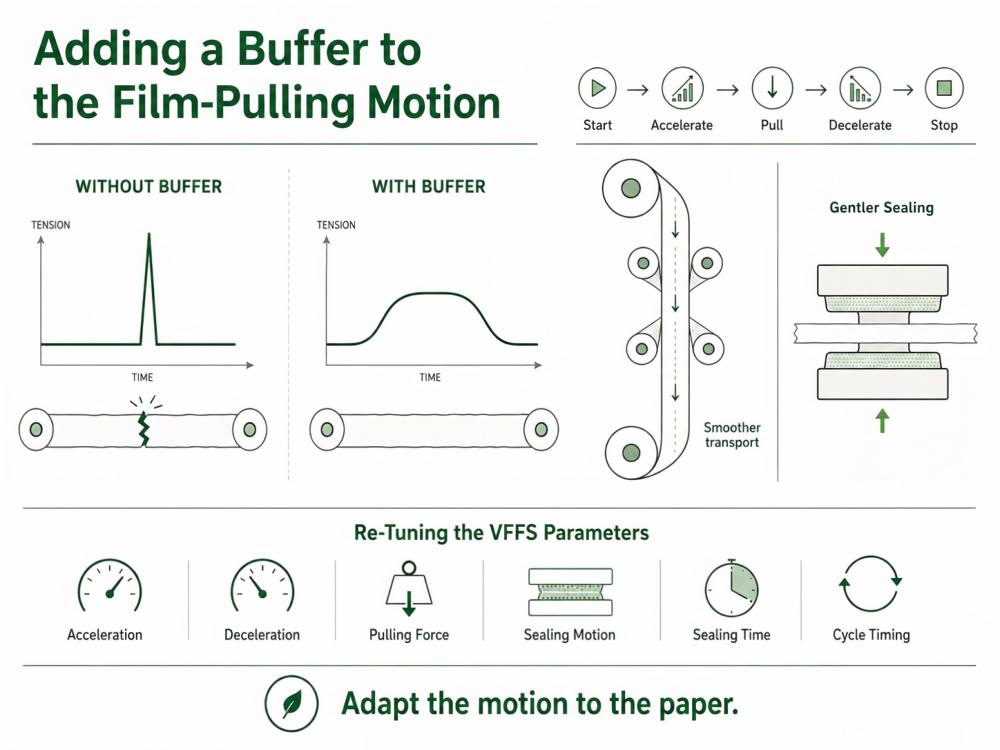
Without buffer: Stop -> Full Pull. With buffer: Start -> Accelerate -> Pull -> Decelerate -> Stop.
The smoother motion reduced the sudden mechanical shock transferred to the paper during state changes.
In addition to the buffer mechanism, we re-tuned several operating parameters specifically for paper-based rollstock:
· Film-pulling acceleration - reduced to limit start-up shock
· Film-pulling deceleration - adjusted to prevent sudden tension spikes when stopping
· Pulling force - reduced to the minimum practical level required for stable web transport
· Sealing motion - adjusted to create a gentler closing action
· Sealing time - re-tuned to match the PE coating structure and sealing window
· Cycle timing - filling, pulling, sealing and cutting were re-coordinated for a smoother cycle rhythm
Instead of forcing paper-based rollstock to behave like ordinary plastic film, the machine was adapted to the mechanical behavior of the paper itself.
This became the central engineering lesson of the project. Looking only at the material would lead to the incomplete conclusion that 40g was too light and 60g was better. Looking only at the machine could lead to the equally incomplete answer: just reduce the speed.
But the customer wanted higher production capacity. The real solution had to balance the material, machine motion and target speed together.
60g Paper Grade + Higher PE Coating Weight + Pulling Buffer + Gentler Motion + Re-Tuned Sealing Parameters
After optimizing both the material and the machine, we confirmed approximately 40-50 packs per minute as the most suitable operating range for the 60g PE-coated paper configuration in this project.
40-50 packs/min | Stable Continuous Production
The objective was not to display the theoretical maximum speed of the packaging machine. It was to establish a practical production range that better balanced film-pulling stability, bag-forming consistency, heat-seal reliability, continuous output and material breakage control.
This is why the project did not continue with the original 40g structure. A slightly heavier paper that runs reliably at the required production speed can be more valuable than a lighter paper that creates repeated stops, cracking and waste.
Reducing speed would have reduced the stress on 40g paper, but it would also have conflicted with the customer's original goal of higher production capacity.
· More machine downtime can outweigh small material savings
· Web breaks create rejected packaging and additional setup time
· More operator intervention lowers line efficiency
· Repeated stops and starts can increase waste and production losses
The better question is not which paper costs less per kilogram. It is which material allows the entire packaging line to operate more efficiently.
If material reduction is considered in isolation, 40g appears better than 60g. But if the lighter structure repeatedly tears during high-speed production, the resulting waste, downtime, rejected packaging and repeated machine starts also matter.
Use the minimum amount of material that can reliably perform the required function - not simply the lowest grammage possible.
This distinction is important for industrial paper-based packaging. Lightweighting only creates value when the package can still survive the actual converting and packaging process.
The project did not stop at rollstock and machinery. The customer also required printed outer paper cartons, so the complete packaging solution combined the automatic inner pack, the VFFS equipment and the retail outer carton.
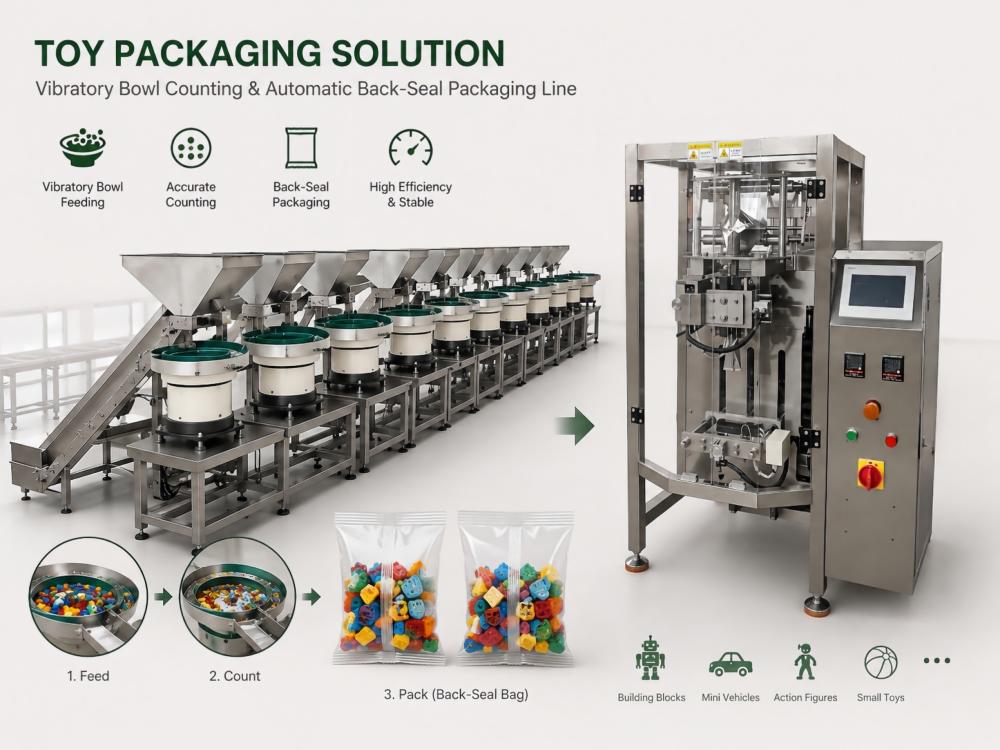
Paper-Based Rollstock + VFFS Packaging Machine + Printed Paper Carton
For a toy manufacturer exporting to Europe and North America, this allowed inner automatic packaging, outer retail presentation and the overall paper-based packaging direction to be considered within one integrated project.
Product | Toy Products |
Target Markets | Europe / North America |
Packaging System | Paper-Based Rollstock + VFFS Machine + Printed Paper Carton |
Initial Material Concept | 40g PE-Coated Paper |
Observed Issue | Cracking and tearing during higher-speed VFFS film pulling |
Final Material Direction | 60g Paper Grade with Increased PE Coating Weight |
Machine Optimization | Film-pulling buffer, reduced acceleration shock, smoother deceleration, optimized pulling force, gentler sealing motion and re-tuned cycle parameters |
Confirmed Production Range | Approximately 40-50 packs/min under the validated project configuration |
Core Engineering Principle | Material strength, coating performance, machine motion and target speed must be tuned as one system |
At the beginning of the project, the question appeared simple: 40g or 60g paper? After testing, the real question became: what combination of paper grammage, coating structure and machine motion can reliably support the customer's required production speed?
The answer was not found in the material specification alone, and it was not found in the machine specification alone. It came from treating them as one integrated system.
Material Strength + Coating Performance + Machine Motion + Packaging Speed
Only when these variables were matched together could the packaging line achieve the customer's target productivity.
Flexible Packaging / Paper Packaging / Packaging Machinery
From paper-based rollstock development and coating structures to VFFS machine configuration and printed outer cartons, we develop packaging solutions around the customer's actual production speed, product requirements and target market.


