


close
Choose Your Site
Global
Social Media
Views: 238 Author: Tom Publish Time: 2026-09-10 Origin: Hlunpack


The customer is a large pet food manufacturer in China producing cat treat sticks, wet cat food and related pet food products.
As market requirements changed, the customer wanted to reduce the overall thickness of its aluminum-foil retort laminate to lower packaging material consumption and total packaging cost. At the same time, the new solution still needed to maintain reliable sealing, high-temperature sterilization compatibility and stable production at approximately 50–60 packs per minute.
The original package used an approximately 140 μm four-layer aluminum-foil retort laminate. The development target was to move toward approximately 100 μm without simply transferring material savings into leakage, wrinkles, rejects or lower machine efficiency.
Engineering objective
Find the lowest practical laminate specification that could maintain packaging speed, seal integrity and retort-process compatibility — not simply the thinnest possible film.
Cat treat sticks are commonly packed in narrow three-side-seal sachets with an easy-open profile that allows consumers to tear the pack and squeeze out the wet food. This creates multiple performance requirements at the same time:
· Reliable longitudinal and cross seals
· Low leakage risk
· Compatibility with high-temperature sterilization
· High oxygen, moisture and light barrier performance
· Sufficient puncture and flex resistance
· Stable easy-open performance
· Consistent film handling at 50–60 packs/min
· Smooth seal appearance with minimal wrinkles
As total laminate thickness decreases, the process becomes more sensitive to film stiffness, thermal behavior, sealing temperature, pressure, dwell time, film tension and residual heat. The packaging material and the machine therefore had to be developed as one system.
The first development trial used a mature three-layer aluminum-foil retort structure:
PET / AL / RCPP
A representative engineering starting point was approximately PET 12 μm / AL 9 μm / RCPP 75–80 μm, with the actual laminate thickness depending on adhesive coating and production tolerance.
The purpose was not to prove whether PET/AL/RCPP could be used for retort packaging. The purpose was to test whether a mature retort laminate, after being reduced toward approximately 100 μm, could still provide a wide enough processing window for 50–60 packs/min production.
At lower speeds, the film could be formed and sealed normally. However, when the packaging speed approached approximately 50 packs/min, large-scale seal wrinkling began to appear and became more obvious during continuous operation.
The trial showed that simply reducing the thickness of a conventional three-layer retort structure did not provide sufficient mechanical and thermal stability for this high-speed application. Increasing jaw temperature could improve seal formation but increased wrinkling; reducing temperature improved appearance but narrowed the sealing safety margin.
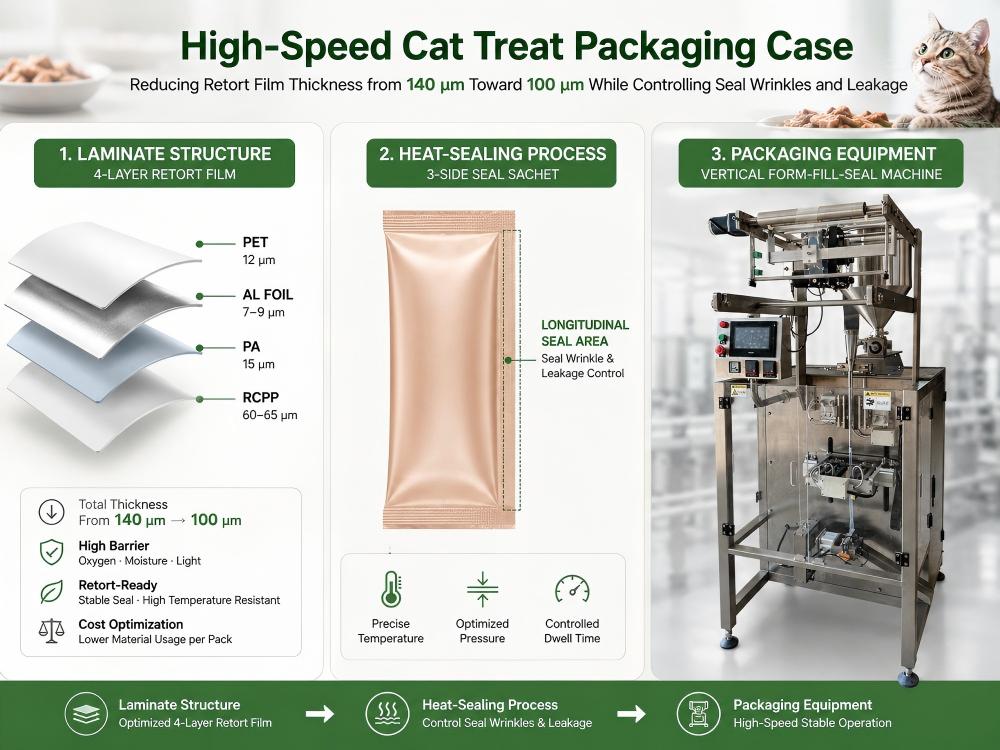
Instead of returning directly to the original 140 μm specification, the second trial kept the development target close to the same 100 μm range and redistributed the functions across four layers:
PET / AL / PA / RCPP
A representative engineering starting point was approximately PET 12 μm / AL 7–9 μm / PA 15 μm / RCPP 60–65 μm. The final specification must be adjusted according to the actual adhesive system, retort conditions and production tolerances.
Layer | Main Function | Why It Matters When Thinning |
PET | Print surface, heat resistance, dimensional stability | Supports high-speed film handling and thermal stability at the sealing area. |
AL | Oxygen, moisture and light barrier | Maintains high barrier performance for wet pet food. |
PA | Toughness, puncture resistance and structural reinforcement | Adds mechanical stability and helps protect the aluminum layer as total thickness is reduced. |
RCPP | Inner heat-seal and retort layer | Provides the sealing layer required for retort-oriented food packaging applications. |
After changing to PET/AL/PA/RCPP, large-scale seal wrinkling was substantially reduced and film handling became more stable at higher speeds. However, a small amount of wrinkling remained during extended high-speed operation.
The key diagnostic clue was that the remaining defect was concentrated mainly at the longitudinal seal on the side of the three-side-seal sachet. This indicated that laminate structure alone was no longer the complete explanation.
Wet cat food is transferred through a pipeline into the packaging machine. The product entering the packaging area can be at a relatively low temperature, while the thinner laminate at the longitudinal sealing position is exposed to a much higher jaw temperature.
We therefore did not attribute the wrinkling to one single cause. The investigation considered several interacting variables:
· Longitudinal sealing temperature
· Sealing pressure
· Sealing contact time
· Packaging speed
· Film tension
· Laminate thermal stability
· RCPP heat-sealing window
· Residual heat after sealing
· Temperature influence from the wet product
After comparing the defect location and performance under different sealing conditions, excessive residual heat after longitudinal sealing was identified as an important contributor to localized wrinkling. The relatively low product temperature also influenced thermal behavior around the seal and made the process more sensitive to parameter changes.
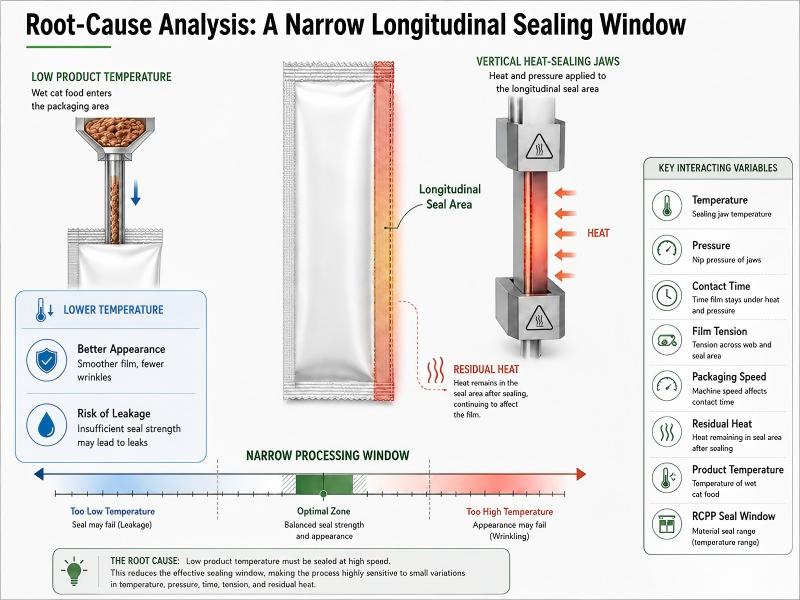
Higher Longitudinal Seal Temperature | Lower Longitudinal Seal Temperature |
Improves RCPP seal formation and sealing strength, but excessive thermal exposure can increase thermal shrinkage, local deformation and seal-edge wrinkling. | Can improve seal appearance, but insufficient sealing energy can increase incomplete seals, reduced seal strength, micro-leakage and leakage risk during subsequent sterilization. |
The process conflict
Higher heat helps seal formation but increases deformation risk. Lower heat reduces wrinkling but narrows the sealing safety margin. Temperature adjustment alone could not provide a sufficiently stable production window.
After residual heat was identified as an important contributor, we stopped treating the problem only as a film issue and optimized the machine around the actual thermal cycle of the longitudinal seal.
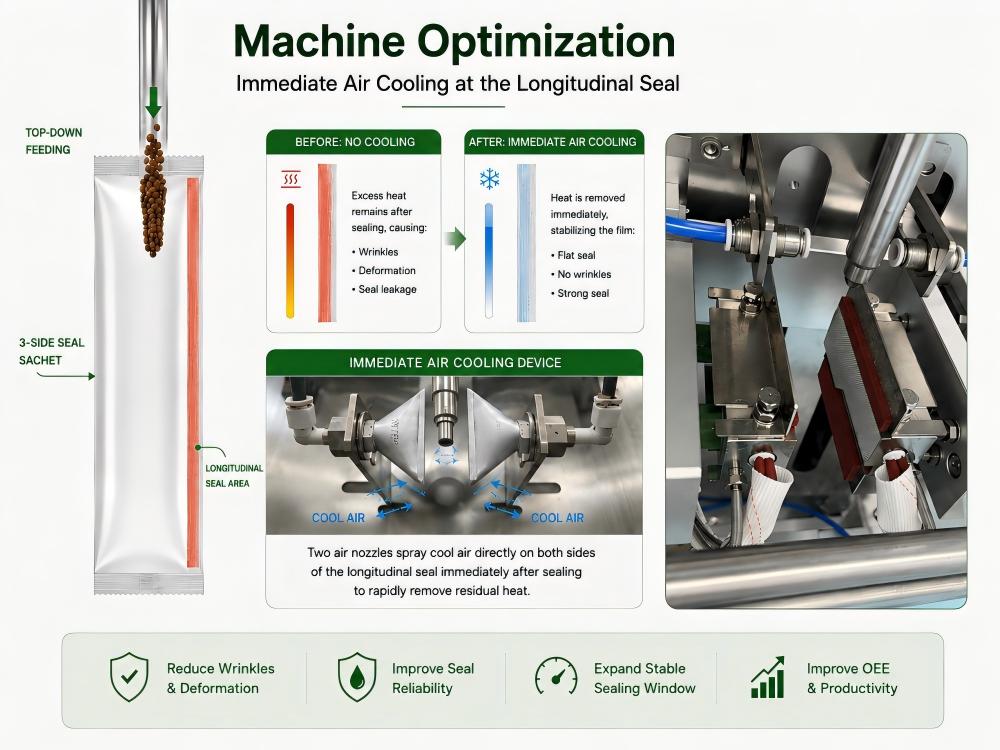
A controlled air-cooling device was installed immediately after the longitudinal sealing position. The principle was simple:
Heat Quickly → Form the Seal → Cool Immediately
Sufficient temperature and pressure were still applied to form a reliable RCPP seal. Immediately afterward, directed airflow removed part of the residual heat so the thinner laminate could stabilize more quickly. The objective was not simply to reduce sealing temperature, but to improve heat removal after seal formation.
The successful solution combined material engineering with targeted equipment optimization rather than relying on a single change.
Area | Original / Problem | Optimized Direction |
Laminate Thickness | Approx. 140 μm | Toward approx. 100 μm (nominal reduction about 29%) |
Laminate Structure | Four-layer aluminum-foil retort laminate | PET / AL / PA / RCPP development direction |
Packaging Speed | High-speed target | Stable operation within the target 50–60 packs/min range |
Main Defect | Seal wrinkles and leakage risk | Large-scale wrinkling reduced; longitudinal seal stabilized |
Machine Adjustment | Temperature adjustment alone was insufficient | Immediate air cooling after longitudinal sealing |
· Stable operation within the customer’s target range of approximately 50–60 packs/min
· Significant reduction in longitudinal seal wrinkles
· Improved sealing consistency and lower leakage risk
· Target laminate thickness reduced from approximately 140 μm toward 100 μm
· Approximately 29% reduction in nominal laminate thickness
· High-barrier aluminum-foil structure retained
· PA added to improve mechanical stability of the thinner laminate
· RCPP retained as the retort-oriented inner sealing layer
· Lower material usage per pack and improved high-speed production stability
Final laminate approval must still be based on the customer’s actual product formulation, filling conditions and validated sterilization temperature, time and pressure. A machine trial is not a substitute for full retort-process validation.
In high-speed flexible packaging, a thinner or cheaper film does not automatically create the lowest finished-pack cost. If material reduction leads to more wrinkles, leakage, rejects, film waste, machine stops or lower output, the apparent material saving can be lost in production.
The real cost target
The lowest total packaging cost per acceptable finished pack — not simply the lowest film price per kilogram or the lowest possible film thickness.
At HLunPACK, flexible packaging materials and packaging machinery are not treated as completely separate products. When a customer wants to reduce material thickness, increase speed, solve sealing defects or optimize retort packaging, we evaluate the complete packaging system.
· Laminate structure and total film thickness
· Sealant selection and retort requirements
· Sealing temperature, pressure and dwell time
· Packaging speed and film tension
· Sealing-jaw design and seal geometry
· Product temperature and product condition
· Post-seal cooling and stabilization
Material Performance + Packaging Speed + Process Stability
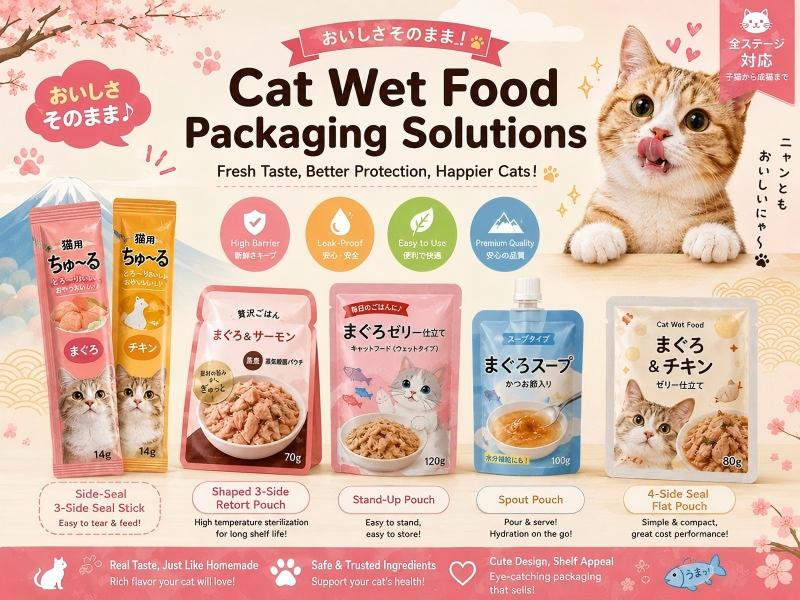
The same engineering approach can be extended to other wet pet food formats, including shaped three-side-seal retort pouches, stand-up pouches, spout pouches and four-side-seal flat pouches. The final laminate and sealing system should be matched to the product, sterilization process, pack geometry and filling method.
What type of packaging is commonly used for cat treat sticks?
Cat treat sticks are commonly packed in narrow three-side-seal sachets. Depending on the product and sterilization process, high-barrier aluminum-foil retort laminates can be used to provide barrier and package integrity.
Can cat treat retort film be reduced from 140 μm to around 100 μm?
It can be a practical development target, but thickness must not be reduced independently of laminate structure, machine settings and retort validation. This case required a change in structure plus machine optimization.
Why can thinner film wrinkle at higher packaging speeds?
As laminate thickness decreases and speed increases, the process becomes more sensitive to temperature, pressure, dwell time, tension and residual heat. A film that runs normally at low speed may have a much narrower processing window at 50–60 packs/min.
Why was PA added to the laminate?
PA adds toughness, puncture resistance and mechanical stability. In this project, it helped reinforce the thinner PET/AL/PA/RCPP structure without simply returning to a thicker overall laminate.
How was the remaining longitudinal seal wrinkling reduced?
A controlled air-cooling system was installed immediately after the longitudinal sealing position to remove residual heat and help the thinner laminate stabilize faster while retaining sufficient sealing energy.
What information is required before confirming a retort laminate?
Product type, pack size, filling conditions, packaging speed, sterilization temperature/time/pressure, required shelf life, mechanical requirements and actual machine configuration should all be evaluated before final approval.


