


close
Choose Your Site
Global
Social Media
Views: 289 Author: HLun PACK Publish Time: 2026-08-16 Origin: Site


Content Menu
● What Are Biodegradable Mylar Bags?
● Why Brands Are Considering Compostable Flexible Packaging
>> Product categories with a stronger fit
● Compostable, Biodegradable, and Recyclable: Key Differences
● How to Choose the Right Compostable Pouch Structure
>> 1. Identify your product risks
>> 3. Validate barrier and seal performance
● Avoid Greenwashing Before Printing
>> Match claims to local infrastructure
● Packaging Equipment Considerations for Compostable Pouches
● A Practical Implementation Process
● Start Your Compostable Pouch Project
>> 1. Are biodegradable Mylar bags really compostable?
>> 2. Can compostable pouches be placed in a home compost bin?
>> 3. Do compostable pouches provide the same barrier as foil pouches?
>> 4. What certification should I look for in the United States?
>> 5. What standard is relevant for compostable packaging in Europe?
>> 6. Can I use a compostable pouch on my existing packaging machine?
>> 7. Is "eco-friendly packaging" a safe claim to print on a pouch?
When buyers search for biodegradable Mylar bags, they are usually looking for more than an eco-friendly label. They need flexible packaging that protects a product from moisture, oxygen, light, and contamination—while supporting a credible end-of-life strategy.
That goal is achievable, but the terminology matters. Traditional "Mylar" commonly refers to PET polyester film. A genuinely compostable pouch must instead use a verified compostable material structure, compatible inks, adhesives, zippers, and valves where applicable. At HLun Pack, we help brands evaluate the entire packaging system, not simply select a material that sounds sustainable.

"Biodegradable Mylar bags" is a common market term for flexible pouches designed to provide the appearance or performance associated with high-barrier Mylar packaging while using materials intended to break down under defined composting conditions.
From an engineering perspective, the phrase should never replace a material specification. Traditional high-barrier pouches may combine PET, aluminum foil, metallized film, polyethylene, adhesives, and printing layers. These structures can offer excellent shelf-life protection, but they are not automatically biodegradable or compostable.
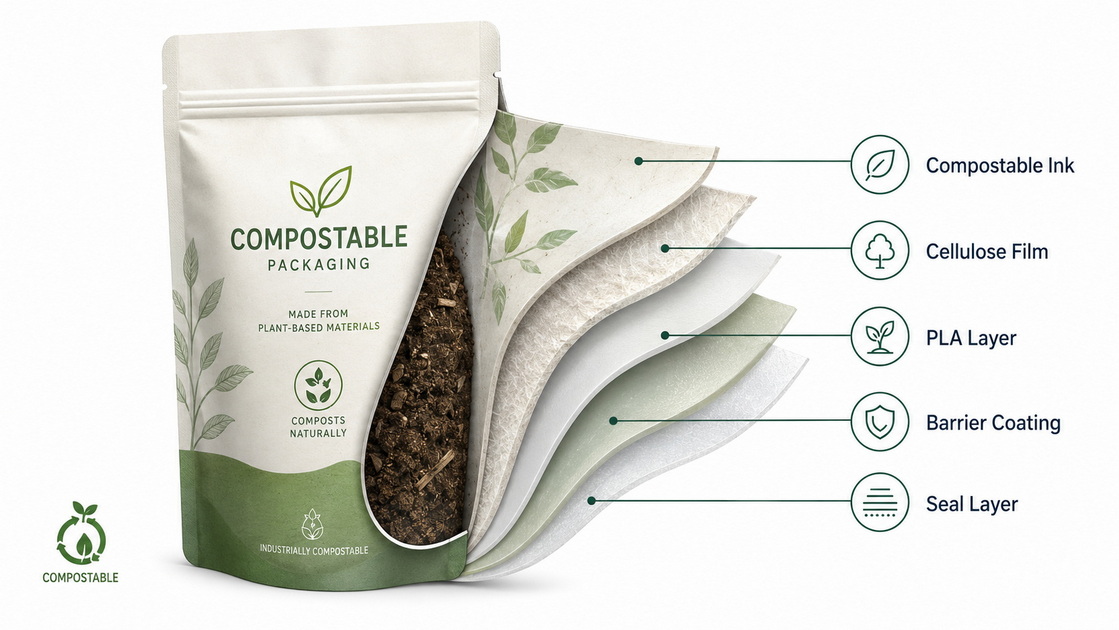
A compostable flexible pouch may use combinations of:
- PLA (polylactic acid), a bio-based polymer often derived from renewable feedstocks
- Cellulose-based films that can provide clarity and printability
- PHA-based materials, which may offer different biodegradation characteristics
- Compostable coatings, inks, and adhesives designed for the intended disposal system
- Specialized barrier layers that balance product protection with compostability requirements
The word "compostable" should be used only when the complete package—not just one film layer—has supporting evidence. ASTM D6400 covers plastics and plastic products intended for aerobic municipal or industrial composting, while EN 13432 is a key European framework for packaging recoverable through composting and biodegradation.
Flexible packaging can reduce material use compared with many rigid formats, but its sustainability outcome depends on the material structure, collection system, and actual disposal behavior. Compostable packaging can be a relevant option when it solves a clear waste-management problem rather than serving as a broad marketing claim.
Compostable pouches are often worth evaluating for products where food residue makes conventional recycling difficult, or where the packaging is likely to be discarded alongside organic waste.
Potential applications include:
- Coffee, tea, and dry snack products
- Granola, nuts, dried fruit, and bakery items
- Pet treats and selected dry pet-food formats
- Single-use samples and portion packs
- Garden, seed, and agricultural-product packaging
- Personal-care products where the pouch structure and formulation are compatible
A compostable pouch is not automatically the best answer for every product. For example, products requiring a very long shelf life, extremely high oxygen protection, retort processing, deep freezing, or aggressive chemical resistance may require a different material strategy.
Clear terminology protects your brand, your distributors, and your customers from confusion.
| Term | What it should mean | Buyer question to ask |
|---|---|---|
| Compostable | Breaks down into usable compost under specified conditions | Is it industrially compostable, home compostable, or both? |
| Biodegradable | Can be broken down by microorganisms, but conditions and time may vary | Under what environment, timeframe, and test method? |
| Recyclable | Can be collected, sorted, and processed into new material | Is recycling available where the package is sold? |
| Bio-based | Made partly or fully from renewable biological feedstocks | Does it also meet compostability or recyclability requirements? |
| Eco-friendly | A broad environmental claim | What precise, verifiable benefit supports this statement? |
The best biodegradable Mylar bag alternative begins with the product, not the visual design. Before selecting a pouch, define the protection level the product actually requires.
Ask these questions first:
1. Is moisture the primary threat to product quality?
2. Does oxygen exposure cause oxidation, fading, flavor loss, or rancidity?
3. Is the product sensitive to light?
4. What shelf-life target must the pouch achieve?
5. Will the package face puncture, compression, or transportation stress?
6. Does the filling process involve heat, dust, oil, sharp edges, or static?
7. What disposal infrastructure is available in the markets where you sell?
A roasted coffee pouch, for example, may need strong oxygen and aroma protection plus a degassing valve. A dry snack pouch may prioritize moisture resistance, resealability, and shelf appeal. These are different performance briefs and should not receive the same material recommendation by default.
Common compostable flexible-packaging formats include:
- Stand-up pouches: Suitable for retail display and larger fill weights
- Flat pouches: Useful for samples, sachets, and compact products
- Three-side-seal pouches: A practical choice for many dry goods
- Side-gusset bags: Often considered for coffee and premium food products
- Rollstock film: Suitable for brands using form-fill-seal packaging lines
Format selection affects material consumption, filling efficiency, shelf presentation, sealing parameters, and consumer convenience.
Do not approve packaging based only on a sample's appearance or thickness. Confirm the critical performance data for the finished structure, including:
- Oxygen transmission rate
- Water-vapor transmission rate
- Seal-strength range
- Puncture resistance
- Drop or compression resistance
- Migration and food-contact compliance where relevant
- Compatibility with product oils, powders, acidity, and storage temperature
A compostable pouch must protect the product throughout its intended life. If the package fails early, product waste can undermine the environmental benefit of using a lower-impact material.
As a packaging manufacturer, we recommend treating environmental claims as an engineering and compliance project—not only a design decision.
A claim can fail if a single component is incompatible with the intended composting route. Review:
- Base films and barrier coatings
- Laminating adhesives
- Printing inks and varnishes
- Zippers, tear notches, hang holes, and valves
- Labels and pressure-sensitive adhesives
- Product-contact layer
- Secondary packaging and disposal instructions
BPI's commercial compostability certification uses ASTM D6400 as its base assessment standard and limits eligibility to items associated with desired organic-waste feedstocks, such as food scraps and yard trimmings. This reinforces a practical point: compostable packaging is most credible where its use supports a functioning organics-management system.
Before making a public claim, request and retain:
- Material specification sheets
- Test reports for the final structure where available
- Certification scope and validity information
- Food-contact declarations for target markets
- Ink and adhesive compliance documentation
- Clear disposal-label artwork
- Version-controlled packaging specifications
Do not assume that a certification for a film resin automatically covers a printed, laminated, zipped, or valved pouch.
Industrial composting generally uses managed aerobic conditions, including elevated temperatures that are not equivalent to a backyard compost pile. ASTM D6400 specifically addresses materials designed for municipal and industrial aerobic composting facilities.
If your consumers do not have realistic access to accepted composting programs, include an honest disposal instruction. The package can still be technically compostable, but the communication must not imply that decomposition will occur quickly in a landfill, recycling bin, or natural environment.
Material innovation and packaging machinery must work together. Compostable films can behave differently from conventional PET/PE or foil-laminated structures during converting, filling, and sealing.
HLun Pack supports flexible-packaging projects through packaging machinery and integrated packaging solutions. For compostable pouch applications, your equipment assessment should include:
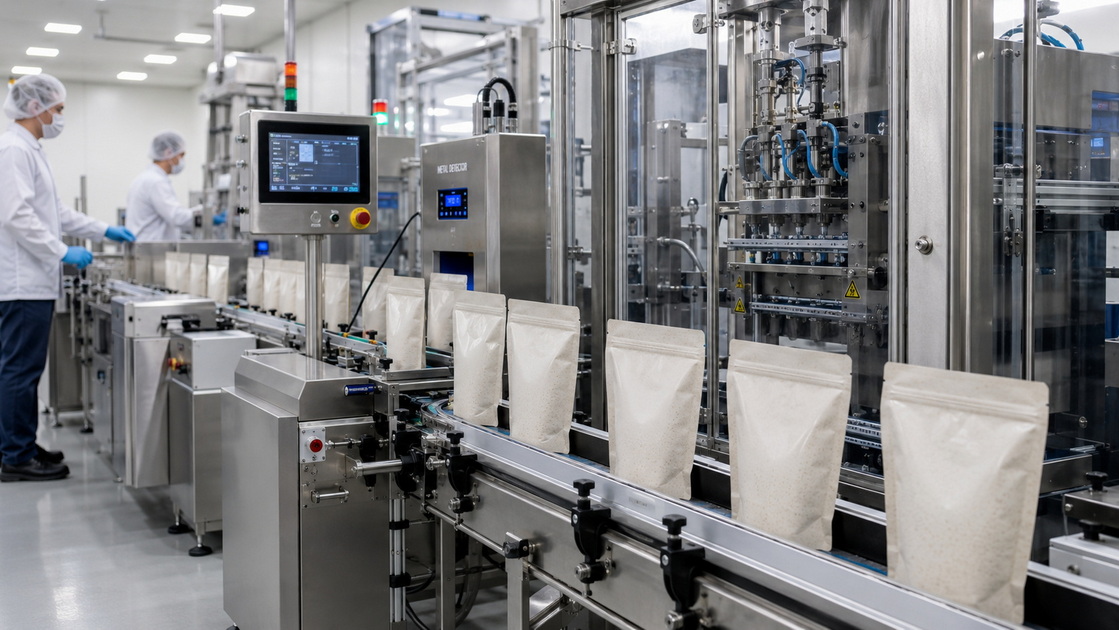
| Equipment area | What to evaluate |
|---|---|
| Filling system | Product flow, dust control, dosing accuracy, and material contact |
| Heat sealing | Temperature window, dwell time, pressure, and seal consistency |
| Form-fill-seal line | Film tracking, tension control, registration accuracy, and forming behavior |
| Zipper or valve application | Component compatibility and application precision |
| Inspection system | Seal inspection, weight checking, metal detection, and code verification |
| Secondary packaging | Cartoning, case packing, and protection against transit damage |
Run a pilot trial before large-scale production. Measure seal integrity, package appearance, filling speed, rejects, and shelf-life performance under realistic logistics conditions. This helps avoid a common failure: developing a promising sustainable pouch in the laboratory that cannot run reliably on the commercial packaging line.
A disciplined packaging-development process reduces risk and improves launch speed.
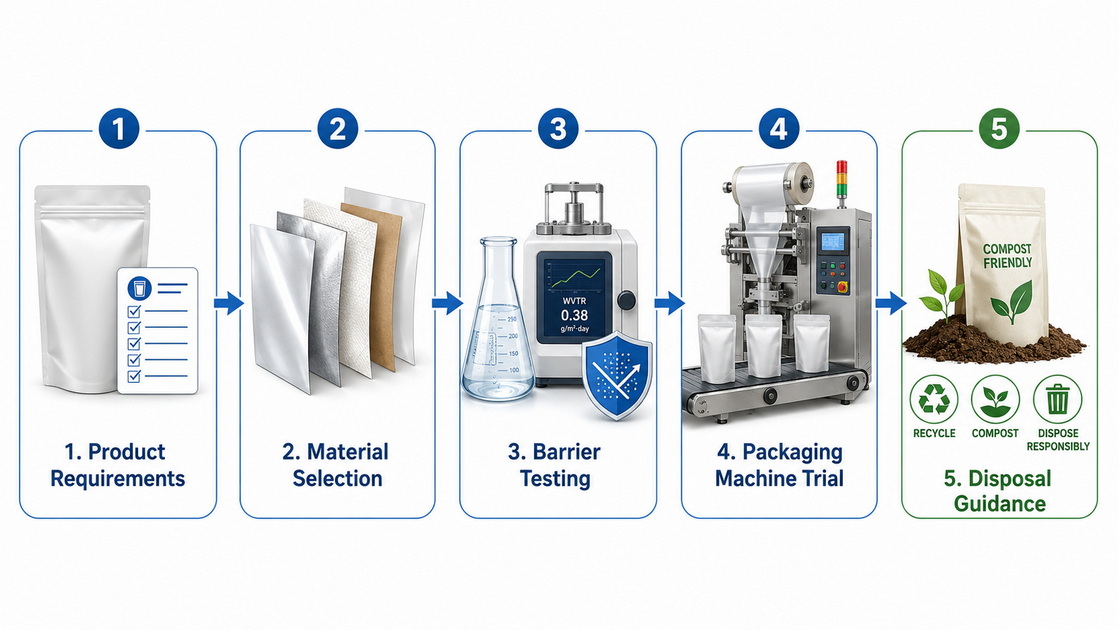
1. Define the product brief. Document shelf-life requirements, barrier needs, target pack size, product sensitivity, expected annual volume, sales markets, and disposal pathway.
2. Choose the material direction. Compare compostable, recyclable mono-material, and conventional high-barrier options according to product protection and end-of-life feasibility.
3. Develop a technical specification. Define pouch format, dimensions, film structure, print coverage, zipper or valve needs, sealing window, and inspection requirements.
4. Produce trial samples. Test samples with the actual product, not only with air or substitute materials.
5. Validate on equipment. Run production trials to confirm forming, filling, sealing, coding, and packing performance.
6. Confirm claim substantiation. Review test reports, certifications, labels, and market-specific compliance requirements before artwork release.
7. Launch with clear instructions. Use specific disposal language and train your distributors, retailers, and customer-service teams to explain it accurately.
A sustainable pouch is only successful when packaging material, product protection, machinery performance, and user communication align. HLun Pack focuses on flexible packaging equipment and integrated packaging solutions, helping manufacturers connect pouch design decisions with practical production requirements.
Our project approach can support brands that need to:
- Assess pouch formats for new or existing products
- Improve filling, sealing, and inspection consistency
- Integrate packaging equipment into a complete line
- Reduce trial-and-error during packaging-material transitions
- Build packaging specifications around actual production conditions
The goal is not to apply "compostable" as a generic label. The goal is to create a packaging system that protects the product, runs reliably, and communicates environmental attributes with evidence.
If you are evaluating biodegradable Mylar bags or compostable flexible packaging, begin with a technical consultation—not a generic quotation request. Share your product type, pack size, target shelf life, destination markets, existing equipment, expected output, and sustainability objective.
HLun Pack can help you evaluate the right pouch format, packaging-machine configuration, and integrated process for your project. Contact our team to discuss a customized flexible-packaging solution built around your real product and production requirements.
Not necessarily. "Biodegradable Mylar bags" is widely used as a search term, but traditional Mylar commonly refers to PET polyester film. A pouch should be called compostable only when its complete structure has appropriate supporting evidence for the specified composting environment.
Only if the specific finished pouch is designed, tested, and labelled for home composting. Many compostable flexible packages are intended for industrial composting, which uses more controlled conditions than home composting.
Not always. Some compostable structures can provide useful moisture, oxygen, and aroma protection, but they may not match every foil-laminate application. Barrier targets should be tested against the product's actual shelf-life requirements.
For industrially compostable plastic packaging, ASTM D6400 is an important standard. BPI certification uses ASTM D6400 as a core assessment basis for eligible products.
EN 13432 is widely used for packaging recoverable through composting and biodegradation. Brands should also review the packaging and labelling requirements of each target market before making a claim.
Possibly, but you should conduct trials. Compostable films may require changes to sealing temperature, dwell time, pressure, film tension, forming settings, or filling speed.
It is usually too broad on its own. Use precise, substantiated wording instead, such as "industrially compostable where accepted," together with applicable certification information and disposal guidance.
1. [Original article: "Biodegradable Mylar Bags – A Compostable and Eco-friendly Packaging Solution"] — source structure and baseline topics used for this rewrite. [yltpacking]
2. [U.S. Federal Trade Commission: Green Guides—Environmental Claims Summary] — guidance on qualified environmental, compostable, degradable, and recyclable claims. [ftc]
3. [ASTM International: ASTM D6400] — specification for labelling plastics designed for aerobic municipal or industrial composting. [astm]
4. [TÜV SÜD: EN 13432 Biodegradable Packaging Certification] — overview of EN 13432 for packaging recoverable through composting and biodegradation. [tuvsud]
5. [Biodegradable Products Institute: Commercial Compostability Certification] — BPI eligibility and ASTM-based assessment information. [bpiworld]
6. [European Commission: Packaging Waste] — European packaging and packaging-waste regulatory context. [environment.ec.europa]


