


close
Choose Your Site
Global
Social Media
Views: 267 Author: HLun PACK Publish Time: 2026-08-18 Origin: Site


Content Menu
● Why Businesses Use Mylar Bags
>> 1. Better Protection Against Oxygen, Moisture, and Light
>> 2. Longer Shelf Life When the Full System Is Correct
>> 3. Lightweight Packaging With Efficient Logistics
>> 4. Strong Branding and Shelf Impact
>> 5. Reliable Mechanical Strength and Product Protection
>> 6. Consumer-Friendly Resealability and Portion Control
● Mylar Bag Applications by Product Type
● How to Choose the Right Mylar Bag Structure
>> Start With Product Conditions
>> Match the Pouch to the Machine
● Food Safety, Compliance, and Seal Validation
● Use a Balanced Packaging Strategy
>> 1. Are Mylar bags the same as aluminum foil bags?
>> 2. Can Mylar bags extend food shelf life?
>> 3. Are Mylar bags safe for food packaging?
>> 4. What products are best suited to high-barrier Mylar-style pouches?
>> 5. Do Mylar bags need oxygen absorbers?
>> 6. Can Mylar bags be recycled?
>> 7. What packaging machine is used for Mylar bags?
Mylar bags are widely used in flexible packaging because they can help protect products from oxygen, moisture, light, odor, and physical damage. For food, coffee, pet food, nutraceuticals, cannabis products, powders, and industrial components, the right high-barrier pouch can preserve product quality, improve shelf appeal, and support efficient automated packing.
However, not every "Mylar bag" is the same. In commercial packaging, the result depends on the complete pouch structure, product characteristics, sealing method, filling environment, and packaging machine settings. At HLun Pack, we view the pouch and the machinery as one integrated system: the material must run reliably, seal consistently, and protect the product throughout distribution.
This guide explains the main benefits of Mylar bags, where they work best, how to select the right format, and what manufacturers should verify before production.

"Mylar" is technically a registered trademark historically associated with biaxially oriented polyethylene terephthalate, or BOPET, film. In everyday packaging language, buyers often use "Mylar bags" to describe metallic-looking, high-barrier flexible pouches made with PET, metallized PET, aluminum foil, polyethylene, and other functional layers.
This distinction matters. A pouch's actual performance is not determined by its appearance alone. Its oxygen barrier, moisture barrier, puncture resistance, heat-seal window, and recyclability depend on the full laminate design.
For example, a transparent PET/PE pouch may offer good clarity and strength but only moderate barrier protection. A metallized PET laminate can provide improved light and gas barrier. An aluminum-foil laminate can deliver very high barrier performance, although it is not transparent and may require different converting and sealing considerations.
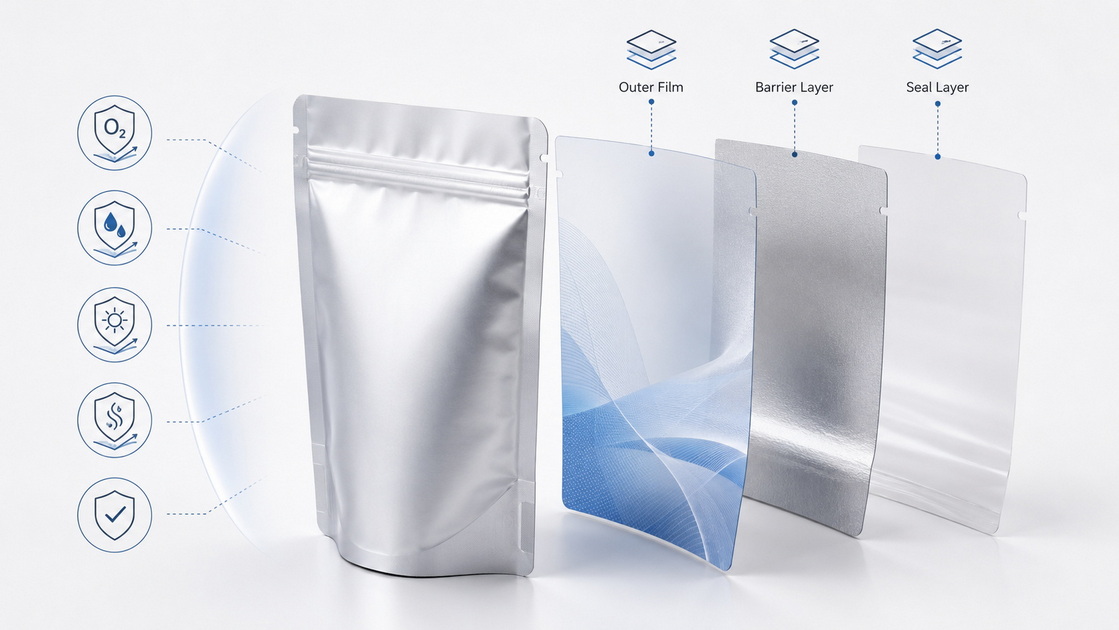
Many products lose quality when exposed to environmental factors. Oxygen can accelerate oxidation in coffee, snacks, nuts, supplements, and certain powders. Moisture may cause clumping, loss of crispness, microbial risk, or reduced product performance. Light can degrade colors, flavors, and light-sensitive ingredients.
A correctly specified high-barrier pouch helps limit these exposures. Metallized layers and foil layers are particularly valuable when a product needs strong protection from light and gas transmission.
For a brand owner, this can translate into:
- Better flavor retention for coffee, tea, snacks, and spices
- Improved crispness for dry foods
- Reduced moisture uptake in powders and dehydrated ingredients
- Better protection for odor-sensitive or aroma-rich products
- More stable appearance and quality during retail display
Important: High-barrier packaging supports shelf life, but it does not replace good manufacturing practice, hygienic filling, appropriate product formulation, or suitable storage conditions.
One of the most searched benefits of Mylar bags is long-term storage. This benefit is real, but it must be explained accurately. A pouch alone cannot guarantee a specific shelf-life period.
Shelf life is influenced by several combined factors:
- Product water activity and moisture content
- Oxygen sensitivity and fat content
- Residual oxygen after filling
- Oxygen absorber or nitrogen-flushing strategy
- Seal integrity
- Pouch barrier properties
- Warehouse temperature and humidity
- Exposure to light
- Product microbiological stability
For dry, low-moisture products, a high-barrier pouch combined with reliable heat seals and an appropriate oxygen-management method can greatly improve storage stability. For products with higher moisture content, perishable ingredients, or microbiological risk, packaging must be validated as part of the entire food-safety and shelf-life program.
Compared with rigid packaging formats such as glass jars, metal cans, and some plastic tubs, flexible pouches generally use less material by weight and occupy less space before filling. This can reduce inbound storage requirements and shipping volume for packaging materials.
For export-oriented manufacturers, this is especially useful. Flat pouch rolls, premade bags, and lightweight finished packs can help improve container utilization and reduce handling complexity.
Flexible packaging also offers strong format flexibility:
- Flat pouches for samples and small portions
- Stand-up pouches for shelf display
- Side-gusset bags for coffee and bulk dry goods
- Quad-seal bags for premium presentation
- Spouted pouches for sauces, liquids, and gels
- Stick packs and sachets for single-dose products
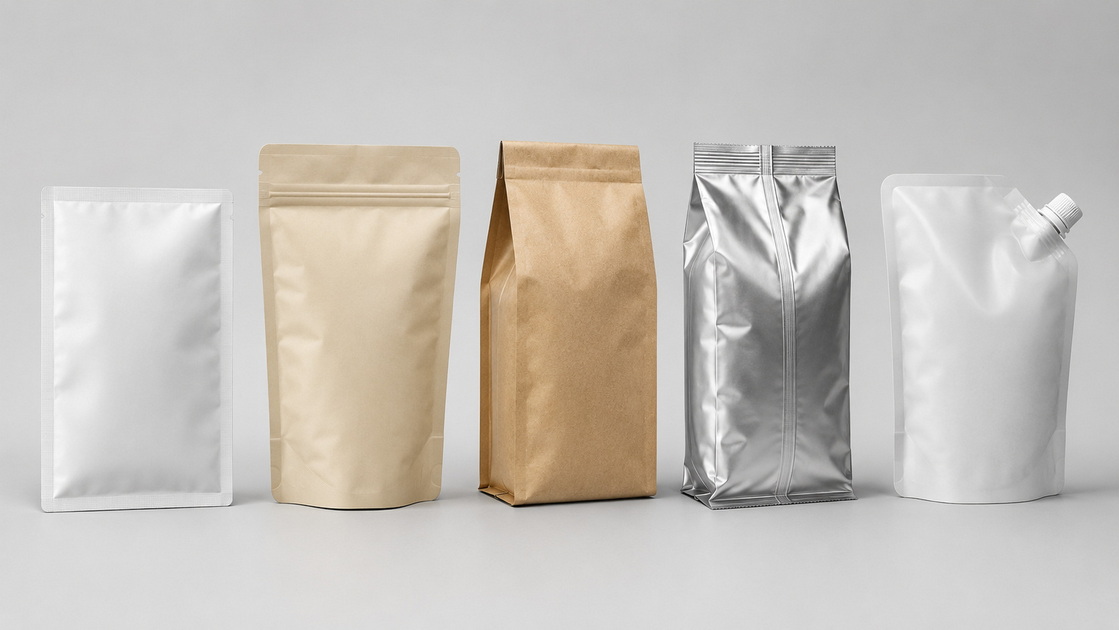
Packaging is often the first physical interaction between a consumer and a product. Mylar-style flexible pouches support high-quality graphics, matte or gloss finishes, metallic effects, transparent windows, tactile varnishes, and customized pouch shapes.
This makes them suitable for brands that need both protection and a differentiated appearance. Coffee roasters, snack brands, supplement companies, and pet-food manufacturers often use pouch design to communicate freshness, premium positioning, flavor, usage instructions, and sustainability information.
Common branding features include:
- Custom printed logos and product information
- Matte, gloss, soft-touch, or metallic finishes
- Clear windows where product visibility is beneficial
- Resealable zippers for convenience
- Hang holes for retail merchandising
- Easy-tear notches for better opening experience
- Laser scoring for controlled opening
- One-way degassing valves for coffee packaging
A pouch should not only look attractive. It should remain functional after printing, filling, sealing, transportation, and customer use.
Many flexible packaging structures offer good tensile strength, puncture resistance, and flex-crack resistance. These properties are especially important for products with sharp edges, abrasive particles, or heavy fill weights.
Examples include:
- Nuts and snack mixes
- Frozen foods
- Pet treats and pet food
- Hardware components
- Agricultural seeds
- Chemical powders
- Small automotive parts
The correct structure should be selected according to the product. A fine powder may require strong sealability and dust-management features. A sharp snack may need improved puncture resistance. A heavy product may need reinforced seals and a pouch geometry that distributes weight effectively.
Resealable closures make flexible packaging more convenient after first opening. A zipper, slider, press-to-close closure, or peel-and-reseal feature can help consumers store products more easily and reduce accidental spills.
For product categories such as nuts, granola, pet treats, dried fruit, supplements, and cannabis products, resealability can improve the overall user experience.
However, a zipper is not automatically a hermetic closure. The primary heat seal must still be designed and validated to protect the product before first opening. For child-resistant packaging or regulated products, the closure must also meet the applicable functional and regulatory requirements in the target market.
| Product category | Main packaging risk | Recommended pouch features |
|---|---|---|
| Coffee | Oxygen, aroma loss, degassing | High-barrier laminate, one-way valve, zipper or tin tie |
| Snacks and nuts | Oxidation, moisture, puncture | Metallized or foil barrier, strong seals, zipper |
| Powders | Moisture, dust in seal area | High-barrier structure, wide seal area, auger-filling compatibility |
| Pet food and treats | Odor, fat oxidation, high fill weight | Durable laminate, puncture resistance, carry handle if needed |
| Nutraceuticals | Moisture, oxygen, light | High barrier, food-contact documentation, precise dosage format |
| Seeds and agricultural products | Moisture, puncture, labeling | Durable pouch, moisture barrier, clear labeling area |
| Hardware and components | Corrosion, abrasion, loss of small parts | Tear resistance, labeling, optional anti-static or corrosion-control features |
Choosing a pouch starts with the product—not with a generic material name. A packaging supplier should ask targeted questions before recommending a structure.
Consider the following:
1. Is the product dry, oily, powdered, liquid, frozen, or sharp-edged?
2. Is it sensitive to oxygen, moisture, light, or odor?
3. What is the target shelf life?
4. Will the product be hot-filled, vacuum-packed, nitrogen-flushed, or packed under normal atmosphere?
5. What is the fill weight and pouch size?
6. Does the pack need to stand upright, hang, or fit into a shipping carton?
7. Does the product require a zipper, spout, valve, child-resistant feature, or easy-open design?
8. Which country or market will the product enter?
A technical pouch specification should include measurable requirements rather than vague terms such as "premium barrier." For example, brands may define required oxygen transmission rate, water vapor transmission rate, seal strength, drop resistance, and storage conditions.
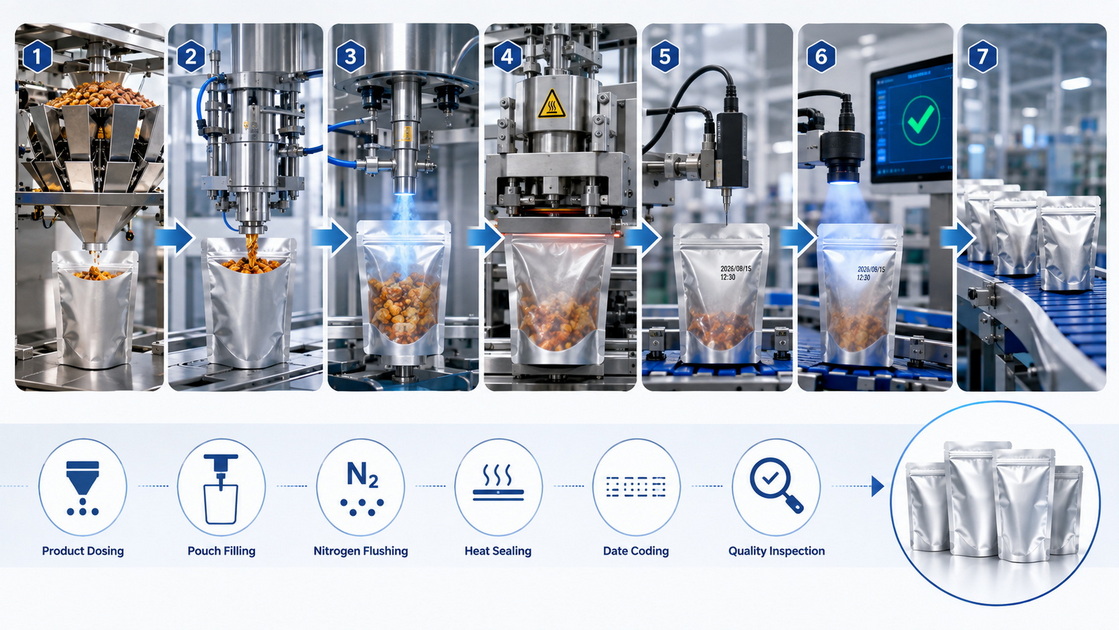
A high-quality pouch can still fail if it is incompatible with the filling and sealing process. Common production issues include wrinkled seals, seal contamination from powder, zipper misalignment, film tracking problems, inconsistent temperature control, and insufficient dwell time.
At HLun Pack, integrated packaging planning considers both material and equipment. This is particularly important for automated systems such as:
- Vertical form-fill-seal machines
- Premade pouch packing machines
- Multihead weigher systems
- Auger filling machines
- Liquid and paste filling systems
- Vacuum packaging machines
- Nitrogen-flushing systems
- Checkweighers and metal detectors
- Cartoning and case-packing equipment
A practical approach is to conduct a packaging trial with the real product, target pouch, filling speed, and intended sealing parameters. This helps identify issues before full-scale production.
For food packaging, the material must be suitable for its intended food-contact application. The U.S. Food and Drug Administration defines food-contact substances as materials that come into contact with food and are not intended to have a technical effect in the food. Packaging components fall within this area, so exporters should request relevant compliance documentation from their packaging-material suppliers.
Before production, buyers should verify:
- Food-contact compliance for the destination market
- Migration-test documentation where applicable
- Ink, adhesive, and laminate suitability
- Seal-strength targets
- Seal integrity under actual filling conditions
- Packaging performance after transportation and storage
- Lot traceability and quality-control records
For products requiring long shelf life, package validation can include seal-strength testing, burst testing, leak detection, dye penetration testing, and real-time or accelerated shelf-life studies. The right method depends on the product, pouch type, and applicable regulations.
Flexible packaging can support sustainability goals because it is lightweight and may use less material than many rigid alternatives. Lower pack weight can improve transportation efficiency, and high barrier protection can help reduce food waste by preserving product quality.
But sustainability claims should be specific and evidence-based. Many high-barrier pouches are made from multilayer structures, which can be difficult to recycle in locations without appropriate collection and processing systems.
A more responsible approach is to evaluate the complete packaging system:
- Use the minimum material needed for product protection
- Avoid over-packaging
- Select recyclable mono-material structures where performance and infrastructure allow
- Consider post-consumer recycled content where appropriate and compliant
- Design packs that reduce product loss and food waste
- Clearly communicate disposal guidance for the target market
Expert perspective: The most sustainable pouch is not necessarily the thinnest or simplest one. It is the pouch that provides the required protection with the lowest practical overall material and product-waste impact.
HLun Pack provides flexible packaging equipment and integrated packaging solutions for businesses that need more than a standard bag. We help manufacturers connect pouch design, material performance, filling technology, sealing reliability, and production efficiency.
Whether you need a high-barrier pouch solution for coffee, powders, snacks, pet food, or industrial products, our team can help evaluate your packaging goals and recommend suitable machinery and line configurations.
Ready to improve your packaging performance? Contact HLun Pack to discuss your product, pouch format, output target, and automation requirements. We can help you build a practical flexible-packaging solution designed for reliable sealing, efficient operation, and consistent product protection.
Not always. "Mylar bag" is commonly used to describe high-barrier flexible pouches, but the actual structure may use clear PET, metallized PET, aluminum foil, polyethylene, or multiple layers. Foil pouches typically provide stronger light and gas barrier than standard clear-film structures.
Yes, a properly designed high-barrier pouch can help extend the shelf life of suitable products by limiting oxygen, moisture, and light exposure. However, actual shelf life depends on the food itself, filling conditions, seal quality, storage temperature, and the complete packaging system.
They can be, provided the complete packaging structure—including film, inks, adhesives, and sealant layers—is suitable for the intended food-contact use and complies with applicable market requirements. Always request compliance documentation from the supplier.
Common applications include coffee, tea, snacks, nuts, dried fruit, spices, protein powders, pet food, supplements, seeds, and moisture-sensitive industrial goods. The ideal structure varies according to the product's barrier and handling requirements.
Not every product needs them. Oxygen absorbers are mainly used for specific dry, shelf-stable products where oxygen reduction is appropriate. For commercial operations, nitrogen flushing, vacuum packaging, or modified-atmosphere packaging may also be considered depending on the product and production process.
It depends on the pouch construction and local recycling infrastructure. Some mono-material flexible packaging structures may be designed for recycling, while many multilayer barrier laminates are harder to process through conventional recycling systems. Evaluate material structure and local collection options before making recyclability claims.
Premade pouch packaging machines are commonly used for preformed stand-up pouches, zipper pouches, and spouted pouches. Vertical form-fill-seal machines are often used to make and fill bags from rollstock. The best solution depends on pouch format, product type, filling method, required speed, and sealing requirements.
1. U.S. Food and Drug Administration. "Food Packaging & Other Substances that Come in Contact with Food." Explains what food-contact substances are and includes packaging components within this category. [https://www.fda.gov/food/food-ingredients-packaging/food-packaging-other-substances-come-contact-food-information-consumers] [fda]
2. Museum of Fine Arts, Boston, CAMEO. "Mylar." Defines Mylar as a registered trademark for polyester film and provides material-property context, including barrier-related information. [https://cameo.mfa.org/wiki/Mylar] [cameo.mfa]
3. SigmaQ. "Mylar: A Dynamic Flexible Packaging Ingredient That Extends Shelf Life." Discusses PET-based Mylar film, metallization, and the contribution of metal layers to protection from light, moisture, and oxygen. [https://sigmaq.com/en/mylar-a-dynamic-flexible-packaging-ingredient-that-extends-shelf-life/] [sigmaq]
4. OXO Packaging. "10 Benefits of Using Mylar Bags You Should Know." Original competitor article reviewed for topic coverage, including storage, resealability, protection, and customization themes. [https://oxopackaging.com/blog/benefits-of-using-mylar-bags.html] [oxopackaging]
5. Mylar Shop. "Which Foods Can You Store in Mylar Bags?" Provides example food categories and illustrates why storage duration must be evaluated by product type rather than claimed universally. [https://mylarshop.com/mylar-shop-articles/which-foods-can-you-store-in-mylar-bags/] [mylarshop]


