


close
Choose Your Site
Global
Social Media
Views: 257 Author: HLun PACK Publish Time: 2026-08-23 Origin: Site


Content Menu
● Why Eco-Friendly Paper Packaging Matters
● What Makes Paper Packaging Sustainable?
>> Five Questions to Ask Before Choosing a Material
● Types of Eco-Friendly Paper Packaging Materials
>> 1. Corrugated Cardboard for Shipping and Transport Packaging
>> 2. Kraft Paper for Wrapping, Void Fill, and Protective Cushioning
>> 3. Molded Pulp for Protective Inserts and Trays
>> 4. Paperboard for Folding Cartons and Retail Packaging
>> 5. Honeycomb Paper for Heavy-Duty Protection
>> 6. Glassine and Grease-Resistant Paper Applications
● How to Compare Sustainable Paper Packaging Materials
● Design for Recycling, Not Just for Appearance
● The Equipment-Material Connection: Where Sustainable Packaging Projects Often Fail
● A Practical Sustainable Packaging Checklist
● Build a More Efficient Paper Packaging System With HLun Pack
● FAQ
>> 1. What is the most eco-friendly paper packaging material?
>> 2. Is all paper packaging recyclable?
>> 3. Is FSC-certified packaging automatically recyclable?
>> 4. Can paper packaging replace plastic packaging completely?
>> 5. How can packaging machinery support sustainability?
>> 6. What should we test before switching to a new paper packaging material?
Choosing eco-friendly paper packaging materials is no longer only a branding decision. For manufacturers, retailers, and e-commerce businesses, it affects product protection, packing speed, shipping cost, recycling outcomes, and regulatory readiness.
At HLun Pack, we see one recurring lesson in packaging projects: sustainable packaging works only when the material, structural design, and packaging equipment work together. A recyclable paper mailer that jams on an automated line, a corrugated carton that uses excessive void fill, or a coated paper pack that local recycling systems cannot process will not deliver the intended result.
This guide explains the most practical sustainable paper packaging materials, how to compare them, and how to select a solution that supports both operational performance and environmental goals.
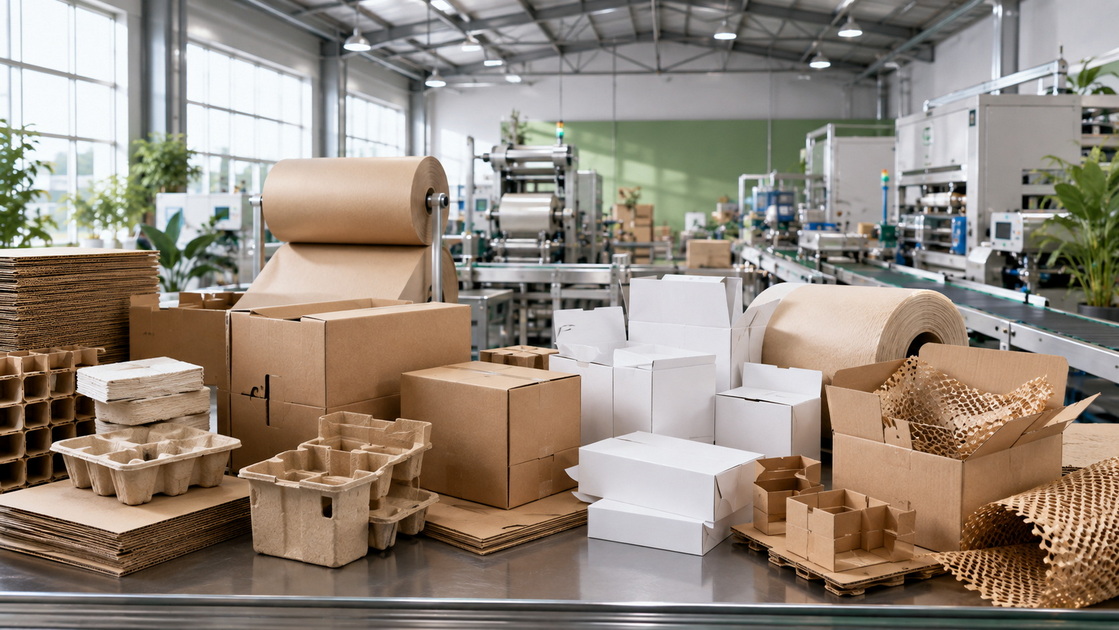
Packaging is an essential part of modern commerce, but it also represents a major material-flow challenge. In the European Union, packaging waste reached 79.7 million tonnes in 2023. Paper and cardboard accounted for the largest share of packaging waste by material type, at approximately 40 percent.
Paper packaging can support a more circular packaging system when it is:
- Right-sized to reduce unnecessary material use
- Made with responsibly sourced fiber or recycled content
- Designed for practical collection and recycling
- Strong enough to prevent product damage and returns
- Compatible with efficient packaging machinery
- Clearly labeled to help end users dispose of it correctly
The U.S. Environmental Protection Agency emphasizes source reduction—using less material in the first place—as a key part of sustainable packaging. Lightweighting and efficient packaging construction can reduce waste while also lowering material and transport costs.
However, paper is not automatically "eco-friendly." A responsible decision requires looking beyond the material name and evaluating the full packaging system.
A sustainable paper packaging solution should be evaluated across its complete life cycle: fiber sourcing, conversion, transport, filling, product protection, collection, and end-of-life recovery.
The Sustainable Packaging Coalition recommends a holistic design approach. This includes reducing or eliminating unnecessary materials, considering sourcing, improving transportation efficiency, and addressing material health.
Before selecting a paper packaging material, packaging teams should ask:
1. Does the pack protect the product effectively?
Product damage creates replacement shipments, customer dissatisfaction, and additional material waste.
2. Can the package be reduced or right-sized?
Avoid oversized cartons, unnecessary inserts, and excessive layers.
3. Is the fiber responsibly sourced or recycled?
Ask suppliers for relevant chain-of-custody documentation and recycled-content specifications.
4. Can consumers or commercial users realistically recycle it?
Design should match the recycling infrastructure in the product's actual destination market.
5. Will the material run reliably on the packing line?
Paper stiffness, caliper, surface friction, moisture, fold memory, and dimensional consistency all influence machine performance.
The best material depends on the product, channel, shipping conditions, customer expectations, and available equipment. Below are the most common paper-based options.
Corrugated cardboard remains one of the most versatile materials for e-commerce, industrial shipping, and retail-ready packaging. Its fluted inner layer creates cushioning strength with relatively low material weight.
Common corrugated packaging formats include:
- Regular slotted cartons
- Die-cut mailer boxes
- Shelf-ready trays
- Corrugated dividers
- Protective corner guards
- Custom shipping inserts
Corrugated boxes are particularly useful for products that need compression resistance during warehousing and transport. They can also be optimized through right-sizing, flute selection, board-grade selection, and structural engineering.
In the U.S., corrugated boxes had a reported recycling rate of 96.5 percent in the EPA's 2018 material data. This figure is useful context, but businesses should recognize that recovery rates vary by country, collection system, and measurement method.
HLun Pack equipment consideration: Corrugated box packaging equipment should be matched to carton dimensions, board stiffness, speed requirements, and closure method. Carton erectors, case packers, carton sealers, and robotic loading systems can improve consistency while reducing manual handling.
Kraft paper is widely used because it is strong, flexible, printable, and suitable for many packaging applications. It can be supplied in virgin, recycled, or mixed-fiber grades depending on protection and appearance requirements.
Kraft paper works well for:
- Product wrapping
- Interleaving between items
- Paper void fill
- Protective paper cushioning
- Retail bags
- Paper mailers
- Protective outer wraps
For e-commerce fulfillment, kraft paper can replace some plastic void-fill applications when the paper grade and dispensing method are chosen correctly. The key is not simply adding more paper: it is creating a repeatable cushioning pattern that holds the product in position.
Machine-fit insight: Paper void-fill and cushioning machines require consistent roll width, paper basis weight, and tension behavior. Low-quality paper variation can cause tearing, dust accumulation, inconsistent crumpling, and unplanned downtime.
Molded pulp packaging is typically formed from recycled paper fibers. It is commonly used for electronics, cosmetics, wine, food-service products, small appliances, and glass containers.
Its main benefits include:
- Custom-fit cushioning
- Reduced reliance on expanded plastic foam
- Stackable shapes for efficient logistics
- A natural, fiber-based appearance
- Potential use of recycled fiber feedstock
Molded pulp is a strong option when the packaging needs to immobilize fragile products inside a corrugated outer carton. However, it should be tested for moisture exposure, surface-finish expectations, dimensional tolerances, and product-contact requirements.
Paperboard is commonly used for folding cartons, sleeves, display boxes, inserts, and premium consumer-product packaging. It provides a broad printable surface for branding, instructions, and recycling information.
Typical paperboard packaging applications include:
- Cosmetics boxes
- Food cartons
- Pharmaceutical secondary packaging
- Electronics accessory boxes
- Gift boxes
- Subscription box sleeves
Paperboard can support efficient high-speed folding-carton operations, but design details matter. Heavy coatings, laminated windows, foil layers, and difficult-to-separate components may affect recyclability or sorting performance.
Practical recommendation: Use a mono-material paperboard structure whenever product protection allows. If a barrier is needed, evaluate whether the coating is necessary, whether it is compatible with local recovery streams, and whether it can be reduced.
Honeycomb paper structures use expanded paper cells to create a lightweight but rigid protective material. They can be used for pallets, edge protectors, interior blocks, and furniture or appliance protection.
This material is especially relevant when companies need to reduce foam or timber components in transport packaging. Honeycomb structures can provide compressive strength while using a fiber-based format that may be easier to integrate into paper-recycling streams than mixed-material alternatives.
Glassine is a smooth, translucent paper frequently used for wrapping delicate products, confectionery, bakery goods, photographs, and selected food applications. It can offer a premium appearance while retaining a paper-based format.
For food-contact packaging, material selection must account for product oil content, moisture, storage duration, regulatory requirements, and sealing needs. Do not assume that every "paper-like" material has the same barrier performance or end-of-life characteristics.
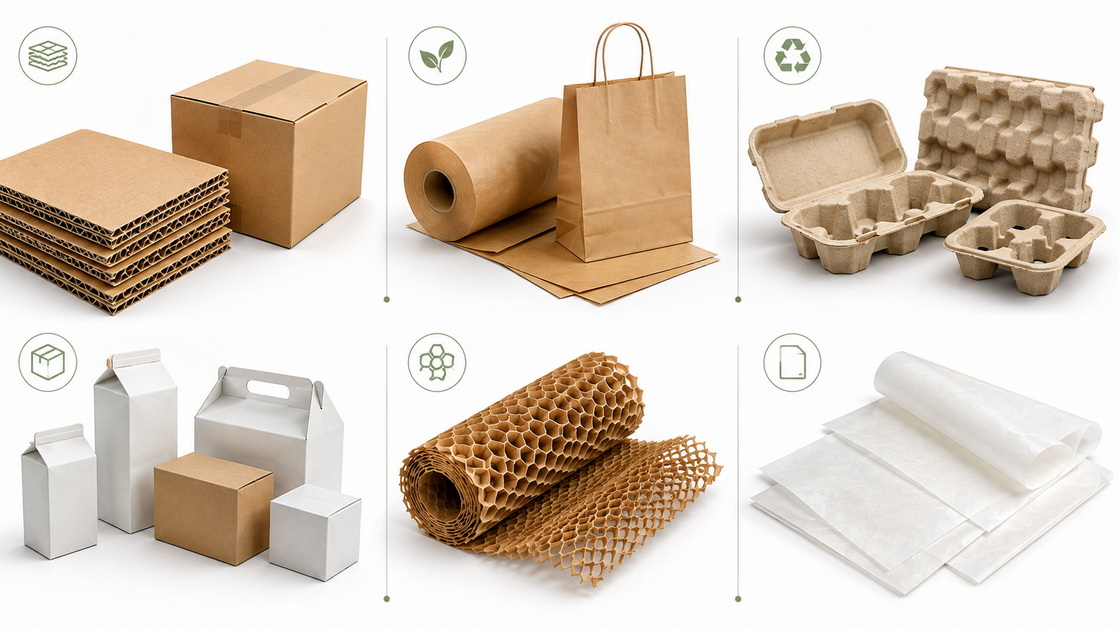
| Material | Best Use | Main Strength | Key Limitation | Equipment Consideration |
|---|---|---|---|---|
| Corrugated cardboard | Shipping cartons and dividers | Strong and highly versatile | Can be bulky if over-engineered | Carton erectors, case packers, sealers |
| Kraft paper | Wrapping and void fill | Flexible and easy to convert | Limited moisture barrier | Paper cushioning and wrapping systems |
| Molded pulp | Protective inserts and trays | Custom-fit protection | Tooling and moisture sensitivity | Tray loading and automated insertion systems |
| Paperboard | Retail cartons and sleeves | Excellent printability | Coatings may complicate recovery | Cartoning and folding-carton equipment |
| Honeycomb paper | Heavy-duty protection | High compression performance | Less suitable for small premium packs | Cutting, forming, and case-packing systems |
| Glassine paper | Delicate or food-related wraps | Smooth and translucent | Limited barrier performance | Roll-fed wrapping equipment |
One of the most common mistakes in sustainable packaging is treating a recycling symbol as proof of circularity. In reality, recyclability depends on the material structure, local collection systems, sorting technology, contamination levels, and consumer behavior.
A more reliable design approach is to simplify the pack.
Whenever possible:
- Use mono-material paper or paperboard structures
- Avoid unnecessary plastic windows, metalized films, magnets, and mixed-material decorations
- Make labels and adhesives compatible with the target recycling stream
- Design inserts to be removable when multiple materials are necessary
- Avoid excessive ink coverage where it does not add functional value
- Provide clear disposal instructions based on the market where the product is sold
FSC certification can help demonstrate responsible fiber sourcing. However, it does not independently prove that a package is recyclable, compostable, or made with recycled content. These are separate claims that require separate evidence.
A packaging material may look excellent in a sample room but fail during full-scale production. This is where packaging engineering and automation expertise make a measurable difference.
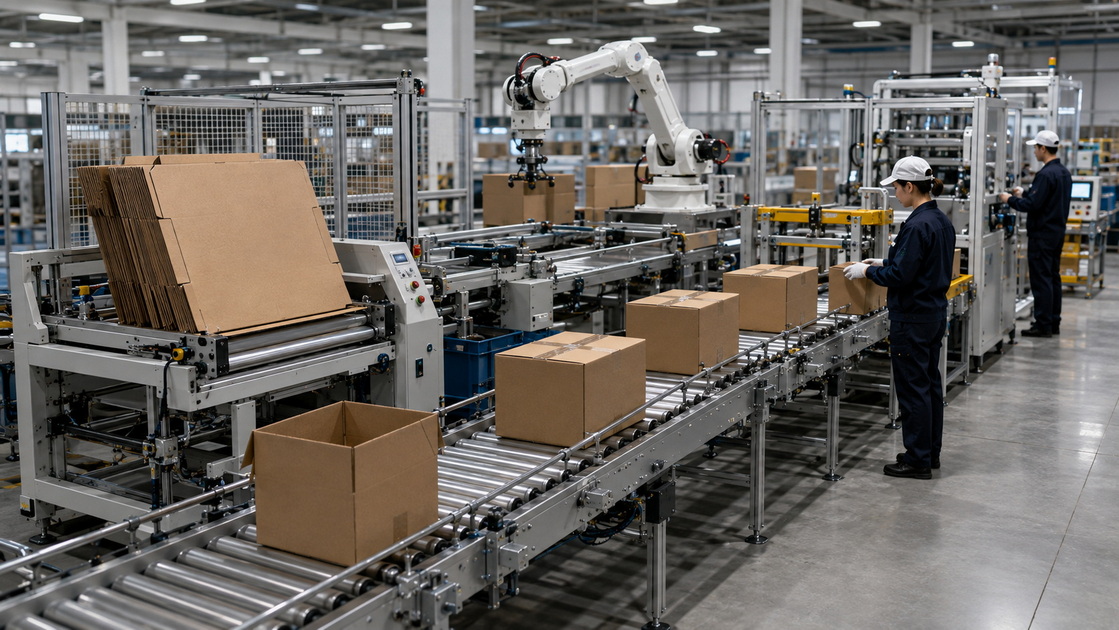
From an equipment perspective, sustainable paper packaging projects should validate:
- Material consistency: Caliper, moisture, stiffness, basis weight, and surface friction
- Feeding performance: Reliable separation and feeding of blanks, cartons, or paper rolls
- Folding quality: Stable scores, flap alignment, and crease performance
- Sealing method: Tape, water-activated tape, glue, tuck closure, or mechanical locking
- Throughput: Actual line speed, not only theoretical machine speed
- Changeover time: Ability to handle multiple box sizes and product configurations
- Waste rate: Reject levels, damaged blanks, misfeeds, and rework
- Product protection: Drop, vibration, compression, and transit validation
Before converting a complete line, run a controlled pilot.
1. Define the baseline
Measure current material consumption, package dimensions, labor hours, line speed, damage rate, and shipping cost.
2. Test the proposed paper format
Run real production samples at realistic speeds. Test multiple material batches, not just one ideal sample roll or carton lot.
3. Evaluate total system performance
Compare material savings, machine uptime, labor demand, packaging quality, transport efficiency, and product-damage outcomes.
This process prevents a common false economy: choosing a lower-cost "green" material that increases downtime, pack failure, or customer returns.
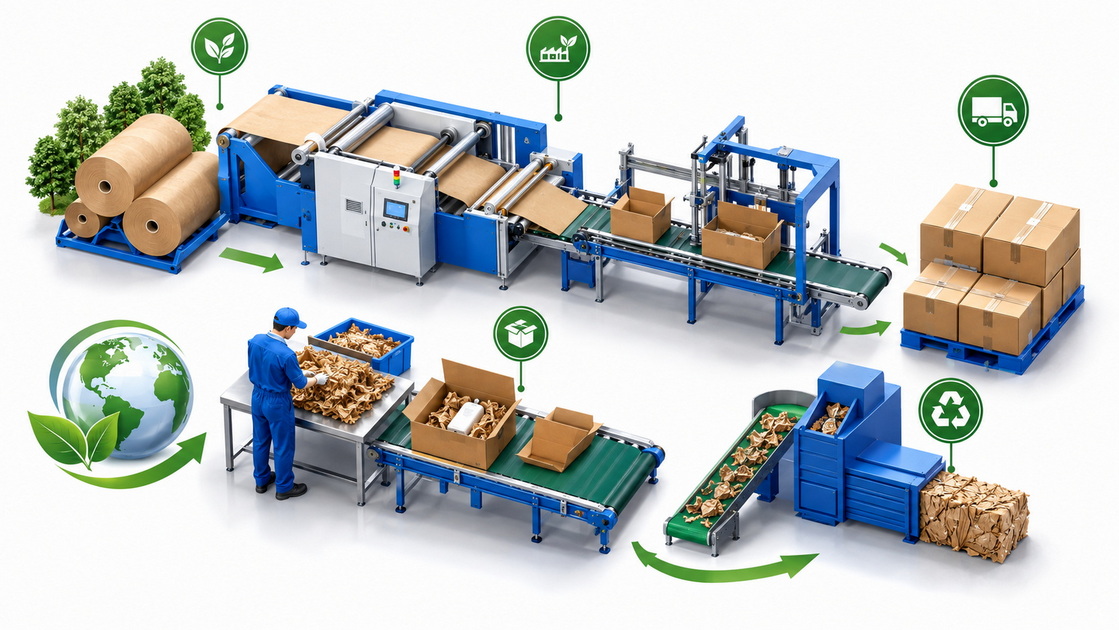
Use this checklist before approving a new paper packaging specification:
- Right-size the package to the product and distribution channel
- Confirm material sourcing and retain supplier documentation
- Specify recycled content where it supports performance requirements
- Minimize mixed materials and non-essential decorative components
- Test moisture, compression, drop, and vibration performance
- Check compatibility with your carton, wrapping, filling, or sealing equipment
- Validate actual machine throughput and reject rate
- Provide clear disposal guidance suitable for the target market
- Avoid unverified environmental claims
- Review the package annually as materials, regulations, and recycling infrastructure change
Sustainable packaging is not achieved by switching to paper alone. It is achieved by designing a packaging system that uses the right material, the right structure, and the right equipment for the product and distribution environment.
HLun Pack helps manufacturers and brand owners develop paper packaging equipment and integrated packaging solutions for corrugated cartons, paperboard packaging, paper protection systems, and automated end-of-line operations.
Contact our packaging specialists to discuss your product dimensions, output target, packaging material, and automation requirements. We can help you evaluate a paper packaging solution that improves efficiency, protects your products, and supports your sustainability objectives.
There is no single best option for every application. Corrugated cardboard is often effective for shipping, kraft paper works well for wrapping and void fill, molded pulp suits protective inserts, and paperboard is appropriate for retail cartons. The best choice is the one that protects the product with the least material and fits real recycling infrastructure.
No. Recyclability depends on the full package structure. Heavy coatings, laminated films, food contamination, adhesives, foil layers, and local collection capabilities can all affect whether a paper package is accepted and successfully recovered.
No. FSC certification relates to responsible forest management and traceable fiber sourcing. It does not by itself confirm recyclability, compostability, recycled content, or the availability of local collection systems.
Not always. Paper packaging may not provide enough moisture, oxygen, grease, or puncture resistance for every product. The right approach is to evaluate protection requirements first and then reduce unnecessary plastic or choose the simplest functional material structure.
Automated packaging machinery can support sustainability by improving carton right-sizing, reducing material waste, increasing packing consistency, lowering reject rates, optimizing paper cushioning use, and reducing unnecessary labor-intensive handling.
Test product protection, material strength, moisture response, print and appearance quality, equipment feeding reliability, line speed, sealing performance, reject rate, transport damage, and end-user opening experience.
1. U.S. Environmental Protection Agency. "Sustainable Packaging." Explains that packaging design can reduce environmental impacts through material efficiency and source reduction. Available at: [EPA Sustainable Packaging]. [epa]
2. Eurostat. "Packaging Waste Statistics." Reports that the EU generated 79.7 million tonnes of packaging waste in 2023 and presents material-specific packaging waste and recycling data. Available at: [Eurostat Packaging Waste Statistics]. [ec.europa]
3. U.S. Environmental Protection Agency. "Paper and Paperboard: Material-Specific Data." Provides U.S. material-generation and recycling data, including historical corrugated box recycling figures. Available at: [EPA Paper and Paperboard Data]. [epa]
4. Sustainable Packaging Coalition. "Packaging Design." Provides guidance on a whole-system approach to sustainable packaging design, including reduction, sourcing, transport efficiency, and material health. Available at: [Sustainable Packaging Coalition Packaging Design]. [sustainablepackaging]
5. Forest Stewardship Council. "Paper & Packaging." Explains FSC's packaging-related services and the role of responsible forest management claims in paper and packaging supply chains. Available at: [FSC Paper & Packaging]. [fsc]
6. European Commission. "Packaging Waste." Outlines the EU packaging-waste challenge and reports per-capita packaging-waste generation. Available at: [European Commission Packaging Waste]. [environment.ec.europa]


