


close
Choose Your Site
Global
Social Media
Views: 278 Author: HLun PACK Publish Time: 2026-08-15 Origin: Site


Content Menu
● What Is a Zipper Stand Up Pouch?
● Zipper Stand Up Pouch vs Heat Seal Pouch: Quick Comparison
● Key Differences That Affect Your Decision
>> 1. Resealability and Consumer Experience
>> 2. Shelf Impact and Brand Communication
>> 3. Freshness, Barrier, and Seal Integrity
>> 4. Production Speed and Packaging Equipment
● Cost Comparison: Look Beyond the Pouch Price
● Sustainability and Material Selection
● How to Choose the Right Pouch: A Practical Checklist
● FAQ
>> 1. Can a zipper stand up pouch also be heat sealed?
>> 2. Is a heat seal pouch better for freshness?
>> 3. Are zipper stand up pouches more expensive?
>> 4. What products are best for heat seal pouches?
>> 5. Can recyclable materials be used for zipper pouches?
>> 6. What should be tested before launching a pouch?
Choosing between a zipper stand up pouch and a heat seal pouch is not simply a choice between two bag styles. It is a decision that affects product freshness, consumer convenience, retail visibility, production speed, packaging cost, and the equipment needed to run your line.
For brands sourcing flexible packaging and packaging machinery, the most important clarification is this: a zipper stand up pouch can also use heat sealing. The real comparison is usually between a resealable, gusseted stand-up format and a simpler pouch that is permanently heat sealed after filling. The correct solution depends on your product, sales channel, shelf-life target, and operating model.
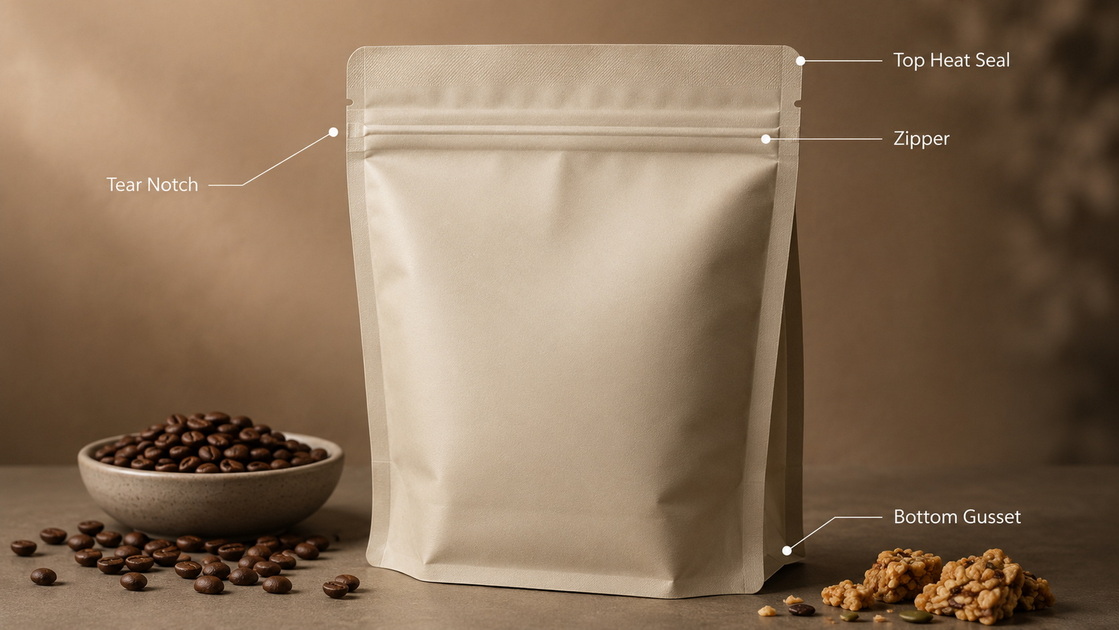
A zipper stand up pouch is a flexible package with a bottom gusset that expands as the pouch is filled, enabling it to stand upright on a shelf. It normally includes a press-to-close zipper that lets consumers open and reclose the package multiple times.
This pouch format is widely used for coffee, tea, snacks, pet treats, dried fruit, protein powder, nutritional products, detergents, and other products consumed over several uses. Its vertical shape gives brands a larger front-facing panel for graphics, product messaging, certifications, and QR codes.
The package may also include:
- Tear notches for easy first opening
- Top heat seals to provide tamper evidence before first use
- Clear windows to show the product
- Degassing valves for roasted coffee
- Hang holes for retail display
- Matte, glossy, soft-touch, or metallized finishes
- High-barrier film structures for moisture, oxygen, light, or aroma protection
A zipper can improve post-opening convenience, but it is not automatically a barrier solution. Barrier performance depends primarily on the selected film structure, sealant layer, product characteristics, and seal quality—not on whether the pouch has a zipper. Proper calibration of temperature, pressure, and dwell time remains essential for reliable pouch seals.
A heat seal pouch is closed by applying controlled heat, pressure, and dwell time to compatible sealant layers. The resulting thermal bond can create a permanent closure that the consumer opens by tearing, cutting, or pulling apart at a designated opening feature.
In the market, "heat seal pouch" often refers to a flat pouch, three-side-seal pouch, four-side-seal pouch, sachet, or stick pack with no resealable zipper. These pouches are typically filled through an open edge and sealed as the final packaging step.
Heat seal pouches are especially suitable for:
- Single-serve products, such as sauces, seasonings, samples, and beverage powders
- High-volume food, pharmaceutical, cosmetic, or industrial consumables
- Products intended to be used all at once
- Cost-sensitive packaging programs
- Lightweight products that need efficient storage and shipment
- Promotional sample packs and e-commerce inserts
For products that need a robust permanent closure, heat sealing is a proven production method. U.S. military pouch specifications, for example, specify heat-seal width and seal-strength requirements for certain flexible food pouch applications, illustrating how seal performance can be defined and verified for demanding uses.
| Comparison Factor | Zipper Stand Up Pouch | Heat Seal Pouch |
|---|---|---|
| Primary format | Gusseted pouch designed to stand upright | Often a flat, three-side, four-side, or sachet format |
| Closure | Resealable zipper, usually plus an initial top seal | Permanent thermal seal |
| Consumer use | Multi-use products | Single-use or portion-controlled products |
| Shelf presence | Strong, vertical “billboard” display | More limited unless hung or placed in a carton |
| Unit cost | Usually higher | Usually lower |
| Material use | More complex due to gusset and zipper | Often simpler and more material-efficient |
| Filling-line complexity | Requires zipper alignment and pouch handling control | Generally simpler to fill and seal |
| Shipping efficiency | Ships flat before filling, but may be bulkier after filling | Very compact and stackable |
| Tamper evidence | Often created by the heat seal above the zipper | Inherent when the permanent seal must be torn open |
| Best examples | Coffee, pet food, snacks, supplements, dry goods | Sachets, samples, condiments, powders, medical items |
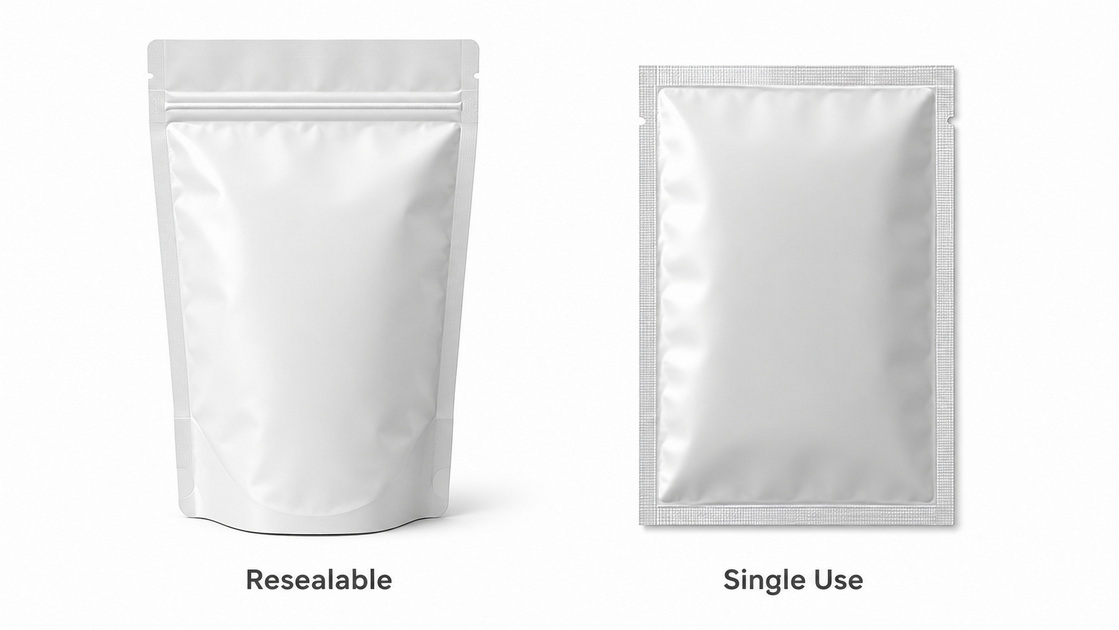
The comparison shows why a zipper stand up pouch is typically selected for value-added retail products, while a heat seal pouch is often the efficient choice for portion packs or high-volume products. Flat pouches generally cost less because they use a simpler structure without a bottom gusset and the additional forming steps required by stand-up formats.
The most visible advantage of a zipper stand up pouch is repeat usability. Consumers can open the pouch, remove a portion, and close it again without transferring the product into another container.
This is valuable for products where freshness after opening matters. Examples include granola, nuts, pet treats, powdered supplements, dried foods, and cleaning tablets. A zipper also makes the package feel more premium and can reduce consumer frustration caused by clips, rubber bands, or torn openings.
A standard heat seal pouch does not provide the same reclose function. Once opened, it is generally intended to be consumed, disposed of, or stored using a secondary closure. That limitation is not necessarily negative. For single-dose, single-serve, or sample applications, resealability may add cost without adding meaningful value.
A zipper stand up pouch offers superior shelf visibility because its bottom gusset supports an upright presentation. The front and back panels create more usable space for product storytelling, ingredients, instructions, claims, certifications, and branding.
This format works especially well when consumers compare multiple competing products at retail. A well-designed pouch can communicate quality before the shopper picks it up.
By contrast, heat seal pouches are commonly laid flat, displayed in cartons, placed in display trays, or hung using a header hole. They can still look professional, but their branding area and shelf presence are usually more limited.
For e-commerce products, the decision may be different. If the pouch is delivered directly to a consumer rather than displayed on a physical shelf, the added cost of a stand-up format should be weighed against unboxing experience, product protection, and repeat use.
It is a common mistake to assume that a heat seal pouch always protects products better than a zipper stand up pouch. In reality, package performance depends on the full packaging system.
A strong flexible packaging specification should consider:
- Product sensitivity to oxygen, moisture, light, aroma loss, or contamination
- Required shelf life
- Film construction and barrier layer selection
- Sealant compatibility
- Filling temperature and product contamination in the seal area
- Seal width, seal temperature, pressure, and dwell time
- Distribution conditions, including drops, compression, and temperature variation
A zipper pouch can provide strong protection when paired with an appropriate high-barrier laminate and a top heat seal above the zipper. The top seal provides first-open tamper evidence; the zipper supports resealing after purchase.
For heat seal pouches, the permanent seal is a core performance point. ASTM F88/F88M covers measurement of seal strength in flexible barrier materials and helps identify how a seal fails, making it a valuable quality-control reference for pouch converters and packers.
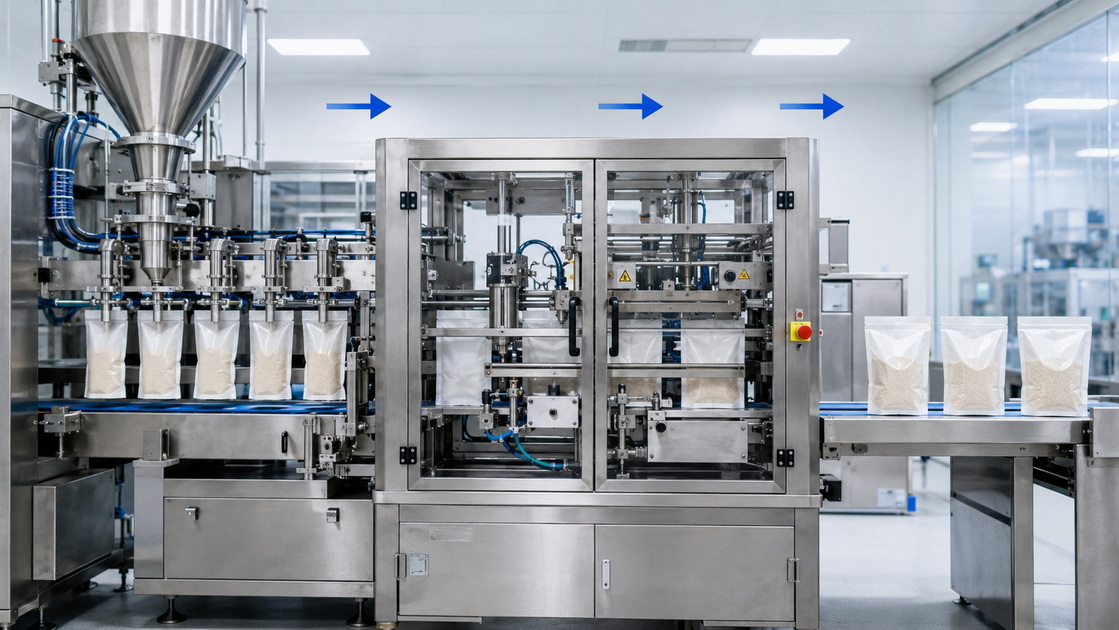
Heat seal pouches generally support simpler, faster operations, particularly for sachets, flat pouches, and high-volume filling lines. The machinery focuses on opening the pouch, dosing the product, removing air where necessary, and creating a final seal.
Zipper stand up pouches need additional mechanical control. The zipper must be correctly positioned, the gusset needs to open consistently, and the pouch must remain properly aligned during filling and sealing. Poor alignment can cause wrinkled seals, zipper deformation, contamination in the seal zone, or inconsistent pouch appearance.
From an equipment perspective, brands should evaluate:
1. Required output per minute
2. Product type: powder, granule, liquid, paste, solid, or irregular piece
3. Existing pouch dimensions and film tolerances
4. Zipper type and opening force
5. Required nitrogen flushing or vacuum function
6. Changeover frequency between SKUs
7. In-line inspection needs, such as metal detection, checkweighing, vision inspection, or leak testing
At HLun Pack, the ideal solution is not just a pouch recommendation. It is the alignment of pouch structure, filling process, sealing method, automation level, and quality-control requirements into one integrated packaging solution.
A heat seal pouch typically has a lower initial unit cost because it uses a simpler structure and does not require a zipper component. It may also run faster and occupy less warehouse space.
However, the lowest pouch price is not always the lowest total packaging cost. A zipper stand up pouch may justify its higher cost when it improves product positioning, increases perceived value, reduces product waste after opening, or supports a larger retail pack size.
Use this cost framework:
| Cost Area | Zipper Stand Up Pouch | Heat Seal Pouch |
|---|---|---|
| Packaging material | Higher | Lower |
| Machinery complexity | Medium to high | Low to medium |
| Retail merchandising value | High | Moderate |
| Product waste after opening | Potentially lower | Potentially higher for multi-use goods |
| Suitable order size | Medium to large, depending on pouch supply | Small to very large |
| Logistics efficiency | Good | Excellent |
For a 30 g seasoning sachet, a zipper is usually unnecessary. For a 500 g pet treat pouch expected to remain open in a home for weeks, a zipper can materially improve the customer experience.
Sustainability should be evaluated through the actual package design, not through format labels alone. Both zipper stand up pouches and heat seal pouches can be developed with lower-material-use designs, mono-material structures where technically appropriate, recycled-content options where regulations and product requirements allow, or downgauged films.
The 2026 sustainable packaging conversation emphasizes reduction, reuse, material substitution, improved recycling, and lower-emission plastics rather than relying on one universal solution. For flexible packaging, the practical challenge is balancing recyclability goals with barrier, sealing, food-contact, and machineability requirements.
A simple heat seal pouch may have an advantage when it uses fewer components. On the other hand, a resealable pouch may reduce household food waste for products used over time. The right environmental choice should be based on a life-cycle-oriented evaluation of product waste, pouch weight, transport efficiency, end-of-life infrastructure, and real consumer behavior.
For food applications entering the U.S. market, food-contact substances must be authorized for their intended use when required under federal law. Brands should verify the compliance status of every relevant film, ink, adhesive, coating, and sealant component rather than assuming a finished pouch is automatically compliant.
Choose a zipper stand up pouch when your product:
- Is consumed over multiple occasions
- Needs stronger retail shelf visibility
- Benefits from a premium or convenient positioning
- Requires a larger front panel for branding
- Is dry, granular, or solid and can be resealed effectively
- Can support the additional material and machinery investment
Choose a heat seal pouch when your product:
- Is single-use, sample-size, or portion controlled
- Requires high-volume, efficient packing
- Has strong cost constraints
- Will be displayed in a carton, tray, or shipping box
- Does not benefit from resealability
- Needs a compact pouch format for shipping or kit assembly
Before finalizing the specification, conduct a packaging trial using the actual product. Test sealing performance, pouch opening behavior, zipper function, drop resistance, compression resistance, leakage, shelf-life performance, and visual quality. A pouch that looks correct on a drawing can still fail if the material and equipment settings are not validated together.
The best choice in the zipper stand up pouch vs heat seal pouch debate depends on what the customer does after opening the package. If the product will be used repeatedly, a zipper stand up pouch usually delivers better convenience, stronger shelf appeal, and higher perceived value. If the product is consumed once or must run at high speed with tight cost control, a heat seal pouch is often the more efficient choice.
HLun Pack can help brands evaluate pouch format, film structure, closure type, filling machinery, sealing technology, and quality-control requirements as one system—not as separate purchasing decisions. Contact our packaging team to discuss your product, target market, pouch dimensions, output requirement, and desired shelf life, and we can help develop a flexible packaging solution tailored to your line.

Yes. Most zipper stand up pouches use a heat seal above the zipper before sale. The consumer tears open this sealed area for first access, then uses the zipper to reclose the package.
Not automatically. Freshness depends on the barrier film, seal quality, product type, and storage environment. A high-barrier zipper pouch with a properly sealed top can protect products very effectively.
Usually, yes. The bottom gusset, zipper, and more complex converting process often increase material and production costs. However, they can create commercial value through improved convenience, retail visibility, and premium positioning.
Heat seal pouches are ideal for single-use powders, sauces, condiments, samples, supplements, cosmetics, medical products, and other products that do not need to be resealed after opening.
Yes, in suitable applications. Recyclable or mono-material-oriented zipper pouch designs are increasingly available, but their barrier performance, sealing window, local recycling compatibility, and product requirements must be assessed carefully.
Test seal strength, leak resistance, drop performance, zipper operation, opening force, print durability, product compatibility, shelf life, and machine performance. ASTM F88/F88M is one recognized method for measuring flexible-package seal strength.
3. [Defense Logistics Agency — Stand Up Pouch Quality Assurance Provisions]
4. [Sustainable Packaging Coalition — 2026 Sustainable Packaging Trends Report]
5. [Red Dot Packaging — What Is a Stand Up Pouch, and When Should You Use One?]
6. [CarePac — Stand-Up Pouch vs. Flat Pouch vs. 3-Side Seal Pouch]


