


close
Choose Your Site
Global
Social Media
Views: 236 Author: HLun PACK Publish Time: 2026-08-17 Origin: Site


Content Menu
● What Is Packaging Equipment?
● What Is a Packaging Machine?
● Packaging Equipment vs. Packaging Machine: Core Differences
● Where Packaging Machines Fit in a Packaging Line
>> 1. Product Preparation and Feeding
● How to Choose: Machine or Complete Equipment System?
>> Choose a Standalone Packaging Machine When:
>> Choose an Integrated Packaging Equipment System When:
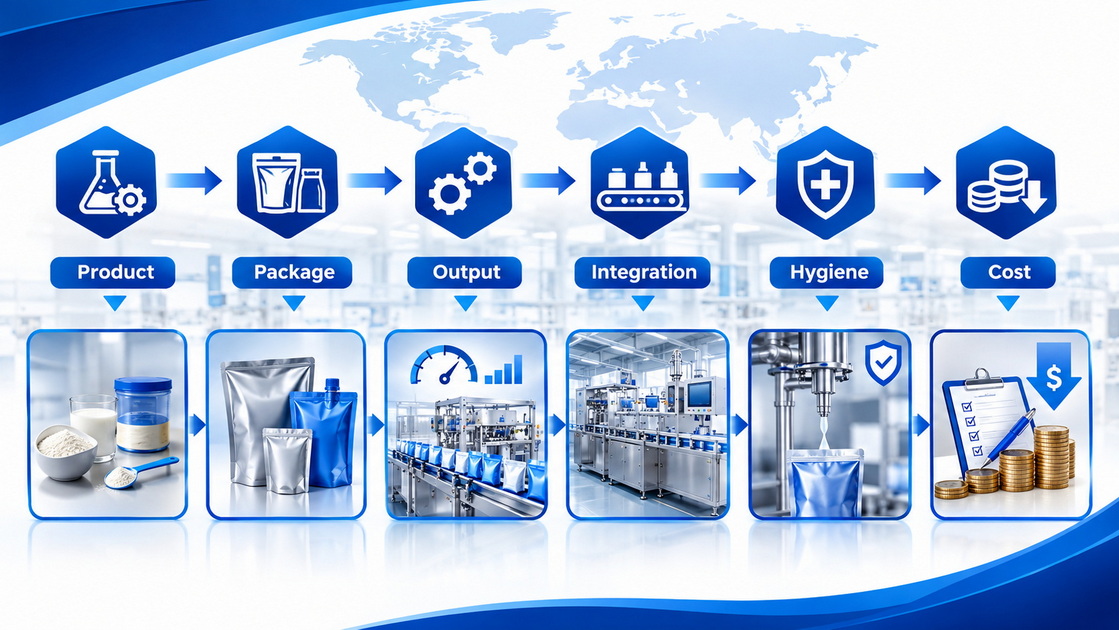
● A Practical Selection Framework for Packaging Projects
>> 1. Define the Product Characteristics
>> 2. Confirm the Packaging Format
>> 3. Set a Realistic Production Target
>> 4. Evaluate Integration Requirements
>> 5. Assess Hygiene, Cleaning, and Compliance
>> 6. Calculate Total Cost of Ownership
● Design for Changeovers, Not Only Speed
● Common Mistakes When Buying Packaging Equipment
>> 1. What is the main difference between packaging equipment and a packaging machine?
>> 2. What packaging machine is best for powder products?
>> 3. Which machine is suitable for granular products?
>> 4. Can one packaging machine handle different bag sizes?
>> 5. What information should I provide to a packaging equipment manufacturer?
>> 6. Is a fully automated packaging line always better?
Packaging equipment and a packaging machine are closely related terms, but they are not interchangeable. A packaging machine is typically one task-focused unit—such as a filler, sealer, or labeler—while packaging equipment refers to the wider system of machines, conveyors, controls, and support components that move a product from bulk material to shipment-ready package.
For manufacturers packing paper products, flexible pouches, granules, liquids, or powders, understanding this difference is essential. The right decision affects production capacity, product quality, labor requirements, hygiene control, changeover time, maintenance costs, and your ability to scale.

Packaging equipment is the complete collection of tools, machinery, systems, and auxiliary devices used throughout a packaging operation. It can include a standalone machine, but more often refers to an integrated packaging line.
A typical packaging equipment system may cover:
- Product feeding, sorting, and conveying
- Weighing, dosing, and filling
- Bag making, pouch forming, sealing, and cutting
- Coding, labeling, and date printing
- Inspection, checkweighing, and metal detection
- Cartoning, case packing, and palletizing
- Automation controls, safety systems, and data collection
In practical terms, packaging equipment is the production ecosystem. It is designed to coordinate multiple packaging stages so materials move reliably from one process to the next.
For example, a powder packaging line may include a screw feeder, auger filler, vertical form-fill-seal machine, nitrogen flushing system, checkweigher, metal detector, conveyor, carton packer, and palletizer. Each component has a different role, but together they form one packaging equipment solution.
A packaging machine is an individual unit that performs one specific packaging function or a limited group of related functions.
Common examples include:
- Liquid filling machines
- Granule packing machines
- Powder filling machines
- Vertical form-fill-seal (VFFS) machines
- Horizontal flow wrappers
- Premade pouch packing machines
- Vacuum packaging machines
- Labeling machines
- Cartoning machines
- Shrink wrapping machines
A packaging machine can work independently or become part of a larger automated system. For example, a small food producer may purchase one semi-automatic liquid filling machine to fill bottles manually. As demand grows, that same business may add capping, labeling, coding, conveyor, and case-packing equipment to create a more integrated line.
The key distinction is simple:
- A packaging machine performs a defined job.
- Packaging equipment describes the broader system that supports the full packaging workflow.
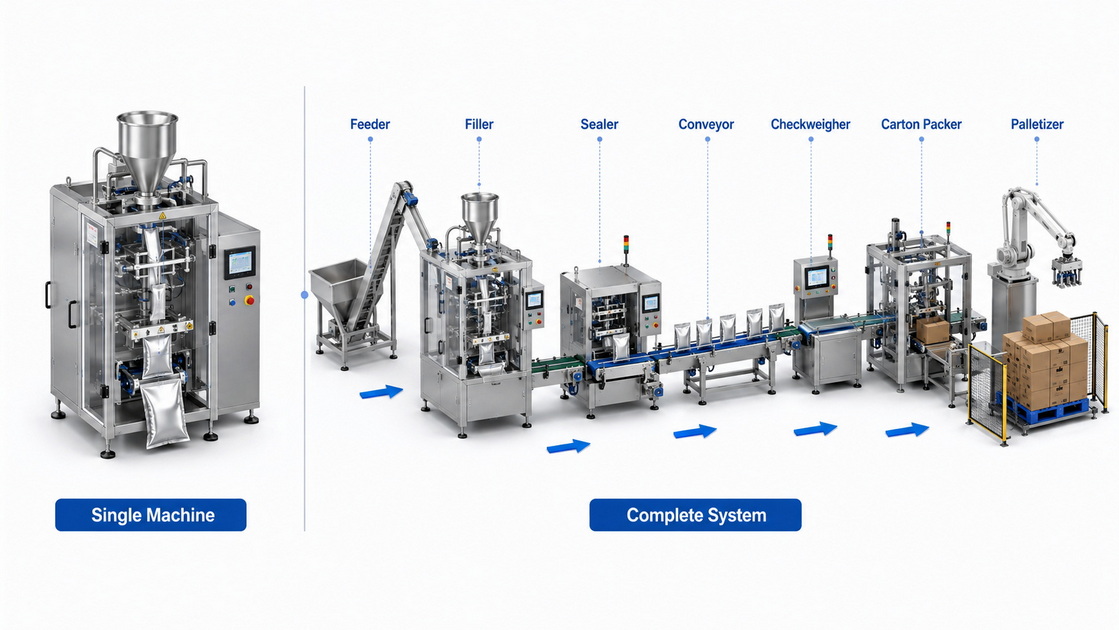
| Factor | Packaging Equipment | Packaging Machine |
|---|---|---|
| Scope | A complete packaging system or line | A single machine or functional unit |
| Main role | Connects and supports multiple packaging stages | Performs a specific packaging task |
| Typical components | Machines, conveyors, controls, inspection systems, auxiliaries | Filler, sealer, wrapper, labeler, cartoner, etc. |
| Investment level | Often higher because it includes integration and automation | Usually lower for a standalone unit |
| Scalability | Designed for line expansion and coordinated production | Can be added, replaced, or upgraded individually |
| Example | A powder filling, sealing, inspection, cartoning, and palletizing line | An auger filler or VFFS machine |
A useful analogy is to compare a packaging line with a kitchen. The packaging equipment is the complete kitchen: appliances, counters, storage, workflow, ventilation, and staff processes. A packaging machine is one appliance, such as an oven or mixer.
Most packaging operations have several stages. The correct equipment configuration depends on your product, package format, required output, hygiene standards, and downstream logistics.
Before filling begins, products must be supplied consistently. This may involve hoppers, elevators, vibratory feeders, screw conveyors, liquid tanks, pumps, or product sorting systems.
For example:
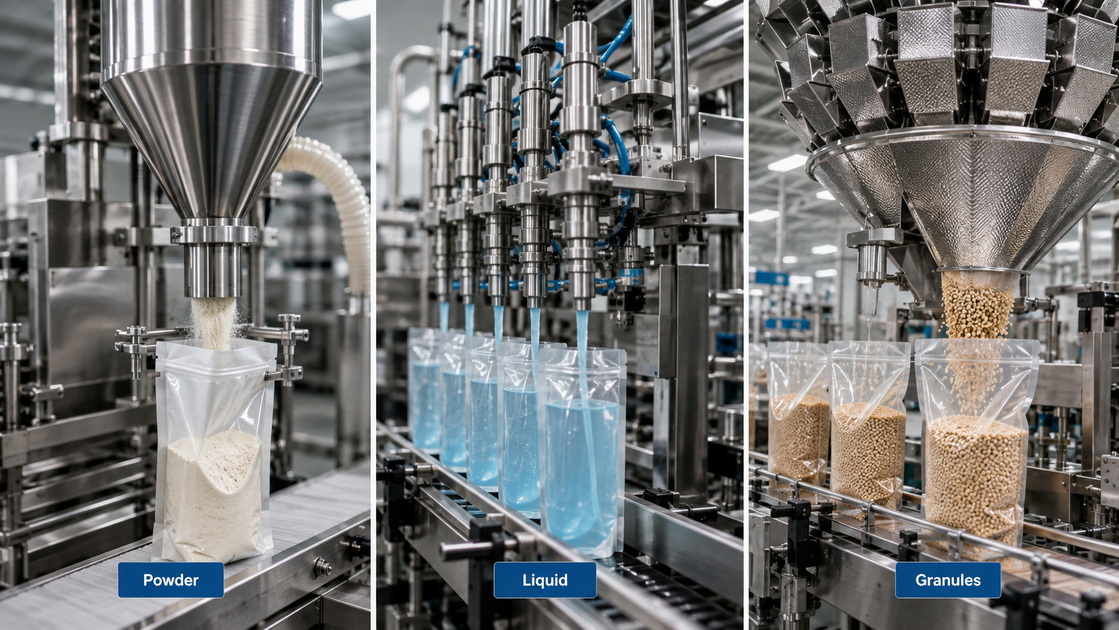
- Granules may require vibratory feeders, multihead weighers, or cup fillers
- Powders often require screw feeders, auger systems, dust collection, and anti-bridging designs
- Liquids may need tanks, pumps, agitation, heating, or temperature control
- Paper packaging products may require automatic feeding, stacking, folding, or counting systems
Primary packaging is the layer directly holding or protecting the product. This is where most packaging machines operate.
Typical primary packaging tasks include:
- Filling liquid into bottles, sachets, or pouches
- Dosing powder into bags, jars, or stick packs
- Weighing granules into flexible bags
- Forming film into pouches
- Sealing paper bags or flexible packages
- Vacuum sealing or nitrogen flushing
For flexible packaging, VFFS machines are widely used because they can form a bag from rollstock film, fill it with product, and seal it in one continuous process.
Secondary packaging groups finished units for storage, retail display, or transport. It may include cartons, boxes, shrink bundles, trays, and multipacks.
Relevant equipment includes:
- Cartoning machines
- Case packers
- Shrink wrapping machines
- Tray formers
- Case sealers
- Labeling and coding systems
End-of-line equipment prepares products for warehousing and shipment.
Common solutions include:
- Checkweighers
- Metal detectors
- Vision inspection systems
- Case erectors
- Palletizers
- Stretch wrappers
- Warehouse conveyor systems
This stage is increasingly important because packaging buyers want better traceability, lower labor dependence, and more consistent shipment quality. PMMI identifies automation, workforce constraints, aftermarket service, and operator-free systems as major packaging-industry considerations.
The correct choice depends less on terminology and more on your production reality. A single machine may be the best starting point for a new product. A fully integrated packaging equipment solution may be more appropriate when output, labor, traceability, or consistency become critical.
- You have one clearly defined bottleneck, such as manual filling or sealing
- Your production volume is relatively low or variable
- You need a lower initial investment
- Your current process has sufficient manual labor capacity
- You are testing a new package format or product category
- You need to replace one outdated unit in an existing line
For instance, a spice producer with manual weighing may install an auger powder filling machine first. This can improve dosing consistency without immediately requiring a full automated packaging line.
- You need stable, high-volume production
- Multiple manual handling steps create errors or delays
- You require synchronized filling, sealing, coding, inspection, and cartoning
- Labor shortages affect output or operating costs
- You need better traceability and production data
- You expect future expansion in product formats or capacity
- Your products require stricter hygiene and contamination control
Automation and robotics are expanding across packaging lines, particularly in case packing, palletizing, and pick-and-place applications, as manufacturers seek to improve throughput and reduce dependence on manual labor.
A packaging machine should not be selected only from a product photo or theoretical speed rating. The best solution is based on real operating conditions.
Use this six-step evaluation process before investing.
Start with the product itself. Packaging performance depends on physical behavior, not only product category.
Evaluate:
- Particle size, density, and flowability for granules
- Dust generation, bridging risk, and moisture sensitivity for powders
- Viscosity, foaming, temperature, and particulates for liquids
- Dimensions, weight, fragility, and surface condition for solid products
- Oxygen, moisture, light, and contamination sensitivity
A free-flowing sugar product, for example, requires very different dosing technology than a sticky milk powder or an irregular snack mix.
Specify the package you want to produce:
- Pillow bag
- Gusset bag
- Quad seal bag
- Doypack or stand-up pouch
- Sachet
- Stick pack
- Bottle
- Jar
- Paper bag
- Carton or shipping case
For flexible packaging, also confirm the film structure, width, thickness, sealing layer, printing registration, and required sealing strength. These details influence machine configuration and long-term operating reliability.
Do not choose equipment based only on maximum cycles per minute. Instead, calculate the output required during normal operation.
Ask:
- How many units must be produced per shift?
- How many shifts will the line operate?
- What is the planned package size range?
- How often will changeovers occur?
- What downtime should be expected for cleaning, film changes, or maintenance?
- What reject rate is acceptable?
A machine rated at 60 bags per minute may not deliver 60 saleable bags per minute after accounting for product feeding, changeovers, inspections, and stoppages.
A packaging machine is only as effective as the upstream and downstream process around it.
Consider whether you need:
- Automatic product feeding
- Conveyor synchronization
- Date coding and batch traceability
- Checkweighing
- Metal detection
- Nitrogen flushing
- Dust extraction
- Cartoning or case packing
- Palletizing
- Remote diagnostics or production data collection
This is where a packaging equipment supplier should provide more than a machine quotation. They should help map the complete material flow.
For food, pharmaceutical, chemical, and sensitive consumer goods, hygienic design cannot be an afterthought. Equipment should be accessible for cleaning, suitable for the intended product, and designed to reduce contamination risks.
FDA current good manufacturing practice regulations establish minimum requirements for the methods, facilities, and controls used to manufacture, process, and pack drug products. In food and packaging supply chains, the revised ISO 22002 series also emphasizes equipment maintenance, hygiene design, cleaning and disinfection practices, and waste management.
Ask equipment suppliers about:
- Product-contact material specifications
- Cleaning access and tool-free removal
- Dust control and sealed transfer points
- Clean-in-place or washdown requirements
- Surface finish and dead-zone prevention
- Maintenance records and calibration support
- Safety guarding and emergency-stop design
The purchase price is important, but it is not the full cost of a packaging solution.
Compare:
- Initial machine price
- Installation and commissioning
- Change parts and tooling
- Energy and compressed-air consumption
- Film or packaging-material waste
- Labor requirements
- Spare parts availability
- Preventive maintenance needs
- Training requirements
- Expected uptime and production losses
The lowest-priced packaging machine may cost more over time if it creates frequent stoppages, excessive material waste, or difficult maintenance.
One of the most overlooked buying criteria is changeover efficiency. Many manufacturers focus on peak speed but underestimate the cost of switching between package sizes, film types, weights, or products.
For businesses with multiple SKUs, a slightly lower maximum speed may deliver better total daily output if the machine offers:
- Recipe-based settings
- Quick-release change parts
- Servo-controlled adjustments
- Repeatable film tracking
- Clear operator instructions
- Easy-clean product-contact areas
- Fast access for maintenance
For example, if a line runs five different pouch sizes each day, reducing each changeover by 20 minutes can recover more than 100 minutes of productive capacity per shift. That benefit may matter more than a small increase in theoretical machine speed.
Avoid these frequent problems:
- Selecting a machine before testing the actual product and packaging material
- Choosing only by speed instead of stable output
- Ignoring upstream feeding and downstream handling
- Underestimating powder dust, product bridging, foaming, or leakage risks
- Forgetting future package sizes and product variations
- Comparing quotations without checking included components
- Neglecting spare parts, remote support, training, and commissioning
- Treating hygiene design as an optional upgrade rather than a core requirement
A strong supplier should ask detailed questions before recommending a solution. If the conversation starts and ends with "How many bags per minute?", the design process is incomplete.
At HLun Pack, we understand that packaging performance depends on the entire process—not only the filling or sealing machine. We provide packaging machinery and integrated packaging solutions for:
- Paper packaging applications
- Flexible packaging applications
- Granular packaging equipment
- Liquid packaging equipment
- Powder packaging equipment
Our approach begins with your product behavior, target packaging format, production capacity, plant layout, and future expansion needs. From standalone equipment to integrated packaging lines, we help manufacturers select practical solutions that support reliable operation, scalable automation, and consistent package quality.
Need help selecting the right packaging machine or designing a complete packaging line? Contact HLun Pack with your product details, bag or container dimensions, target output, and sample packaging materials. Our team can help you develop a tailored packaging solution.
A packaging machine is an individual unit designed for a specific task, such as filling, sealing, wrapping, or labeling. Packaging equipment is the broader term for the complete system, including machines, conveyors, feeding systems, inspection equipment, controls, and end-of-line solutions.
The best powder packaging machine depends on powder flowability, dust level, target weight, package format, and required output. Auger filling systems are commonly used for powders because they can provide controlled volumetric dosing. Products with poor flow characteristics may also need agitation, anti-bridging devices, dust extraction, or specialized feeding systems.
Granular products may use cup fillers, linear weighers, multihead weighers, or VFFS systems. The correct choice depends on particle consistency, target accuracy, product fragility, speed requirements, and bag style.
Many modern packaging machines can handle multiple bag sizes, but they may require adjustments, change parts, or format-specific settings. Before purchasing, confirm the supported width, length, filling volume, film specifications, and expected changeover time for every SKU.
Provide product samples or detailed product characteristics, target package type, bag or container dimensions, fill weight or volume, desired speed, packaging material specifications, factory layout, power supply, and any special requirements such as nitrogen flushing, date coding, weighing, or metal detection.
Not always. A fully automated line is usually beneficial for stable, high-volume production and labor-intensive processes. However, a standalone or semi-automatic machine may be more cost-effective for smaller operations, frequent product changes, limited space, or early-stage product launches.
1. Pallas. "Packaging Equipment vs Packaging Machine Explained 2026." [Read the original article].
2. PMMI. "State of the Industry 2025." [View the PMMI report overview].
3. PMMI. "Building an AI Advantage in Packaging Equipment." [Read the report overview].
4. U.S. Food and Drug Administration. "Current Good Manufacturing Practice (CGMP) Regulations." [View FDA CGMP guidance].
5. Campden BRI. "Examining a Key Update to the ISO 22000 and FSSC 22000 Standards." [Read the ISO 22002 update].
6. PMMI. "AI, Automation, and Sustainability Lead Packaging and Processing Trends." [Read the industry announcement].


