


close
Choose Your Site
Global
Social Media
Views: 269 Author: HLun PACK Publish Time: 2026-09-12 Origin: Site


Content Menu
● What Are the Most Common Ziplock Bag Sizes?
● Why Ziplock Bag Dimensions Matter in B2B Packaging
● How to Measure a Ziplock Bag Correctly
>> Measure Width, Length, and Product Depth
>> Understand Nominal Size Versus Usable Size
● Ziplock Bag Thickness Explained: What Does "Mil" Mean?
>> How to Choose the Right Thickness
● Materials for Resealable Flexible Packaging
>> LDPE: Flexible and Widely Used
>> PE Blends and Heavy-Duty Films
>> Food-Contact Packaging Requires More Than a Label
● Custom Ziplock Bag Options for Brands and Manufacturers
>> Custom Size and Format Options
>> Printing and Brand Visibility
● A Practical Selection Checklist Before Ordering
● Flexible Packaging and Responsible Material Use
● Request a Custom Ziplock Bag Solution From HLun Pack
>> 1. What is the best ziplock bag size for small parts?
>> 2. How much larger should a ziplock bag be than the product?
>> 3. Is a thicker ziplock bag always better?
>> 4. What is the difference between a flat bag and a gusseted zipper bag?
>> 5. Can ziplock bags be customized with a logo and product information?
>> 6. Are ziplock bags suitable for food packaging?
>> 7. Can HLun Pack provide packaging equipment as well as flexible packaging?
Choosing the right ziplock bag size is not simply a purchasing detail. For food brands, apparel sellers, electronics suppliers, hardware distributors, and industrial manufacturers, the right resealable bag affects product protection, packing speed, shipping efficiency, consumer experience, and total packaging cost.
At HLun Pack, we work with flexible packaging projects where a bag that appears "close enough" on paper can create real operational problems: products may not fit below the zipper, excess empty space can make a retail pack look low-value, and inadequate film thickness can lead to punctures during transport. This expert guide explains how to select the right ziplock bag dimensions, film thickness, material structure, and custom features for commercial packaging applications.
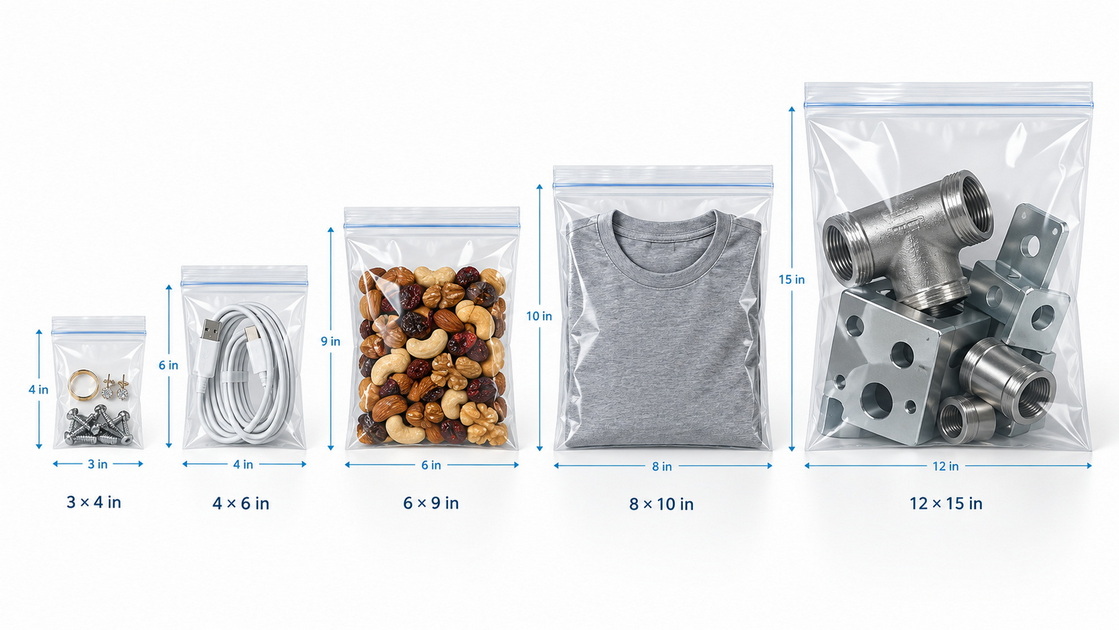
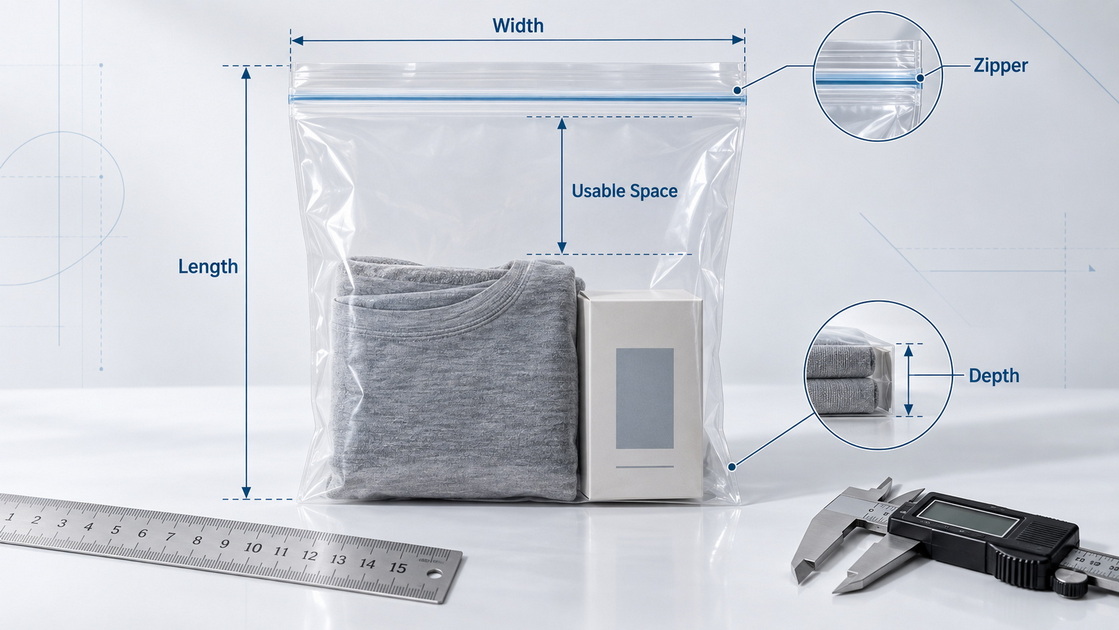
Standard ziplock bags are usually measured by width × length, such as 4 × 6 inches or 8 × 10 inches. Width is measured across the bag opening, while length is measured from the top edge to the bottom seal.
However, buyers should not assume that the listed bag length equals the fully usable internal length. The zipper closure, top seal area, and bottom seal all reduce available packing space.
| Common Bag Type | Typical Outside Dimensions | Typical Commercial Uses |
|---|---|---|
| Mini / sample bag | 2 × 3 to 3 × 4 inches | Jewelry, beads, samples, screws, small electronic parts |
| Small zipper bag | 4 × 6 inches | Cables, accessories, cosmetics, small hardware |
| Medium zipper bag | 5 × 7 to 6 × 9 inches | Snacks, stationery, replacement parts, retail kits |
| Large zipper bag | 8 × 10 to 10 × 12 inches | Apparel, documents, larger accessories, food portions |
| Extra-large zipper bag | 12 × 15 to 15 × 20 inches or larger | Bulk components, textiles, warehouse storage, industrial products |
These dimensions are widely used starting points, but they should not replace a product-specific packaging test. A bag for a flat product such as a label set may need only a small clearance. A bag for a bulky item, irregular-shaped part, or folded garment often requires more room, a bottom gusset, or a wider side gusset.
A resealable bag has to do more than hold a product. In a professional packaging environment, it should support your production workflow and market positioning.
The correct ziplock bag dimensions can help you:
- Reduce wasted plastic film and unnecessary material cost
- Improve product presentation in retail displays and e-commerce fulfillment
- Prevent zipper strain caused by overfilling
- Reduce product movement, scuffing, and impact damage during shipping
- Improve warehouse organization through standardized pack sizes
- Make manual filling or automated packaging faster and more consistent
- Create a more premium, intentional unboxing experience
For example, a supplier packaging 100 small metal fittings in an oversized zipper bag may face excessive product movement and noise during transport. The parts can scratch one another, and the finished pack may look poorly controlled. A better solution may be a 4 × 6-inch heavy-duty zipper bag, or a small pouch with a reinforced zipper and a label panel for part numbers.
In contrast, a clothing exporter may need a larger clear bag that allows buyers to see the folded item, barcode label, size sticker, and care information without opening the package. In that case, a self-sealing garment bag with a suffocation warning, vent holes, and customized printing may be more appropriate than a conventional small ziplock pouch.
Before requesting a quotation, measure the product—not only the package you currently use. Existing packaging may be oversized, under-specified, or designed for a different distribution process.
Use a ruler, digital caliper, or tape measure to record:
1. Product width: Measure the widest point from side to side.
2. Product length or height: Measure the longest point from top to bottom.
3. Product thickness or depth: Measure the thickest point, especially for folded, stacked, or irregular products.
4. Clearance requirement: Add space for easy insertion, zipper closure, and product removal.
5. Header or labeling area: Reserve room if you need a hang hole, barcode, warning statement, or logo.
A practical rule is to leave sufficient clearance around the product rather than selecting the tightest possible bag. This is especially important for manual packing, because workers need space to insert the product efficiently without stretching the zipper or side seals.
A bag listed as 6 × 8 inches does not always provide a full 6 × 8 inches of usable storage area.
The usable internal space can be reduced by:
- The zipper profile and area above the zipper
- Top and bottom heat seals
- Side seals
- Curved or rounded product shapes
- Gusset folds
- Product thickness that consumes internal volume
For a flat item, a 6 × 8-inch bag may work well. For a three-dimensional product, it may be necessary to move up to a 7 × 9-inch bag or select a gusseted format.
A mil is one-thousandth of an inch: 1 mil = 0.001 inch, or approximately 0.0254 mm. Bag thickness is one of the most important specifications for choosing resealable packaging because it influences puncture resistance, tear resistance, stiffness, clarity, and cost.
ASTM D882 is a widely recognized test method used to evaluate tensile properties of thin plastic films and sheeting under 1.0 mm thick. This matters because thickness alone does not tell the entire performance story; film strength, elongation, material blend, seal quality, and product shape also affect real-world durability.
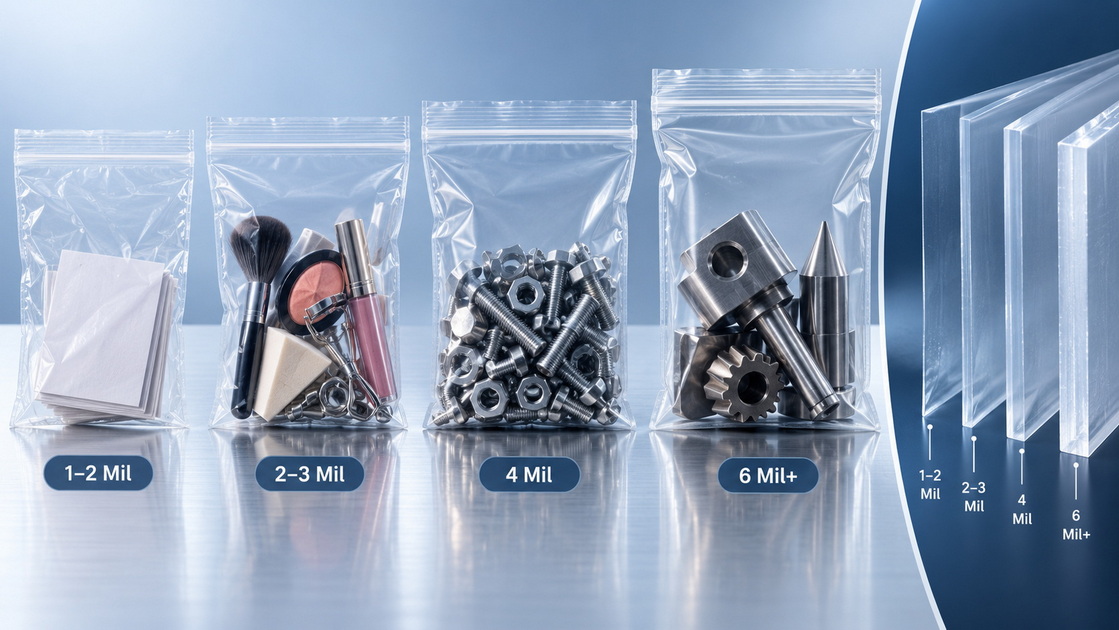
| Bag Thickness | Approximate Metric Thickness | Recommended Uses | Key Considerations |
|---|---|---|---|
| 1–2 mil | 0.025–0.051 mm | Lightweight samples, paper items, soft accessories | Economical but limited puncture protection |
| 2–3 mil | 0.051–0.076 mm | Retail accessories, food portions, stationery, general small parts | A common balance of flexibility and durability |
| 4 mil | About 0.102 mm | Hardware, tools, heavier retail products, repeated handling | Better resistance to tearing and rough handling |
| 6 mil and above | 0.152 mm and above | Sharp parts, industrial components, bulk items, demanding logistics | Higher durability but higher material cost and stiffness |
Use these product questions as a decision framework:
- Is the product sharp, pointed, or edged?
- Is the product heavy for its size?
- Will it be packed in bulk cartons and transported long distances?
- Does the customer need to open and reclose the bag repeatedly?
- Is the bag exposed to dust, moisture, oils, or warehouse handling?
- Does the product need a premium, rigid-feeling package?
- Is the bag designed for single use, retail display, or long-term storage?
For lightweight items, increasing thickness unnecessarily can raise cost without adding meaningful value. For sharp metal fasteners or irregular industrial components, selecting a thin bag can result in punctures, damaged cartons, lost parts, and customer complaints.
Many standard ziplock bags are made from polyethylene-based films. The material choice should be based on the product, use environment, sealing requirements, visual goals, and regulatory requirements.
Low-density polyethylene (LDPE) is commonly used for clear zipper bags because it is flexible, moisture-resistant, and easy to process. It is often suitable for general consumer, retail, and industrial applications.
LDPE bags are frequently selected for:
- Apparel and accessories
- Small parts and hardware
- Promotional kits
- Stationery and craft items
- General storage
- Non-retort food-related packaging applications, when the complete material structure is appropriate for the intended food-contact use
For more demanding applications, manufacturers may use adjusted polyethylene blends or stronger film structures. These can improve stiffness, puncture resistance, clarity, or performance at lower temperatures.
A heavy-duty bag should not be specified only as "thick." Ask the supplier about the complete performance requirement:
- Film thickness
- Seal strength
- Zipper durability
- Puncture resistance
- Transparency or haze
- Odor requirements
- Printing compatibility
- Temperature range during transport and storage
If a zipper bag will directly contact food, do not rely on a generic "food-grade" statement alone. In the United States, food-contact substances include components of food packaging and must be appropriately authorized for their intended use when required under federal law. The regulatory status depends on the individual substances used in the complete package, including polymers, inks, adhesives, additives, and other components that may reasonably migrate to food.
For a food project, request relevant compliance documentation based on your target market and intended product conditions, such as contact type, temperature, storage duration, and whether the food is fatty, acidic, dry, frozen, or hot-filled.
Custom flexible packaging can turn an ordinary resealable bag into a functional sales and operational asset. At HLun Pack, custom solutions should begin with how the package will be used—not only how it will look.
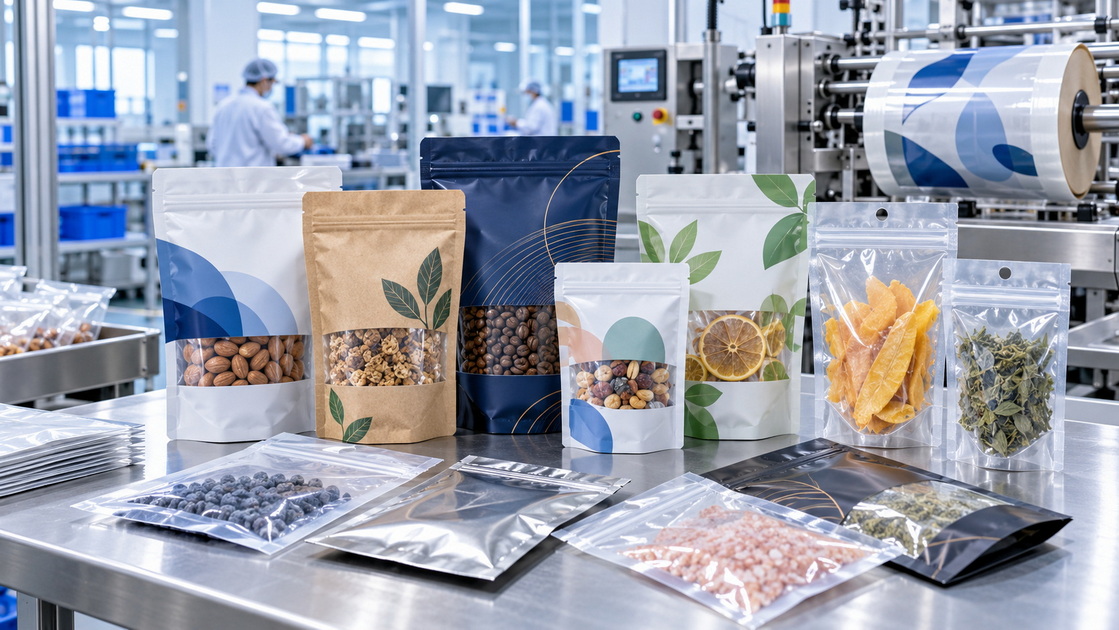
Customizing dimensions helps reduce excess space, protect the product, and create a more professional fit. Available formats can include:
- Custom width and length
- Bottom gussets for added volume
- Side gussets for bulky items
- Stand-up pouch configurations
- Flat zipper bags
- Slider zipper bags
- Hang-hole bags for retail displays
- Header bags for hanging merchandise
- Die-cut shapes for special promotional applications
Custom printing helps transform packaging into a brand touchpoint. Depending on the bag structure and order volume, options may include:
- One-color or multi-color logo printing
- Product instructions and warning statements
- Barcode and QR code placement
- Lot number or batch-code areas
- Matte, glossy, or soft-touch visual effects
- Transparent windows for product visibility
- White ink underprint for stronger color contrast
For example, a consumer hardware brand can print product instructions and installation diagrams directly on a clear zipper bag, reducing the need for a separate insert card. A specialty snack brand can use a stand-up zipper pouch with a resealable closure, product window, nutrition panel, and shelf-ready branding.
Before finalizing a custom ziplock bag order, collect the following information for your packaging manufacturer:
1. Product dimensions, weight, shape, and sharp edges
2. Whether the product is flat, folded, stacked, or bulky
3. Required bag width, length, and gusset dimensions
4. Desired usable capacity rather than only nominal dimensions
5. Product-contact requirements, including food-contact conditions if applicable
6. Film thickness target and durability expectations
7. Zipper style: press-to-close, slider, child-resistant, or specialty closure
8. Printing artwork, color count, branding objectives, and legal text
9. Need for hang holes, vent holes, tear notches, labels, or barcode panels
10. Packing method: hand filling, semi-automatic packaging, or automated packaging equipment
11. Expected storage, shipping, temperature, and moisture conditions
12. Target order quantity and repeat-order forecast
This level of preparation allows packaging engineers to recommend a format that balances functionality, material use, manufacturing practicality, and cost.
Sustainability in flexible packaging should be evaluated realistically. Flexible packaging can use less material than many rigid packaging formats, and its high product-to-package ratio can support source-reduction strategies. However, the environmental outcome depends on the material structure, product protection performance, local collection systems, recycling infrastructure, and end-of-life design.
For brands looking to improve packaging decisions, start with these questions:
- Can the bag be right-sized to eliminate unnecessary film?
- Can the product be protected with a thinner but adequately engineered structure?
- Can unnecessary components, inserts, or secondary packaging be removed?
- Is a mono-material-oriented structure feasible for the required performance?
- Are disposal instructions clear for the markets where the product is sold?
The most responsible package is not always the one with the most marketing claims. It is often the package that protects the product effectively, avoids overpackaging, and is designed with its full lifecycle in mind.
The right zipper bag should protect your product, support efficient packing, reinforce your brand, and fit your distribution process. Whether you need custom ziplock bag sizes, heavy-duty resealable bags, printed retail pouches, food packaging solutions, or integrated flexible packaging equipment, HLun Pack can help you evaluate the technical details before production begins.
Contact HLun Pack today to discuss your product dimensions, material requirements, preferred zipper style, printing needs, and packaging line conditions. Our team can help you move from an initial concept to tested samples and a scalable packaging solution.
For screws, bolts, connectors, jewelry, and small electronic components, common sizes include 2 × 3, 3 × 4, and 4 × 6 inches. The ideal size depends on the quantity, product shape, label area, and whether the bag needs to accommodate instructions or a barcode.
For flat products, allowing modest space around each side is usually enough. For bulky or irregular products, allow additional width and length for insertion and zipper closure. Always test actual filled samples because bag thickness, zipper placement, and product depth affect usable space.
No. A thicker bag can offer better puncture resistance and durability, but it also increases material use, stiffness, and cost. Choose thickness according to product weight, sharpness, handling conditions, and expected reuse—not as a default upgrade.
A flat bag is designed primarily for thin or flat products. A gusseted zipper bag has expandable panels at the bottom or sides, creating extra internal volume for bulkier products, stacked items, or products that need to stand upright.
Yes. Custom zipper bags can include logos, product information, QR codes, barcode areas, instructions, warning labels, and multi-color graphics. The available printing method depends on the bag material, order volume, design complexity, and performance requirements.
They can be, but food use requires material and compliance review for the intended application. Packaging components that contact food must be appropriately authorized or otherwise compliant for their intended use. Consider the food type, storage time, temperature, fat content, and full packaging structure—not only the base film.
Yes. HLun Pack focuses on flexible packaging solutions and packaging machinery. For suitable projects, the packaging format, filling method, and equipment requirements can be reviewed together to help improve efficiency and package consistency.
1. U.S. Food and Drug Administration. "[Food Packaging & Other Substances That Come into Contact with Food]." Explains food-contact substances and FDA authorization requirements for applicable food-contact uses. [fda]
2. U.S. Food and Drug Administration. "[Regulatory Status of Components of a Food Contact Material]." Describes how individual components contribute to the regulatory status of food-contact materials. [fda]
3. ASTM International. "[ASTM D882: Standard Test Method for Tensile Properties of Thin Plastic Sheeting]." Covers tensile testing of plastic films and sheeting less than 1.0 mm thick. [astm]
4. Flexible Packaging Association. "[Sustainability]." Discusses flexible packaging efficiency, source separation, and material recovery considerations. [flexpack]
5. Fresh-Lock. "[How Reclosable Flexible Packaging Can Support a Circular Economy]." Discusses source reduction and product-to-package ratio in flexible packaging. [fresh-lock]
6. YLTPACK. "[Ziplock Bag Sizes Guide with Dimensions, Thickness and Custom Options]." Original article reviewed for baseline size ranges, thickness concepts, and custom bag considerations. [yltpacking]


