


close
Choose Your Site
Global
Social Media
Views: 277 Author: HLun PACK Publish Time: 2026-09-19 Origin: Site


Content Menu
● What Is Flexible Pouch Packaging?
● Why Brands Choose Flexible Pouch Packaging
>> Key Benefits of Flexible Packaging
● Main Types of Flexible Pouches
>> Flat Pouches and Three-Side-Seal Pouches
>> Flat-Bottom and Side-Gusset Pouches
● How Flexible Pouch Materials Work
>> Common Flexible Packaging Materials
>> Understanding Barrier Requirements
● A Practical Pouch Selection Process
>> 2: Define the Consumer Experience
>> 3: Match the Pouch to the Machine
● Food Safety and Compliance Considerations
>> Questions to Ask a Flexible Pouch Supplier
● Sustainable Flexible Packaging: Design Beyond the Claim
>> Better Questions for Sustainable Pouch Design
● Common Packaging Problems and How to Prevent Them
>> Product Spoilage Before Target Shelf Life
● Why Choose HLun Pack for Flexible Packaging Solutions?
● Start Your Flexible Pouch Packaging Project
● FAQ
>> 1. What is the best flexible pouch packaging for snacks?
>> 2. What flexible pouch is best for liquid products?
>> 3. Can flexible pouches replace rigid bottles and jars?
>> 4. Are flexible pouches recyclable?
>> 5. How do I select the right flexible pouch packaging machine?
>> 6. What information should I provide before requesting a pouch packaging solution?
Flexible pouch packaging gives brands a practical way to protect products, reduce logistics weight, improve shelf appeal, and add consumer-friendly features such as resealable zippers and pouring spouts. But a successful pouch is not simply a printed bag—it is a carefully engineered system in which product characteristics, film structure, pouch format, filling equipment, sealing conditions, and end-of-life design must work together.
For food, pet food, beverages, supplements, cosmetics, and industrial products, the right flexible packaging solution can help prevent leaks, preserve freshness, simplify handling, and create a stronger retail presentation. The wrong choice can create sealing failures, shortened shelf life, waste, and expensive production downtime.
At HLun Pack, we approach custom flexible pouch packaging from both the packaging and machinery perspectives. This guide explains how to choose the right pouch structure, features, and packaging equipment for reliable real-world performance.
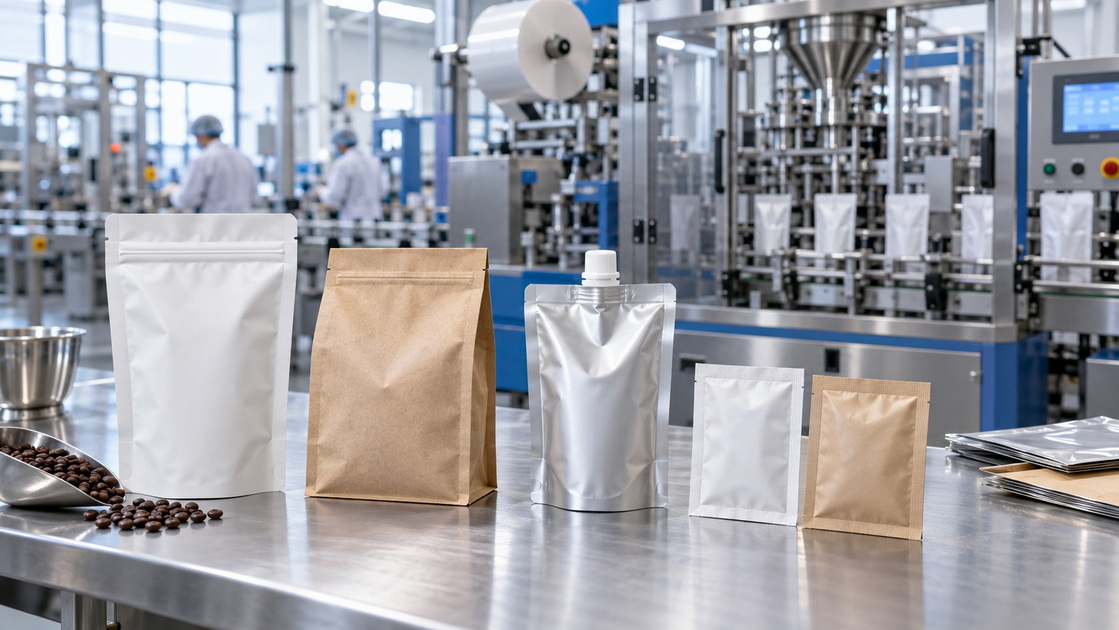
Flexible pouch packaging is a package made from pliable materials such as plastic films, aluminum foil, paper-based laminates, or multilayer combinations. Unlike rigid bottles, jars, cans, and trays, a pouch can bend, fold, and conform to the product it contains.
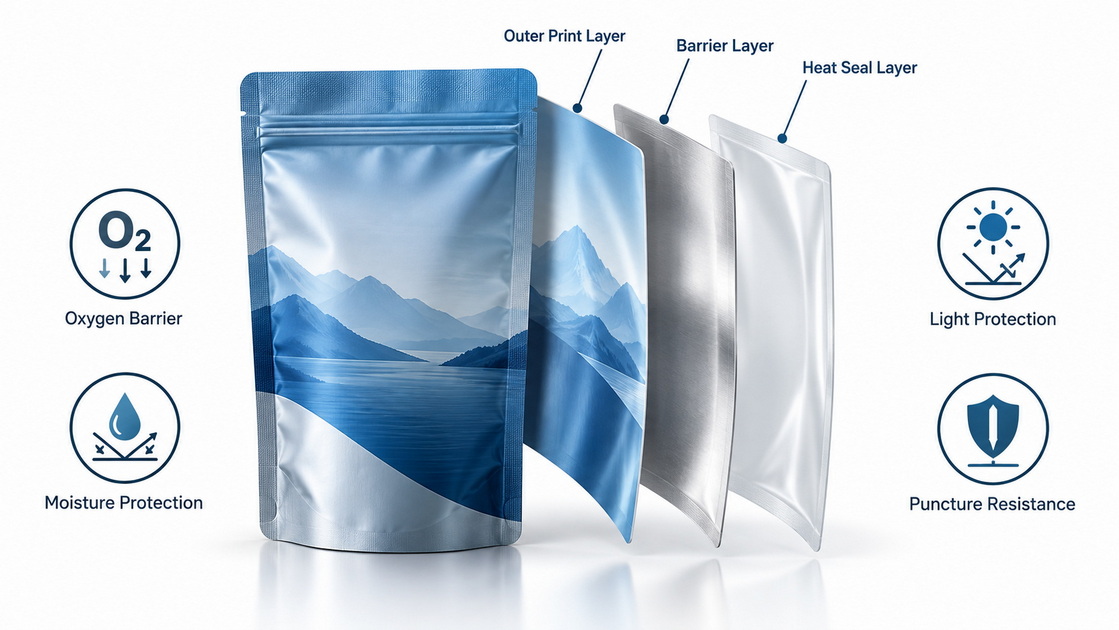
Most high-performance flexible pouches use several layers. Each layer has a different job:
- Outer layer: Supports graphics, scuff resistance, stiffness, and mechanical strength.
- Barrier layer: Helps protect against oxygen, moisture, light, aroma loss, or contamination.
- Sealant layer: Creates a reliable heat seal and contacts the product where appropriate.
- Functional components: May include zippers, spouts, valves, tear notches, hang holes, handles, or laser scoring.
A pouch may look simple to the customer, but the engineering is not simple. For example, a coffee pouch must preserve aroma, resist puncture, seal consistently, and potentially include a one-way degassing valve. A liquid detergent pouch must tolerate product chemistry, survive transport, and dispense without leaking. A retort pouch must maintain package integrity after thermal processing.
This is why flexible packaging should be selected as a product-and-process solution, not only as a packaging design decision.
Flexible pouches are widely used because they can combine product protection, lower material use, improved transport efficiency, and strong branding space. The Flexible Packaging Association notes that flexible formats generally use fewer resources and can require less water and energy to manufacture and transport than many rigid packaging alternatives.
| Benefit | Why It Matters for Brands | Example |
|---|---|---|
| Lower package weight | Can reduce freight, storage, and handling requirements | Lightweight sauce pouch versus a glass jar |
| Product protection | Barrier films can help manage oxygen, moisture, light, and aroma exposure | Coffee, nuts, powdered supplements |
| Shelf differentiation | Large printable surfaces support bold graphics and product information | Premium pet treats or cosmetics |
| Consumer convenience | Zippers, spouts, handles, and tear notches improve usability | Resealable snack pouch or baby-food spout pouch |
| Production flexibility | Pouch styles can support different product types and fill volumes | Powder, granules, liquid, paste, and single-serve products |
| Less empty-pack volume | Unfilled flexible packaging usually occupies less warehouse space than rigid containers | Pre-made pouches delivered flat to a filling facility |
However, flexible packaging is not automatically the right choice for every product. A pouch must be matched to the product's weight, shape, viscosity, shelf-life target, distribution route, filling method, and consumer use case.
For example:
- A fragile product may require stronger puncture resistance.
- An oily product may require careful sealant and ink selection.
- A hot-filled or retorted product needs heat-resistant materials and validated processing conditions.
- A product sold through e-commerce may need stronger seals and drop-test performance.
- A recyclable-pouch project may require trade-offs between barrier performance, stiffness, clarity, and recycling compatibility.
Choosing the pouch format is one of the first decisions in any packaging project. The format affects appearance, capacity, material usage, filling method, machinery configuration, shipping efficiency, and consumer experience.
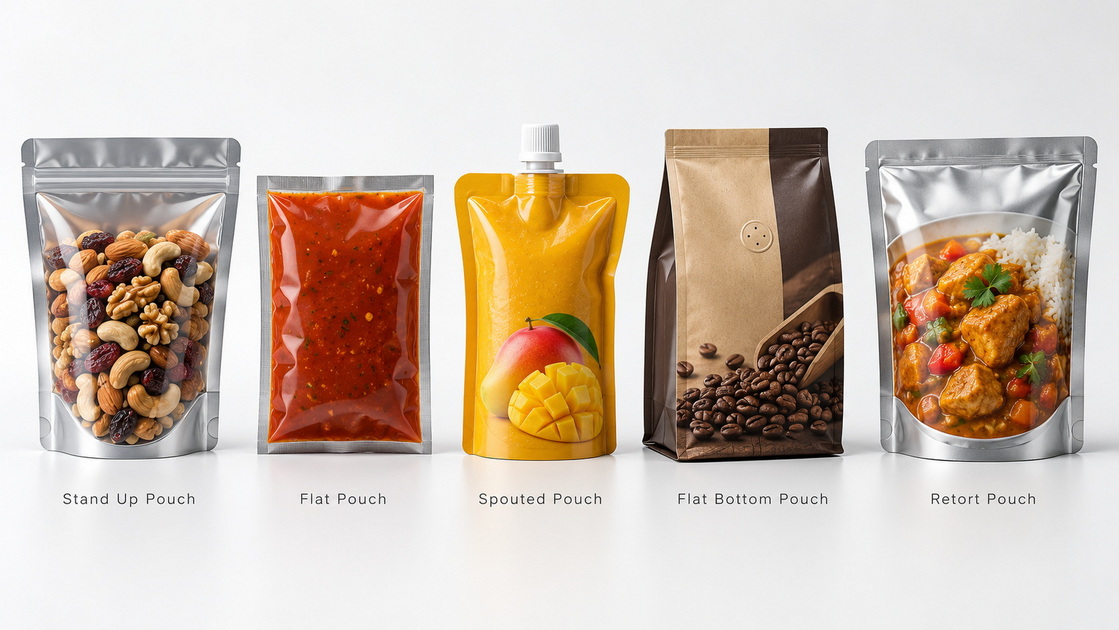
A stand-up pouch, often called a Doypack pouch, has a bottom gusset that allows it to stand upright on a shelf. It is one of the most versatile and popular pouch formats.
Best suited for:
- Snacks and dried fruit
- Coffee and tea
- Pet treats and dry pet food
- Protein powder and nutrition products
- Candy and confectionery
- Granules, seeds, and powdered products
Stand-up pouches can include zippers, windows, handles, hang holes, and spouts. They offer excellent front-facing branding and are especially useful for retail products that need visual impact.
Flat pouches are economical, compact, and often used for samples, single-use packs, refill products, and portion-controlled items. A three-side-seal pouch is sealed on three sides, with the opening or fill area typically located at the top.
Common applications include:
- Sauces and condiments
- Mask packs and cosmetic sachets
- Seasonings and instant drink powders
- Pharmaceutical or nutraceutical sachets
- Sample packs and travel-size products
Their simple geometry often supports efficient high-volume production, particularly for smaller product sizes.
A spouted pouch combines the lightweight advantages of flexible packaging with controlled dispensing. It typically includes a fitment and cap at the top corner, center top, or other custom position.
Ideal uses include:
- Fruit purée and baby food
- Beverages and concentrates
- Shampoo, body wash, and lotion refills
- Liquid detergent
- Sauces, oils, and condiments
- Liquid supplements
The spout position matters. A corner spout may be convenient for pouring, while a center spout can support a more balanced consumer experience. The right answer depends on viscosity, pour behavior, pouch shape, fill temperature, and how the consumer will hold the pack.
Flat-bottom pouches have a box-like structure with a stable base and more display panels. Side-gusset pouches expand at the sides, increasing capacity.
These formats are common for:
- Coffee beans and ground coffee
- Premium pet food
- Bulk snacks
- Tea
- Specialty grains and dry ingredients
For premium brands, flat-bottom pouches can deliver a more structured, upscale look while still using a flexible format.
Retort pouches are designed for products that undergo high-temperature thermal processing after filling. They are commonly used for shelf-stable foods, ready meals, soups, sauces, wet pet food, and certain military or emergency rations.
A retort project requires special attention to:
- Film structure and heat resistance
- Seal performance after processing
- Product acidity and oil content
- Retort temperature, pressure, and dwell time
- Shelf-life validation
- Filling and handling conditions
Flexible packaging materials are usually selected as a laminated structure, rather than as one single film. The structure must balance printability, barrier protection, puncture resistance, sealability, product compatibility, and sustainability goals.
| Material | Typical Role | Key Advantages | Common Considerations |
|---|---|---|---|
| PET | Outer printable layer | Good clarity, stiffness, and print performance | Often combined with other layers |
| PE | Inner sealant layer or mono-material structure | Good sealability and moisture resistance | Barrier performance may need enhancement |
| PP | Sealant or mono-material option | Heat resistance and stiffness | Requires compatibility review for intended use |
| Aluminum foil | High-barrier layer | Excellent protection from oxygen, moisture, and light | Opaque; may affect recyclability pathways |
| EVOH | Oxygen-barrier layer | Strong oxygen barrier at low thickness | Performance depends on humidity and structure |
| Nylon / PA | Strength layer | Puncture resistance and toughness | May complicate recycling design |
| Paper | Outer visual or tactile layer | Natural appearance and premium feel | Requires barrier and sealing design validation |
The most important question is not "Which pouch material is best?" The better question is:
What must the pouch protect the product from?
A packaging engineer may evaluate:
- Oxygen exposure: Important for coffee, nuts, oils, jerky, supplements, and products prone to oxidation.
- Moisture transfer: Important for powders, crisps, dehydrated foods, and hygroscopic ingredients.
- Light exposure: Important for oils, color-sensitive products, vitamins, and some cosmetics.
- Aroma retention: Important for coffee, spices, pet food, and fragranced products.
- Puncture and drop resistance: Important for heavy, sharp, granular, or e-commerce-distributed products.
- Chemical compatibility: Essential for detergents, alcohol-containing products, acidic foods, oils, and cosmetics.
A high barrier is not always better. Over-engineering can increase cost, complicate recycling, and create unnecessary stiffness. The best flexible pouch is the one that provides fit-for-purpose protection with the most appropriate material structure.
Many packaging projects fail because the buyer begins with artwork or pouch shape before defining the technical requirements. A better approach is to follow a structured process.
Start with a detailed product profile:
1. Is the product a powder, solid, granule, liquid, paste, or gel?
2. What is the product's fill weight or volume?
3. Does it contain oil, acid, salt, alcohol, or aggressive ingredients?
4. Is it sensitive to oxygen, moisture, light, odor, or contamination?
5. What shelf life is required?
6. Will the product be hot-filled, retorted, frozen, refrigerated, or stored at ambient temperature?
Consider what happens after the product reaches the customer:
- Does the consumer need to reseal the package?
- Should it stand upright on a kitchen shelf?
- Is controlled pouring needed?
- Is portion control important?
- Will the consumer use the pouch in the shower, outdoors, in a car, or while traveling?
- Should the pouch be easy to open for seniors or people with limited grip strength?
A zipper may be valuable for a family-size snack pouch but unnecessary for a single-serving seasoning sachet. A spout can improve liquid dispensing, but it also adds components, filling considerations, and cost.
Packaging design and packaging machinery must be evaluated together. A pouch that looks excellent in a design mockup may be difficult to open, fill, align, seal, inspect, or carton efficiently on the production line.
For a pre-made pouch project, evaluate:
- Pouch width, height, and bottom-gusset dimensions
- Filling volume and speed target
- Zipper, spout, valve, handle, or unusual pouch geometry
- Product flow and dosing method
- Need for nitrogen flushing or vacuum
- Seal width and sealing temperature window
- Coding, inspection, checkweighing, and downstream packing requirements
HLun Pack recommends conducting sample trials before full-scale production. A practical trial can reveal problems with pouch opening, static, filling accuracy, seal contamination, wrinkles, misalignment, or product bridging before they become a costly mass-production issue.
Before committing to commercial production, request or conduct relevant tests:
- Seal-strength testing
- Leak testing
- Drop testing
- Compression testing
- Puncture-resistance testing
- Shelf-life or accelerated-aging evaluation
- Product compatibility testing
- Transport simulation, where appropriate
- Machine run testing using actual product and intended pouch structure
Expert insight: A pouch package is only as strong as its weakest interface. That interface may be a bottom gusset seal, a zipper transition, a spout weld, a contaminated top seal, or an untested material-product interaction.
For food packaging sold in the United States, packaging components that contact food must be suitable for their intended use. The U.S. Food and Drug Administration defines a food-contact substance as a substance intended for use as a component of materials used in manufacturing, packing, packaging, transporting, or holding food, where it is not intended to have a technical effect in the food itself.
The regulatory status of a food-contact material depends on the individual substances that compose it. FDA guidance notes that applicable substances may be covered by relevant regulations, generally recognized as safe status, a prior sanction, a Threshold of Regulation exemption, or an effective Food Contact Substance Notification.
For buyers, this means asking specific questions rather than relying on generic claims such as "FDA approved."
- Which materials, inks, adhesives, and additives are used in the final pouch structure?
- Is the structure suitable for my exact food type and intended conditions of use?
- Can the supplier provide relevant declarations or compliance documentation?
- Does the package support hot fill, frozen storage, retort, or microwave use if required?
- Has the structure been tested with a similar product?
- What quality controls are used for seal consistency, printing, odor, and contamination prevention?
For food, pet food, pharmaceuticals, and personal-care products, documentation and verification should be planned early—not added after artwork approval.
Sustainability claims should be precise. Flexible packaging can offer resource-efficiency advantages because it generally uses less material and weighs less than many rigid alternatives, but its end-of-life performance depends on the local collection, sorting, and recycling infrastructure.
A package is not meaningfully "recyclable" simply because its materials are theoretically recyclable. The Ellen MacArthur Foundation defines recyclable packaging in terms of collection, sorting, and recycling that is proven to work in practice and at scale.
Instead of asking only, "Can this pouch be recyclable?" ask:
- Is there an established recycling stream for this pouch where it will be sold?
- Can the structure move toward a mono-material PE or PP design?
- Are the zipper, spout, valve, ink, adhesive, and barrier layer compatible with the intended recycling stream?
- Does the required barrier level justify a multi-material structure?
- Could the product-to-package ratio be improved by changing pouch size or format?
- Can the pouch be downsized without compromising product protection?
- Is post-consumer recycled content appropriate and compliant for the intended application?
CEFLEX guidance for plastic-based flexible barrier packaging shows that recyclability design involves more than the main film; polymer composition, density, format dimensions, barriers, and other components all influence compatibility with PE or PP recycling streams.
Practical recommendation: Treat sustainability as an engineering brief. Define the target market, product-protection need, recycling pathway, compliance requirements, and communication claim before selecting materials.
Common causes include incorrect sealing temperature, insufficient dwell time, seal contamination, incompatible sealant layers, wrinkles in the seal area, or product particles trapped in the seal.
Prevention steps:
1. Use the correct sealant layer for the product and process.
2. Establish a validated sealing temperature and pressure window.
3. Keep the seal area clean during filling.
4. Conduct routine seal-strength and leak testing.
5. Use machinery settings that match pouch material and thickness.
Wrinkles, distorted graphics, unstable standing performance, or uneven gussets can reduce shelf appeal.
Preventive actions include:
- Confirming pouch dimensions and artwork bleed areas
- Reviewing registration marks and print tolerances
- Testing the filled pouch, not only the empty pouch
- Checking pouch stiffness and bottom-gusset geometry
- Evaluating how the pouch behaves after transport and storage
Shelf-life failures may result from insufficient barrier properties, seal leaks, poor oxygen control, or unsuitable storage conditions.
To reduce risk:
- Define the shelf-life target clearly.
- Evaluate oxygen, moisture, light, and aroma protection needs.
- Consider nitrogen flushing where appropriate.
- Test the final package with the real product.
- Avoid making shelf-life promises based only on film specifications.
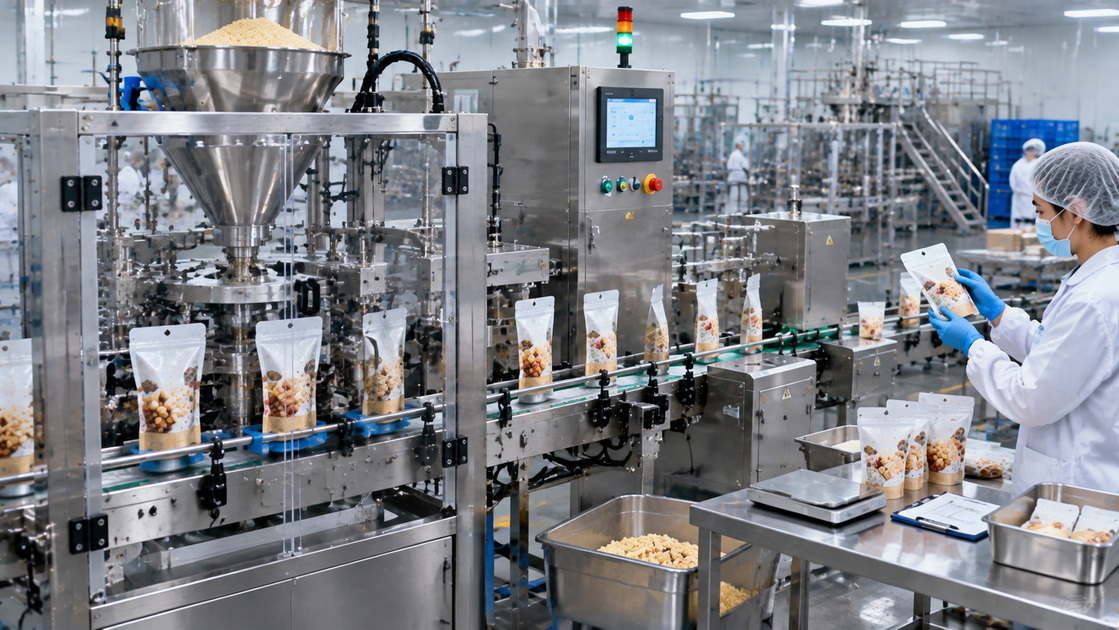
HLun Pack supports customers who need more than a pouch supplier or a machine supplier. We focus on the connection between flexible packaging design, packaging machinery, production efficiency, and practical quality control.
A reliable flexible packaging project requires collaboration across:
- Product and market requirements
- Pouch format and material structure
- Filling and sealing technology
- Packaging-line integration
- Sample validation and quality checks
- Sustainability and compliance documentation
Whether you need a stand-up pouch packaging machine, a spouted pouch filling solution, or a broader flexible packaging line, the goal is the same: create a package that protects the product, supports efficient production, and delivers a better user experience.
If you are developing a new pouch product—or replacing rigid packaging with a more efficient flexible format—start with a technical packaging review before placing a large order.
Share the following information with HLun Pack:
- Product type and fill weight
- Required pouch style and dimensions
- Shelf-life and barrier requirements
- Filling method and target production speed
- Required features, such as zipper, spout, valve, or handle
- Destination market and compliance needs
- Sustainability target and desired end-of-life pathway
Contact HLun Pack today to discuss your flexible pouch packaging machinery and integrated packaging solution. We can help you evaluate pouch compatibility, production requirements, and the equipment configuration needed to move from concept to reliable commercial output.
For many snack products, a resealable stand-up pouch is a strong option because it provides shelf presence, portable storage, and repeat-use convenience. The final material structure should be selected based on moisture sensitivity, oxygen sensitivity, oil content, desired shelf life, and product sharpness.
Spouted pouches are commonly used for liquids, gels, purées, sauces, detergents, and personal-care refills. The pouch material, spout fitment, cap design, seal strength, and filling equipment must be matched to the liquid's viscosity, temperature, and chemical characteristics.
In many applications, yes. Flexible pouches can reduce empty-package weight and storage volume while offering convenient dispensing and strong branding. However, rigid packaging may still be better for products needing high structural protection, repeated dispensing stability, or a premium glass-like presentation.
Some flexible pouches can be designed for recycling, particularly mono-material-oriented PE or PP structures. But actual recyclability depends on the packaging design and whether collection, sorting, and recycling infrastructure exists in the product's end market.
Start with product characteristics, pouch dimensions, fill volume, target speed, and desired features. Then evaluate filling accuracy, pouch opening reliability, sealing performance, nitrogen flushing needs, coding, inspection, and downstream packing integration. Sample trials with the actual product and pouch are highly recommended.
Provide the product type, product density or viscosity, desired pouch format, dimensions, fill weight, target output, required shelf life, packaging features, and destination market. Photos of existing packaging or a drawing of the intended pouch can also help speed up technical evaluation.
1. U.S. Food and Drug Administration. "Food Packaging & Other Substances that Come in Contact with Food." Explains food-contact substances, including packaging components, and FDA safety review considerations. [FDA source]. [fda]
2. U.S. Food and Drug Administration. "Regulatory Status of Components of a Food Contact Material." Describes regulatory pathways for components expected to migrate to food. [FDA source]. [fda]
3. Flexible Packaging Association. "Flexible Packaging Association." Provides industry information on material efficiency, resource use, and flexible packaging sustainability considerations. [FPA source]. [flexpack]
4. Flexible Packaging Association. "Sustainability." Discusses lower material use, packaging weight, energy requirements, and lifecycle considerations for flexible packaging. [FPA sustainability source]. [flexpack]
5. Ellen MacArthur Foundation. "The Global Commitment 2030 Definitions & Reporting Guidance." Defines recyclable packaging in relation to collection, sorting, and recycling proven at scale. [Guidance PDF]. [content.ellenmacarthurfoundation]
6. CEFLEX. "Pioneer Project Barrier: Plastic-Based Flexible Barrier Packaging." Provides design-for-recycling considerations for flexible barrier structures, including polymer composition and compatibility. [CEFLEX guidance]. [ceflex]


