


close
Choose Your Site
Global
Social Media
Views: 299 Author: HLun PACK Publish Time: 2026-09-18 Origin: Site


Content Menu
● What Is Beverage Spout Pouch Packaging?
● What Is Aluminum Can Packaging?
● Beverage Spout Pouch vs Aluminum Can
● 1. Product Protection and Shelf Life
>> Aluminum Cans Offer Exceptional Barrier Protection
>> Beverage Spout Pouches Need Structure-Specific Engineering
>> Barrier Is a System, Not a Material Label
● 2. Consumer Convenience and Use Experience
>> Why Spout Pouches Win for Resealable Consumption
>> Why Aluminum Cans Win for Immediate Consumption
● 3. Logistics, Warehousing, and Transportation Efficiency
>> Spout Pouches Reduce Empty-Pack Volume
>> Aluminum Cans Improve Line Stability and Pallet Stacking
● 4. Sustainability: Material Efficiency vs Circularity
>> Spout Pouches Can Lead in Source Reduction
>> Aluminum Cans Have a Strong Circularity Story
>> Practical Sustainability Decision Matrix
● 5. Filling Equipment and Production Considerations
>> Beverage Spout Pouch Filling Requirements
>> Aluminum Can Filling Requirements
● How to Choose the Right Beverage Package
>> 1. Define the Beverage's Technical Needs
>> 2. Identify the Consumer Occasion
>> 3. Calculate Total Cost of Ownership
>> 4. Test the Complete Package System
>> 5. Match the Sustainability Claim to Reality
● Spout Pouch or Aluminum Can?
● FAQ
>> 1. Are beverage spout pouches suitable for carbonated drinks?
>> 2. Which package is more sustainable: a spout pouch or an aluminum can?
>> 3. Can a beverage spout pouch be recycled?
>> 4. Do aluminum cans protect beverages better than pouches?
>> 5. Which format is better for smoothies and fruit purées?
>> 6. Which packaging option has lower logistics costs?
>> 7. What machinery is required for beverage spout pouch packaging?
For beverage brands, the choice between a beverage spout pouch and aluminum can packaging is not simply a material decision. It affects product protection, filling-line compatibility, logistics cost, retail visibility, consumer convenience, recyclability, and the long-term economics of the brand.
From our experience in flexible packaging and packaging machinery at HLun Pack, the best format depends on the beverage formula, required shelf life, route to market, production scale, consumer use occasion, and sustainability strategy. A spouted pouch may create a strong advantage for resealable beverages, concentrates, purées, and family-size products. An aluminum can remains exceptionally effective for carbonated, light-sensitive, and single-serve beverages that need robust protection and high-speed production.
This in-depth comparison explains where each format performs best—and how beverage producers can select the right packaging system with fewer costly mistakes.
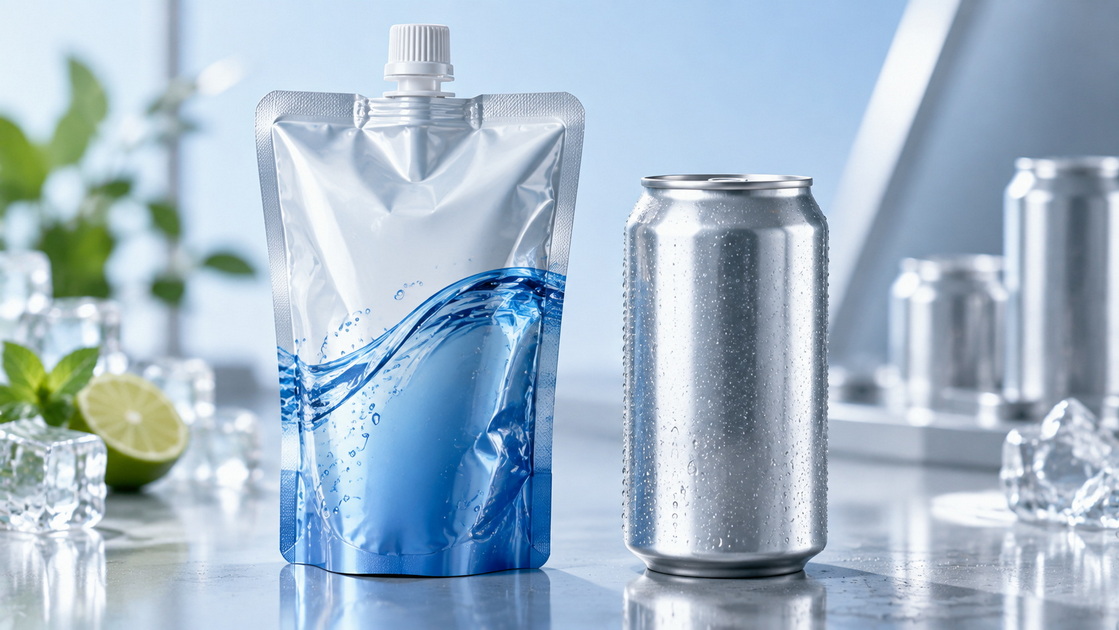
A beverage spout pouch is a flexible package made from one or more film layers and fitted with a rigid plastic spout and cap. The consumer can drink from it, pour from it, squeeze the product out, and—in most designs—reclose it after use.
For beverages, the pouch structure may include polyethylene (PE), polypropylene (PP), polyester (PET), nylon, EVOH, aluminum foil, metallized film, or other barrier layers. The exact structure should be designed around the beverage's oxygen sensitivity, acidity, filling temperature, fat content, carbonation level, and intended shelf life.
A typical beverage spout pouch can be produced as:
- Stand-up pouch with corner spout
- Stand-up pouch with top-center spout
- Flat pouch with fitment
- Retort spout pouch
- Hot-fill spout pouch
- Cold-fill spout pouch
- Mono-material PE or PP recycle-ready pouch
- High-barrier laminated pouch for sensitive beverages
The defining value of this format is its combination of lightweight flexible packaging and controlled, resealable dispensing.
An aluminum beverage can is a rigid metal container, usually formed from an aluminum body and paired with an easy-open end. Most beverage cans use an internal coating to separate the drink from the metal and protect beverage quality.
Aluminum cans are widely used for:
- Carbonated soft drinks
- Sparkling water
- Beer
- Energy drinks
- Ready-to-drink coffee
- Ready-to-drink tea
- Functional beverages
- Juice drinks
- Cocktails and hard seltzers
The can's greatest technical advantage is its ability to create a complete barrier against light and oxygen, two major contributors to flavor degradation in many beverages.
Because aluminum cans are rigid, stackable, and compatible with highly automated high-speed filling lines, they remain a core format for large beverage brands and co-packers.
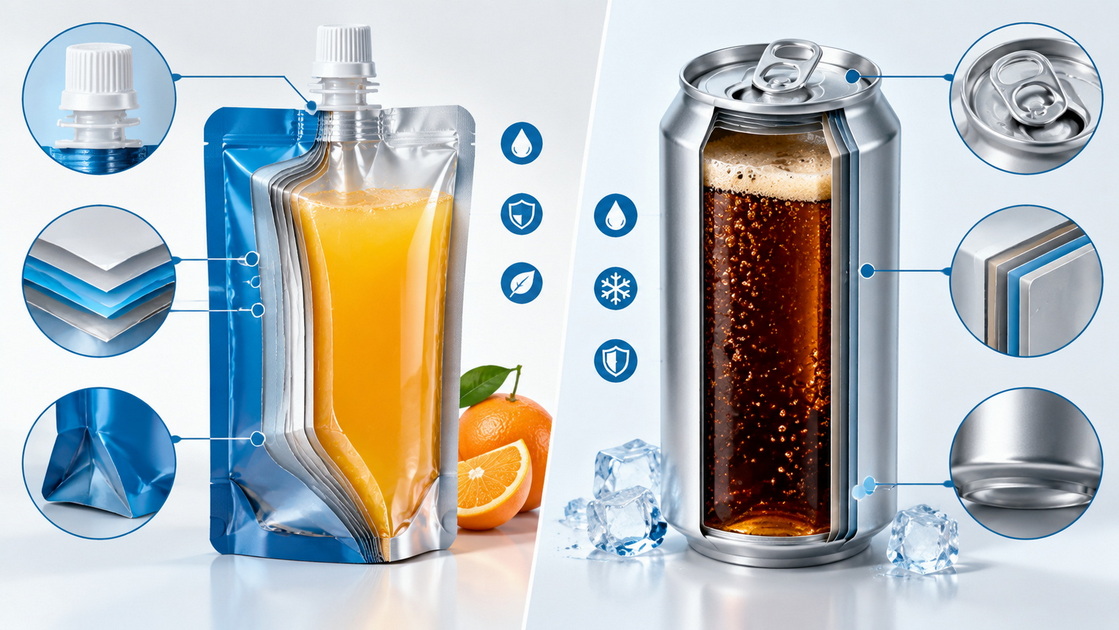
| Comparison Factor | Beverage Spout Pouch | Aluminum Can Packaging |
|---|---|---|
| Primary format | Flexible pouch with spout and cap | Rigid aluminum container with easy-open end |
| Resealability | Excellent in most capped designs | Usually not resealable after opening |
| Barrier performance | Can be engineered from moderate to very high | Excellent barrier against light, oxygen, and moisture |
| Carbonated beverages | Generally challenging; requires specialized engineering | Highly suitable |
| Empty-pack transport | Highly efficient; pouches can ship flat | Less efficient because cans are preformed and rigid |
| Product-to-package ratio | Often favorable due to low package weight | Good, but generally heavier than a pouch |
| Shelf impact | Strong graphic flexibility and unique shapes | Strong 360-degree decoration and premium metallic appearance |
| Consumer use | Ideal for sipping, pouring, squeezing, and multi-use consumption | Ideal for on-the-go, immediate single-serve consumption |
| Recycling pathway | Depends heavily on material structure and local collection systems | Widely recognized and valuable in established metal-recycling streams |
| Filling equipment | Requires pouch filling, spout handling, sealing, and inspection systems | Requires can filling, seaming, rinsing, and high-speed conveyance |
| Best applications | Purées, smoothies, concentrates, kids’ drinks, sauces, refill beverages | Carbonated drinks, beer, energy drinks, RTD beverages |
For beverages that are highly sensitive to light or oxygen, aluminum can packaging is difficult to beat. Metal packaging provides a full barrier to light, gas, and moisture, helping protect flavor, aroma, color, and nutritional attributes.
This is especially important for:
- Beer and malt beverages
- Carbonated soft drinks
- Light-sensitive functional ingredients
- Oxygen-sensitive coffee and tea beverages
- Products with delicate flavor profiles
- Long-distribution products sold through ambient channels
An aluminum can also creates a rigid physical barrier. It is less likely than a flexible pouch to be punctured by sharp edges, poor pallet handling, or rough secondary packaging.
However, brands should remember that a can is not simply "bare aluminum." Internal coatings are a critical component of the package system. Food-contact materials—including coatings, adhesives, colorants, and other package components—must be suitable for their intended use and comply with applicable food-contact requirements. The U.S. Food and Drug Administration notes that food-contact substances are assessed for safety, including potential migration into food.
A beverage spout pouch can provide strong protection, but its barrier performance is determined by the selected film structure, sealing quality, cap system, filling process, and product chemistry.
For example:
- A simple mono-PE pouch may be appropriate for some refrigerated or shorter-shelf-life beverages.
- An EVOH-containing structure may improve oxygen barrier performance.
- A foil-based laminate can provide stronger barrier protection for highly sensitive products.
- A retort pouch structure may be required for heat-processed shelf-stable beverages.
- A high-acid juice may need different material compatibility than a dairy beverage or oil-containing nutritional drink.
Recent flexible-packaging developments show that mono-PP spouted pouch structures can be engineered for chilled dairy beverages while targeting the required oxygen and water-vapor barrier performance.
The key lesson is simple: do not choose a pouch structure only by appearance or price. The package must be validated with the real beverage, real filling conditions, real distribution temperatures, and real shelf-life target.
In packaging development, "high barrier" is not enough information. A professional evaluation should define:
1. Product pH and formula characteristics
2. Oxygen sensitivity and light sensitivity
3. Required shelf life
4. Filling and sterilization method
5. Storage temperature
6. Distribution distance and climate exposure
7. Consumer opening and resealing behavior
8. End-of-life packaging requirements
A pouch may be the superior option for one beverage and a high-risk option for another. The same is true for cans.
The strongest consumer advantage of a spout pouch is resealability. A screw cap, flip-top cap, or sports cap allows consumers to close the package after drinking or pouring.
This makes beverage spout pouches especially useful for:
- Children's drinks
- Smoothies
- Fruit purées
- Yogurt drinks
- Nutritional beverages
- Liquid supplements
- Beverage concentrates
- Multi-serve family packs
- Outdoor and travel use
- Refill formats
A flexible pouch also lets consumers squeeze or evacuate a large share of the product. For thick beverages, fruit purées, or functional gels, this can reduce product waste compared with containers that trap material in corners or at the bottom.
Pouches can also offer tactile comfort. They are lightweight, easier to carry in a bag, and safer than rigid glass in situations such as schools, sports venues, travel, and outdoor events.
Aluminum cans deliver a familiar, fast, and highly convenient beverage experience:
- Easy to chill
- Easy to stack
- Easy to open
- Easy to hold
- Strong for vending machines
- Suitable for single-serve portions
- Effective for on-the-go consumption
For carbonated drinks, cans are particularly compelling because they offer the rigid package integrity needed to manage internal pressure. A standard spout pouch is generally not the first choice for highly carbonated beverages, because flexible packaging and spout closures must be specially designed to tolerate pressure and maintain carbonation.
The limitation is obvious: most cans are single-use after opening. Consumers cannot reliably reseal them, which can be inconvenient for large portions or beverages meant to be consumed gradually.
Flexible packaging offers a major operational advantage before filling. Empty beverage pouches can usually be supplied in rolls or stacks, occupying far less space than preformed rigid cans.
This can reduce:
- Inbound freight volume
- Packaging warehouse space
- Internal material handling
- Storage complexity
- Empty-package transportation emissions
For companies managing multiple SKUs, promotional runs, or seasonal beverages, this storage efficiency can be commercially meaningful.
A stand-up pouch also has lower package weight than many rigid alternatives. Less packaging mass can mean lower material consumption and potentially lower outbound freight costs, especially when products travel long distances.
However, the final logistics outcome depends on the full supply chain. Pouches may require stronger secondary packaging or carefully designed case packing to prevent crushing, leaks, or spout damage during distribution.
Aluminum cans do not ship flat, but they offer excellent rigidity and stackability. Their uniform geometry supports automated handling, high-speed conveying, palletization, and retail display.
For high-volume beverage producers, this can create advantages in:
- Filling-line speed
- Case packing
- Tray packing
- Pallet stability
- Automated retail replenishment
- Vending compatibility
The right decision should be based on total delivered cost, not packaging material cost alone.
A lower-cost pouch may become expensive if the line experiences sealing failures, frequent downtime, or high reject rates. Conversely, a can may carry higher material and freight costs but deliver stronger throughput and more predictable line performance at very large volumes.
A beverage spout pouch can use much less material than a comparable rigid package. Its low weight and flat shipping profile can support source reduction and transport efficiency.
This can be particularly attractive for brands that want to reduce:
- Packaging weight
- Empty-pack transport volume
- Warehouse footprint
- Material use per serving
- Product-to-package ratio
However, "less material" does not automatically mean "easier to recycle."
Traditional high-barrier spouted pouches may use multiple materials—such as PET, aluminum foil, nylon, PE, adhesives, and a different plastic spout. Those constructions can be technically difficult to sort and recycle in many existing municipal systems.
A more recycling-oriented strategy is to develop a mono-material pouch, such as an all-PE or all-PP construction, with a compatible spout and cap where feasible. SÜDPACK, for example, has highlighted mono-PP spouted pouch structures designed to support recycling within a PP stream when paired with a PP spout.
Still, recyclability claims must be precise. A package may be technically recyclable, compatible with a specific stream, or accepted only through a particular collection program. Brands should avoid broad "100% recyclable" statements unless they can substantiate local collection, sorting, processing, and end-market availability.
Aluminum cans have a major advantage in recycling value and established collection infrastructure. The International Aluminium Institute reported a global aluminum beverage can recycling rate of 74.8% in 2023, compared with 47% for PET and 42% for glass in the same comparison.
In the United States, collection performance varies significantly by region and program design. U.S. Environmental Protection Agency data reported a 50.4% recycling rate for aluminum beer and soft drink cans in 2018.
The key sustainability distinction is this:
- Spout pouch: Often better for lightweighting and source reduction.
- Aluminum can: Often better for established recycling value and closed-loop recycling potential.
Neither claim should be used in isolation. A meaningful sustainability assessment should consider material sourcing, package weight, recycled content, production energy, transportation, recovery rates, product waste, and local end-of-life infrastructure.
| Brand Priority | Better Starting Option | Why |
|---|---|---|
| Lowest package weight | Beverage spout pouch | Flexible structures can use less material and ship efficiently |
| Strong recycling economics | Aluminum can | Aluminum has material value and established recycling demand |
| Refillable or multi-use consumption | Beverage spout pouch | Resealable cap supports intermittent use |
| Carbonated beverage protection | Aluminum can | Rigid format is highly suitable for internal pressure |
| Recycle-ready flexible strategy | Mono-material spout pouch | Designed for compatibility with relevant PE or PP recycling streams |
| Long shelf life with complete light barrier | Aluminum can | Metal blocks light and provides excellent oxygen protection |
Packaging selection must match the machinery strategy. This is where many projects become expensive: a brand chooses a package format first, then discovers that the filling process, cap application, sterilization requirement, or line speed does not match the chosen equipment.
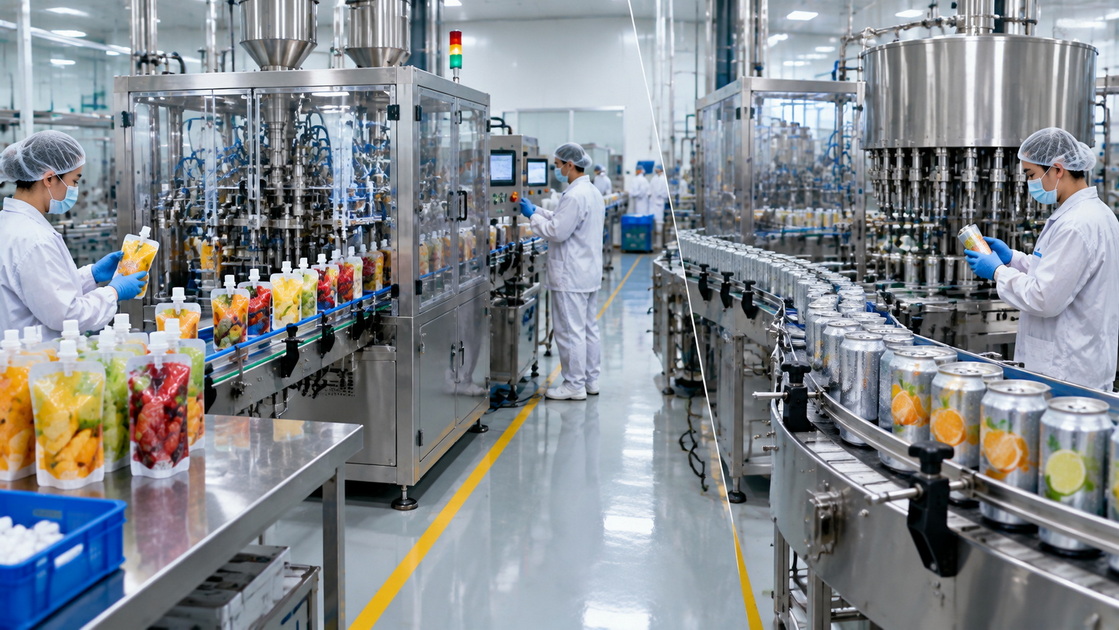
A spout pouch line may require:
- Pouch feeding or rollstock handling
- Product dosing and filling
- Spout insertion or pre-spouted pouch handling
- Cap application and torque control
- Heat sealing
- Leak detection
- Vision inspection
- Date coding
- Secondary packaging
- Optional retort, pasteurization, or aseptic integration
For liquid products, sealing quality is critical. A small contamination area in the seal zone can cause leakage, microbial risk, customer complaints, and product recalls.
At HLun Pack, we recommend evaluating pouch machinery not only by nominal output speed, but also by seal integrity, changeover time, cap handling reliability, cleaning access, reject control, and compatibility with the selected film structure.
An aluminum can line typically includes:
- Depalletizing
- Can rinsing
- Filling
- Lid placement
- Double seaming
- Seam inspection
- Pasteurization or warming, where required
- Coding
- Tray, carton, or multipack application
- Palletizing
For canned beverages, the double seam is one of the most critical quality-control points. Seam defects can compromise package integrity, carbonation retention, and product safety.
For high-volume carbonated drinks, aluminum can systems can provide very high throughput. But they often require larger capital investment, more line space, and a production volume that justifies the equipment scale.
Use this practical five-step process before committing to either a beverage spout pouch or aluminum can.
Document the beverage's:
- Carbonation level
- Acidity and pH
- Oxygen sensitivity
- Light sensitivity
- Viscosity
- Filling temperature
- Shelf-life requirement
- Storage condition
- Distribution environment
A sparkling energy drink, a chilled yogurt beverage, and a shelf-stable fruit concentrate should not be packaged using the same decision criteria.
Ask how the product will be used:
- Is it consumed in one sitting?
- Does it need to be resealed?
- Is it for children?
- Is it poured into another container?
- Is it used while traveling?
- Is portion control important?
- Is premium shelf presentation a priority?
If the answer involves gradual consumption, pouring, or family use, a resealable spout pouch may create a better experience.
Compare more than unit packaging cost. Include:
- Packaging material price
- Filling-line investment
- Labor requirements
- Production speed
- Scrap and leakage rate
- Secondary packaging cost
- Warehouse cost
- Freight cost
- Retail handling
- EPR fees where applicable
- Recycling and sustainability obligations
Do not approve packaging from a sample alone. Run validation tests for:
- Drop resistance
- Compression resistance
- Leak resistance
- Seal integrity
- Cap torque
- Shelf life
- Flavor preservation
- Transportation vibration
- Heat exposure
- Consumer opening and pouring
If using a recyclable claim, verify:
- Material composition
- Spout and cap compatibility
- Local recycling acceptance
- Sorting capability
- Processing availability
- Clear consumer disposal instructions
This protects the brand from misleading environmental claims and helps create a more credible sustainability story.
There is no universal winner in the beverage spout pouch vs aluminum can packaging debate.
Choose a beverage spout pouch when your product needs resealability, lightweighting, flexible branding, controlled pouring, compact storage, or a family-size and multi-use format. It is particularly suitable for smoothies, purées, nutrition drinks, yogurt beverages, concentrates, and non-carbonated functional products.
Choose an aluminum can when your beverage requires maximum protection from light and oxygen, high-speed filling, robust distribution performance, single-serve convenience, or reliable carbonation management. It is a natural fit for sparkling water, soft drinks, beer, energy drinks, RTD coffee, and canned cocktails.
The most successful beverage brands do not choose packaging based on trends alone. They choose it based on the beverage formula, consumer journey, production system, retail channel, and measurable sustainability performance.
HLun Pack helps beverage brands develop flexible packaging solutions, spout pouch systems, and integrated packaging machinery solutions tailored to real production requirements.
Whether you are launching a resealable functional beverage pouch, upgrading a high-barrier liquid packaging format, or evaluating the machinery needed for reliable pouch filling and sealing, our team can help you assess the package structure, equipment configuration, and operational risks before you invest.
Contact HLun Pack to discuss your beverage product, target shelf life, filling method, package size, and production volume—and receive a practical packaging and machinery recommendation built around your project.
Standard beverage spout pouches are generally less suitable for highly carbonated drinks because carbonation creates internal pressure. Specialized flexible packaging structures and closures may be developed for certain applications, but aluminum cans are usually the more proven and scalable choice for carbonated beverages.
It depends on the sustainability metric. A spout pouch can use less material and reduce shipping volume, while an aluminum can has a strong recycling value and a more established recycling pathway in many markets. The best choice should consider local collection systems, recycled content, package weight, product waste, and transportation distance.
Some can be designed for recycling, especially mono-material PE or PP pouch structures with compatible spouts and caps. However, actual recycling depends on local collection, sorting, and processing infrastructure. Multi-layer pouches with mixed materials can be harder to recycle.
Aluminum cans provide a complete barrier against light and strong protection from oxygen and moisture. A well-engineered high-barrier pouch can also provide substantial protection, but its performance depends on the film layers, seal quality, spout system, and application conditions.
A beverage spout pouch is usually a strong option for smoothies and fruit purées because it is resealable, lightweight, easy to squeeze, and convenient for children and active consumers. The final pouch structure should be matched to the required shelf life and filling process.
Spout pouches often have an advantage in empty-package logistics because they can ship flat and occupy less warehouse space. However, aluminum cans can offer handling and stacking benefits for high-volume operations. A total-cost analysis is necessary to determine the real outcome.
A beverage spout pouch packaging line typically includes pouch feeding, filling, spout or cap handling, heat sealing, leak detection, coding, inspection, and secondary packaging. Depending on the product, the line may also require hot-fill, retort, pasteurization, or aseptic capabilities.
1. International Aluminium Institute. "Global Aluminium Can Recycling Reaches 75%, Marking Major Step Toward Circular Economy." Data cited includes a 74.8% global recycling rate for aluminum beverage cans in 2023. [International Aluminium Institute] [international-aluminium]
2. U.S. Environmental Protection Agency. "Aluminum: Material-Specific Data." EPA-reported aluminum container and packaging recycling data, including the 50.4% recycling rate for beer and soft drink cans in 2018. [U.S. EPA] [epa]
3. U.S. Environmental Protection Agency. "Containers and Packaging: Product-Specific Data." Packaging generation and recycling data for aluminum beverage containers. [U.S. EPA] [epa]
4. U.S. Food and Drug Administration. "Food Packaging & Other Substances that Come in Contact with Food." FDA information on food-contact substances, packaging components, and safety assessments related to migration. [U.S. FDA] [fda]
5. Crown Holdings. "Benefits of Beverage Cans." Information on the ability of metal cans to provide a complete barrier against light and oxygen. [Crown Holdings] [crowncork]
6. Deshwal, G.K., Panjagari, N.R., and Alam, T. "An Overview of Paper and Metal Based Food Packaging Materials and Their Application." Peer-reviewed review discussing the barrier properties, recyclability, heating tolerance, and food-packaging uses of metal packaging. [PubMed Central] [pmc.ncbi.nlm.nih]
7. SÜDPACK. "Expands Application Range for Spouted Pouches." Information on mono-PP spouted pouch developments for drinkable yogurt and the relationship between pouch structure, barrier performance, and recycling design. [Packaging Journal] [packaging-journal]


