


close
Choose Your Site
Global
Social Media
Views: 269 Author: HLun PACK Publish Time: 2026-09-26 Origin: Site


Content Menu
● Why Retort Pouches Matter for Modern Food Brands
● Retort Pouch Safety Depends on a Validated System
>> Commercial Sterility Is Product-Specific
>> Retort Temperature Is Only One Variable
● How to Choose the Right Retort Pouch Structure
>> Key Questions Before Pouch Development
>> Foil Versus Clear High-Barrier Structures
>> Food-Contact Compliance Must Be Documented
● The Retort Pouch Production Workflow
>> 1. Confirm Product and Process Parameters
>> 2. Engineer the Pouch Format
>> 3. Validate Filling and Sealing
>> 4. Run the Scheduled Retort Process
>> 5. Cool, Dry, Inspect, and Store
● Seal Integrity: The Most Important Quality-Control Check
● Common Retort Pouch Problems and How to Prevent Them
>> Pouch Bursting or Ballooning
● Retort Pouches Versus Cans: A Practical Comparison
● How HLun Pack Supports Retort Packaging Projects
● Start Your Retort Packaging Project
>> 1. Can any heat-seal pouch be used for retort processing?
>> 2. Are retort pouches safe for low-acid foods?
>> 3. How long does food last in a retort pouch?
>> 4. Can retort pouches go in the microwave?
>> 5. What is the difference between hot-fill and retort pouches?
>> 6. How can a manufacturer test retort-pouch seal quality?
>> 7. What information should I provide when requesting a retort pouch quotation?
Retort pouches are one of the most important flexible packaging formats for brands that need shelf-stable food, strong product protection, and consumer convenience in one pack. Unlike ordinary heat-seal bags, a retort pouch must survive a validated high-temperature, high-pressure thermal process while preserving seal integrity, barrier performance, and food quality.
For food manufacturers, co-packers, pet-food producers, and emerging ready-meal brands, choosing the right retort pouch is not simply a packaging-material decision. It is a product-safety, process-engineering, and brand-positioning decision. At HLun Pack, we view retort packaging as an integrated system: pouch structure, filling method, sealing performance, retort equipment, process validation, cooling, inspection, and final distribution must work together.
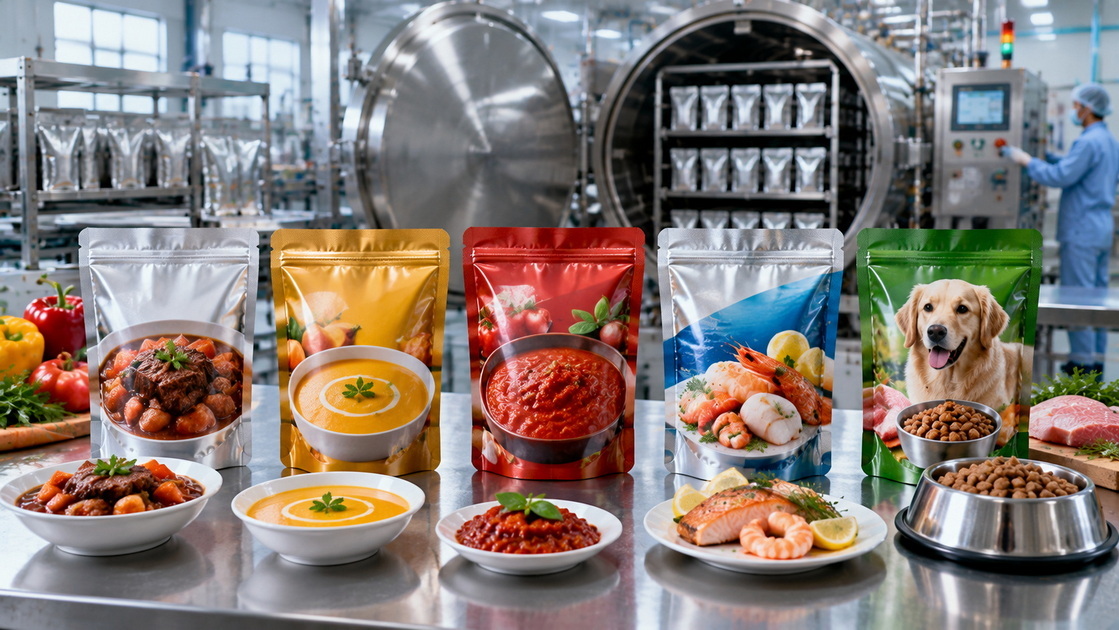
A retort pouch is a multilayer flexible package designed to be filled, hermetically sealed, and heat processed in a retort under controlled temperature and pressure. This process creates a commercially sterile food product that can normally be stored at ambient temperature until opening.
The format is often compared with metal cans because both rely on thermal processing and a hermetic seal to deliver shelf stability. However, retort pouches use flexible laminates rather than rigid steel or aluminum containers. Their thin profile can support faster heat transfer than many traditional rigid formats, while their flat or stand-up design can reduce material use, shipping weight, and warehouse space.
A typical retort pouch may include:
| Layer | Common Material Options | Main Function |
|---|---|---|
| Outer layer | PET, nylon, printed PET | Printability, puncture resistance, mechanical strength |
| Barrier layer | Aluminum foil, metallized film, EVOH-based structure | Protection against oxygen, moisture, aroma loss, and sometimes light |
| Adhesive layer | Retort-grade adhesive | Lamination bonding and thermal-process resistance |
| Sealant layer | Retort CPP or specialized heat-seal resin | Food contact, hermetic sealing, retort resistance |
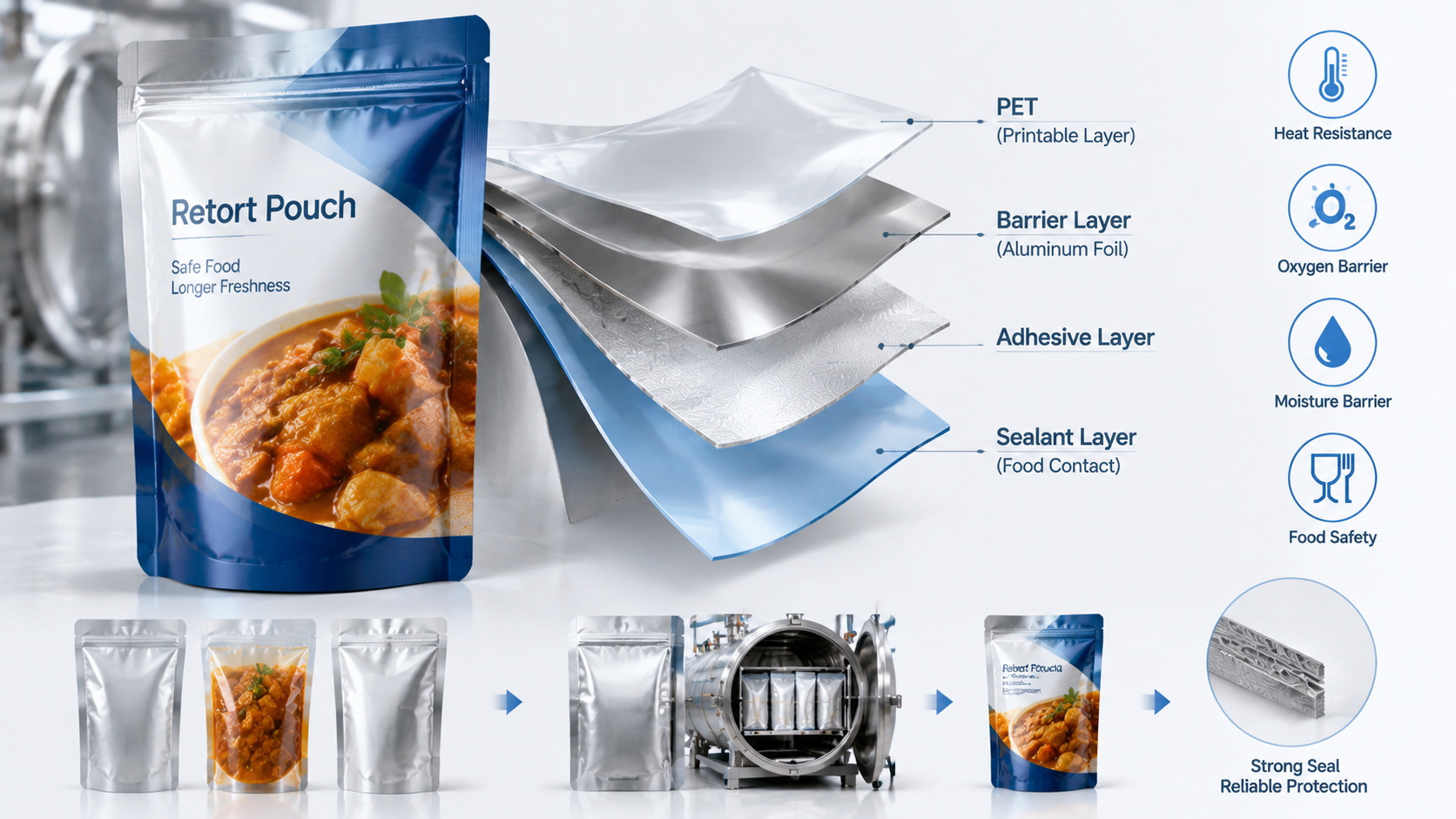
The exact structure should never be selected solely by appearance or a generic material list. It must be matched to the food product, filling temperature, oil and acid content, target shelf life, retort profile, pouch geometry, sealing equipment, and distribution conditions.
For example, a high-fat curry, a low-acid meat stew, a tomato sauce, and a microwaveable vegetable meal can require very different material and process considerations.
Retort pouches combine the shelf stability associated with canned food with the portability and visual flexibility of modern flexible packaging. They are commonly used for ready-to-eat meals, soups, sauces, rice dishes, tuna, seafood, baby food, military rations, camping meals, wet pet food, and nutritional products.
The format can offer several commercial and operational benefits.
- Shelf stability: Properly developed and processed retort products can be stored without refrigeration before opening.
- Lower packaging weight: Flexible pouches generally weigh far less than glass jars and metal cans, which can reduce logistics burdens.
- Compact shipping: Empty pouches are delivered flat, which can substantially reduce storage requirements before filling.
- Fast consumer preparation: Many products can be reheated in hot water, and certain structures can be developed for microwave use when the full package design and instructions support it.
- Large branding surface: Full-surface gravure or digital printing can support photography, nutrition information, multilingual content, product stories, and premium shelf presentation.
- Convenient opening: Tear notches, laser scoring, spouts, and ergonomic pouch shapes can improve the end-user experience.
Retort pouches should not be presented as an automatic replacement for every can or jar. Rigid packaging may still be the better choice for products requiring exceptional crush resistance, a particular premium appearance, easier recycling in a specific market, or high-speed filling infrastructure designed around cans.
The best packaging decision comes from evaluating the entire product system rather than comparing materials in isolation.
A retort pouch is not made shelf-stable simply because it is heated. Food safety depends on a controlled and scientifically validated thermal process, along with correct pouch materials and reliable sealing.
For low-acid shelf-stable foods in hermetically sealed containers sold in the United States, commercial processors must comply with applicable FDA requirements. FDA guidance explains that processors of shelf-stable acidified and low-acid canned foods must register facilities and file scheduled processes for the relevant product, container size and type, and processing method. Flexible retort pouches are included within this broader category of hermetically sealed food containers.
A common mistake is to treat "121°C for 20 minutes" as a universal retort formula. It is not. A safe process depends on variables such as:
- Product pH and water activity
- Product viscosity and particulates
- Fill weight and pouch dimensions
- Headspace and residual air
- Initial product temperature
- Retort type and circulation method
- Heating medium and overpressure control
- Cold-spot location within the product
- Cooling method and cooling-water quality
- Target microorganisms and required lethality
For low-acid foods, the thermal process must be designed to control the risk of *Clostridium botulinum*. A review of retort processing notes that a commonly referenced minimum "botulinum cook" value for low-acid foods is an \(F_0\) value of 3 minutes, but the actual scheduled process must be determined for the specific product and package system rather than copied from another product.
This is why professional food processors work with a qualified process authority. The process authority evaluates heat penetration, determines the scheduled process, and helps ensure that the slowest-heating point in the package receives adequate treatment.
Retort systems often operate within a high-temperature range—commonly around 115°C to 121°C or higher, depending on the product and process. However, processing time, pressure, container loading, and temperature distribution are equally important.
For flexible pouches, overpressure control is especially critical. During heating, water and gases inside the pouch expand. If external counterpressure is inadequate, the pouch can balloon, distort, delaminate, or suffer seal failure. If cooling is poorly managed, a pouch may experience stress damage or contamination risk.
The correct question is not "What retort temperature should I use?" The correct question is: "What validated time-temperature-pressure process is required for this exact food, pouch, fill weight, and retort system?"
A reliable retort pouch starts with a practical packaging brief. Before selecting materials, define the product and process requirements clearly.
1. What product will be packed?
2. Is it low-acid, acidified, oily, salty, particulate, liquid, or highly viscous?
3. What is the target shelf life and distribution climate?
4. Will the pouch be retorted, hot-filled, pasteurized, boiled, or microwaved?
5. What retort process and maximum temperature will be used?
6. Does the product need light protection?
7. Is a transparent viewing window required?
8. What filling and sealing equipment will be used?
9. Does the pouch need a spout, zipper, tear notch, handle, or stand-up gusset?
10. What testing and compliance documents are required in the destination market?
Aluminum foil remains a common barrier material for retort packaging because it offers strong protection from oxygen, moisture, and light. It can be highly suitable for foods that are sensitive to oxidation, light exposure, aroma loss, or long distribution cycles.
However, foil is not always the only solution. Some brands seek transparent or partially transparent pouches for visual appeal, product visibility, or microwave-related design requirements. In those cases, high-barrier structures may use materials such as EVOH or coated films, but the final structure must be evaluated carefully for barrier performance, retort resistance, flex-crack resistance, and shelf-life requirements.
Do not assume that a "clear retort pouch" provides the same light barrier as a foil structure. Product formulation, consumer handling, and retail lighting can all affect the decision.
Food-contact packaging materials must be suitable for their intended use. The U.S. FDA maintains information and inventories for authorized food-contact substances, and specific food-contact clearances may include limitations on food type, temperature, laminate use, and retort-pouch applications.
For an export project, request relevant documentation early, such as:
- Declaration of compliance
- Food-contact material statements
- Migration-test information where applicable
- Material specifications
- Ink and adhesive compliance information
- Retort-condition validation data
- Third-party testing reports
- Batch traceability information
A high-quality retort pack is created through disciplined control from pouch conversion through final inspection. The following workflow is a useful framework for food brands and co-packers.
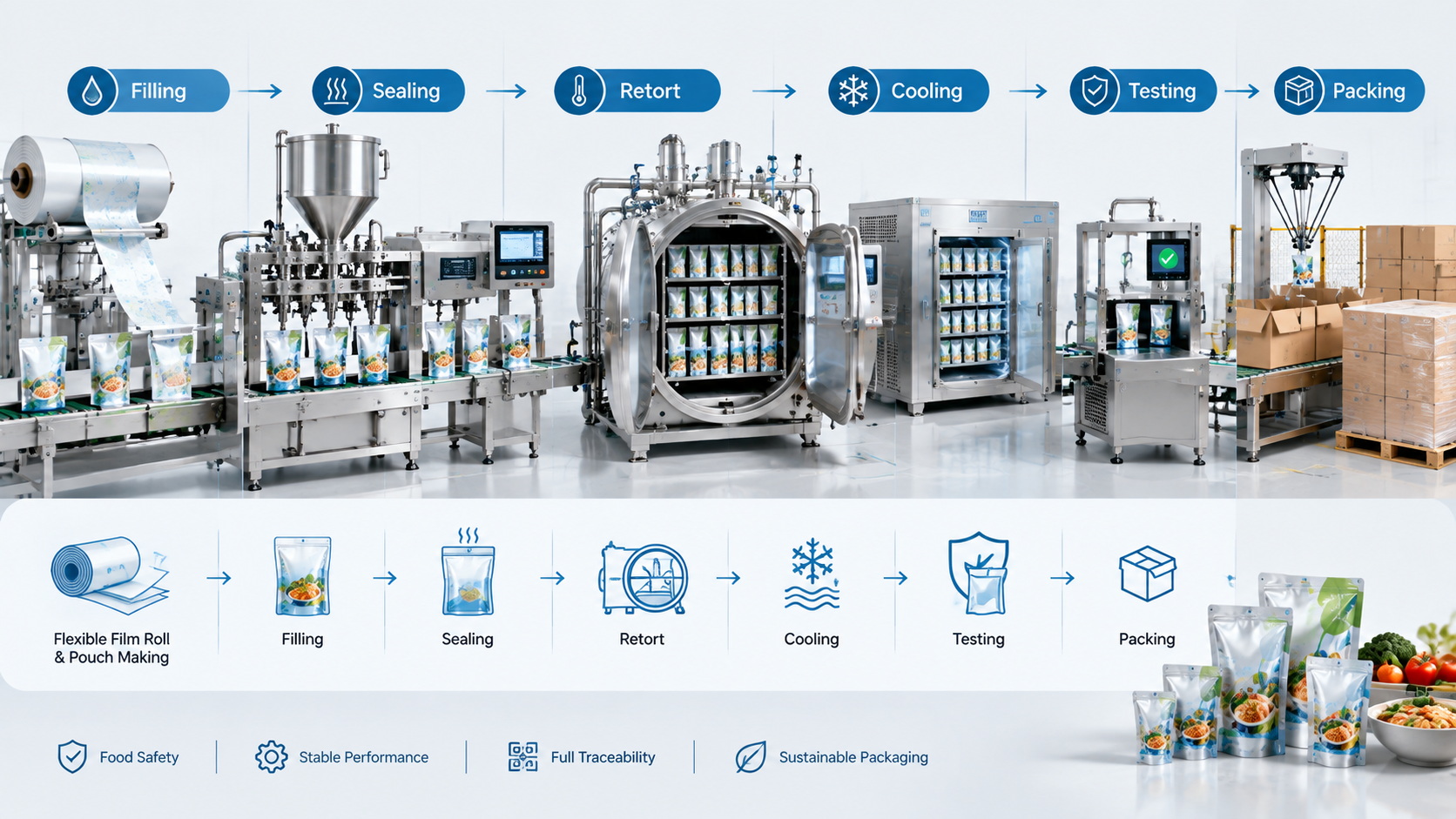
Start with the formula, pH, viscosity, particle size, intended fill weight, required shelf life, and target markets. This information guides both the process authority and the packaging supplier.
Choose the pouch style based on function and consumer experience:
- Three-side-seal pouches for simple, economical applications
- Four-side-seal pouches for a clean, premium flat format
- Stand-up pouches for stronger shelf presence
- Spouted pouches for sauces, purees, and liquid products
- Shaped pouches for brand differentiation
- High-temperature microwaveable formats where suitable
The sealing area must remain clean, dry, flat, and correctly positioned. Food particles, oil, sauce residue, wrinkles, and poor jaw alignment can compromise the hermetic seal.
The Canadian Food Inspection Agency identifies contamination in the seal area as a major cause of retort-pouch seal problems. It also notes that good sealing requires undamaged pouches, clean sealing surfaces, proper pouch placement, and smooth, parallel sealing jaws.
The food is filled and sealed before retorting. The sealed packs are loaded according to the validated retort loading pattern and processed using the approved time-temperature-pressure schedule.
Recordkeeping should include the production date, product identification, retort identification, process temperature, time, pressure, initial temperature where applicable, deviations, corrective actions, and release decisions.
Cooling stops the cooking process and protects product quality. It must also be controlled because poor water quality or damaged seals can create contamination risk.
After cooling, inspect packs for:
- Swelling or abnormal puffing
- Seal wrinkles or channels
- Leakers
- Delamination
- Punctures and flex cracks
- Printing damage
- Distorted gussets or corners
- Poor cosmetic appearance
A retort pouch can have an excellent barrier film and attractive printing, but if its seal fails, the packaging system fails. Seal integrity protects the food from microbial contamination, leakage, spoilage, and consumer complaints.
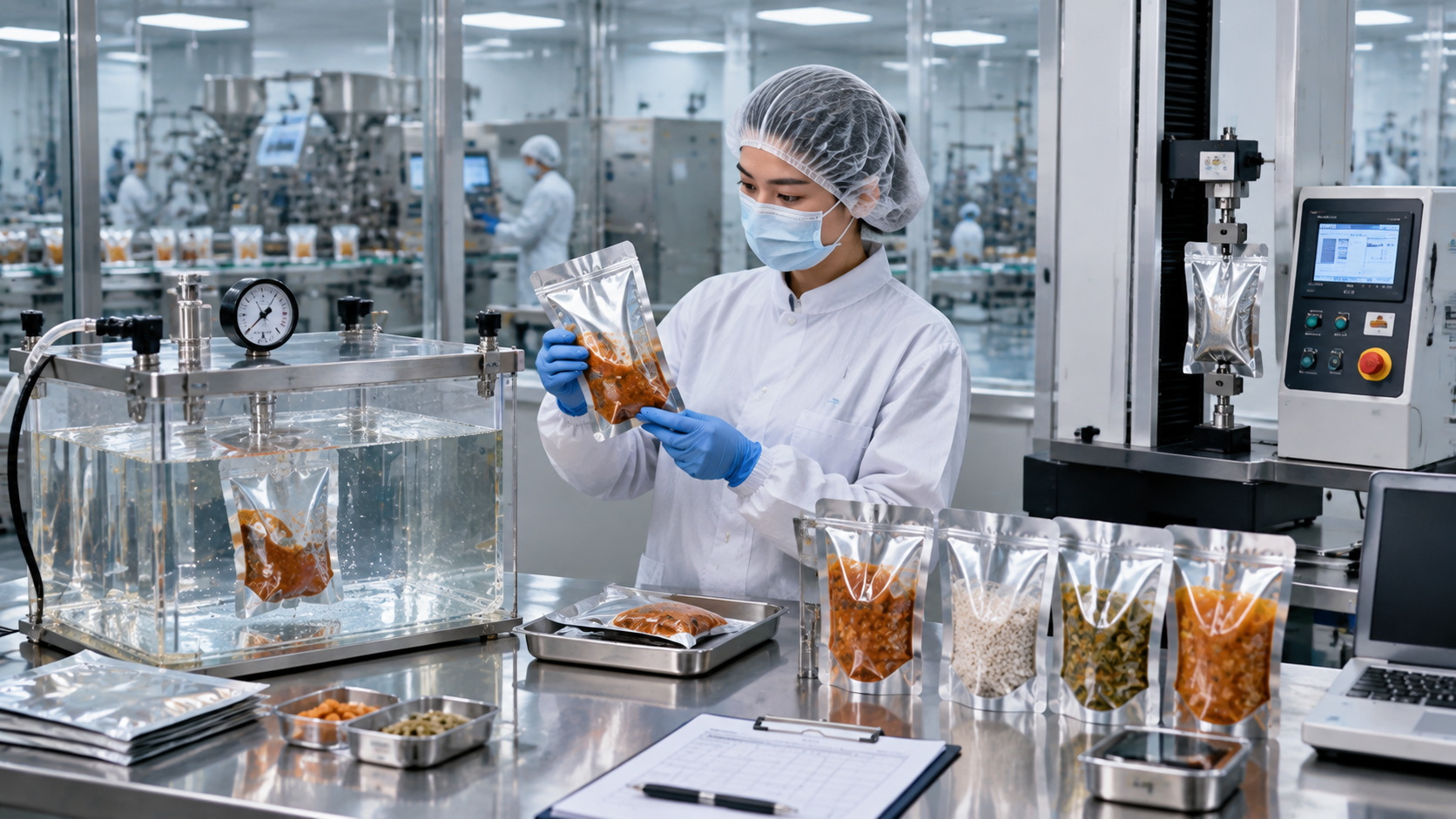
A robust quality-control plan should combine visual inspection with physical testing.
| Test | What It Helps Identify | When to Use It |
|---|---|---|
| Visual seal inspection | Product residue, wrinkles, seal contamination, pouch damage | Every production run |
| Seal-width measurement | Inadequate or inconsistent seal area | Setup and routine verification |
| Burst test | Weak seals and pressure resistance | Before and after retorting |
| Tensile or peel test | Seal weld performance | Routine validation |
| Vacuum leak test | Microleaks and channel leaks | Troubleshooting and verification |
| Dye penetration test | Small seal-channel defects | Investigation and qualification |
Packaging-integrity specialists use methods including burst testing, vacuum testing, dye penetration, and peel testing to assess whether a food package remains intact during its life cycle. Vacuum leak detection can reveal defects by showing bubbles escaping from a submerged pack when a vacuum is applied.
For flexible retort pouches, testing should not stop at the sealing machine. It should also examine pouches after retorting and after storage simulation, because thermal processing and handling can reduce seal strength or expose weaknesses that were not visible before processing.
Cause: Sauce, oil, food particulates, or moisture enter the sealing zone.
Prevention: Improve filling accuracy, keep the seal zone clean, use appropriate filling nozzles, optimize pouch support, and establish frequent seal-area inspections.
Cause: Inadequate counterpressure, incorrect retort profile, excess residual air, overfilling, or unsuitable pouch construction.
Prevention: Validate the retort process, control headspace, use the proper pouch structure, and confirm loading configuration.
Cause: Incompatible adhesive system, inadequate curing, excessive thermal stress, poor material selection, or chemical interaction with the food.
Prevention: Use retort-grade lamination systems, verify curing conditions, conduct product-contact trials, and test finished pouches after retort exposure.
Cause: Rough handling, sharp food particulates, poor case packing, abrasive distribution conditions, or excessive folding.
Prevention: Improve puncture-resistant structure, control product shape, add protective secondary packaging, and conduct transport simulation when appropriate.
Cause: A thermal process that is not optimized for the product's heat penetration characteristics.
Prevention: Work with a qualified process authority, identify the cold spot, validate the process, and control product consistency from batch to batch.
| Factor | Retort Pouch | Metal Can |
|---|---|---|
| Shelf stability | Possible with a validated process | Possible with a validated process |
| Empty-package storage | Ships flat and uses less space | Rigid and requires more storage space |
| Consumer convenience | Tear notches, easy handling, portable | May require a can opener unless easy-open end is used |
| Branding area | Large printable surface | Often uses labels or printed metal |
| Heat transfer | Thin profile can support faster heating | Rigid geometry can require longer heat penetration |
| Puncture resistance | Requires careful material and handling design | Strong resistance to external crushing |
| Recycling pathway | Depends on local flexible-packaging collection systems | Often has established metal recycling streams |
| Premium shelf appearance | High flexibility in shape and graphics | Familiar, durable, traditional format |
The right choice depends on the brand's operations, shelf-life target, product sensitivity, market expectations, logistics, retail format, and end-of-life packaging strategy.
HLun Pack supports food manufacturers and packaging buyers who need more than a standard pouch. We help turn an initial product concept into a packaging system that can be evaluated for performance, processing compatibility, and market readiness.
Our approach focuses on:
- Flexible packaging structure selection based on product and retort conditions
- Custom pouch formats including flat, stand-up, spouted, and shaped solutions
- High-barrier material options for oxygen, moisture, aroma, and light protection
- Custom printing and brand development for stronger shelf communication
- Equipment-oriented packaging support for filling, sealing, and retort workflows
- Packaging-line integration as part of broader packaging machinery and turnkey packaging solutions
- Quality-control planning around seal integrity, thermal-process resistance, and finished-pack inspection
For new projects, we recommend beginning with a technical packaging brief rather than requesting a pouch quotation based only on dimensions. A complete brief saves time, reduces trial failures, and gives suppliers the information needed to recommend a suitable structure.
A successful retort pouch program requires more than a visually attractive bag. It requires the right material structure, correct sealing conditions, validated thermal processing, disciplined quality control, and equipment that supports repeatable production.
If you are developing a shelf-stable meal, sauce, pet-food product, soup, seafood item, or nutritional food product, contact HLun Pack to discuss your packaging requirements. Share your product type, fill weight, target retort conditions, desired pouch format, and sales market, and our team can help you evaluate flexible packaging options and integrated packaging-equipment solutions for your project.
No. A standard heat-seal pouch is not necessarily retortable. Retort packaging must use a laminate structure, adhesives, inks, and sealant layers designed to withstand the required heat, pressure, moisture, and mechanical stress of the validated retort process.
They can be safe when the food, pouch, sealing system, and thermal process are properly designed and validated. Low-acid shelf-stable foods require particular attention because of the risk posed by *Clostridium botulinum*. Commercial processors should work with a qualified process authority and comply with applicable regulations.
Shelf life depends on the food formulation, packaging barrier, retort process, storage temperature, and distribution environment. Many properly processed shelf-stable products may target 12–24 months or longer, but the claimed shelf life should be supported by product-specific validation and storage testing. A general assumption should never replace a documented shelf-life study.
Only if the pouch structure is specifically designed and labeled for microwave use. Foil-based retort pouches should generally not be placed in a microwave. Always follow the product manufacturer's heating instructions.
Hot-fill packaging is designed for products filled at elevated temperatures, often acidic foods such as sauces or beverages. Retort pouches are designed to withstand a more demanding post-seal thermal process under heat and pressure. A hot-fill pouch is not automatically suitable for retort processing.
Manufacturers typically use a combination of visual inspection, seal-width checks, burst testing, tensile or peel testing, vacuum leak testing, and dye penetration testing. Testing should be conducted before and after retort processing because heat exposure can reveal seal weaknesses.
Provide the food type, pH if known, fill weight, pouch dimensions, target shelf life, retort temperature and time, pouch style, filling method, target market, artwork requirements, estimated order quantity, and any required compliance documents. If the retort process is not yet established, state that clearly so the packaging design can be evaluated alongside your process-development plan.
1. U.S. Food and Drug Administration. "[Acidified & Low-Acid Canned Foods Guidance Documents & Regulatory Information]." FDA states that commercial processors of shelf-stable acidified and low-acid foods in hermetically sealed containers for U.S. sale must register establishments and file scheduled processes. [fda]
2. Electronic Code of Federal Regulations. "[21 CFR Part 113—Thermally Processed Low-Acid Foods Packaged in Hermetically Sealed Containers]." Regulatory framework for thermally processed low-acid food operations. [ecfr]
3. U.S. Food and Drug Administration. "[Food Packaging & Other Substances that Come in Contact with Food]." Overview of FDA food-contact-substance information and authorization resources. [fda]
4. U.S. Food and Drug Administration. "[Inventory of Effective Food Contact Substance Notifications]." Example of an authorized adhesive use for laminate constructions in retort pouch applications up to 135°C, subject to stated limitations. [hfpappexternal.fda]
5. Ramesh, M. et al. "[Understanding Retort Processing: A Review]." Review article discussing commercial sterilization, thermal processing conditions, *Clostridium botulinum* control, and shelf-stable food preservation. [pmc.ncbi.nlm.nih]
6. Canadian Food Inspection Agency. "[Flexible Retort Pouch Defects Manual—Identification and Evaluation of Defects]." Guidance on seal contamination, visual checks, seal-width measurement, burst testing, and tensile testing for retort pouches. [inspection.canada]
7. Campden BRI. "[Food Package Strength and Integrity]." Overview of integrity-testing methods, including burst, vacuum, dye penetration, and peel testing. [campdenbri.co]
8. Campden BRI. "[Food Packaging Leak Detection and Seal Strength]." Explanation of vacuum-based packaging leak detection. [campdenbri.co]
9. U.S. Department of Agriculture, Food Safety and Inspection Service. "[Shelf-Stable Food Safety]." Consumer guidance stating that meat and poultry products in retort pouches should follow manufacturer package recommendations after opening, typically 3–4 days refrigerated. [fsis.usda]


