


close
Choose Your Site
Global
Social Media
Views: 197 Author: Hlunpack Publish Time: 2026-07-15 Origin: Hlunpack


Content Menu
>> 1. Does every formulation change require new packaging?
>> 2.Why should packaging be reviewed if the retort process remains unchanged?
>> 3. Is passing a 121°C retort test sufficient?
>> 4. What aspects are typically reviewed during a packaging evaluation?
Retort Packaging Engineering Series · Chapter 1
Product reformulation is a routine part of food innovation.
Manufacturers continuously improve recipes by adjusting ingredients, optimizing flavor profiles and responding to changing consumer preferences. While the product evolves, packaging is often expected to remain unchanged.
From an engineering perspective, however, this assumption deserves careful evaluation.
Packaging is not an independent component. It is engineered to perform with a specific product throughout its entire commercial life cycle.
When a formulation changes—even if the 121°C commercial retort sterilization process, packaging equipment and production workflow remain the same—the environment inside the package may become fundamentally different.
This leads to an increasingly important engineering question:
When should a formulation change trigger a new packaging evaluation?
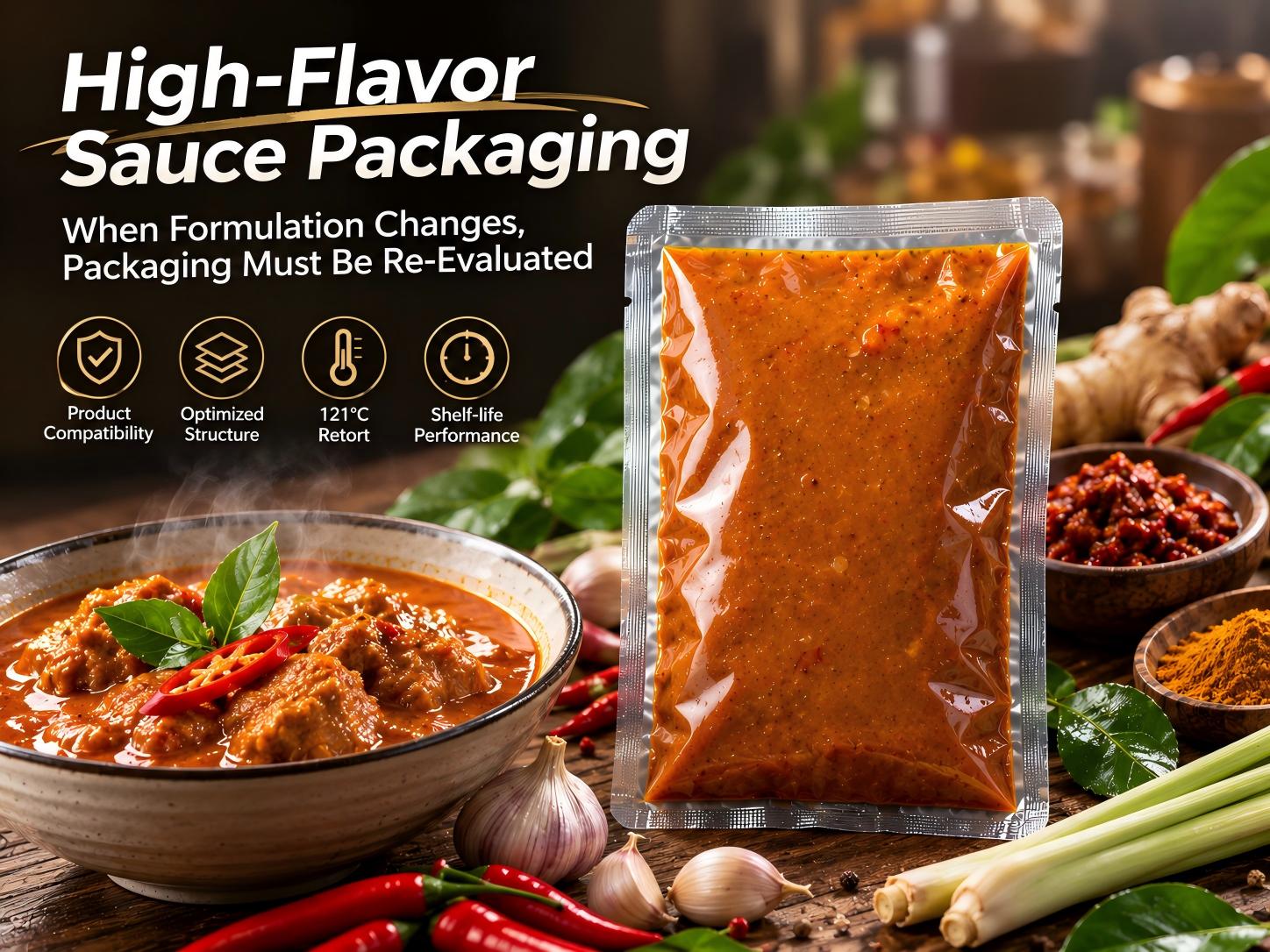
Across multiple retort sauce packaging projects, one engineering observation appears repeatedly.
Packaging that performs consistently with one formulation does not always behave in exactly the same way after the product formulation has been revised.
During production, automatic filling, heat sealing and commercial retort sterilization may continue to operate normally.
However, during subsequent storage evaluation, differences in long-term package performance can occasionally be observed.
These observations do not necessarily indicate packaging failure.
In many cases, seal integrity remains satisfactory and food safety is not affected.
Instead, they indicate that the package is now interacting with a different product environment throughout storage and distribution.
One engineering observation became particularly clear throughout these projects:
The package had not changed—the product had.
When formulation changes are introduced, packaging engineers begin by evaluating the product rather than the packaging materials.
A comprehensive engineering review typically considers the following factors.
* Oil and fat content
* Spice and seasoning system
* Product acidity (pH)
* Water activity (Aw)
* Presence of solid ingredients
* Filling method
* Commercial retort parameters
* Cooling process
* Packaging speed
* Target shelf life
* Export markets
* Tropical storage and transportation conditions
* Warehouse environment
The engineering objective is no longer limited to determining whether the package can withstand 121°C commercial retort sterilization.
Instead, the question becomes:
Can the package continue to perform reliably throughout the product’s entire commercial life cycle?
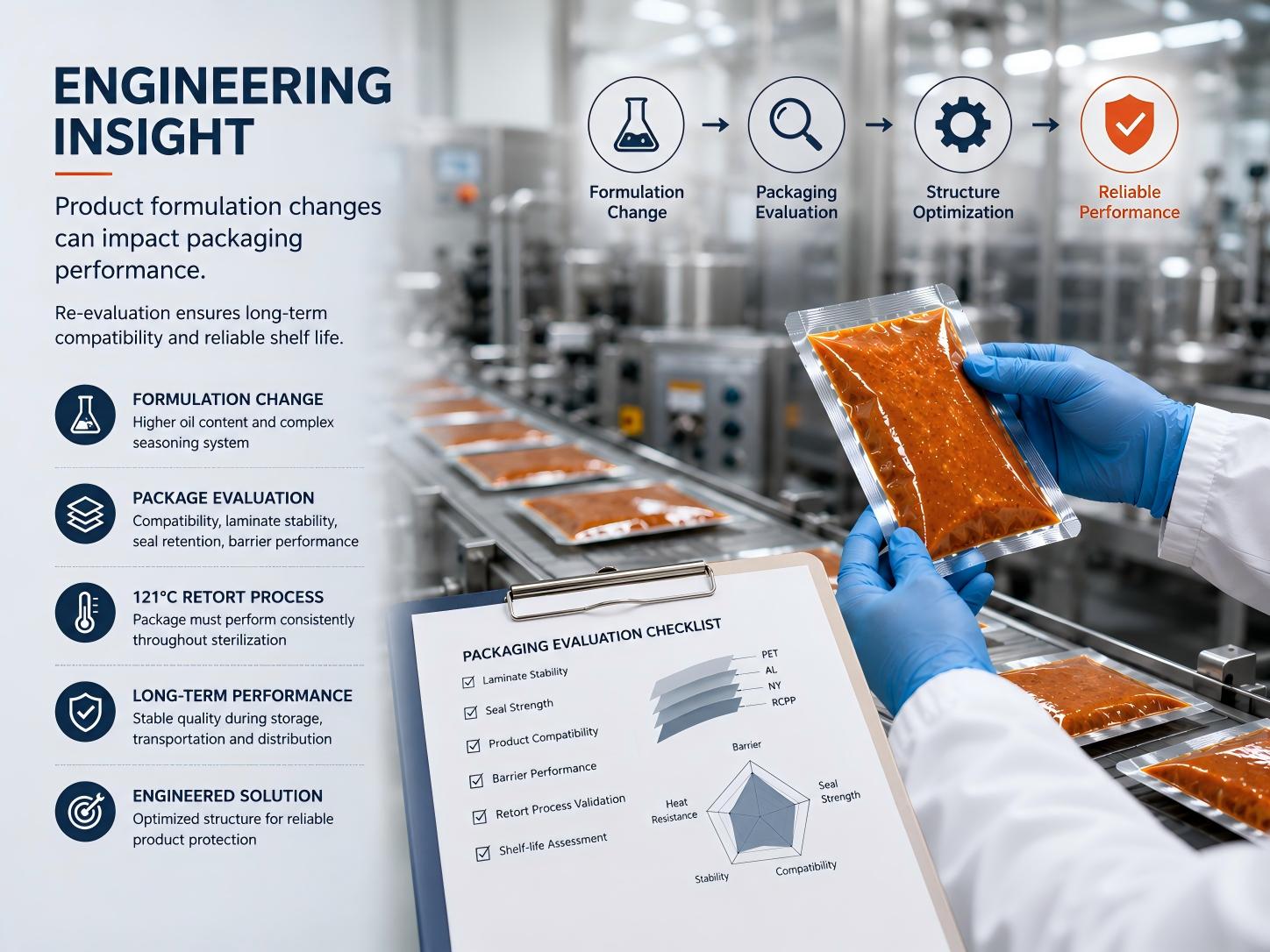
One project involved a food manufacturer supplying high-flavor sauces to Southeast Asian markets.
The customer upgraded the product formulation by increasing the vegetable oil content and refining the seasoning system with natural spices and flavor-enhancing ingredients.
The commercial retort process remained unchanged at 121°C.
During production trials, automatic filling, heat sealing and retort sterilization were completed successfully without abnormalities.
However, during subsequent storage evaluation, engineering observations indicated subtle differences compared with the previous formulation.
Attention was focused on:
* Folded areas of the pouch
* Seal regions
* Laminate stability during storage
Although the package continued to meet product requirements, these observations suggested that the revised formulation had created new engineering considerations for the packaging system.
Rather than assuming the existing laminate remained optimal, the project proceeded to a complete packaging review.
The engineering review did not begin by replacing materials.
Instead, the first objective was to re-establish the relationship between the product formulation and the packaging system.
The review focused on several functional areas:
* Barrier performance throughout shelf life
* Compatibility of the food-contact layer
* Long-term laminate stability
* Seal retention after storage
* Distribution performance under tropical conditions
The review demonstrated an important engineering principle.
Packaging development is rarely about changing one material.
It is about maintaining the balance between product, package, process and distribution environment.
Following the engineering review, the revised packaging system entered the validation stage.
Using the customer’s existing production process, the package successfully completed:
* Heat seal evaluation
* Commercial retort validation
* Laminate integrity assessment
* Vacuum leak testing
* Storage performance observation
* Long-term stability evaluation
The objective of validation was not only to confirm retort resistance, but also to verify that the package remained compatible with the revised formulation throughout its intended commercial shelf life.
Not every product reformulation requires an entirely new package.
However, every formulation change deserves a new engineering evaluation.
Packaging should not only survive the retort process.
It should continue protecting the product throughout storage, transportation and distribution.
A formulation change does not always require a new package.
It should always trigger a new packaging evaluation.
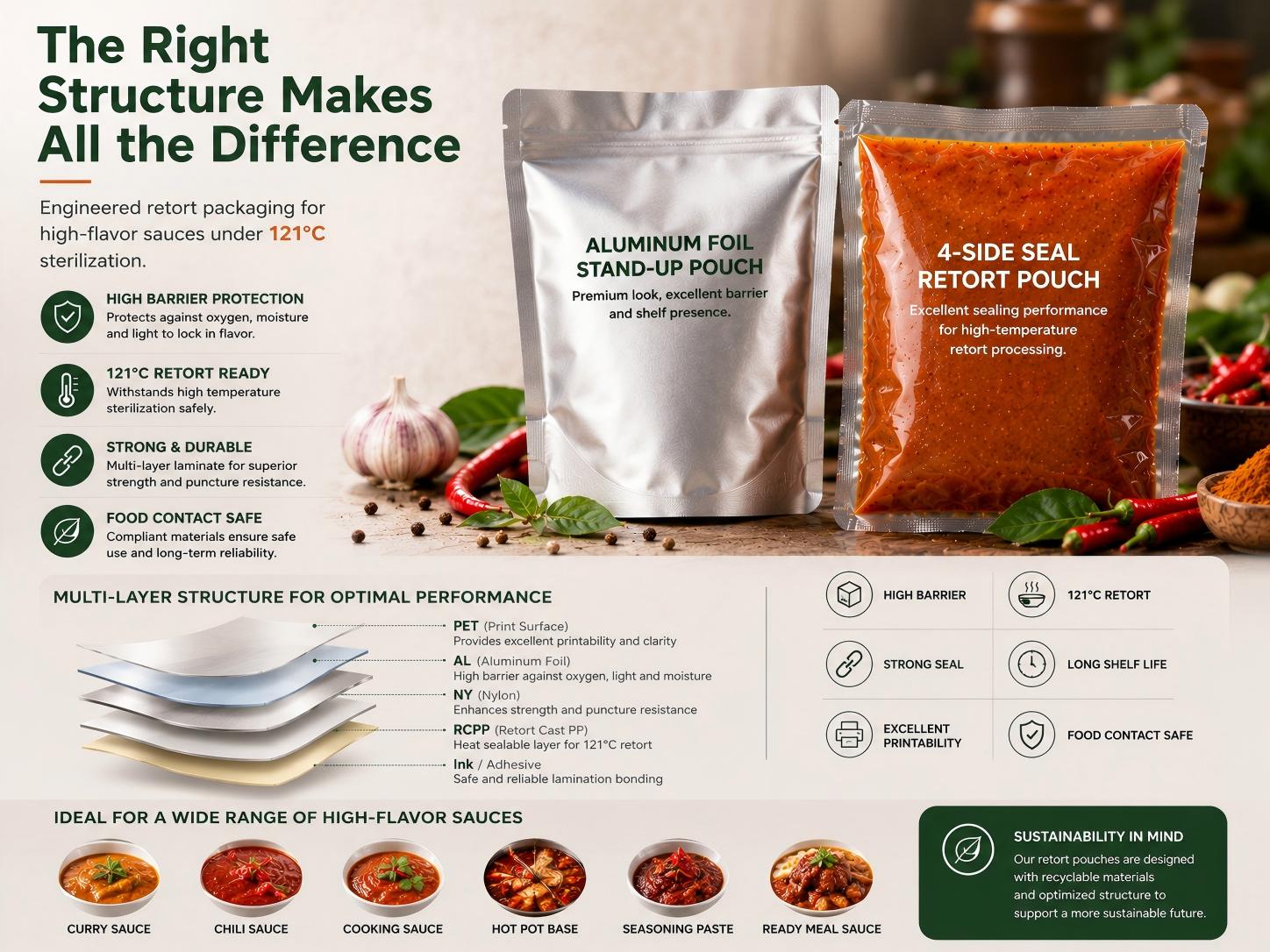
This chapter focuses on:
* Product reformulation
* Packaging compatibility
* Commercial retort packaging
* Engineering evaluation
* Flexible packaging performance
* Shelf-life stability
* High-flavor sauce packaging
* Packaging life-cycle engineering
The engineering principles discussed in this article are applicable to:
* Curry Sauce
* Chili Sauce
* Cooking Sauce
* Meat Sauce
* BBQ Sauce
* Hot Pot Base
* Soup Concentrate
* Ready Meal Sauce
* Other Commercial Retort Foods
Not necessarily.
However, any significant formulation change should trigger a packaging evaluation to confirm long-term compatibility between the product and the packaging system.
Because the product formulation determines the environment in which the package performs throughout storage and distribution. Changes in formulation may influence long-term package behavior even when the sterilization process remains identical.
Not always.
Commercial retort validation confirms package performance during sterilization. Long-term storage, transportation and continuous product contact should also be evaluated.
Engineering reviews commonly assess package compatibility, barrier performance, food-contact layer suitability, laminate stability, seal retention and long-term storage performance.
Understanding when packaging should be re-evaluated is only the first step.
The next engineering decision is equally important:
How should the appropriate retort pouch laminate structure be selected?
In Chapter 2 – “How to Select the Right Retort Pouch Structure for High-Flavor Sauce Packaging”, we will explore how packaging engineers determine laminate structures based on formulation, retort conditions, shelf-life requirements and distribution environments rather than simply selecting higher-specification materials.
HLunPACK specializes in flexible packaging, paper packaging and packaging machinery for food, pharmaceutical and consumer product industries. By integrating material engineering, laminate design and manufacturing expertise, we help customers develop packaging systems that balance product protection, production efficiency and long-term commercial performance.


