


close
Choose Your Site
Global
Social Media
Views: 257 Author: Hlunpack Publish Time: 2026-08-03 Origin: Hlunpack


Content Menu
>> Seal Leakage
>>> Background
>>> Common Causes
>>> Engineering Prevention Strategy
>> Delamination
>>> Background
>>> Common Causes
>>> Engineering Prevention Strategy
>>> Background
>>> Common Causes
>>> Engineering Prevention Strategy
>>> Background
>>> Common Causes
>>> Engineering Prevention Strategy
>>> Background
>>> Common Causes
>>> Engineering Prevention Strategy
>>> Background
>>> Common Causes
>>> Engineering Prevention Strategy
>>> Background
>>> Common Causes
>>> Engineering Prevention Strategy
>>> Packaging Failure Prevention Checklist
>> 1. Why do retort pouches leak after sterilization?
>> 2. What causes laminate delamination?
>> 3. Can thicker films eliminate puncture damage?
>> 4. How can packaging failures be minimized?
Retort Packaging Engineering Series · Chapter 7
Engineering Approaches to Improving Package Reliability
Flexible packaging is expected to maintain product integrity throughout processing, transportation, storage and retail distribution.
However, packaging failures may still occur even when packages appear visually acceptable after production.
Most failures are not caused by a single material or manufacturing defect. Instead, they typically result from the interaction of product characteristics, material selection, laminate structure, package design, manufacturing processes and distribution conditions.
Understanding these interactions enables packaging engineers to identify potential risks early and improve long-term package reliability.
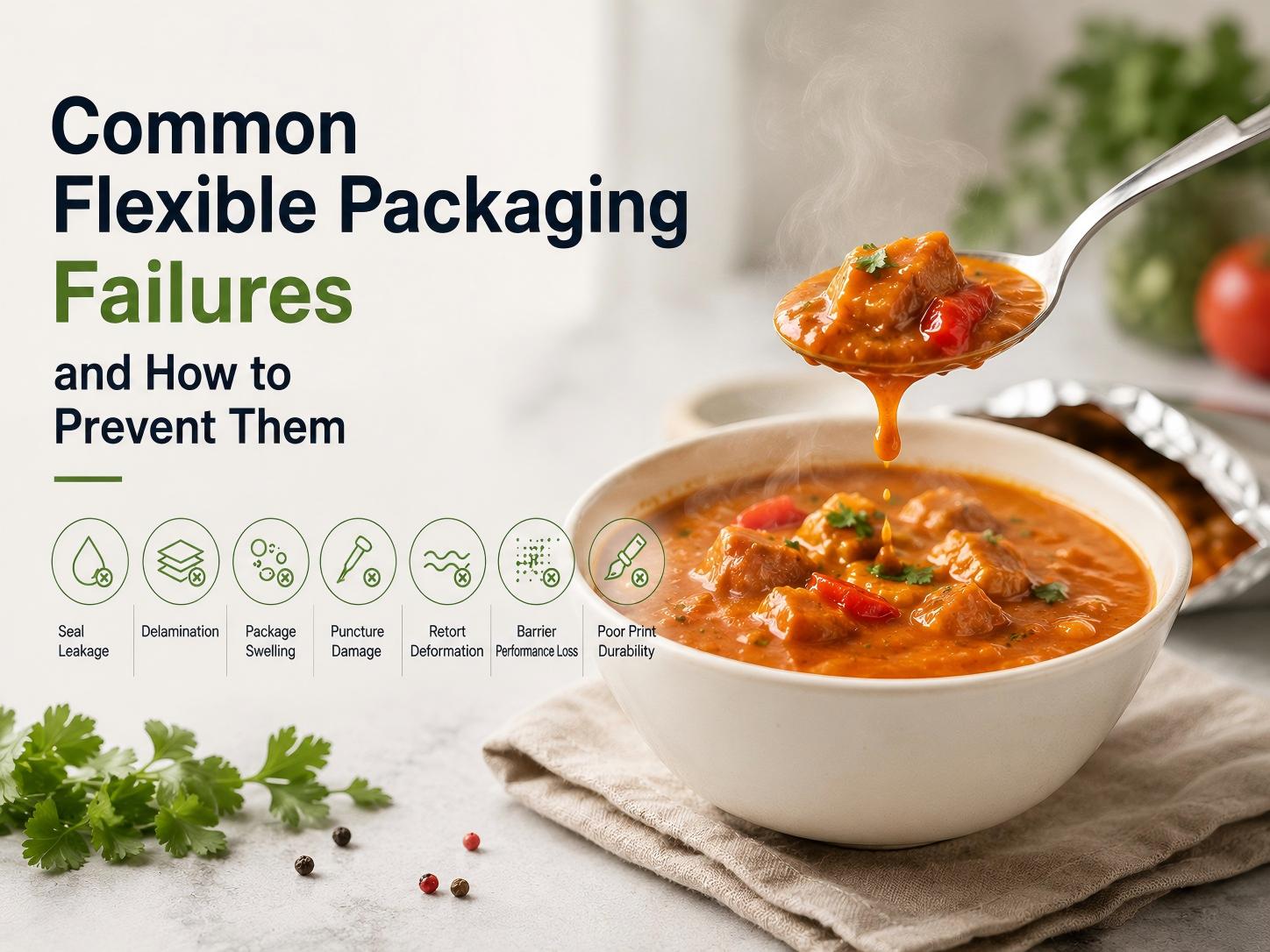
Common packaging failures encountered in commercial food applications include:
* Seal Leakage
* Delamination
* Package Swelling
* Puncture Damage
* Barrier Performance Loss
* Retort Deformation
* Print Durability Issues
Although these failures appear different, many share common engineering causes.
Successful packaging engineering focuses on preventing failures during development rather than correcting them after commercialization.
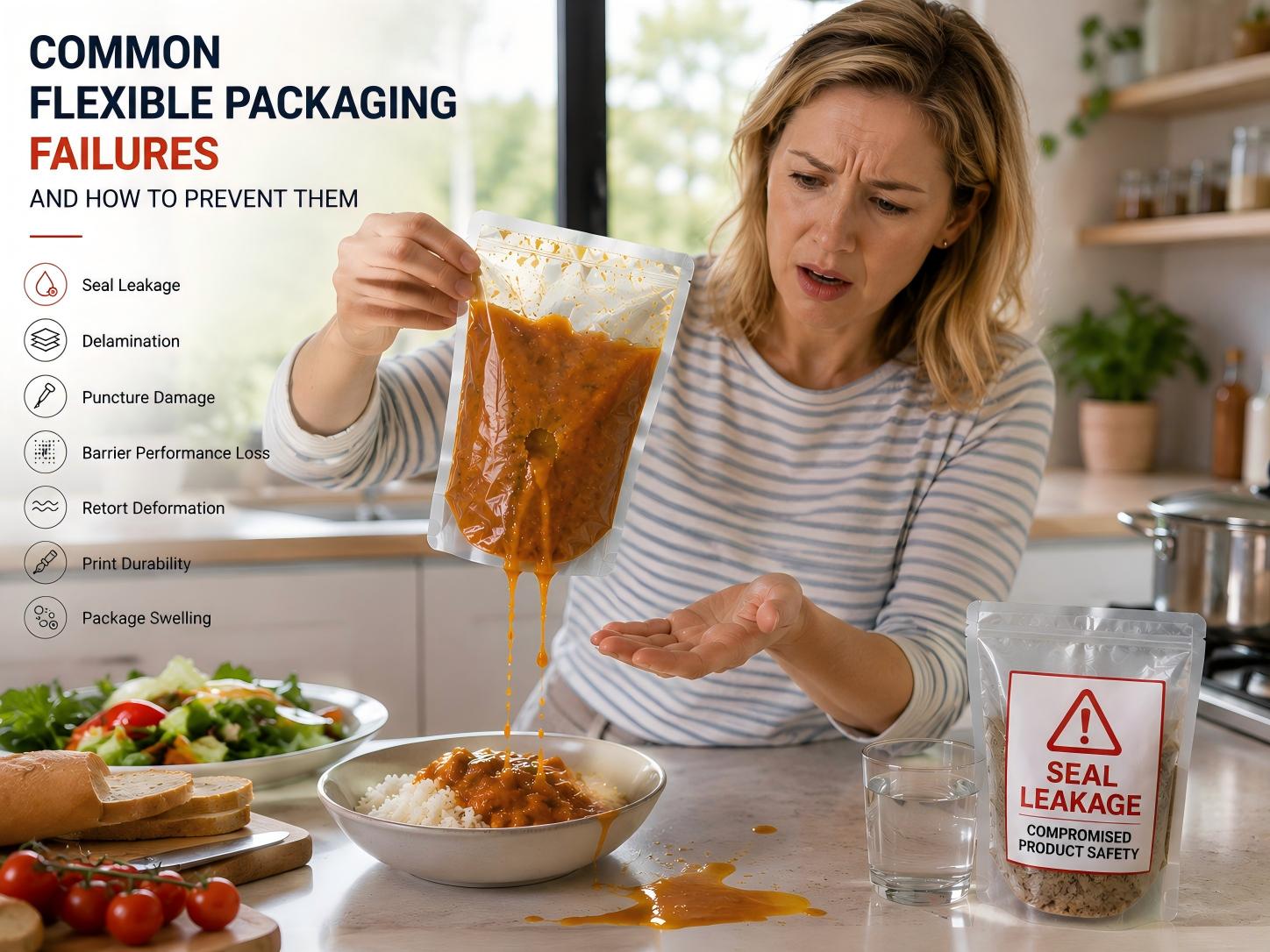
Seal integrity is one of the most critical performance indicators in flexible packaging.
Even a small sealing defect may compromise product safety, reduce shelf life and increase the risk of microbial contamination.
* Inappropriate sealing temperature
* Insufficient sealing pressure
* Inadequate dwell time
* Product contamination in the seal area
* Unsuitable sealant material
* Uneven sealing jaw temperature
Packaging engineers typically reduce seal leakage by:
* Developing a validated seal window based on temperature, pressure and dwell time.
* Selecting CPP or RCPP sealant layers compatible with the product and sterilization process.
* Designing filling operations to prevent product contamination within the sealing area.
* Monitoring sealing equipment to maintain stable process conditions.
* Verifying sealing performance after retort processing rather than only before sterilization.
Typical validation includes:
* Seal Strength Test
* Vacuum Leak Test
* Dye Penetration Test
* Burst Test
Lamination creates a single engineered structure from multiple materials.
Loss of interlayer adhesion may reduce mechanical strength, barrier performance and overall package reliability.
* Incorrect adhesive selection
* Insufficient curing time
* Excessive residual solvent
* Retort conditions exceeding laminate capability
* Poor material compatibility
Packaging engineers generally:
* Select adhesives designed for the required retort temperature.
* Allow sufficient curing before converting or filling.
* Control residual solvent levels during lamination.
* Match laminate materials with compatible surface treatments.
* Evaluate laminate performance throughout the intended shelf life.
Typical validation includes:
* Peel Strength Test
* Retort Resistance Test
* Accelerated Aging Test
* Laminate Bond Evaluation
Packages containing sharp or rigid products experience concentrated mechanical stress during filling, transportation and handling.
Structural reinforcement is often more effective than simply increasing film thickness.
* Bone-in meat products
* Shellfish
* Frozen foods with sharp edges
* Hard ingredients
Packaging engineers commonly:
* Incorporate nylon (PA) into laminate structures.
* Increase the PA layer when additional puncture resistance is required.
* Evaluate product geometry to identify stress concentration areas.
* Optimize pouch dimensions to reduce localized stress.
* Improve secondary packaging to minimize transportation damage.
Typical validation includes:
* Puncture Resistance Test
* Drop Test
* Compression Test
* Transportation Simulation
Barrier performance should be designed according to product sensitivity rather than selecting the highest available barrier.
Over-designed structures increase cost, while under-designed structures may shorten shelf life.
* Insufficient barrier design
* High temperature or humidity exposure
* Package damage
* Product formulation changes
Packaging engineers typically:
* Define OTR and WVTR targets according to shelf-life objectives.
* Develop barrier requirements through shelf-life modeling.
* Select high-barrier structures only where technically required.
* Evaluate export environments with temperature and humidity simulation.
* Reassess barrier requirements whenever product formulations change.
Typical validation includes:
* Oxygen Transmission Rate (OTR)
* Water Vapor Transmission Rate (WVTR)
* Shelf-Life Validation
* Environmental Simulation
Retort sterilization subjects packaging to high temperature and pressure.
Different laminate layers expand and contract differently during heating and cooling, creating internal stress.
* Material shrinkage mismatch
* Poor dimensional stability
* Improper retort profile
* Excessive filling volume
Packaging engineers generally:
* Select PET films with excellent dimensional stability.
* Balance thermal shrinkage characteristics across laminate layers.
* Optimize retort heating and cooling profiles.
* Control filling volume to minimize internal pressure.
* Design pouch geometry suitable for sterilization.
Typical validation includes:
* Retort Simulation
* Dimensional Stability Evaluation
* Seal Integrity Inspection
* Appearance Assessment
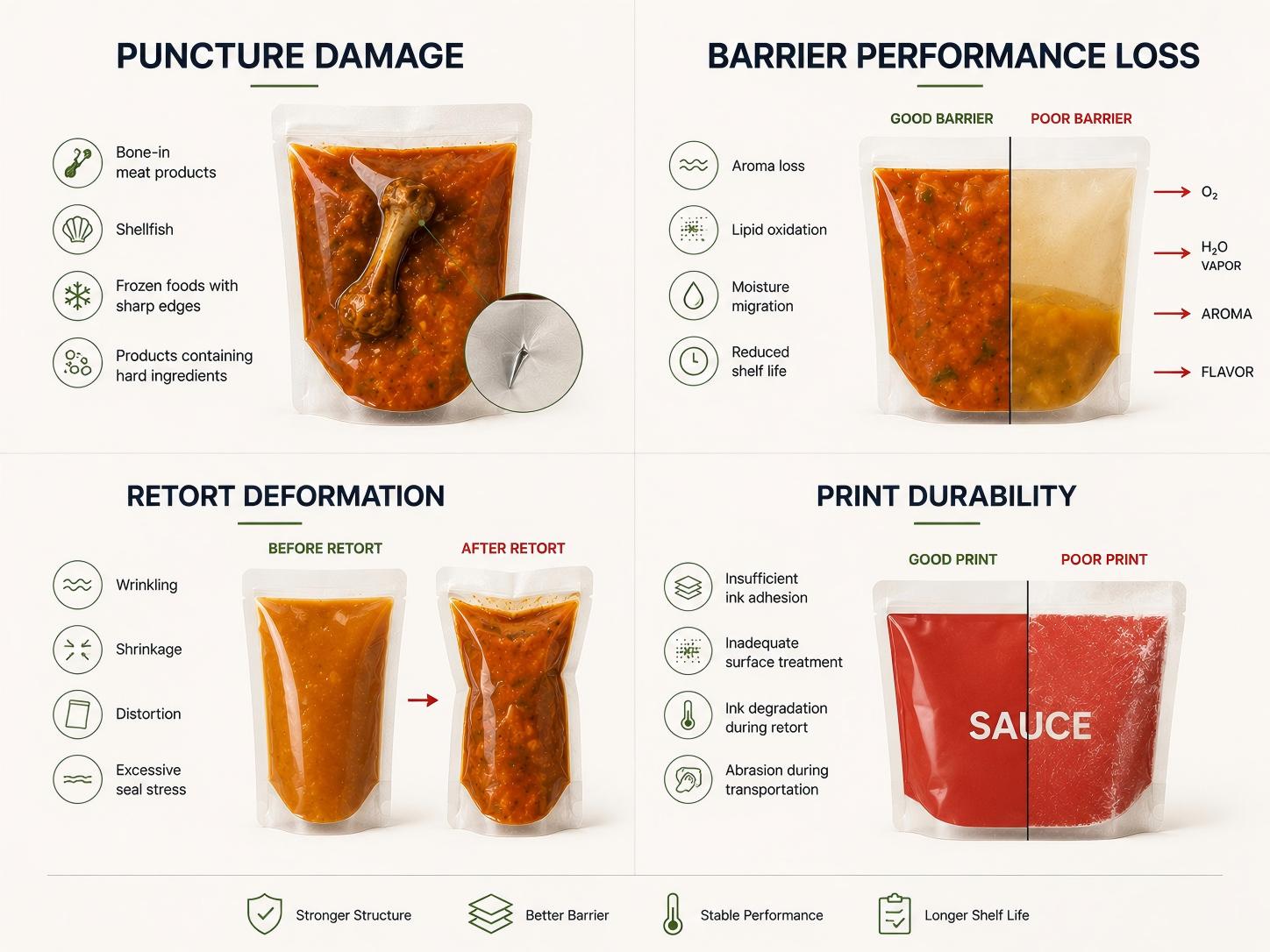
Packaging graphics should remain legible throughout production, transportation and shelf life.
Print durability contributes to both product appearance and brand consistency.
* Poor ink adhesion
* Inadequate corona treatment
* Ink degradation during retort
* Abrasion during transportation
Packaging engineers typically:
* Maintain appropriate corona treatment levels.
* Select ink systems suitable for retort applications.
* Evaluate abrasion resistance under transportation conditions.
* Apply protective surface finishes where necessary.
* Validate print performance after retort and distribution simulation.
Typical validation includes:
* Ink Adhesion Test
* Rub Resistance Test
* Retort Print Evaluation
* Transportation Simulation
Package swelling may indicate loss of package integrity or microbiological activity.
It is one of the most critical quality concerns for shelf-stable food products.
* Inadequate sterilization
* Seal leakage
* Microbial contamination
* Product formulation changes
* Barrier performance degradation
Packaging engineers generally:
* Validate commercial sterilization processes.
* Verify seal integrity after retort processing.
* Conduct microbiological challenge studies where appropriate.
* Monitor shelf-life performance throughout commercialization.
* Revalidate packaging whenever product formulations change.
Typical validation includes:
* Commercial Sterility Validation
* Microbiological Testing
* Shelf-Life Validation
* Seal Integrity Testing
Before commercial production, packaging engineers typically verify:
Engineering Evaluation Recommended
Product Compatibility Assessment ✓
Material Structure Evaluation ✓
Seal Window Validation ✓
Laminate Bond Strength Test ✓
Oxygen Transmission Rate (OTR) ✓
Water Vapor Transmission Rate (WVTR) ✓
Retort Validation ✓
Vacuum Leak Test ✓
Drop Test ✓
Transportation Simulation ✓
Accelerated Aging Test ✓
Shelf-Life Validation ✓
Reliable flexible packaging is achieved through the integration of material engineering, laminate design, sealing technology, process control and validation testing.
The most effective way to reduce packaging failures is to identify potential risks during package development—not after products reach the market.
* Packaging Failure Analysis
* Seal Integrity
* Delamination
* Barrier Performance
* Retort Packaging
* Packaging Validation
* Packaging Reliability
* Quality Control
* Engineering Prevention
Applicable to:
* Ready Meals
* Retort Sauces
* Soup Products
* Meat Products
* Seafood
* Pet Food
* Dairy Products
* Frozen Foods
* Coffee
* Powdered Foods
Seal leakage is typically associated with sealing parameter variation, seal contamination, unsuitable sealant materials or excessive stress during retort processing. A complete evaluation of seal design, process settings and package structure is recommended.
Delamination may result from adhesive incompatibility, insufficient curing, excessive retort conditions or poor laminate design.
Not necessarily. Optimizing laminate structures and incorporating reinforcement materials such as PA is generally more effective than simply increasing overall thickness.
Packaging failures are best reduced through systematic engineering, including material selection, laminate design, process optimization and comprehensive validation before commercialization.
In Chapter 8 – The Future of Flexible Packaging: Sustainability, High-Barrier Innovation and Smart Packaging, we will explore how recyclable mono-material structures, advanced barrier technologies and digital manufacturing are shaping the future of flexible packaging engineering.
HLunPACK provides integrated solutions for flexible packaging, paper packaging and packaging machinery for the food, pharmaceutical and consumer goods industries.
Through material engineering, packaging design and manufacturing expertise, we help customers develop packaging systems that improve product protection, production efficiency and long-term commercial performance.


