


close
Choose Your Site
Global
Social Media
Views: 257 Author: Hlunpack Publish Time: 2026-08-25 Origin: Hlunpack


Rethinking Shelf-Stable Tuna Packaging Beyond the Traditional Can
A seafood producer approached HLunPACK to explore replacing part of its conventional canned tuna range with high-barrier retort pouches - not simply to change appearance, but to redesign packaging weight, logistics, retail flexibility and shelf-stable product development.
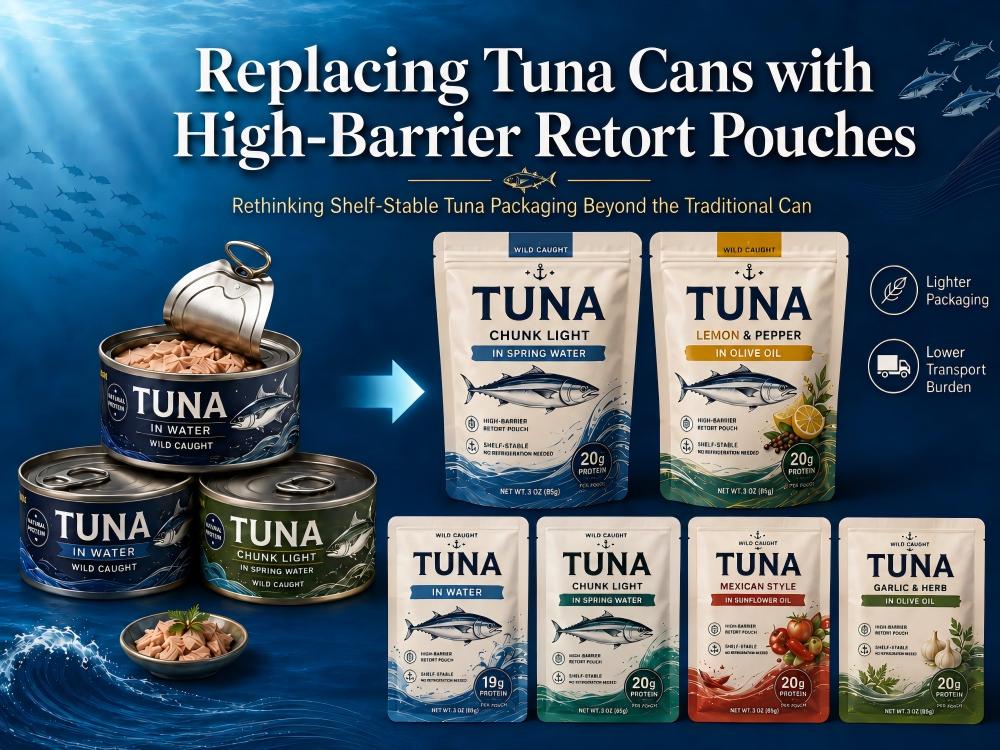
Metal cans have been the standard packaging format for shelf-stable tuna for decades.
They are strong, reliable and supported by a highly established processing and distribution system.
But one seafood producer approached us with a different question:
Does shelf-stable tuna still have to be packed in a metal can?
The customer wanted to develop a new packaging format using a high-barrier retort pouch capable of commercial thermal sterilization, with the intention of gradually replacing part of its conventional canned tuna range.
The goal was not simply to change the appearance of the package.
The customer wanted to:
· Reduce packaging weight
· Reduce the logistics burden of importing empty packaging
· Improve shipping and storage efficiency
· Create more convenient retail formats
· Maintain long ambient shelf life
· Develop new portion sizes and flavored tuna products
· Explore a packaging system with lower material-related environmental impact
This turned the project into something much larger than a pouch-development exercise.
It became a redesign of the customer's shelf-stable tuna packaging platform.
The first question we considered was whether the market itself supported such a transition.
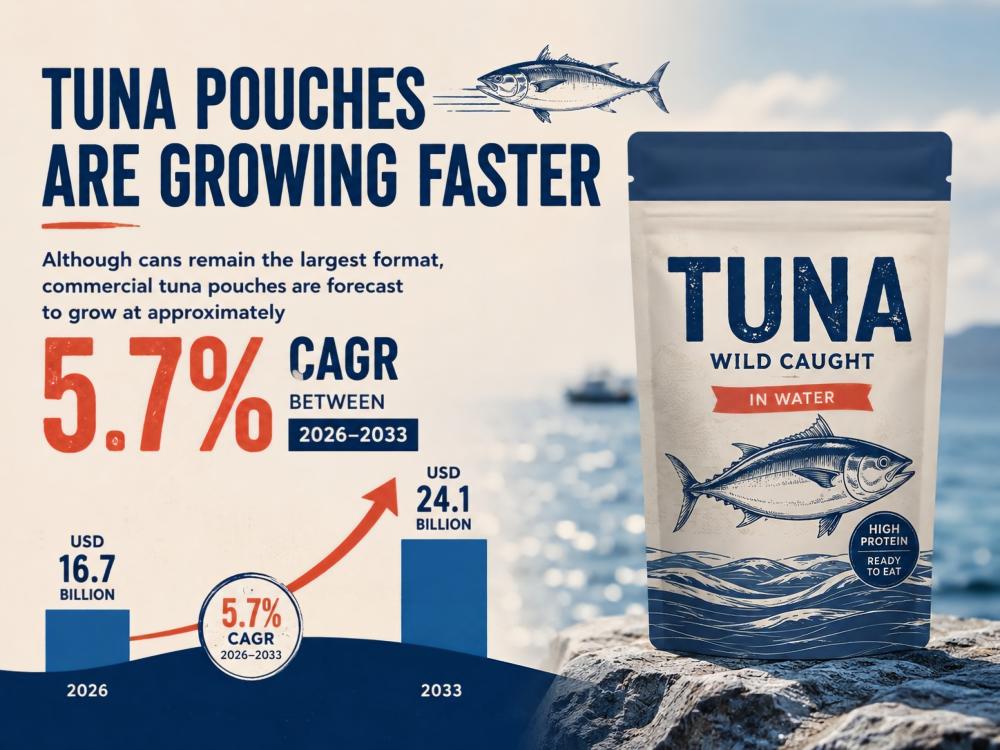
Current industry forecasts indicate that the global packaged tuna market was valued at approximately USD 16.0 billion in 2025, is estimated at USD 16.7 billion in 2026, and is projected to reach approximately USD 24.1 billion by 2033, representing a CAGR of about 5.3% from 2026 to 2033. (Grand View Research)
Metal cans remain dominant.
In 2025, canned tuna represented approximately 67.5% of the packaged tuna market. (Grand View Research)
This is important.
We do not believe retort pouches are about to make traditional tuna cans disappear.
Cans + Pouches + Portion Packs - each format serving different consumption occasions.
Although cans remain the largest format, commercial tuna pouches are forecast to grow at approximately 5.7% CAGR between 2026 and 2033.
Convenience, portability, ready-to-eat consumption and portion control are among the factors supporting this growth. Pouched tuna is particularly suited to office meals, meal preparation, fitness-oriented diets and on-the-go consumption. (Grand View Research)
The market is also moving beyond plain tuna in oil or brine.
· Lemon Pepper Tuna
· Chili Tuna
· Mediterranean Tuna
· Seasoned Tuna
· Single-Serve Protein Packs
These formats are creating additional reasons for producers to reconsider traditional packaging formats.
Recent retail launches are already showing this direction. In 2025, for example, Chicken of the Sea and McCormick introduced new seasoned tuna packets designed for ready-to-eat consumption. (Grand View Research)
The pouch is not simply an alternative container. It can become a platform for developing new shelf-stable tuna products.
The trend is not limited to North America or Europe.
The Asia-Pacific packaged tuna market is forecast to grow at approximately 5.5% CAGR from 2026 to 2033, supported by demand for convenient, high-protein and easy-to-prepare seafood products across markets including Japan, South Korea, China, Thailand and Australia. (Grand View Research)
For seafood processors located in Asia, this creates an interesting opportunity.
They can continue serving traditional canned-tuna markets while developing pouch formats for:
· Retail
· Convenience Stores
· E-commerce
· Travel
· Outdoor Food
· Meal Kits
· Other emerging consumption channels
One of the customer's biggest concerns was not the tuna itself. It was the packaging logistics.
A metal can already has a fixed three-dimensional shape before it reaches the tuna-processing plant.
When empty cans are imported, the customer is effectively paying to transport:
Metal Weight + Empty Container Volume
Retort pouches are fundamentally different. Before filling, they can be transported flat and densely packed.
That creates the potential for:
· Lower Packaging Weight
· Higher Empty-Pack Shipping Density
· Lower Warehouse Space Requirements
· Improved Container Utilization
For a seafood producer importing large volumes of primary packaging, these factors can have a direct effect on logistics cost.
We therefore looked at the project not only in terms of price per package, but in terms of total packaging logistics per finished unit of tuna.
The environmental discussion around cans and flexible packaging needs to be handled carefully.
A review of seafood life-cycle-assessment studies found that, for canned seafood products, packaging represents on average approximately 27% of final product weight and contributes around 42% of the product's climate-change impact, although actual values vary widely depending on product, packaging material, production location and recycling assumptions. (Journal of Industrial Ecology / Springer-linked review)
This makes packaging selection particularly important for shelf-stable seafood.
The same review found that previous tuna studies had identified potential environmental improvements from replacing tinplate packaging with lighter packaging alternatives, while also emphasizing that environmental results depend heavily on the assumptions used in each life-cycle analysis. (Journal of Industrial Ecology / Springer-linked review)
Not necessarily.
And this distinction is important.
A tuna-specific carbon-footprint study found that manufacturing retort pouches produced approximately 60% less greenhouse-gas emissions than manufacturing metal cans.
However, when the researchers evaluated the entire tuna packaging system rather than only manufacturing the container, the pouch was not automatically the lowest-carbon option. (Wiley Online Library)
Other seafood life-cycle studies have reached different conclusions depending on processing assumptions, transport, package weight, recycling and system boundaries. (Seafood LCA review)
Therefore, we would not describe this project with a simple marketing statement such as "60% Lower Carbon Footprint."
Without a product-specific LCA, that would be too broad.
A more accurate description: Reduced Packaging Material and Logistics Burden
The pouch has clear engineering advantages in reducing package mass and transporting empty packaging more efficiently.
The final carbon footprint must still be evaluated using the customer's actual:
· Supply chain
· Retort process
· Energy source
· Distribution distance
· Secondary packaging
· Waste treatment
· Recycling system
This distinction makes the sustainability argument much more credible.
Making the package lighter does not make the engineering requirement easier. In fact, the opposite is often true.
Shelf-stable tuna is a high-moisture, protein-rich food that requires a validated commercial sterilization process.
The package therefore needs to provide several functions simultaneously:
· Hermetic Seal Integrity
· Retort Resistance
· Very High Oxygen Barrier
· Moisture Barrier
· Light Protection
· Oil Resistance
· Puncture Resistance
· Mechanical Strength During Distribution
Official Canadian guidance for flexible retort pouches specifically identifies low oxygen permeability, low moisture permeability, sterilizability, resistance to oils and food components, and sufficient physical strength against tearing, pin-holing, impact and abrasion as essential characteristics of a satisfactory retort pouch. (Canadian Food Inspection Agency)
The pouch is much lighter than a metal can, but it still has to perform the same fundamental food-protection function.
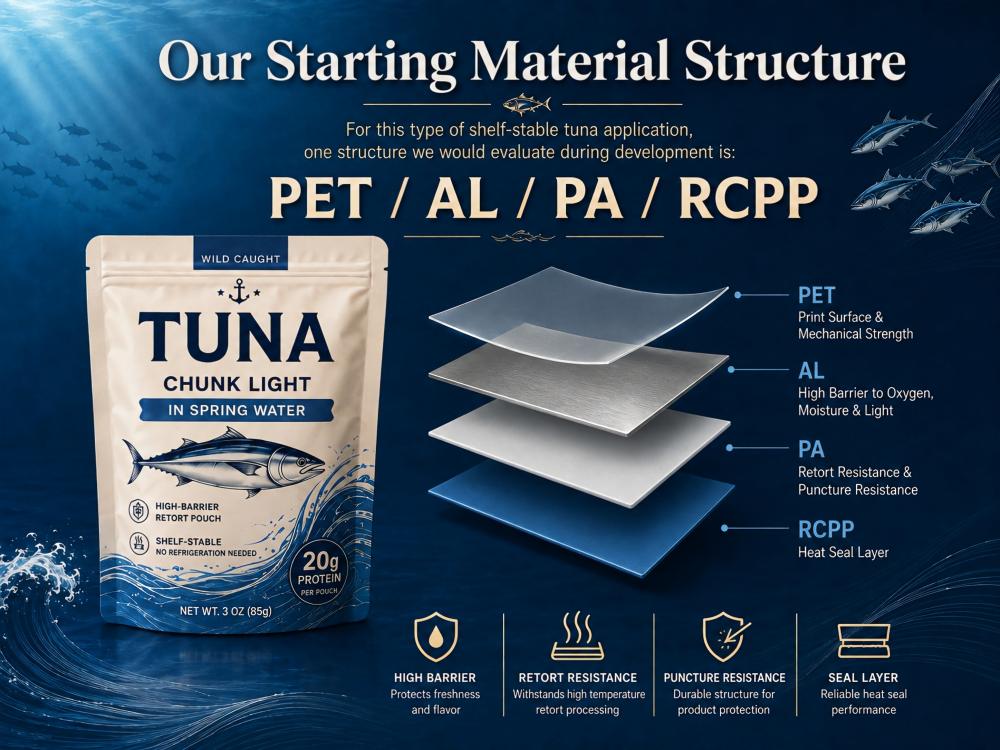
For this type of shelf-stable tuna application, one structure we would evaluate during development is:PET / AL / PA / RCPP
A representative engineering starting point could be:
Layer |
Reference Thickness |
Main Function |
PET |
12 microns |
Printing, dimensional stability and outer mechanical protection |
Aluminum Foil |
7-9 microns |
High oxygen, moisture and light barrier |
PA / Nylon |
15 microns |
Puncture resistance and mechanical strength |
RCPP |
70-80 microns |
Food-contact sealant and retort-resistant heat-seal layer |
Nominal film thickness: approximately 104-116 microns before allowing for adhesive layers and final specification tolerances.
A four-layer PET 12 microns / Aluminum 9 microns / Nylon 15 microns / CPP 70 microns retort structure has been used in published thermal-processing research, providing a useful technical reference for this type of laminate design. (PubMed Central (PMC))
Another published high-barrier pouch study used PET 12 microns / Aluminum 9 microns / BOPA 15 microns / RCPP 80 microns, illustrating how the sealant thickness can be adjusted depending on processing and mechanical requirements. (Washington State University)
These figures should be treated as an engineering starting range, not as the final specification for every tuna product.
The final laminate must be determined according to:
· Tuna piece size
· Net weight
· Oil or brine filling medium
· Pouch dimensions
· Retort temperature
· Process duration
· Drop and transport requirements
· Required shelf life
· Target market regulations
For long-term ambient seafood storage, oxygen and light can have a major effect on product quality.
The aluminum layer provides extremely strong protection against oxygen, water vapor and light, while the PA layer improves mechanical durability and puncture resistance.
The RCPP layer provides the food-contact sealing surface and must retain seal integrity after thermal processing.
This layered approach allows an extremely thin flexible package to perform functions that would otherwise be provided by a much thicker rigid container.
This is one area where retort-pouch technology can continue to evolve.
A recent study evaluated reducing aluminum foil thickness in a retort pouch from 9 microns to 7 microns.
Under the conditions tested, the researchers reported no significant deterioration in the relevant barrier performance after retort processing, storage and simulated transportation. (Wiley Online Library)
This does not mean every retort pouch should immediately move to 7 microns aluminum.
Material Optimization Without Sacrificing Barrier Performance
Instead of only asking "Can we replace a metal can with a pouch?", future packaging development will increasingly ask: "How much material does the pouch actually need to deliver the required shelf life and process performance?"
That is a much more advanced sustainability question.
Another major difference between a can and a pouch is geometry.
A conventional can has a relatively deep product cross-section. A flat retort pouch can spread the tuna over a thinner profile.
This can shorten the distance heat must travel before reaching the slowest-heating region of the product.
That creates the potential for more efficient heat penetration and, depending on the validated process, shorter thermal exposure.
But this advantage must never be treated as a fixed processing rule.
For low-acid foods, thermal processing must be established for the actual product and container.
This is particularly important for flexible retort packaging.
Current FDA low-acid retorted-food filing documents specifically identify flexible pouches as a container type and require information including: (U.S. Food and Drug Administration)
· Maximum thickness during retort processing
· Maximum residual air
· Whether physical restraint is used
· Whether overpressure is used
These are not simply packaging-design details. They can affect heat penetration and package behavior during sterilization.
Residual air, for example, can cause significant pouch expansion during retort processing and may influence heating behavior depending on the process configuration. (U.S. Food and Drug Administration)
This is why we would never define the process simply as "121°C for 30 minutes."
That may sound convenient in marketing material, but it is not how a commercially sterile tuna process should be established.
A temperature around 121°C is widely associated with commercial retort processing, but the final scheduled process cannot be determined by the pouch supplier alone.
It must be validated according to the actual product and filling configuration.
Important variables may include:
· Tuna Piece Size
· Oil / Brine / Sauce Ratio
· Net Weight
· Initial Product Temperature
· Pouch Length and Width
· Maximum Filled Thickness
· Residual Air
· Product Arrangement
· Retort Type
· Heating Medium
· Retort Position
· Heat-Penetration Data
· Target F0 / Commercial Sterility Requirement
FDA's current low-acid retort filing framework specifically treats product form, packing medium, container dimensions, maximum pouch thickness and process conditions as part of the scheduled thermal process. (U.S. Food and Drug Administration)
Retort pouch development is not only a material project. It is a material + product + process project.
This is where the pouch begins to offer something different from the traditional can.
The customer can now consider multiple pack sizes such as 80g, 100g, 150g, 200g and 250g without being restricted to the same conventional can formats.
The same packaging platform can also support different product concepts:
Tuna in Brine - A classic shelf-stable product in a lighter and easier-to-open format.
Tuna in Olive Oil - Suitable for premium positioning and Mediterranean-style products.
Chili Tuna - A ready-to-eat flavored product designed for convenience retail.
Lemon Pepper Tuna - A modern single-serve option for salads, sandwiches and meal preparation.
High-Protein Tuna Pack - A portion-controlled format for sports, fitness and on-the-go consumption.
This is where we see the strongest future opportunity.
We do not expect one packaging format to dominate every market. Instead, shelf-stable tuna is becoming more segmented.
will remain important for:
· Traditional retail
· Family consumption
· Large-volume production
· Markets with established can-recycling infrastructure
· Customers prioritizing rigid-package durability
have stronger potential in:
· Single-serve products
· Ready-to-eat tuna
· Flavored tuna
· Office lunches
· Fitness and high-protein snacks
· Travel and outdoor food
· E-commerce multipacks
· Lightweight export-oriented products
The numbers support this direction.
The overall packaged tuna market is expected to grow at approximately 5.3% annually through 2033, while the commercial pouch segment is forecast at approximately 5.7% annually over the same period. (Grand View Research)
Can + Pouch - Each Designed for a Different Consumer Need
Product |
Shelf-Stable Tuna |
Original Packaging |
Metal Can |
New Packaging Direction |
High-Barrier Retort Pouch |
Reference Laminate Concept |
PET / AL / PA / RCPP |
Engineering Starting Range |
PET 12 microns / AL 7-9 microns / PA 15 microns / RCPP 70-80 microns |
Reference Nominal Thickness |
Approximately 104-116 microns, before adhesive and final manufacturing tolerances |
Typical Retort Temperature Reference |
Around 121°C, subject to product-specific validation |
· High oxygen barrier
· High moisture barrier
· Light protection
· Oil resistance
· Puncture resistance
· High-temperature resistance
· Stable heat-seal performance
· Long-term package integrity
· Reduce primary packaging weight
· Reduce the logistics burden of importing empty packaging
· Improve storage and shipping efficiency
· Maintain ambient shelf-stable protection
· Develop more flexible retail pack sizes
· Create new ready-to-eat tuna formats
· Reduce packaging-related environmental impact where validated
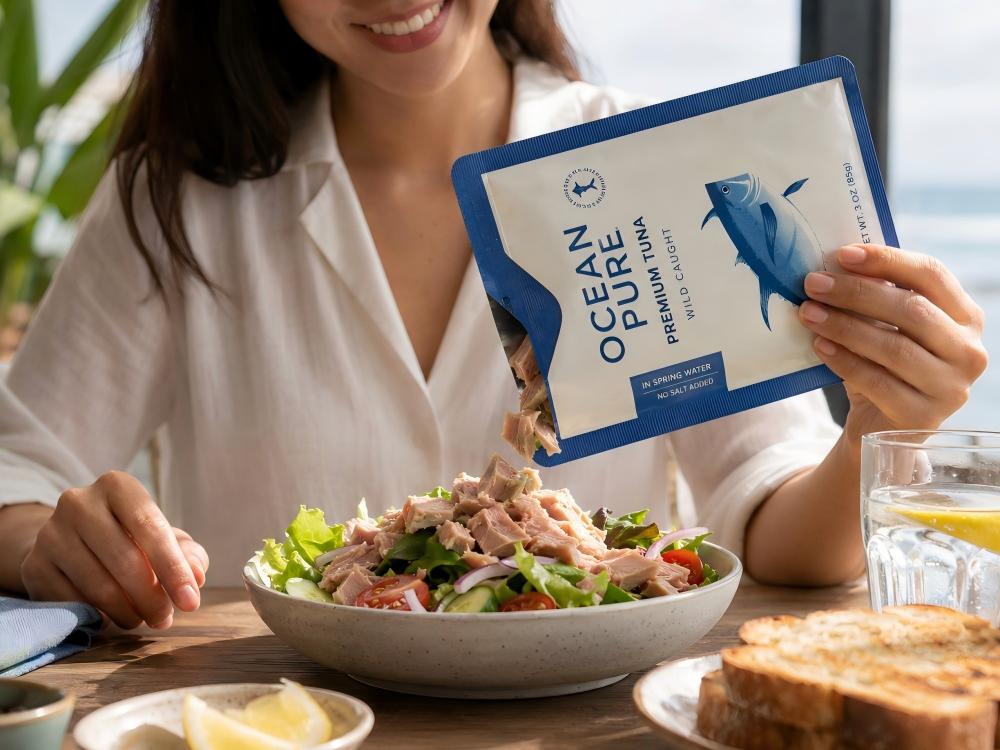
At first glance, the project appears simple:
Metal Can -> Flexible Pouch
But the real transformation is much larger.
It changes:
· Packaging Weight
· Inbound Logistics
· Storage Efficiency
· Thermal Processing Geometry
· Pack Size Flexibility
· Retail Convenience
· Product Development Possibilities
· Potential Packaging-Related Environmental Impact
The objective is not to make a thinner version of a tuna can.
It is to use flexible packaging to rethink how shelf-stable tuna can be manufactured, transported, sold and consumed.
For HLunPACK, the key question in this project was therefore not:
"Can we manufacture a retort pouch for tuna?"
It was:
"Can this pouch reliably take over the protection role of the metal can while giving the customer a lighter, more flexible and commercially valuable packaging platform?"
That is what makes this project more than a packaging change.
It is a new direction for shelf-stable seafood packaging.
Flexible Packaging / Paper Packaging / Packaging Machinery
From high-barrier laminate development and retort pouch design to filling compatibility and packaging-system planning, we develop packaging solutions around the customer's actual product, processing conditions and market requirements.
Market and technical references cited in this case include Grand View Research, the U.S. Food and Drug Administration, the Canadian Food Inspection Agency, PubMed Central, Washington State University, Wiley Online Library, and seafood life-cycle-assessment literature. The market figures and published laminate structures are presented as external reference data; final pouch specifications and retort schedules require product-specific validation.


