


close
Choose Your Site
Global
Social Media
Views: 260 Author: HLun PACK Publish Time: 2026-09-06 Origin: Site


Content Menu
● What Does a Packaging Line Include?
● Why Flexible Packaging Lines Need Specialized Design
>> Typical Flexible Packaging Line Configuration
● Main Types of Packaging Lines for Flexible Packaging
>> Granule and Snack Packaging Lines
>> Liquid and Sauce Pouch Packaging Lines
>> Premade Pouch Packaging Lines
● Packaging Line vs. Standalone Packaging Machine
● How to Design a Packaging Line That Performs Reliably
>> Start With Product and Packaging Data
>> Balance Speeds Across the Entire Line
>> Design for Changeovers, Not Only Maximum Speed
● Quality Control: Build It Into the Line
● Common Packaging Line Problems and How to Avoid Them
>> Bottlenecks Between Machines
>> Film Tracking and Registration Errors
>> Difficult Cleaning and Maintenance
● Choosing the Right Packaging Line Supplier
● Build a Flexible Packaging Line Around Your Real Production Needs
>> 1. What is a packaging line?
>> 2. What is the difference between a packaging machine and a packaging line?
>> 3. Which machine is used for flexible packaging?
>> 4. How do I choose the right flexible packaging line?
>> 5. What is OEE in a packaging line?
>> 6. Why is seal integrity important in pouch packaging?
>> 7. Can a flexible packaging line be upgraded later?
A packaging line is an integrated system of machines, controls, material-handling equipment, and quality-inspection devices that work together to convert a product into a finished, shipment-ready package. For flexible packaging manufacturers, the line commonly handles processes such as product feeding, dosing, bag or pouch forming, filling, sealing, coding, inspection, case packing, and palletizing.
At HLun Pack, we view a packaging line as more than a collection of individual machines. A successful line is a coordinated production system designed around the product, packaging material, output target, factory layout, quality requirements, and future growth plan. When the system is engineered correctly, it can improve consistency, reduce manual handling, control product waste, and create a more reliable path from bulk product to finished flexible packages.
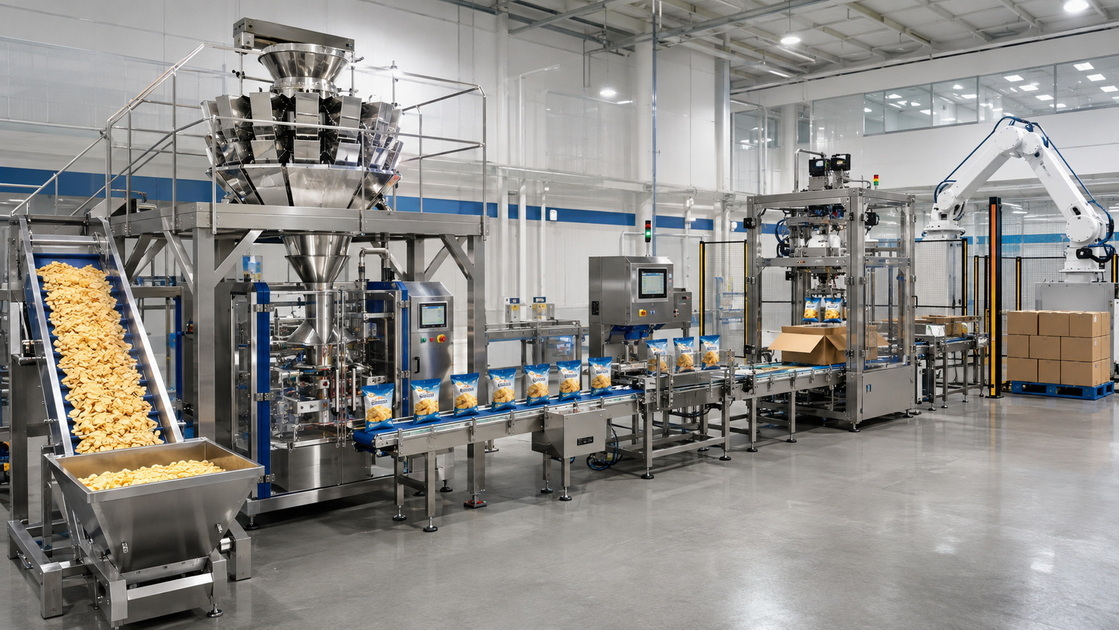
A packaging line brings several packaging operations into one connected workflow. Rather than moving products manually between standalone machines, the product and packaging materials move through synchronized stations at a planned speed.
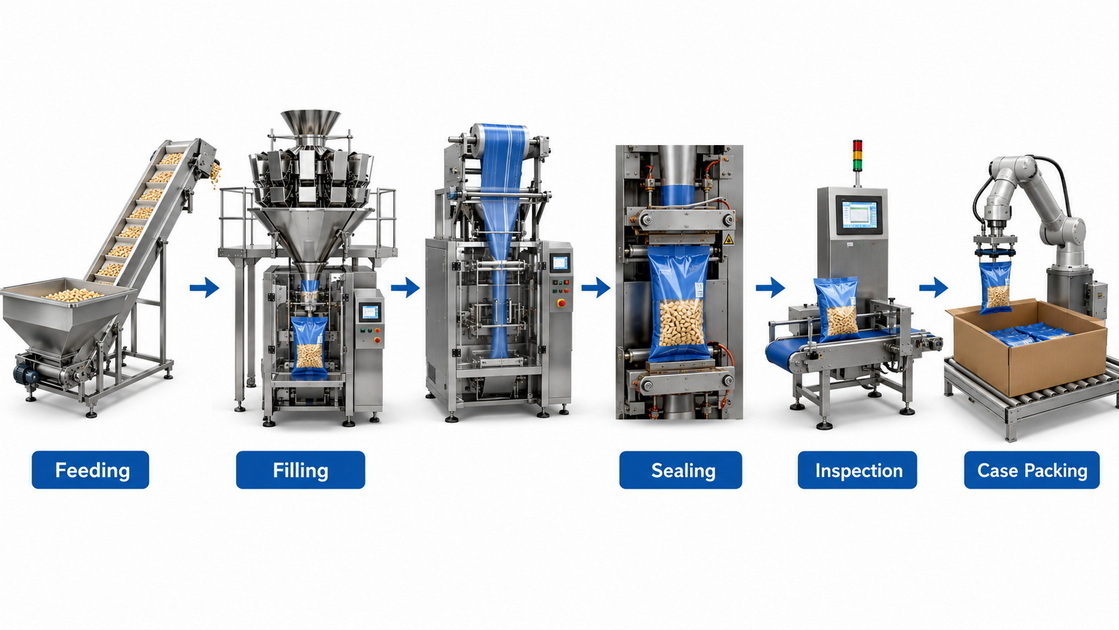
For a typical flexible packaging application, the workflow may look like this:
1. Product feeding and conveying
Raw product enters the system through a hopper, elevator, conveyor, pump, screw feeder, or other feeding device.
2. Measuring, weighing, or dosing
The line delivers a controlled product quantity into each package. Depending on the product, this may use an auger filler, volumetric cup, multihead weigher, piston filler, liquid pump, or counting system.
3. Package forming or pouch feeding
A vertical form-fill-seal machine forms bags from roll film, while a premade pouch machine opens and presents preformed pouches for filling.
4. Filling and sealing
Product enters the bag or pouch, and the package is closed using heat sealing, ultrasonic sealing, zipper application, spout sealing, or another format-specific method.
5. Coding and labeling
The line applies batch codes, production dates, expiration dates, QR codes, barcodes, traceability information, or labels.
6. Quality inspection
Inspection devices can check package weight, metal contamination, seal integrity, code readability, label position, and general package appearance.
7. Secondary packaging
Finished flexible packages are grouped into cartons, trays, cases, shrink bundles, or display-ready packs.
8. End-of-line handling
Case packing, sealing, palletizing, stretch wrapping, and warehouse transfer prepare finished goods for shipment.
A packaging line may be semi-automatic, automatic, or fully integrated with robotic systems and centralized control. The right choice depends on the product, available labor, desired production capacity, and budget.
Flexible packaging is different from rigid packaging. Bottles, jars, cans, and containers have inherent shape and rigidity. Bags, sachets, rollstock film, and stand-up pouches do not. That creates specific engineering challenges involving film control, package stability, sealing performance, product flow, and downstream handling.
For example, a powdered product may require an auger filler, dust extraction, static-control measures, and carefully controlled sealing conditions. A snack product may need a multihead weigher, gentle product handling, nitrogen flushing, and a checkweigher. A liquid sauce pouch may require a piston or pump-based filler, anti-drip controls, seal contamination prevention, and leak testing.
The packaging machine is important, but it is only one part of the production result. The packaging material, product behavior, environmental conditions, operator procedures, and connected downstream equipment all affect performance.
| Production Stage | Typical Equipment | Main Purpose |
|---|---|---|
| Product infeed | Hopper, bucket elevator, screw feeder, pump, conveyor | Transfers product consistently to the filling system |
| Dosing and filling | Multihead weigher, auger filler, volumetric filler, liquid filler | Delivers accurate product portions |
| Primary packaging | VFFS machine, HFFS machine, premade pouch machine | Forms, fills, and seals the package |
| Coding and traceability | Inkjet printer, thermal transfer printer, laser coder | Prints batch, date, lot, and traceability information |
| Quality control | Checkweigher, metal detector, X-ray, vision inspection, leak tester | Identifies nonconforming packages |
| Secondary packaging | Cartoner, case packer, shrink wrapper | Groups finished packages for transport |
| Palletizing | Robotic palletizer, conventional palletizer, stretch wrapper | Creates stable warehouse and shipping loads |
Different products require different packaging technologies. A line designed for granules cannot simply be used for viscous liquids without changing key equipment, controls, hygiene measures, and package-handling systems.
Powder packaging lines are used for products such as flour, coffee, milk powder, protein powder, spices, additives, detergents, pharmaceuticals, and chemical powders.
A common powder packaging line may include:
- Product hopper and screw feeder
- Auger filler for controlled dosing
- Vertical form-fill-seal machine
- Dust collection equipment
- Date coding system
- Checkweigher and metal detector
- Cartoning or case packing equipment
Powder behavior matters. Products can bridge, clump, generate dust, absorb moisture, or vary in bulk density. An experienced packaging equipment supplier should evaluate the powder's flowability, particle size, density, hygroscopicity, and required fill accuracy before recommending a solution.
Granule packaging systems are widely used for rice, sugar, beans, seeds, nuts, pet food, frozen products, candies, snack foods, and other free-flowing products.
These lines often use a multihead weigher to achieve high-speed, accurate portions. The weigher combines different small product weights to reach the target fill weight with minimal giveaway.
Typical equipment may include:
- Z-type bucket elevator
- Vibratory feeder
- Multihead weigher
- VFFS bagging machine
- Nitrogen-flushing system, if required
- Metal detector and checkweigher
- Automatic case packer
For snack foods, gentle handling is especially important. Excessive drop heights, sharp transfer points, or poorly designed conveyors can create broken product, increase waste, and reduce shelf appeal.
Liquid packaging lines can handle water, beverages, edible oil, sauces, shampoo, detergent, cosmetics, chemicals, and other fluid products.
Depending on viscosity, the system may use:
- Gravity fillers
- Piston fillers
- Servo-driven pumps
- Peristaltic pumps
- Flowmeter filling systems
Liquid pouches require careful seal management. Even a small amount of product trapped in the seal area can weaken package integrity and create leakage risk. For food and beverage applications, line design should also consider cleanability, hygienic material selection, cleaning procedures, and production validation.
The U.S. Food and Drug Administration notes that packaging systems and packaging materials can be critical factors in processes designed to achieve commercial sterility for certain aseptically processed foods. This illustrates why sealing performance, equipment condition, and validation must be treated as production-critical—not merely cosmetic—considerations.
Premade pouch packaging lines are often selected for stand-up pouches, zipper pouches, shaped pouches, flat pouches, spouted pouches, and premium retail formats.
A typical line can include:
- Automatic pouch feeder
- Pouch opening station
- Product filler
- Vibration or settling device
- Zipper or spout handling system
- Heat sealing station
- Cooling station
- Date coder
- Inspection and discharge system
Premade pouches can offer strong shelf presence and user-friendly features, but they may have a higher packaging-material cost than rollstock film. The correct choice depends on production volume, branding requirements, SKU variety, pouch type, labor cost, and the desired level of automation.
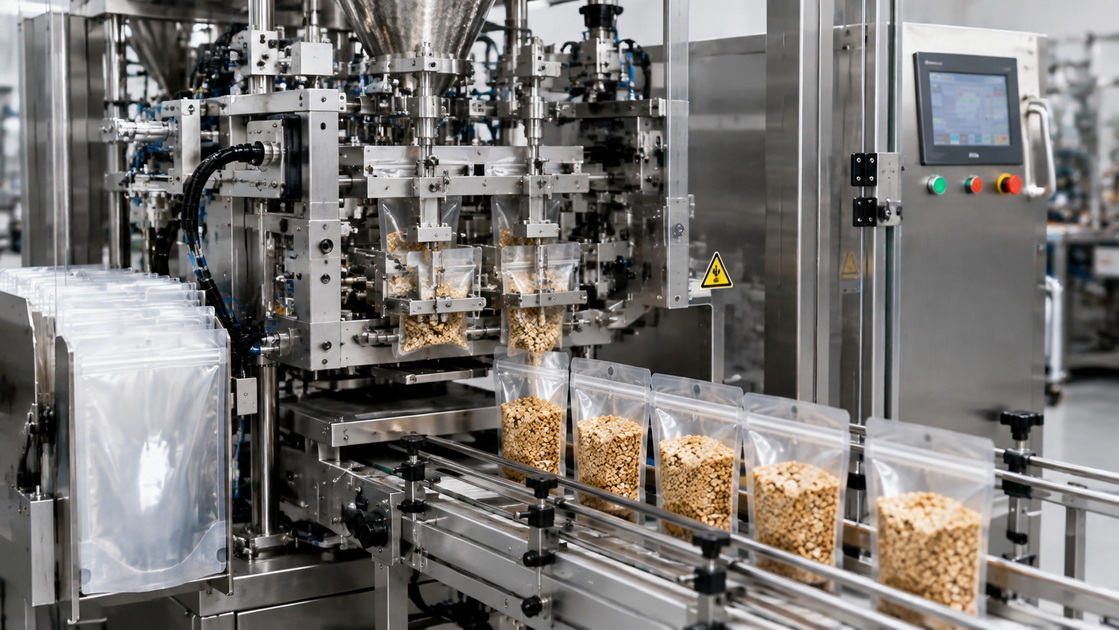
A standalone packaging machine performs one major packaging task. A packaging line connects multiple machines so the full packaging process can run as one controlled system.
| Factor | Standalone Machine | Integrated Packaging Line |
|---|---|---|
| Scope | Performs one process, such as filling or sealing | Connects several packaging stages |
| Product movement | Often requires manual transfer | Uses conveyors, automation, and synchronized controls |
| Output capacity | Suitable for limited or simple production | Designed for continuous, scalable production |
| Labor demand | Usually higher between processes | Lower manual handling across the workflow |
| Initial investment | Lower upfront cost | Higher investment but broader automation value |
| Changeover flexibility | Can be simple for small batches | Requires engineered change parts and procedures |
| Best fit | Startups, pilot runs, low-volume packaging | Growing brands and high-volume manufacturers |
The best answer is not always "buy a fully automatic line." A small manufacturer with frequent SKU changes may benefit from modular semi-automatic equipment. A high-volume producer with stable demand may gain more value from an integrated solution with automated feeding, inspection, case packing, and palletizing.
Packaging-line performance begins long before installation. Many underperforming lines are not caused by one defective machine; they result from incomplete planning, unclear product data, mismatched speeds, insufficient factory space, or poorly defined operating procedures.
Before selecting equipment, document the variables that affect machine design:
- Product type: powder, granule, liquid, paste, solid, fragile item, or mixed product
- Product characteristics: density, viscosity, moisture, temperature, particle size, dust level, stickiness, and flowability
- Package format: pillow bag, sachet, stand-up pouch, zipper pouch, spouted pouch, quad-seal bag, or flat-bottom bag
- Package dimensions and fill weights
- Packaging film structure and thickness
- Required output per minute, hour, and shift
- Quality requirements, including allowable fill variation and seal requirements
- Food, pharmaceutical, chemical, or other compliance needs
- Future SKU expansion and expected production growth
This data enables the supplier to recommend suitable dosing technology, packaging machinery, conveyor design, sealing controls, and inspection equipment.
A packaging line is only as productive as its slowest critical stage. If a bagging machine can produce 80 bags per minute but the checkweigher, case packer, or product feeder can support only 60 bags per minute, the theoretical bagging speed does not represent actual line capacity.
Line balancing should consider:
- Rated machine speed versus realistic operating speed
- Product accumulation zones
- Bag or pouch transfer stability
- Inspection-system throughput
- Carton loading speed
- Changeover time
- Operator access and replenishment tasks
- Planned maintenance intervals
A practical way to monitor packaging-line performance is through overall equipment effectiveness, or OEE. OEE combines availability, performance, and quality into one operational measure:
OEE=Availability×Performance×Quality
Availability measures how much planned time the line actually runs. Performance compares actual output with the intended speed. Quality measures the percentage of good packages among total packages produced.
In flexible packaging, frequent changes are common. A manufacturer may run multiple bag sizes, flavors, weights, film designs, pouch styles, or customer-specific labels in the same week.
A line that is fast during production but slow to change over can still lose substantial capacity. Changeover should be measured from the last good package of the previous run to the first good package of the next run.
To reduce changeover time:
1. Standardize change parts for recurring package sizes.
2. Use clear format recipes in the machine control system.
3. Label tools, parts, and settings for each SKU.
4. Prepare film rolls, pouches, cartons, labels, and coding data before stopping the line.
5. Move external tasks—such as material preparation—outside the actual downtime window.
6. Train operators using documented changeover procedures.
7. Track actual changeover duration and identify repeated delays.
Quality control should not be treated as the final step after packaging. It should be built into the packaging-line design from the beginning.
For flexible packaging, a strong quality-control plan may include:
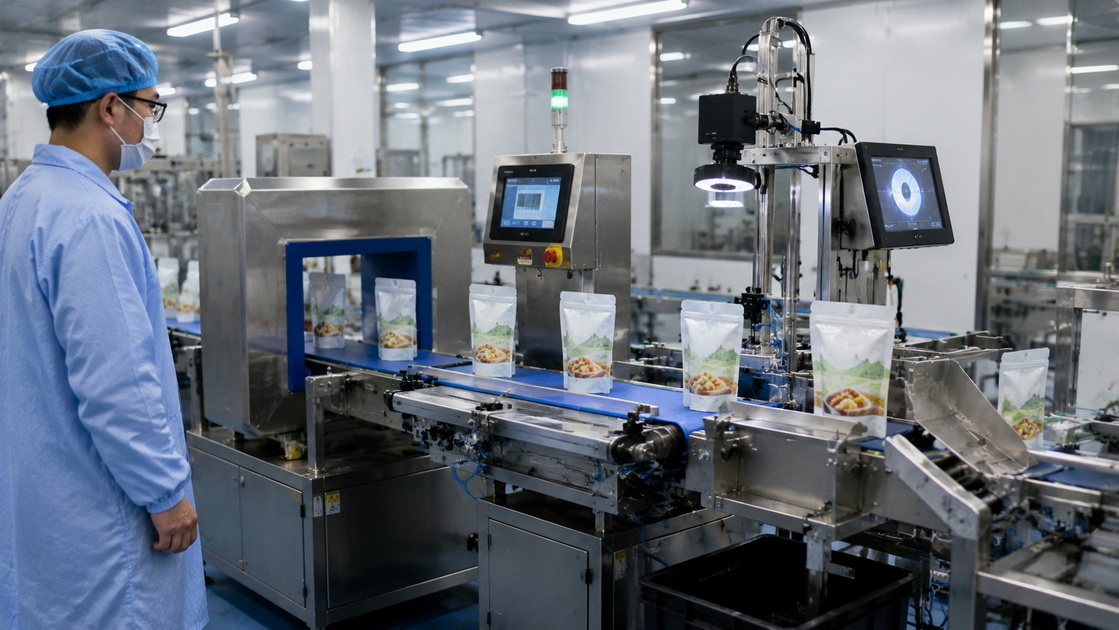
- Fill-weight verification with a checkweigher
- Metal detection or X-ray inspection where appropriate
- Seal-temperature, pressure, and dwell-time controls
- Vision inspection for code presence, barcode readability, label alignment, and print quality
- Leak detection or seal-integrity testing
- Rejection systems that remove nonconforming packages automatically
- Lot-code verification and traceability records
For food-related operations, food safety management systems should be tied to practical production controls. ISO 22000 is an international standard for food safety management systems designed to help organizations identify hazards, manage risks, and demonstrate their ability to control food-safety requirements.
A packaging operation does not need every inspection technology available. It needs a documented, risk-based inspection plan suited to its product, package type, process, customer requirements, and regulatory environment.
The most common problem is a speed mismatch. Products accumulate before one station, or downstream equipment starves because the previous machine cannot supply product consistently.
Solution: Conduct a line-capacity study before purchase. Define realistic target speeds, buffer capacity, and operating conditions for every major machine.
Weak, wrinkled, contaminated, or incomplete seals can lead to leaks, spoilage, returns, and brand damage.
Solution: Match sealing technology to film structure and product behavior. Validate seal settings, monitor the seal area, and use routine integrity checks.
Overfilling protects against underweight packages, but it quietly reduces profitability.
Solution: Use the appropriate filling technology, calibrate dosing equipment, monitor weight variation, and review target weights using actual production data.
Poor film tracking can cause off-center graphics, incorrect cutting positions, package defects, and wasted film.
Solution: Use proper web-guiding controls, maintain tension settings, verify photo-mark registration, and select packaging films compatible with the machine and process.
If operators cannot safely access key machine areas, cleaning takes longer, maintenance is delayed, and downtime rises.
Solution: Review hygiene, accessibility, spare parts, lubrication points, and maintenance procedures during the design stage—not after commissioning.
Selecting a packaging-line supplier is not only a machine-purchase decision. It is a long-term operational decision. The supplier should understand your product, flexible packaging format, target output, factory constraints, quality expectations, and future expansion plans.
When comparing suppliers, ask:
- Have they handled products and package formats similar to yours?
- Can they provide a complete line layout, not only individual machine specifications?
- Will they conduct product and packaging-material trials?
- How will they synchronize speeds between machines?
- What quality-control equipment is included?
- What training, documentation, spare parts, and remote support are available?
- Can the line accommodate future package sizes or production expansion?
- What are the acceptance criteria before shipment and after installation?
HLun Pack supports customers with packaging machinery and integrated packaging solutions for flexible packaging applications. The objective is not simply to deliver equipment. It is to develop a system that supports stable output, package quality, efficient material use, practical operation, and scalable growth.
The best packaging line is the one that fits your actual product, packaging format, output goals, quality requirements, labor model, and factory space. It should run reliably at an achievable production rate, not only perform well in a specification sheet.
If you are planning a new flexible packaging line, upgrading a pouch packaging machine, reducing manual packing work, or improving line efficiency, HLun Pack can help assess your product and recommend an integrated solution.
Contact HLun Pack today to discuss your product, bag or pouch format, target output, and factory layout. Our packaging specialists can help you build a practical, scalable flexible packaging solution.
A packaging line is a group of connected machines that complete packaging tasks in sequence. Depending on the application, it can include feeding, dosing, filling, bag forming, sealing, coding, inspection, case packing, and palletizing equipment.
A packaging machine normally performs one specific operation, such as filling or sealing. A packaging line integrates multiple machines and handling systems so products can move through the entire packaging process with less manual transfer.
Flexible packaging can use vertical form-fill-seal machines, horizontal form-fill-seal machines, premade pouch packing machines, sachet machines, multihead weighers, auger fillers, liquid fillers, checkweighers, metal detectors, cartoners, and palletizers. The correct configuration depends on the product and pouch or bag format.
Start by defining your product characteristics, package dimensions, fill weight, packaging material, target speed, available floor space, hygiene requirements, quality-control needs, and future production plans. Then evaluate suppliers based on their ability to test your product and integrate the full line.
OEE means overall equipment effectiveness. It measures how well a production line performs by combining availability, performance, and quality. It helps manufacturers identify losses caused by downtime, slow operation, rejects, and quality problems.
Seal integrity protects the product from leakage, contamination, moisture, oxygen exposure, and package failure during storage and transport. Seal quality also affects shelf life, customer satisfaction, and brand reputation.
Yes. A well-planned modular line can often be upgraded with faster fillers, automatic feeding, inspection equipment, cartoning systems, robotic case packing, palletizing, or digital production monitoring. Expansion should be considered during the initial layout and control-system design.
1. Pallas MT. "(https://www.pallasmt.com/what-is-a-packaging-line/)." Accessed September 2, 2026. Used as the baseline source for the general definition, common components, types, and basic packaging-line workflow.
2. U.S. Food and Drug Administration. "(https://www.fda.gov/inspections-compliance-enforcement-and-criminal-investigations/inspection-guides/aseptic-processing-and-packaging-food-industry)." Used to support the importance of packaging systems, packaging materials, and validation in aseptic food-processing contexts.
3. International Organization for Standardization. "(https://www.iso.org/home/insights-news/resources/iso-22000-explained.html)." Used to support the description of ISO 22000 as a food safety management system standard focused on hazard identification and risk management.
4. Shoplogix. "(https://shoplogix.com/blog/oee-for-packaging-industry/)." Used for the explanation of OEE components—availability, performance, and quality—and the importance of tracking changeover performance.
5. Butler Automatic. "(http://www.butlerautomatic.com/oee)." Used to corroborate the OEE framework as availability multiplied by performance multiplied by quality.
6. Septimatech. "(https://www.septimatech.com/blog/how-to-improve-changeover-efficiency-in-packaging-operations/)." Used for the practical definition of changeover time from the last good unit of one run to the first good unit of the next.
7. U.S. Food and Drug Administration. "(https://www.fda.gov/inspections-compliance-enforcement-and-criminal-investigations/inspection-guides/guide-inspections-low-acid-canned-food-manufacturers-part-3)." Used as supporting context for the importance of scheduled package-closure inspection and post-adjustment verification in regulated packaging operations.


