


close
Choose Your Site
Global
Social Media
Views: 239 Author: Tom Publish Time: 2026-10-28 Origin: Hlunpack


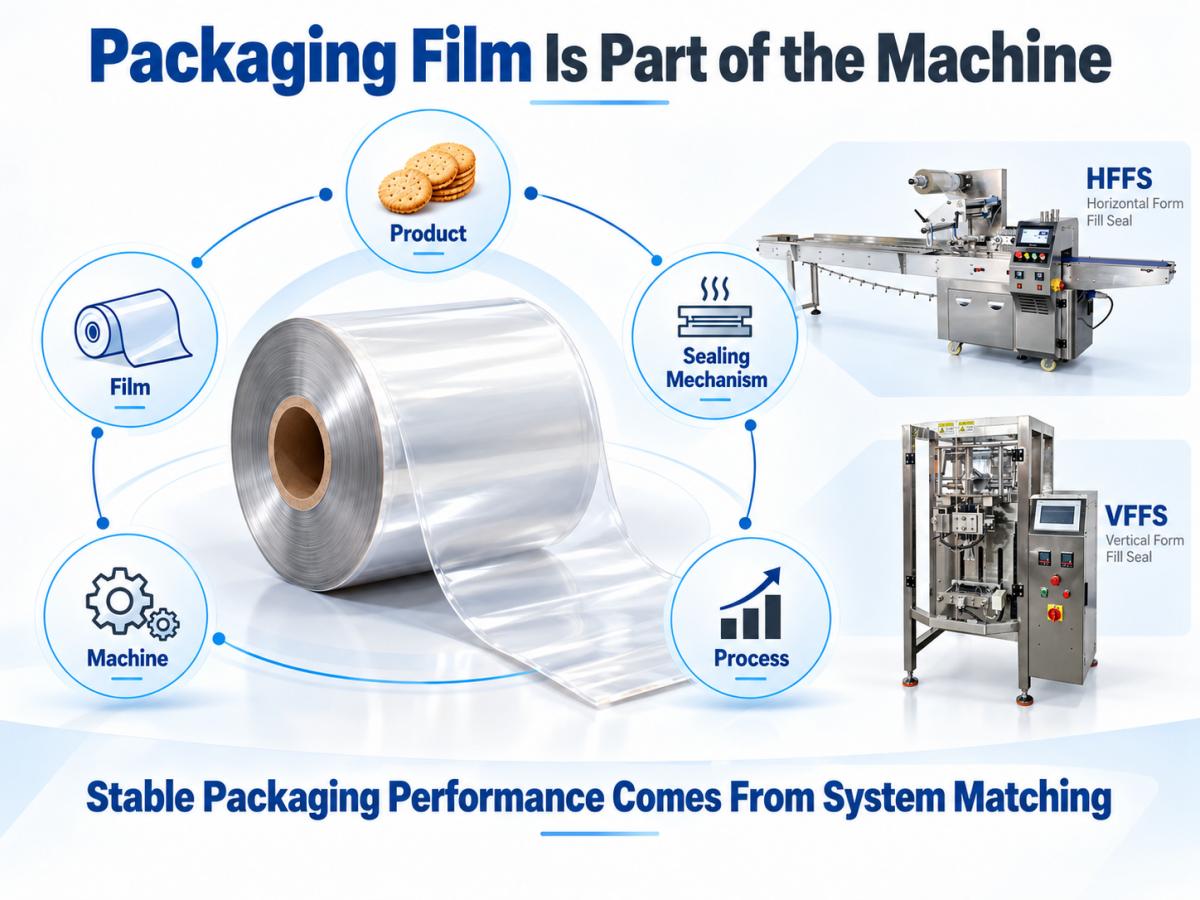
Flexible packaging film is often treated as a consumable material. On a high-speed packaging line, however, the film behaves much more like a functional part of the machine.
Its sealant response, stiffness, coefficient of friction, web stability, registration accuracy, thermal behavior and contamination tolerance all interact directly with the packaging equipment. This is why two films with similar thickness and appearance can perform very differently on the same machine.
Which film and sealing mechanism create the widest stable operating window for the actual product and machine?
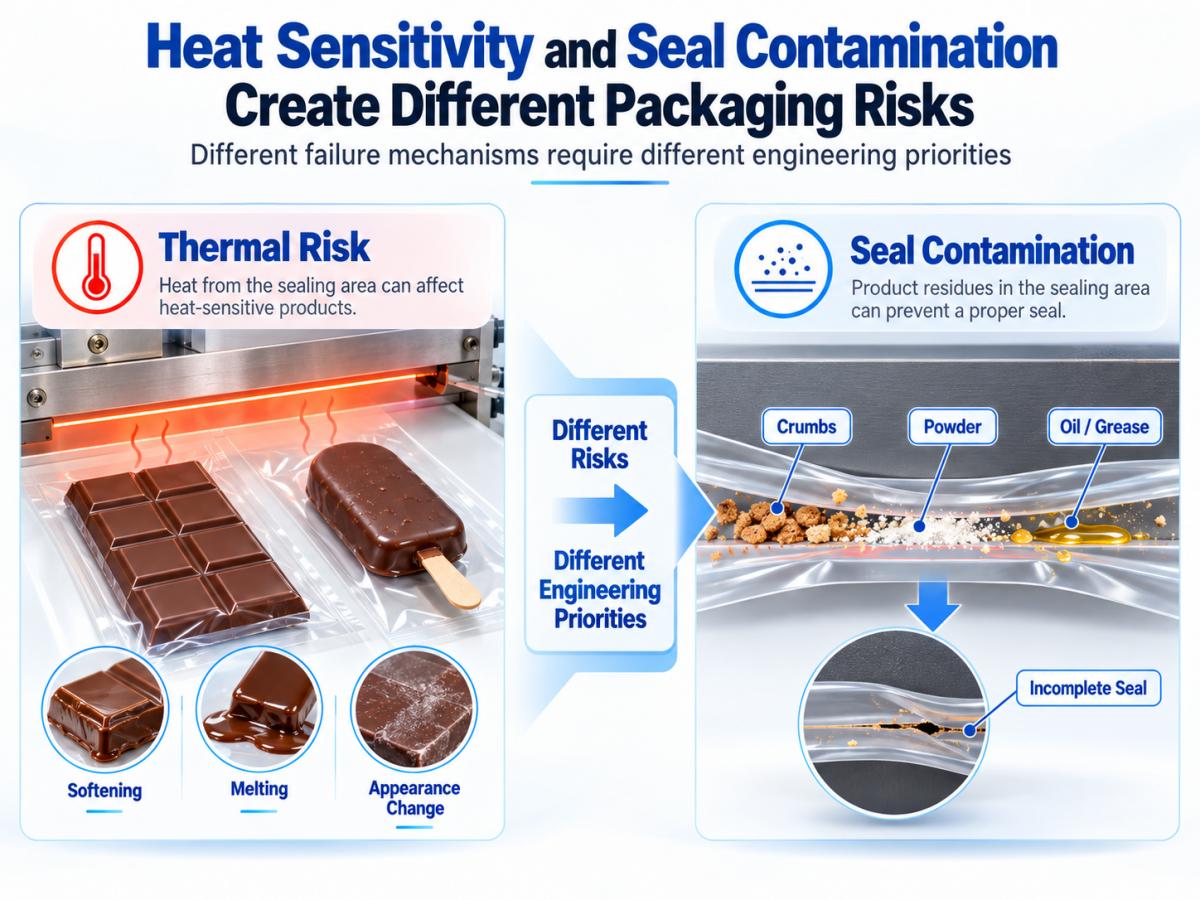
Product heat sensitivity describes how thermal exposure can influence shape, texture, surface appearance and product stability. Seal contamination describes how product material interferes with the sealing interface.
Typical contaminants include crumbs, powder, sugar, seasoning, oil, sauce and product particles. These risks should not be treated as interchangeable. High heat sensitivity increases the value of reducing dependence on thermal sealing, while high contamination increases the importance of maintaining reliable seal formation under imperfect seal-area contact.
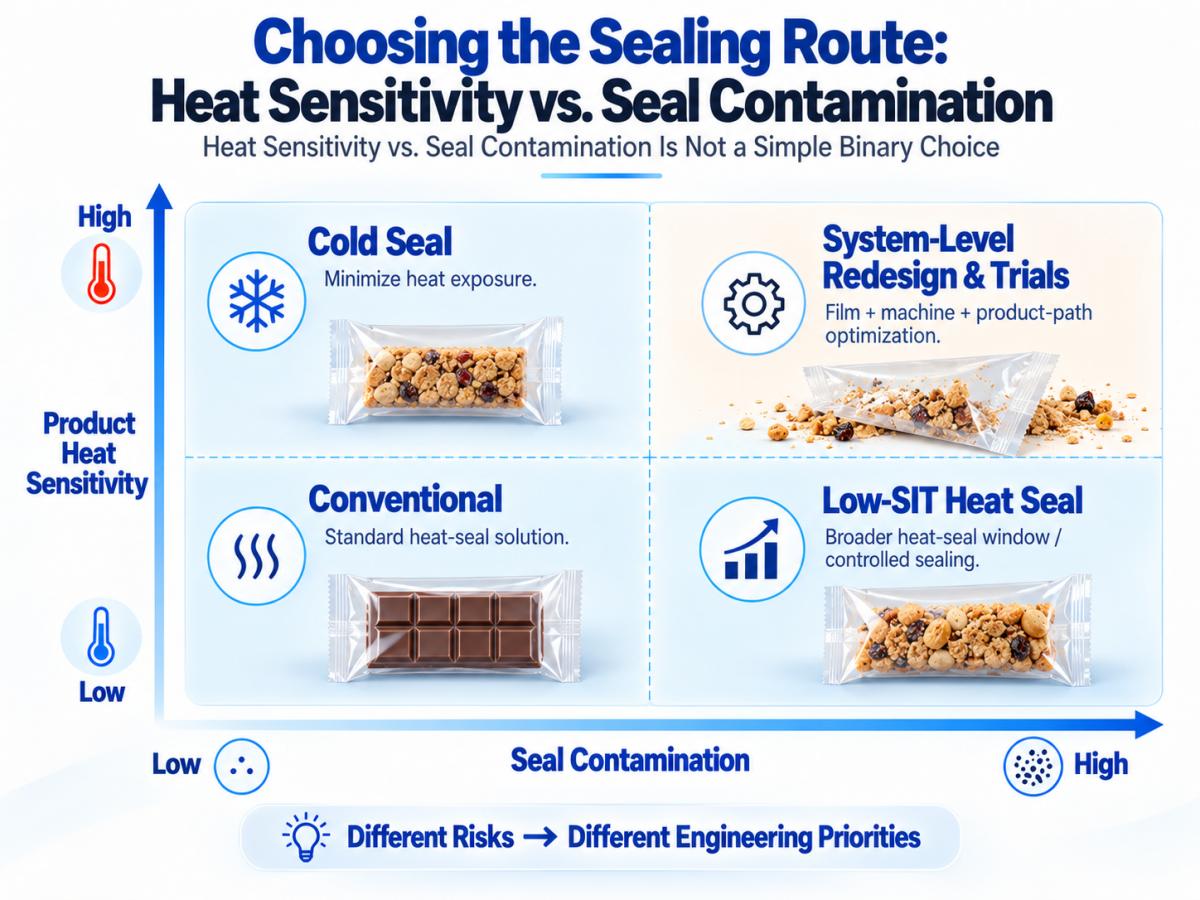
Heat sensitivity and seal contamination do not directly determine the sealing technology. They determine which failure mechanism deserves the highest priority during system selection.
A heat-sensitive product is not defined only by melting point. Thermal exposure may alter surface appearance, texture, shape, coating stability, stickiness or process stability.
A more useful engineering model considers intrinsic heat sensitivity, initial product temperature, product thermal mass, product-to-seal distance and exposure time. Two products located the same distance from the sealing jaws may still respond differently because their thermal mass and starting temperatures are different.
Traditional heat sealing generally relies on heat, pressure and effective dwell time. Thermal energy must pass through the laminate and activate the inner sealant layer.
For heat-sensitive products such as chocolate, ice cream, chocolate-coated bars and selected confectionery, the film may require sufficient thermal energy to form a reliable seal while the nearby product requires limited thermal exposure. The narrower the overlap between these requirements, the more difficult the process becomes.
One engineering route is to retain conventional heat sealing while improving the sealant response. A properly designed Low-SIT PE-based sealant system may combine lower seal initiation temperature, strong hot tack and a wider heat-seal window.
Low-SIT PE should not be understood as one single resin. Depending on the application, the sealant layer may use engineered PE blends, metallocene-based materials or coextruded sealant structures designed for faster seal development. The objective is sufficient seal strength with lower thermal demand and shorter effective sealing time.
For highly heat-sensitive products, optimizing heat sealing may not go far enough. Cold seal relies on compatible cold-seal coating, controlled contact and pressure rather than primarily on thermoplastic sealant activation.
This can substantially reduce dependence on thermal seal formation and is particularly relevant to chocolate, ice cream, confectionery and other heat-sensitive bars where product thermal protection can become the dominant process constraint.
Real production lines may introduce dry crumbs, fine powder, sugar, oil, seasoning, sauce or larger product particles into the seal area. These contaminants do not all behave the same way.
Important variables include contamination type, particle size, thickness, distribution and surface coverage. Dry particulate contamination can create a different sealing challenge from oil or liquid contamination.
Cold-seal performance depends strongly on effective coating-to-coating contact. If product material separates the coated surfaces, the available bond area may decrease.
Contamination tolerance varies with cold-seal formulation, product type, contamination level and contact pressure. Cold seal should therefore be validated under the actual contamination conditions of the product rather than judged by a general rule.
Heat-seal structures are also affected by contamination. However, some sealant systems can be engineered for improved seal-through-contamination performance in applications involving powders, oily products, seasonings or product residue.
Low SIT, hot tack and contamination tolerance are separate performance characteristics. A successful sealant system must balance them according to the actual application.
The decision should not be simplified to “heat sensitive = cold seal” and “contaminated = heat seal.” A more useful model asks which failure mechanism dominates and what technical route deserves validation first.
· When heat sensitivity dominates: evaluate whether reducing thermal dependence can widen the process window.
· When contamination dominates: evaluate whether a contamination-tolerant heat-seal system provides greater seal reliability.
· When both are significant: consider package geometry, product feeding, seal position, film structure and machine conditions together.
A heat-sensitive product does not need to physically touch the sealing jaws to be affected by heat. Thermal risk is influenced by product-to-seal distance, product thermal mass, initial temperature and exposure time.
Increasing the distance between the product and cross-seal area can sometimes reduce thermal risk without changing the sealing technology completely. Package geometry is therefore part of the sealing system.
Excessive contamination inside the seal area may appear to be a film problem, but the root cause can originate earlier in the process through poor product timing, inaccurate dosing, product bounce, unstable feeding, incorrect package pitch or product migration.
Even a high-performance seal-through-contamination material cannot fully compensate for uncontrolled product placement.
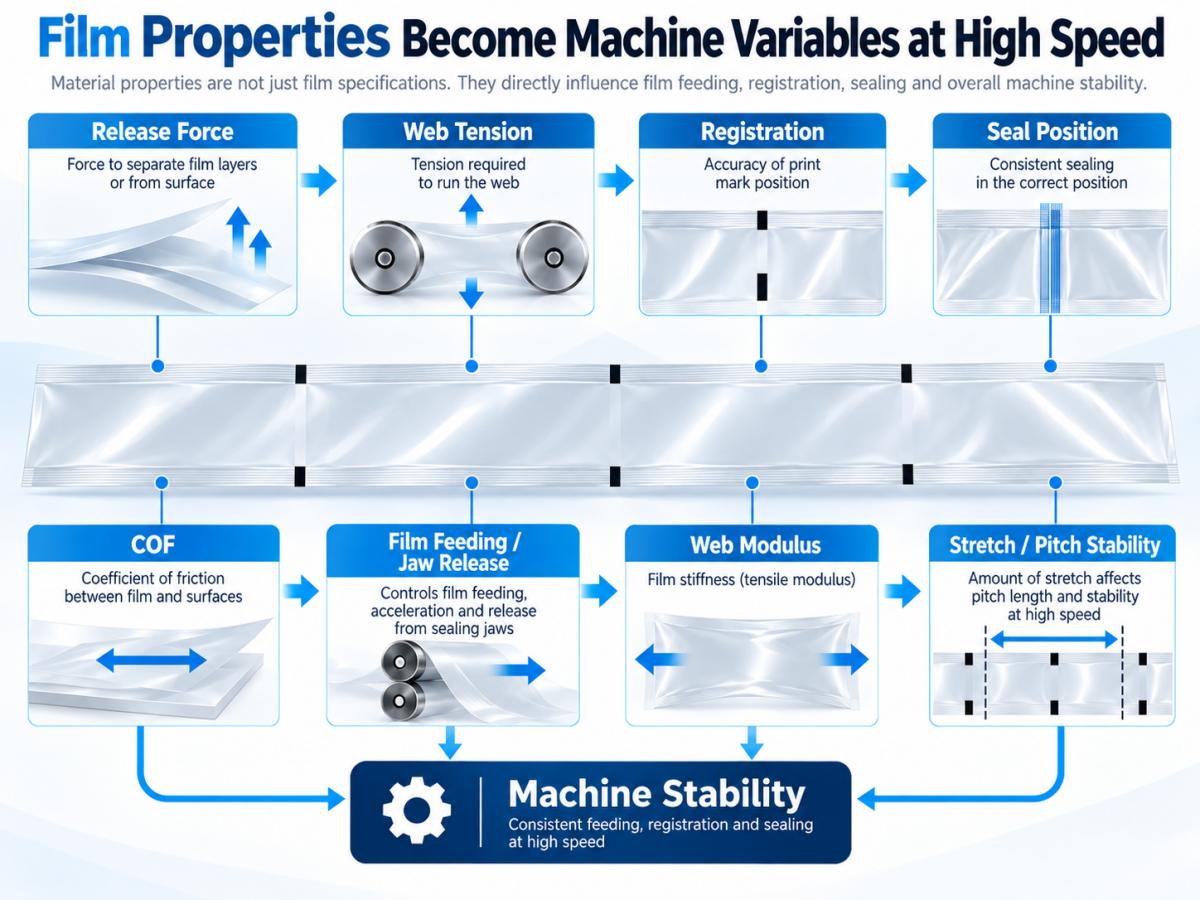
At high speed, flexible packaging film interacts directly with the unwind system, tension control, forming section, pull belts, registration sensor, sealing jaws, crimp rollers and cutting system.
Relevant material properties include thickness, stiffness, web modulus, stretch behavior, COF, curl/flatness, heat shrinkage, thermal response, sealant type, surface treatment and registration stability. These parameters directly influence machine operation.
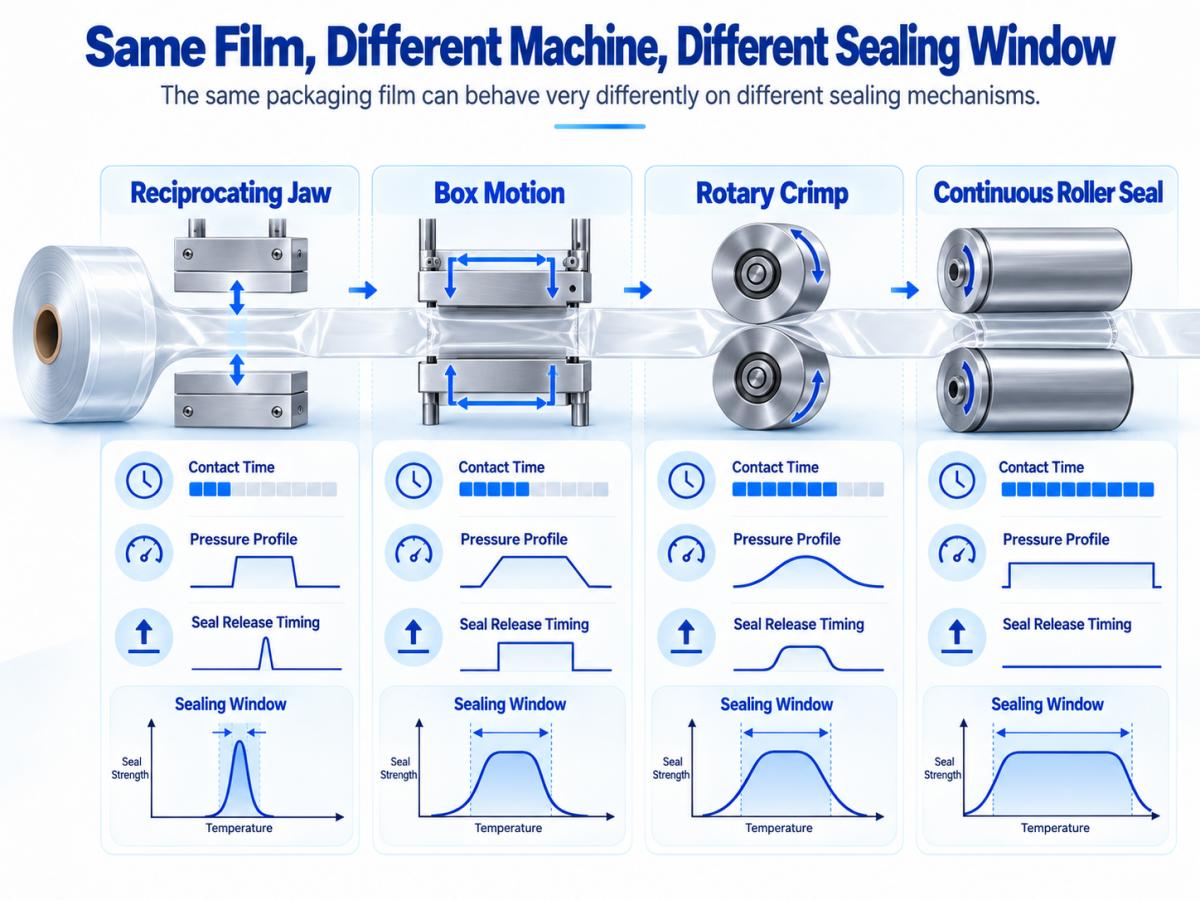
Consider one laminate running on reciprocating jaws, box-motion jaws, rotary crimps or continuous roller sealing. The material can experience very different contact time, pressure profile, interface temperature, seal release timing and cooling time.
Same Film ≠ Same Machine Performance
A reciprocating sealing system may provide relatively long contact time. A high-speed rotary system may operate with a short contact arc, continuous motion and rapid seal release.
This can increase the importance of fast seal development and strong hot tack. A material that performs reliably on a slower reciprocating machine may need a different sealant design for high-speed rotary sealing.
Cold seal is not simply a replacement roll of film. A cold-seal packaging system may require appropriate pressure crimping, pattern registration, web tension, film tracking and release performance.
Cold-seal rollstock may also involve a registered cold-seal pattern and release lacquer. The machine must maintain alignment among print artwork, cold-seal pattern, registration mark, product pitch and cut position.
In conventional heat-seal packaging, registration commonly controls print position, package pitch and cut position, and may also influence easy-open notches, laser scores, zipper position or seal-free areas.
With registered cold seal, pattern shift can directly reduce coating-to-coating contact. Registration therefore becomes a functional sealing variable, not merely a graphics or cutting variable.
Cold-seal film commonly uses release lacquer on the reverse side of the web to reduce blocking in the wound roll. Release behavior also affects unwind force and therefore web tension.
Release Force → Web Tension → Registration Stability → Seal Performance
Static COF influences initial movement, while dynamic COF influences continuous sliding behavior. Lower COF is not automatically better.
If friction is too high, film drag increases. If it is too low, web control may become unstable. The correct objective is stable, machine-appropriate COF.
Some applications require permanent hermetic seals while others require peelable or easy-open seals. The strongest possible seal is not always the correct seal.
A package can show high peel strength and still contain channels, contamination defects or microleaks. Depending on the application, validation may need to include seal strength, leak resistance, seal integrity and opening behavior.
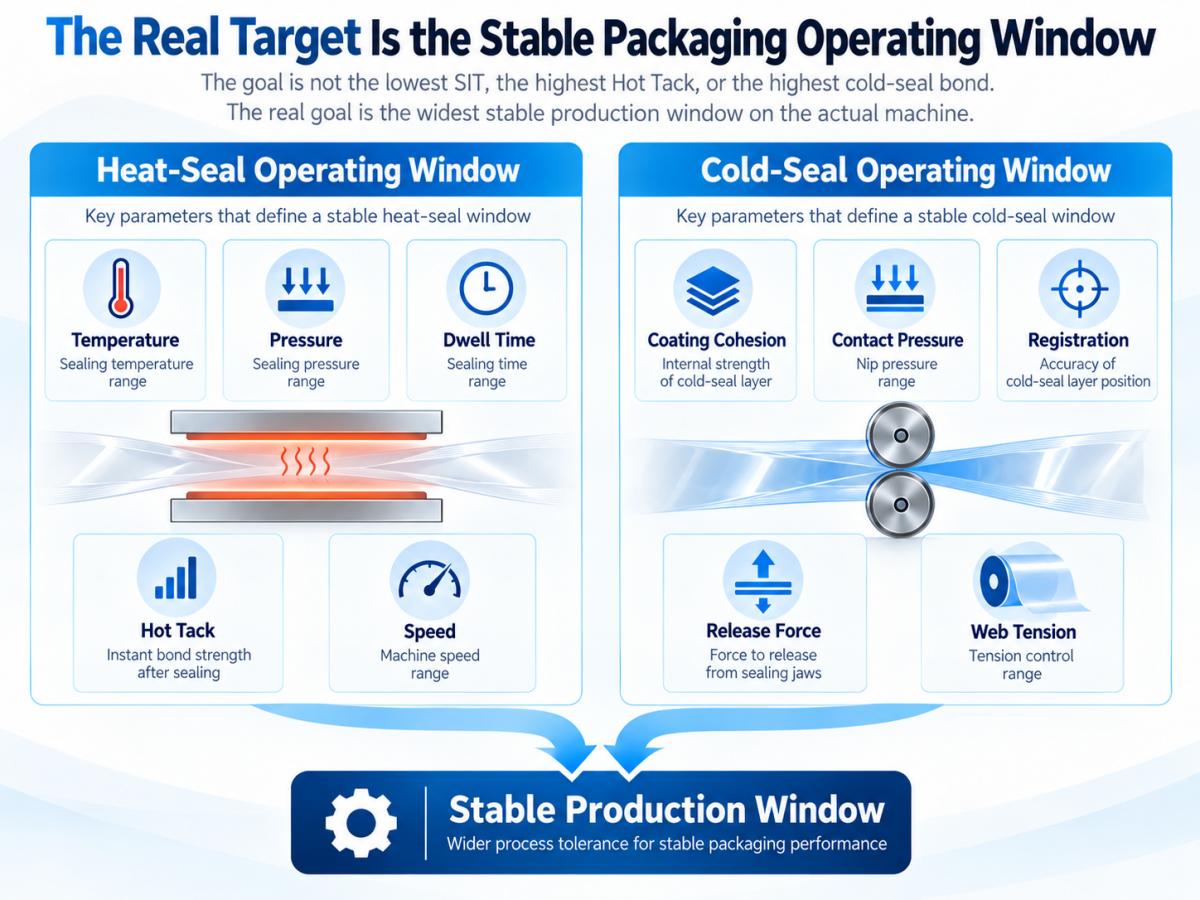
A packaging line does not run at one perfectly constant temperature, pressure, speed or tension. Real industrial production always contains variation.
For heat-seal systems, the stable window may depend on temperature, pressure, dwell time, SIT, hot tack, machine speed and product condition. For cold-seal systems, the window shifts toward coating cohesion, contact pressure, registration, release force and web tension.
The film with the lowest SIT is not automatically the best film. The film with the highest hot-tack peak is not automatically the best film. The cold-seal coating with the highest laboratory bond strength is not automatically the best cold-seal system.
Broad stable performance is often more valuable than one peak specification.
A machine may have a mechanical rating of 100 packs/min, but this does not mean every combination of product, film, sealant and machine setting can run at that speed.
Actual stable production speed depends on seal development, product feeding, web stability, cooling, film tension and machine geometry. The relevant engineering metric is maximum stable packaging-system speed, not simply maximum mechanical machine speed.
The following matrix is a preliminary engineering screening framework, not a universal material-selection rule.
Application Condition | Technical Route to Evaluate |
High heat sensitivity + low contamination | Cold seal deserves strong consideration |
Moderate heat sensitivity + clean sealing area | Low-SIT PE-based heat seal may be suitable |
Low heat sensitivity + high contamination | Contamination-tolerant heat seal deserves evaluation |
High heat sensitivity + high contamination | System-level redesign and production trials are especially important |
Existing heat-seal machine with limited retrofit options | Optimize Low-SIT / Hot Tack / Heat-Seal Window first |
Cold-seal-compatible high-speed flow wrapper | Cold seal may reduce the thermal bottleneck significantly |
The technically ideal material is not always the most practical commercial solution. Changing from heat seal to cold seal may require registration changes, crimp-system modification, film conversion changes, release control and operator adjustment.
Technology selection should therefore consider technical feasibility, retrofit feasibility and production economics.
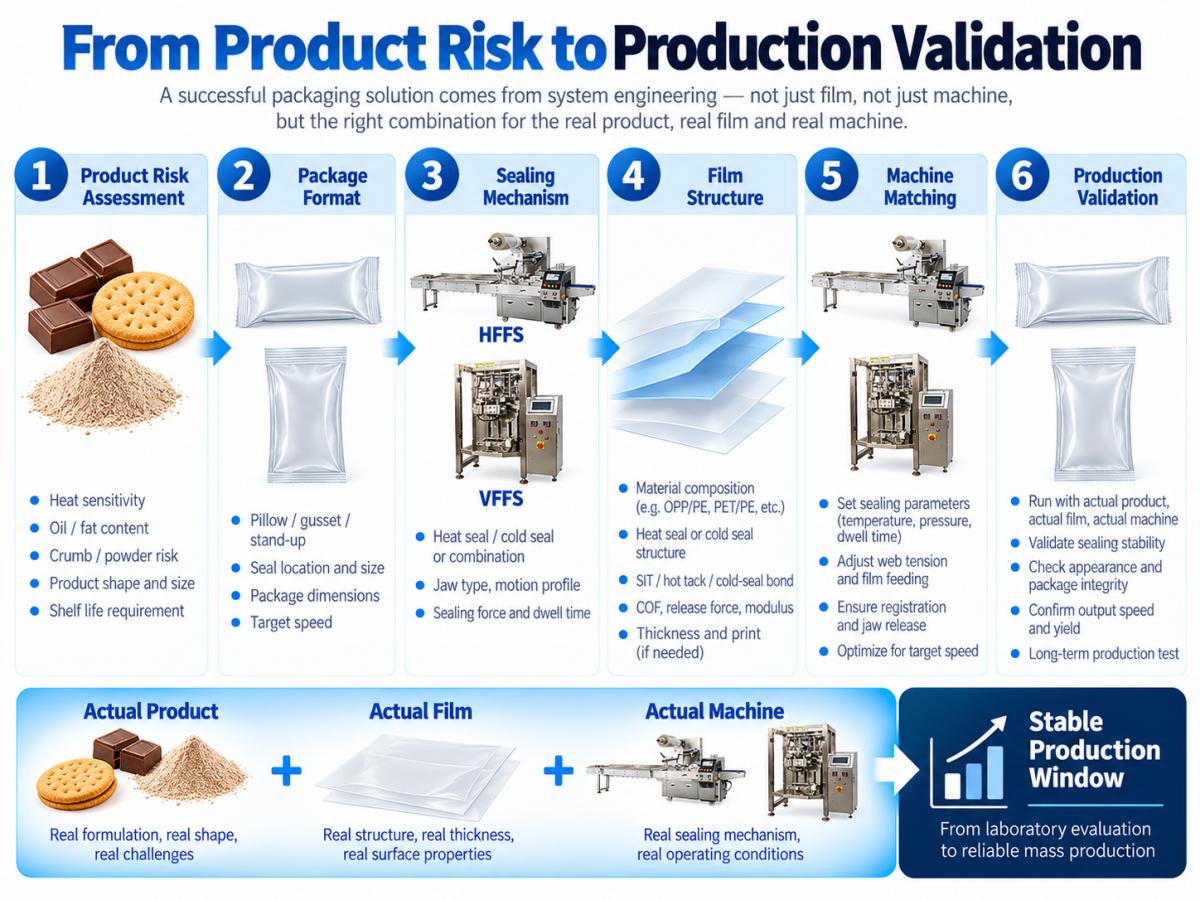
A common development sequence is Buy Machine → Find Film → Adjust Product. A stronger engineering sequence is Product → Package Format → Sealing Mechanism → Film Structure → Machine Design.
This reduces the risk of discovering later that the film and machine operating windows do not overlap.
Technology selection should begin with the product: heat sensitivity, contamination type, product temperature, product shape, product-to-seal distance and shelf-life requirement.
Bag length, seal width, headspace, product-to-seal distance, package pitch and seal profile influence both thermal exposure and mechanical sealing conditions.
Material development can then consider barrier requirement, mechanical strength, SIT, hot tack, heat-seal window, contamination tolerance, COF, dimensional stability and registration requirement. The correct structure is application-specific.
Machine evaluation should include machine speed, jaw type, rotary vs. reciprocating motion, effective dwell time, pressure distribution, cooling, registration control and web tension. If the film does not work inside this equipment window, either the film design or machine conditions must change.
Final validation should use actual product, actual film and the actual packaging machine. Laboratory testing is valuable for material comparison, but it cannot fully reproduce real contamination, dynamic product impact, web tension, machine acceleration or actual product temperature.
Where applicable, relevant laboratory methods may include seal-strength testing such as ASTM F88/F88M and hot-tack testing such as ASTM F1921. Cold-seal systems may also require bond-strength, release-force, coat-weight and registration checks.
A common development problem is that the film supplier optimizes the material and the machine supplier optimizes the equipment, but the interaction between the two is not fully evaluated. Many production failures occur precisely at this interface.
The better approach is Film + Machine Co-Engineering.
A leak may appear to be a film problem while the real cause is insufficient dwell time, poor pressure distribution, seal contamination, inadequate cooling or incorrect web tension. Likewise, what appears to be a machine problem may originate from excessive COF, poor film stiffness, unstable registration or inappropriate sealant response.
The same system-matching approach applies to peelable sealants, retort sealants, high-barrier laminates, easy-open structures and specialty heat-seal films. There is no universal sealant for every machine and every product.
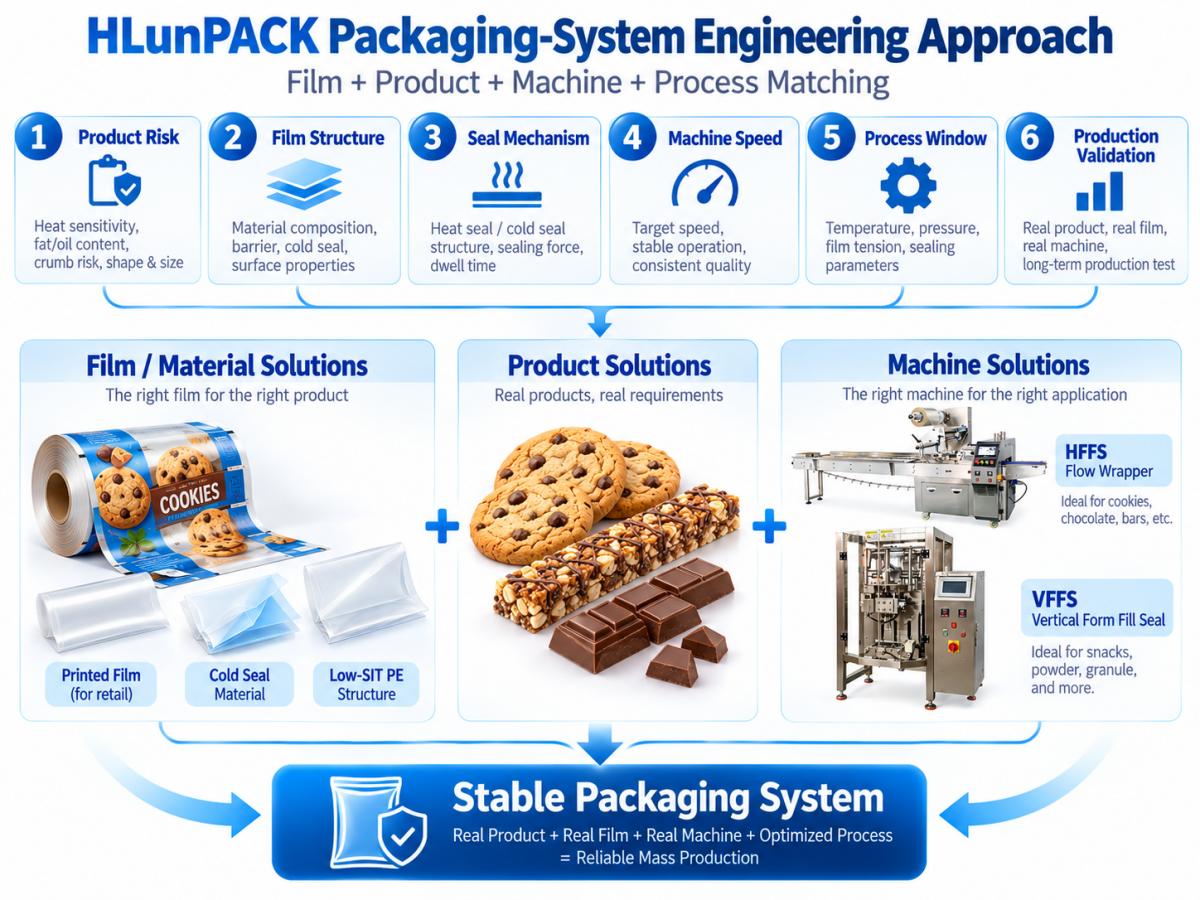
At HLunPACK, high-speed flexible packaging is evaluated through four connected stages: product risk assessment, film and sealant selection, machine matching and production validation.
Heat sensitivity, seal contamination, product temperature, product geometry and product-to-seal distance.
Film structure, SIT, hot tack, heat-seal window, COF, barrier performance and contamination tolerance.
Machine speed, jaw/roller geometry, effective dwell time, pressure distribution, cooling, registration and web tension.
Actual product + actual film + actual machine, validated as one packaging system.
Cold seal becomes particularly relevant when product heat sensitivity is high and thermal seal formation is becoming a major production constraint. Evaluation should also include seal contamination, pattern registration, release performance and machine compatibility before the technology is selected.
A Low-SIT PE-based sealant system is particularly useful when conventional heat sealing should be retained but the line requires faster seal development, strong hot tack, a wider heat-seal window and improved high-speed stability. Depending on the product, seal-through-contamination performance may also need to be engineered into the structure.
There is no universal answer to “Cold Seal or Low-SIT PE?” If the dominant failure mechanism is product thermal risk, reducing thermal dependence may become the priority. If seal contamination dominates, contamination-tolerant sealing may matter more. If machine speed is the main limitation, the answer may depend on dwell time, hot tack, jaw geometry and cooling.
At high speed, film properties directly affect equipment behavior. At the same time, machine conditions determine whether the film can express its intended performance.
Conceptually: Film Performance × Machine Conditions = Packaging Performance
This is not a mathematical equation. It represents the system relationship between material capability and actual process conditions.
Choosing the right sealing technology is not a competition between Cold Seal and Low-SIT PE. Each solves a different engineering problem.
Cold seal can significantly reduce dependence on thermal seal formation where product heat sensitivity is the dominant constraint. Low-SIT PE-based sealant systems can improve conventional heat-seal performance through lower thermal demand, strong hot tack and wider process tolerance.
Seal contamination may change that decision. So may product geometry, machine speed, dwell time, pressure distribution, cooling, registration and web handling. The correct solution must therefore be developed around Product + Film + Sealing Mechanism + Machine + Process.
Packaging performance is created by the operating window where the product, film, sealing mechanism and machine work together.
The best packaging material is therefore not simply the one with the strongest laboratory specification. It is the one that delivers the widest stable production window on the actual packaging line.


