


close
Choose Your Site
Global
Social Media
Views: 224 Author: Tom Publish Time: 2026-10-26 Origin: Hlunpack


When flexible packaging films are evaluated, final seal strength is often treated as one of the most important performance indicators. But in high-speed packaging, final seal strength tells only part of the story.
A package may eventually develop a strong seal after cooling and still fail on the production line. The reason is simple: the seal can be loaded before it has fully cooled.
Immediately after leaving the sealing jaws or rollers, the sealant may still be hot, soft and mechanically vulnerable. At that moment, the newly formed seal may already experience web tension, product weight, product impact, internal package pressure, conveyor movement or downstream acceleration.
The property that determines whether the fresh seal can survive this stage is hot tack. For high-speed flexible packaging, hot tack can become one of the rate-limiting factors that determines whether a packaging line operates at high speed with stable output and reliable seal integrity.
A strong final seal is not enough. The seal must become strong at the right time.
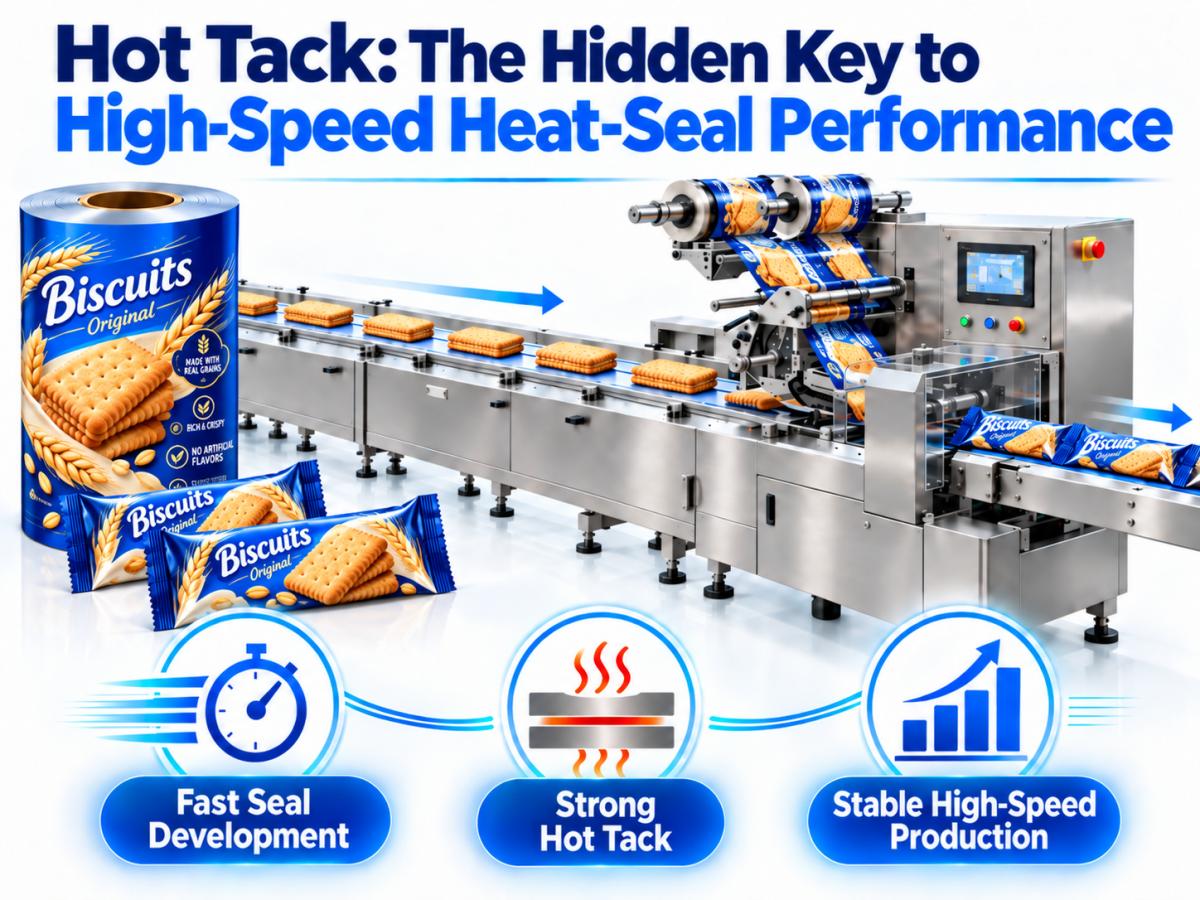
Hot tack is the ability of a newly formed heat seal to resist separation while the seal is still hot. It describes the mechanical strength available between seal formation and final mechanical stabilization.
A simplified heat-sealing sequence is: heat and pressure → sealant softening → interfacial bond formation → hot seal → cooling and stabilization → final seal strength. The hot-seal stage is often the period when the joint is most vulnerable.
Hot tack describes strength shortly after heat sealing, before the sealant has fully cooled and regained mechanical stiffness. Final seal strength describes the joint after sufficient cooling and stabilization.
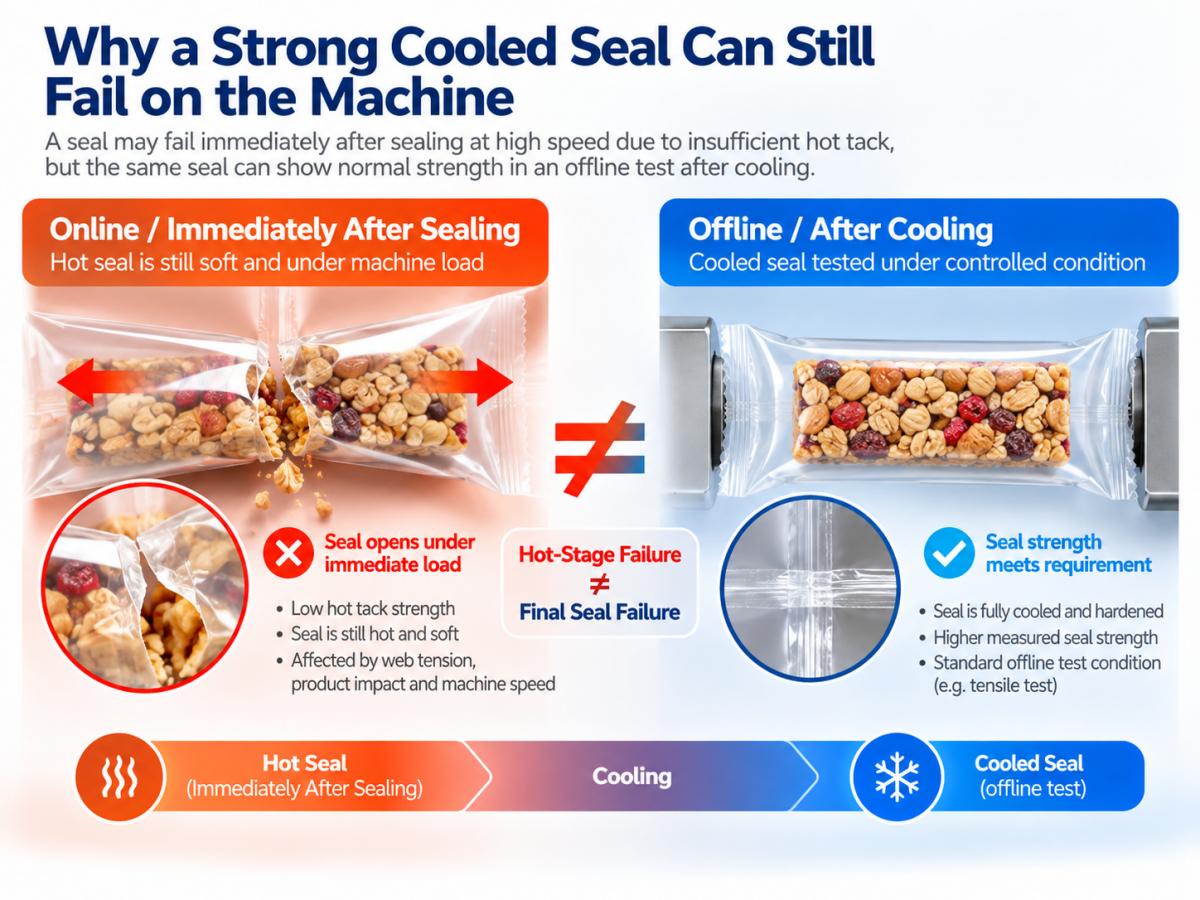
A film can therefore show strong final seal strength but weak hot tack. This explains why a material may perform well in an offline seal-strength test while still producing leakage or seal opening at high machine speed.
As line speed increases, the effective sealing time available per package often becomes more limited. The interval between sealing and downstream mechanical loading can also become shorter.
The practical relationship is that higher line speed leaves less time for seal development and cooling while mechanical stress arrives earlier. The fresh seal must therefore build useful strength within a narrower time window.
Machine Speed ↑ → Available Seal Development / Cooling Time ↓ → Mechanical Stress Arrives Earlier
For high-speed packaging, the important question is not only how strong the seal eventually becomes. A more useful question is how much strength the seal has at the exact moment the machine starts loading it.
A slower line may allow the fresh seal to cool before significant stress arrives. A faster line may load the same seal only milliseconds after formation. The final cooled strength can be similar, while production performance is completely different.
Hot tack is not measured at one universal moment. The result depends strongly on the delay between seal formation and mechanical testing.
A seal evaluated 50 ms after formation can behave very differently from the same seal evaluated after 200 ms. For machine correlation, hot tack should therefore be considered as seal formation + delay time + mechanical loading, and the selected delay should reflect the real packaging process as closely as possible.
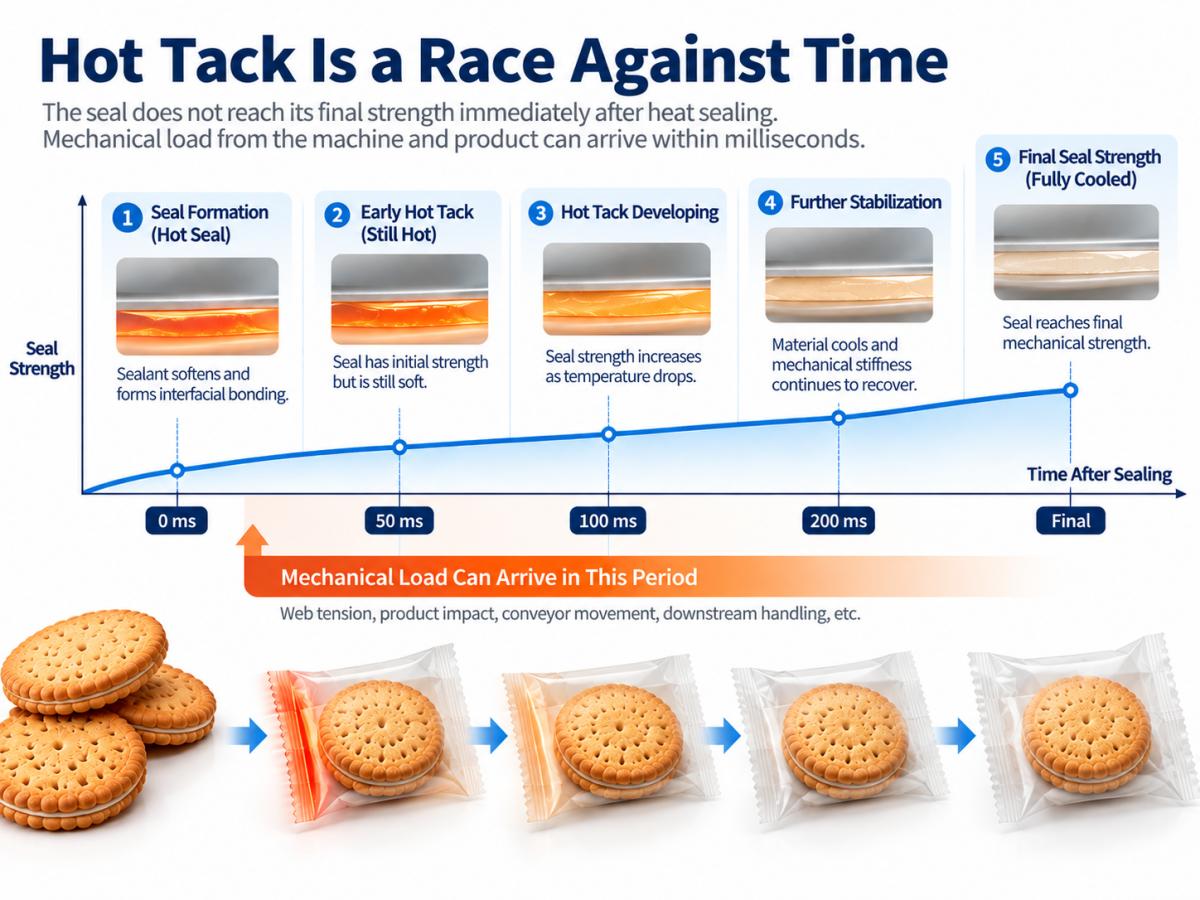
Immediately after sealing, the sealant may still have high temperature, low modulus and limited mechanical stability. It has not yet recovered the stiffness available after cooling.
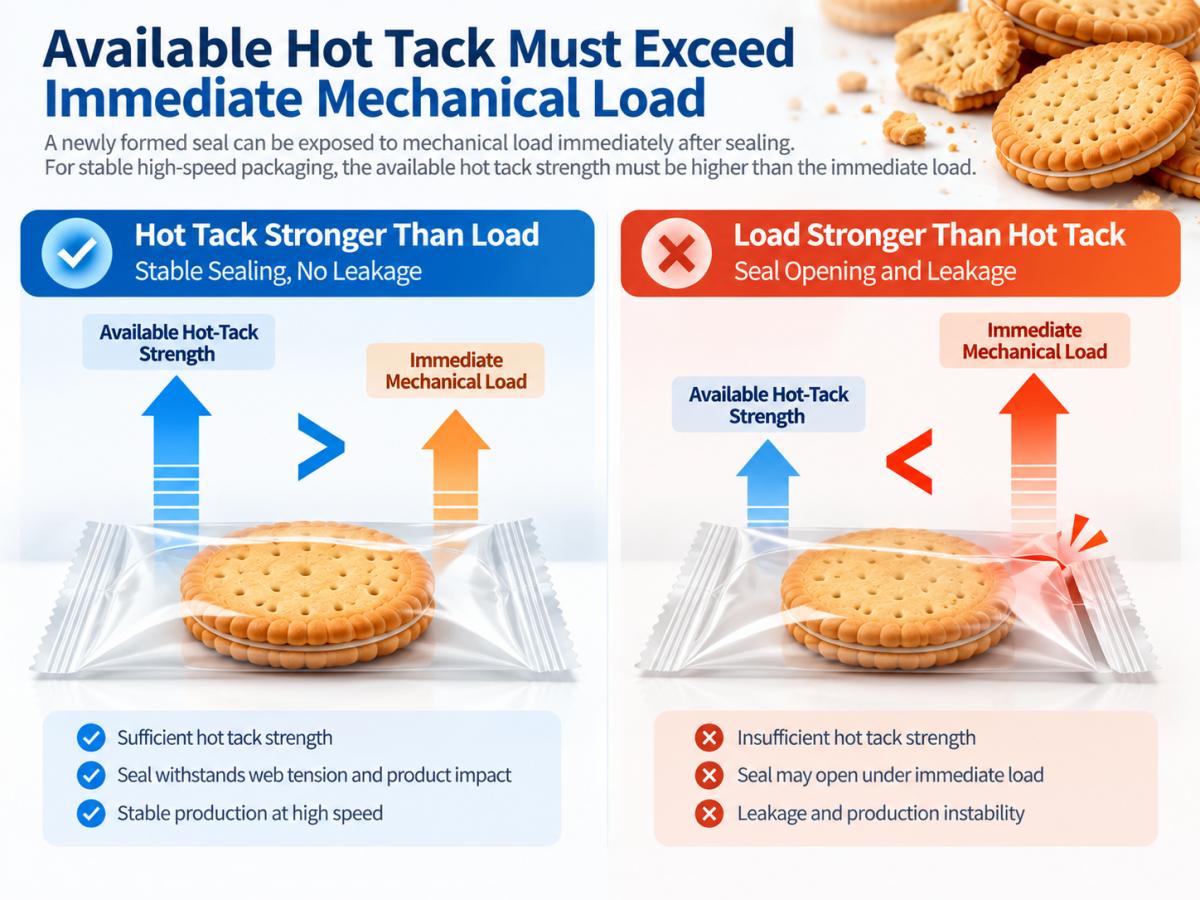
If the mechanical load applied by the machine exceeds the available hot-tack strength, the seal can stretch, peel, open or distort even though the same joint would develop excellent final strength later.
A useful engineering model is simple: available hot-tack strength must exceed the immediate mechanical load applied to the fresh seal.
If that condition is satisfied, the seal can survive the packaging cycle. If the immediate mechanical load is greater than the available hot-tack strength, instability becomes much more likely. The target is therefore sufficient hot tack at the required machine timing, not the highest laboratory number in isolation.
Available Hot-Tack Strength > Immediate Mechanical Load
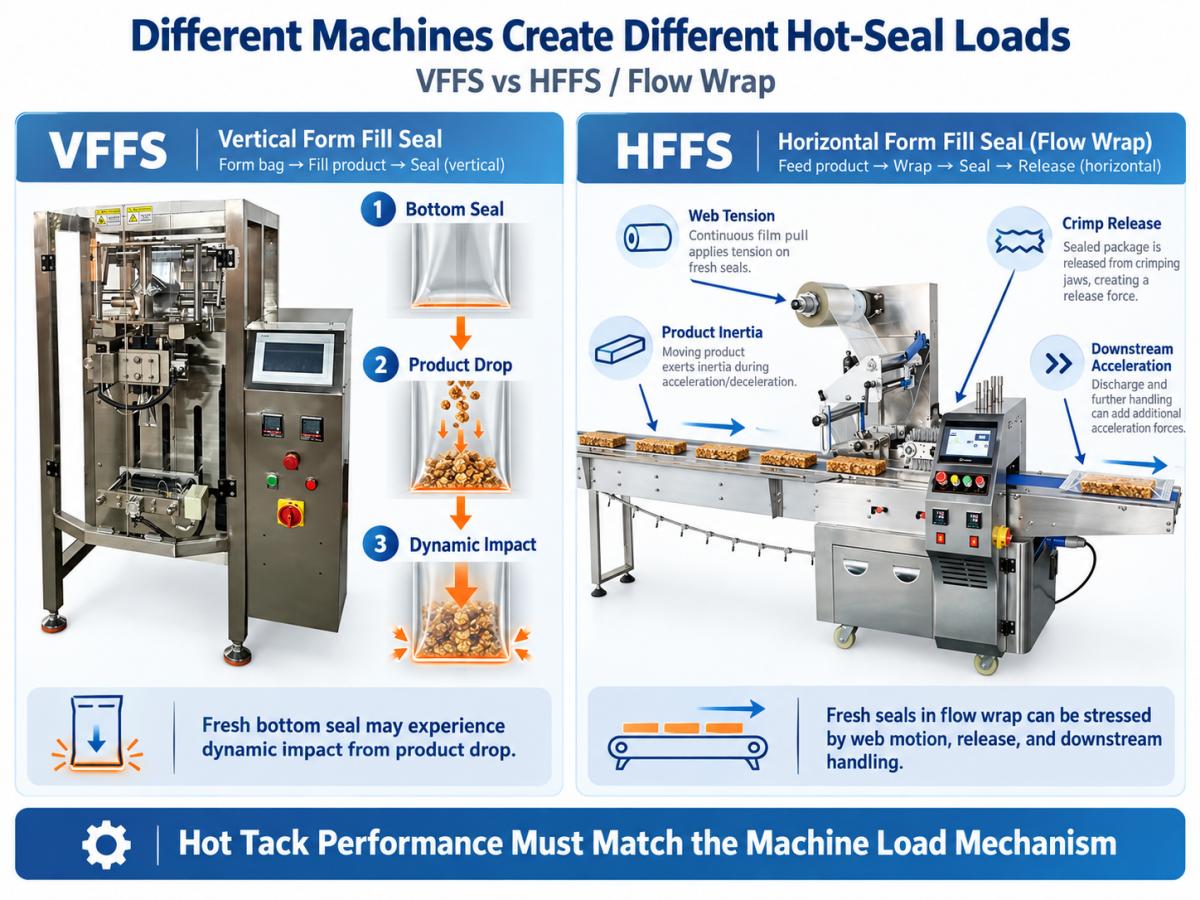
A newly formed seal can experience product weight, product momentum, web tension, internal package pressure, conveyor acceleration, crimp release and downstream transfer.
These stresses are dynamic rather than purely static. Hot-tack performance therefore needs to be evaluated as part of the complete machine process.
In vertical form-fill-seal packaging, the bottom cross seal may be loaded shortly after it is formed. The sequence can be bottom seal formation → product discharge → product impact on the fresh seal.
The bottom seal can experience both static product weight and dynamic impact. Product mass, density, drop height and timing all influence the hot-tack requirement.
Horizontal form-fill-seal packaging creates a different load pattern. A newly formed cross seal may immediately experience web tension, product inertia, crimp release and downstream acceleration.
At high line speeds these forces can reach the seal almost immediately after it exits the sealing zone. Strong hot tack can therefore contribute directly to stable packaging of biscuits, chocolate bars, protein bars, confectionery and bakery products.
Continuous rotary sealing systems often combine high line speed, a short contact arc and rapid seal release. The seal can leave the heated zone after a very short effective contact time, with mechanical stress following almost immediately.
Fast hot-tack development is therefore especially important in rotary systems. A sealant that builds useful immediate strength quickly can create a much larger practical operating window.
Hot tack should not be treated as a single fixed material value. Measured performance depends on sealing temperature, pressure, effective dwell time, delay time, peel speed and laminate structure.
A statement such as “hot tack = X N” has limited engineering meaning without the test conditions. The more useful approach is to evaluate hot tack as a performance curve.
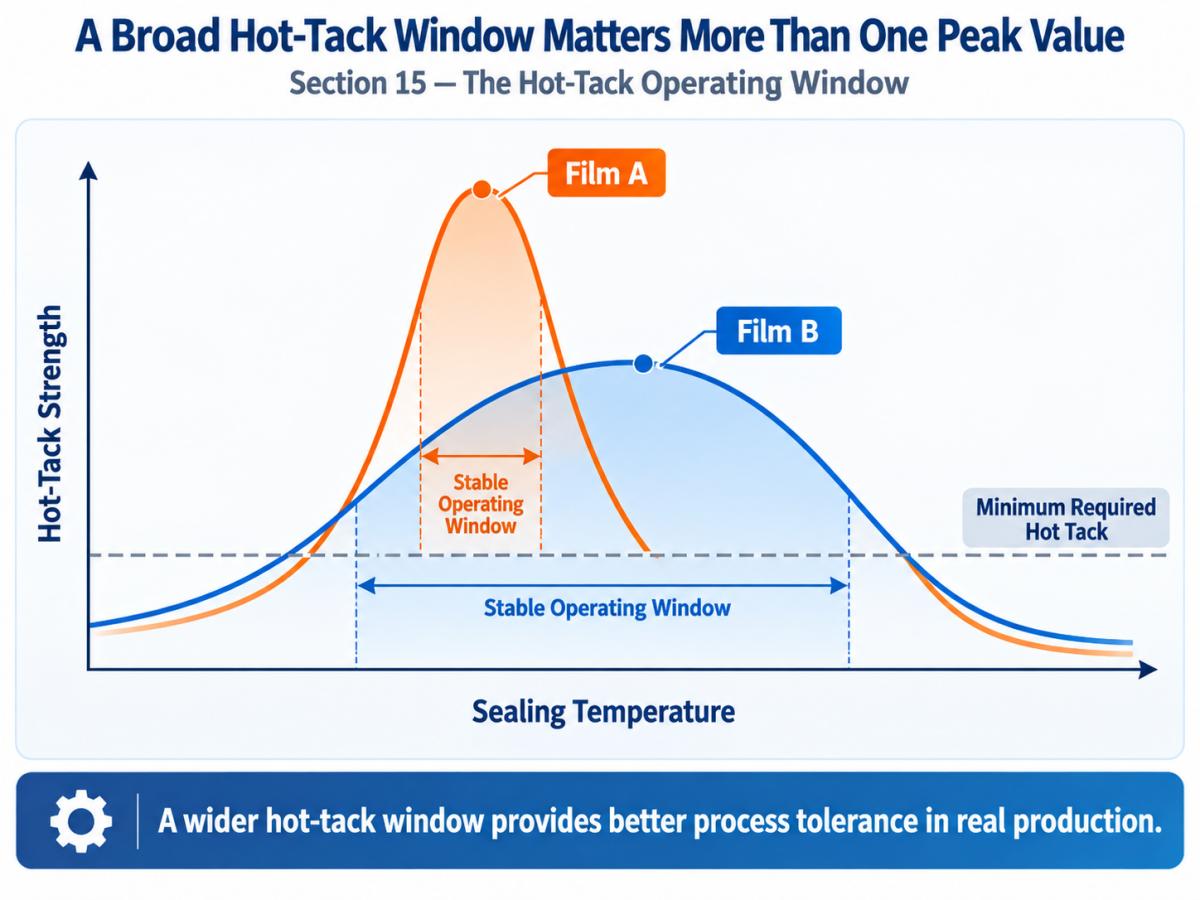
A typical hot-tack evaluation plots hot-tack strength against sealing temperature. At low temperatures the sealant may not develop sufficient interfacial bonding. As temperature increases, hot-tack strength rises and a useful operating region appears.
The key question is not simply the maximum value. It is how broad the usable range is under real process conditions.
Film A may achieve a very high hot-tack peak within a narrow temperature band. Film B may have a slightly lower peak but maintain sufficient hot tack over a much broader temperature range.
For industrial production, Film B may provide greater stability. A high peak hot-tack value is not necessarily better than a broad hot-tack window.
For high-speed packaging, the more useful concept is the hot-tack operating window: the range of process conditions where available hot tack remains at or above the minimum strength required by the machine.
The wider this operating window, the more tolerant the process can be to normal variations in temperature, pressure, speed and film behavior.
Hot-Tack Operating Window = Conditions Where Available Hot Tack ≥ Minimum Required Hot Tack
There is no universal hot-tack strength that is correct for every application. The minimum required strength depends on package weight, product impact, web tension, machine speed, downstream acceleration and package geometry.
The same film may perform well on one machine and fail on another. The target is application-specific.
Seal Initiation Temperature (SIT) describes when a seal begins to reach a defined minimum strength under specified test conditions. Hot tack answers a different question: can the newly formed seal survive mechanical load before it has fully cooled?
Low SIT therefore does not automatically mean strong hot tack. A material may begin sealing at a relatively low temperature yet still have limited immediate strength.
Low SIT ≠ Automatically Strong Hot Tack
For high-speed heat sealing, an effective PE-based sealant system often combines lower SIT, strong hot tack and a wider heat-seal window.
Lower SIT helps useful seal development begin earlier; strong hot tack helps the fresh joint survive immediate stress; and a wider heat-seal window increases tolerance to normal production variation.
Lower SIT + Strong Hot Tack + Wider Heat-Seal Window
A film may technically seal at a very low temperature, but if the fresh joint remains mechanically weak for too long, the machine can still experience seal opening, stretching, leakage or unstable production.
The better engineering target is fast seal formation plus strong immediate strength, not the lowest possible sealing temperature.
At higher line speeds the effective time available for sealing may become more limited. The material has less time to receive heat and develop interfacial bonding.
A faster-response sealant can compensate by building useful hot strength more quickly. Machine speed, effective dwell time and hot tack should therefore be evaluated together.
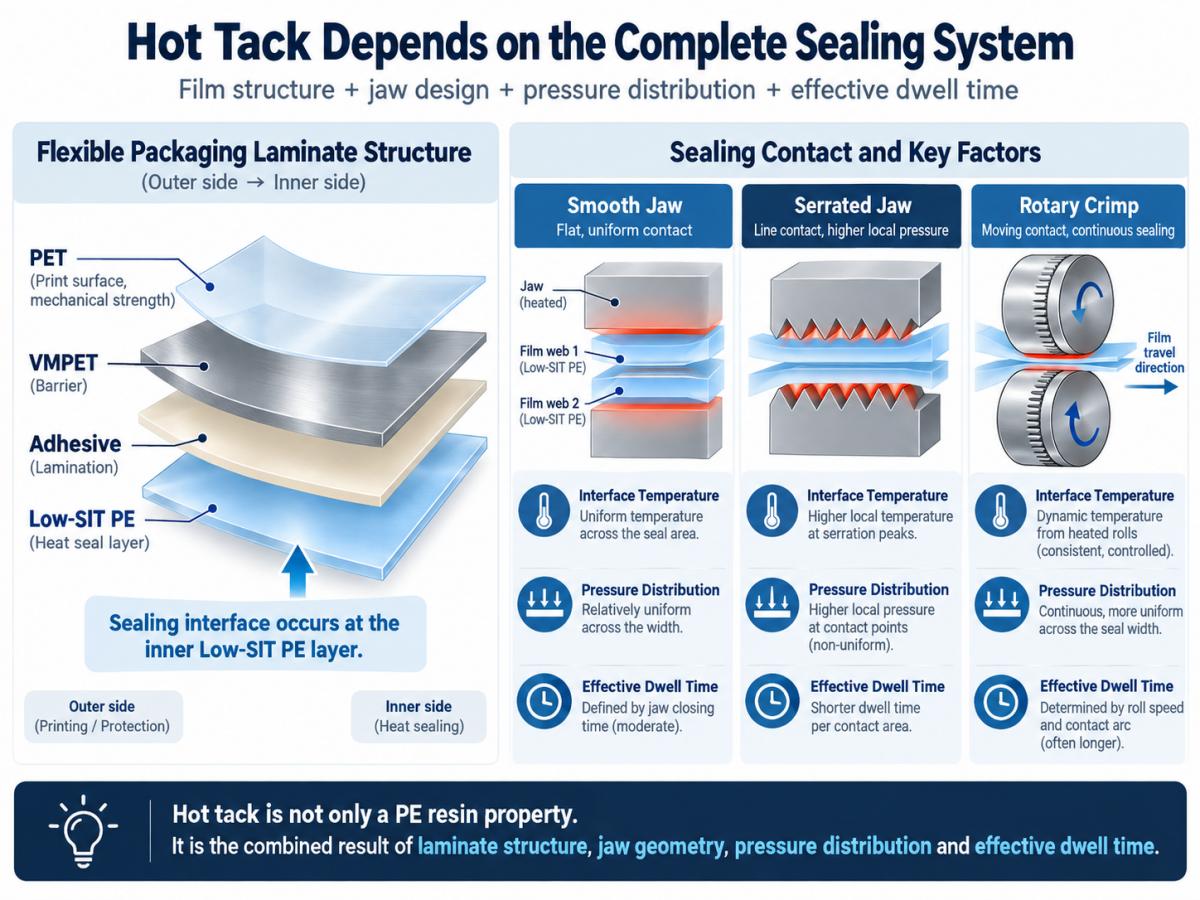
The temperature displayed on the packaging machine is not necessarily the temperature reached at the sealant interface. Heat must travel through the laminate.
Outer layers, barrier layers, adhesives, total thickness and thermal properties all influence the actual interface response. The same sealant can behave differently in PET/PE, PET/VMPET/PE or other multilayer structures.
Pressure helps softened sealant surfaces achieve intimate contact, but average pressure alone does not describe the entire seal. Pressure distribution, jaw parallelism and seal geometry also matter.
Too little pressure can create incomplete contact, while excessive or uneven pressure can contribute to sealant squeeze-out, seal thinning or film distortion. The objective is appropriate and uniform pressure across the seal area.
Packaging machines may use smooth jaws, serrated jaws, rotary crimps, fin-seal systems or continuous rollers. Each geometry produces different contact areas, local pressures, heat-transfer behavior and effective dwell conditions.
The same film can therefore show different hot-tack performance on different equipment. Machine-specific validation remains essential.
After sealing, the material does not simply become colder. As the sealant cools, it regains mechanical stiffness and the joint becomes progressively less vulnerable to stretching and peeling.
This is why cooling should also be understood as modulus recovery and mechanical stabilization.
When hot-tack-related failure occurs, changing the film is not always the only solution. Depending on equipment design, air cooling, cooling bars, a longer cooling distance or reduced immediate downstream load may improve performance.
The most robust solution may combine material optimization with machine cooling optimization.
A packaging machine may be mechanically capable of running at a higher speed than the seal can support. If seals begin opening above a certain line speed, the real limitation may be the rate at which seal strength develops.
Hot tack can therefore become one of the factors defining maximum stable production speed.
A package may fail immediately after sealing, yet later testing of the remaining cooled seals may show excellent final strength. This can create the misleading conclusion that the film has enough seal strength.
The actual failure may have occurred during the hot stage. Troubleshooting should therefore distinguish hot-stage failure from final-stage seal failure.
Hot-Stage Failure ≠ Final-Stage Seal Failure
Seal evaluation should not focus only on peak force. Failure modes such as seal peel, cohesive sealant failure, film tear, sealant squeeze-out or laminate delamination can provide useful evidence.
The failure mode can also change depending on whether the seal is tested hot or fully cooled. Strength, failure mode and timing should be evaluated together.
Real packaging lines do not always provide perfectly clean sealing areas. Oil, powder, sugar, seasoning, crumbs, sauce or product particles can reduce effective sealant-to-sealant contact.
During the short hot stage this may reduce the immediate strength available to resist mechanical load. Clean-laboratory hot tack does not automatically predict contaminated-line performance.
For contamination-prone applications, the relevant question is whether the material can develop enough immediate strength under the actual contamination conditions of the product.
Powder, oil, sauce and product particles create different sealing challenges, so testing should reproduce the real product environment whenever possible.
Coefficient of friction (COF) is not a hot-tack property, but it can indirectly affect hot-seal stability by influencing web feeding, jaw release, film drag, product movement and web tension.
If friction becomes excessive or unstable, additional mechanical force may be transferred to the fresh seal. Hot tack, COF and web handling should therefore be considered as part of the same machine-film system.
Product temperature changes heat flow around the sealing area. Frozen, chilled, ambient and hot-filled products can influence local cooling differently.
Real sealing behavior can therefore depend on film temperature, product temperature and ambient conditions. This is another reason laboratory data alone cannot fully predict production performance.
A film can provide strong hot tack and still be unsuitable for high-temperature processing after packaging. Strong hot tack does not equal retort suitability.
Retort packaging requires the complete laminate and seal to survive subsequent thermal processing, such as 121°C sterilization. Hot tack primarily concerns the immediate post-sealing stage.
Heat-seal systems depend strongly on hot tack because the thermoplastic joint needs to survive while still hot. Cold-seal systems depend more on immediate coating-to-coating cohesive bond strength.
This is one reason Low-SIT PE and Cold Seal represent different engineering routes rather than interchangeable material choices.
A film can show strong laboratory hot-tack performance and still behave differently on a real packaging line. Actual performance depends on machine speed, pressure, effective dwell time, jaw temperature, delay time, cooling, product load, film tension and contamination.
The real objective is sufficient hot tack across the actual machine operating window.
Hot tack can be evaluated using standardized methods such as ASTM F1921 or equivalent internal test procedures.
Standardized methods improve material comparison, but results must still be interpreted together with sealing temperature, pressure, dwell time, delay time and test speed. Laboratory testing is a screening and comparison tool, not a substitute for production-line validation.
For high-speed applications, a more complete sealing evaluation should consider SIT, seal strength versus temperature, hot tack versus temperature and hot tack versus delay time.
Together these curves show when useful sealing begins, how quickly strength develops, how strong the joint is while hot and how rapidly it stabilizes after leaving the sealing station.
Hot tack should become a major troubleshooting focus when a line performs well at lower speed but develops leakage or seal opening as speed increases.
Typical warning signs include seals opening immediately after the jaws, bottom-seal failure after product drop, cross-seal stretching, acceptable final seal strength but poor running performance, or a sharp increase in rejects after speed-up.
When seals become unstable at higher speed, increasing temperature is often the first adjustment. Sometimes this helps, but excessive thermal input can increase film distortion, jaw sticking, sealant squeeze-out and product thermal risk.
A more robust solution may involve a faster-response sealant, stronger hot tack, better pressure distribution and improved cooling. The objective is to widen the operating window rather than simply raise the set temperature.
When two films are compared, one may advertise a lower SIT while the other develops stronger hot tack within the actual machine cycle.
For a high-speed line, the second material may deliver better production stability. The lowest SIT does not always produce the highest stable machine speed; the better hot-tack operating window can matter more.
At HLunPACK, we do not evaluate high-speed heat-seal films only by nominal sealing temperature or final seal strength. We consider machine speed, effective dwell time, delay time, jaw or roller geometry, pressure distribution, film structure, product load, product temperature, seal contamination, COF and cooling conditions.
The objective is not simply to create a seal. The objective is to develop enough seal strength at the exact moment the machine needs it.
For one application, the main improvement may come from lower SIT. For another, it may be stronger hot tack, a wider heat-seal window, improved cooling, better pressure control or revised machine timing. The correct solution must match film + machine + product + process.
Film + Machine + Product + Process → Stable Production Speed
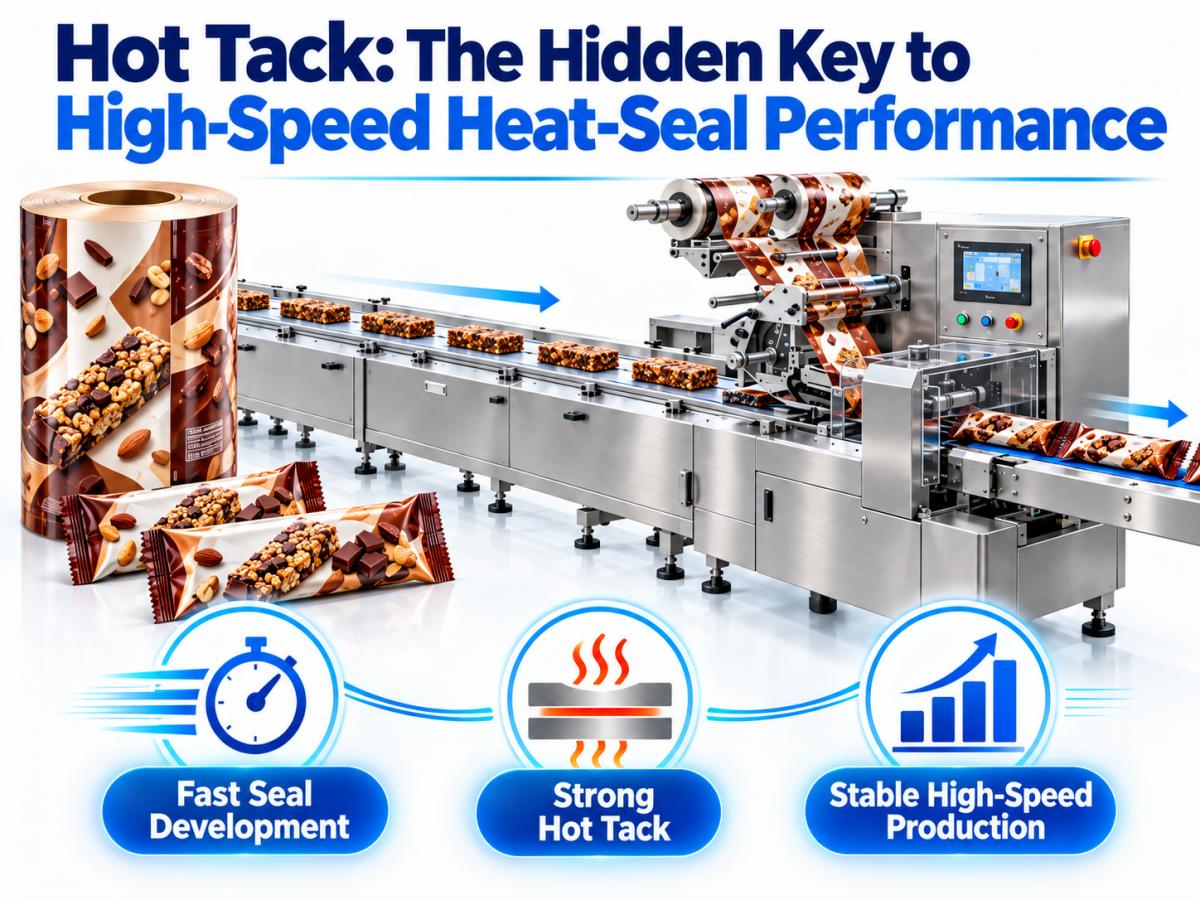
Final seal strength tells us how strong a package becomes after cooling. High-speed packaging asks another, more demanding question: how strong is the seal before it has fully stabilized?
As machine speed increases, the time available for sealing and cooling becomes more limited while mechanical loading can reach the package earlier. The seal must develop enough strength quickly enough to survive the first moments after leaving the sealing station.
This leads to one of the most important principles in high-speed heat sealing: a strong final seal is not enough. The seal must become strong at the right time.
The most robust high-speed sealing system aims to combine fast seal formation, sufficient hot tack, a wide hot-tack operating window, controlled mechanical load and adequate cooling. That is what converts theoretical machine speed into stable production speed.
Fast Seal Formation + Sufficient Hot Tack + Wide Operating Window + Controlled Load + Adequate Cooling = Stable Production Speed
Hot tack is the strength of a heat seal while the seal is still hot, shortly after it leaves the sealing jaws or rollers and before final cooling and mechanical stabilization.
At higher machine speeds, fresh seals can experience product load, web tension, crimp release or downstream movement before they are fully cooled. Sufficient hot tack helps the seal survive this early mechanical stress.
No. SIT indicates when useful sealing begins under specified test conditions. Hot tack indicates whether the newly formed hot seal has enough immediate strength to resist load before cooling.
Yes. A seal can fail during the hot stage and later show acceptable strength after cooling. This is why online failure timing and hot-tack behavior should be considered during troubleshooting.
Depending on the application, improvement may involve a faster-response sealant, stronger hot-tack formulation, optimized pressure distribution, revised dwell time, better cooling, lower downstream load or changes to the complete laminate structure.


