


close
Choose Your Site
Global
Social Media
Views: 215 Author: Tom Publish Time: 2026-10-23 Origin: Hlunpack


In conventional heat sealing, one of the fundamental limits on packaging speed is time. The sealing jaws may already be hot, but a reliable seal cannot form until sufficient thermal energy has passed through the laminate and reached the inner sealant interface.
As machine speed increases, the available sealing time becomes shorter. The film still needs enough time and thermal input to form a reliable seal, while the line must continue to move faster.
Cold seal changes this relationship. Instead of depending primarily on thermoplastic sealant activation through heat, cold-seal packaging relies on compatible cold-seal-coated surfaces coming into contact under controlled pressure.
Heat Seal: Heat + Pressure + Time → Cold Seal: Coating Cohesion + Contact Pressure + Registration + Surface Contact
This is why cold seal can largely bypass one of the most important speed constraints in conventional high-speed flexible packaging: thermal transfer time.
In a conventional heat-seal laminate, the heat source is outside the package structure while the sealing interface is inside. Before useful bond strength can develop, heat must travel through the laminate and activate the inner thermoplastic sealant.
The rate of this process depends on jaw temperature, laminate structure, film thickness, thermal conductivity, pressure, effective dwell time and sealant response. At higher speeds, the available time becomes increasingly limited.
Heated Jaw → Outer Film → Intermediate Layers → Inner Sealant Interface → Seal Formation
Heat transfer is only the first part of the problem. After the heat seal is formed, the seal remains hot and mechanically vulnerable until it cools and stabilizes.
At higher packaging speeds, downstream web tension, product load and conveying forces arrive sooner. This is why hot tack becomes increasingly important in high-speed heat-seal systems.
Heat Transfer → Sealant Activation → Hot Seal → Cooling → Mechanical Stabilization
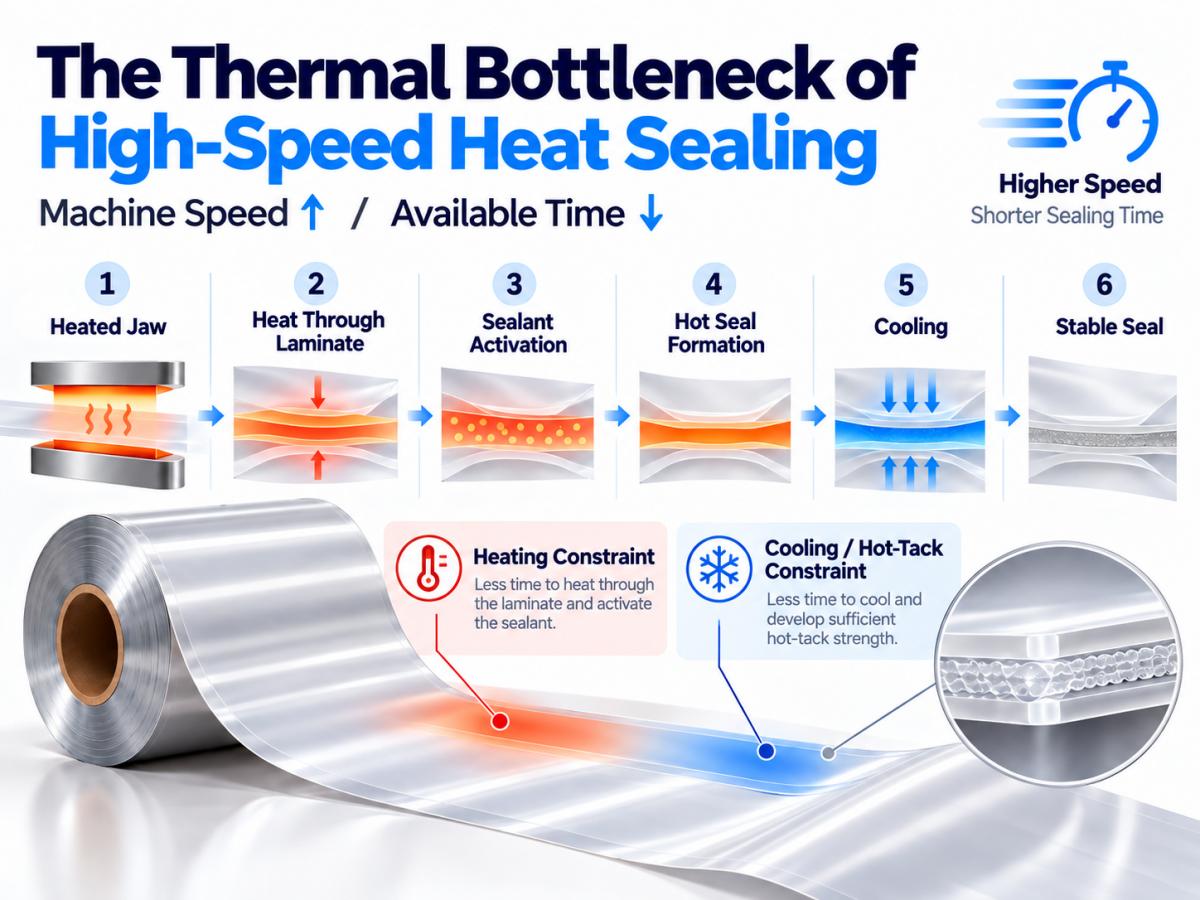
When effective dwell time decreases, increasing sealing temperature can accelerate heat transfer. However, higher thermal input also introduces additional risks.
· Film shrinkage or outer-layer deformation
· Print distortion or surface sticking
· Sealant squeeze-out and seal thinning
· Narrower operating tolerance
· Higher thermal exposure to the product
The engineering target is therefore not simply more heat. It is faster, more reliable seal formation without exceeding the thermal tolerance of the film or the product.
Low-SIT PE can reduce the thermal demand required before useful seal strength begins to develop. In a properly engineered sealant system, it can support earlier seal initiation, strong hot tack and a wider heat-seal window.
However, the basic mechanism remains thermal: heat still has to pass through the laminate to reach the sealant interface. Low-SIT PE optimizes thermal sealing; cold seal changes the seal-formation mechanism.
Cold-seal packaging uses a specially formulated self-sealing coating applied to defined sealing areas of the web. When two compatible coated surfaces are brought together under sufficient pressure, they develop a strong bond.
The key distinction is that thermal energy is no longer the primary trigger for package closure. Performance depends much more strongly on coating cohesion, surface contact, pressure and registration.
Cold-Seal Coating + Cold-Seal Coating + Controlled Pressure → Cohesive Seal Formation
Cold seal should not be understood as a conventional adhesive that simply sticks to any surface. The coating is designed to preferentially bond to a compatible cold-seal-coated surface.
A stable system therefore requires compatible coating surfaces, correct pattern alignment, adequate pressure and clean contact in the intended seal area.
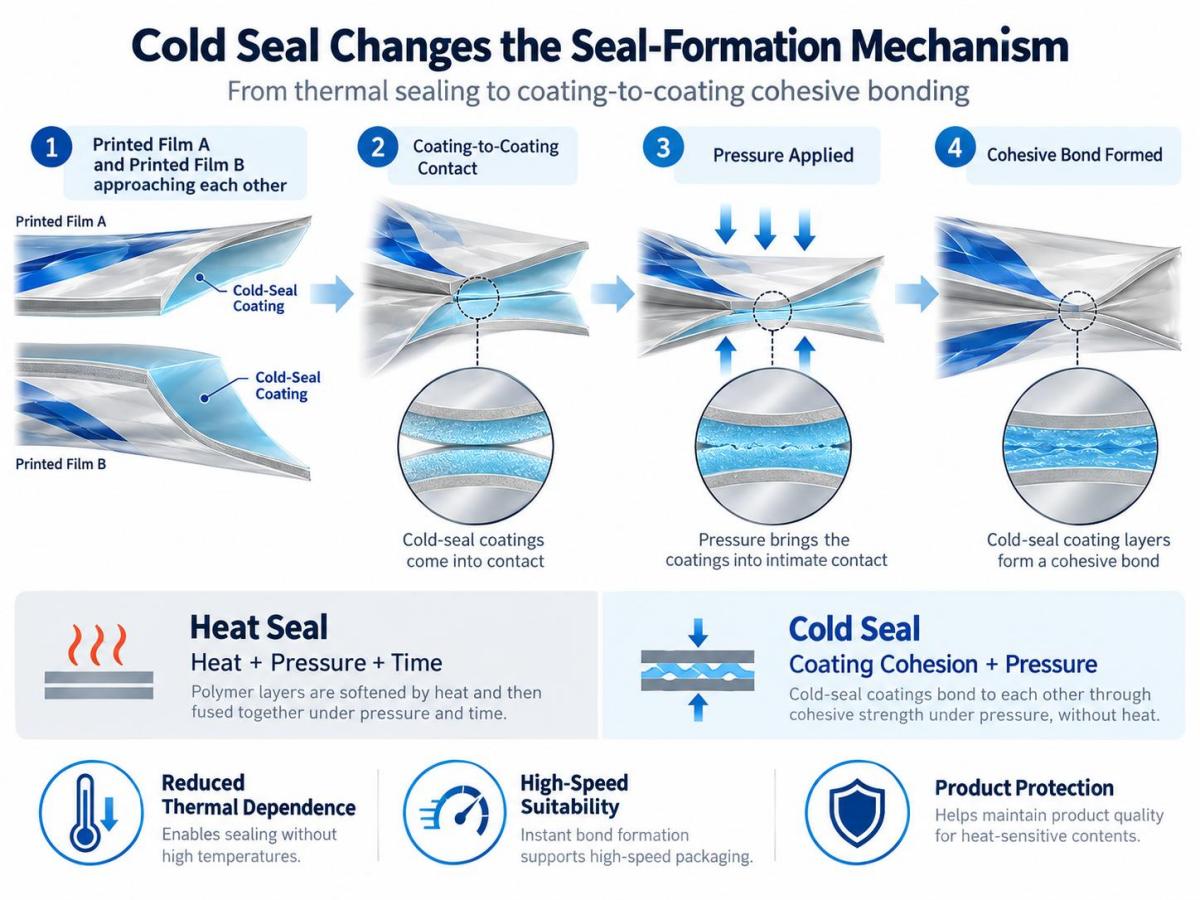
The term cold seal does not mean that temperature is irrelevant everywhere in the packaging process. Product temperature, ambient conditions, roll-storage temperature and machine conditions may still influence performance.
The technically accurate statement is that cold seal greatly reduces dependence on thermoplastic heat-seal activation during package closure.
In heat sealing, the available cycle must accommodate heat transfer, sealant activation, bond formation and hot-seal stabilization. In cold sealing, the critical cycle focuses more on coating contact, pressure and immediate bond formation.
The process constraint therefore shifts away from thermal transfer and toward coating, registration and web-control variables.
Thermal Management → Coating Contact + Pressure + Registration + Web Control
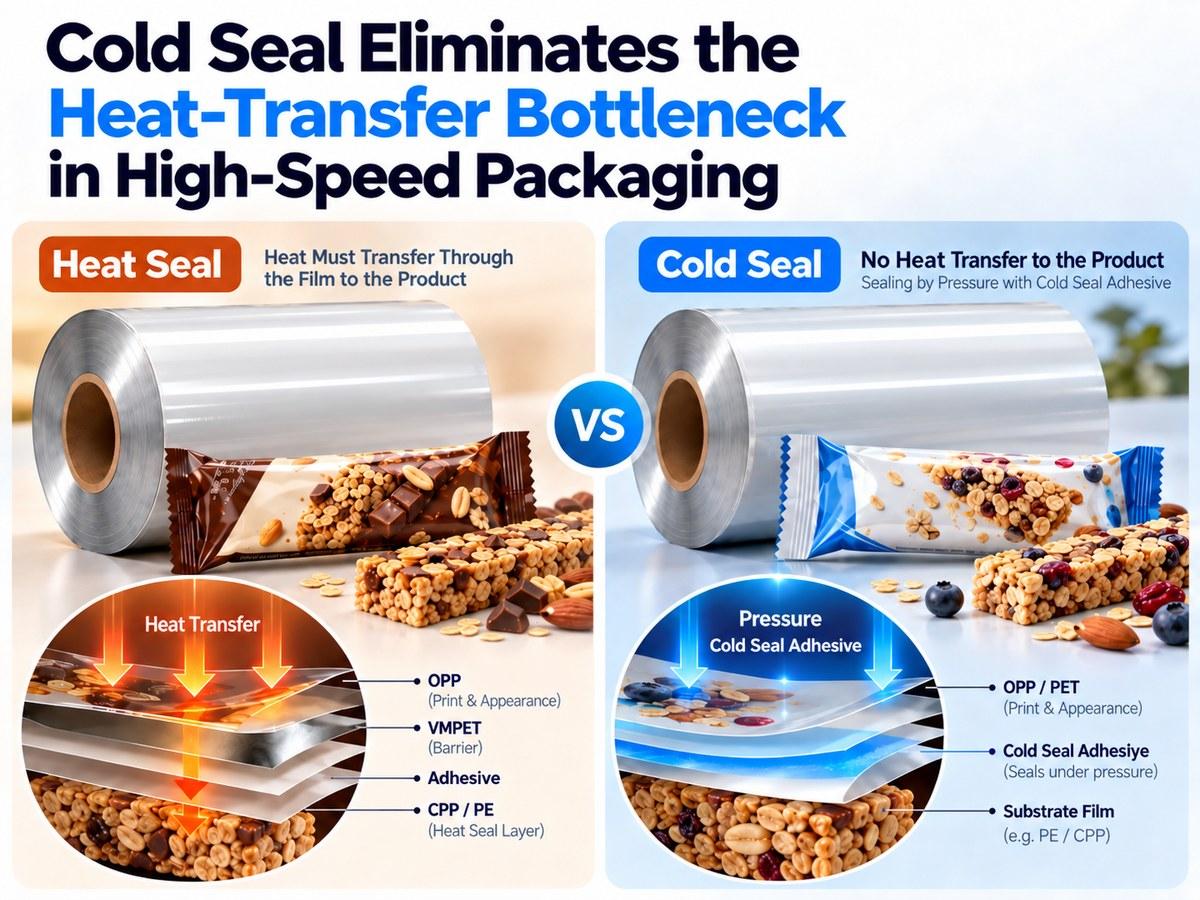
Cold seal is especially attractive when product quality can be affected by localized thermal exposure. Typical applications include chocolate, chocolate-coated bars, protein bars, cereal bars, confectionery, ice cream and selected bakery products.
· Softening or surface marking
· Sticking or coating deformation
· Shape change
· Texture or appearance variation
For these applications, cold seal can address high packaging speed and reduced product thermal exposure at the same time.
Cold seal reduces thermal dependence, but package geometry remains important. Bag pitch, product registration, cross-seal position, headspace and product alignment must still be controlled.
Cold seal does not compensate for poor package geometry; it changes the sealing mechanism while the rest of the packaging system still has to remain synchronized.
One of the most established uses of cold seal is high-speed horizontal form-fill-seal (HFFS) or flow-wrap packaging. Products move continuously through infeed, film forming, longitudinal sealing, cross sealing, cutting and discharge.
For heat-sensitive products, the combination of continuous motion, high throughput and lower thermal dependence makes cold seal particularly attractive.
Bypassing the thermal-transfer bottleneck does not mean machine speed becomes unlimited. At sufficiently high speed, other variables can become the new limiting factors.
· Product feeding and spacing
· Film tracking and web tension
· Pattern-to-print registration
· Crimp pressure and jaw geometry
· Cutting accuracy
· Machine acceleration and deceleration
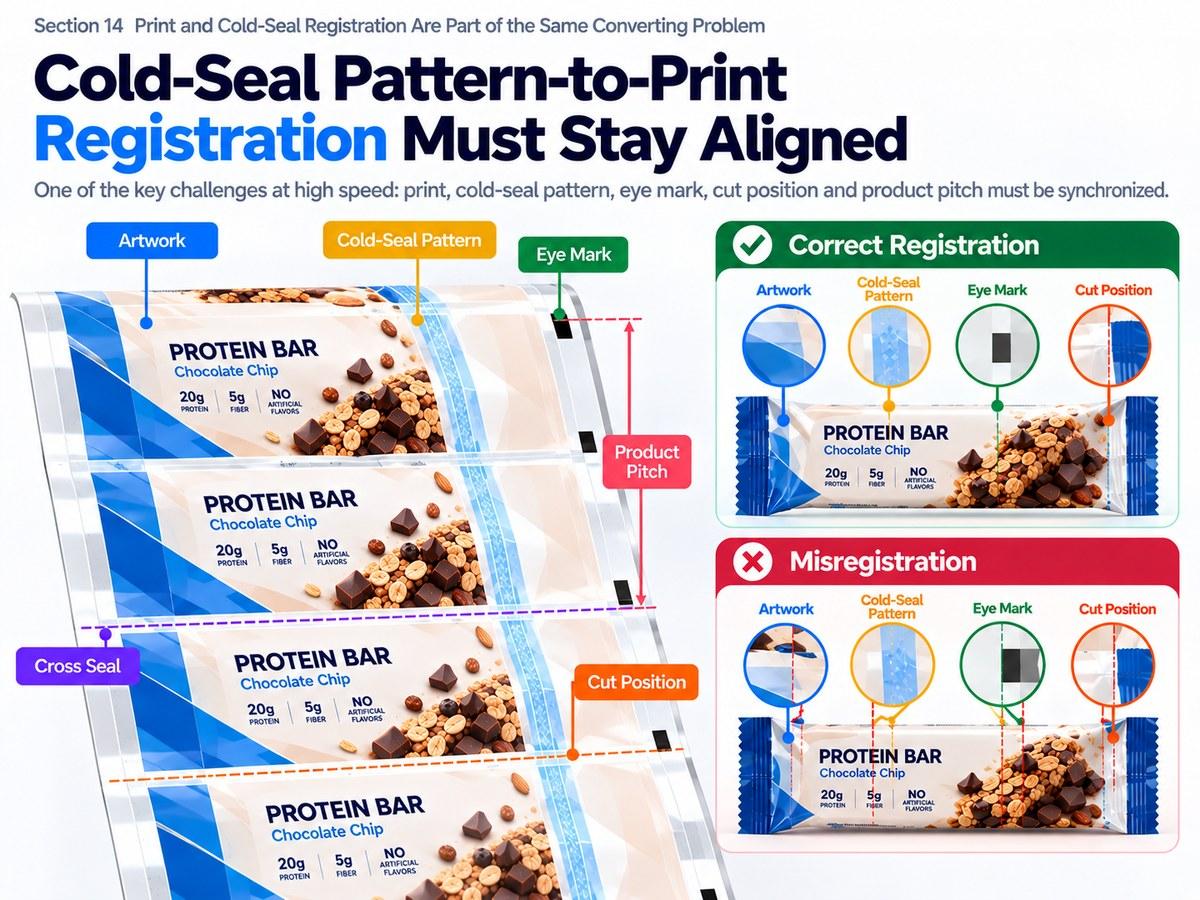
Cold-seal coating is commonly applied only to selected sealing areas. The coating pattern must therefore align accurately with the printed artwork, product pitch, eye mark, longitudinal seal, cross seal and cut position.
Small errors can produce incomplete coating overlap, poor seal formation, coating outside the intended seal area, graphic misalignment or inaccurate cutting.
In cold-seal packaging, converting accuracy must coordinate several registered elements at the same time. Web stretch, tension, repeat length, coating registration and print registration all influence package accuracy.
Artwork ↔ Cold-Seal Pattern ↔ Eye Mark ↔ Product Pitch ↔ Cross Seal ↔ Cut Position
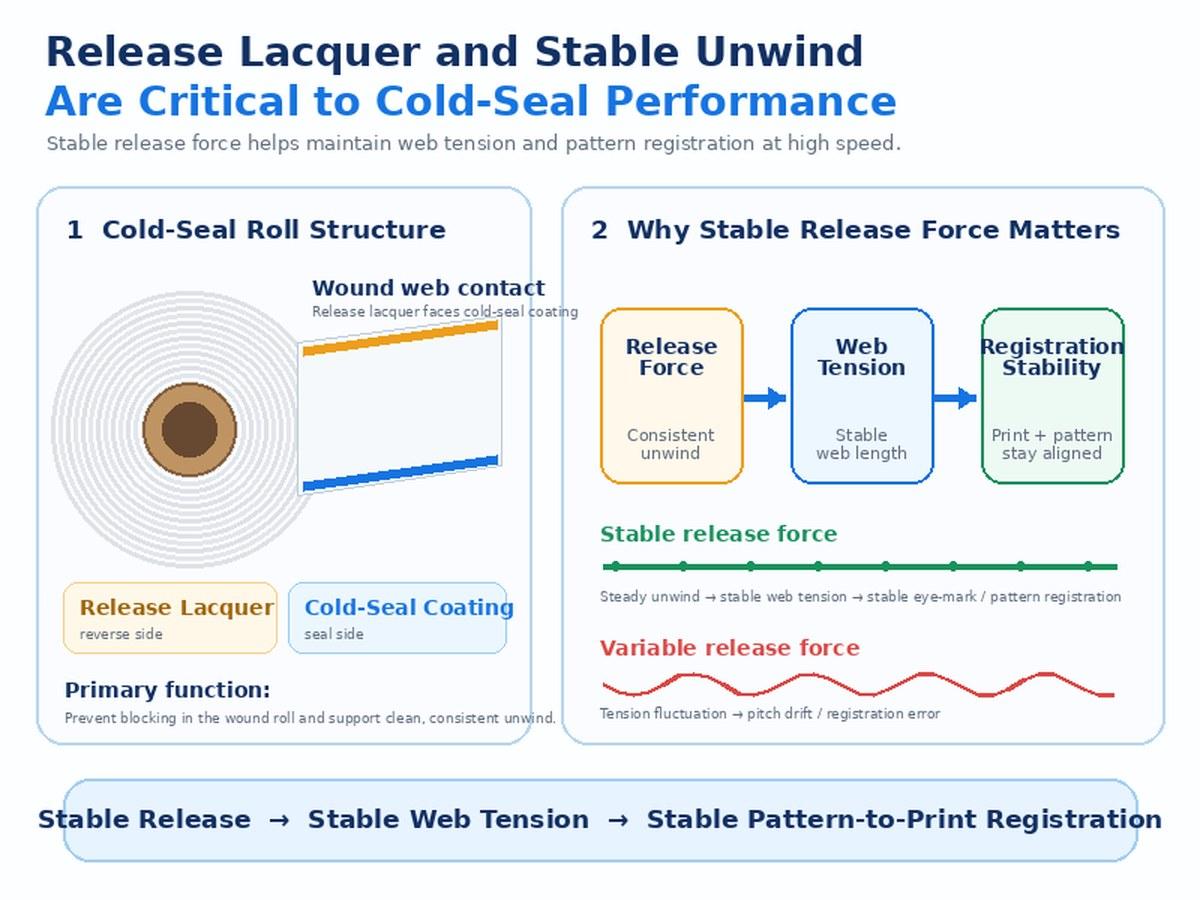
Cold-seal coating is normally applied to the seal side of the web. When the film is wound into a roll, that coated surface contacts the opposite side of the film.
A release lacquer is commonly applied to the reverse surface to prevent blocking during winding and storage and to support consistent unwind behavior.
For high-speed packaging, it is not enough that the roll can unwind. Release force should remain consistent across the roll.
If release force fluctuates, unwind tension can change. That can create web stretch, pitch variation and registration drift, which ultimately affects cold-seal pattern alignment and sealing consistency.
Release Force → Web Tension → Registration Stability
Cold seal requires the coated areas on opposing surfaces to meet each other in the intended seal zone. If forming geometry or registration is incorrect, the machine may create coating-to-uncoated-film contact instead of coating-to-coating contact.
This is why film path, forming geometry and pattern registration must be designed together.
In heat sealing, temperature, pressure and dwell time are the traditional process variables. In cold seal, temperature plays a much smaller role in bond activation, so machine control shifts toward contact pressure, contact area and contact time.
Pressure must be sufficient to create intimate coating-to-coating contact, but excessive pressure can mark the film, compress the product or distort the package.
Pressure alone cannot create a good seal if the cold-seal coating itself does not have appropriate bonding performance.
Cold-seal performance therefore combines material variables such as coating chemistry, cohesive strength, coat weight and coating anchorage with machine variables such as pressure, registration, web tension and crimp geometry.
Cold-seal machines may use pressure rollers, crimp jaws or rotary crimp systems. Their geometry affects pressure distribution, contact area, film marking and product compression.
For delicate products such as chocolate bars, coated wafers and protein bars, crimp design should provide enough pressure for a reliable bond without damaging the product.
Average cold-seal coat weight is an important specification, but average coat weight alone is not enough. Performance also depends on how uniformly the coating is applied across the web and along the machine direction.
Significant coating variation can create package-to-package differences in immediate bond strength and seal consistency.
Cold-seal performance depends not only on coating-to-coating cohesion but also on the ability of the coating to remain attached to the substrate.
Surface treatment, surface energy, primer or coating compatibility and base-film selection can all influence coating anchorage.
High-speed packaging lines place mechanical stress on the package soon after sealing. Cold-seal evaluation should therefore consider immediate bond strength, not only final bond strength after storage.
The package must have sufficient initial integrity to withstand conveying, cutting, product handling and downstream transfer.
A complete cold-seal evaluation can include immediate bond strength, aged bond strength and failure mode. Depending on coating chemistry and package conditions, bond behavior may change after sealing.
The relevant question is not only whether the package initially closes, but whether the bond remains appropriate during handling, distribution and shelf life.
Heat-seal systems depend heavily on hot tack because the thermoplastic seal can be mechanically weak while still hot. Cold-seal systems rely more on immediate coating-to-coating cohesive bond strength.
The two mechanisms solve the same functional problem - maintaining package integrity immediately after sealing - but they do so through different material physics.

Cold seal generally depends strongly on clean coating-to-coating contact. Oil, powder, crumbs, moisture and product particles can interfere with effective bonding.
Contamination tolerance varies by formulation and application, so actual product trials are necessary rather than assuming that all cold-seal systems behave the same way.
Low thermal demand does not automatically mean better seal-through-contamination performance. Heat-seal layers can be specifically engineered for contaminated seal areas, while cold seal depends strongly on physical contact between compatible coated surfaces.
Applications with significant powder, oil or product particles should therefore be validated with the actual product, film and machine.
Cold-seal coatings are not one universal material. Commercial systems can use different technologies, including natural-rubber-latex-based or synthetic formulations, depending on application and regulatory requirements.
Chemistry can influence bond strength, release behavior, aging, odor, food-contact suitability and processing conditions.
Cold-seal film is a functional coated material. Roll storage and handling can influence release behavior, surface condition, unwind stability and bond performance.
Temperature, humidity, winding pressure, storage time and protection from contamination should therefore be considered as part of the packaging system.
Reducing dependence on thermoplastic heat activation can lower the thermal load on both the packaged product and the flexible packaging structure.
This can help reduce film shrinkage, print distortion, heat-related sticking and surface deformation, although mechanical web stability still remains important.
Heat-seal equipment must maintain sufficient effective thermal contact. As line speed increases, this becomes increasingly difficult.
Cold seal is well suited to continuous-motion packaging because bond formation relies mainly on pressure and coating contact rather than waiting for the sealant interface to heat and then cool.
A high-quality cold-seal film cannot compensate for poor equipment control. The machine must still provide stable film tracking, controlled web tension, correct forming geometry, reliable crimp pressure, accurate registration, clean contact surfaces and stable cutting.
Cold seal should therefore be treated as film + machine system engineering, not simply as a material substitution.
Because the cold-seal pattern must remain aligned with print, product position, seal position and cut, web tension needs to remain stable.
Excessive or fluctuating tension can cause web stretch, pitch variation and registration drift. At high speed, even small dimensional changes can affect sealing accuracy.
Packaging lines start, stop, accelerate, decelerate and recover after jams. During these transitions, tension and registration can temporarily change.
A robust cold-seal system should therefore remain stable not only at nominal line speed but also during dynamic machine conditions.
Low-SIT PE reduces the thermal demand required to develop sufficient heat-seal strength but still relies on heat, pressure and time. Cold seal changes the seal-formation mechanism itself and therefore largely bypasses the thermal-transfer bottleneck.
This is the fundamental engineering distinction between the two routes.
Low-SIT PE: Reduce Thermal Demand | Cold Seal: Largely Bypass Thermal Seal Formation
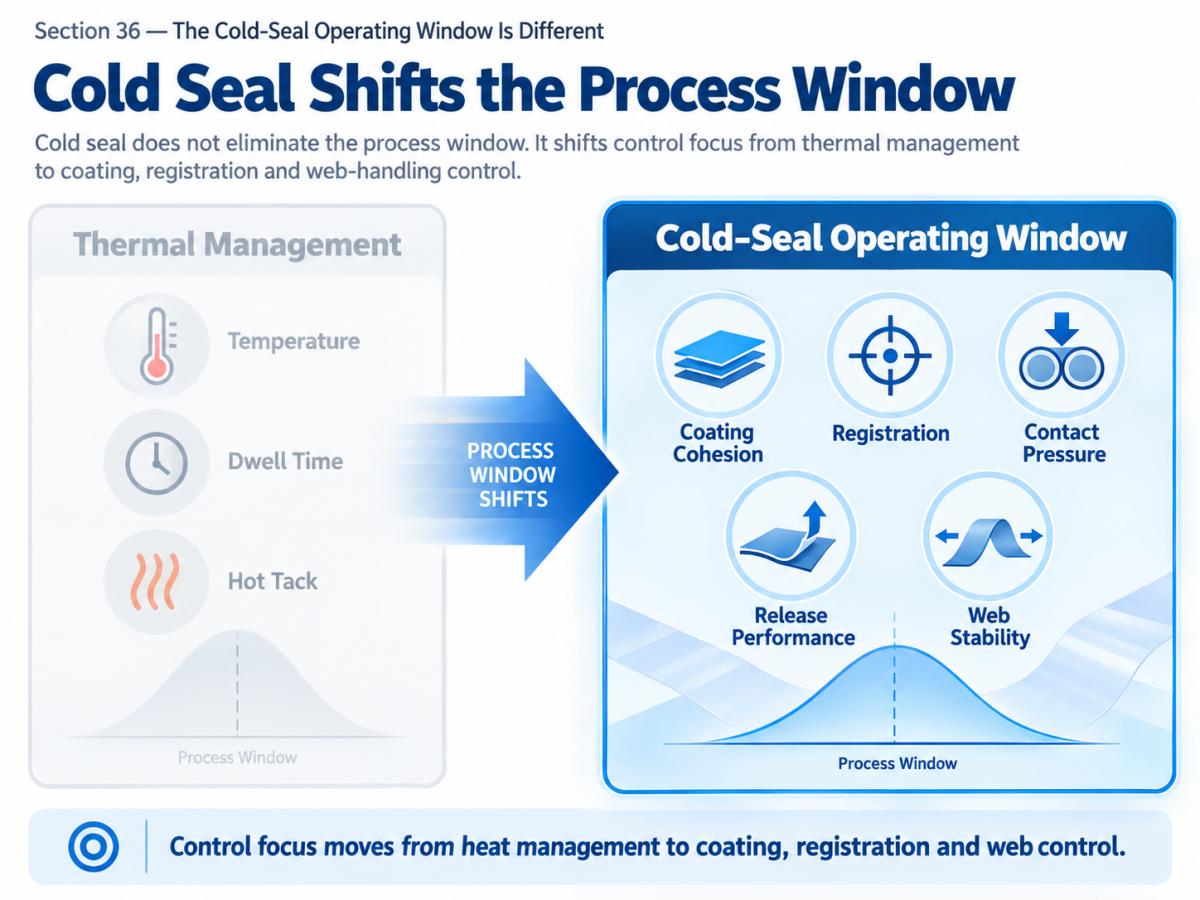
Once thermal transfer is no longer the dominant constraint, the operating window changes. Stable cold-seal production depends on a different group of variables.
Cold seal does not remove process control; it shifts the control focus from thermal management to coating, registration and web-control management.
Cold-Seal Operating Window = Coating Cohesion + Registration + Contact Pressure + Release Performance + Web Stability
Engineering Factor | Heat Seal / Low-SIT PE | Cold Seal |
Primary seal mechanism | Thermoplastic sealant activation | Coating-to-coating cohesive bonding |
Main trigger | Heat + pressure | Contact + pressure |
Thermal-transfer dependence | High to moderate | Much lower |
Product heat exposure | Present | Greatly reduced |
Post-seal concern | Hot tack / cooling | Immediate bond strength |
Registration sensitivity | Moderate | High |
Release lacquer | Usually unnecessary | Commonly important |
Pattern coating | Not normally required | Critical |
Contamination response | Sealant dependent | Coating-contact dependent |
Typical machine route | Heat-seal HFFS / VFFS | Cold-seal-compatible flow wrap |
Cold seal deserves serious evaluation when the application combines high machine speed, high product heat sensitivity, a flow-wrap format, small product-to-seal distance and cold-seal-compatible equipment.
· Chocolate and chocolate-coated bars
· Protein and cereal bars
· Confectionery
· Ice cream and other strongly heat-sensitive flow-wrap products
Cold seal is not automatically the best solution for every high-speed package. An optimized Low-SIT PE heat-seal system may be more practical when the existing machine is already designed for thermal sealing, the product tolerates controlled heat, contamination is significant, or cold-seal registration and release requirements add unnecessary complexity.
The correct decision should be based on total packaging-system performance rather than one material property.
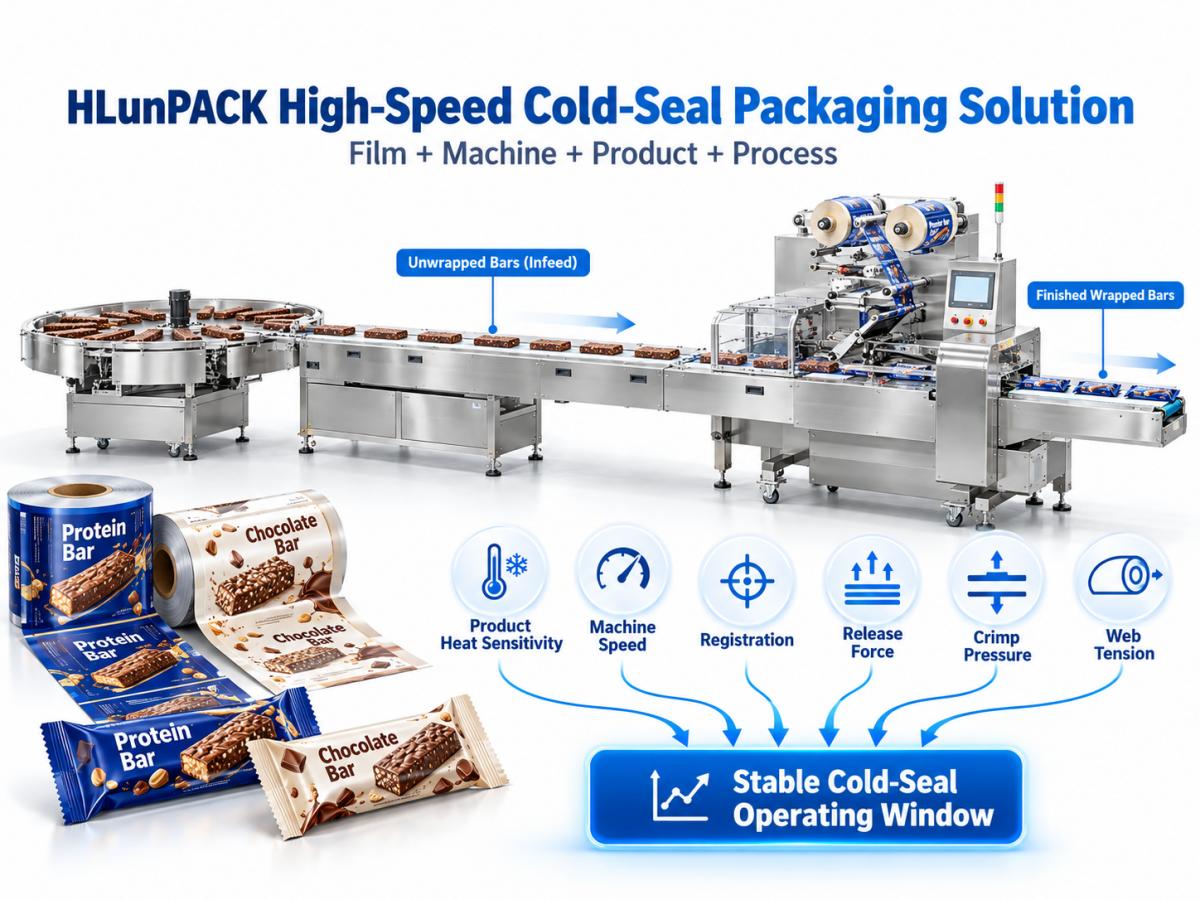
At HLunPACK, we do not evaluate cold seal as an isolated coating specification. For high-speed packaging applications, we consider product heat sensitivity, machine speed, product-to-seal distance, film structure, cold-seal pattern, pattern-to-print registration, web tension, release force, coat-weight uniformity, crimp pressure, seal contamination and machine design.
The objective is to determine whether the application should optimize thermal sealing through Low-SIT PE, strong hot tack and a wider heat-seal window, or largely bypass the thermal bottleneck through cold seal.
The final solution should match film, product, package geometry and packaging machine as one system.
In high-speed heat sealing, time is one of the fundamental limits. The machine must transfer enough heat through the laminate to activate the inner sealant before the packaging cycle moves on, and the hot seal must then survive mechanical stress while it cools and stabilizes.
Low-SIT PE improves this process by reducing thermal demand and accelerating seal development. Cold seal changes the mechanism itself. Instead of waiting for heat to pass through the laminate, cold seal relies primarily on coating-to-coating cohesion and controlled pressure.
This is why cold seal can largely bypass the heat-transfer bottleneck in high-speed flexible packaging. The engineering challenge does not disappear; it shifts toward coating cohesion, registration, release performance, pressure and web control.
Best System = Speed + Product Protection + Seal Integrity + Machine Compatibility
The correct sealing technology is not simply the one that uses the lowest temperature or offers the highest theoretical speed. It is the system that delivers the most stable operating window for the real product, film structure and packaging line.


