


close
Choose Your Site
Global
Social Media
Views: 279 Author: HLun PACK Publish Time: 2026-10-26 Origin: Site


Content Menu
● Vacuum Packaging vs MAP: Key Differences at a Glance
>> Where Vacuum Packaging Works Well
>> Main Limitations of Vacuum Packaging
● What Is Modified Atmosphere Packaging?
● Shelf Life and Food Safety: Which Method Performs Better?
>> Why Fixed Shelf-Life Claims Can Mislead
>> Reduced Oxygen Requires Specific Safety Controls
● Flexible Packaging Materials: Match the Film to the Process
>> Film Specifications Worth Comparing
● Packaging Equipment: Compare Complete Systems
>> Questions to Ask Before Requesting a Quotation
● Practical Selection Scenarios: Start With the Product
>> 1: Firm Cheese Blocks for Foodservice
>> 2: Soft Bakery Products for Retail
>> 3: Fresh Beef With Different Sales Channels
● A Six-Step Validation Plan Before Equipment Investment
● Compare Cost Per Saleable Pack, Not Just Machine Price
● Build the Packaging Solution Around Your Product
>> Is MAP Better Than Vacuum Packaging?
>> Does Vacuum Packaging Kill Bacteria?
>> Can MAP Replace Refrigeration?
>> Can One Machine Perform Both Processes?
>> Which Method Is Better for Fragile Foods?
>> How Should a Manufacturer Choose the Gas Mixture?
Vacuum packaging vs modified atmosphere packaging (MAP) is a choice between two ways of controlling the environment around a product. Vacuum packaging removes air before sealing. MAP replaces the surrounding atmosphere with a selected gas or gas mixture.
For food manufacturers, the better option depends on product texture, appearance, spoilage mechanisms, distribution conditions, and production economics. Neither method is universally superior, and neither makes unsafe food safe.
At HLun Pack, our approach to flexible packaging and packaging equipment starts with one principle: product fit. The package, machine, material, and preservation strategy must work together.
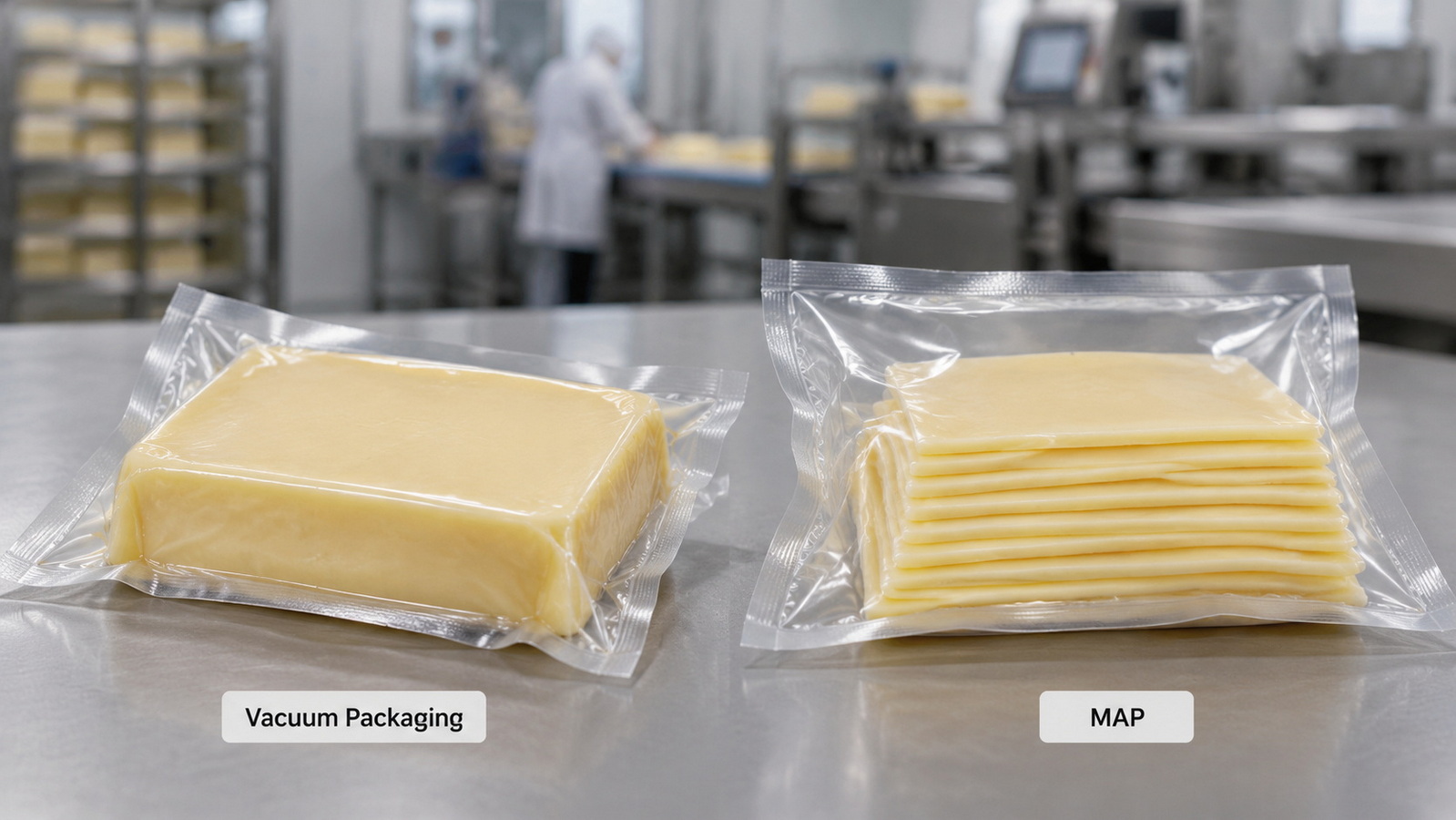
| Comparison factor | Vacuum packaging | Modified atmosphere packaging |
|---|---|---|
| Operating principle | Removes air before sealing | Establishes a selected gas atmosphere |
| Package appearance | Usually tight around the product | Often retains protective headspace |
| Product compression | Can compress delicate products | Can help preserve shape |
| Gas supply | Not required for conventional vacuum packaging | Required for active gas-flush MAP |
| Typical applications | Meat cuts, firm cheese, processed foods | Bakery products, sliced foods, selected fresh foods |
| Main process checks | Vacuum level, seal integrity, leaks | Gas composition, residual oxygen, seals, leaks |
| Material requirements | Barrier and sealing properties matched to the product | Barrier or controlled permeability matched to the atmosphere |
| Main limitation | Compression and appearance changes | Greater gas-management complexity |
Both methods can extend usable life, but the result depends on the food and the complete storage system.
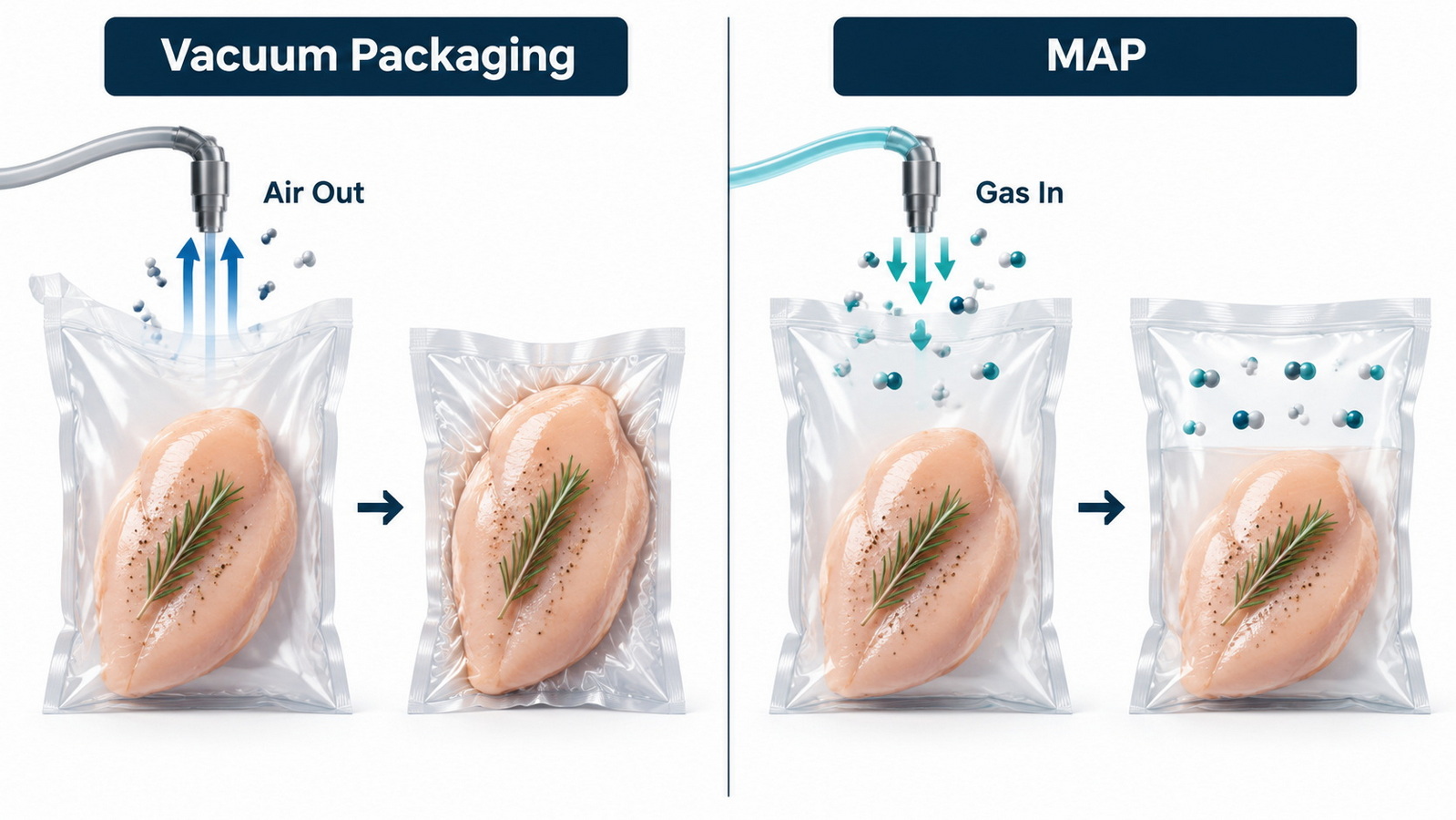
Vacuum packaging removes air from a pouch or formed package and seals it. In a conventional flexible vacuum pack, atmospheric pressure then presses the material against the product.
Removing much of the oxygen can slow oxidative deterioration and limit the growth of aerobic spoilage organisms. However, vacuum packaging does not remove every trace of oxygen or eliminate microorganisms.
Vacuum packaging is often a strong candidate for:
- Firm meat portions.
- Processed meat products.
- Hard cheeses.
- Products that tolerate close-fitting packaging.
- Bulk foodservice packs where compactness matters.
Its close fit can reduce empty package volume. However, sharp bones, hard edges, and product contamination in the sealing area create challenges that require suitable materials and process controls.
Conventional vacuum packaging can flatten soft products or pull slices together. It may also produce an appearance that differs from an air-packed product.
Fresh beef, for example, can look darker or more purplish under low-oxygen conditions. That appearance alone is not a reliable indication of spoilage or safety.
A vacuum pack therefore needs evaluation for both preservation performance and customer acceptance.
Modified atmosphere packaging changes the gas composition surrounding a food before the package is sealed.
Active MAP may use gas flushing or a vacuum-and-gas-backfill sequence. The exact process depends on the packaging machine and format.
Unlike conventional vacuum packaging, MAP commonly leaves headspace around the product. This can help protect delicate structures and maintain separation between food and packaging.
Three gases are especially important:
- Carbon dioxide helps inhibit many spoilage bacteria and molds.
- Nitrogen acts as a relatively inert filler and helps displace oxygen.
- Oxygen may be deliberately included for selected products, including certain fresh red-meat applications.
More carbon dioxide is not automatically better. It can dissolve into foods, changing headspace volume and potentially affecting package appearance.
Likewise, MAP does not always mean "oxygen-free." Gas composition must reflect the product's biology, chemistry, and presentation requirements.
MAP is worth evaluating for:
- Soft bakery products vulnerable to mold.
- Sliced or grated cheeses.
- Delicate foods that should not be compressed.
- Retail products requiring an open, visible presentation.
- Selected fresh meat products with defined color requirements.
Fresh produce needs additional care because it continues to respire. Its packaging may require controlled gas transmission rather than the highest possible barrier.
Neither vacuum packaging nor MAP has a universal shelf-life advantage.
Vacuum packaging may suit a firm product whose deterioration is strongly influenced by oxygen exposure. MAP may be more appropriate when spoilage control and shape protection must be achieved together.
Claims such as "MAP triples shelf life" omit important conditions.
Actual performance depends on:
- Initial microbial load.
- Processing hygiene.
- Product pH and water activity.
- Storage temperature.
- Film permeability.
- Seal integrity.
- Gas composition and headspace.
- Distribution conditions.
A result from one product cannot simply become the date code for another. Shelf-life claims require product-specific evidence, including safety and quality assessments.
Neither method sterilizes food. Reduced-oxygen conditions can also create hazards that require careful management.
UK guidance identifies non-proteolytic *Clostridium botulinum* as a concern in relevant chilled vacuum-packed and MAP foods. It can grow and produce toxin at temperatures of 3°C and above under suitable conditions.
The guidance uses a 10-day shelf-life threshold for relevant products unless additional controlling factors are established. This is not a universal global rule or a blanket limit for every food category.
Manufacturers should obtain qualified food-safety advice, apply local requirements, and validate the intended shelf life.
A capable machine cannot compensate for an unsuitable film.
For vacuum packaging, evaluate puncture resistance, flexibility, oxygen barrier, and reliable sealing. The material must withstand close contact with the product throughout handling and distribution.
For MAP, evaluate gas retention alongside moisture control and sealing performance. For respiring produce, controlled permeability may be essential.
| Specification | Practical reason to check it |
|---|---|
| Oxygen transmission rate | Influences oxygen entry during storage |
| Water vapor transmission rate | Affects moisture loss or gain |
| Puncture resistance | Helps protect packs containing hard edges |
| Seal strength and seal window | Influence sealing consistency |
| Food-contact suitability | Must match the food, temperature, and destination market |
Compare barrier data under stated test conditions. Temperature and humidity matter, so two headline values may not represent equivalent performance.
Do not assume a thinner or recyclable structure is a direct replacement for an existing laminate. Confirm protection, machinability, and sealing performance through trials.
The equipment decision extends beyond "vacuum machine versus MAP machine."
Vacuum packaging may use chamber equipment or integrated thermoforming systems. MAP may use compatible pouch, tray, flow-wrap, or thermoforming equipment with appropriate atmosphere-control capability.
Not every machine supports every format or process.
1. What are the product dimensions, temperature, and physical characteristics?
2. Which pack sizes and formats are required?
3. What finished-pack output is needed during normal operation?
4. How frequently will products and formats change?
5. Which utilities, gases, and inspection systems are available?
6. What cleaning and maintenance procedures are required?
For MAP, also specify gas supply arrangements, mixture control, and sampling requirements.
For either method, assess loading, sealing, discharge, and downstream handling. A fast packaging cycle provides little benefit if another operation limits the line.
These scenarios illustrate decision logic rather than documented customer results.
Vacuum packaging is a sensible starting point when the cheese tolerates compression and compact distribution is important.
For grated cheese, MAP may deserve evaluation because product separation and presentation create different requirements.
MAP may offer a better starting point when mold control and shape retention are priorities.
The trial should assess package collapse, texture, flavor, and condensation—not mold growth alone. Packaging cannot compensate for inadequate cooling or poor hygiene.
A foodservice buyer may accept a compact vacuum pack, while a retail program may prioritize a different appearance.
Selected oxygen-containing MAP systems can support fresh red-meat presentation, but appearance is only one criterion. Oxidation, safety, shelf life, and distribution performance still require evaluation.
The commercial objective changes the packaging specification, even when the underlying food is similar.
A structured trial can prevent an expensive mismatch between product, film, and machinery.
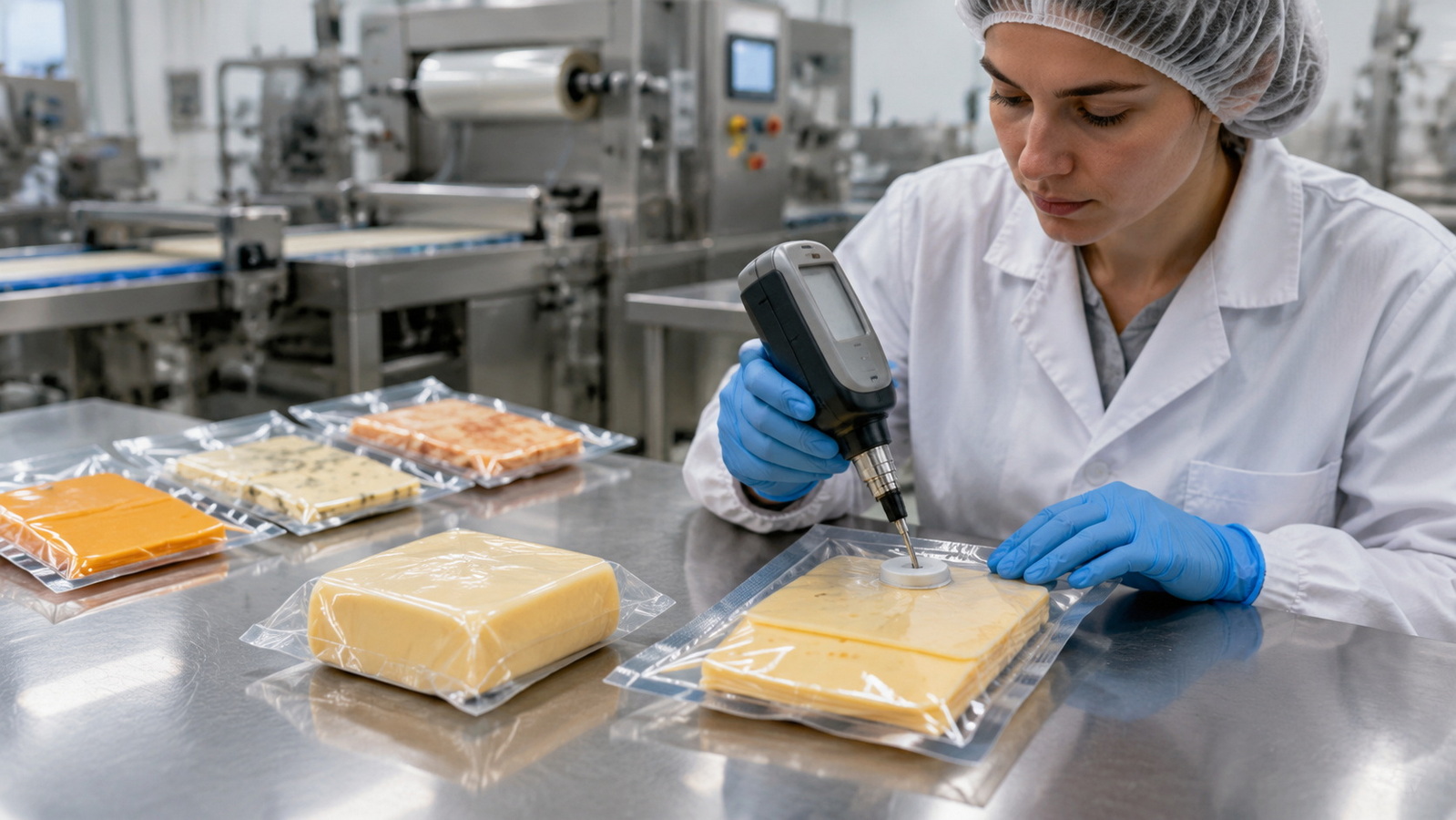
1. Define acceptance criteria. Set measurable requirements for safety, appearance, texture, leakage, and saleable life.
2. Establish a baseline. Record current rejection rates, packaging costs, spoilage, and production output.
3. Test realistic alternatives. Compare suitable vacuum and MAP formats using controlled product batches.
4. Measure packaging performance. Check seals, leaks, and relevant atmosphere measurements.
5. Validate storage performance. Assess microbiology, sensory quality, and package condition under intended distribution conditions.
6. Confirm production repeatability. Repeat trials across batches, shifts, and format changes.
For MAP, do not measure the atmosphere only immediately after sealing. Gas dissolution, food respiration, and material transmission can change it during storage.
Document the operating settings behind successful results so production teams can reproduce them.
Vacuum packaging avoids the process-gas expense of active MAP, but that does not automatically make it cheaper overall.
The more useful comparison is:
Cost per saleable pack = total relevant cost ÷ packs accepted for sale
Include:
- Film, pouches, trays, and lidding.
- Gas, electricity, and other utilities.
- Labor and changeover time.
- Maintenance and inspection.
- Rejected packs and food losses.
- Transport and storage implications.
This approach reveals whether a higher-cost format earns its place through lower damage, reduced waste, or better commercial acceptance.
Environmental comparisons need the same discipline. Consider material use and food protection together rather than assuming one method always has the smaller footprint.
The strongest choice is not the method with the longest theoretical shelf life. It is the system that consistently delivers safe, acceptable products at a commercially sustainable cost.
HLun Pack focuses on flexible packaging, packaging machinery, and integrated packaging solutions. Share your product samples, target shelf life, pack dimensions, distribution conditions, and required output with our team to begin a product-specific packaging assessment.
Not universally. MAP can help protect delicate products and control headspace composition. Vacuum packaging often suits firm products requiring close-fitting protection. Product trials should determine the better choice.
No. It changes the environment inside the pack but does not sterilize the food. Hygiene, validated processing, appropriate temperature control, and hazard management remain necessary.
Not for foods that require refrigeration. MAP is one preservation tool within a larger system. It does not remove a product's cold-chain requirements.
Some equipment can support vacuum sealing and gas backfilling. Compatibility depends on its design, controls, tooling, and packaging format. Confirm the exact process capability before purchasing.
MAP is often a stronger starting point because retained headspace can reduce compression. However, the package must also withstand stacking, vibration, and normal distribution handling.
Start with the food's spoilage mechanisms, composition, appearance requirements, and storage conditions. Then work with qualified technical specialists and validate the mixture using the intended package and process.
1- UK Government, Food Standards Agency. "Vacuum Packaging." Official guidance on chilled vacuum-packed and modified-atmosphere-packed foods, non-proteolytic *Clostridium botulinum*, and shelf-life controls. [gov]
2- Centre for Food Safety, Hong Kong. "Botulism and Vacuum Packed Food." Explanation of reduced-oxygen packaging hazards and additional controlling measures. [cfs.gov]
3- Air Products. "Modified Atmosphere Packaging (MAP)." Overview of protective atmospheres, packaging materials, and storage conditions. [airproducts]
4- Air Products. "Dairy Products—Modified Atmosphere Packaging (MAP)." Product-specific guidance on hard, soft, and grated cheese. [airproducts]
5- MULTIVAC. "Different Packaging Concepts and Methods for Preserving Meat Quality." Technical discussion of vacuum packaging, MAP, gas mixtures, and meat preservation. [multivac]
6- MULTIVAC. "MAP and EMAP." Overview of modified atmospheres, gas-tight packaging, and relevant food applications. [multivac]
7- Air Products. "Bakery Products." Application guidance covering gas mixtures, mold control, and the need for product trials. [airproducts]


