


close
Choose Your Site
Global
Social Media
Views: 279 Author: HLun PACK Publish Time: 2026-11-09 Origin: Site


Content Menu
● Vacuum Bag vs Three Side Seal Bag
>> Vacuum Bag Materials and Their Functions
>> Smooth vs Embossed Vacuum Bags
● What Is a Three Side Seal Bag?
>> Three Side Seal Pouch Materials
● Vacuum Bag vs Three Side Seal Bag: Six Critical Differences
>> 1. Oxygen Control and Barrier Performance
>> 2. Moisture Protection and Product Texture
>> 3. Seal Strength and Leak Resistance
>> 4. Branding and Consumer Convenience
>> 5. Filling and Packaging Equipment
>> 6. Cost and Production Economics
● A Practical Five-Step Packaging Selection Process
>> 1: Define the Product's Main Failure Risk
>> 2: Document the Distribution Conditions
>> 3: Build a Measurable Material Specification
>> 4: Run Trials on the Intended Equipment
>> 5: Validate Finished Packages
● Separate Strength Testing from Leak Testing
● How the Right Choice Changes
>> Chilled Meat: Combine the Two Categories
>> Fragile Snacks: Protect Texture Before Removing Air
>> Industrial Components: Check More Than Moisture
● Food Safety and Sustainability Limitations
● Plan Your Packaging Solution with HLun Pack
>> Can a three side seal bag be used for vacuum packaging?
>> Are all vacuum bags three side seal bags?
>> Which option is better for food preservation?
>> Can smooth vacuum bags work with external-suction sealers?
>> Are vacuum bags suitable for boiling, microwaving, or retorting?
>> How should buyers compare supplier quotations?
When comparing a vacuum bag vs three side seal bag, the most important distinction is that these terms describe different characteristics. A vacuum bag is designed for air removal and vacuum retention. A three side seal bag describes a pouch sealed along three edges, with one opening for filling. One package can therefore belong to both categories.
For manufacturers, this distinction affects purchasing, equipment selection, product protection, and production efficiency. Choosing by name alone can lead to incompatible materials or unnecessary processing costs.
At HLun Pack, our approach to integrated packaging solutions starts with the product and packaging process—not simply the bag's appearance. This guide explains how to compare both options and develop a practical specification.
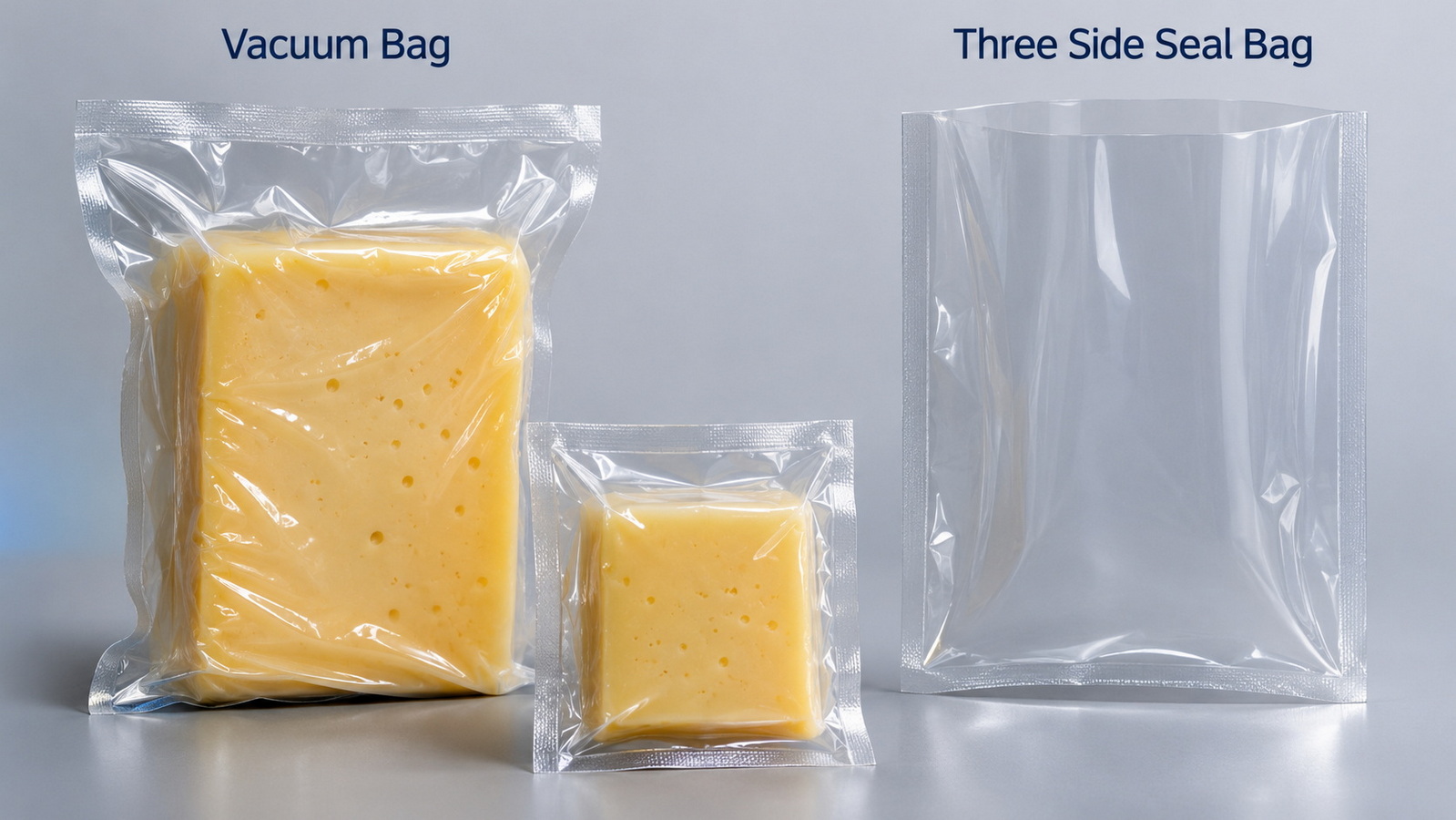
The key word is overlap: a three side seal pouch can also be a vacuum bag when its materials, seals, and dimensions support vacuum packaging.
For this comparison, "standard three side seal bag" means a flat pouch without an assumed vacuum-performance specification.
| Comparison point | Vacuum bag | Standard three side seal bag |
|---|---|---|
| Primary definition | Functional: designed for vacuum packaging | Structural: sealed on three sides before filling |
| Air removal | Intended for evacuation before final sealing | Optional; depends on specification and equipment |
| Material requirements | Must withstand evacuation and maintain package integrity | Selected for the product’s barrier, sealing, and presentation needs |
| Common construction | Smooth or embossed multilayer pouch | Flat pouch with one open filling edge |
| Equipment | Compatible vacuum packaging machine | Suitable filling and heat-sealing equipment |
| Appearance after packing | Usually conforms closely to the product | Generally remains flatter or retains headspace |
| Typical applications | Meat, cheese, selected frozen foods, industrial components | Snacks, powders, samples, and portion packs |
| Can both descriptions apply? | Yes | Yes, when designed and validated for vacuum use |
Neither category automatically provides better protection. Performance depends on the complete package specification.
A vacuum bag is a flexible pouch intended for a process that removes air before sealing. After the package returns to atmospheric pressure, the film usually conforms closely around its contents.
Vacuum packaging reduces the oxygen initially surrounding a product. A suitable barrier film and reliable seals then help limit oxygen re-entry.
However, vacuum packaging does not remove every trace of oxygen, sterilize food, or guarantee a particular shelf life.
Common vacuum pouch structures include polyamide/polyethylene, often written as PA/PE. Other structures may incorporate additional barrier layers, such as EVOH, depending on the application.
Different layers perform different jobs:
- Polyamide contributes mechanical strength and puncture resistance.
- Polyethylene commonly provides the heat-sealing layer.
- Additional barrier layers can improve resistance to gas transmission.
- Specialized structures may support validated cooking, freezing, or other processing conditions.
Thickness alone is not a complete quality measure. A thicker pouch with unsuitable barrier properties or inconsistent seals can perform worse than a properly engineered thinner alternative.
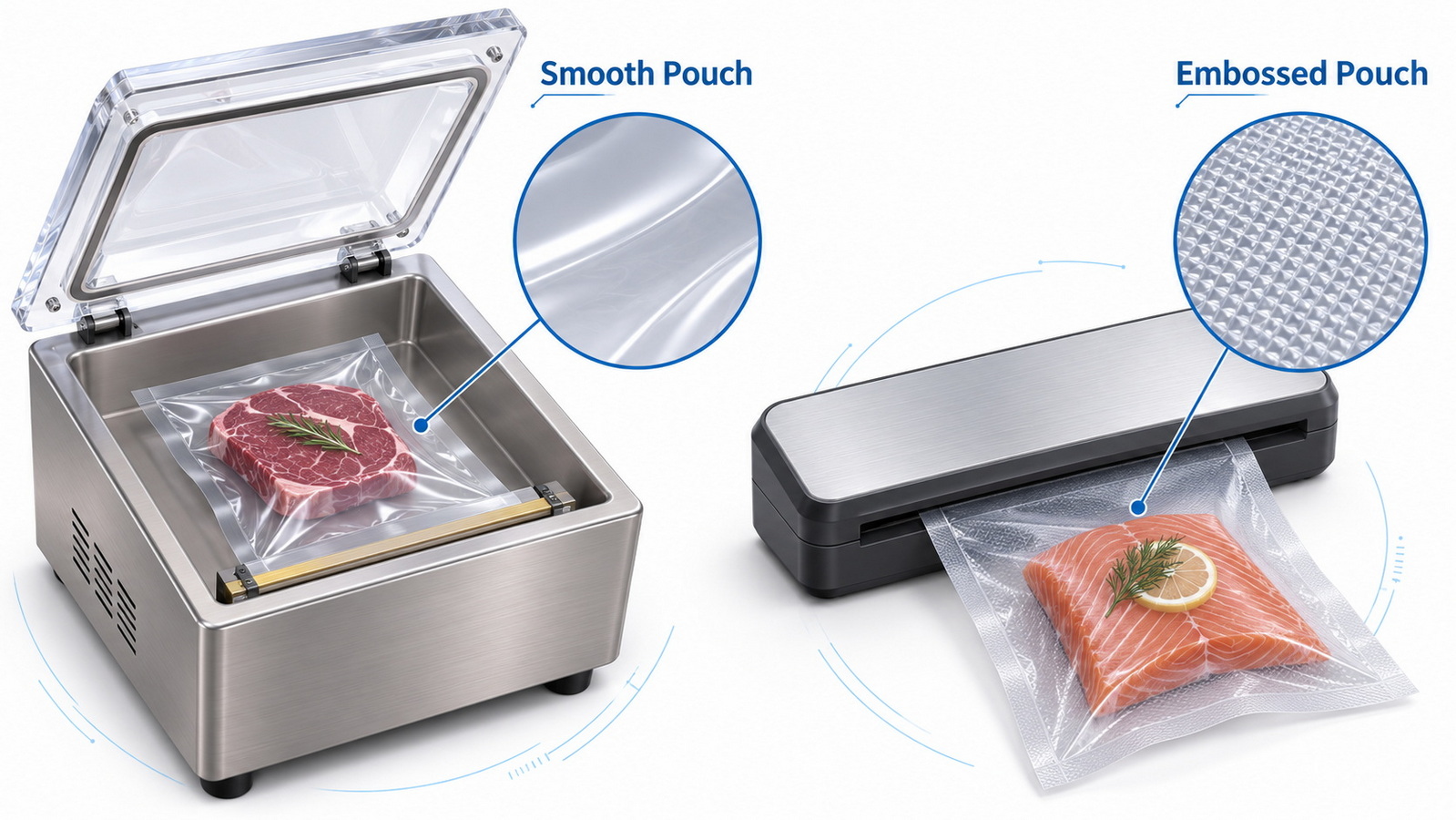
Smooth vacuum bags commonly work with chamber machines. The machine evacuates the chamber and pouch before sealing.
Many external-suction sealers instead require embossed bags. Their textured channels help air move toward the extraction point.
Do not assume that every smooth pouch works with every external machine. Nozzle-based systems and other specialized designs may operate differently. Confirm compatibility with the specific equipment.
A three side seal bag, also called a three side seal pouch or flat pouch, arrives with three edges sealed and one edge open.
The packer fills the pouch through that opening and completes the final seal.
This format supports compact portion packs, printed retail packaging, samples, and numerous industrial applications. Depending on its design, it can accommodate conventional air packing, gas flushing, or vacuum sealing.
Material selection follows the application rather than the pouch shape.
Possible structures include:
- PET/PE for selected printed packaging applications.
- PA/PE for applications requiring toughness and suitable vacuum performance.
- Foil-containing laminates for strong light and gas barriers.
- Metallized structures where their measured barrier performance is sufficient.
- Mono-material structures where functionality and applicable recycling requirements align.
A foil-looking pouch is not necessarily aluminum foil. Likewise, a transparent pouch does not necessarily have a weak oxygen barrier. Request the actual structure and test data.
Vacuum packaging and barrier packaging solve related but different problems.
Evacuation reduces the air initially inside the package. Barrier materials slow the movement of gases through the film afterward.
A high-barrier three side seal bag can still contain substantial oxygen if sealed with ordinary air inside. Conversely, a well-evacuated pouch may lose protection if its material allows excessive oxygen ingress.
Compare oxygen transmission rate, or OTR, using equivalent test conditions. Temperature, humidity, units, and film construction matter when interpreting results.
Water vapor transmission rate, or WVTR, helps describe moisture movement through packaging film.
For dry powders and crisp snacks, moisture protection may be more important than vacuum retention. For chilled products, package integrity and appropriate storage conditions remain essential.
Vacuum is not automatically appropriate for fragile products. Atmospheric pressure acting on an evacuated pouch can compress delicate contents.
Where product shape matters, evaluate a non-vacuum pouch or a suitable protective-atmosphere process instead.
Both formats depend on sound seals.
Wrinkles, powder, oil, or product fragments in the sealing area can create weak points or leak channels. Vacuum applications also require the pouch to maintain integrity while conforming around the product.
Separate two questions during evaluation:
- Is the seal mechanically strong enough?
- Is the completed package free from unacceptable leaks?
A strong seal does not automatically prove leak-tightness. Use complementary inspection and test methods.
Three side seal pouches provide broad, relatively flat surfaces for printing. Depending on the design, they may include tear notches, hanging holes, or resealable features.
Vacuum pouches can also be printed. However, film contraction around irregular products may distort artwork or reduce the visibility of small text.
Review artwork on filled samples, not only flat proofs. Position critical information where it remains readable after packing.
A zipper provides convenience after opening; it does not replace a validated hermetic seal.
A basic heat sealer closes a pouch but does not remove air.
Vacuum packaging requires a compatible evacuation-and-sealing system. Chamber size, seal-bar length, pouch dimensions, product loading, and cycle settings all affect suitability.
Automated three side seal pouch filling requires additional attention to:
- Pouch opening consistency.
- Gripper clearance.
- Fill accuracy.
- Product contamination near the seal.
- Final seal positioning.
- Changeover requirements.
Evaluate the pouch and machine together rather than treating them as separate purchases.
There is no universal rule that vacuum bags cost more or three side seal bags cost less. The categories overlap, and specifications drive pricing.
Compare the total cost of producing an acceptable pack, including:
- Pouch purchase price.
- Filling and sealing labor.
- Equipment operation.
- Inspection and rejects.
- Product damage.
- Rework and downtime.
A lower-priced pouch can become expensive if it causes frequent stoppages or package failures.
Identify what would make the product unacceptable: oxidation, moisture uptake, dehydration, puncture damage, leakage, or crushing.
Start with the failure mechanism, not a preferred pouch style.
Specify intended storage temperature, distribution duration, handling conditions, and target shelf life.
Separate chilled, frozen, ambient, and heat-processed applications. One pouch specification should not be assumed suitable for all four.
Request:
- Full material structure and nominal thickness.
- Thickness tolerance.
- OTR and WVTR with test conditions.
- Relevant mechanical performance.
- Intended food-contact documentation.
- Approved temperature and processing limits.
Avoid accepting descriptions such as "premium barrier" without measurable supporting information.
Use actual products and production-representative pouches.
Assess loading, evacuation, seal cleanliness, cycle time, finished appearance, and handling after packaging. Include challenging product sizes rather than testing only ideal samples.
Inspect seals and assess strength, leaks, transport performance, and storage behavior.
For food, shelf-life validation should consider microbiological safety as well as sensory quality. A package that still looks acceptable is not necessarily safe.
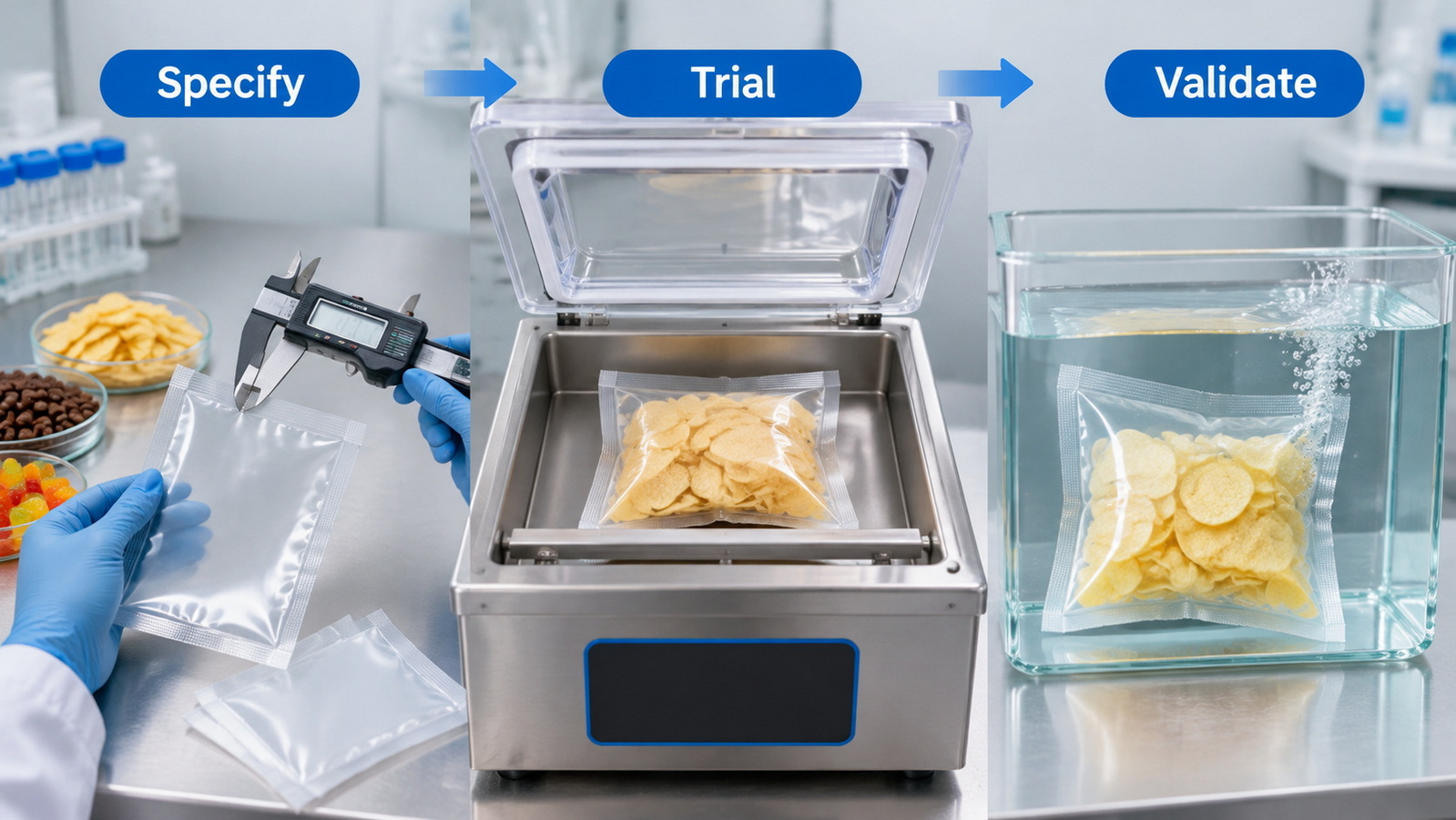
A useful qualification plan avoids treating one successful test as proof of complete package performance.
ASTM F88/F88M addresses seal strength in flexible barrier materials. ASTM F2096 addresses gross-leak detection through internal pressurization and bubble observation.
These tests answer different questions. Neither alone establishes shelf life, barrier suitability, or complete process capability.
For nonporous flexible packaging, select any dye-penetration method carefully. ASTM F3039 addresses nonporous packaging; ASTM F1929 concerns porous medical packaging and should not be selected merely because both involve dye.
Set acceptance criteria before trials. The appropriate test method, sample quantity, and limits depend on the product and risk assessment.
The following are illustrative selection scenarios, not reported HLun Pack customer case studies.
A meat processor may need a vacuum-compatible three side seal pouch.
The specification should address oxygen barrier, puncture resistance, seal reliability, and cold-chain conditions. Bone edges may require additional protection or a different packaging configuration.
The answer is not "vacuum bag or three side seal bag." It is a three side seal bag engineered for vacuum packaging.
For a brittle snack, aggressive vacuum may increase breakage.
A printed flat pouch with appropriate moisture protection may be more suitable. If oxygen control is necessary, evaluate compatible gas-flushing equipment and the required film barrier.
The preservation method should protect both product quality and physical shape.
Vacuum packaging can restrain some components and reduce movement within the pouch.
However, sharp edges require puncture evaluation. Corrosion-sensitive products may also require a wider preservation strategy. Electronic components can introduce electrostatic-control requirements that ordinary vacuum film does not address.
Vacuum packaging is not a substitute for refrigeration, validated processing, or hygienic handling.
Reduced-oxygen conditions can introduce significant food-safety hazards. For seafood in particular, control of Clostridium botulinum requires product-specific assessment and appropriate preventive measures.
Do not claim a universal shelf-life multiplier. Validate the actual product, process, package, and distribution conditions.
Environmental comparisons also require care. A lightweight pouch may use less material, but that does not establish recyclability or lower overall impact.
Assess material weight, product waste, production losses, and recycling options in the destination market. Neither "vacuum" nor "three side seal" is an environmental certification.
The right package combines a suitable pouch structure, appropriate materials, compatible equipment, and a validated process.
Send HLun Pack your product dimensions, fill weight, storage conditions, target output, existing machine details, and sample packaging. Request a coordinated pouch-and-equipment review before committing to bulk materials or a production-line configuration.
This gives the project a clear technical starting point and helps prevent mismatches between packaging promises and production reality.
Yes, provided its film, seals, dimensions, and machine compatibility support the intended vacuum process. The three side seal format alone does not establish vacuum suitability.
No. Vacuum packaging uses several constructions, including other bag formats and packages formed directly on suitable equipment. Vacuum describes the packaging function, not one exclusive shape.
Neither label is sufficient. Choose according to the food's deterioration risks, required barrier, processing conditions, and safety controls. Validate shelf life rather than relying on the bag name.
Many standard external-suction sealers require embossed channels. Smooth bags commonly suit chamber machines, although specialized external systems may differ. Check the machine manufacturer's requirements.
Only when the exact pouch is specified and validated for that process. A bag approved for chilled or frozen storage is not automatically suitable for cooking or sterilization.
Compare identical requirements: material structure, thickness tolerance, dimensions, barrier data, printing, quantity, and testing. Then evaluate performance on the intended machine and total cost per acceptable pack.
1. [Sealed Air — CRYOVAC Brand Three Side Seal Pouches]. Supports the format definition, material options, and compatibility of appropriately designed three side seal pouches with vacuum sealing and gas flushing. [sealedair]
2. [MULTIVAC — Vacuum Pouches and Shrink Bags]. Supports chamber-machine pouch applications and variation in materials, barrier properties, and sealing media. [multivac]
3. [MULTIVAC — Chamber Machines]. Supports coordinated evaluation of material, vacuum, machine, product, and packaging atmosphere. [multivac]
4. [Link Trade — Smooth vs Embossed Vacuum Pouches]. Supports the practical distinction between smooth chamber pouches and embossed pouches for common external-suction equipment. [linktrade.com]
5. [U.S. Food and Drug Administration — Recognized Consensus Standards: Packaging]. Lists the distinct scopes of ASTM F88/F88M, F2096, F3039, and F1929. Inclusion here supports test identification, not a claim that medical-device requirements automatically apply to food packaging. [accessdata.fda]
6. [U.S. Food and Drug Administration — Growth and Toxin Formation in Reduced Oxygen Packaged Fish and Fishery Products]. Supports the reduced-oxygen seafood safety discussion and need for appropriate hazard controls. [fda]
7. [MULTIVAC — Different Packaging Concepts and Methods for Preserving Meat Quality]. Supports product-specific selection of vacuum and modified-atmosphere packaging, including the limits of oxygen removal as a preservation mechanism. [multivac]


