


close
Choose Your Site
Global
Social Media
Views: 269 Author: HLun PACK Publish Time: 2026-11-13 Origin: Site


Content Menu
● Paper Bag vs. OPP Film: Understanding the Actual Comparison
>> What Does "Paper Bag" Mean?
>> What Is OPP Film for Pasta Packaging?
● Quick Comparison for Automatic Pasta Packaging
● Product Protection: Moisture, Seals, and Pasta Breakage
>> Compare Moisture Barrier Under Matching Conditions
>> Test the Finished Package, Not Just the Web
>> Treat Pasta Shape as an Engineering Input
● Automatic Packaging Performance: Look Beyond Rated Speed
>> Separate Premade Bags From Rollstock
>> Match the Platform to the Pasta Format
>> Validate Sealing and Web Handling
● Cost Comparison: Calculate Cost per Saleable Pack
>> Illustrative Throughput Calculation
● Sustainability: Assess the Complete Packaging System
>> Paper Content Does Not Prove Recyclability
>> Include Protection and Distribution
>> Account for Changing Market Requirements
● A Practical Validation Plan Before Switching Materials
>> 1: Define Acceptance Criteria
>> 2: Test Representative Conditions
>> 4: Inspect After Distribution Simulation
● Which Material Should Your Pasta Business Choose?
● Plan Your Automatic Pasta Packaging Line With HLun Pack
>> 1. Is OPP Film Always Better Than Paper for Pasta?
>> 2. Can Paper Run on an Existing Automatic Pasta Packaging Machine?
>> 3. Does Every OPP Film Heat-Seal?
>> 4. Which Material Gives Pasta a Longer Shelf Life?
>> 5. Are Paper Pasta Bags Plastic-Free?
>> 6. What Output Should Buyers Request During Trials?
Paper bag vs. OPP film for high-volume automatic pasta packaging lines is more than a material comparison. The decision affects sealing reliability, product protection, usable output, operating costs, and the packaging equipment your factory needs.
My starting point is compatibility: choose the packaging structure and machine together. A material that looks attractive on a purchasing spreadsheet can become expensive if it causes frequent stops or unreliable seals.
For many dry-pasta applications, a suitable heat-sealable OPP structure offers a practical starting point for moisture protection, product visibility, and automated handling. Paper bags can support a distinctive retail presentation, but their coatings, closures, and machine requirements need equally careful evaluation.
This guide focuses on dried pasta. Fresh, chilled, and filled pasta require a separate assessment of food safety, barrier performance, and storage conditions.
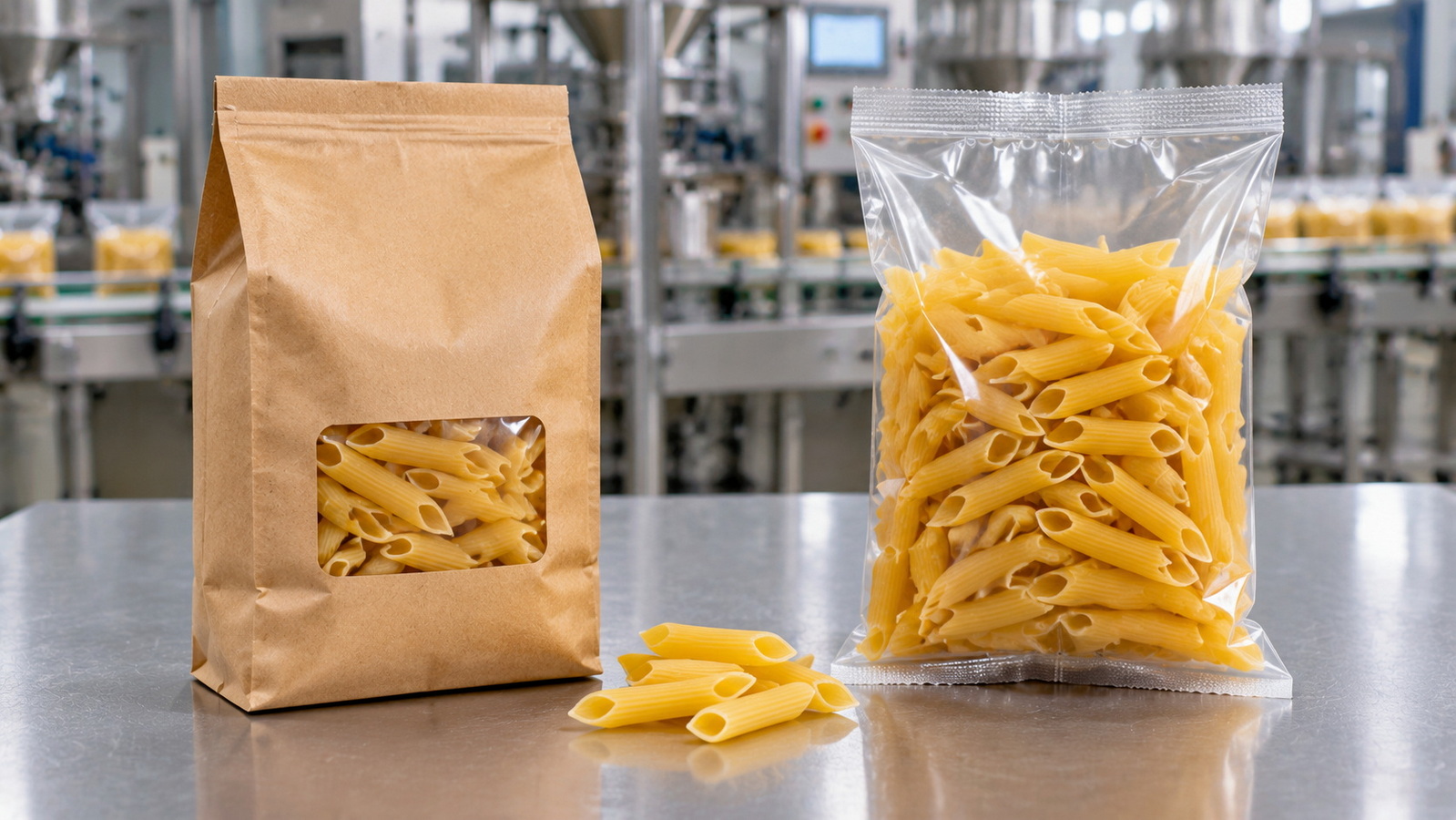
A paper bag might be an uncoated kraft bag, a coated heat-sealable paper package, or a paper-based laminate containing a plastic barrier.
These are not interchangeable.
Uncoated paper does not provide the same moisture protection as a purpose-designed barrier structure. For automated heat sealing, paper generally needs an appropriate sealable coating or layer. Alternatively, a premade paper bag may use a folded or adhesive closure.
The correct question is therefore not simply "Can the machine run paper?" It is "Can this machine form, fill, and close this specific paper structure?"
OPP means oriented polypropylene. BOPP, or biaxially oriented polypropylene, is stretched in two directions and is widely available for flexible packaging.
However, not every OPP film is heat-sealable. Commercial grades include sealable and non-sealable films, transparent and opaque versions, and different barrier constructions.
A pasta package may use a suitable single web or a laminate combining printing, barrier, and sealing functions. Specify the complete construction rather than approving material based on the letters "OPP" alone.
| Decision factor | Paper bags and paper-based structures | OPP-based film structures |
|---|---|---|
| Moisture protection | Depends strongly on coatings, liners, and closures | Suitable grades provide moisture resistance; performance varies |
| Product visibility | Usually opaque unless a window is added | Transparent options allow product inspection |
| Sealing | Requires compatible coatings, layers, or alternative closure systems | Requires a heat-sealable grade or sealant layer |
| Machine compatibility | Must validate forming, feeding, and closing behavior | Grades are available for multiple automated packaging formats |
| Retail presentation | Supports a natural, tactile appearance | Supports clear, glossy, matte, and opaque designs |
| Recycling assessment | Must consider coatings, windows, and adhesives | Must consider the complete structure and local collection |
| Cost evaluation | Include bag conversion, handling, and closure costs | Include film conversion, sealing, and actual line performance |
Neither material has a universal speed, shelf-life, or environmental advantage. Those conclusions require application-specific evidence.
For dry pasta, moisture protection deserves close attention. Request the water vapor transmission rate, or WVTR, for each candidate structure.
A meaningful comparison needs:
- The same test temperature and relative humidity.
- The tested material thickness or basis weight.
- The test method.
- Results for the complete structure, where available.
Do not compare a paper result measured under mild conditions with a film result measured under demanding conditions.
Supplier data illustrates why grade selection matters. Jindal Films lists WVTR values of 5.5 and 4.6 g/m²/24 hours for two Bicor HNA grades at 38°C and 90% relative humidity. These figures describe those grades, not all OPP films, and do not independently establish pasta shelf life.
A strong barrier web cannot compensate for a leaking closure.
Evaluate seal channels, folds, punctures, and damage after transport. Paper coatings should also be assessed after forming and creasing, rather than only as flat samples.
For both materials, validate the finished package with the intended pasta, storage conditions, and distribution route.
Spaghetti, penne, and irregular shapes create different handling challenges.
Long pasta needs controlled alignment. Short pasta may require careful dosing and drop-height management. Sharp edges and broken pieces can challenge package integrity.
Material thickness alone does not predict puncture performance. Test the complete package after realistic filling and handling.
Comparing a premade paper bag with OPP rollstock also compares two packaging architectures.
A premade-bag system must present, open, fill, and close each bag. A form-fill-seal system creates packages from a continuous web.
Paper-based rollstock can also be suitable for certain form-fill-seal applications, provided its structure and the equipment are compatible.
For a fair comparison, identify whether you are changing the material, the package format, the machine platform, or all three.
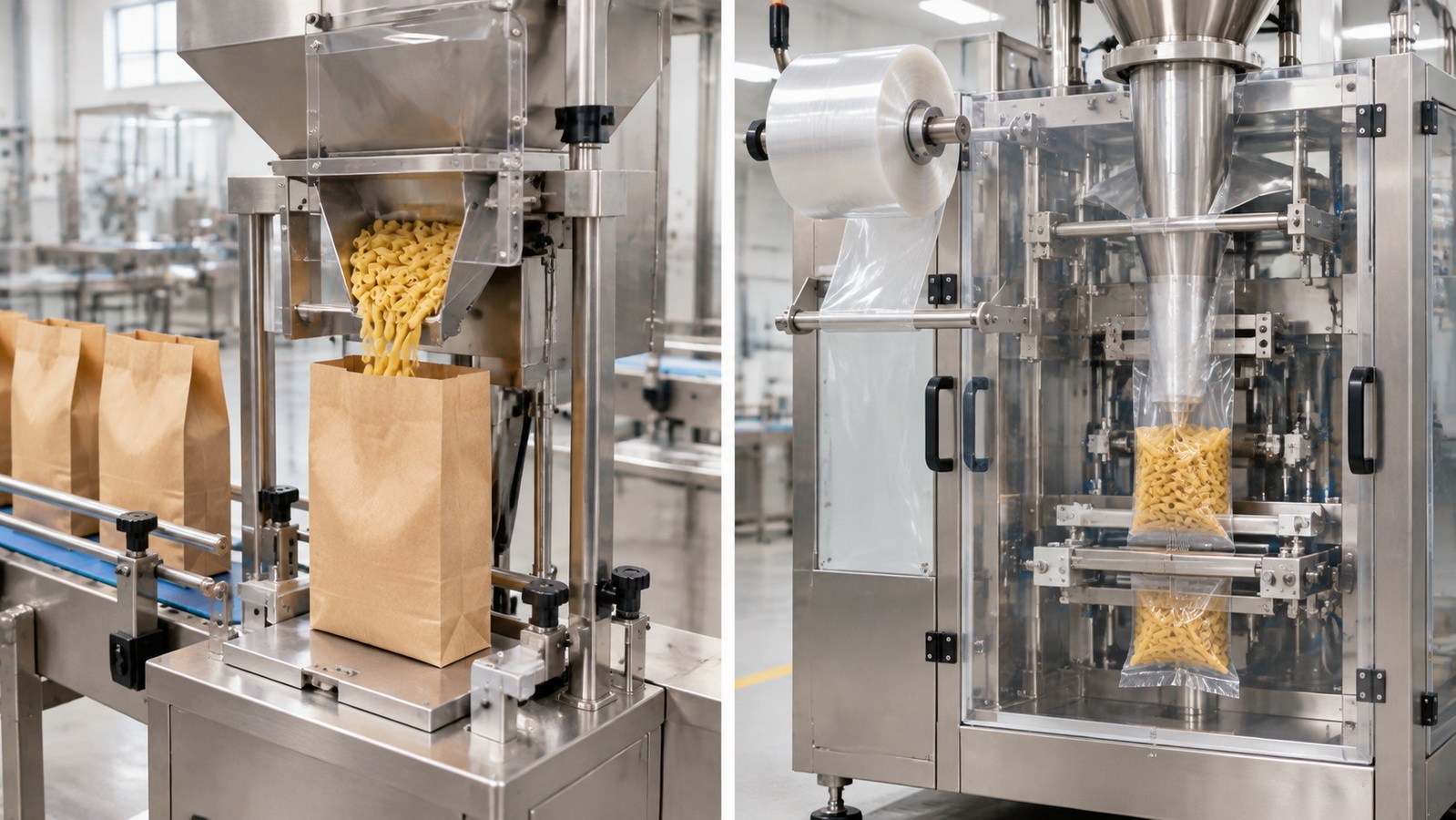
Vertical form-fill-seal systems are a common consideration for free-flowing short pasta. Long-pasta applications may require dedicated handling and a different packaging arrangement.
Before evaluating speed, define:
1. Pasta shape and dimensions.
2. Target pack weight.
3. Package dimensions and style.
4. Dosing and orientation requirements.
5. Required saleable output.
The filling system can become the bottleneck even when the packaging machine has unused capacity.
OPP grades differ in seal initiation temperature, sealing range, hot tack, and friction behavior. Hot tack describes the strength of a seal while it is still hot—important when a newly sealed pack immediately carries product weight.
Paper-based materials also require trials covering web tension, tracking, forming resistance, and closure performance.
Avoid universal jaw-temperature recommendations. Build a validated operating window for the selected material, machine, and production speed.
The lowest material price does not necessarily deliver the lowest packaging cost.
A more useful purchasing calculation is:
Cost per saleable pack=Total relevant production cost / Accepted packs
Include:
- Packaging material and conversion.
- Startup waste and rejected packs.
- Direct labor and changeovers.
- Energy and maintenance.
- Downtime and product losses.
Keep cost boundaries consistent so that the same expense is not counted twice.
Consider two hypothetical trial results:
| Trial input | Candidate A | Candidate B |
|---|---|---|
| Running speed | 100 packs/minute | 90 packs/minute |
| Availability | 85% | 95% |
| Accepted-pack rate | 98% | 99% |
| Saleable output per scheduled minute | 83.3 | 84.6 |
The calculation multiplies running speed by availability and accepted-pack rate.
Candidate B delivers slightly more saleable output despite its lower running speed. This is an illustrative model, not an HLun Pack customer result or a benchmark for either material.
The lesson is practical: measure sustained accepted output, not just the fastest observed machine cycle.
A paper appearance is not a recycling assessment.
Barrier coatings, plastic windows, adhesives, and other components can influence collection, sorting, and recycling. Request evidence covering the finished package and its intended market.
Likewise, an OPP-based package is not automatically accepted in local recycling systems. A mono-PP design may improve material compatibility, but that does not establish collection or recycling availability everywhere.
Avoid unsupported claims such as "fully recyclable" or "plastic-free."
A useful environmental comparison considers more than the primary material:
- Package weight and manufacturing.
- Protection against product loss.
- Secondary packaging requirements.
- Transport efficiency.
- Local end-of-life infrastructure.
Without a suitably scoped life-cycle assessment, do not claim that paper or OPP always has the lower overall impact.
For businesses supplying the European Union, Regulation (EU) 2025/40 generally applies from August 12, 2026, with requirements introduced in stages.
Its recyclability framework makes complete packaging design increasingly important. Applicable dates and obligations should be checked against the legal text and relevant implementing measures.
Request supplier documentation early, rather than waiting until the final artwork approval.
A controlled trial is more valuable than an unsupported claim that a material is "high-speed ready."
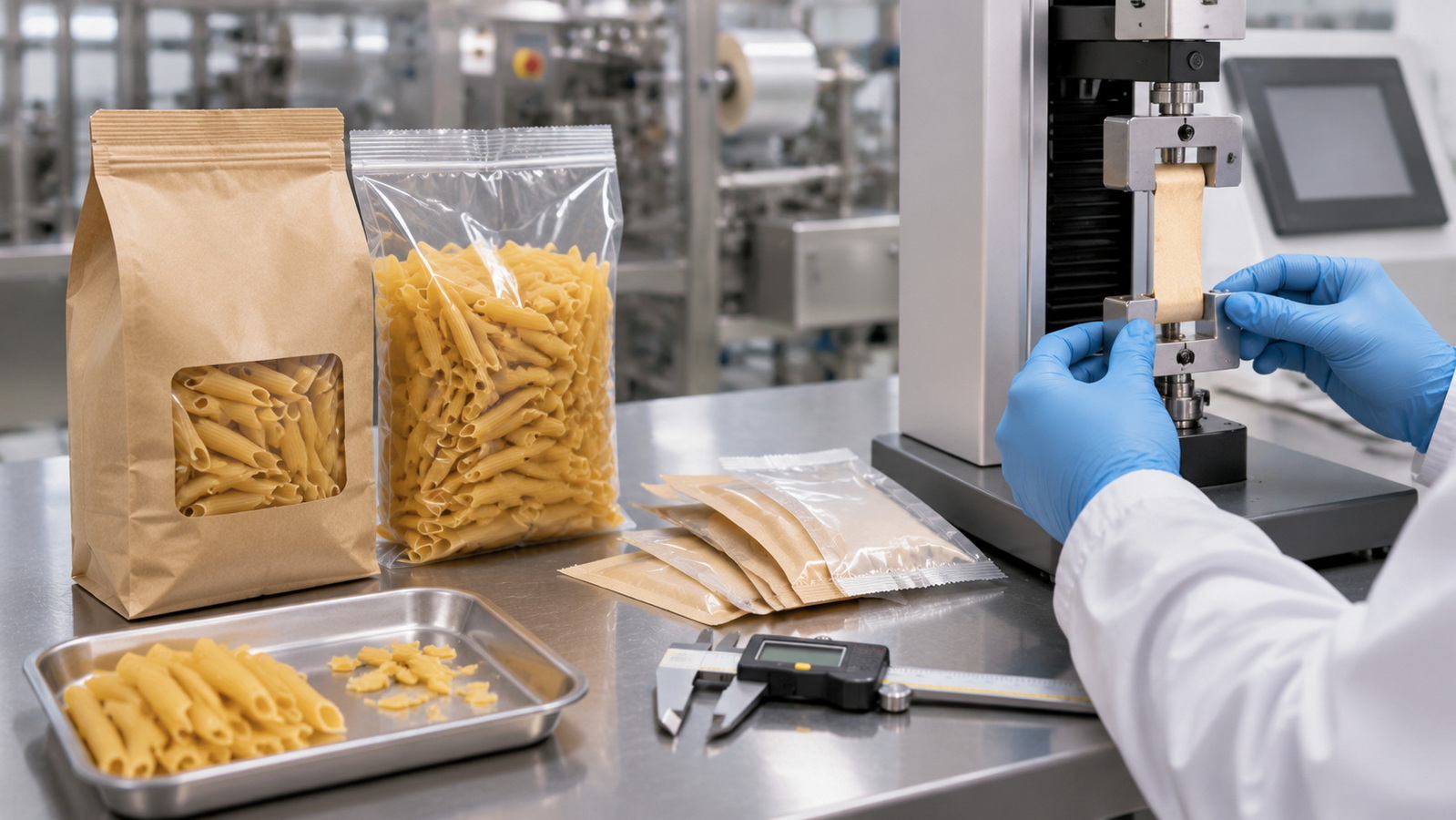
Agree on measurable requirements before testing:
- Minimum sustained accepted output.
- Maximum reject rate.
- Seal-integrity requirements.
- Acceptable pasta breakage.
- Shelf-life and transport performance.
Use the same criteria for both candidates.
Include startup, normal running, restarts, and changeovers. Where practical, test more than one material roll or bag batch.
For paper-based materials, examine the effects of storage conditions and forming. For film, record tracking, friction behavior, and sealing consistency.
Test realistic difficult conditions, including low product levels, broken pasta, and contamination near the seal area.
The purpose is not to force failure artificially. It is to understand how much operating margin the system has.
Inspect seals and package integrity after handling and transport testing. Follow with storage validation appropriate to the intended shelf life.
Document the results, material specifications, and approved machine settings.
A suitable OPP-based structure deserves priority evaluation when your project requires transparent presentation, moisture resistance, and compatibility with an existing film-based line.
Paper deserves priority evaluation when a paper-led retail identity is commercially important and a validated structure can meet protection, closing, and output requirements.
Neither recommendation replaces testing.
A useful intermediate option is a matte or paper-look OPP design. Commercial films can provide a paper-like appearance without changing to a paper substrate. However, the package must still be described accurately; appearance does not change its material identity.
For HLun Pack projects, the most useful approach is to evaluate packaging materials and machinery as one integrated system—not as separate purchases.
HLun Pack focuses on flexible packaging equipment and integrated packaging solutions.
To begin a project discussion, provide your pasta samples, target pack weights, package dimensions, candidate material specifications, required output, and destination markets.
Ask for a material-and-machine evaluation covering forming or bag handling, dosing, sealing, inspection, and downstream integration. Agree on measurable trial criteria before finalizing the equipment configuration or committing to a new packaging structure.
No. A suitable OPP structure can offer useful moisture protection and visibility. A validated paper-based structure may better support a particular retail concept. Compare complete packages and production results.
Possibly, but it is not necessarily a drop-in replacement. The material must match the machine's forming, feeding, and closure capabilities. Confirm compatibility through trials.
No. OPP is available in sealable and non-sealable grades. Specify the sealing surfaces and full laminate construction before ordering.
The material name alone cannot answer this. Barrier performance, closure integrity, pasta characteristics, and storage conditions all matter. Validate shelf life using the finished package.
Not necessarily. Some contain polymer coatings, liners, or windows. Request a full composition statement before making a plastic-free claim.
Request sustained accepted packs per scheduled minute, supported by downtime and reject records. Also assess seal integrity, weight accuracy, and product breakage.
The technical comparison draws on the sources below. The validation framework and purchasing recommendations are editorial synthesis. The throughput example is hypothetical, and no verified HLun Pack production data has been supplied.
1. [Jindal Films — "Our Brands."] Describes transparent BOPP applications, packaging formats, and specialized barrier-film families. [jindalfilms]
2. [Jindal Films — "Bicor HNA: Oriented Polypropylene Film."] Provides grade-specific sealing characteristics, hot-tack information, and WVTR data with stated test conditions. [jindalfilms]
3. [Jindal Films — "Metallyte MM488 Barrier Sealant Film."] Explains moisture barrier, sealing range, hot tack, controlled friction, and applicable packaging formats. [jindalfilms]
4. [Jindal Films — "Mono PP: Improved Flexible Packaging Solutions."] Explains functional differences among OPP grades, mono-PP design approaches, and paper-look film options. [jindalfilms]
5. [Ball & Doggett — "Functional Packaging Papers."] Describes Sappi paper grades with barrier functionality and heat-sealable coatings for flexible packaging applications. [ballanddoggett.com]
6. [EUR-Lex — "Packaging and Packaging Waste (from 2026)."] Summarizes Regulation (EU) 2025/40, its application date, and phased recyclability requirements. [eur-lex.europa]
7. [EUR-Lex — Regulation (EU) 2025/40: Official Legal Text.] Establishes the legal framework and addresses the relevance of barriers and coatings to packaging recyclability. [eur-lex.europa]


