


close
Choose Your Site
Global
Social Media
Views: 279 Author: HLun PACK Publish Time: 2026-09-25 Origin: Site


Content Menu
● What Is a Standard Spout Pouch?
>> Advantages of Standard Spout Pouches
>> Limitations of Standard Spout Pouches
● What Is a Custom Spout Pouch?
>> Why Customization Matters in Flexible Packaging
● Custom Spout Pouch vs Standard Spout Pouch: Detailed Comparison
● Compare Product Protection and Shelf Life
>> Standard Pouches: Suitable for Basic Protection Needs
>> Custom Pouches: Engineered for the Actual Product
● Compare Spout, Cap, and Dispensing Performance
>> Custom Spout and Cap Design
● Compare Branding and Retail Conversion
>> Branding Benefits of Custom Pouches
>> UX Design Checklist for Spout Pouches
● Compare Sustainability and Regulatory Readiness
>> Standard Pouch Sustainability Considerations
>> Custom Pouch Sustainability Opportunities
>> Important Sustainability Claim Warning
● Compare Manufacturing and Filling-Line Compatibility
>> Standard Pouch Manufacturing Risks
>> Custom Pouch Development for Better Line Efficiency
● Cost Analysis: Look Beyond Unit Price
>> Evaluate Total Cost of Ownership
● How to Choose the Right Spout Pouch
● FAQ
>> 1. Is a custom spout pouch more expensive than a standard spout pouch?
>> 2. Can standard spout pouches be printed with my brand logo?
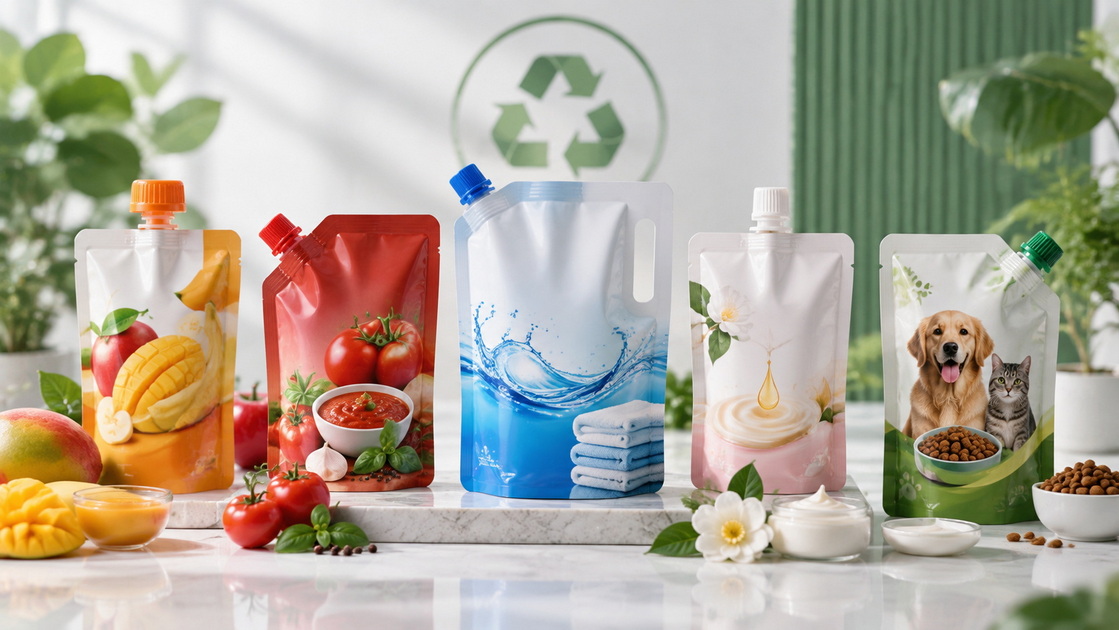
>> 3. Which products are suitable for custom spout pouches?
>> 4. Are spout pouches recyclable?
>> 5. Can a custom spout pouch work with automatic filling machines?
>> 6. What information should I provide before requesting a custom spout pouch quotation?
>> 7. Should I choose a corner-spout pouch or a top-spout pouch?
Choosing between a custom spout pouch and a standard spout pouch is not simply a graphic-design decision. It affects product protection, filling efficiency, consumer usability, compliance documentation, unit economics, brand differentiation, and the long-term scalability of your packaging operation.
For liquid, semi-liquid, viscous, and refillable products, a standard pouch can provide a practical route to market. However, a custom solution is often the stronger strategic option when a brand needs a precise fitment position, differentiated shelf presence, controlled dispensing, high-barrier protection, or compatibility with a specific pouch filling machine. At HLun Pack, we view the pouch and the filling process as one system—not two separate purchasing decisions.
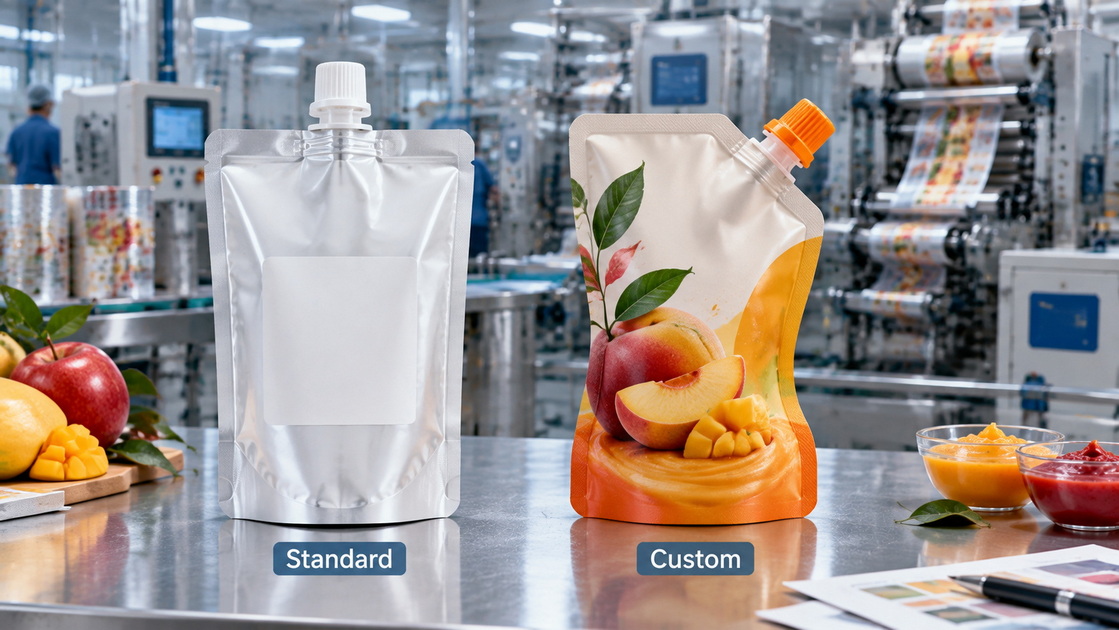
A standard spout pouch is a pre-engineered flexible pouch format made with commonly available pouch dimensions, materials, spout sizes, closures, and sealing structures. It is usually selected from an existing supplier catalog rather than developed from scratch.
Typical standard formats include:
- Stand-up pouches with top-center spouts
- Corner-spout pouches
- Flat-bottom or three-side-seal pouches
- Common capacities such as 100 ml, 200 ml, 500 ml, 750 ml, and 1,000 ml
- Standard screw caps, flip-top caps, or simple tamper-evident closures
- Stock colors, clear windows, or limited printing options
For emerging brands, local co-packers, test launches, and lower-volume procurement, standard spout pouches can shorten the time between packaging approval and production.
However, "standard" does not mean universally suitable. A stock pouch may not match the viscosity of a product, the fill nozzle, the expected shelf life, the shipping route, or the desired consumer dispensing experience.
- Lower initial tooling and development cost
- Faster sourcing and shorter approval cycle
- Simpler purchasing for common products
- Lower minimum order quantity in some cases
- Useful for pilot launches and product testing
- Suitable for basic liquids, sauces, detergents, and refill packs
A standard pouch can be particularly effective when the product is already stable, the filling method is uncomplicated, and the brand does not need unusual shapes, premium graphics, or specialized barrier performance.
The biggest limitation is compromise. The pouch may be available quickly, but it may force the product, filling line, or visual identity to adapt around it.
Common risks include:
- A spout diameter that dispenses too slowly or too quickly
- Poor compatibility with thick products such as honey, puree, gel, cream, or concentrated detergent
- Unnecessary headspace or inefficient pouch dimensions
- Limited print area for regulated labels and multilingual information
- Reduced shelf differentiation in competitive retail environments
- Inadequate oxygen, moisture, light, aroma, or chemical barrier
- A filling-machine mismatch that causes leaks, wrinkles, poor cap torque, or lower line efficiency
For example, a 500 ml standard corner-spout pouch may be technically usable for a fruit puree. But if the puree is highly viscous, contains particulates, requires hot filling, or needs a premium child-friendly dispensing experience, the standard structure may create avoidable quality issues.
A custom spout pouch is developed around the product, target customer, production method, branding requirements, regulatory destination, and commercial goals. The customization can range from printed artwork to a complete pouch-engineering program.
A custom pouch may include:
- Tailored dimensions and pouch geometry
- Customized spout placement
- Specific spout diameter and neck design
- Custom cap type, color, shape, and tamper-evident feature
- High-barrier or medium-barrier film structures
- Matte, gloss, soft-touch, metallic, holographic, or paper-look finishes
- Digital or gravure printing with brand-specific artwork
- Tear notches, hanging holes, handles, rounded corners, or shaped profiles
- Product-specific sealing layers
- Recyclable-ready mono-material PE or PP structures where technically feasible
- Compatibility adjustments for automatic pouch filling and capping equipment
The goal is not customization for its own sake. The goal is to engineer a package that protects the product, supports reliable production, improves user experience, and helps the brand sell more effectively.
In practical packaging projects, the most expensive problems are often discovered after the pouch artwork has been approved. A beautiful pouch does not automatically guarantee stable production.
A pouch must work across the full packaging journey:
1. Film conversion and pouch making
2. Transport and warehouse storage
3. Filling and sealing
4. Capping or spout insertion
5. Secondary packaging and palletization
6. Distribution conditions
7. Retail display or e-commerce shipping
8. Consumer opening, pouring, squeezing, resealing, and disposal
A custom spout pouch provides more control over those variables. It is particularly valuable when the product is sensitive, viscous, premium-priced, export-oriented, or packed on high-speed automatic equipment.
| Comparison Factor | Custom Spout Pouch | Standard Spout Pouch |
|---|---|---|
| Initial investment | Higher due to design, printing, tooling, and validation | Lower, especially for stock or lightly customized formats |
| Lead time | Longer during development and sampling | Usually faster for available catalog sizes |
| Minimum order quantity | Often higher, especially for gravure printing | Often lower for stock pouches or digital print runs |
| Brand differentiation | Strong; supports unique colors, finishes, shapes, and functional details | Limited; similar formats may be used by many brands |
| Product fit | Optimized for viscosity, fill volume, barrier needs, and dispensing | General-purpose; may require compromises |
| Filling-line compatibility | Can be engineered for the selected filling and capping system | Must be checked carefully against existing equipment |
| Shelf-life protection | Can use product-specific barrier structures | May offer only standard barrier performance |
| Consumer experience | Custom spout, cap, grip, opening, and pour control | Basic usability; less product-specific |
| Regulatory documentation | Can be specified for target-market requirements | Must be verified case by case |
| Sustainability pathway | Can be designed toward mono-material or recyclable-ready structures | Depends on stock material and closure configuration |
| Best use case | Established brands, export projects, premium products, automated production | Trials, basic products, short runs, cost-sensitive launches |
The best option depends on the entire project—not just the pouch purchase price.
Product protection should be the first technical evaluation point. A spout pouch is not just a container. It is a barrier system made from films, adhesives, inks, sealant layers, the spout, and the cap.
Standard pouches can perform well for stable, lower-risk products where shelf-life expectations are moderate and product sensitivity is limited.
They are commonly considered for:
- Drinking water and simple beverages
- Household liquid refills
- Short-shelf-life sauces
- Cleaning products
- Sample packs
- Promotional products
- Low-volume private-label projects
However, a stock pouch structure may not be appropriate for products that are sensitive to oxygen, moisture, UV light, migration risk, aroma loss, aggressive ingredients, or temperature exposure.
A custom spout pouch allows a packaging team to select the correct film structure based on real product conditions. This may involve evaluating:
- Oxygen transmission rate
- Water-vapor transmission rate
- Light protection
- Puncture resistance
- Drop resistance
- Seal strength
- Chemical resistance
- Retort, pasteurization, or hot-fill compatibility
- Product–package interaction
- Transportation temperature range
For food-contact applications, packaging components must be assessed for the intended use conditions. In the United States, the FDA regulates food-contact substances used in packaging and expects such substances to be appropriately authorized for their intended applications.
For products entering the European market, food-contact materials must comply with the EU framework under Regulation (EC) No 1935/2004. The European Commission also states that packaging materials intended to contact food—including plastics, paper, glass, and metal—must meet applicable food-safety requirements.
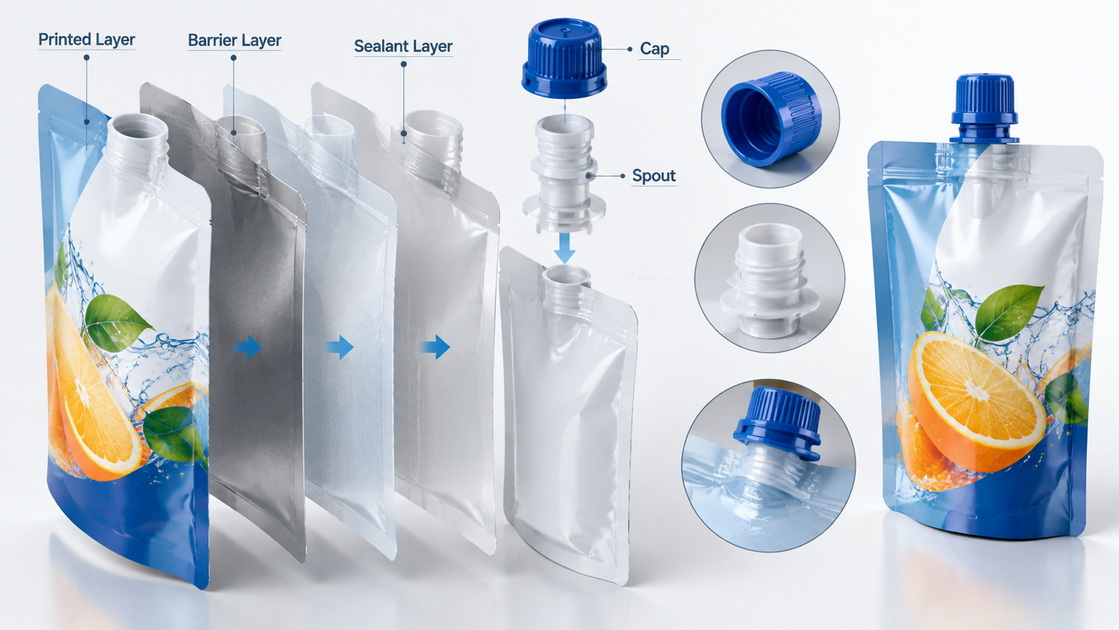
The spout and cap are often the most important functional parts of a pouch. They determine whether a consumer can open, pour, squeeze, control dosage, reseal, and store the product without mess.
A standard spout pouch usually uses common fitments with fixed neck diameters and conventional caps. This is acceptable for thin liquids and uncomplicated use cases.
A standard spout may work well for:
- Juice concentrates
- Thin sauces
- Liquid soap refills
- Fabric softener
- Hand wash
- Sports drink concentrates
- Basic cosmetic refills
The risk emerges when the product is thick, contains particles, or requires controlled dosage. A spout that is too narrow may frustrate the user. A spout that is too large may cause splashing, overdosing, or poor closure security.
With a custom spout pouch, brands can select fitments according to real consumer behavior and product rheology.
Potential customization includes:
- Corner, top-center, or angled spout placement
- Small, medium, or wide dispensing orifice
- Flip-top, screw, push-pull, disc-top, or child-resistant cap
- Tamper-evident bands
- Controlled-flow inserts
- Easy-squeeze pouch geometry
- Anti-drip features
- Color-coded caps for multiple product variants
- Spout orientation matched to automated filling equipment
For baby food, puree, condiments, and beauty products, the dispensing experience directly influences repurchase intent. For industrial lubricants, agricultural products, or chemical liquids, the correct spout can also reduce waste, improve dosage accuracy, and strengthen safety.
A standard spout pouch can carry a label or basic print. A custom pouch can become a high-value brand asset.
In crowded retail aisles and online marketplaces, consumers often make packaging judgments in seconds. A customized pouch can communicate category, quality, use instructions, sustainability positioning, and brand personality immediately.
- Larger usable display area
- Premium matte or metallic finishes
- High-definition product photography and color blocks
- Clear product hierarchy
- Multilingual export labeling
- Variable sizes with consistent brand architecture
- QR codes for traceability, campaigns, instructions, or recycling guidance
- Better space for legally required icons, storage information, and batch codes
A well-designed pouch also reduces customer confusion. For instance, a refill pouch should clearly show what product it refills, how it is opened, which direction it should pour, and how it should be disposed of.
Before approving artwork, check whether the pouch answers these consumer questions:
- What is this product?
- What is it used for?
- How much product is included?
- How do I open it?
- Where should I pour or squeeze it?
- Can I reseal it?
- How should I store it?
- Is it food-safe, child-safe, or suitable for the stated use?
- How should I dispose of or recycle it?
Practical advice: Do not use the entire pouch surface for decoration. Reserve clean, readable zones for instructions, regulatory information, date coding, and barcodes.
Flexible packaging can reduce material use and transportation weight compared with many rigid formats, but sustainability claims must be specific and evidence-based.
A pouch that uses less material is not automatically recyclable. Likewise, a pouch described as "recyclable-ready" may still depend on collection and processing systems that differ by region.
Many conventional spout pouches use multi-material laminates. These structures can provide excellent barrier performance, but they may be difficult to recycle in practice because the layers and fitments are made from different materials.
Before purchasing a standard pouch, ask:
- What is the pouch's complete material structure?
- Is the spout made from the same polymer family as the pouch?
- Is the cap compatible with the intended recycling stream?
- Is the claimed recyclability supported by a recognized test protocol?
- Does the target market have collection infrastructure for this format?
- Are inks, adhesives, metallization, labels, and barriers compatible with the claim?
Custom development gives brands more freedom to explore:
- Mono-material PE structures
- Mono-material PP structures
- Recyclable-ready pouch and closure combinations
- Reduced pouch gauge without compromising performance
- Lightweight caps and fitments
- PCR-content options where suitable and legally appropriate
- Refill formats that replace rigid bottles
- Packaging designed around regional recycling guidelines
The Association of Plastic Recyclers provides design guidance and testing protocols that packaging developers can use when assessing individual packaging components against accepted industry standards.
For European-bound packaging, the Packaging and Packaging Waste Regulation—Regulation (EU) 2025/40—entered into force in February 2025 and generally began applying from 12 August 2026. It introduces phased requirements related to packaging waste reduction, recyclability, substances of concern, and other packaging obligations.
Avoid vague claims such as:
- "100% eco-friendly"
- "Zero-waste pouch"
- "Fully recyclable everywhere"
- "Sustainable packaging" without supporting details
Instead, use precise claims such as:
- "Designed with a mono-material PE structure."
- "Developed for compatibility with specified flexible-film recycling streams, subject to local collection availability."
- "Uses less packaging material than the previous rigid bottle format, based on an internal packaging-weight comparison."
- "Contains X% post-consumer recycled content where permitted and verified."
For HLun Pack customers, this is often the deciding issue. A pouch may look excellent in a supplier sample but perform poorly during actual filling.
The pouch, filling nozzle, spout position, capper, sealing system, conveyor, coding unit, and secondary-packaging process must work together.
A standard pouch can require additional adjustments if it does not match the machine configuration.
Possible challenges include:
- Incorrect pouch width or height for magazine loading
- Spout position incompatible with the filling head
- Inconsistent pouch opening
- Improper sealing due to material mismatch
- Cap cross-threading or insufficient torque
- Product splashing during fill
- Poor pouch stability after filling
- Wrinkling around the spout area
- Leakage during drop testing or transport
For a custom pouch project, HLun Pack would typically encourage an integrated validation process:
1. Define the product and target volume
2. Confirm product viscosity, temperature, acidity, oil content, and particulate size
3. Select the pouch structure and fitment
4. Match pouch dimensions to the filling machine
5. Produce samples or pilot pouches
6. Test filling, sealing, capping, leakage, drop resistance, and storage
7. Adjust machine settings and pouch specifications
8. Approve the production specification before mass production
This approach reduces the risk of buying packaging that is technically attractive but operationally inefficient.

A standard spout pouch often has the lower upfront price. That does not automatically make it less expensive over the product's life cycle.
A custom pouch can reduce hidden costs if it improves filling efficiency, lowers leakage, reduces product waste, increases shelf impact, improves freight utilization, or supports a higher retail price.
Use this formula when comparing options:
Total Packaging Cost =Pouch Cost +Fitment Cost+Printing/Tooling +Filling Loss +Downtime +Leakage Claims +Freight +Secondary Packaging +Brand Opportunity Cost
A lower-cost pouch that causes repeated line stops can cost more than a custom pouch with a higher unit price but stronger operational stability.
Imagine a premium sauce brand selling 500 ml refill pouches.
A standard pouch may cost less and launch faster. But if the generic spout causes drips, consumer complaints, and excess product residue in the pouch, the brand may lose repeat purchases.
A custom pouch could use:
- A controlled-flow spout
- A stronger bottom gusset
- A high-barrier structure
- A premium matte finish
- Easier-to-read pouring instructions
- A cap color matching the flavor variant
The unit cost may be higher, but the brand can potentially improve consumer satisfaction, reduce leakage risk, and support premium positioning.
Use a standard spout pouch if your project has most of these characteristics:
- You need a fast launch
- You are testing demand
- Your product is a simple, stable liquid
- Your order quantity is low
- Your branding needs are basic
- Your filling process is manual or semi-automatic
- A common spout format is sufficient
Choose a custom spout pouch if your project involves:
- High-value or premium products
- Export-market requirements
- Food, beverage, baby food, cosmetics, or sensitive formulations
- Thick, particulate, hot-filled, retorted, or chemically aggressive products
- High-speed automated pouch filling
- Strong retail differentiation needs
- Specialized dispensing or child-resistant closures
- Recyclability or material-reduction targets
- Multiple SKUs that need a consistent brand system
A standard spout pouch is a smart starting point when speed, flexibility, and lower upfront cost are the priorities. It is especially suitable for early-stage launches, short runs, and uncomplicated liquid products.
A custom spout pouch is the better long-term solution when packaging must protect a specific product, fit automated machinery, strengthen the brand, improve consumer use, and meet demanding export or sustainability requirements.
At HLun Pack, we recommend making the decision based on the full packaging system: your product formulation, filling method, target market, shelf-life target, cap and spout function, order volume, and growth plan. The right pouch is not simply the one that costs less per piece—it is the one that performs reliably from factory to consumer.
Planning a liquid, sauce, puree, detergent, cosmetic, or refill-pouch project? Contact HLun Pack with your product type, target volume, filling method, market destination, and expected order quantity. Our packaging team can help evaluate whether a standard pouch is sufficient or whether a custom spout pouch and integrated filling solution will deliver better long-term value.
Usually, yes—at least initially. Custom pouches may require artwork preparation, cylinder or plate costs, sampling, specialized materials, and higher minimum order quantities. However, the total cost can be lower over time if the pouch improves filling efficiency, reduces leakage, and supports a higher-value brand position.
Yes. Many standard pouches can be labeled, digitally printed, or printed with limited customization. However, the available size, structure, spout location, finish, and cap style may still be restricted compared with a fully custom pouch program.
Custom spout pouches are suitable for beverages, sauces, condiments, purees, baby food, yogurt, pet nutrition, cosmetics, lotions, detergents, cleaning liquids, lubricants, agricultural liquids, and other flowable products. Material and fitment selection must be matched to the product and process.
It depends on the complete pouch construction, including film layers, spout, cap, inks, adhesives, and local recycling infrastructure. Multi-material pouches can be difficult to recycle, while mono-material PE or PP designs may offer improved recycling compatibility in markets that collect and process those materials. Claims should always be verified for the target region.
Yes. In fact, custom development is often the best route for automated filling. Pouch dimensions, spout position, material stiffness, opening behavior, cap type, and sealing properties can be designed and tested around the specific filling and capping machine.
Provide the product type, fill volume, viscosity, pH, oil content, fill temperature, shelf-life target, packaging dimensions, target country, printing requirements, cap preference, filling-machine information, annual demand, and desired delivery schedule. The more complete the information, the more accurate the pouch recommendation will be.
Choose based on product use and machinery. Corner spouts are common for pouring and can create a familiar consumer experience. Top-center spouts may be suitable for upright dispensing, direct drinking, or certain filling arrangements. The best choice depends on pouch shape, product viscosity, nozzle access, and how consumers handle the package.
1. U.S. Food and Drug Administration. "Packaging & Food Contact Substances (FCS)." Explains FDA resources, guidance, and regulatory information for food-contact packaging materials. [FDA source] [fda]
2. U.S. Food and Drug Administration. "Regulatory Status of Components of a Food Contact Material." Details FDA pathways for food-contact material components, including 21 CFR regulations, GRAS status, threshold exemptions, and Food Contact Notifications. [FDA source] [fda]
3. European Commission. "Food Contact Materials." States that food-contact packaging materials placed on the EU market must comply with EU safety rules and Regulation (EC) No 1935/2004. [European Commission source] [food.ec.europa]
4. European Commission. "Packaging Waste." Provides current information on Regulation (EU) 2025/40 on packaging and packaging waste, including its entry into force and application date. [European Commission source] [environment.ec.europa]
5. EUR-Lex. "Regulation (EU) 2025/40 on Packaging and Packaging Waste." Official text of the EU Packaging and Packaging Waste Regulation. [EUR-Lex source] [eur-lex.europa]
6. Association of Plastic Recyclers. "APR Design Guide Overview." Provides packaging design guidance and testing protocols for recyclability assessment. [APR source] [plasticsrecycling]
7. Zacros America. "Flexible Pouch." Discusses flexible pouch materials, high-barrier structures, and recycling challenges for multi-material pouches. [Zacros America source] [zacrosamerica]
8. SÜDPACK. "Sustainable Spouted Pouches." Discusses PP-based mono-material pouch structures and third-party recyclability testing for a specific PP spouted-pouch solution. [SÜDPACK source] [suedpack]


