


close
Choose Your Site
Global
Social Media
Views: 288 Author: HLun PACK Publish Time: 2026-10-28 Origin: Site


Content Menu
● Stick Pack vs Sachet Packaging: The Main Differences
● When Does Stick Pack Packaging Make Sense?
>> Powders Poured Into Bottles or Cups
>> Small Liquid and Gel Portions
● When Is Sachet Packaging the Better Choice?
>> Products Requiring a Broader Opening
>> Products Needing More Communication Space
● Packaging Materials: Shape Does Not Determine Shelf Life
>> Specify Barrier Performance, Not Just Layer Names
>> Validate the Finished Package
● Stick Pack Machines vs Sachet Machines: Compare the Whole Line
>> Match the Dosing System to Product Behavior
>> Compare Saleable Output, Not Headline Speed
● Calculate Total Cost per Saleable Pack
● A Practical Trial and Acceptance Plan
>> 1: Define the Product and Pack
>> 2: Test Representative Materials
>> 3: Run Beyond a Short Demonstration
>> 4: Record Acceptance Criteria
>> 5: Confirm Downstream Handling
● Test the Consumer Experience Before Finalizing Dimensions
● Separate Material Reduction From Recyclability
● Discuss Your Packaging Project With HLun Pack
>> 1. What Is the Main Difference Between a Stick Pack and a Sachet?
>> 2. Can Stick Packs Be Used for Liquids?
>> 3. Are Stick Packs Always Cheaper Than Sachets?
>> 4. Which Format Provides Better Moisture Protection?
>> 5. Can One Machine Produce Both Formats?
>> 6. What Information Should I Send a Packaging Equipment Supplier?
Choosing between stick pack vs sachet packaging starts with your product, not the shape of the packet. Both formats support convenient portions, attractive presentation, and automated production. However, they differ in pouring behavior, printable space, equipment configuration, and production economics.
The practical answer is straightforward: stick packs often suit products poured into bottles or consumed in narrow portions. Sachets often suit products requiring a wider opening, broader presentation, or more space for instructions.
Neither format automatically delivers better protection or lower costs.
At HLun Pack, our approach to flexible packaging is to evaluate the product, packaging material, and machinery together. This guide explains how to compare the two formats and build a specification that supports reliable production.
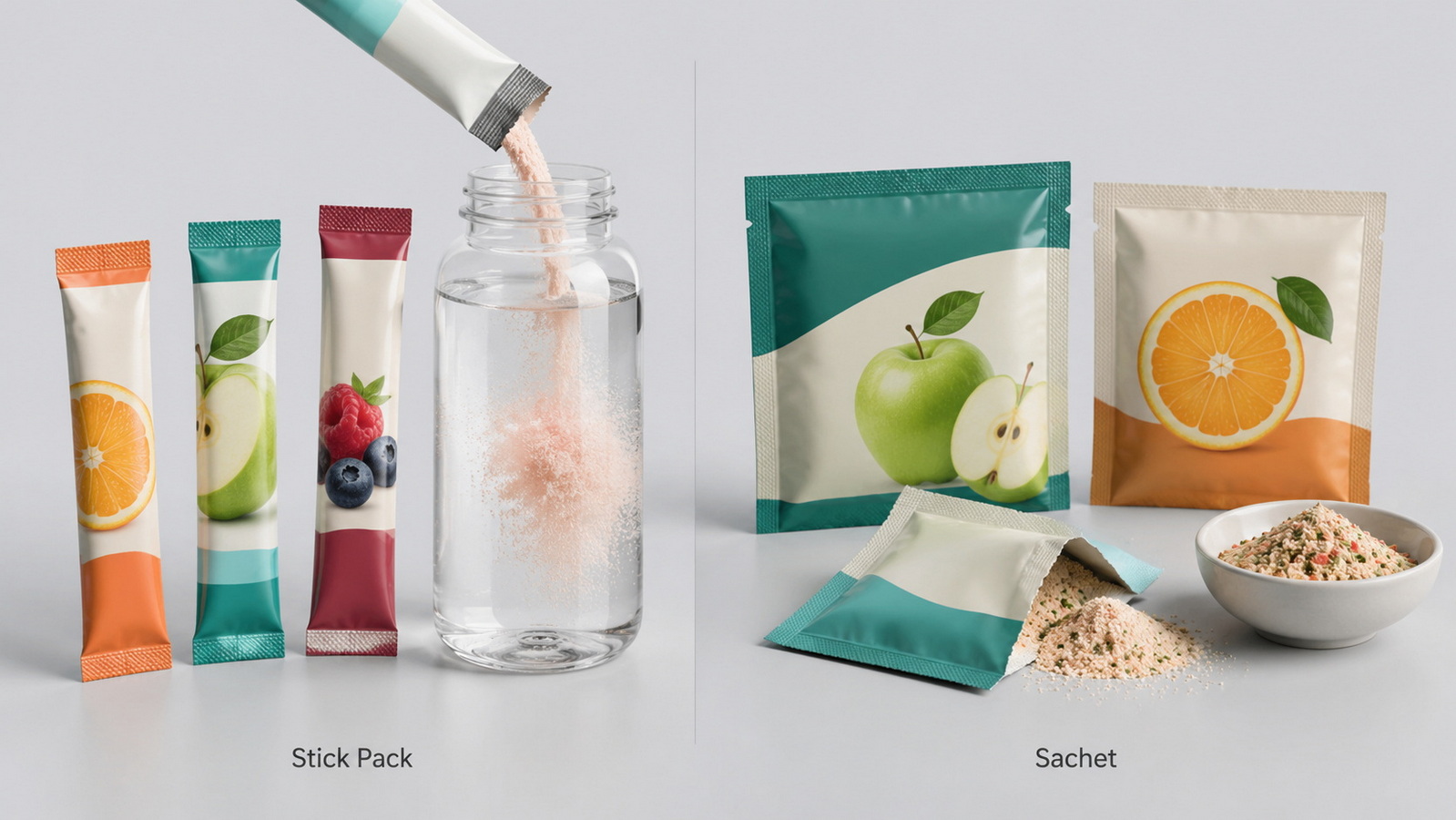
A stick pack is a narrow, elongated flexible packet, typically formed with a longitudinal seal and two end seals.
A sachet is generally a flatter packet, commonly using a three-side or four-side seal configuration. Commercial terminology sometimes overlaps, so drawings and dimensions matter more than names alone.
| Decision factor | Stick pack packaging | Sachet packaging |
|---|---|---|
| Typical appearance | Narrow, elongated packet | Flat square or rectangular packet |
| Common applications | Drink powders, sweeteners, liquid supplements | Seasonings, sauces, cosmetic samples, powders |
| Dispensing experience | Focused pouring or squeezing | Wider opening or squeeze area |
| Printable surface | Narrow panels | Broader panels |
| Filling options | Powder, granule, liquid, or gel systems | Powder, granule, liquid, or paste systems |
| Protection | Depends on film and seal integrity | Depends on film and seal integrity |
| Production cost | Requires project-specific calculation | Requires project-specific calculation |
Think of this comparison as a starting point. Product trials should determine the final choice.
Stick packs are a strong candidate for electrolyte powders, instant coffee, powdered sweeteners, and drink concentrates.
Their narrow opening can help users direct the contents into a small bottle neck. However, easy pouring depends on more than packet width.
Check whether the powder:
- Flows consistently after storage.
- Bridges near the opening.
- Generates dust when poured.
- Remains trapped around the seals.
A slim packet that looks convenient may disappoint users if the product cakes or empties slowly.
Stick pack machines can also package liquids and gels when equipped with suitable dosing systems.
Possible applications include syrups, sauces, and liquid nutritional products. The important questions concern viscosity, stringing, dripping, and contamination of the seal area.
Do not reject stick packs simply because your product is liquid. Instead, test whether the filling system can deliver a clean dose within the required cycle time.
Sachets deserve consideration for seasoning blends, larger powder portions, and products that users scoop, sprinkle, or squeeze.
Their wider geometry can support a different opening experience from a narrow stick pack. That advantage still needs confirmation through handling tests.
A wide tear opening may improve access, but it can also make an uncontrolled powder spill easier.
A broader sachet can accommodate preparation instructions, multilingual text, product information, and prominent graphics.
This matters when customers need to understand dilution ratios, application steps, or handling precautions before use.
Compare artwork at actual printed size. A design that appears readable on a monitor may become difficult to understand on the finished packet.
Keep tear notches, date codes, and sealing zones clear of essential information.
One important correction to common comparisons is that sachets do not inherently provide stronger barriers, and stick packs do not inherently require one particular laminate.
Both formats can use different flexible material structures.
Film selection should follow the product's sensitivity to moisture, oxygen, light, and other relevant exposure conditions.
Ask your material supplier for:
- Oxygen transmission rate, or OTR.
- Water vapor transmission rate, or WVTR.
- Test temperature and humidity.
- Material thickness and construction.
- Food-contact documentation where applicable.
- Sealing recommendations for the proposed structure.
OTR describes oxygen transmission through a material. WVTR describes water vapor transmission.
Numbers are only useful when the test conditions are understood. Comparing results measured under different conditions can produce misleading conclusions.
For a moisture-sensitive powder, connect the barrier specification to stability testing rather than accepting "high barrier" as a complete answer.
Film data alone cannot establish finished-pack performance.
A suitable laminate can still produce an unreliable packet if seals are contaminated, inconsistent, or damaged during handling.
Evaluate the filled package under expected storage and distribution conditions. Include opening performance, appearance, leakage, and product condition.
Adding more seals does not automatically improve protection. Every seal must perform consistently.
Stick packs are commonly produced on vertical form-fill-seal equipment using rollstock film.
Sachets can be produced on vertical or horizontal form-fill-seal systems. Some applications also use premade packets and separate filling equipment.
Avoid assuming that all stick pack machines run continuously or that all sachet machines share the same operating principle.

The filler deserves as much attention as the packet format.
Possible configurations include:
- Auger systems for suitable powders.
- Volumetric systems for suitable free-flowing granules.
- Pump-based systems for liquids.
- Product-specific arrangements for viscous or difficult materials.
Selection depends on dose size, flow behavior, density variation, viscosity, and required accuracy.
For powder packaging, provide representative samples rather than relying only on a product name. Two drink powders can behave very differently during filling.
A machine's lane count and cycle rate describe theoretical output, not necessarily finished production.
Consider this illustrative calculation:
- Eight lanes.
- Forty cycles per minute.
- Theoretical output: 320 packets per minute.
- Assumed overall equipment effectiveness: 75%.
- Planned good output: approximately 240 packets per minute.
These figures are a calculation example, not an HLun Pack performance claim.
Use a consistent definition of overall equipment effectiveness. If it already includes quality losses, do not subtract rejects again.
Also check cartoning, counting, inspection, and case packing. The complete line cannot sustainably exceed its limiting operation.
Stick packs can offer material savings in suitable applications, but the format alone does not guarantee lower unit costs.
Compare both options using the same product dose, annual demand, quality requirements, and operating assumptions.
A useful calculation is:
Total cost per saleable pack = total relevant production cost ÷ accepted packs.
Include:
1. Packaging film and printing.
2. Product giveaway from overfilling.
3. Operators and supervision.
4. Cleaning and changeovers.
5. Maintenance and consumables.
6. Startup waste and rejected packs.
7. Secondary packaging.
8. Equipment ownership costs.
A small film saving may disappear if the selected line requires longer cleaning or produces more rejected packets.
For film comparisons, request actual web layouts and pack drawings. Calculate material consumption from the proposed dimensions and seal allowances, not a generic percentage-saving claim.
Before purchasing a stick pack machine or sachet packaging machine, agree on a written trial protocol.
Provide the target dose, acceptable variation, product characteristics, packet dimensions, shelf-life objective, and intended sales market.
Include the expected number of product changes per shift or week.
Use the intended product and film wherever practical.
If substitutes are necessary, document their differences and identify what must be retested before production approval.
Observe startup, steady production, stopping, restarting, and replenishment.
For multilane equipment, compare results across lanes. An acceptable average can conceal one lane that consistently underfills or produces weaker seals.
Agree on measurable criteria for:
- Fill performance.
- Seal appearance and integrity.
- Sustained accepted output.
- Date-code readability.
- Opening performance.
- Cleaning and changeover time.
Set numerical limits according to your product and requirements rather than copying another project.

Verify counting, grouping, cartoning, and transport handling.
A packet that runs well at the sealing station may still cause problems when transferred, accumulated, or loaded into cartons.
Technical performance and user convenience should be assessed together.
Prepare filled samples and observe users completing the intended task without coaching.
Can they locate the opening point? Can they tear the packet comfortably? Does the product reach the container rather than the surrounding surface?
For drink powders, test the bottle opening customers are likely to use. For sauces and gels, inspect how much product remains after normal squeezing.
Record difficulties instead of asking only whether participants "like" the pack.
These observations can guide tear-notch placement, opening width, packet length, and instructions before tooling and artwork are finalized.
Using less material and being recyclable are different claims.
A lighter packet may reduce material consumption per serving without being accepted by local recycling systems.
Likewise, a paper-looking exterior does not prove that the complete package is recyclable or compostable.
When evaluating alternatives, ask:
- What is the complete material structure?
- Can it deliver the required protection?
- Does it run reliably on the intended machine?
- Is the finished packet collected and processed in the target market?
- What evidence supports the proposed environmental wording?
Describe verified attributes precisely. Avoid broad claims that go beyond the available evidence.
The right choice connects product protection, consumer convenience, and dependable production.
Send HLun Pack your product characteristics, target fill weight or volume, preferred packet dimensions, expected output, and available film specifications. Include existing samples if possible.
We can use that starting brief to discuss packaging materials, machinery configuration, and integrated line requirements—and identify the trials needed before you commit to a format.
A stick pack is narrow and elongated, while a sachet is generally flatter and broader. Their geometry affects dispensing and printable space, but either format can support different products when properly engineered.
Yes. Suitable machines can fill liquids and gels. Successful production depends on viscosity, dosing control, nozzle performance, material selection, and keeping product away from the sealing area.
No. Some designs use less film, but total cost also includes equipment, labor, waste, cleaning, product giveaway, and secondary packaging. Compare costs per accepted packet under equivalent production assumptions.
Neither wins automatically. Moisture protection depends on the material's barrier properties, package construction, and seal integrity. Validate the finished package against the product's storage and shelf-life requirements.
Some platforms support multiple packet styles with appropriate configurations or change parts. Do not assume interchangeability. Confirm the proposed dimensions, sealing arrangement, filler compatibility, conversion procedure, and demonstrated performance.
Provide product samples, dose requirements, target packet dimensions, film information, production demand, cleaning needs, and secondary packaging requirements. Identify unresolved details so the supplier can propose trials rather than make unsupported assumptions.
1. Yundu. "Stick Pack Vs Sachet: What Packaging Is Best." July 18, 2025. Original article used as the restructuring baseline. Its generalizations about materials, barriers, costs, and machinery were not adopted as universal rules. [yundufillingmachine]
2. Mespack. "Multilane Stick Pack Machines for Single-Dose Packaging." Manufacturer information supporting powder, granule, liquid, and gel applications; dosing configurations; intermittent-motion equipment; and downstream integration. [mespack]
3. Intertek. "Oxygen Permeation of Flexible Barrier Materials Using a Coulometric Sensor ASTM D3985, ISO 15105." Technical explanation supporting OTR testing and the importance of material thickness and environmental test conditions; also identifies WVTR testing under ASTM F1249. [intertek]
4. Federal Trade Commission. "Environmental Claims: Summary of the Green Guides." Guidance supporting qualified recyclability statements and the distinction between theoretical recyclability and access to appropriate recycling facilities. [ftc]
5. Federal Trade Commission. "Guides for the Use of Environmental Marketing Claims," 16 CFR Part 260. Detailed guidance on substantiating and qualifying environmental marketing claims. [ftc]


