


close
Choose Your Site
Global
Social Media
Views: 270 Author: HLun PACK Publish Time: 2026-11-12 Origin: Site


Content Menu
● What Is Die Cutting in Paper Packaging?
● How Does the Die-Cutting Process Work?
>> 1. Develop and Validate the Structural Design
>> 2. Match the Material and Tooling
>> 3. Set Up Cutting and Creasing
>> 4. Remove Waste and Separate Blanks
>> 5. Check Downstream Performance
● Types of Die Cutting: Which Method Fits Your Packaging?
>> Digital Knife and Laser Cutting
● Die Cutting vs. Creasing: Why Packaging Needs Both
● How to Choose a Die-Cutting Machine for Paper Packaging
>> Evaluate the Complete Workflow
>> Request a Representative Material Trial
● What Determines Die-Cutting Cost?
>> Compare Tooling Against Repeat Demand
>> Measure Output Beyond Sheets per Hour
● Common Die-Cutting Problems and What to Check
● A Practical Approval Checklist Before Full Production
● Plan Your Packaging and Equipment Together With HLun Pack
>> What is die cutting used for in packaging?
>> Is die cutting the same as laser cutting?
>> Can one cutting die process different paperboards?
>> Does every packaging design need a new die?
>> What is the difference between stripping and blanking?
>> How can I reduce cracking along carton folds?
Die cutting is a manufacturing process that uses a shaped tool to cut paper, paperboard, or corrugated board into repeatable designs. In paper packaging, it creates the panels, tabs, slots, and windows that allow a flat sheet to become a functional box or insert.
But understanding what die cutting is involves more than recognizing a cutting tool. Packaging performance also depends on creasing, material selection, print alignment, waste removal, and downstream assembly.
At HLun Pack, our focus is packaging machinery and integrated packaging solutions. This guide takes a production-focused approach: how die cutting works, which methods suit different applications, and what buyers should check before approving packaging or investing in equipment.
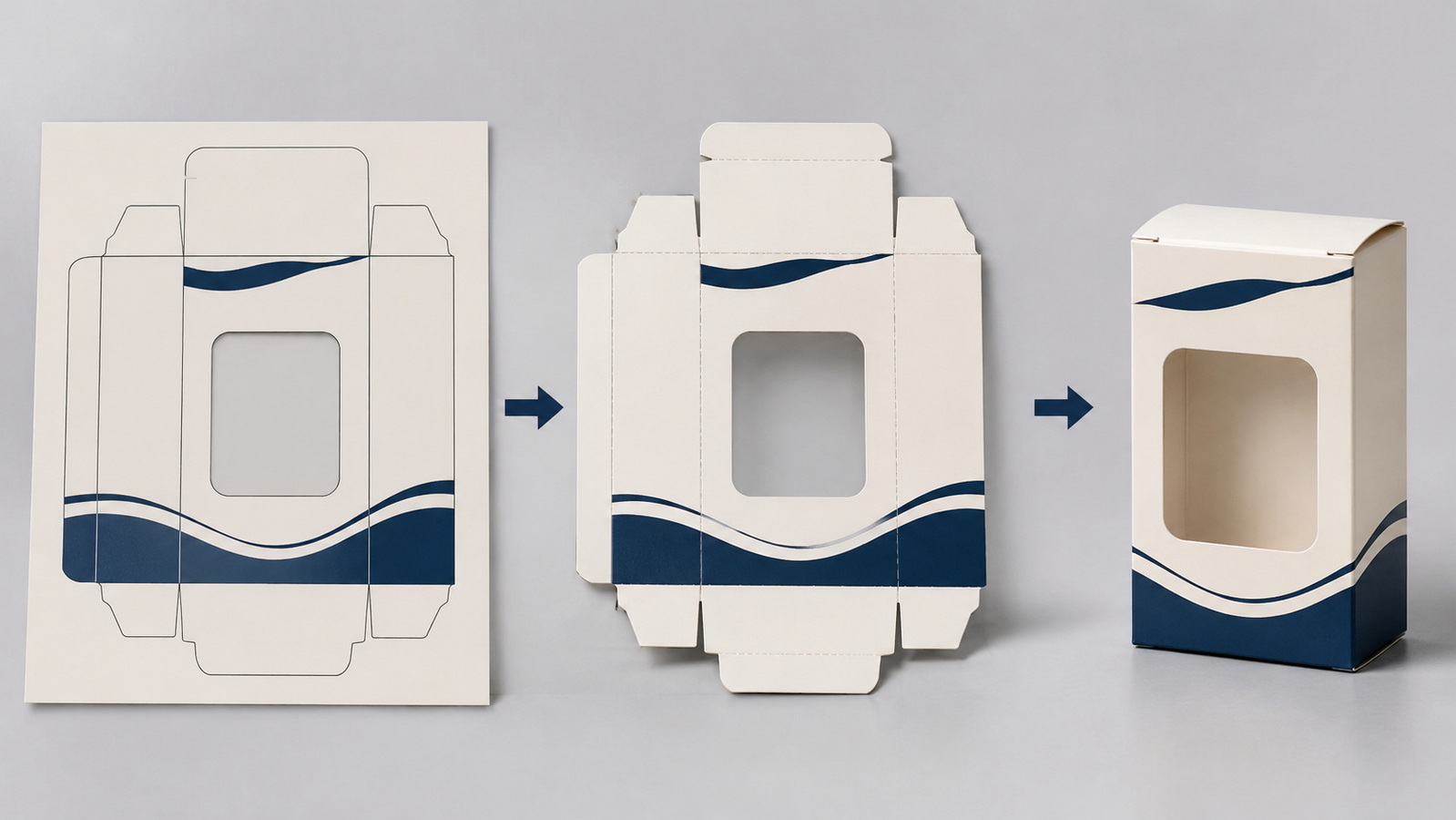
A die-cutting machine applies controlled force through a cutting tool to separate material along a defined outline. That outline may form a carton's outer shape, an internal opening, or a locking feature.
Typical applications include:
- Folding cartons for cosmetics, food, and consumer goods.
- Corrugated mailers and shipping boxes.
- Paperboard inserts that position products.
- Retail displays and presentation packaging.
- Sleeves, hang tags, and promotional cards.
The main advantage is repeatability. Once the tooling and machine settings are established, the same structural design can be reproduced across a production run.
However, a clean-looking blank is only an intermediate result. The finished packaging must also fold correctly, close reliably, protect its contents, and run through the intended packing process.
A cutting die is the physical tool that defines the cut geometry.
For many paperboard applications, a steel-rule die contains sharpened steel rules mounted in a supporting board. Creasing rules can be incorporated to create folding lines during the same press cycle.
Ejection rubber helps release the sheet from the cutting rules.
Cutting plates, shims, and supporting materials assist the process, but they are not interchangeable names for cutting dies. Keeping these components distinct makes technical discussions and equipment quotations more accurate.
A reliable die-cutting process begins before the sheet reaches the press.
The packaging designer creates a dieline: a flat technical drawing showing the package's structure.
It should distinguish:
- Cutting paths.
- Creasing positions.
- Perforations.
- Glue areas.
- Relevant dimensions and production notes.
Artwork should remain separate from structural instructions. Dieline colors and layer conventions should follow the converter's requirements rather than an assumed universal standard.
A physical prototype helps verify product fit, opening behavior, closure strength, and assembly sequence before production tooling is finalized.
Tool selection must account for board thickness, construction, coating, and intended folding behavior.
Grammage alone is insufficient. Two boards with the same weight per square meter can differ in thickness, stiffness, and converting performance.
The die, creasing rules, and counter-material must therefore be matched to the actual substrate.
During make-ready, the operator establishes sheet registration, cutting pressure, and tooling alignment.
The objective is complete cutting and consistent creasing without unnecessary damage to the sheet.
More pressure is not automatically better. Excessive force can conceal a tooling problem while creating new quality issues.
Stripping removes unwanted waste around or within the cut layout.
Blanking separates individual packaging blanks from the sheet. Depending on the equipment configuration, these operations may be integrated or completed separately.
Approved blanks move to folding, gluing, erection, or packing.
This final check matters: a blank can meet dimensional requirements yet still fold poorly or cause feeding problems on another machine.
The right process depends on material, order profile, structural complexity, and the surrounding production line.
| Method | Typical applications | Main advantage | Main consideration |
|---|---|---|---|
| Flatbed die cutting | Folding cartons, inserts, corrugated packaging | Combines cutting and creasing with application-specific tooling | Requires tooling and make-ready |
| Rotary die cutting | Repetitive converting applications, including corrugated packaging and labels | Continuous rotary processing | Tooling and material suitability require evaluation |
| Digital knife cutting | Prototypes, samples, frequently changing designs | No physical cutting die required | Cutting time depends on toolpath and design complexity |
| Laser cutting | Intricate decorative patterns and fine openings | Non-contact cutting of detailed shapes | Edge appearance and material response need testing |
Flatbed systems press a flat tool against the sheet and a supporting counter-surface.
They are widely relevant to paper packaging because they can combine structural cutting and creasing.
Flatbed does not mean low-volume only. Industrial automated systems can support substantial production, including integrated stripping and blanking. The practical choice depends on the machine configuration and job requirements.
Rotary systems use rotating tooling to process material through the cutting section.
They can be attractive for repetitive production, but suitability varies across applications. Label converting and corrugated-box manufacturing have different material-handling and tooling requirements.
Evaluate the intended job rather than selecting rotary equipment solely because it is associated with speed.
Digital knife systems follow a computer-controlled path instead of using a fixed cutting die. They are useful when validating designs or producing changing structures.
Laser cutting uses thermal energy rather than a blade. It can create intricate details, but edge discoloration and the response of coatings or laminates require assessment.
Digital cutting is an alternative to conventional die cutting, not simply the same process with computerized controls.
Cutting separates material. Creasing creates a controlled folding zone.
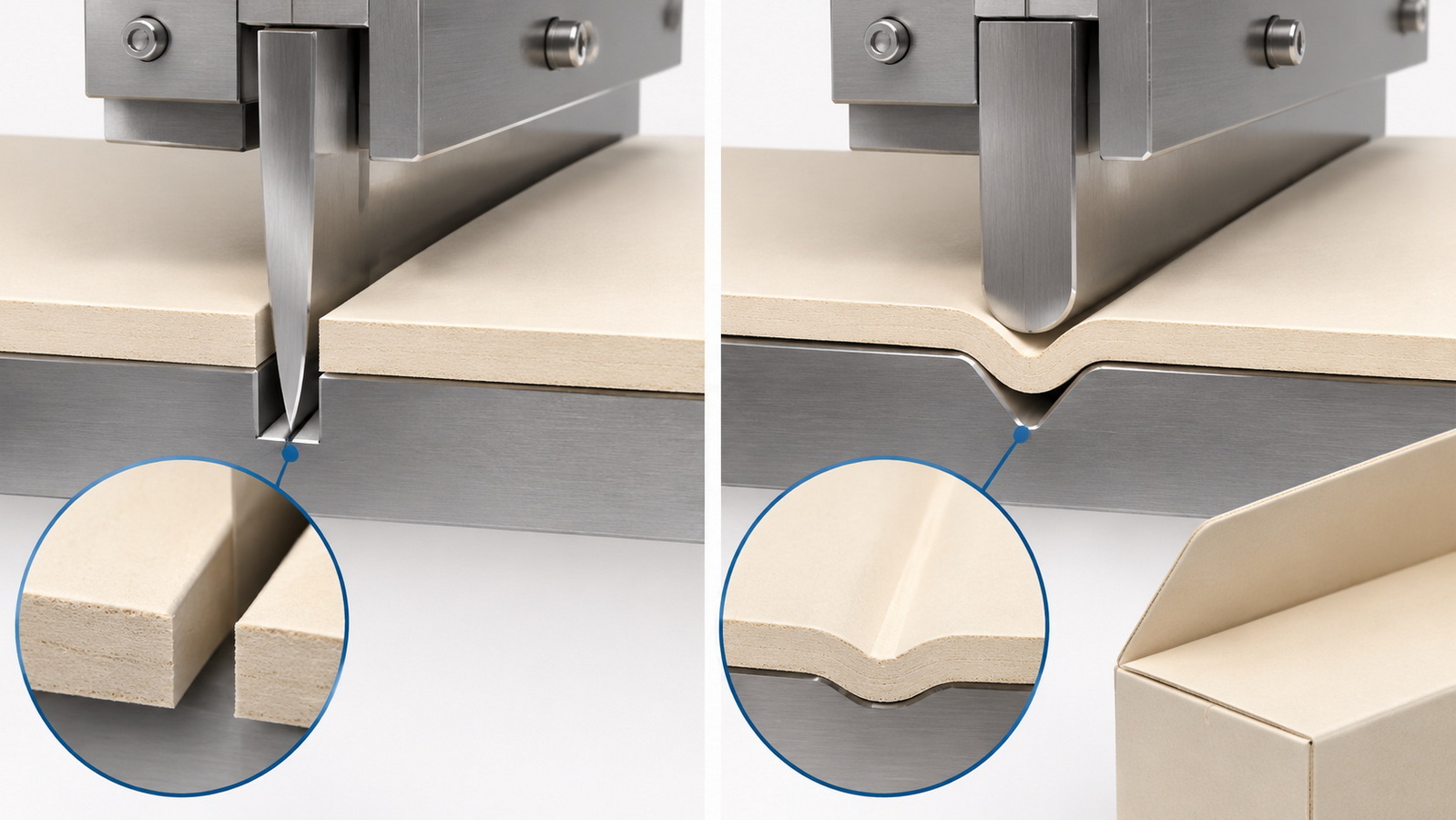
For a folding carton, both functions affect performance. Accurate cuts cannot compensate for folds that crack, resist bending, or sit in the wrong position.
A creasing rule presses the board into a corresponding channel. Tool geometry and paperboard properties determine how the fold develops.
Important variables include:
- Board thickness and construction.
- Grain direction.
- Creasing-rule dimensions.
- Counter-channel geometry.
- Pressure and alignment.
- Printed or laminated surface behavior.
The practical priority is foldability: can the package form its intended shape consistently without unacceptable damage?
Approve a folded sample, not only a flat sheet.
Begin with the production requirement, not the largest advertised speed.
Prepare a representative list of current and expected work:
- Minimum and maximum sheet dimensions.
- Board grades and thicknesses.
- Typical order quantities.
- Number of design changes per shift.
- Cutting and creasing complexity.
- Required stripping and blanking functions.
- Downstream folding and packing equipment.
A plant running many changing carton designs has different priorities from one producing long runs of a stable corrugated structure.
Compare feeding, registration, cutting, waste removal, delivery, and downstream handling.
A faster cutting section may provide limited benefit if operators must manually separate blanks or repeatedly clear delivery problems.
Also consider tooling availability, maintenance access, training, spare parts, and technical support.
Use your intended board and a realistic packaging design.
Include challenging features such as narrow slots, printed folds, internal waste, and locking tabs.
Agree on acceptance criteria before testing. Record good output, stoppages, waste, and make-ready time rather than relying on a short demonstration of maximum speed.
The lowest machine rate does not necessarily produce the lowest packaging cost.
A useful comparison includes:
- Cost per accepted blank = total relevant production cost ÷ accepted blanks.
Relevant costs may include tooling, make-ready, material, running time, labor, waste handling, and rejected output.
A dedicated die introduces an upfront expense, but repeat orders can spread that expense across more accepted units.
Digital cutting avoids a physical cutting die, which may suit prototypes or changing designs. However, processing time still matters.
Ask for comparisons based on your expected order pattern rather than a universal quantity threshold.
One sheet may contain several blanks.
For an illustrative calculation, 4,000 sheets per hour with six blanks per sheet produces 24,000 theoretical blanks. At a 95% accepted yield, that becomes 22,800 accepted blanks before allowing for downtime.
These are hypothetical figures, not an HLun Pack performance claim.
The lesson is simple: compare accepted output over a realistic production period.
Troubleshooting should identify the cause before changing settings.
| Problem | Possible causes | Initial checks |
|---|---|---|
| Incomplete cuts | Worn rules, uneven pressure, unsuitable setup | Inspect tooling and cutting consistency |
| Cracked folds | Mismatched creasing geometry, board condition, grain direction | Test the actual board and crease setup |
| Print-to-cut misalignment | Registration errors or sheet variation | Check feeding, reference marks, and registration |
| Torn edges | Damaged rules, difficult features, unsuitable settings | Examine rule condition and design geometry |
| Waste remaining in openings | Stripping problems or difficult internal features | Review waste-removal tooling and support |
| Folding or gluing interruptions | Inconsistent creases, distorted blanks, structural issues | Test blanks on downstream equipment |
Change one variable at a time and retain approved samples. This makes repeat-job setup more reliable and helps separate material variation from machine-related problems.
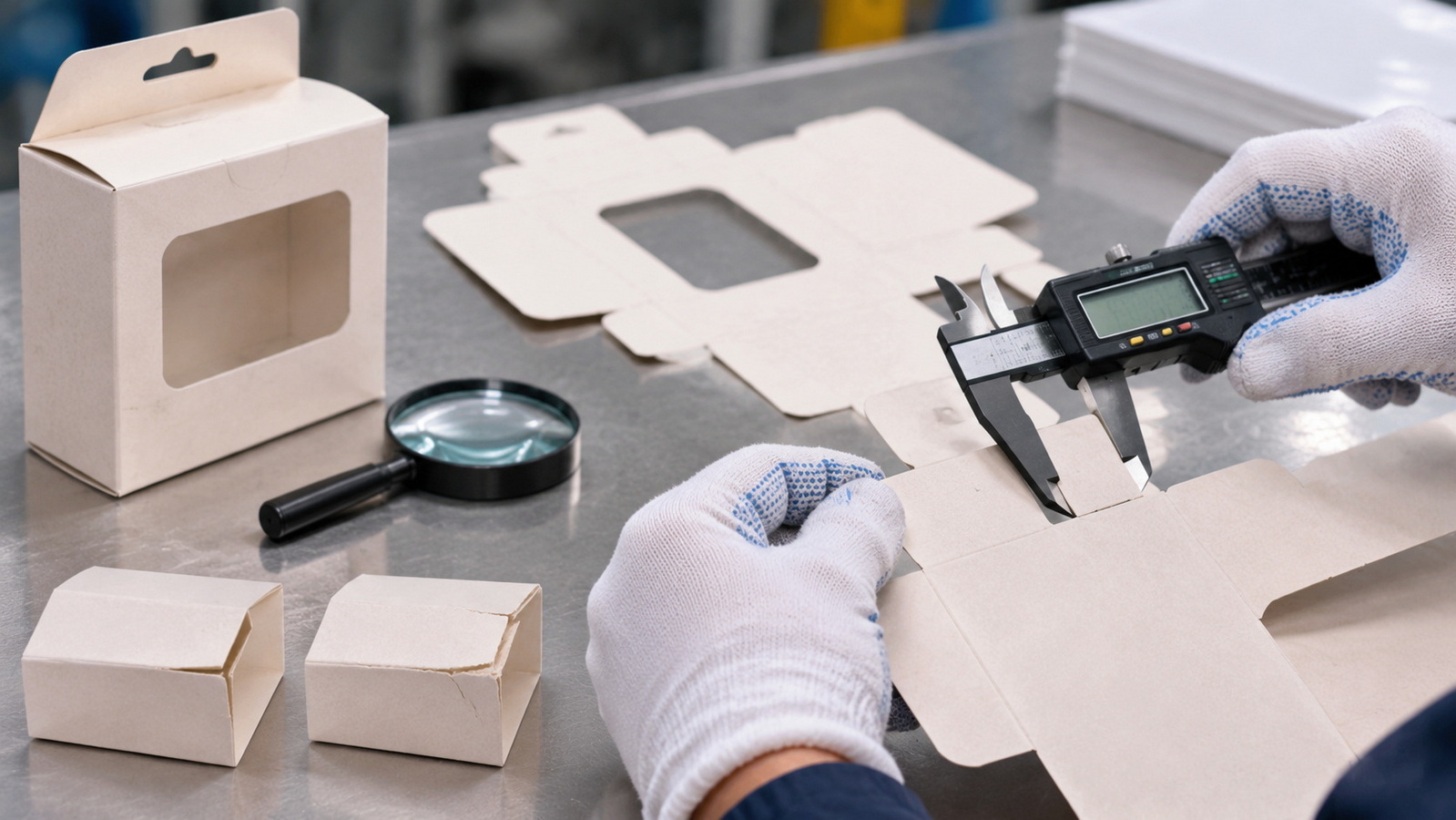
Use a documented first-off inspection before releasing a production run.
1. Confirm the approved dieline revision.
2. Check board grade, thickness, and grain direction.
3. Measure critical dimensions and openings.
4. Verify print-to-cut alignment.
5. Inspect cuts, creases, and stripped areas.
6. Fold and close the package.
7. Test product fit and retention.
8. Run samples through relevant downstream equipment.
9. Record approved settings and acceptance limits.
Agree on tolerances with the converter. One blanket tolerance may not suit external dimensions, small slots, and product-retention features equally well.
Repeat checks during production, especially after material changes or machine adjustments.
Die cutting works best when packaging structure, board selection, tooling, and downstream machinery are considered together.
For a project review, send HLun Pack your product dimensions, packaging drawing or sample, intended material, order quantities, and expected output.
Also identify current difficulties, such as cracked folds, excessive manual separation, slow changeovers, or unreliable carton erection.
Use this information to define a practical packaging and equipment brief, establish trial requirements, and compare solutions against measurable production goals.
It creates repeatable packaging shapes, including carton outlines, windows, slots, locking tabs, and inserts. It is commonly combined with creasing so flat paperboard can fold into a usable package.
No. Conventional die cutting uses a physical tool and mechanical force. Laser cutting uses a focused beam. Both can create shapes, but their tooling requirements and effects on materials differ.
Sometimes, but compatibility must be tested. Changes in board thickness, construction, or coating may require different creasing arrangements, settings, or tooling.
A structural change may require new or modified tooling. An artwork-only change may not, provided the cutting and creasing geometry remain unchanged and the existing tool is suitable.
Stripping removes unwanted waste from the sheet. Blanking separates the individual packaging blanks. These functions may be integrated into a production line or performed separately.
Match the board, grain direction, creasing geometry, and machine settings. Test printed or laminated material under representative conditions, then inspect folded samples before approving the run.
The sources below support the process descriptions and engineering principles. Selection checklists and purchasing recommendations are editorial synthesis; the numerical output example is illustrative.
1. [OXO Packaging — "What Is Die Cutting? Its Types & Applications"]. Original article by Waqas Khan Pitafi, published July 26, 2024. Used as the starting point for restructuring the topic and identifying gaps. [oxopackaging]
2. [Iggesund Paperboard — Graphics Handbook: "Die Cutting and Creasing"]. Technical guidance on cutting tools, paperboard compatibility, tooling geometry, and combined cutting and creasing. [iggesund]
3. [Iggesund Paperboard — Graphics Handbook: "Creasing and Folding in Practice"]. Technical guidance on grain direction, creasing geometry, tooling variables, and fold evaluation. [iggesund]
4. [BOBST — NOVACUT 106 ER]. Equipment documentation supporting the distinction between cutting, stripping, and blanking, alongside registration and changeover considerations. [bobst]
5. [BOBST — MASTERCUT 106 PER]. Industrial example demonstrating that automated flatbed die cutting is not restricted to low-volume work. Manufacturer capabilities are not presented as HLun Pack specifications. [bobst]
6. [Holmen / Iggesund — "Digital Printing & Finishing in Your Business"]. Background on paperboard selection, digital finishing, creasing, and laser-cutting considerations. [iggesund]


