


close
Choose Your Site
Global
Social Media
Views: 255 Author: HLun PACK Publish Time: 2026-09-05 Origin: Site


Content Menu
● How Retort Pouch Packaging Works
● Why Retort Pouches Heat Faster Than Cans
● Retort Pouch Material Structure
>> Common Retort Pouch Structures
>> What Can Go Wrong With the Wrong Structure?
● Retort Pouches vs. Cans and Glass Jars
● Retort Pouch Sustainability: The Real Trade-Off
>> A Practical Sustainability Framework
● Choosing Retort Packaging Equipment
>> Core Equipment for a Retort Pouch Line
>> Questions to Ask Before Buying
● Expert Checklist for Retort Pouch Development
>> Product and Process Validation
>> Commercial and Consumer Fit
● Request a Retort Packaging Consultation
>> 1. What is the difference between a retort pouch and a regular stand-up pouch?
>> 2. Can retort pouches be microwaved?
>> 3. How long can food last in a retort pouch?
>> 4. Are retort pouches safe for food?
>> 5. Are retort pouches recyclable?
>> 6. What products are best suited for retort pouch packaging?
>> 7. What is the most important factor when selecting a retort pouch supplier?
Retort pouches enable shelf-stable foods, sauces, pet food, and ready meals to be thermally processed in a lightweight flexible package. For brands, co-packers, and food processors, success depends on more than choosing a pouch: it requires a compatible product formulation, validated thermal process, retort-resistant flexible packaging structure, reliable sealing, and well-matched retort packaging equipment.
At HLun Pack, we work with flexible-packaging manufacturers and food brands that need more than a standard pouch. In practical production environments, the question is not simply "Can this pouch withstand 121°C?" The more important question is: Can the pouch, filling method, sealing system, retort process, cooling stage, and distribution conditions work reliably together?
This guide explains how retort pouches work, where they fit, how to select materials and machinery, and what buyers should evaluate before moving from concept to commercial production.
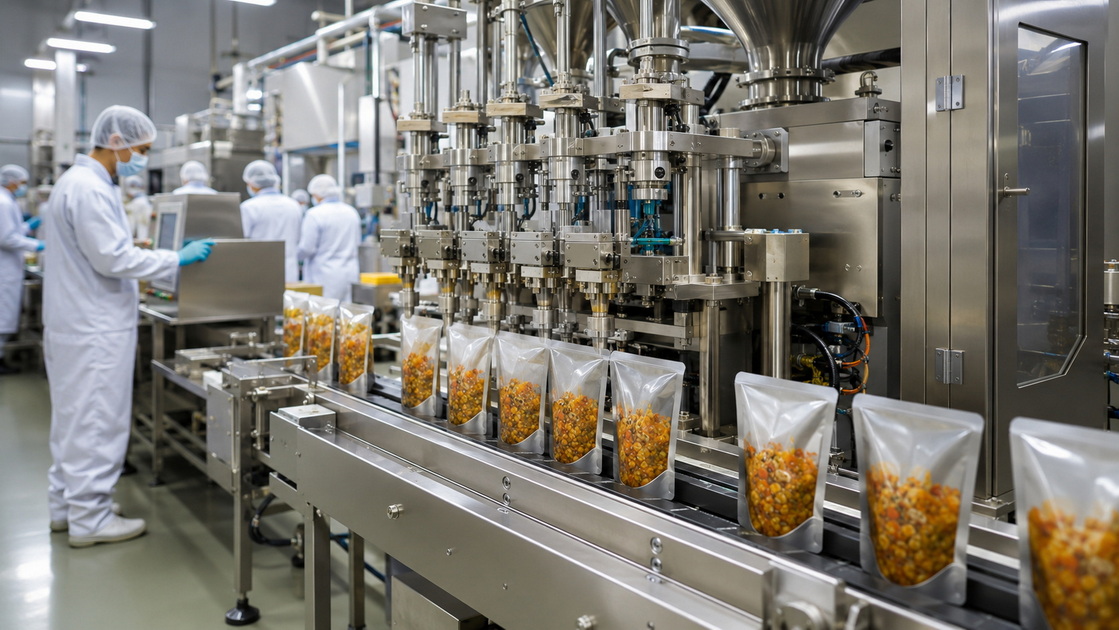
A retort pouch is a flexible, hermetically sealed package designed to hold food or other products during high-temperature thermal processing. After filling and sealing, the pouch is processed in a pressurized retort vessel. The process delivers enough heat to create commercial sterility for applicable shelf-stable products.
Retort pouch packaging is widely used for:
- Ready-to-eat meals
- Soups and broths
- Curry, rice, and pasta dishes
- Sauces, gravies, and condiments
- Seafood and meat products
- Baby food and purées
- Wet pet food
- Military and emergency rations
- Certain healthcare and specialty products
For low-acid foods sold in the United States, retort processing is not merely a packaging preference. Commercial processors must comply with regulatory requirements for thermally processed low-acid or acidified foods in hermetically sealed containers. FDA guidance states that processors must register their establishments and file scheduled processes for each applicable product, container type, container size, and processing method.
In simple terms, a retort pouch combines three elements:
1. A high-barrier flexible packaging structure
2. A secure heat seal that remains intact during retorting
3. A validated thermal process that controls microbiological hazards
A pouch alone does not make a product shelf-stable. Shelf stability is achieved by the complete packaging-and-process system.
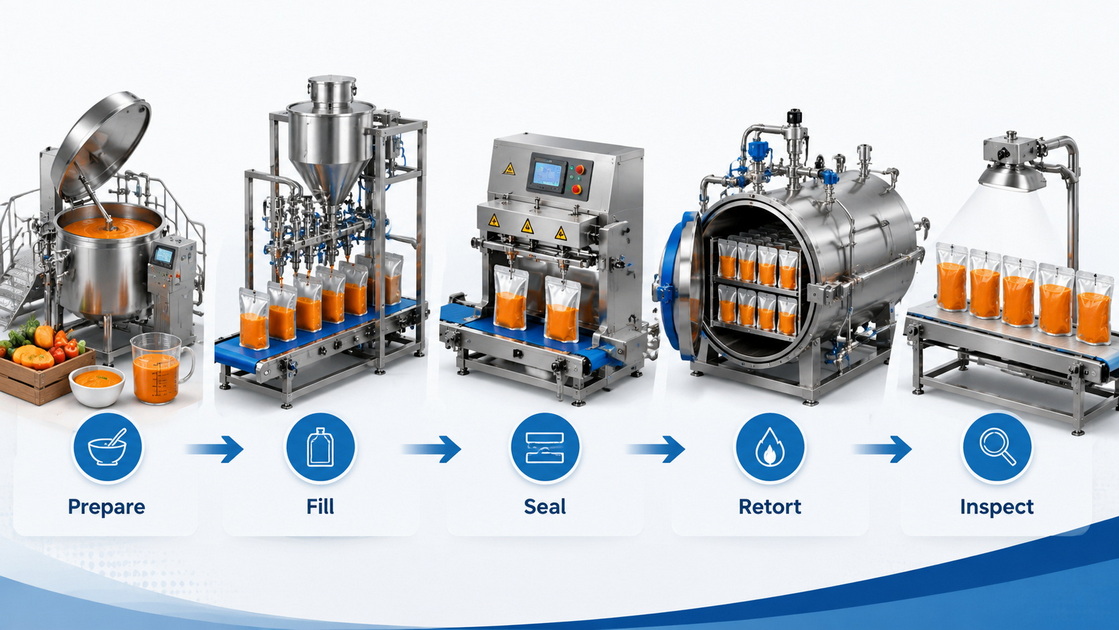
Retort packaging relies on controlled heat and pressure. Food is filled into the pouch, the pouch is hermetically sealed, and the sealed packs are processed in a retort. Depending on the product, package geometry, retort type, and scheduled process, the retort cycle may include heating, holding, cooling, and pressure-control stages.
A commonly referenced retort condition is approximately 121°C / 250°F, although actual temperatures and processing times must be set through product-specific validation rather than copied from another product or package. FDA materials identify high-temperature heat sterilization or retorting as a food-contact condition of use associated with roughly 121°C / 250°F.
1. Product preparation
The food is cooked, blended, portioned, or otherwise prepared according to the product specification.
2. Pouch filling
The product is filled into a retort-compatible pouch. Headspace, product temperature, particulate size, viscosity, and fill weight must be controlled.
3. Vacuuming or steam flushing
Depending on the application, excess air may be removed to improve pack appearance, seal performance, and heat transfer consistency.
4. Heat sealing
The pouch is sealed using precise temperature, pressure, and dwell-time settings. A seal contaminated by oil, food particles, sauce, or moisture can fail during retorting.
5. Retort sterilization
Sealed pouches enter a steam, water-spray, water-immersion, or rotary retort system. Heat is applied according to a validated scheduled process.
6. Cooling and overpressure control
The package is cooled while pressure is controlled to reduce pouch stress, prevent seal damage, and maintain package appearance.
7. Inspection and quality verification
Manufacturers inspect pouch seals, check for leaks, evaluate delamination, review retort records, and conduct microbial or shelf-life verification as required.
One of the most important advantages of retort pouch packaging is geometry. A pouch generally has a thinner product profile than a conventional metal can or glass jar. This provides a higher surface-area-to-volume ratio and can allow heat to travel into the product more efficiently.
The Institute of Food Technologists notes that retort pouches and trays can transmit heat faster than conventional cans or jars because of their higher surface-to-volume ratio. This can reduce excessive thermal exposure and may help preserve product quality, including flavor, texture, and color, when the process is properly designed.
However, fast heating should not be confused with automatic safety or universal process reduction. Thermal processing performance depends on many variables:
- Product viscosity
- Particulate size and distribution
- Package thickness
- Fill weight
- Initial product temperature
- Retort medium and circulation
- Retort loading pattern
- Rotation or agitation
- Container orientation
- Cold-spot location
- Target shelf life
- Required microbial lethality
For example, a thin liquid soup may heat very differently from a chunky beef stew, thick curry sauce, or pet-food formula containing meat pieces. A reliable process must account for the slowest-heating point inside the pouch and the actual behavior of the product during processing.
A retort pouch is usually a multi-layer laminate. Each layer provides a different function, such as printability, mechanical strength, puncture resistance, oxygen barrier, light barrier, and heat sealing.
A common traditional structure is:
| Layer | Typical Material | Primary Function |
|---|---|---|
| Outer layer | PET | Print surface, stiffness, abrasion resistance, heat resistance |
| Reinforcement layer | Nylon / PA | Puncture resistance, flex-crack resistance, mechanical strength |
| Barrier layer | Aluminum foil, EVOH, SiOx, or AlOx | Oxygen, moisture, aroma, and/or light barrier |
| Sealant layer | CPP / PP | Heat sealing, food-contact interface, retort resistance |
| Product Type | Example Packaging Structure | Why It May Be Used |
|---|---|---|
| Sauces and liquid meals | PET / AL / CPP | Strong light and oxygen barrier; stable shelf presentation |
| Acidic foods | PET / AL / CPP or PET / barrier / PP | Chemical compatibility and reliable heat sealing |
| Meat and seafood | PET / PA / AL / CPP | Added puncture resistance for bones, edges, and particles |
| Ready meals | PET / PA / EVOH / PP | Flexible barrier solution with strong mechanical performance |
| Pet food | PET / PA / AL / CPP or PP-based high-barrier structures | Resistance to fat, odor, pressure, and particulate stress |
| Recyclability-focused concepts | PP / high-barrier coating / PP | Designed to reduce material complexity where performance permits |
The correct laminate is determined by the actual product and process, not by appearance alone. A spicy oil-based sauce, acidic tomato product, protein-rich wet pet food, and high-fat seafood product can place very different demands on the adhesive system, barrier layer, and sealant.
From an equipment and packaging perspective, common failures include:
- Delamination after retort processing
- Seal-channel leaks
- Burst pouches during pressure changes
- Wrinkling or distorted pouch appearance
- Pinholes in aluminum foil
- Flex-cracking in barrier layers
- Oil migration or flavor scalping
- Weak seals caused by product contamination
- Reduced shelf life caused by oxygen ingress
This is why HLun Pack recommends beginning with a structured compatibility review: product formula + pouch structure + sealing system + retort method + target shelf life.
Retort pouches are not the right answer for every product. Cans and glass jars remain established formats, especially where line infrastructure, consumer expectations, recycling systems, or extremely high mechanical protection are priorities.
Still, flexible retort packaging offers significant operational and marketing advantages.
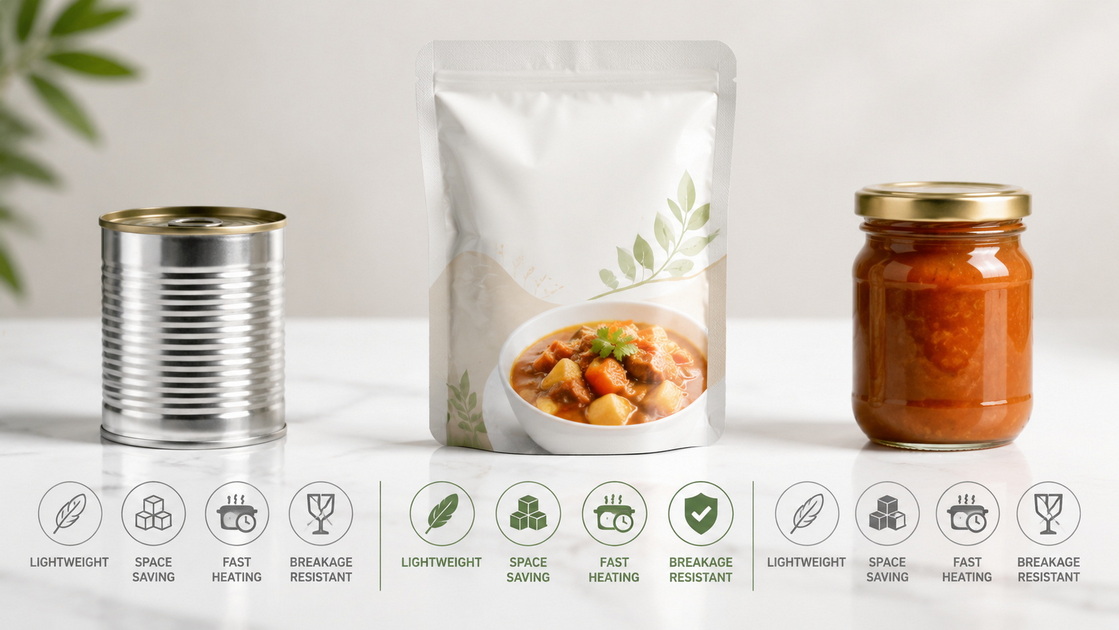
| Criteria | Retort Pouch | Metal Can | Glass Jar |
|---|---|---|---|
| Package weight | Very low | Moderate | High |
| Empty-package storage | Flat and space-efficient | Bulky | Bulky and fragile |
| Heat transfer potential | Often faster due to thin profile | Generally slower | Generally slower |
| Breakage risk | Low | Low | Higher |
| Printing and graphics | Large printable surface | Moderate | Often label-dependent |
| Consumer convenience | Easy-open, tear notch, spout, stand-up options | Requires opening tool or pull tab | Requires lid removal |
| Shelf appearance | Flexible and customizable | Traditional | Premium and transparent |
| Recycling reality | Depends on local flexible-film collection | Widely recycled in many markets | Widely recycled in many markets |
| Puncture resistance | Must be engineered carefully | Excellent | Excellent but breakable |
- Lower shipping weight: Flexible pouches typically use less packaging material than rigid glass or metal formats.
- More efficient storage: Empty pouches ship flat and occupy far less warehouse space before filling.
- Strong shelf impact: Full-surface printing supports brand storytelling, nutrition panels, instructions, and premium graphics.
- Consumer-friendly features: Tear notches, laser scoring, hang holes, spouts, handles, and stand-up bases can improve usability.
- Potential food-quality benefits: Faster heat transfer can reduce thermal exposure when the product and process are correctly engineered.
A life-cycle assessment highlighted by Huhtamaki reported that, for a 400 g content comparison, a flexible pouch showed a 63% lower climate-change impact than a glass jar and a 69% lower impact than a steel can. These results are directional rather than universal: environmental performance depends on material structure, product-to-package ratio, transport distances, food-waste prevention, and end-of-life management.
Flexible packaging can reduce material use and transport-related burden, but traditional multi-material retort laminates are often difficult to recycle through standard municipal systems. This is the central sustainability challenge of retort packaging.
A foil-based retort pouch may deliver exceptional oxygen and light protection, but it can be difficult to sort and recycle because it combines multiple polymer layers, adhesives, inks, coatings, and sometimes aluminum foil.
The industry is responding through mono-material and reduced-complexity structures, especially PP-based solutions designed to retain retort resistance while improving compatibility with flexible-packaging recycling streams.
CEFLEX recommends designing flexible packaging toward mono-material solutions where possible. Its design guidance describes a mono-material approach as one where more than 90% of the packaging is based on one primary polymer type, excluding smaller components such as inks, adhesives, and barrier materials.
Do not ask only, "Is this retort pouch recyclable?" Ask these five questions instead:
1. Does the pouch meet required barrier and retort performance?
2. Does the material design align with the recycling infrastructure in the target market?
3. Can the package reduce food waste by protecting the product through its intended shelf life?
4. Is the environmental claim supported by a credible life-cycle assessment or technical documentation?
5. Are recycling instructions clear and accurate for the consumer?
For food brands, the best sustainability decision is often a balance between lightweight design, package performance, food-waste prevention, and realistic recovery options.
A high-performance pouch will fail if the filling and sealing system is unstable. Similarly, excellent machinery cannot compensate for an incompatible film structure.
For companies investing in a retort packaging line, equipment selection should begin with the product—not the machine catalog.
Depending on production volume and product type, a complete retort pouch packaging solution may include:
- Product preparation and cooking equipment
- Mixing or homogenizing equipment
- Product transfer pumps
- Pouch feeding system
- Premade pouch filling machine
- Vacuum or steam-flushing system
- Heat-sealing station
- Metal detection or X-ray inspection
- Retort sterilizer
- Cooling and drying system
- Coding and traceability equipment
- Case packing and palletizing equipment
| Evaluation Area | Questions for Your Team |
|---|---|
| Product characteristics | Is the product liquid, viscous, particulate, oily, acidic, or protein-rich? |
| Production volume | What is the required output per hour, shift, or year? |
| Pouch format | Flat pouch, stand-up pouch, spout pouch, shaped pouch, or quad-seal pouch? |
| Filling accuracy | What fill-weight tolerance is acceptable? |
| Seal performance | Does the product contaminate the seal area? Is vacuum sealing required? |
| Retort method | Steam, water spray, water immersion, rotary, or continuous retort? |
| Automation | Is the objective labor reduction, higher consistency, or greater traceability? |
| Changeover | How often will pouch sizes, recipes, or SKUs change? |
| Compliance | What food-safety, validation, documentation, and export-market requirements apply? |
| After-sales support | Are spare parts, remote diagnostics, commissioning, and operator training available? |
Before launching a commercial retort pouch product, use this practical checklist.
- Confirm the product's pH, water activity, viscosity, fat content, salt level, and particulate characteristics.
- Work with a qualified process authority where required.
- Establish a scheduled thermal process for the specific product, pouch size, pouch geometry, and retort system.
- Validate the cold spot and heat penetration behavior.
- Maintain accurate processing records and deviation procedures.
FDA requirements for thermally processed low-acid foods cover areas including equipment, processing operations, records, and controls. The applicable process must be followed exactly; packaging format and processing conditions cannot be substituted casually.
- Conduct retort simulation and commercial-scale trials.
- Test seal strength before and after retorting.
- Perform burst, creep, leak, and dye-penetration testing where appropriate.
- Check for delamination, flex cracks, wrinkles, pinholes, and print degradation.
- Evaluate oxygen transmission, water-vapor transmission, and light protection based on the product's sensitivity.
- Confirm food-contact compliance for the target market.
FDA defines food-contact substances broadly to include packaging and components that contact food. Manufacturers should ensure that their materials, additives, inks, adhesives, and relevant food-contact layers meet the regulatory requirements for the markets where the product will be sold.
- Select a pouch size that matches portioning and price strategy.
- Choose opening features that work reliably after retort processing.
- Include clear microwave, boiling-water, disposal, and storage instructions where relevant.
- Verify that graphic design remains legible after retorting.
- Test shelf appearance after transportation and distribution.
HLun Pack focuses on flexible packaging equipment and integrated packaging solutions for manufacturers that need dependable production, not just individual machines.
For retort pouch projects, our approach begins with the entire system:
- Product characteristics
- Pouch structure and format
- Filling accuracy
- Seal integrity
- Thermal-process compatibility
- Retort configuration
- Automation requirements
- Quality-control needs
- Long-term operating efficiency
We understand that a retort pouch project involves many connected decisions. A better seal profile can reduce leakage risk. A suitable pouch-feeding system can improve line stability. Better filling control can reduce product waste. A correctly selected retort can improve process consistency and protect finished-pack quality.
The objective is not simply to package food. The objective is to build a reliable, scalable, and commercially viable shelf-stable packaging system.
If you are developing a new shelf-stable food, upgrading from cans or jars, launching wet pet food, or improving an existing retort pouch production line, HLun Pack can help evaluate your technical requirements.
Contact our team to discuss:
- Retort pouch packaging machine selection
- Flexible packaging formats and compatibility
- Filling and sealing solutions
- Retort system integration
- Automation and line-layout planning
- Custom packaging equipment for sauces, meals, pet food, and other shelf-stable products
Send HLun Pack your product details, pouch size, target production capacity, and preferred automation level to receive a tailored packaging solution.
A regular stand-up pouch may be suitable for dry goods, snacks, coffee, or products with limited processing demands. A retort pouch is specifically engineered to withstand high-temperature, high-pressure thermal processing. It requires retort-resistant materials, adhesives, barrier layers, and heat seals.
Some retort pouches can be heated in a microwave, but not all are microwave-safe. Pouches containing aluminum foil should generally not be microwaved. Brands should provide clear consumer instructions based on the exact pouch structure and product heating method.
Shelf life varies by product formulation, pouch structure, oxygen barrier, retort process, storage conditions, and distribution environment. Many retorted foods are designed for ambient shelf life measured in months or years, but the exact shelf life must be validated for the specific product and package.
Retort pouches can be safe for food when the food-contact materials are compliant, the pouch structure is compatible with the product and process, seals remain intact, and the thermal process is validated and properly controlled. Food safety depends on the complete system, not the pouch alone.
Some conventional multi-layer retort pouches are difficult to recycle because they combine several materials. New PP-based or mono-material-oriented retort structures may offer improved recyclability potential, but actual recyclability depends on local collection, sorting, and recycling systems.
Common applications include ready meals, sauces, soups, rice dishes, meat products, seafood, baby food, purées, wet pet food, and emergency rations. The best candidates are products that need long ambient shelf life and can tolerate thermal processing without unacceptable quality loss.
The most important factor is proven compatibility between the pouch structure, food product, sealing conditions, and retort process. Price matters, but a low-cost pouch that leaks, delaminates, or cannot meet shelf-life requirements can create much higher operational and reputational costs.
1. U.S. Food and Drug Administration. "(https://www.fda.gov/food/guidance-documents-regulatory-information-topic-food-and-dietary-supplements/acidified-low-acid-canned-foods-guidance-documents-regulatory-information)." Covers FDA registration and scheduled-process filing requirements for applicable shelf-stable acidified and low-acid foods in hermetically sealed containers.
2. Electronic Code of Federal Regulations. "(https://www.ecfr.gov/current/title-21/chapter-I/subchapter-B/part-113)." U.S. regulatory requirements covering processing and control of thermally processed low-acid foods.
3. U.S. Food and Drug Administration. "(https://www.fda.gov/food/food-ingredients-packaging/packaging-food-contact-substances-fcs)." FDA information and guidance resources for food-contact packaging materials and substances.
4. U.S. Food and Drug Administration. "(https://www.fda.gov/food/food-ingredients-packaging/food-packaging-other-substances-come-contact-food-information-consumers)." Defines food-contact substances and explains their role in food packaging.
5. Institute of Food Technologists. "(https://www.ift.org/food-technology-magazine/retort-pouches-trays-a-growing-market)." Discusses heat transfer, commercial sterility, and product-quality advantages associated with retort pouch formats.
6. CEFLEX. "(https://ceflex.eu/how-to-redesign-flexible-packaging-for-circular-prosperity/)." Provides circular-design principles and promotes mono-material packaging structures where technically feasible.
7. Huhtamaki. "(https://www.huhtamaki.com/en/highlights/sustainability/environmental-advantages-of-flexible-packaging-backed-up-by-new-lca-study/)." Reports life-cycle assessment findings comparing flexible packaging with glass jars and steel cans.


