


close
Choose Your Site
Global
Social Media
Views: 269 Author: HLun PACK Publish Time: 2026-08-21 Origin: Site


Content Menu
● What Is Retort Pouch Packaging?
● How Does the Retort Pouch Process Work?
● Key Advantages of Retort Pouch Packaging
>> 1. Lightweight Packaging Can Improve Logistics Efficiency
>> 2. High-Barrier Structures Protect Product Quality
>> 3. Shelf-Stable Products Offer Distribution Flexibility
>> 4. Strong Consumer Convenience
>> 5. Product Differentiation and Brand Visibility
● Retort Pouch Packaging Disadvantages
>> 1. Recycling Is Still a Major Challenge
>> 2. Equipment and Validation Require Investment
>> 3. Seal Integrity Is Non-Negotiable
>> 4. Processed Flavor and Texture May Need Optimization
● Retort Pouch vs. Cans vs. Glass Jars
● How to Choose the Right Retort Pouch and Equipment
>> 3: Validate the Material Structure
>> 4: Engineer the Filling and Sealing System
>> 5: Build Quality Checks Into the Line
>> 6: Run Commercial Trials Before Scale-Up
● Work With a Retort Packaging Equipment Partner
>> 1. What is retort pouch packaging used for?
>> 2. Are retort pouches safe for food?
>> 3. How long do products last in retort pouches?
>> 4. Are retort pouches recyclable?
>> 5. What equipment is needed for retort pouch production?
>> 6. Can retort pouches replace metal cans?
Retort pouch packaging gives food and pet-food brands a lightweight, shelf-stable alternative to many rigid cans and jars. However, a successful retort pouch program depends on more than choosing a high-barrier laminate—it requires the right pouch design, validated thermal process, reliable sealing, and packaging machinery engineered for stable production.
At HLun Pack, we work with flexible-packaging manufacturers that need packaging equipment and integrated production solutions. From an equipment and process perspective, the key question is not simply "Are retort pouches good?" It is: Can your product, pouch structure, filling method, sealing process, and retort cycle work together consistently at commercial scale?
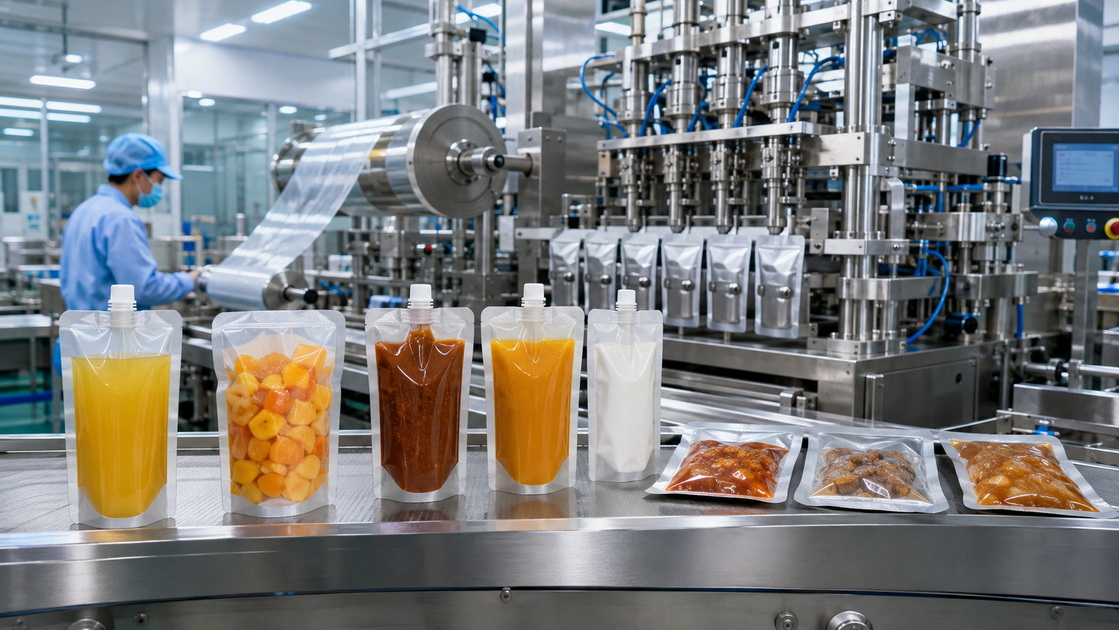
A retort pouch is a flexible, heat-resistant package used for foods that are filled, hermetically sealed, and heat processed in a retort. The objective is to achieve commercial sterility so the product can be stored at ambient temperature for its validated shelf life.
Typical retort pouch applications include:
- Ready-to-eat meals
- Soups, broths, sauces, and curry
- Rice, grains, and vegetable dishes
- Seafood and meat products
- Baby food and purées
- Wet pet food
- Emergency and outdoor meal kits
Unlike ordinary flexible pouches, a retort pouch must tolerate a demanding combination of heat, pressure, moisture, handling stress, and product contact. The pouch material, sealant layer, ink system, adhesive, and final seal must remain functional after the specified thermal process.
For low-acid foods, thermal processing is a critical food-safety control—not a packaging afterthought. In the United States, thermally processed low-acid foods are governed by requirements under 21 CFR Part 113, while the scheduled process must be suitable for the product and final package format.
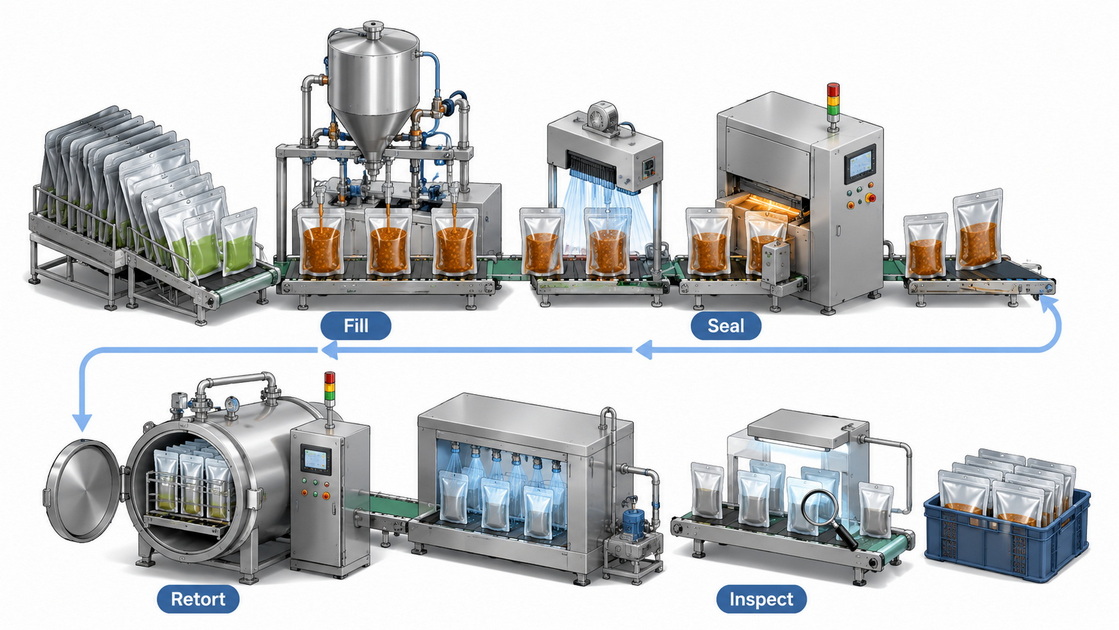
A standard retort pouch packaging line typically follows this sequence:
1. Pouch preparation
Preformed pouches are supplied to the filling and sealing equipment, or rollstock is formed into pouches on a form-fill-seal system.
2. Product filling
The system doses the correct weight or volume of product into each pouch. Viscous sauces, particulate meals, liquids, and protein products may require different filling technologies.
3. Headspace and pouch cleaning
Controlled headspace supports seal quality and retort performance. The seal area must also be kept free of product residue, oil, moisture, or particles.
4. Hermetic sealing
The pouch is heat-sealed under controlled temperature, pressure, and dwell time. This is one of the most important stages in the entire production line.
5. Retort sterilization
Sealed pouches enter a retort, where the validated time-temperature-pressure profile is applied. Commercial sterilization of low-acid foods often operates above 100°C; industry references commonly describe processes around 115–130°C, with the exact profile determined by the food, package, and scheduled process.
6. Cooling, drying, and inspection
Pouches are cooled under controlled conditions, dried, inspected for defects, and prepared for secondary packaging.
7. Final quality release
Manufacturers verify package integrity, process records, coding, appearance, and other defined quality controls before shipment.
One of the biggest advantages of retort pouch packaging is its low package weight. Compared with many glass jars and metal cans, flexible pouches can reduce the packaging mass moved through warehousing and distribution.
For brands and co-packers, that can create practical benefits:
- More efficient storage of empty packaging
- Reduced transport weight per unit
- Lower risk of glass breakage
- Easier handling for consumers
- Potentially improved pallet and truck utilization
The actual cost outcome depends on pouch dimensions, shipping distances, secondary packaging, product density, and automation level. Still, pouch formats often provide a strong logistics case where space and weight matter.
Retort pouches are usually built with multiple layers, each serving a purpose. Depending on the product requirements, a structure may provide barriers against oxygen, moisture, light, aroma loss, or external contamination.
A well-designed structure helps protect:
- Flavor and aroma
- Color and visual appeal
- Product texture
- Nutritional quality
- Shelf-life stability
However, barrier performance is not universal. A sauce with oil, a high-protein meal, and a fruit purée can impose very different requirements. The appropriate laminate must be selected according to the product formula, processing condition, shelf-life target, storage environment, and regulatory market.
Retort processing can enable shelf-stable distribution when the product and process are properly validated. This is valuable for brands selling through supermarkets, e-commerce, export channels, travel retail, institutional foodservice, or emergency-food programs.
For example, a properly validated shelf-stable meal pouch may avoid the expense and operational complexity of a refrigerated supply chain. But shelf life should never be promised based only on pouch type. It must be confirmed through product-specific validation, storage studies, and quality testing.
Research on retort-processed spaceflight foods found that projected quality life varied substantially by product category, ranging from approximately 1 to 8 years in the products evaluated. This illustrates why shelf life is determined by the full food-and-package system rather than a single generic number.
Consumers value packaging that is easy to carry, store, open, heat, and dispose of. Retort pouches can meet these expectations with features such as:
- Tear notches
- Easy-open designs
- Spouts and fitments
- Stand-up gussets
- Microwave-use instructions where appropriate
- Compact, portable pack formats
For products such as camping meals, lunch-ready rice, baby food, or wet pet food, a pouch can be a more convenient format than a rigid container.
Flexible packaging provides a broad printable surface for brand storytelling, preparation instructions, ingredient information, and export-market labeling. Stand-up retort pouches can also create strong shelf visibility, especially in categories dominated by conventional cans.
For growing brands, the right pouch format can balance function, consumer appeal, and operational feasibility.
The most important environmental limitation is that many traditional retort pouch structures use multi-material laminates. Layers may include different polymers, aluminum foil, inks, adhesives, and coatings. These combinations can be difficult to separate and process in conventional recycling systems.
The Association of Plastic Recyclers notes that recyclability depends on the complete package design—not merely the main substrate. Resins, inks, adhesives, barriers, labels, closures, and other components can affect whether a package is compatible with a recycling stream.
This does not mean every retort pouch is inherently unsustainable. It means brands should avoid unsupported "recyclable" claims and evaluate the local collection, sorting, and recycling reality in each target market.
A retort pouch line is not simply a pouch filling machine. It is an integrated process involving filling, sealing, retort treatment, cooling, inspection, and traceability.
Initial investment may include:
- Pouch filling and sealing equipment
- Retort sterilization system
- Conveying and handling equipment
- Seal inspection and leak-testing tools
- Coding and traceability equipment
- Water, steam, compressed air, and utility systems
- Process validation and quality-control resources
For a new product launch, the total project cost can be significant. The strongest business case is usually achieved when production volume, product margin, market potential, and automation requirements justify the capital expenditure.
A retort pouch may look perfectly acceptable and still fail if the seal is contaminated, underheated, over-compressed, wrinkled, or damaged during retorting. Seal failure can lead to leaks, loss of sterility, product waste, and serious quality risk.
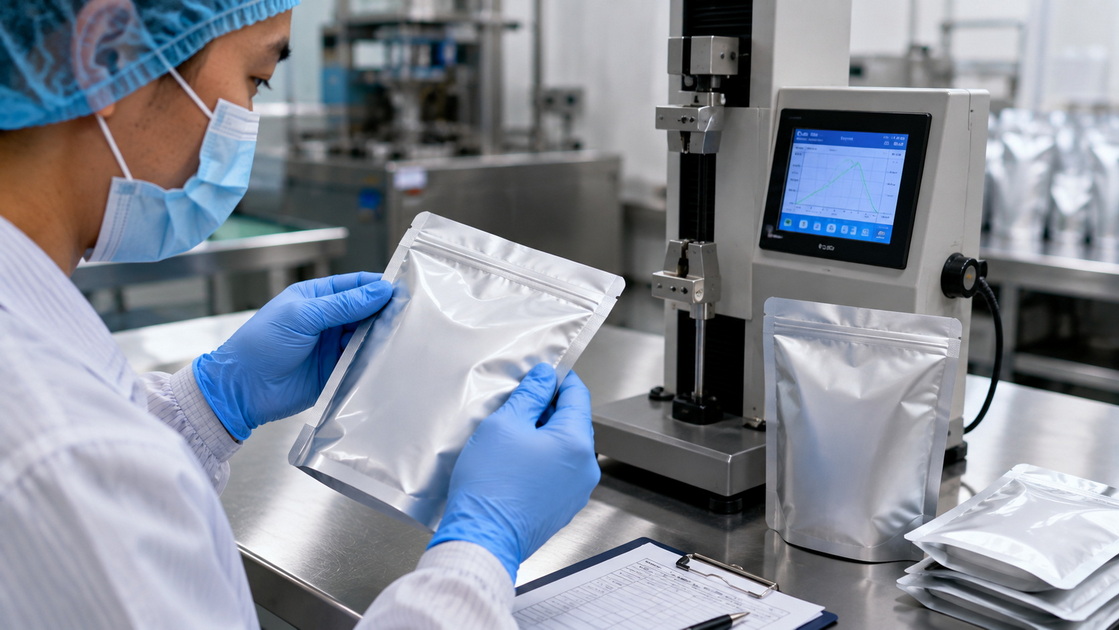
Common causes include:
| Failure point | Typical cause | Prevention focus |
|---|---|---|
| Contaminated seal area | Sauce, oil, particles, or moisture on the seal | Pouch cleaning and filling control |
| Inconsistent sealing | Incorrect temperature, pressure, or dwell time | Recipe management and parameter verification |
| Wrinkles or channels | Poor pouch positioning or excess headspace | Mechanical alignment and process trials |
| Retort-related stress | Incompatible material or pressure imbalance | Package-retort compatibility testing |
| Handling damage | Sharp edges, poor conveying, or drop impact | Gentle transport and secondary-pack design |
Expert insight: Packaging equipment should be selected for repeatability, not only headline speed. A machine that produces stable seals, accommodates product variation, and supports inspection may deliver more value than a faster system that creates high reject rates.
Retort heat treatment is intense. Some foods may experience changes in texture, color, aroma, or nutrient profile. Delicate vegetables, seafood, dairy ingredients, and starch-based formulations can require additional development work.
This is why packaging development should involve more than the equipment supplier. The project team should include product developers, a qualified process authority where required, packaging specialists, and quality personnel.
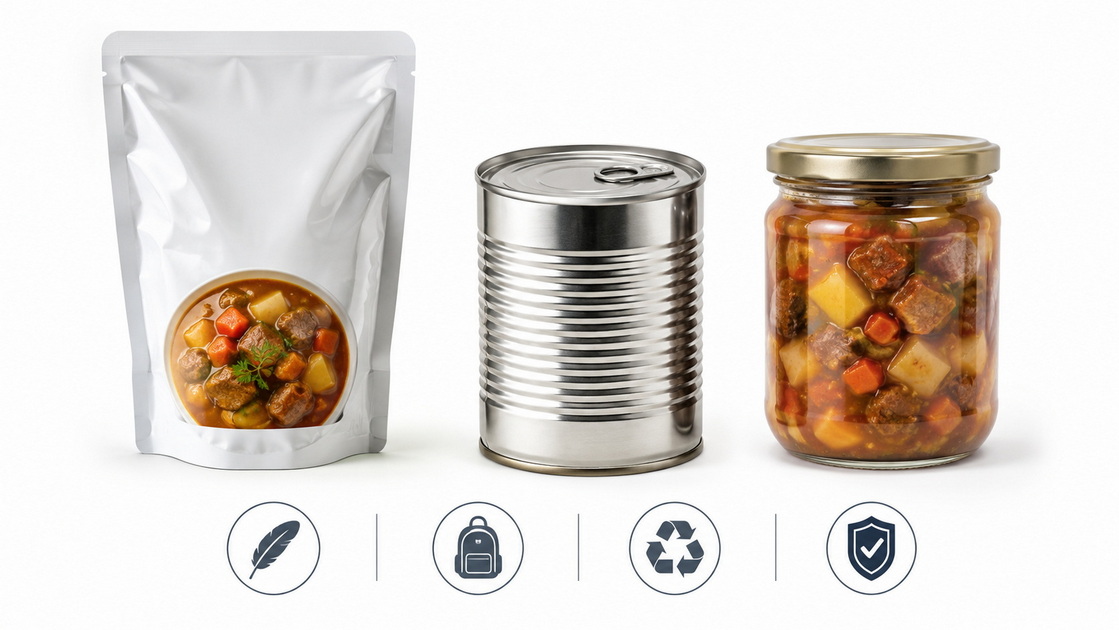
| Factor | Retort pouches | Metal cans | Glass jars |
|---|---|---|---|
| Package weight | Usually low | Moderate | High |
| Breakage risk | Low | Low | Higher |
| Shelf appeal | Highly customizable | Strong but more standardized | Premium visibility |
| Storage efficiency | Often high | Moderate | Moderate |
| Recycling access | Can be limited for multi-layer structures | Often widely recycled | Often widely recycled |
| Filling and processing | Requires specialized pouch handling | Mature, established systems | Mature, established systems |
| Consumer portability | Excellent | Good | Lower |
The best option depends on the product, market, sustainability claims, distribution model, desired shelf image, and production capability. A retort pouch is not automatically better than a can or jar—but it can be the better system for the right application.
Before purchasing packaging machinery or finalizing a pouch specification, evaluate the entire system.
Document the formula, pH, viscosity, particulates, fat content, filling temperature, target net weight, and desired shelf life. These variables influence filling technology, pouch design, retort cycle, and quality testing.
Choose among flat pouches, stand-up pouches, spouted pouches, shaped pouches, or multi-compartment designs. Consider consumer use, product flow, filling method, secondary packaging, and retail presentation.
Confirm that the laminate, ink, adhesive, and sealant system can withstand the proposed retort conditions. Do not rely solely on supplier claims—conduct real product trials.
The equipment must match the product. Liquid soup, chunky curry, viscous sauce, and pet-food pâté each need different filling accuracy, anti-drip controls, pouch handling, and seal-area management.
A robust line should include practical controls for:
- Fill weight verification
- Seal parameter monitoring
- Vision or code inspection
- Leak and burst testing
- Retort record management
- Batch traceability
- Reject handling
Test final product in the final pouch using the intended line settings and retort process. For regulated low-acid or acidified foods, work with the appropriate process authority and regulatory requirements before commercial release. New Mexico State University's process-review guidance similarly emphasizes testing the product in final packaging, collecting process information, and obtaining expert review.
Retort pouch packaging can create a compelling combination of shelf stability, consumer convenience, transport efficiency, and brand differentiation. Its success, however, depends on process control from filling through final inspection.
HLun Pack provides packaging machinery and integrated packaging solutions for flexible packaging applications. Whether you are developing a new ready-meal pouch, upgrading a pet-food line, or evaluating automation for a shelf-stable product, our team can help assess pouch handling, filling, sealing, inspection, and line integration requirements.
Contact HLun Pack to discuss your product, target output, pouch format, and retort packaging equipment requirements. We will help you build a more reliable, scalable packaging solution.
Retort pouch packaging is used for foods and pet foods that need heat sterilization and ambient shelf stability. Common products include ready meals, soups, sauces, rice dishes, seafood, baby food, and wet pet food.
They can be safe when the pouch materials are suitable for food contact, the package is properly sealed, and the food is processed using a validated thermal process. Food safety depends on the total system, including formulation, filling, sealing, retort conditions, and quality controls.
Shelf life varies by food formulation, package structure, thermal process, storage conditions, and quality target. It should be validated for each specific product instead of using a generic shelf-life claim.
Many conventional retort pouches are difficult to recycle because they contain multiple bonded materials. Brands should evaluate the complete pouch structure and the recycling infrastructure in each intended market before making recycling claims.
A typical system includes pouch handling, filling, sealing, retort sterilization, cooling, inspection, coding, conveying, and secondary packaging equipment. The configuration depends on the product characteristics, pouch format, capacity target, and automation level.
In some applications, yes. Retort pouches can offer lower package weight, strong consumer convenience, and high printability. However, cans may remain preferable where recycling access, established filling infrastructure, or product protection requirements favor rigid metal packaging.
1. U.S. Food and Drug Administration. [CP 7303.070: Acidified and Low-Acid Canned Foods Program].
2. North Carolina State University. [Low-Acid Canned Foods: 21 CFR Part 113].
3. PMC. [Understanding Retort Processing: A Review].
4. PubMed. [Assessment of the Long-Term Stability of Retort Pouch Foods].
5. New Mexico State University Extension. [How to Submit a Commercial Food Product for Process Review].
6. Association of Plastic Recyclers. [APR Design Guide Overview].
7. YLT Packing. [The Advantages and Disadvantages of Retort Pouch Packaging]. [yltpacking]


