


close
Choose Your Site
Global
Social Media
Views: 266 Author: HLun PACK Publish Time: 2026-11-25 Origin: Site


Content Menu
● What Does a Granular Packaging Production Line Include?
● Start With Product Behavior Before Selecting Equipment
>> Evaluate Flow, Density, and Particle Variation
>> Protect Fragile and Mixed Products
● How to Choose Granular Packaging Equipment
>> Multihead Weighers for Combination Weighing
>> Linear Weighers for Suitable Production Requirements
>> Volumetric Systems for Stable Products
● Vertical Form Fill Seal or Premade Pouch Packaging?
>> When Vertical Form Fill Seal Makes Sense
>> When Premade Pouches Deserve Consideration
● Packaging Materials and Sealing Must Work Together
>> Validate the Complete Seal Window
>> Match Barrier Properties to Product Needs
● Measure Saleable Output, Not Just Maximum Speed
>> A Practical Capacity Calculation
● Design Hygiene and Maintenance Into the Line
>> Match Cleaning Methods to the Production Environment
● Use a Structured Trial and Acceptance Plan
● Compare Total Cost Before Choosing a Supplier
● Plan Your Granular Packaging Line With HLun Pack
>> What Products Can Granular Packaging Equipment Handle?
>> Can One Packaging Line Handle Different Products?
>> How Accurate Is an Automatic Granule Packing Machine?
>> Is a Checkweigher Still Useful After Automatic Weighing?
>> How Can We Reduce Product in the Seal Area?
>> What Information Is Needed for a Meaningful Quotation?
Effective packaging production line solutions start with the product, not the machine catalogue. For rice, nuts, coffee beans, seeds, snacks, and other granular products, reliable packaging depends on coordinating feeding, weighing, bag handling, sealing, inspection, and downstream packing.
At HLun Pack, our approach connects packaging machinery with the packaging materials and operating requirements around it. We believe buyers should evaluate a complete process rather than purchase individual machines and hope they work together.
This guide explains how to select granular packaging equipment, compare line configurations, evaluate operating costs, and establish practical acceptance criteria before investing.
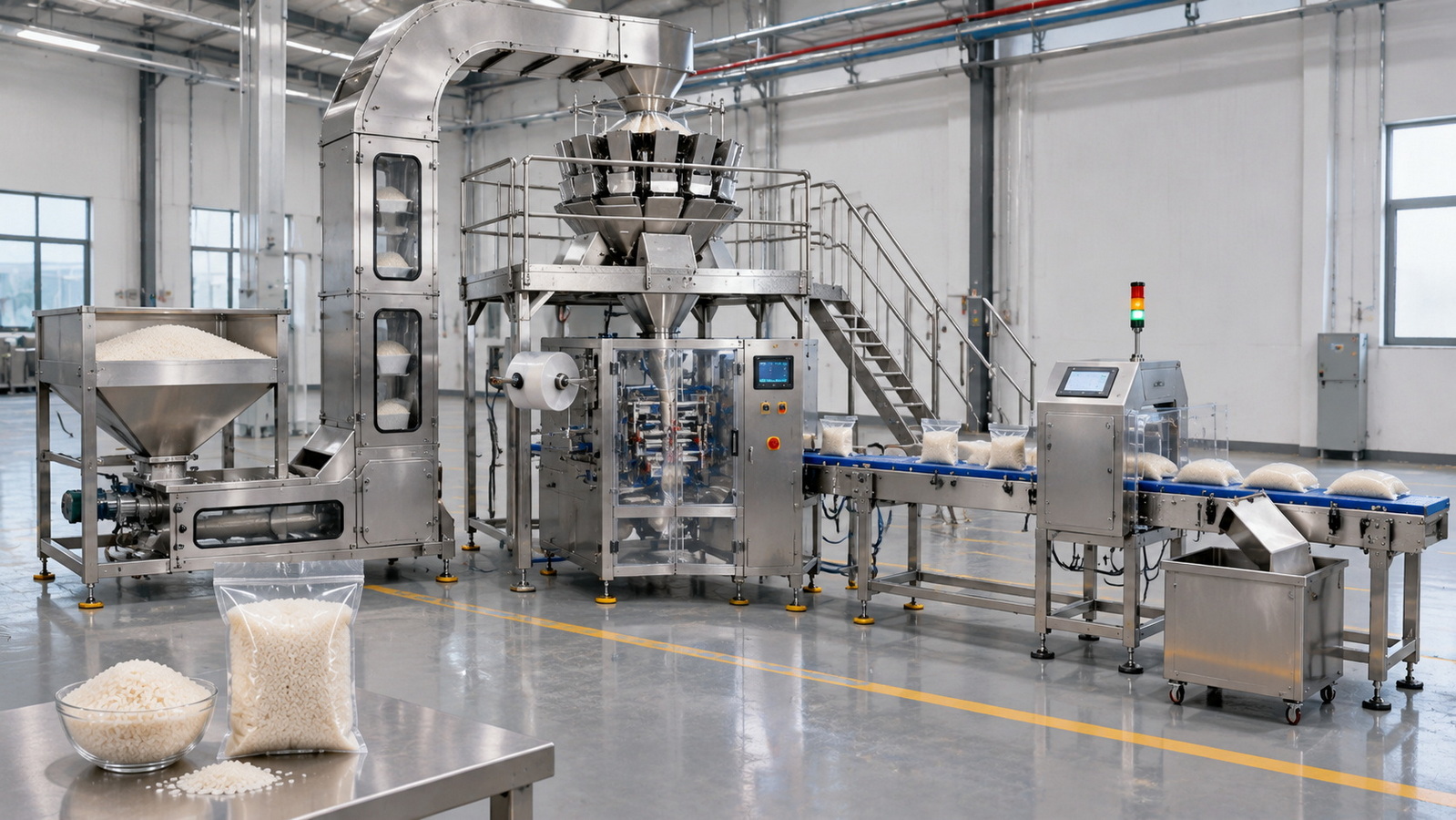
A granular packaging production line combines equipment that moves loose product into measured, sealed, and identifiable packages. Depending on the application, it may also inspect finished packs and prepare them for shipping.
A typical process follows this sequence:
Product feeding → controlled conveying → weighing → bag forming or pouch opening → filling → sealing → inspection → case packing.
Not every project requires every module. The objective is to build the simplest configuration that consistently meets the product specification and production schedule.
| Production stage | Typical equipment | Main selection question |
|---|---|---|
| Product feeding | Hopper and feeder | Does product flow consistently without bridging? |
| Conveying | Elevator or conveyor | Can it transfer product without unacceptable damage? |
| Portioning | Multihead, linear, or volumetric system | What accuracy and speed does the application require? |
| Primary packaging | Vertical bagger or premade pouch machine | Which package format suits the product and market? |
| Inspection | Checkweigher and suitable inspection equipment | Which defects must be detected and rejected? |
| Secondary packaging | Case packing and pallet handling | Can downstream operations absorb the finished output? |
"Granular" describes a broad product category, not a uniform processing behavior.
Dry rice may flow readily. Oily nuts can leave residues. Irregular snacks can bridge at transfer points. Mixed products may separate during handling.
Before requesting a quotation, document:
- Particle size and shape.
- Bulk density and expected variation.
- Surface oil, stickiness, and dust generation.
- Moisture sensitivity.
- Breakage susceptibility.
- Ingredient proportions in mixed products.
- Minimum and maximum fill weights.
These characteristics influence hopper geometry, feeder settings, contact surfaces, and the available weighing options.
For delicate products, transfer design deserves as much attention as weighing accuracy. Long drops, abrupt direction changes, and excessive vibration can increase breakage.
Trials should compare product condition before and after the complete handling route—not merely after discharge from the weigher.
Mixed products need another check: does each finished pack contain an acceptable ingredient distribution? Accurate total weight alone does not demonstrate a consistent blend.
A multihead weigher combines portions from multiple weighing hoppers to approach a target weight. It is a common option when buyers need a balance of speed and weight control.
However, standard equipment is not automatically suitable for every product. Fragile, sticky, elongated, or mixed products may require application-specific feeding and discharge arrangements.
Ask for trials using your actual product, especially when particle shape or surface condition varies between batches.
A linear weighing system feeds product into one or more weighing channels until the target portion is reached.
It can be worth evaluating for applications where production requirements, product behavior, and investment priorities support this configuration.
Compare demonstrated performance rather than assuming that more weighing heads always produce a better commercial result.
Volumetric fillers measure a defined volume rather than weighing every portion.
They may suit free-flowing products with sufficiently stable bulk density. However, the same volume can produce different weights when density changes.
If the product settles, absorbs moisture, or varies substantially between batches, evaluate whether the resulting weight variation is acceptable before selecting this method.
Packaging format affects machinery selection, material purchasing, changeovers, and shelf presentation.
| Consideration | Vertical form fill seal | Premade pouch packaging |
|---|---|---|
| Starting material | Rollstock film | Individually manufactured pouches |
| Packaging process | Forms, fills, and seals bags | Opens, fills, and seals existing pouches |
| Common formats | Pillow and selected gusseted bags | Stand-up and other compatible pouch formats |
| Key setup variables | Film tracking, forming, sealing, and product timing | Pouch feeding, opening, gripping, and sealing |
| Important trial question | Can the film run consistently at the required conditions? | Can the machine reliably handle the specified pouch? |
A vertical form fill seal machine is worth considering when your product and preferred bag format suit rollstock-based production.
Evaluate forming components, film tracking, registration control, seal consistency, and the time needed to change bag sizes.
The most useful comparison is not simply film price versus pouch price. Include material waste, setup labor, and production interruptions.
Premade pouch filling equipment can suit brands prioritizing particular pouch shapes, resealable features, or retail presentation.
Compatibility still needs testing. Pouch stiffness, zipper placement, dimensional consistency, and opening behavior can affect operation.
A visually attractive pouch is commercially useful only if the line can fill and seal it reliably.
Film selection and machine settings should be developed together.
Sealing temperature, pressure, and dwell time interact with the sealant layer, film thickness, and operating speed. Product particles caught in the sealing area can also compromise package integrity.
A practical trial should examine:
1. Seal appearance across the full sealing width.
2. Seal strength and suitable integrity-test results.
3. Wrinkles, trapped particles, and distorted areas.
4. Performance after normal handling and distribution simulation.
5. Consistency after stops, restarts, and speed changes.
Appearance alone is not sufficient evidence of a reliable seal.
Coffee beans, nuts, rice, and fertilizer do not share the same protection requirements.
Evaluate moisture, oxygen, light, and odor protection according to the product and intended distribution conditions.
Where gas flushing is proposed, define a measurable acceptance target and verify it during trials. Adding a gas connection does not, by itself, establish shelf life.
Shelf-life claims require evidence from the finished product and package.
The fastest machine in a quotation does not determine the output of the whole line.
A weigher may deliver portions faster than the bagger can seal them. Finished bags may accumulate because case packing is too slow. Frequent cleaning or format changes may reduce available production time.
Use the following planning relationship:
Saleable output = operating rate × scheduled time × operating-time proportion × acceptable-pack proportion.
Consider an illustrative line running at 40 packs per minute during an eight-hour shift:
- Scheduled capacity: 19,200 packs.
- Operating-time proportion: 75%.
- Acceptable-pack proportion: 98%.
- Estimated saleable output: approximately 14,112 packs.
These are hypothetical planning assumptions, not HLun Pack performance guarantees.
The example demonstrates why a lower headline speed with fewer interruptions can outperform a faster but unstable configuration.
Overfilling also deserves attention.
For illustration, an average excess fill of 2 grams across 20,000 packs equals 40 kilograms of product per day. At a product cost of $4 per kilogram, that represents $160 daily before considering other losses.
These assumed figures show the calculation method, not an expected saving.
Review the full fill-weight distribution, including underweight rejects. Reducing average fill is not an improvement if it creates unacceptable packages or breaches applicable quantity requirements.
Dry food packaging requires a cleaning strategy suited to the product and facility.
For low-moisture food operations, introducing water without adequate controls can create additional contamination risks. Equipment should support the required cleaning method, and wet-cleaned food-contact surfaces must be appropriately sanitized when necessary and thoroughly dried before reuse.
During equipment evaluation, inspect:
- Access beneath hoppers and conveyors.
- Removal of product-contact components.
- Residue traps and difficult corners.
- Inspection access after cleaning.
- Protection of electrical components.
- Procedures for allergen changeovers.
Stainless steel construction alone does not establish hygienic suitability.
Ask operators and maintenance staff to review the proposed layout.
Can they reach wearing parts? Is there enough space to remove a sealing assembly? Can sensors be inspected without unnecessary dismantling?
Request maintenance schedules, recommended spares, electrical drawings, and backup procedures for machine settings.
An accessible machine is easier to inspect and restore to service.
A factory acceptance test should demonstrate agreed performance under documented conditions. A short video of a machine running a convenient sample is not an adequate substitute.
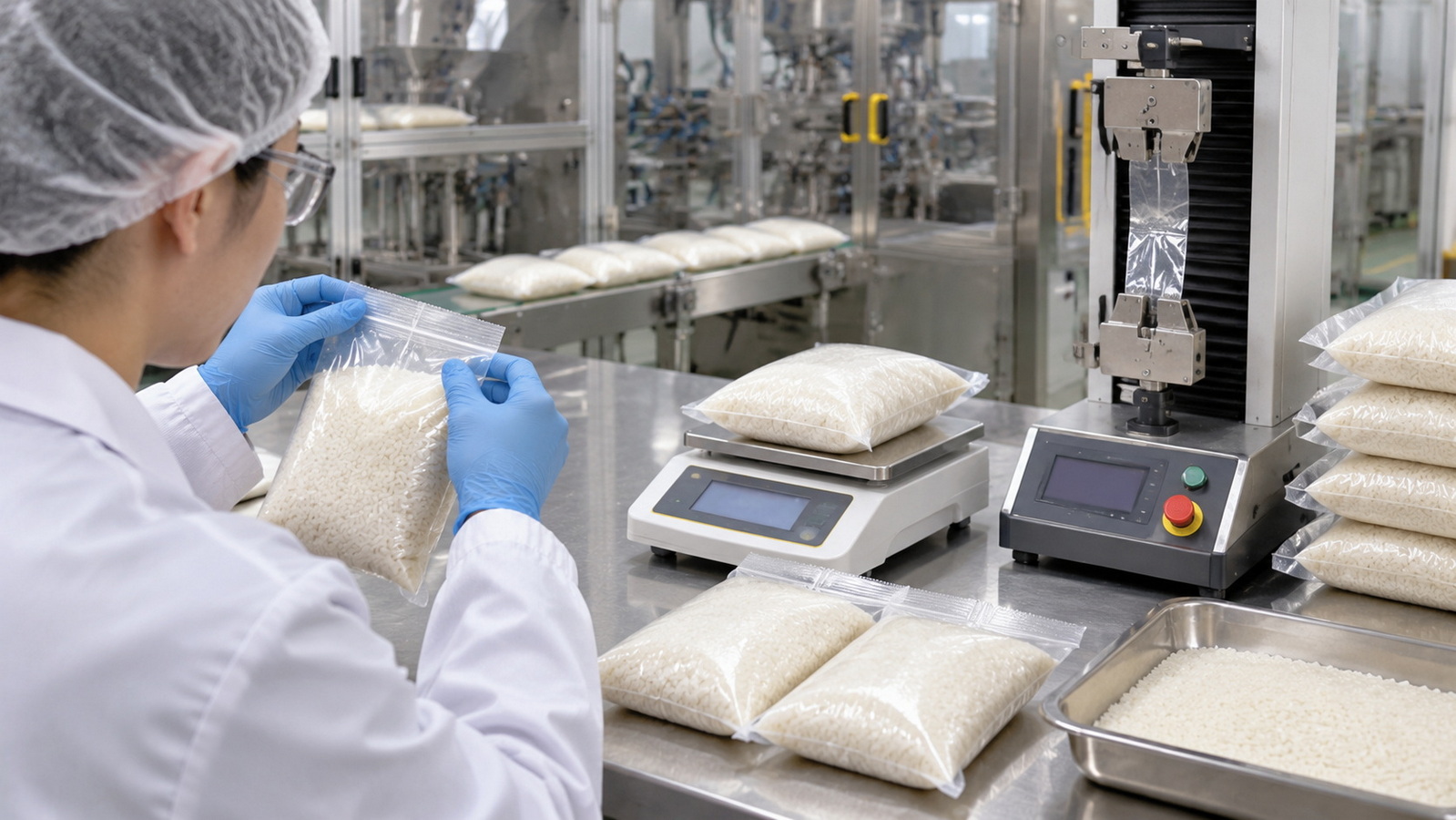
1. Supply representative samples. Include normal variation in particle size, density, and surface condition.
2. Use production-intent packaging. Match the intended film structure or pouch specification.
3. Test challenging combinations. Include small fills, large fills, and difficult package sizes.
4. Run long enough to expose instability. Observe replenishment, interruptions, restarts, and reject handling.
5. Record measurable results. Capture sustained speed, weight variation, rejects, breakage, and seal quality.
6. Verify changeovers and cleaning. Observe the actual procedure, tools, labor, and time required.
Agree acceptance limits before testing. Record the product, packaging, settings, utilities, and environmental conditions associated with each result.
Repeat relevant checks after installation because site conditions and upstream feeding can differ from the factory setup.
The purchase price is only one part of ownership cost.
Compare proposals using the same assumptions for:
- Product and packaging materials.
- Required saleable output.
- Shift patterns and changeover frequency.
- Labor responsibilities.
- Installation and commissioning scope.
- Utilities and site modifications.
- Consumables, maintenance, and spare parts.
- Training, documentation, and support.
Be cautious when an attractive quotation excludes conveyors, inspection equipment, platforms, or integration work required for operation.
Also clarify who coordinates the complete line. When several suppliers are involved, responsibility for controls, timing, guarding, and acceptance testing should be explicit.
At HLun Pack, we approach packaging production line solutions as a connected machinery-and-materials project.
To begin a useful technical discussion, send your product details, representative samples, target fill weights, preferred package format, required saleable output, destination market, and available floor plan.
Include existing equipment interfaces and known production problems where applicable.
Contact HLun Pack to discuss a granular packaging configuration and an appropriate sample-testing plan. Establishing the requirements first provides a clearer basis for equipment selection, quotation comparison, and future acceptance testing.
Potential applications include rice, nuts, seeds, coffee beans, snacks, pet food, and selected nonfood granules. Suitability depends on flow behavior, particle size, fragility, dust, and required packaging conditions. Confirm compatibility through representative trials.
Sometimes, but flexibility has limits. Similar products may share equipment with adjusted settings or change parts. Major differences in stickiness, fragility, allergens, or package dimensions can require additional components or a different configuration.
Accuracy depends on the dosing method, product behavior, target weight, feeding consistency, and operating conditions. Request measured trial results, including weight distribution and reject rates, rather than relying on an unsupported universal accuracy claim.
Yes. It provides an additional finished-pack weight check and can support rejection and production monitoring. Its role differs from upstream dosing. Define suitable limits and verify the reject mechanism during commissioning.
Review discharge timing, product fall behavior, filling-tube geometry, settling time, and bag length. Dust extraction or other application-specific measures may help, but the solution should be validated without compromising filling consistency.
Provide product samples, fill-weight ranges, package drawings, packaging specifications, output requirements, utilities, layout constraints, and inspection needs. State cleaning and changeover expectations so proposals can be compared on an equivalent basis.
1. [Yundu — "Packaging Production Line Solutions"]
Original page supplied for restructuring. Used to assess its existing equipment categories, integration themes, service positioning, and FAQ coverage. Its brand-specific certifications, specifications, and commercial claims have not been transferred to HLun Pack. [yundufillingmachine]
2. [Ishida — "Special Applications"]
Manufacturer technical information describing specialized weighing arrangements for fragile products, dry pasta, mixed products, and granular applications. Supports the distinction between standard and application-specific weighing systems. [ishida]
3. [Ishida — "FF-Series: Automatic Weighing Solutions for Fresh Foods"]
Technical brochure illustrating how product characteristics influence feeder, hopper, discharge, cleaning, and changeover design. Published performance figures are application-dependent and have not been presented as HLun Pack capabilities. [ishida]
January 2025 draft guidance; the listed page records reopening of the comment period in May 2025. Used for sanitation context. This document contains nonbinding recommendations and is identified as draft guidance, not a new mandatory certification requirement. [fda]
5. [U.S. Food and Drug Administration — Draft Guidance Full Text]
Detailed discussion of dry-environment equipment design, dry cleaning, controlled wet cleaning, and sanitation considerations for low-moisture ready-to-eat foods. [fda]
Regulatory text addressing food-contact surface sanitation, including clean, dry, sanitary conditions for low-moisture food operations and appropriate drying after wet cleaning. [fda]
7. [Ishida — "Seal Testers and Leak Detection"]
Technical overview supporting the distinction between visual appearance, package-integrity inspection, checkweighing, and other quality-control functions. Specific inspection suitability requires application testing. [ishida]


