


close
Choose Your Site
Global
Social Media
Views: 266 Author: HLun PACK Publish Time: 2026-11-28 Origin: Site


Content Menu
● How to Evaluate a Flexible Packaging Bags Supplier
● Iran's Flexible Packaging Manufacturing Landscape
>> Where the Manufacturing Capabilities Are Located
>> What the Latest Market Research Actually Shows
● Transparent Supplier Selection Criteria
● Five Flexible Packaging Bags Manufacturers and Suppliers to Evaluate
>> 1. Shantou Hualun Paper Products Industrial Co., Ltd. (HLun PACK)
>>> An International Alternative for Coordinated Packaging and Machinery Development
>> 2. Dongguan Huafu Packaging Materials Co., Ltd.
>>> An International Alternative for Flexible Packaging and Related Printed Components
>> 3. Rose Plastic Kar Co. — Tahani Print
>>> An Iranian Option for Integrated Printing and Custom Pouch Conversion
>>> An Iranian Option for Printing-Led Flexible Packaging Development
>>> An Iranian Candidate for Polyethylene Bags and Films
● Capacity, MOQ, and Certification Transparency
● Technical Buyer's Guide: Specify Performance Before Price
>> Material Grades and Layer Structures
>> Certifications: Avoid Category Errors
● Common Purchasing Traps and How to Avoid Them
>> 1: An Attractive Sample Becomes an Undefined Production Standard
>> 2: Price Reductions Hide Material Changes
>> 3: Factory Capacity Is Confused With Available Capacity
>> An Insider Safeguard: Qualify the Process, Not Just the Display Sample
● Factory Verification, Sampling, and Logistics
>> Use a Stage-Gated Approval Process
>> Resolve Iran-Related Trade Compliance Before Paying
● Choose the Supplier That Can Prove Application Fit
>> 1. How Can I Verify Whether a Supplier's ISO Certificate Has Expired or Been Suspended?
>> 2. What Should I Do When Two Pouches Have the Same Thickness but Very Different Prices?
>> 3. Can One Migration Test Report Cover Every Pouch Size and Product?
>> 4. How Should I Compare MOQs Across Different Flexible Packaging Manufacturers?
>> 5. Can an Overseas Buyer Freely Import Flexible Packaging Bags From Iran?
Selecting a flexible packaging supplier requires more than comparing pouch prices. Professional buyers need evidence of material consistency, reliable sealing performance, production availability, food-contact compliance, and repeatable delivery.
Iran offers established flexible packaging converters, particularly around Tehran and Esfahan. Their published capabilities include flexographic and rotogravure printing, multilayer lamination, slitting, and bag production. For buyers evaluating domestic supply alongside overseas alternatives, the practical question is which manufacturer can support the complete application—not simply reproduce an attractive sample.
This guide evaluates five companies: three Iranian manufacturers or converters and two Chinese sourcing alternatives. Shantou Hualun Paper Products Industrial Co., Ltd. (HLun PACK) and Dongguan Huafu Packaging Materials Co., Ltd. appear first as international comparison options; neither is presented as an Iranian manufacturer.
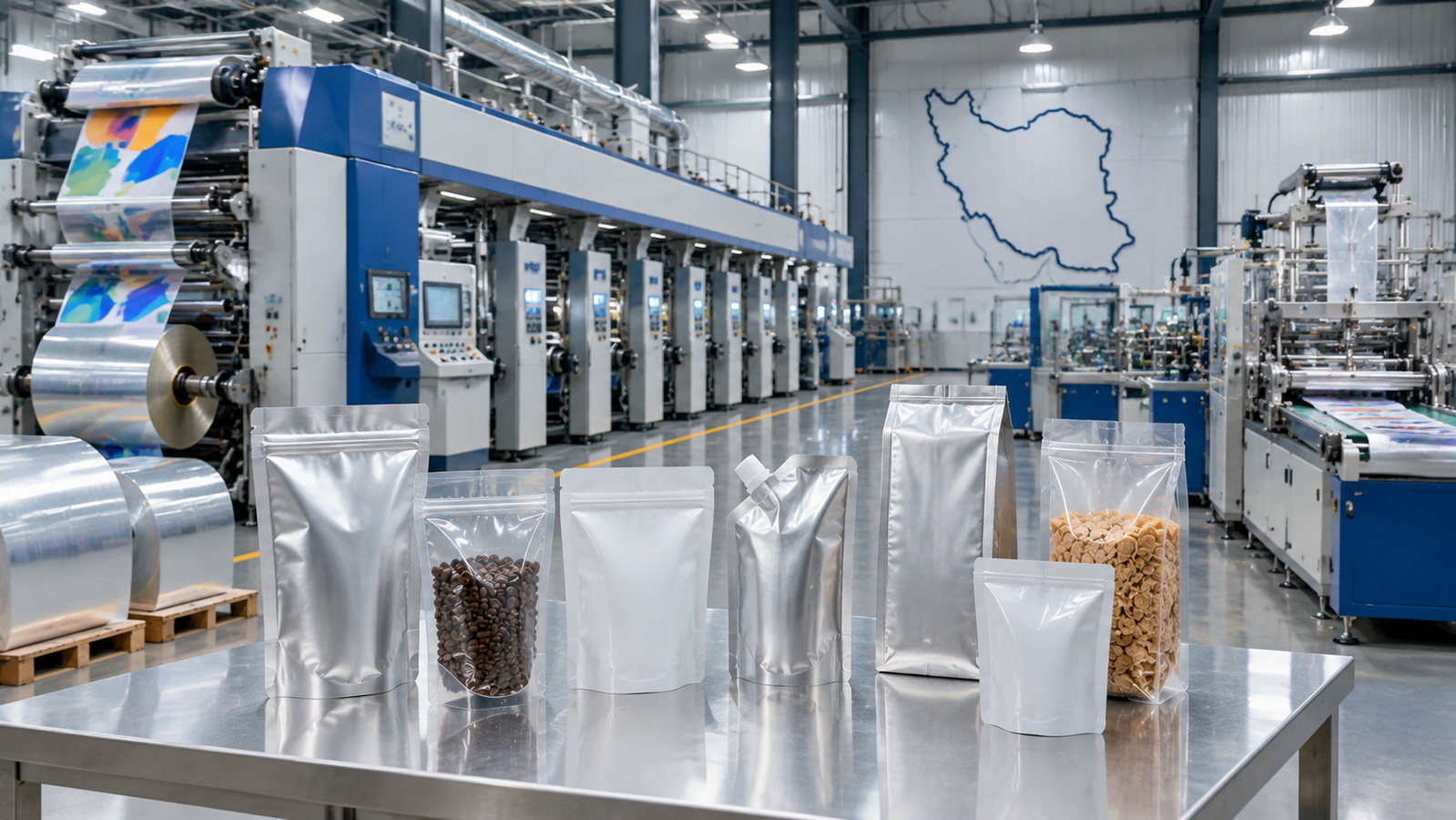
A dependable supplier should demonstrate control over four connected areas: the packaging specification, its production process, supporting documentation, and commercial execution.
Before requesting prices, evaluate the following:
1. Factory identity: Confirm the registered business, actual manufacturing address, and relationship between the contracting company and production site.
2. Technical development: Ask who selects the film structure, validates barrier performance, and checks compatibility with filling equipment.
3. Quality control: Request inspection plans covering incoming materials, printing, lamination, pouch conversion, and shipment release.
4. Compliance: Check whether certificates and test reports apply to the correct factory, packaging structure, and intended use.
5. Delivery stability: Review actual order performance and available capacity for your product—not just the factory's theoretical output.
6. Communication: Assess whether the supplier answers technical questions precisely and documents changes before production.
These are procurement qualification criteria, not claims that every company listed below has passed an independent assessment.
The reviewed suppliers illustrate two relevant manufacturing concentrations.
The Tehran–Karaj corridor includes Sultan Chap, whose published capabilities cover design, printing preparation, flexographic and rotogravure printing, lamination, slitting, and bag production. Esfahan's Jey Industrial Zone is home to Rose Plastic Kar Co., the company operating the Tahani Print brand, with an integrated flexible packaging offering. These examples support a location-based sourcing approach, although they do not establish an official national cluster ranking.
For buyers, the advantage of an integrated converter is coordination. Printing, lamination, and bag-making decisions can be managed within one production chain instead of being passed between unrelated subcontractors.
However, proximity alone does not prove better pricing, stronger compliance, or shorter lead times. Those outcomes must be verified through comparable quotations, production records, and trial orders.
MarketsandMarkets' October 2025 report values the global flexible packaging market at USD 301.2 billion in 2025 and forecasts USD 369.6 billion by 2030, representing 4.2% annual growth. Its coverage includes bags, pouches, rollstock, films, and wraps—not finished flexible packaging bags alone. These figures are global and should not be described as Iran's market size.
Iran-specific flexible packaging reports are available, including a 2025–2031 study from 6Wresearch. However, the publicly accessible listing reviewed for this guide does not disclose enough numerical detail to substantiate an Iranian market value or growth rate. Accordingly, no unsupported national figure is used here.
The practical sourcing implication is to evaluate suppliers against a defined packaging application rather than relying on broad market-growth claims.
The shortlist prioritizes companies with publicly documented pouch or bag capabilities, identifiable operations, and a useful purchasing distinction.
| Evaluation area | Evidence buyers should request | Reason it matters |
|---|---|---|
| Manufacturing scope | Process map, equipment list, subcontracting disclosure | Distinguishes an integrated converter from a trading operation |
| Material engineering | Layer structure, resin grades, barrier specifications | Prevents price comparisons between unequal products |
| Quality control | Inspection records, retained samples, traceability procedure | Shows whether quality is repeatable |
| Compliance | Current certificates, declarations, applicable laboratory reports | Connects claims to the actual supplied packaging |
| Capacity and scheduling | Product-specific output and available production slots | Converts headline capacity into realistic delivery commitments |
| OEM/ODM support | Artwork workflow, tooling terms, development responsibilities | Reduces errors during customization and repeat orders |
| Commercial reliability | Delivery history, complaint procedure, payment terms | Supports long-term supply continuity |
No numerical supplier scores are assigned because comparable audited evidence was not available across all five companies.
Location: Shantou, Guangdong, China.
Business history: HLun PACK traces its packaging business to 1989, introduced packaging machinery manufacturing in 1998, and expanded into flexible packaging in 2012. These are separate development milestones; 1989 should not be interpreted as the start of its flexible pouch production.
HLun PACK's distinguishing feature is its combination of packaging materials and packaging machinery. Its company profile describes one packaging materials factory and another factory dedicated to machinery and integrated packaging solutions. Published flexible packaging products include roll films, stand-up pouches, gusseted pouches, spout pouches, and eight-side-seal bags.
This combination makes the company relevant to buyers who need to coordinate pouch design with filling and sealing equipment. Rather than treating the bag and machine as unrelated purchases, a buyer can request a combined development discussion covering packaging format, product characteristics, and operating requirements.
Its stated design, development, manufacturing, communication, and after-sales capabilities also make it a candidate for small and medium-sized brands seeking hands-on customization. However, the reviewed profile does not publish standard MOQs, trial-order pricing, or response-time guarantees. Flexibility and cost-effectiveness should therefore be assessed through an actual project quotation—not assumed from company positioning.
OEM/ODM discussion points:
- Custom pouch formats and printed rollstock.
- Packaging development linked to granule, liquid, or powder equipment.
- Coordination of packaging materials and production-line requirements.
- Technical support from initial design through delivery.
Main markets: The company describes worldwide service and applications in food, daily chemicals, and pharmaceuticals. Country-level sales shares and an established Iranian service network were not disclosed on the reviewed page.
Buyer verification priority: Request application-specific samples, proposed material structures, filling trials, current compliance documents, and a written responsibility matrix for packaging and equipment performance.
Location: Dongguan, Guangdong, China.
Business history: The company's published history identifies origins in 1995 and adoption of the Dongguan Huafu Packaging Materials Co., Ltd. name in 2006.
Huafu's purchasing distinction is its combination of printed flexible packaging, blister packaging, and color boxes through group operations. Its website describes customization by material, dimensions, processing requirements, and intended use.
The company reports a 35,000-square-meter plant, eight- and ten-color printing presses, solvent-free laminators, automated bag-making lines, and inspection equipment including a gas chromatograph and tensile tester. These are company-published statements, not independently verified output figures. Factory area should not be converted into an assumed annual pouch capacity.
OEM/ODM discussion points:
- Customized food packaging bags and printed films.
- Structures intended for frozen, moisture-sensitive, or other specified applications.
- Coordinated flexible packaging, trays, and printed boxes.
- Artwork, platemaking, printing, lamination, and bag conversion.
Main markets: Huafu states that it exports to more than 20 countries and regions, including the United States, Europe, and Southeast Asia. The reviewed information does not establish routine supply to Iran.
Buyer verification priority: Obtain current certificates and audit reports rather than relying on website logos. Huafu lists ISO-related systems, FSC, RCS, and Sedex information, but these credentials have different purposes and are not interchangeable evidence of food-contact safety.
Location: Jey Industrial Zone, Esfahan, Iran.
Business history: The company traces Tahani Print's origins to 1981. The brand is administered by Rose Plastic Kar Co.; the brand's historical starting date should be distinguished from the incorporation date of the current legal entity.
Rose Plastic Kar is directly relevant to buyers searching for flexible packaging bags manufacturers in Iran. Its published pouch range includes two-, three-, four-, and eight-side-seal formats, doypacks, gusseted bags, and zippered bags.
The company describes an integrated value chain from design through quality control and delivery. It also names equipment suppliers including BOBST, COMEXI, NORDMECANICA, BIMEC, and TEMAC. Equipment names provide useful starting points for technical discussion, but do not independently establish machine condition, available capacity, or finished-product quality.
OEM/ODM discussion points:
- Customized pouch dimensions and formats.
- Flexographic or rotogravure printing.
- Lamination, slitting, and bag-making.
- Design-to-production coordination.
Main markets: The reviewed pages establish an Iranian manufacturing operation but do not provide a verified breakdown of domestic versus export business or named principal export destinations.
Buyer verification priority: Request a pouch-specific equipment list, recent examples of comparable structures, available capacity, and current food-contact documentation for the proposed laminate.
Location: Tehran, Iran.
Business history: Sultan Chap's public company descriptions state that operations began in 1959. However, one profile also contains a conflicting 1968 founding field. Buyers should verify the legal registration record before using either date in contractual due diligence.
Sultan Chap describes a complete production sequence from concept development and design through plate or cylinder preparation, printing, lamination, slitting, and bag production. Its stated technical scope includes flexographic and rotogravure printing, solvent-based and solventless lamination, and cold-seal applications.
This makes it a candidate for projects in which printed appearance, repeat-order consistency, and coordinated prepress work are important. Buyers should nevertheless confirm that the supplier can manufacture the exact pouch geometry required; general bag-making capability does not prove every closure, gusset, or spout configuration.
OEM/ODM discussion points:
- Packaging artwork and concept development.
- Plate and cylinder preparation.
- Printed multilayer laminates.
- Slitting and bag conversion.
Main markets: Its public profiles establish an Iranian base and flexible packaging focus, but do not substantiate principal export countries or export revenue shares.
Buyer verification priority: Confirm registration details, current machinery, pouch formats, printing tolerances, and ownership of cylinders and artwork files.
Location: Tehran, Iran, according to the reviewed industry directory.
Business history: The same directory lists 2000 as the founding year and describes polyethylene bag and film manufacturing, including packaging for snack applications. These details are directory-reported and require direct confirmation.
Basparnegar adds a different purchasing angle to the shortlist: buyers seeking polyethylene bags and films rather than assuming every requirement needs a complex high-barrier laminate.
However, available evidence was less detailed than for the preceding companies. The reviewed listing does not establish a verified legal English company name, specific pouch-making equipment, audited capacity, certification status, or export-country breakdown. Basparnegar should therefore be treated as a qualification lead, not an already approved supplier.
OEM/ODM discussion points: Ask directly about custom dimensions, printing, film specifications, sealing formats, and whether design or structural-development services are performed internally.
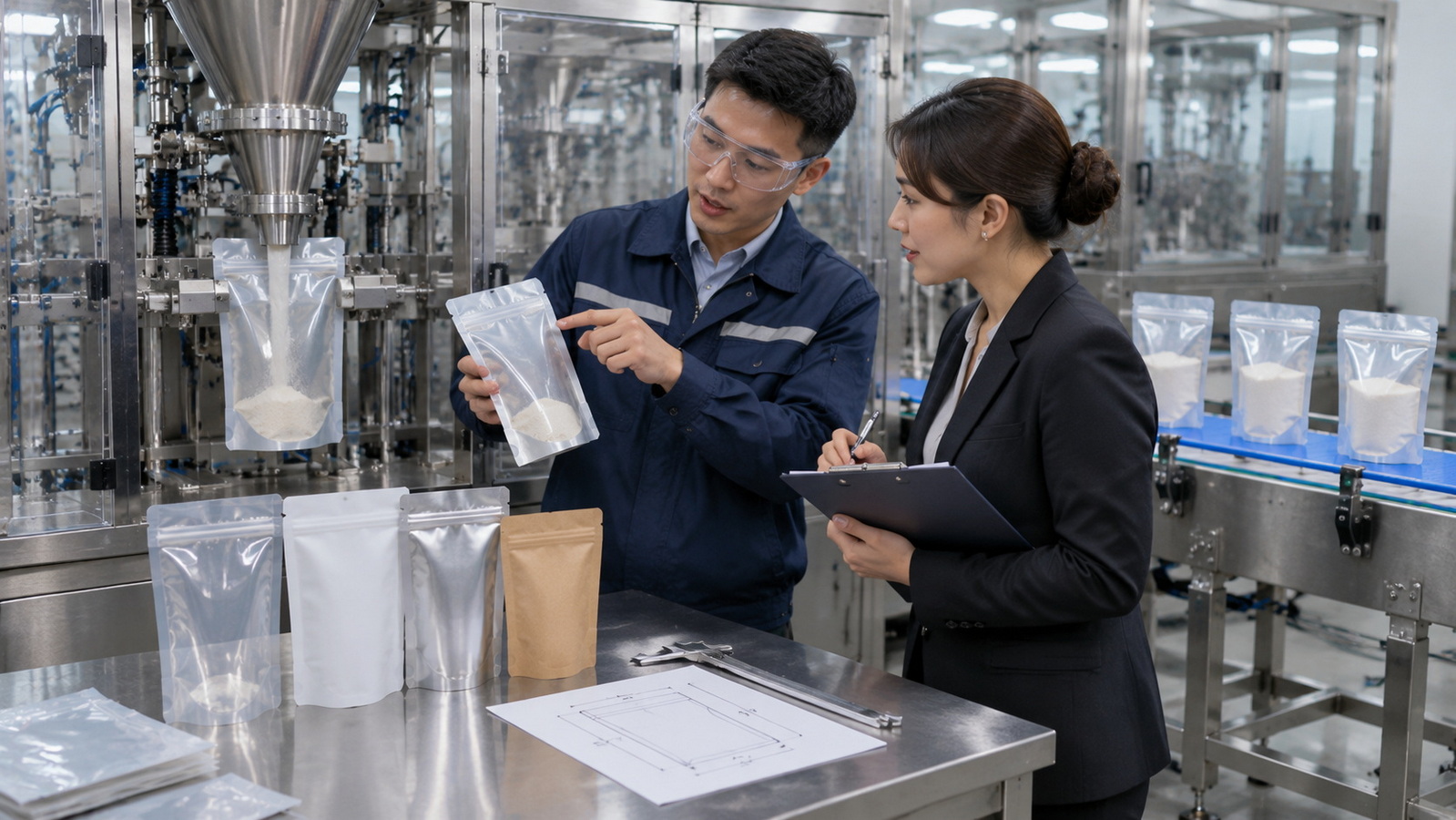
Main markets: Not sufficiently disclosed in the reviewed source.
Buyer verification priority: Complete identity and capability checks before progressing to commercial sampling.
"Not disclosed" means the reviewed sources did not provide a usable figure. It does not mean a supplier lacks capacity or certification.
| Supplier | Manufacturing base | Principal purchasing fit | Public capacity information | MOQ | Certification evidence reviewed |
|---|---|---|---|---|---|
| HLun PACK | China | Pouches, rollstock, and machinery coordination | Two-factory operating model; numerical pouch output not disclosed | Request by specification | Current packaging-system certificates not established from reviewed profile |
| Dongguan Huafu Packaging Materials Co., Ltd. | China | Flexible packaging plus trays and printed boxes | Reports 35,000 m² plant; no comparable verified pouch-output figure | Request by specification | Website lists ISO-related systems, FSC, RCS, and Sedex information; verify documents |
| Rose Plastic Kar Co. | Iran | Custom pouch formats and integrated conversion | Equipment brands disclosed; numerical output not established | Request by format and print run | Current certificate status not established |
| Sultan Chap Co. | Iran | Printing-led development, lamination, and bags | Process scope disclosed; numerical output not established | Request by specification | Current certificate status not established |
| Basparnegar | Iran | Polyethylene bags and films | Not established | Not established | Not established |
Company capability information above comes from the reviewed profiles and directory listing; none provides a directly comparable, independently audited capacity dataset.
For meaningful quotations, specify the same dimensions, layer structure, thickness tolerances, print coverage, closure, order quantity, and delivery terms to every supplier.
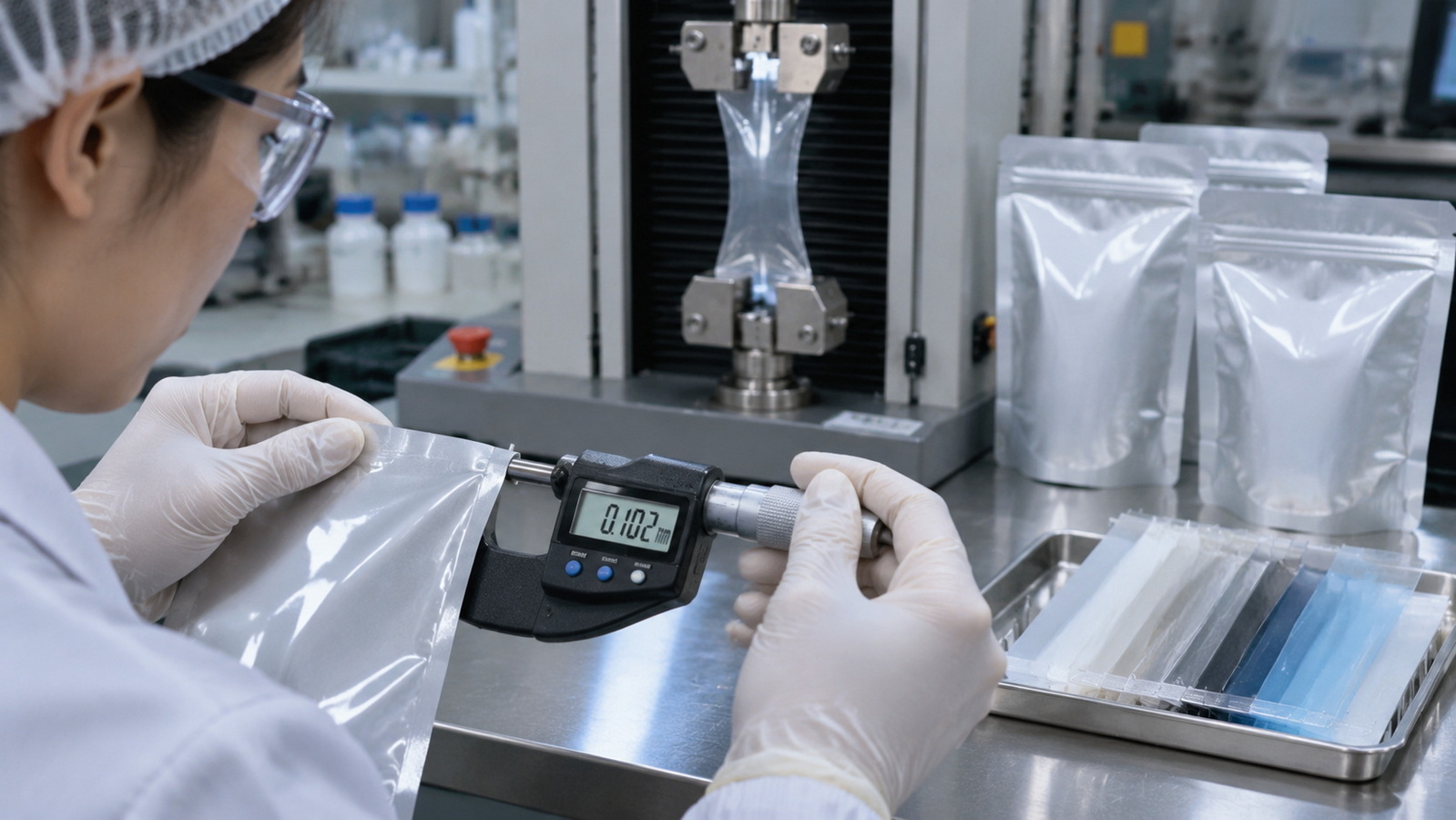
Do not approve a quotation that describes the product only as a "food-grade laminated pouch."
Ask the supplier to propose and document:
- Every film layer and its thickness.
- Food-contact layer composition.
- Barrier targets and testing conditions.
- Adhesive and ink systems.
- Intended filling, storage, and distribution conditions.
- Whether recycled content is present and its suitability for the intended use.
- Restrictions on material substitution.
Require the converter to explain why its proposed structure suits your product. A packaging choice for dry snacks should not automatically be transferred to oily foods, aggressive liquids, frozen products, or thermal processing.
For food-contact applications, documentation should address the finished material and intended conditions of use. European requirements include composition controls, migration restrictions, supporting documentation, and a Declaration of Compliance where applicable—not merely a general statement that the raw resin is suitable.
Separate three questions:
1. Does the factory operate a documented management system?
2. Does the supplied packaging comply with applicable food-contact requirements?
3. Is a particular environmental claim substantiated?
A positive answer to one does not automatically answer the others.
Do not accept CE or RoHS paperwork as the approval basis for ordinary food pouches. Those documents do not replace the food-contact evidence relevant to packaging. For European food-contact applications, start with the applicable framework, good manufacturing practice requirements, and plastics legislation, including Regulation (EU) No 10/2011 where relevant.
Similarly, a recycled-content claim and a recyclability claim address different issues. Require the supplier to identify exactly what its certificate or assessment covers instead of accepting "eco-friendly" as a specification.
A visually approved pouch does not fully define its composition or performance.
Before ordering, approve a controlled specification alongside the physical sample. Include material structure, tolerances, test methods, acceptance criteria, and a change-approval procedure.
Food-contact traceability is particularly important: European guidance emphasizes identification through the supply chain and supporting documentation linked to the supplied materials.
When a revised quotation becomes substantially cheaper, ask for a written change comparison.
Check whether the supplier changed thickness, barrier layers, adhesive, zipper, print coverage, order quantity, or delivery terms. Do not infer equivalence from similar appearance.
A practical purchasing clause is: "No change to the approved bill of materials, manufacturing site, or critical process without prior written approval and any required revalidation."
Request capacity for your actual product and delivery window.
A factory may have substantial printing capability but limited availability at another production stage. Ask the supplier to identify the scheduling constraint for your order and explain how it will protect repeat-order lead times.
A useful but often overlooked question is whether qualification samples were produced under the same conditions intended for bulk supply.
Request samples from a documented pilot or production run, linked to the material specification, manufacturing date, and batch records. Where lamination is involved, ask the converter to define its validated curing and release conditions rather than imposing an arbitrary universal waiting period.
Also compare the supplied sample with packaging tested on your own equipment. A hand-filled pouch can demonstrate appearance without demonstrating stable automated filling, handling, or sealing.
This is a recommended qualification protocol, not a claim that any listed supplier uses inadequate sampling.
1. Define the application. Provide product composition, filling conditions, target shelf life, destination market, and equipment details.
2. Review documentation. Check business identity, proposed structure, certificates, and applicable laboratory evidence.
3. Inspect samples. Evaluate dimensions, print, opening features, and construction.
4. Conduct product and equipment trials. Test the actual product under intended operating conditions.
5. Approve a pilot order. Confirm production consistency before scaling.
6. Establish repeat-order controls. Retain approved samples and require advance notification of changes.
Transactions involving Iran require jurisdiction-specific sanctions review. Depending on the parties, ownership, banks, goods, and applicable laws, a transaction may be prohibited, restricted, or require authorization. OFAC maintains an Iran sanctions program and specifically recommends appropriate counterparty due diligence.
Before placing an order:
- Obtain legal review where necessary.
- Verify the supplier and beneficial owners.
- Confirm that the bank, carrier, and insurer will handle the transaction.
- Agree accurate product descriptions and customs documentation.
- Confirm delivery responsibilities and remedies for transport disruption.
Do not assume that packaging intended for food automatically qualifies for humanitarian trade authorizations. Their scope and conditions must be checked for the actual transaction. Do not conceal origin, counterparties, or payment beneficiaries.
For domestic Iranian sourcing, Rose Plastic Kar Co. and Sultan Chap Co. provide publicly documented integrated flexible packaging capabilities. Basparnegar offers an additional qualification lead for polyethylene bags and films, although its public evidence requires more extensive verification.
For international comparison, HLun PACK is relevant when packaging materials and machinery need coordinated development, while Dongguan Huafu Packaging Materials Co., Ltd. offers flexible packaging alongside other printed packaging components. Neither company's inclusion establishes an Iranian factory or guaranteed eligibility to supply a particular Iran-related transaction.
To begin a technical discussion with HLun PACK, prepare your product information, target pouch dimensions, filling conditions, annual demand, destination market, and current packaging challenges. Request a written proposal covering material selection, OEM customization, sample validation, equipment compatibility, MOQ, and delivery assumptions.
The objective is not simply a lower pouch price. It is a packaging system that performs consistently from the first approved trial to the next repeat order.
Request the complete certificate rather than a cropped logo. Check the legal entity, manufacturing address, standard, scope, certificate number, issue date, and expiry date.
Then verify its current status directly with the issuing certification body using independently obtained contact details. Ask specifically about suspension, withdrawal, site coverage, and any scope exclusions. Do not rely on the printed expiry date alone.
For food packaging, continue the assessment beyond management-system certification: applicable food-contact compliance requires its own supporting evidence.
Treat thickness as only one comparison point.
Ask both suppliers for layer-by-layer structures, performance targets, closure specifications, printing assumptions, and commercial terms. Require each supplier to explain any difference from the approved specification.
For food-contact materials, supporting documentation should also relate to the proposed composition and intended use. A lower price is not a valid saving if it changes the qualified packaging without adequate review.
Do not assume universal coverage.
Ask the supplier or competent laboratory to explain whether the report covers the proposed material, food-contact conditions, and intended application. Request a documented rationale for any grouping of products or structures.
European guidance links compliance documentation to identifiable materials and relevant use restrictions; it also requires updates when significant composition or production changes affect migration or when new scientific information becomes relevant.
Request separate figures for the minimum production run, minimum quantity per design, minimum quantity per size, and minimum repeat order.
Ask whether multiple artwork versions can share material purchasing or production setup. Also separate tooling charges from unit prices.
Because comparable MOQs were not disclosed for the shortlisted companies, obtain written, application-specific quotations rather than treating a generic advertised minimum as binding.
There is no universal approval covering every buyer or transaction.
The answer depends on the buyer's jurisdiction, the supplier and owners, payment route, transport providers, and applicable restrictions. U.S. persons face broad Iran-related prohibitions unless an exemption or authorization applies; other buyers may also face relevant restrictions and banking limitations. Obtain transaction-specific advice before committing funds.
1. HLun PACK, "About Us." Company history, flexible packaging products, machinery operations, and integrated services. [hlunpack]
2. Dongguan Huafu Packaging Materials Co., Ltd., official website. Product scope, reported plant information, inspection equipment, markets, and credential claims. [dghuafupackaging]
3. Huafu Packaging, "Top 10 Snack Packaging Manufacturers in China." Published company-history details. [dghuafupackaging]
4. Rose Plastic Kar Co., "About Us." Tahani Print history, Esfahan operations, and converting capabilities. [roseplastickar]
5. Rose Plastic Kar Co., official product and contact information. Pouch formats and manufacturing location. [roseplastickar]
6. Sultan Chap, public company profiles. Manufacturing scope and conflicting historical-date information. [linkedin]
7. Ensun, "Top 11 Flexible Packaging Companies in Iran." Directory information used as a preliminary lead for Basparnegar. [ensun]
8. MarketsandMarkets, *Flexible Packaging Market—Global Forecast to 2030*, published October 2025. Global market estimates and category definitions. [marketsandmarkets]
9. 6Wresearch, *Iran Flexible Packaging Market, 2025–2031*. Public report listing; no undisclosed national figures reproduced. [6wresearch]
10. European Commission, "Packaging" and "Food Contact Materials Legislation." Food-contact safety, traceability, plastics requirements, and compliance documentation. [food.ec.europa]
11. European Commission, guidance on Regulation (EU) No 10/2011. Declarations of Compliance, supporting information, and compliance testing. [food.ec.europa]
12. Flexible Packaging Europe, official press releases. Industry-association updates on flexible packaging materials and regulatory developments. [flexpack-europe]
13. U.S. Department of the Treasury, Office of Foreign Assets Control, "Iran Sanctions" and related guidance. Transaction restrictions, authorizations, and due diligence. [ofac.treasury]


