


close
Choose Your Site
Global
Social Media
Views: 237 Author: HLun PACK Publish Time: 2026-11-27 Origin: Site


Content Menu
● Doypack Machine vs. Can Filling Machine
● Why Premium Powdered Milk Requires Specialized Packaging
>> Moisture, Oxygen, and Light Protection
>> Hygiene Must Remain a Separate Requirement
● How a Doypack Machine Packages Milk Powder
>> Advantages of Stand-Up Pouch Packaging
>> Limitations Buyers Should Address
● How a Can Filling Machine Packages Milk Powder
>> Advantages of Canned Milk Powder Packaging
>> Limitations Buyers Should Address
● Shelf Life: Compare the Whole Package, Not Just the Material
>> Request Meaningful Barrier Specifications
>> Validate Nitrogen Flushing Under Production Conditions
● Filling Accuracy, Throughput, and Changeover Performance
>> Powder Behavior Controls Dosing Performance
>> Compare Saleable Output Instead of Advertised Speed
● Hygiene and Cleanability for Powder Packaging Equipment
● Total Cost: Calculate Cost per Saleable Pack
>> Illustrative Giveaway Example
● A Six-Step Validation Plan Before Equipment Purchase
● Which Packaging Machine Should Your Brand Choose?
>> Can a Doypack Machine Handle Whole Milk Powder?
>> Does a Can Filling Machine Automatically Include a Seamer?
>> Is Nitrogen Flushing Required for Every Milk Powder Product?
>> Can Resealable Pouches Match the Protection of Cans?
>> Which Machine Is Better for Small Production Runs?
>> Can These Machines Package Powdered Infant Formula?
A doypack machine suits premium powdered milk brands seeking lightweight, resealable packaging and flexible product presentation. A can filling machine suits brands prioritizing rigid protection, stackability, and a traditional premium appearance. Neither automatically delivers better shelf life: the result depends on the complete package, filling environment, oxygen control, and closure integrity.
At HLun Pack, our approach to powder packaging equipment starts with the product and distribution requirements—not simply the container's appearance. A milk powder refill pouch and a flagship nutritional powder can may need similar dosing technology but very different handling and sealing systems.
This guide compares both options and provides a practical framework for choosing an integrated packaging solution.
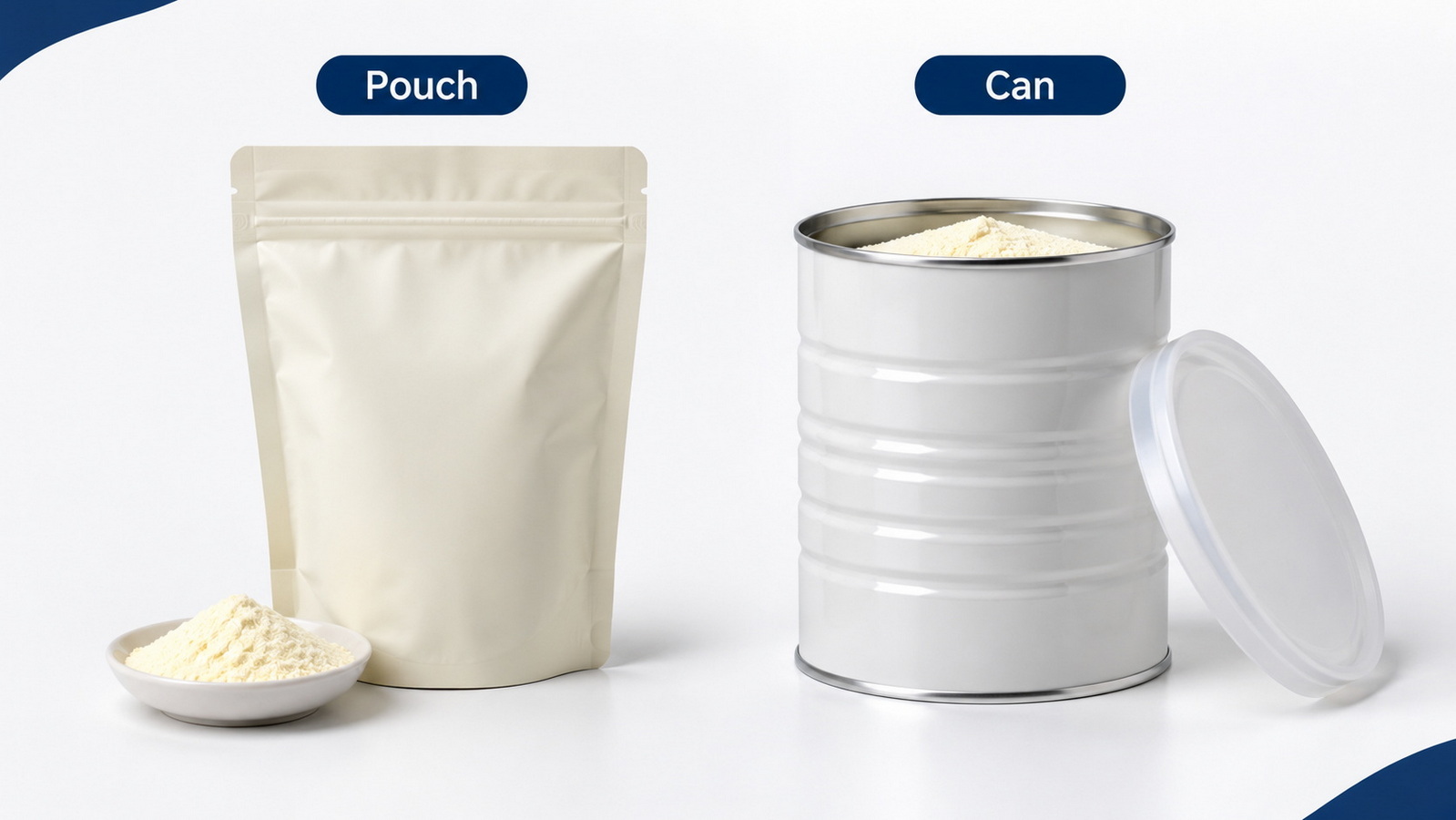
For this comparison, "doypack machine" means a premade stand-up pouch filling and sealing system. "Can filling machine" means a powder filler integrated with can handling and closing equipment. A filler alone does not complete either package.
| Selection factor | Doypack machine | Can filling machine |
|---|---|---|
| Primary package | Flexible stand-up pouch | Rigid can |
| Typical dosing option | Auger filler | Auger or specialized powder filler |
| Final closure | Heat seal above the opening or zipper | Double seam for suitable metal cans |
| Main protection concern | Laminate integrity and seal cleanliness | Can condition and seam integrity |
| Oxygen control | Nitrogen flushing where configured | Nitrogen flushing, potentially with vacuum |
| Consumer convenience | Lightweight; zipper options | Stable opening; convenient scoop access |
| Empty-container storage | Usually compact | Typically requires more warehouse space |
| Format changeovers | Pouch handling and dosing adjustments | Can guides, tooling, and seamer adjustments |
| Best commercial fit | Refills, portable packs, varied designs | Rigid premium formats and established can markets |
The useful comparison is between complete, validated lines—not two isolated machines.
Premium positioning cannot compensate for powder that develops off-flavors, absorbs moisture, or reaches customers in damaged packaging.
Milk powder can absorb moisture, contributing to caking and reduced handling quality. Oxygen exposure can promote fat oxidation, especially in whole milk powder. Light protection also matters for maintaining product quality.
Codex specifies a maximum water content of 5% for the milk powder categories covered by its milk powders standard, with an important qualification concerning lactose crystallization water. That composition limit is not a packaging design target or a shelf-life guarantee.
Packaging specifications should therefore address:
- Moisture and oxygen barriers.
- Closure integrity.
- Storage temperature and humidity.
- Physical distribution hazards.
- Product quality throughout the intended shelf life.
Low moisture does not mean sterile. Powdered infant formula, in particular, requires product-specific regulatory controls and stringent contamination prevention.
Nitrogen flushing reduces oxygen exposure; it does not sterilize powder or replace hygienic manufacturing. Standard milk powder and infant formula should not be treated as interchangeable applications when defining equipment requirements.
A powder doypack packing machine handles preformed pouches and coordinates their movement with a dosing system.
A typical sequence includes:
1. Feeding and gripping the pouch.
2. Opening the mouth and zipper, where applicable.
3. Confirming that the pouch is properly open.
4. Dispensing the powder.
5. Managing dust and allowing settling.
6. Flushing with nitrogen where specified.
7. Heat-sealing and discharging the package.
The exact sequence depends on the machine configuration and package design.
Pouches offer substantial design flexibility. Brands can use different graphics, sizes, and resealable features to distinguish adult nutrition, family milk powder, and refill products.
Empty pouches generally occupy less storage space than rigid cans. Their low package weight can also benefit distribution, although actual savings depend on shipping cartons, protective materials, and pallet utilization.
From a purchasing perspective, I would consider pouches particularly attractive when refill convenience and packaging variety are central to the product strategy.
Flexible packaging depends on more than film thickness. Laminate construction, puncture resistance, sealant compatibility, and handling conditions all influence performance.
Fine powder in the sealing area can create weak seals or leakage paths. Zippers add convenience after opening, but they do not replace the unopened package's primary heat seal.
Request trials using the actual pouch—not merely another bag with similar dimensions.
A milk powder can filling line may combine:
- Empty-can feeding and inspection.
- Appropriate container cleaning.
- Powder dosing and weight checking.
- Vacuum and nitrogen treatment where specified.
- Lid feeding and seaming.
- Coding, inspection, and overcap application.
Metal cans are the focus here. Composite cans and plastic containers require separate assessments of their barriers, closures, and equipment compatibility.
Metal can walls provide strong barriers against moisture, oxygen, and light. Their rigid structure also supports stacking and protects against some handling stresses.
A broad opening can make scooping convenient, while the rigid container maintains its shape during repeated use.
For premium powdered milk products sold in markets where cans are familiar, the format can reinforce perceived value. That commercial benefit should be confirmed through customer research rather than assumed.
Cans require warehouse space before filling, and damaged flanges or container distortion can interfere with closing.
A can line also needs more than accurate dosing. Seamer setup, lid compatibility, seam inspection, and maintenance determine whether the package retains its intended protection.
A plastic overcap provides convenience after opening; it is not equivalent to the original sealed closure.
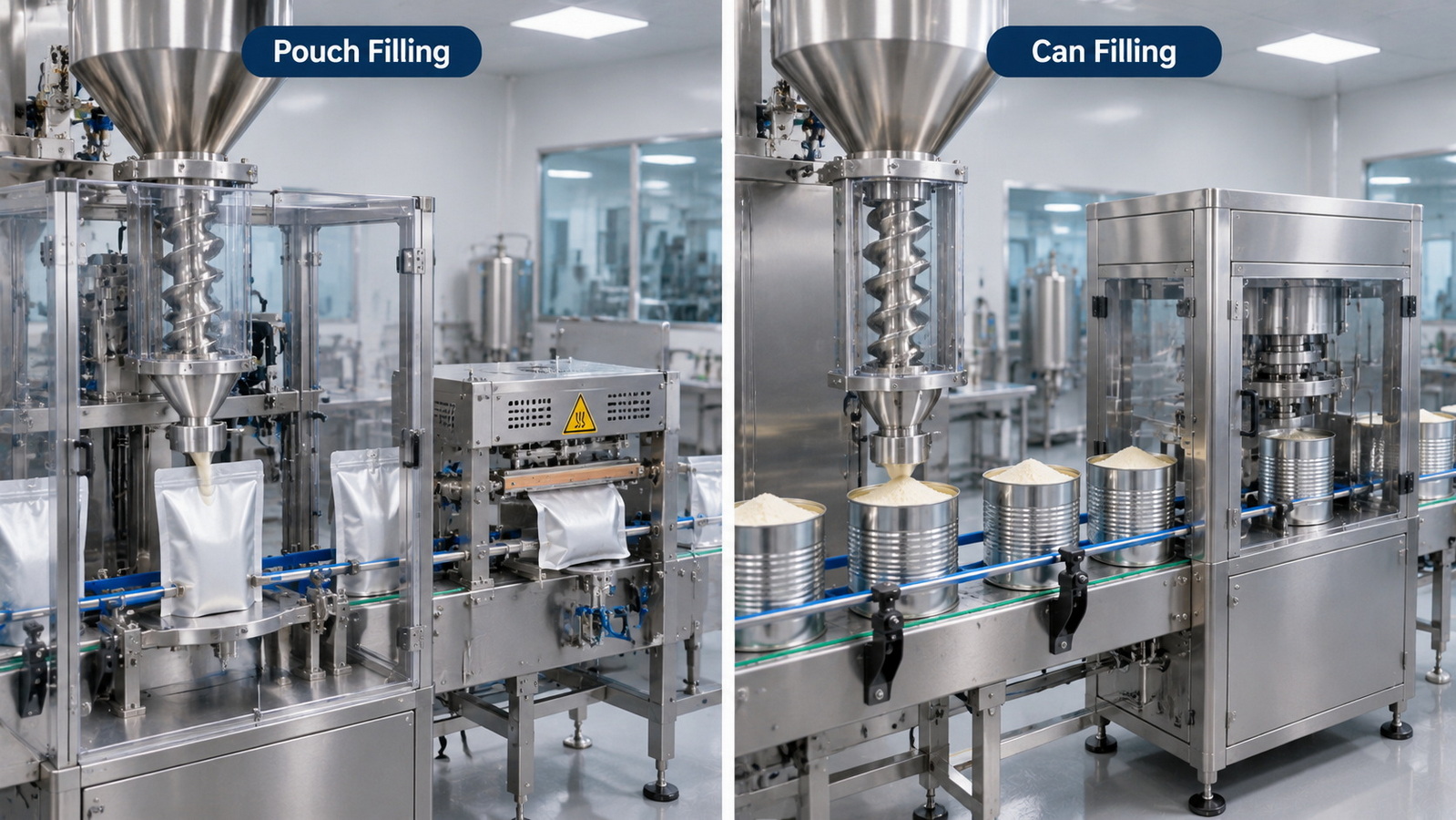
The question "Do cans preserve milk powder longer than pouches?" has no universal answer.
A properly specified high-barrier pouch can provide effective protection. A poorly closed can can fail despite its excellent wall barrier.
For flexible materials, ask for oxygen transmission rate and water vapor transmission rate, including test conditions. Temperature and humidity affect how those figures should be interpreted.
Also distinguish flat-film measurements from finished-package performance. Seals, folds, zippers, and distribution damage can change the result.
For cans, review closure performance and container integrity rather than relying only on the metal wall's barrier properties.
Do not accept "nitrogen-ready" as a complete specification.
Agree on:
- Residual oxygen acceptance limits.
- Measurement timing after sealing.
- Sampling frequency.
- Gas purity and consumption.
- Production speed during testing.
- Procedures following stoppages.
Oxygen trapped between powder particles can complicate measurements. Immediate headspace readings alone may not fully describe the package's subsequent oxygen condition.
Shelf-life claims should come from product testing in the intended package and storage conditions—not from a machinery brochure.
Both formats can use servo-driven auger dosing. Neither package shape inherently guarantees better fill accuracy.
Bulk density, flowability, aeration, and hopper conditions influence the mass delivered by an auger.
Instantized powder and fine milk powder may behave differently, even at the same target weight. Product trials should therefore cover realistic variations rather than one ideal sample.
Useful controls include consistent feeding, suitable auger tooling, checkweighing, and a defined response to weight drift.
The relevant output is correctly filled, properly closed, accepted packages per minute.
A line's practical capacity may be restricted by pouch opening, dust settling, gas treatment, can seaming, or inspection.
Ask suppliers to demonstrate sustained performance that includes routine replenishment and representative stoppages. Measure changeover from the last accepted pack of one format to stable production of the next.
My preferred evaluation question is simple: can operators inspect and clean every location where powder may accumulate?
Review:
- Product-contact surfaces and joints.
- Hopper and auger accessibility.
- Removal of dosing tools.
- Dust collection arrangements.
- Seals, gaskets, and concealed ledges.
- Cleaning instructions and verification methods.
Dust extraction must be balanced against product loss and disturbance of the filling process.
Cleaning methods should match the facility's validated hygiene program. Where water is used, drying and restart controls require particular attention.
For infant formula projects, obtain specialist review of the complete manufacturing environment. A hygienic-looking packaging machine is not evidence that the overall process meets applicable requirements.
Comparing purchase prices alone can lead to the wrong investment.
Use this cost-per-saleable-pack framework:
Cost per saleable pack=Total relevant operating costs / Accepted packs produced
Include packaging materials, labor, utilities, nitrogen, maintenance, product giveaway, rejects, cleaning, and allocated equipment costs. Avoid counting the same expense twice.
Suppose a line produces one million packs annually. An average overfill of two grams represents two tonnes of additional powder.
That is an illustrative calculation, not a published industry average. Its purpose is to show why dosing consistency can matter as much as container price.
Likewise, pouch material savings may be offset by excessive rejects, while a faster can line may be underutilized by frequent short runs.
Sustainability comparisons also need product-specific evidence. Packaging weight alone does not establish overall environmental performance or local recyclability.
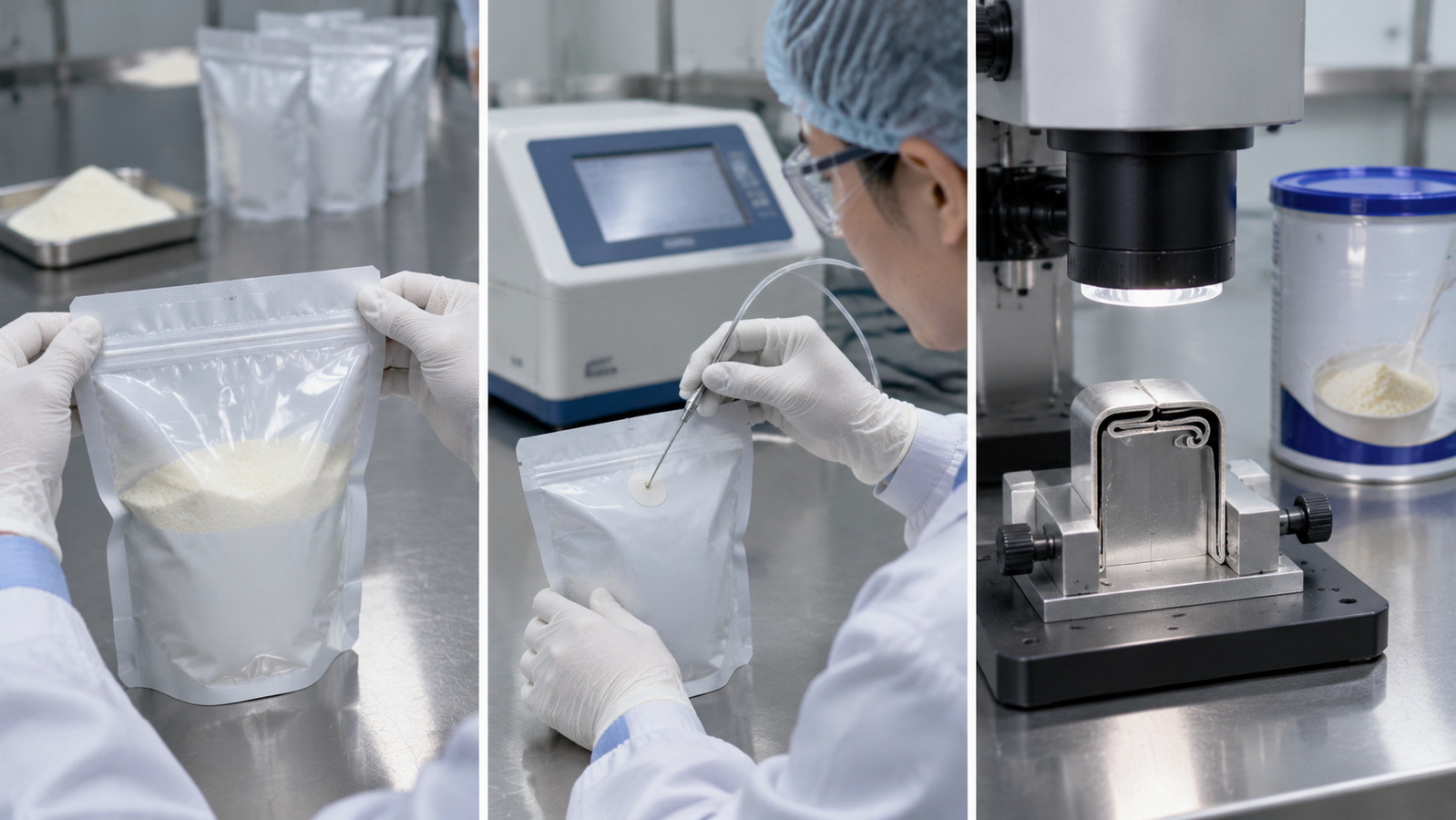
Use the same acceptance framework for both proposed lines.
1. Define the application. Record powder characteristics, pack weights, market requirements, shelf life, and storage conditions.
2. Supply representative materials. Include actual powder, pouches or cans, lids, and relevant supplier drawings.
3. Test the operating range. Cover minimum and maximum pack sizes, different production rates, and representative powder conditions.
4. Verify package quality. Evaluate fill weights, residual oxygen where relevant, heat seals or seams, and rejection functions.
5. Challenge distribution performance. Select appropriate transport, compression, and handling tests for the intended route.
6. Document acceptance criteria. Agree on output, losses, cleaning, changeovers, training, and responsibilities before ordering.
Continue shelf-life validation separately. A successful factory trial does not establish an eighteen- or twenty-four-month shelf life.
Choose a doypack machine when your priorities include:
- Refill or lightweight retail formats.
- Compact empty-package storage.
- Resealable convenience.
- Frequent graphic or pack-size variations.
Choose a can filling machine when your priorities include:
- Rigid container presentation.
- Strong stackability.
- Convenient access through a stable opening.
- Compatibility with an established canned-product range.
A dual-format strategy may also make sense: cans for the flagship product and pouches for refills. However, validate each format independently and provide clear storage instructions.
For HLun Pack, the objective is to coordinate powder feeding, dosing, container handling, closure, and inspection around the application.
Send HLun Pack your powder specification, target fill weights, packaging samples, required output, and destination markets. Request a coordinated equipment proposal and a documented trial plan before finalizing the packaging format.
Yes, with a suitable powder dosing system and pouch-handling configuration. Confirm performance using the actual powder, because fat content, flowability, and aeration can affect filling and sealing.
No. Some quotations cover only the filler. Confirm whether can feeding, cleaning, gas treatment, seaming, inspection, and conveying are included in the proposed line.
Not universally. Its suitability depends on formulation, oxygen sensitivity, intended shelf life, and packaging performance. Set requirements through product evaluation rather than treating nitrogen as an automatic guarantee.
Potentially, for a defined application. The answer depends on laminate barriers, finished-package integrity, storage, and validation. After opening, neither a zipper nor an overcap recreates the original sealed atmosphere.
Compare cleaning time, format changes, staffing, and minimum economical operating quantities. A smaller machine with straightforward changeovers may suit short runs better than a high-speed line in either format.
Potentially, but suitability requires a much broader assessment. Infant formula involves specific regulatory, microbiological, environmental, and process-control requirements that cannot be established from the container format alone.
1. [Codex Alimentarius — Standard for Milk Powders and Cream Powder, CXS 207-1999]. Primary basis for the milk powder composition discussion and the maximum water-content qualification. [fao]
2. [U.S. Food and Drug Administration — Cronobacter sakazakii]. Authoritative background on pathogen survival in low-moisture foods and the particular risks associated with powdered infant formula. [fda]
3. [U.S. Food and Drug Administration — Information for Infant Formula Manufacturers and Retailers]. Regulatory context supporting the distinction between general milk powder packaging and infant formula manufacturing requirements. [fda]
4. [PMG Engineering — Packaging Materials for Dried Milk Products]. Technical background on moisture, oxygen, light, mechanical protection, and packaging material selection. [pmg]
5. [AUGER — Automatic Powder Premade Pouch Packing Machine, PM4-3035A]. Manufacturer documentation illustrating pouch feeding, opening, auger dosing, dust control, and heat-sealing functions. Its specifications are machine-specific, not universal benchmarks or HLun Pack performance claims. [auger-filling]
6. [VTOPS — Milk Powder Canning Line]. Manufacturer documentation illustrating integrated can filling, weight inspection, gas treatment, seaming, and application-dependent residual oxygen performance. No advertised performance figures are adopted as general guarantees. [vtops]


