


close
Choose Your Site
Global
Social Media
Views: 266 Author: HLun PACK Publish Time: 2026-11-29 Origin: Site


Content Menu
● Why Source Rollstock Film from China?
● How to Evaluate a Rollstock Film Manufacturer
● Quick Comparison: Capacity, MOQ, and Certification
● The Top 10 Rollstock Film Manufacturers in China
>> 1. Shantou Hualun Paper Products Industrial Co., Ltd. — HLun PACK
>> 2. Dongguan Huafu Packaging Materials Co., Ltd.
>> 3. LD PACKAGING CO., LTD — LD PACK
>> 4. Guangdong Danqing Printing Co., Ltd. — DQ PACK
>> 5. Jiangsu Sunkey Packaging High Technology Co., Ltd.
>> 6. Guangdong Huihua Packaging Co., Ltd.
>> 7. Dongguan OK Packaging Manufacturing Co., Ltd.
>> 8. Shanghai Xiangwei Packaging & Printing Co., Ltd. — PACKMIC
>> 9. BOWE PACK
>> 10. Kazuo Beiyin Paper and Plastic Packing Co., Ltd.
● Technical Buying Guide: Specify Performance Before Requesting Prices
>> Define the complete film structure
>> Separate film compliance from machinery compliance
>> Examine environmental claims carefully
● Common Sourcing Pitfalls and How to Avoid Them
>> 1: Buying a structure name instead of a controlled specification
>> 2: Comparing price per kilogram without usable output
>> 3: Treating the sample as proof of repeatability
>> 4: Accepting an unrelated certificate or test report
● A Fresh Trial Roll May Not Behave Like Stored Inventory
● Buyer's Guide: From Factory Verification to Shipment
>> 1: Confirm who manufactures the film
>> 2: Build a staged sample program
>> 3: Agree on roll configuration
>> 4: Verify delivery feasibility
>> 5: Write a shipment and receiving plan
● Choose the Supplier That Reduces Total Packaging Risk
● FAQ
>> 1. How can I verify whether a manufacturer's ISO certificate has expired or been suspended?
>> 4. How should I compare a supplier quoting by kilogram with one quoting by meter?
>> 5. Can I replace a conventional laminate with mono-material film without changing machine settings?
China offers a broad choice of rollstock film manufacturers, but choosing a long-term supplier requires more than comparing printed samples and prices per kilogram. Professional buyers need to assess material consistency, food-contact documentation, production capacity, machine compatibility, and the factory's ability to resolve problems after delivery.
This guide compares ten Chinese suppliers of custom printed rollstock film and related flexible packaging. It starts with HLun PACK and Dongguan Huafu Packaging Materials Co., Ltd., followed by manufacturers offering different combinations of technical development, production scale, and export experience.

China's appeal lies in the range of suppliers available within connected manufacturing regions. The Guangdong companies in this guide include operations in Shantou, Chaozhou, Dongguan, Foshan, and Jieyang. Their capabilities cover packaging materials, printing, lamination, converting, machinery, and technical development. Shanghai and Wuxi provide additional options for custom flexible packaging and technically demanding applications.
These regional concentrations give buyers an opportunity to compare several manufacturing approaches rather than rely on a single factory model. For example, a growing food brand may need responsive artwork development and machine trials, while a multinational procurement team may prioritize multiple production lines and formal supplier-approval systems.
Recent industry figures also illustrate the scale of the wider supply base. A February 2026 trade-press account of the China Packaging Federation's 2025 industry bulletin reported 20,230 above-designated-size packaging enterprises and approximately RMB 2.055 trillion in annual revenue. These figures cover the broader packaging industry—not rollstock film alone—and should not be presented as the size of China's flexible film market.
For ongoing monitoring, the China Packaging Federation publishes industry operating reports and plastic-packaging import and export analyses. These category-specific publications are more relevant to sourcing decisions than unsupported claims about a single "rollstock film market" figure.
A supplier should qualify through evidence, not through its position in a list. For procurement teams, the following framework provides a practical starting point.
| Evaluation area | What to investigate | Evidence to request |
|---|---|---|
| Factory identity | Whether the seller operates the manufacturing site | Business license, factory address, production walkthrough, subcontracting disclosure |
| Material engineering | Ability to translate product requirements into a film structure | Layer specification, material grades, barrier targets, sealing requirements |
| Quality control | Controls from incoming materials through finished rolls | Inspection procedures, batch records, test reports, traceability examples |
| Regulatory suitability | Compliance for the actual destination and intended use | Applicable declarations, migration reports, current site-specific certificates |
| Machine compatibility | Performance on the buyer’s filling and sealing equipment | Trial rolls, agreed operating window, troubleshooting records |
| Capacity and delivery | Available output rather than theoretical annual capacity | Production plan, bottleneck analysis, curing schedule, delivery history |
| OEM/ODM support | Depth of customization and technical communication | Artwork workflow, development responsibilities, change-control procedure |
This is a recommended purchasing framework, not a claim that every factory below has passed an on-site audit.
A useful distinction is between management-system certification and product suitability. ISO certification can support confidence in a management system, but food-contact suitability requires evidence addressing the material, food type, contact conditions, and applicable rules. For EU plastic food-contact materials, the relevant framework includes Regulation (EU) No 10/2011 and supporting compliance documentation.
The table separates published output from other scale indicators. Factory area, production-line count, and annual tonnage are not interchangeable. Published capacity may also include pouches and other products rather than rollstock film exclusively.
"Quote required" means that a comparable, specification-specific rollstock MOQ was not established from the reviewed information. It does not mean the supplier necessarily accepts small orders.
| Manufacturer | Published capacity or scale indicator | Rollstock film MOQ | Reported credentials or verification position |
|---|---|---|---|
| HLun PACK | One packaging-materials factory and one packaging-machinery factory; annual film tonnage not disclosed | Quote required | About page reports innovation-related honors; current management-system and food-contact documents should be requested. |
| Dongguan Huafu Packaging Materials Co., Ltd. | Website reports a 35,000 m² plant; comparable annual rollstock output not disclosed | Quote required | Reports production licensing, FSC, RCS, and Sedex-related credentials; states ISO 9001/14001 implementation. Verify certificate and audit scope. |
| LD PACKAGING CO., LTD | More than 25,000 tonnes annual flexible-packaging capacity; eight automatic printing lines | Quote required | Company describes certification milestones; request current certificates for the supplying site. |
| Guangdong Danqing Printing Co., Ltd. — DQ PACK | Company page reports approximately 30,000 m² of facilities and two QC laboratories | Quote required | Reports BRC, ISO 9001, and AEO credentials; verify current status and scope. |
| Jiangsu Sunkey Packaging High Technology Co., Ltd. | Reports 50,000 m² building area and 10,000 m² GMP clean production space | Quote required | Reports ISO systems, FSSC 22000, BRCGS, and laboratory accreditation; request current records. |
| Guangdong Huihua Packaging Co., Ltd. | More than 10,000 tonnes annually; 12 printing and lamination lines | Quote required | Reports ISO and production-license credentials; clarify the standard designation shown on its website. |
| Dongguan OK Packaging Manufacturing Co., Ltd. | Supplier profile reports approximately 30,000 m² | Customized by material, thickness, and printing colors | Reports BRC and ISO-related credentials; verify relevant certificates and reports. |
| Shanghai Xiangwei Packaging & Printing Co., Ltd. — PACKMIC | Official Chinese profile reports more than 10,000 m² | Quote required | Reports ISO 9001 and BRCGS systems. |
| BOWE PACK | Up to 7,200 tonnes annually; six high-speed production lines | Quote required | Reports ISO 9001 and BRC-related credentials; verify current scope. |
| Kazuo Beiyin Paper and Plastic Packing Co., Ltd. | Custom packaging and roll-film portfolio; comparable annual output not established | Quote required | Current certification details were not established from the reviewed company profile. |
- Location: Shantou, Guangdong.
- Manufacturing history: Packaging operations trace to 1989; machinery division established in 1998; flexible packaging added in 2012.
- Markets: The company describes worldwide supply, without publishing a regional sales breakdown.
- OEM/ODM scope: Roll films, flexible pouches, paper packaging, packaging machinery, and integrated packaging solutions.
HLun PACK's most useful differentiator is its combination of packaging-material production and packaging-machinery manufacturing. Its public profile describes in-house design, development, and production across both activities. Its flexible packaging range includes roll films, stand-up pouches, gusseted pouches, spout pouches, and eight-side-seal bags.
For small and midsized brands, this makes the company worth evaluating when film selection and equipment performance need to be discussed together. Rather than treating the roll film as an isolated consumable, buyers can frame the project around filling conditions, sealing requirements, package appearance, and operating stability.
The company also emphasizes proactive communication, cross-department coordination, technical development, and after-sales support. These are relevant to buyers seeking flexible OEM customization and fewer communication handoffs, although response speed and project execution should still be tested during sampling.
Procurement assessment: Consider HLun PACK as a potential value-oriented development partner, particularly where materials and machinery must work as a system. "Cost-effective" should be established through comparable quotations and line performance—not assumed from positioning. Request project-specific MOQ, production capacity, compliance documents, and a written trial plan.
- Location: Zhangmutou, Dongguan, Guangdong.
- Established: Manufacturing history began in 1995; the current company name dates to 2006.
- Markets: Reports exports to more than 20 countries and regions, including the United States, Europe, and Southeast Asia.
- OEM/ODM scope: Printed packaging films, laminated bags, application-specific materials, blister packaging, and paper boxes.
Huafu is relevant for buyers who want flexible packaging alongside other packaging components. Its history describes a transition from shrink-film production into printing, lamination, slitting, and bag making, followed by broader group capabilities in blister and paper packaging.
Its automatic packaging roll-film offering lists structures such as OPP/CPP, PET/PE, and PA/PE, with custom sizing, full-color printing, and lamination. This makes the company a practical candidate for food, daily-use goods, and other automated packaging applications.
Procurement assessment: Huafu's cross-format offering may simplify coordination when a project includes both primary flexible packaging and secondary presentation packaging. Verify exactly which facility produces the roll film and which certificates cover that operation. Its website's references to Sedex should be reviewed as audit-related information, rather than accepted as a substitute for food-contact evidence.
- Location: Foshan, Guangdong.
- Established: 1990.
- Markets: Reports service across 30 regions and offices or operations covering multiple international markets.
- OEM/ODM scope: Liquid, dairy, pet food, modified-atmosphere, seasoning, household-product, and technical film applications.
LD PACK publishes one of the clearer production-scale statements in this shortlist: annual flexible-packaging capacity exceeding 25,000 tonnes, supported by eight automatic printing lines. Its facilities description includes solvent-free, dry, and extrusion lamination.
The company's technology institute focuses on high-barrier, mono-material, and recyclable flexible packaging. This is particularly relevant when a buyer needs to compare a familiar laminate with a redesigned structure rather than simply reproduce existing artwork.
Procurement assessment: Shortlist LD PACK for programs combining technical development and larger recurring demand. Ask which lines are assigned to the proposed structure, how much capacity is available during peak periods, and whether the quotation covers the same barrier and sealing targets as competing offers.
- Location: Chaozhou, Guangdong.
- Established: Manufacturing roots in 1991; its history records registration under Guangdong Danqing Printing Co., Ltd. in 1993.
- Markets: Reports more than 1,200 customers across over 140 countries and regions.
- OEM/ODM scope: Printed rollstock films, spout pouches, stand-up pouches, retort pouches, and other custom flexible formats.
DQ PACK is notable for publishing details of its material and finished-product testing. Its company page lists oxygen-permeability testing, gas chromatography, heat-seal testing, tensile testing, coefficient-of-friction testing, and other laboratory equipment.
Its documented development workflow also includes suggesting material structures and providing samples for customer filling-machine trials before production. This is directly relevant to buyers who need evidence of machine suitability rather than only a visual sample.
Procurement assessment: DQ PACK is worth assessing for export-oriented custom rollstock projects requiring structured QC discussions. Request actual batch-report examples, acceptance limits, and laboratory methods; an equipment list alone does not establish the quality of the proposed film.
- Location: Wuxi, Jiangsu.
- Established: 2002.
- Markets: Serves domestic and multinational customers; a current regional sales breakdown is not established here.
- OEM/ODM scope: Food, pharmaceutical, daily chemical, industrial, and other technically specified flexible films and bags.
Sunkey's profile emphasizes material development, controlled production environments, and testing. It reports 10,000 m² of GMP clean production space and laboratory equipment including gas chromatography, oxygen and moisture transmission instruments, and infrared spectroscopy.
The company also describes collaboration with Jiangnan University on packaging-material research and reports multiple management-system certifications. These capabilities make it a relevant candidate for projects involving demanding barrier performance or detailed qualification procedures.
Procurement assessment: Match the supplier's technical resources to the actual project. A highly specified food-contact film and a pharmaceutical packaging material may require different qualification routes. Do not assume that a credential for one product category automatically covers another.
- Location: Jieyang, Guangdong.
- Established: 1993; a second production base was established in 2003, with operations merged in 2019.
- Markets: Reports worldwide exports; leading regions are not separately identified.
- OEM/ODM scope: Flexible packaging for snacks, confectionery, coffee, beverages, pet food, frozen food, meat, seasonings, and personal care.
Huihua reports annual capacity exceeding 10,000 tonnes, supported by 12 printing and lamination lines and more than 30 bag-making lines. Its profile also describes artwork support, material recommendations, and packaging development.
This combination makes Huihua relevant to buyers managing recurring printed-packaging programs across several product categories.
Procurement assessment: Clarify how much of the published capacity relates to finished rollstock rather than converted bags. Also request original certification documents: the company page uses the designation "ISO9001:2018," which should be clarified rather than repeated as a verified standard edition.
- Location: Dongguan, Guangdong.
- Established: 1996.
- Markets: Reports sales to more than 50 countries; its supplier profile identifies the United States, Europe, South America, South Africa, Australia, New Zealand, Japan, and Singapore.
- OEM/ODM scope: Rolling film, laminated pouches, spout pouches, vacuum packaging, coffee packaging, and bag-in-box formats.
OK Packaging combines roll-film production with a wide range of converted packaging formats. Its website describes R&D personnel, QC staff, laboratories, and testing equipment, while its film pages list customized materials and thicknesses.
Its roll-film product information explicitly states that MOQ depends on material, thickness, and printing colors. That is a more useful starting point than a generic minimum order that ignores the structure and artwork.
Procurement assessment: Consider OK Packaging when comparing rollstock with alternative pouch formats. Require a dedicated rollstock specification and trial: success with a premade pouch does not, by itself, demonstrate performance on your automatic filling line.
- Location: Songjiang, Shanghai.
- Established: 2009, according to its official Chinese company profile.
- Markets: Describes domestic and international customers, with cooperation across more than 40 countries and regions.
- OEM/ODM scope: Custom films and pouches for food, coffee, tea, pet food, frozen products, health products, and daily-use goods.
PACKMIC's official Chinese profile describes more than 10,000 m² of factory space and ISO 9001 and BRCGS systems. Its product portfolio includes printed rollstock alongside a range of pouch constructions.
Procurement assessment: PACKMIC is a relevant Shanghai-area option for branded flexible packaging. However, some English-language pages refer to 2003, while its Chinese profile identifies registration in 2009. Use the contracting entity's business license to establish the legal incorporation date rather than combining inconsistent histories.
- Location: Xinxing County, Yunfu, Guangdong.
- Established: Manufacturing history stated as 1997.
- Markets: Reports customers in more than 30 countries; principal regional shares are not disclosed.
- OEM/ODM scope: Custom flexible bags, rollstock films, printed packaging, and application-specific pouch development.
BOWE PACK's factory-capacity page reports six automatic high-speed production lines and annual capacity reaching 7,200 tonnes. It also describes hygiene-controlled workshops and physical, hygienic, microbiological, and characteristic testing.
Its product range makes it relevant for buyers who want to compare custom rollstock with pouches from the same supplier.
Procurement assessment: Request a rollstock-specific quotation rather than adopting pouch figures as a reference. A published retort-pouch MOQ or delivery estimate should not be assumed to apply to a printed film order with different materials and production steps.
- Location: Kazuo County, Chaoyang, Liaoning.
- Established: Company history traces to 1998 through its predecessor.
- Markets: Describes service to global brands; a verified regional sales breakdown is not provided in the reviewed profile.
- OEM/ODM scope: Printed roll film, laminated packaging, vacuum bags, aluminum-foil bags, stand-up pouches, spout pouches, and paper-based packaging.
Beiyin provides a geographically different sourcing option from the Guangdong and Yangtze River Delta suppliers above. Its public product range includes both printed roll film and kraft-paper rollstock, alongside numerous custom pouch formats.
Procurement assessment: Consider Beiyin when broadening a supplier search beyond southern China. Before qualification, establish the current legal entity, relevant production lines, annual rollstock capacity, destination-market experience, and current certification status.
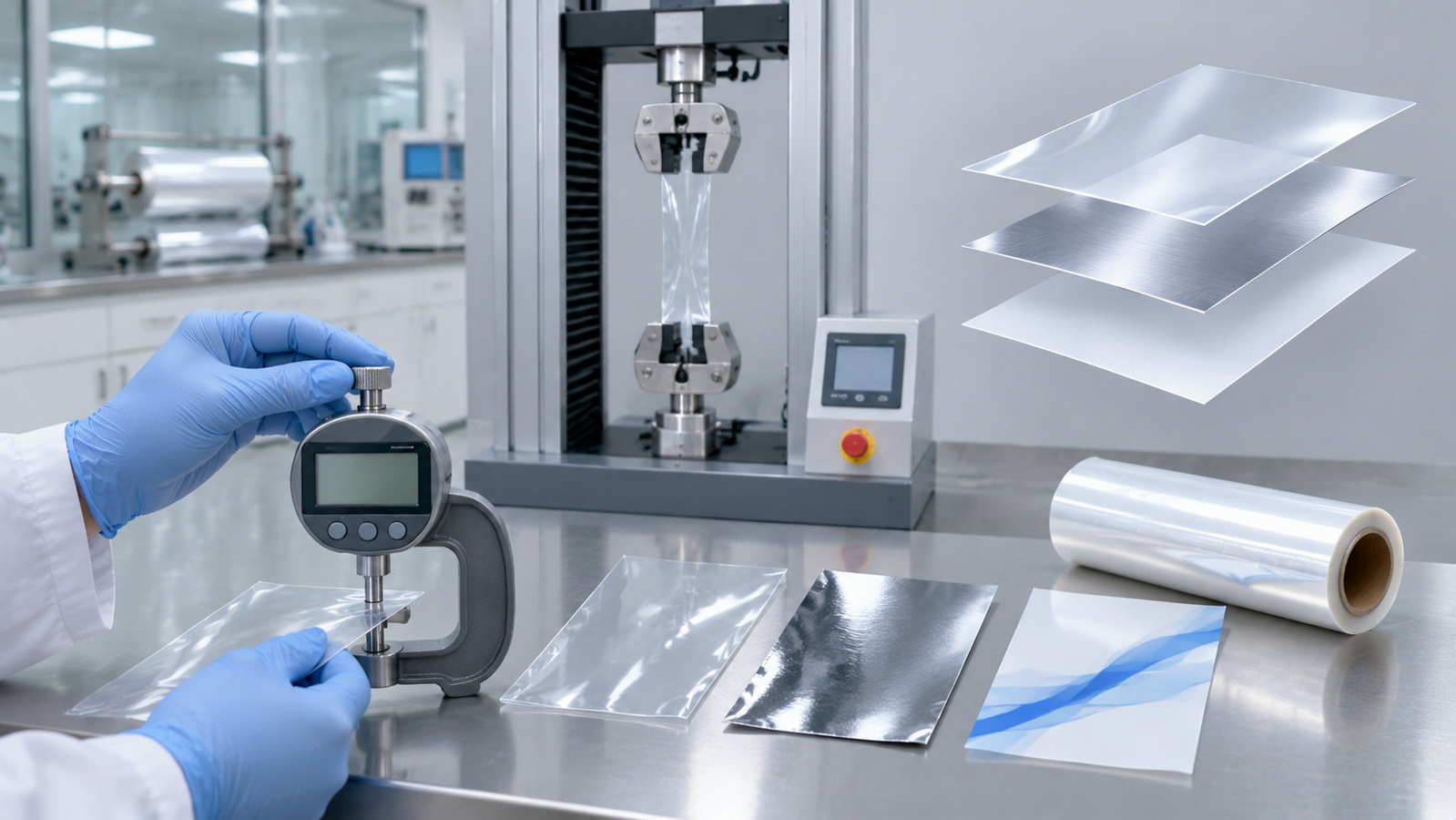
"Food-grade rollstock film" is not a complete specification. Suppliers in this shortlist offer multiple structures, including OPP/CPP, PET/PE, PA/PE, and PET/VMPET/PE. These are different material constructions, not interchangeable descriptions of the same product.
A useful request for quotation should identify:
- Product composition, including oil, acidity, aroma, and moisture sensitivity.
- Filling temperature and any subsequent thermal processing.
- Target shelf life and storage conditions.
- Required oxygen and moisture barrier performance.
- Film structure, individual-layer thicknesses, and total-thickness tolerance.
- Seal requirements and the intended packaging machine.
- Printing colors, repeat length, finish, and artwork versions.
- Food-contact requirements in the destination market.
Where the final structure is not yet known, ask each supplier to propose a construction against the same product and operating conditions. Otherwise, the lowest quotation may simply reflect a different specification.
For ordinary food-packaging rollstock, CE marking is not the appropriate general qualification criterion. EU guidance states that CE marking applies only to products covered by legislation that specifically requires it; it must not be used where no such requirement exists. Packaging machinery is a separate assessment from the packaging film it processes.
Similarly, RoHS concerns electrical and electronic equipment and is not a general food-contact approval for ordinary flexible packaging. A film supplier's RoHS test report cannot replace the documentation required for the intended food-contact application.
For EU projects, request a suitable Declaration of Compliance and supporting documentation addressing the intended food types, time, temperature, and applicable material restrictions. Evaluate the current amended legal requirements, not simply an old report bearing the number "10/2011."
Several suppliers describe mono-material, recycled-content, or recyclable packaging developments. Treat these as separate claims requiring separate evidence, rather than one interchangeable sustainability category. LD PACK, for example, specifically describes research into high-barrier and mono-material structures.
In your purchasing specification, ask the supplier to state exactly what is being claimed, which finished structure the evidence covers, and what limitations apply. A certificate associated with paper sourcing, recycled content, or factory management should not be treated as blanket proof of every environmental statement made about a film.
Two quotations can both say "PET/PE" without defining identical layer gauges, resin grades, sealing properties, or tolerances.
Recommended safeguard: Approve a controlled specification with material identification, layer thicknesses, tolerances, critical performance limits, and written approval requirements for substitutions.
A lower kilogram price does not settle the total purchasing decision. Buyers also need to compare the contracted film dimensions, usable quantity, production performance, and losses.
Recommended safeguard: Ask for comparable quotations in both mass and usable area or length, then compare cost per accepted finished pack during the trial.
A visually attractive sample does not demonstrate consistent barrier, seal quality, or machine performance across production batches.
Recommended safeguard: Require production-representative trial rolls, retain an approved reference, and agree on batch-release documentation. DQ PACK's published workflow expressly includes customer filling-machine trials, illustrating why this step belongs before full production approval.
A report for a different structure or a certificate issued to another site may not answer the buyer's actual qualification question.
Recommended safeguard: Match every document to the legal entity, manufacturing address, material identification, scope, and intended use. Food-contact documentation should address the proposed application rather than merely identify a general packaging category.
A less obvious sourcing risk is approving film immediately after production without considering how its handling properties develop over time.
Coefficient of friction, commonly abbreviated COF, affects how film slides against itself and processing equipment. Ampacet explains that migratory slip additives move toward the film surface over time. Depending on the additive, the ultimate COF may not be reached until seven to ten days after extrusion, although much of the change can occur in the first 24–48 hours.
Lamination introduces another consideration. Ampacet also documents that conventional slip additives can lose effectiveness after lamination or transfer to the opposite film surface, creating inconsistent converting and packing behavior.
The practical lesson is not that one COF value suits every machine. It is that the test conditions and film age must be controlled.
For qualification, specify:
1. The conditioning period before testing.
2. The film surfaces being compared.
3. Whether static COF, dynamic COF, or both are required.
4. The agreed test method and acceptance window.
5. Retesting after a storage period representative of the actual supply chain.
6. A machine trial using production-representative material.
Ampacet identifies ASTM D1894 as a method used to measure film COF. Ask the supplier to report the method and conditions rather than providing an unexplained number.
Match the quotation, business license, production address, certificate holder, and payment beneficiary. Ask whether printing, lamination, curing, and slitting occur at the disclosed site or involve subcontractors.
If a trading company or affiliated exporter handles the transaction, clarify its relationship with the factory rather than assuming that a different company name automatically indicates a problem.
Use a qualification sequence with clear approval gates:
1. Existing material samples for initial assessment.
2. A proposed technical specification.
3. Artwork and color approval.
4. Production-representative printed trial rolls.
5. Testing on the intended filling machine.
6. Relevant laboratory verification.
7. A controlled first commercial order.
Record which aspects each sample approves. An artwork proof should not inadvertently become approval of barrier performance or machine compatibility.
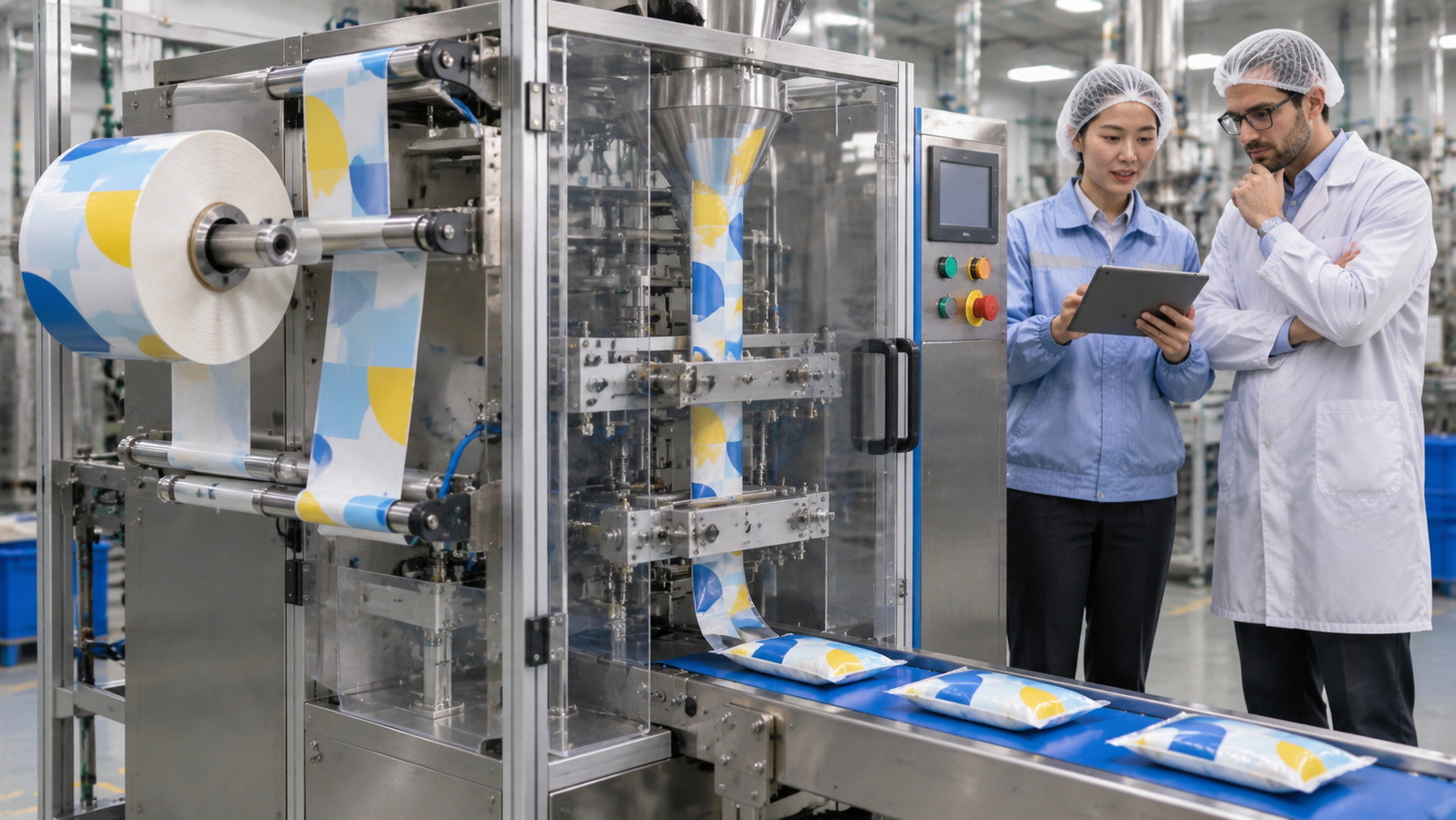
Rollstock quotations should define web width, core dimensions, maximum outside diameter, winding direction, print repeat, eye-mark details, roll weight, splice rules, and labeling requirements. These are also the kinds of roll-configuration details identified in Huafu's published buyer guidance.
Include a drawing where orientation could be misunderstood. A signed diagram is usually more useful than relying solely on informal descriptions.
Ask suppliers to separate the schedule into artwork approval, tooling, material procurement, printing, lamination, any required conditioning or curing, slitting, inspection, and dispatch.
Treat these as project milestones. A promised dispatch date is less informative without knowing what must happen before release.
Specify the required roll protection, carton or pallet arrangement, transport orientation, handling limits, identification labels, and storage instructions.
Before payment release, reconcile the agreed packing list with roll quantities, net film mass, batch identifiers, and inspection records. On receipt, inspect packaging damage and roll condition before releasing material to production.
These ten suppliers represent different sourcing approaches, not identical alternatives.
HLun PACK's combined materials-and-machinery operation makes it relevant when film customization and packing-line performance must be developed together. Huafu offers flexible packaging alongside blister and paper packaging. LD PACK, DQ PACK, Sunkey, and Huihua publish different combinations of production scale, technical development, and QC resources. The remaining suppliers broaden the shortlist by location, format range, and customization focus.
The purchasing decision should ultimately rest on the same controlled specification, comparable commercial terms, verified documents, and a successful production-representative trial.
For a project-specific discussion with HLun PACK, submit your product details, target market, proposed film structure, artwork, annual demand, and filling-machine specifications. Request a written proposal covering material selection, trial-roll preparation, OEM customization, compliance documentation, MOQ, and delivery milestones.
Search the company name or full certificate number through IAF CertSearch. Review the status, standard, scope, legal entity, site details, issuing certification body, and last update. If information is missing or unclear, contact the issuing certification body directly before accepting the certificate.
Do not rely only on the expiration date printed on a PDF. The current status and the scope covering the actual manufacturing operation are equally important.
Do not assume that it can. Ask the supplier and testing laboratory to explain the scope of coverage and the basis for any representative or worst-case assessment.
EU food-contact documentation depends on factors including material composition, intended food types, and contact conditions. Changes should therefore be reviewed against the existing compliance evidence rather than automatically treated as covered.
First, compare the delivered roll identification and specification with the approved trial material. Then review machine settings, roll configuration, sealing conditions, registration, and film handling properties.
Include COF history in the investigation: slip performance can change with time and after lamination. Retain unopened rolls, production records, and samples from the affected batch so the supplier can reproduce the issue rather than troubleshoot from photographs alone.
Require both suppliers to quote against the same width, structure, layer gauges, tolerances, and print requirements. Ask each to state the relationship between net film mass and usable length or area, excluding cores and shipping materials.
Then evaluate the quotations against actual trial performance. The commercially meaningful comparison is the cost of producing accepted packages, not simply the lowest number attached to a different unit.
Do not approve it as an automatic substitution. Treat the change as a new material qualification, with agreed requirements for sealing, handling, barrier performance, and finished-pack integrity.
Suppliers such as LD PACK describe dedicated development work on mono-material structures, while DQ PACK's published process includes filling-machine trials. Together, these illustrate why material redesign and equipment validation should be considered part of the same project.
1- China Packaging Federation — industry operating reports and plastic-packaging trade analyses. [cpf.org]
2- China Paper Online — February 2026 account of the China Packaging Federation's 2025 industry bulletin; broader packaging-sector figures, not rollstock-specific market data. [paper.com]
3- EUR-Lex — Regulation (EU) No 10/2011 and access to its consolidated text. [eur-lex.europa]
4- VDMA — explanation of plastic food-contact compliance and supporting declarations. [vdma]
5- European Union, Your Europe — official CE-marking requirements and scope. [europa]
6- Intertek — EU plastic food-contact requirements and amendments. [intertek]
7- Intertek — RoHS scope for electrical and electronic equipment. [intertek.com]
8- IAF CertSearch — accredited management-system certificate verification. [iafcertsearch]
9- Ampacet — slip-additive migration, COF testing, and laminated-film handling considerations. [ampacet]
10- HLun PACK — company profile and manufacturing milestones. [hlunpack]
11- Dongguan Huafu Packaging Materials Co., Ltd. — history, capabilities, and export markets. [dghuafupackaging]
12- LD PACKAGING CO., LTD — capacity, facilities, and technical development. [ldpack]
13- DQ PACK — company history, export profile, and QC facilities. [dqpack]
14- Jiangsu Sunkey Packaging High Technology Co., Ltd. — company and technical profile. [sunkeycn]
15- Guangdong Huihua Packaging Co., Ltd. — company profile and production capacity. [huihua-pack]
16- Dongguan OK Packaging Manufacturing Co., Ltd. — company and roll-film information. [gdokpackaging]
17- PACKMIC — official Chinese company profile and product information. [zh.packmic]
18- BOWE PACK — manufacturing background and factory capacity. [bowepack]
19- Kazuo Beiyin Paper and Plastic Packing Co., Ltd. — company history and product range. [beyinpacking]


