


close
Choose Your Site
Global
Social Media
Views: 277 Author: HLun PACK Publish Time: 2026-10-12 Origin: Site


Content Menu
● How Offset Printing Works for Paper Packaging
>> Advantages of Offset Printing
>> Limitations of Offset Printing
● How Digital Printing Works for Paper Packaging
>> Advantages of Digital Printing
>> Limitations of Digital Printing
● Offset vs Digital Printing Costs: Calculate the Real Break-Even Point
>> An Illustrative Cost Example
>> Compare Cost per Usable Carton
● Print Quality and Brand Color: What Buyers Should Verify
>> Spot Colors and Process-Color Simulation
>> Approve Color on the Intended Material
● Paperboard, Finishing, and Packaging Equipment Compatibility
>> Check Board Properties, Not Just Grammage
>> Test Creasing, Scuffing, and Glue Areas
>> Run Samples on the Intended Equipment
● Food Packaging Safety and Environmental Claims
>> Assess the Complete Food-Packaging Construction
>> Compare Waste Across the Packaging Lifecycle
● A Practical Workflow for Choosing Your Printing Method
>> 1. Define Demand by Artwork Version
>> 2. Lock the Packaging Specification
>> 3. Request Comparable Alternatives
>> 4. Approve a Representative Finished Sample
● What to Include in a Packaging Printing Quotation Request
● Plan Your Paper Packaging Project with HLun Pack
>> 1. Is Offset Printing Better Than Digital Printing for Packaging?
>> 2. What Quantity Makes Offset Printing Cheaper?
>> 3. Can Digital Printing Match Brand Colors?
>> 4. Is Digital Printing Less Durable Than Offset?
>> 5. Can Printed Cartons Run on Automated Packaging Equipment?
>> 6. Which Method Is Better for Food Packaging?
Offset vs digital printing is more than a comparison of print quality. For paper packaging, the right choice affects purchasing costs, launch schedules, brand consistency, inventory exposure, and performance on packaging equipment.
Offset printing often offers attractive economics for repeat orders with stable artwork. Digital printing offers flexibility for shorter runs, frequent design changes, and personalized packaging. Neither method wins every project.
At HLun Pack, our focus combines paper packaging, packaging machinery, and integrated packaging solutions. From that perspective, the most useful question is not simply, "Which print looks better?" It is, "Which process delivers reliable finished packaging at the right total cost?"
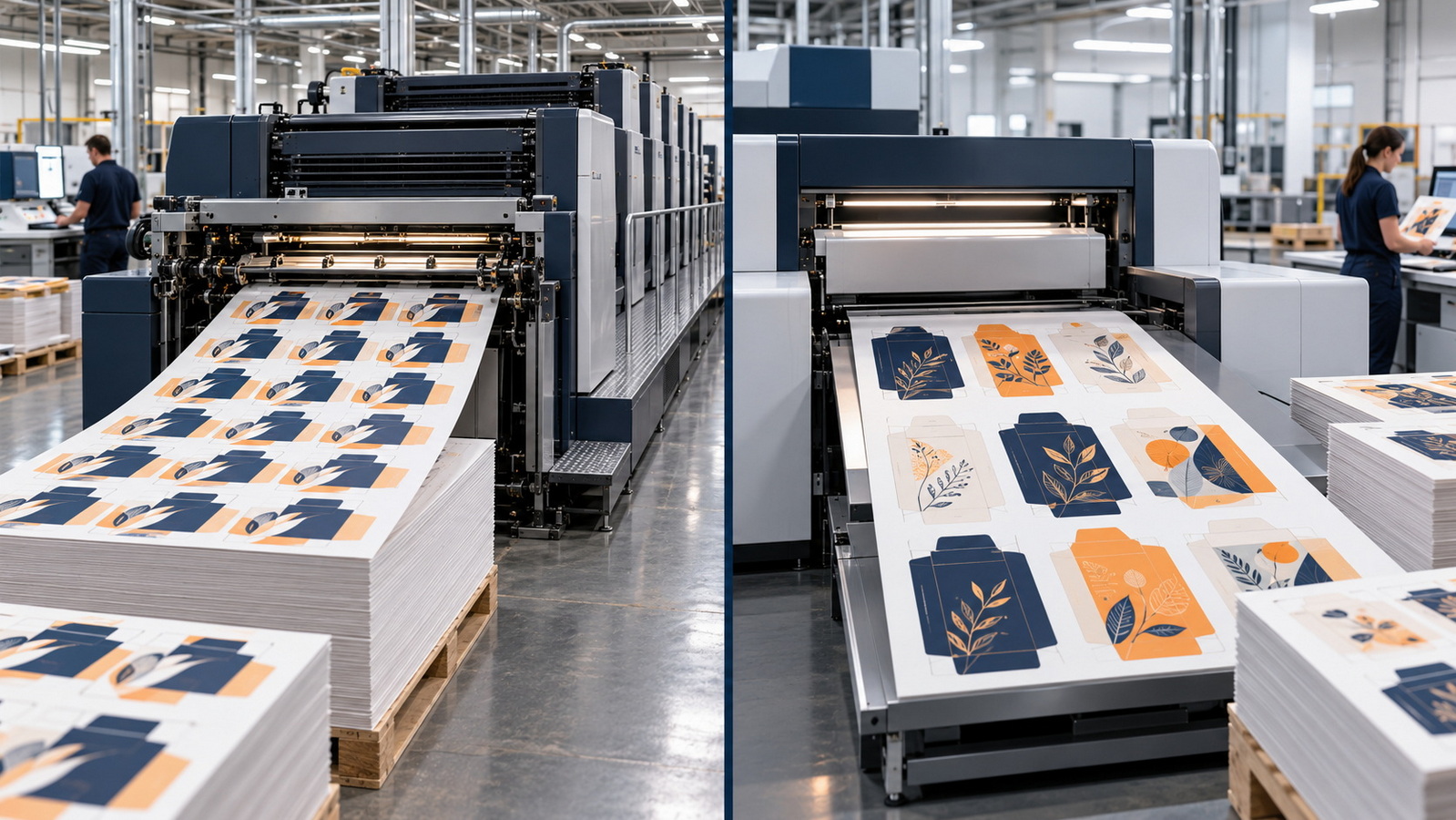
| Decision factor | Offset printing | Digital printing |
|---|---|---|
| Image transfer | Plates transfer ink through a rubber blanket | Digital files drive imaging without conventional printing plates |
| Setup | Plate preparation and press setup | Less plate-related preparation |
| Typical fit | Stable designs and repeat production | Short runs, multiple versions, and changing artwork |
| Unit economics | Setup costs spread across larger quantities | Lower setup burden; running costs remain important |
| Color options | Process colors and dedicated spot inks | Process colors; specialty capabilities depend on the press |
| Personalization | Usually requires another process | Supports variable text, graphics, or codes |
| Packaging suitability | Depends on stock, ink, and finishing | Depends on stock, imaging technology, and finishing |
Treat this table as a starting point, not a purchasing rule. Actual quotations and finished samples matter more than broad labels.
Offset lithography transfers an image from a printing plate to a rubber blanket, then onto the substrate. In conventional operation, image and non-image areas control where ink is accepted.
For folding cartons, the printed sheet normally continues through coating, die-cutting, creasing, folding, and gluing.
Offset printing offers several advantages for established packaging programs:
- Competitive unit costs when setup expenses are distributed across suitable production volumes.
- Access to dedicated spot inks for demanding brand-color requirements.
- Efficient production of repeated designs.
- Compatibility with many paper and paperboard specifications, subject to press and ink suitability.
- Integration with a wide range of coating and converting workflows.
For a stable carton design ordered repeatedly, these benefits can outweigh the higher initial setup burden.
Plates, preparation, and make-ready create costs before saleable production begins. Artwork changes can require new plates and additional setup.
That makes offset less convenient when a brand is testing several designs or updating information frequently. Individualized text or unique codes generally need a separate digital imaging or coding stage.
Offset also does not eliminate quality risks. Incorrect ink settings, unsuitable coatings, or poor creasing can compromise otherwise attractive packaging.
Digital printing produces images from electronic files without conventional offset plates. Packaging systems may use electrophotographic or inkjet technologies, each with different substrate, ink, and finishing requirements.
The absence of plates makes artwork changes easier, but it does not remove every production step. File checking, color management, coating, cutting, and converting still matter.
Digital printing is particularly useful when packaging requirements change rapidly:
- Short-run production without conventional plate charges.
- Multiple designs within a packaging program.
- Regional language versions or promotional editions.
- Variable graphics, serialized identifiers, and personalized content.
- Smaller replenishment orders that can reduce obsolete stock.
These capabilities help brands order around actual demand rather than committing early to one large print run.
Digital printing is not automatically cheaper, more durable, or less durable than offset.
At higher volumes, digital running costs may outweigh its setup advantage. Certain presses also impose restrictions on sheet size, board thickness, surface treatment, or coating compatibility.
Specialty colors and effects vary considerably between systems. Some advanced presses support spot colors and specialty inks; others rely primarily on process-color simulation.
Ask what the proposed press can deliver on your selected board, not what digital printing can achieve in general.
A universal crossover quantity is misleading. Carton dimensions, sheet utilization, artwork versions, ink coverage, finishing, and production efficiency all influence the result.
A useful first comparison separates fixed setup costs from variable production costs.
Suppose two quotations for the same specification use these simplified assumptions:
| Cost component | Offset | Digital |
|---|---|---|
| Fixed setup | $600 | $100 |
| Variable printing cost per carton | $0.12 | $0.22 |
| Printing cost at 2,000 cartons | $840 | $540 |
| Printing cost at 10,000 cartons | $1,800 | $2,300 |
These are hypothetical figures, not HLun Pack prices or industry averages. They exclude shared converting costs, freight, taxes, and inventory losses.
Under these assumptions, the printing costs match at 5,000 cartons. Below that point, digital costs less; above it, offset costs less.
Your crossover may be very different. Request comparable quotations rather than applying this example as a rule.
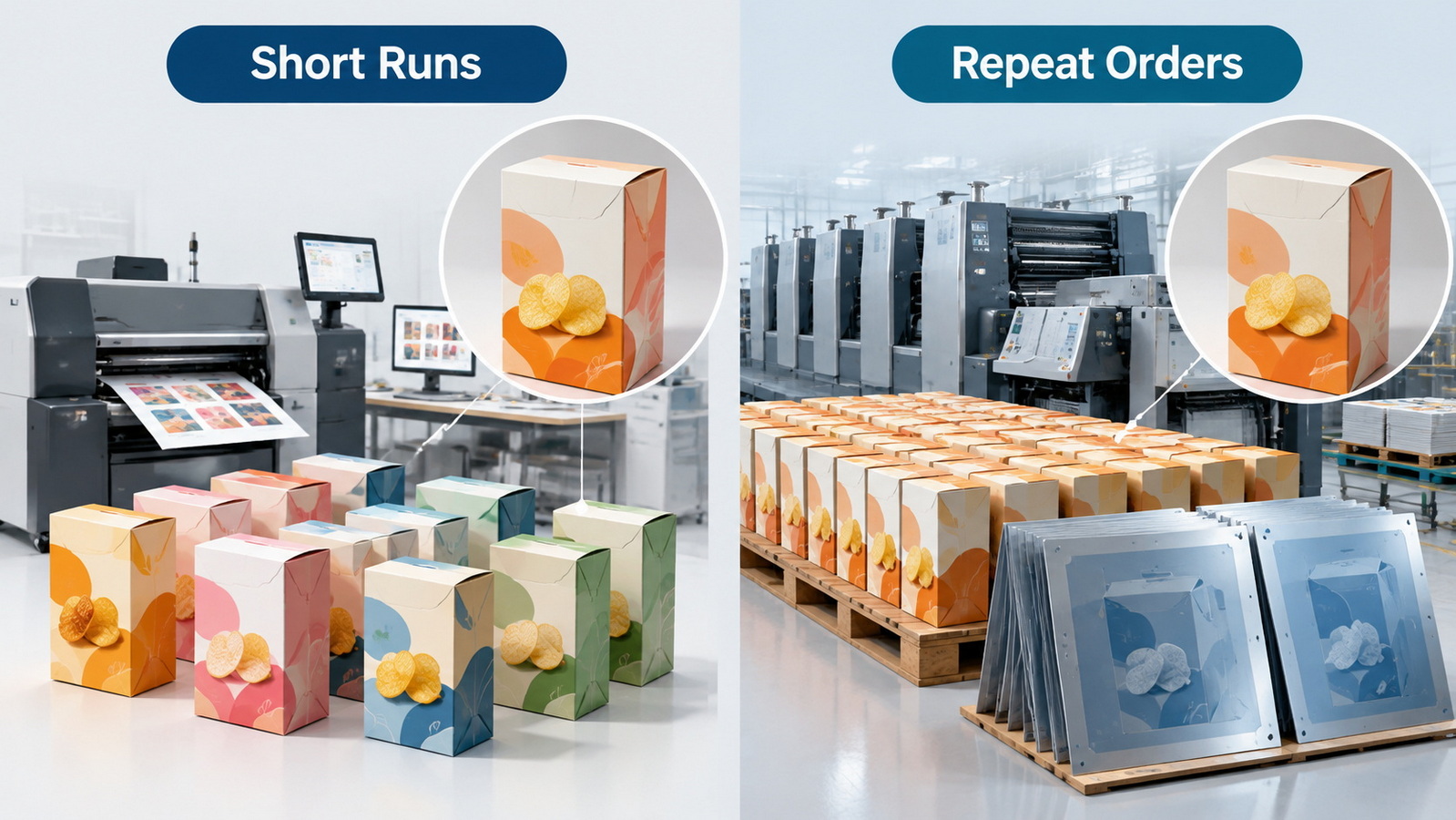
The more valuable measure is usable packaging cost.
Include:
- Printing and setup.
- Coating and converting.
- Freight and storage.
- Inspection and rejected cartons.
- Obsolete packaging after artwork changes.
- Equipment stoppages linked to packaging problems.
A lower purchase price loses its advantage if cartons require rework or cannot run consistently on the intended line.
Both offset and digital systems can produce excellent packaging. The outcome depends on the press, substrate, calibration, artwork, and finishing.
Offset presses can print dedicated spot inks. That can be valuable for brand colors that are difficult to reproduce using standard process colors.
Digital capability varies. Some systems offer extended color sets and dedicated spot-color options, while others simulate brand colors through their available process inks.
Neither approach guarantees identical appearance on every substrate. White coated board and brown kraft can produce noticeably different results from the same artwork.
For color-sensitive work, provide:
1. A physical color reference where available.
2. The intended board specification.
3. The coating or lamination requirement.
4. An agreed measurement and acceptance approach.
A screen preview is not a physical print standard. Likewise, a sample printed on different stock may not predict the final carton accurately.
Keep an approved production reference for repeat orders.
A printed sheet is not yet a successful package. It must survive converting, handling, filling, and distribution.
This is where a packaging-focused assessment becomes more useful than a print-only comparison.
Two boards with similar grammage can behave differently. Caliper, stiffness, grain direction, coating, surface absorbency, and moisture condition all influence performance.
Ask the supplier to confirm compatibility between the selected stock and the proposed printing process.
Then evaluate the finished structure rather than judging only a flat sheet.
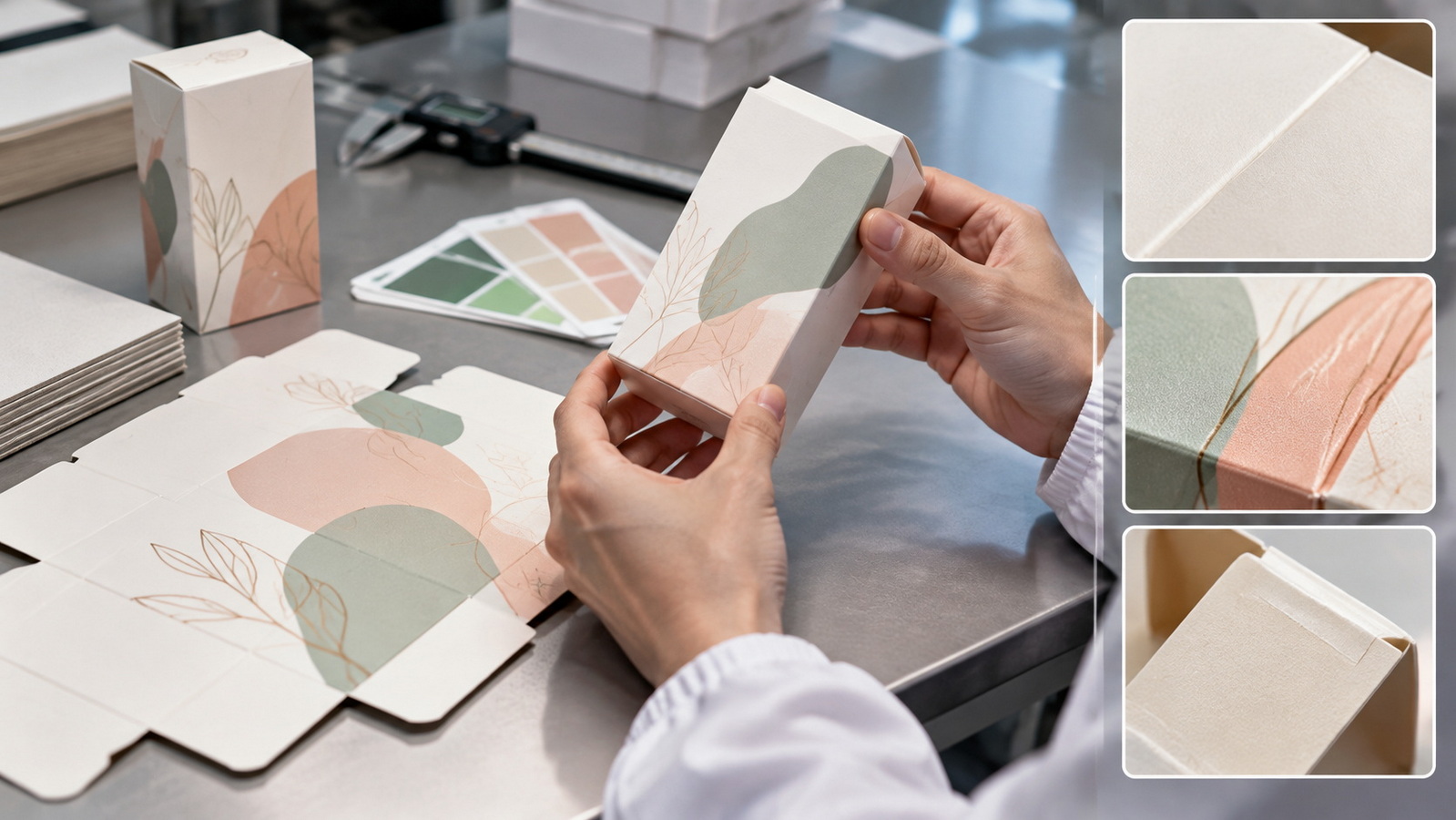
Dark graphics across fold lines can make cracking more visible. Coatings may improve surface resistance but can also affect adhesive performance.
During sample approval, inspect:
- Crease lines after folding.
- Printed surfaces after handling.
- Lamination adhesion, where applicable.
- Glue-flap preparation and bond quality.
- Die-cut accuracy and carton geometry.
Keep glue areas compatible with the chosen adhesive. Do not assume every varnished or laminated surface will bond reliably.
Before scaling an unfamiliar specification, trial finished cartons under representative operating conditions.
Check feeding, opening, registration, closure, and rejection behavior. Record the material specification and machine settings alongside the results.
This turns sample approval into a repeatable production standard rather than a visual preference.
Printing technology alone does not establish food-contact suitability or environmental performance.
For food applications, suitability depends on inks, coatings, substrates, barriers, intended use, and applicable market requirements.
Potential transfer routes include migration through materials and set-off, where a printed surface contacts another surface during stacking or winding.
Request relevant supplier documentation and a finished-packaging assessment. Where necessary, arrange appropriate testing.
An ink described as suitable for food packaging does not automatically establish compliance of the complete carton.
Digital printing can reduce plate-related preparation and enable smaller orders. Offset may offer efficient production for stable, longer runs.
However, neither process is inherently the more sustainable choice in every case.
Consider:
- Actual make-ready waste.
- Unsold or obsolete inventory.
- Substrate sourcing.
- Coatings, adhesives, and laminates.
- Energy and transport.
- Local recycling compatibility.
Avoid treating "digital," "paper," or "natural-looking" as proof of environmental superiority. Use evidence specific to the finished packaging.
Use this sequence to turn a broad comparison into a purchasing decision.
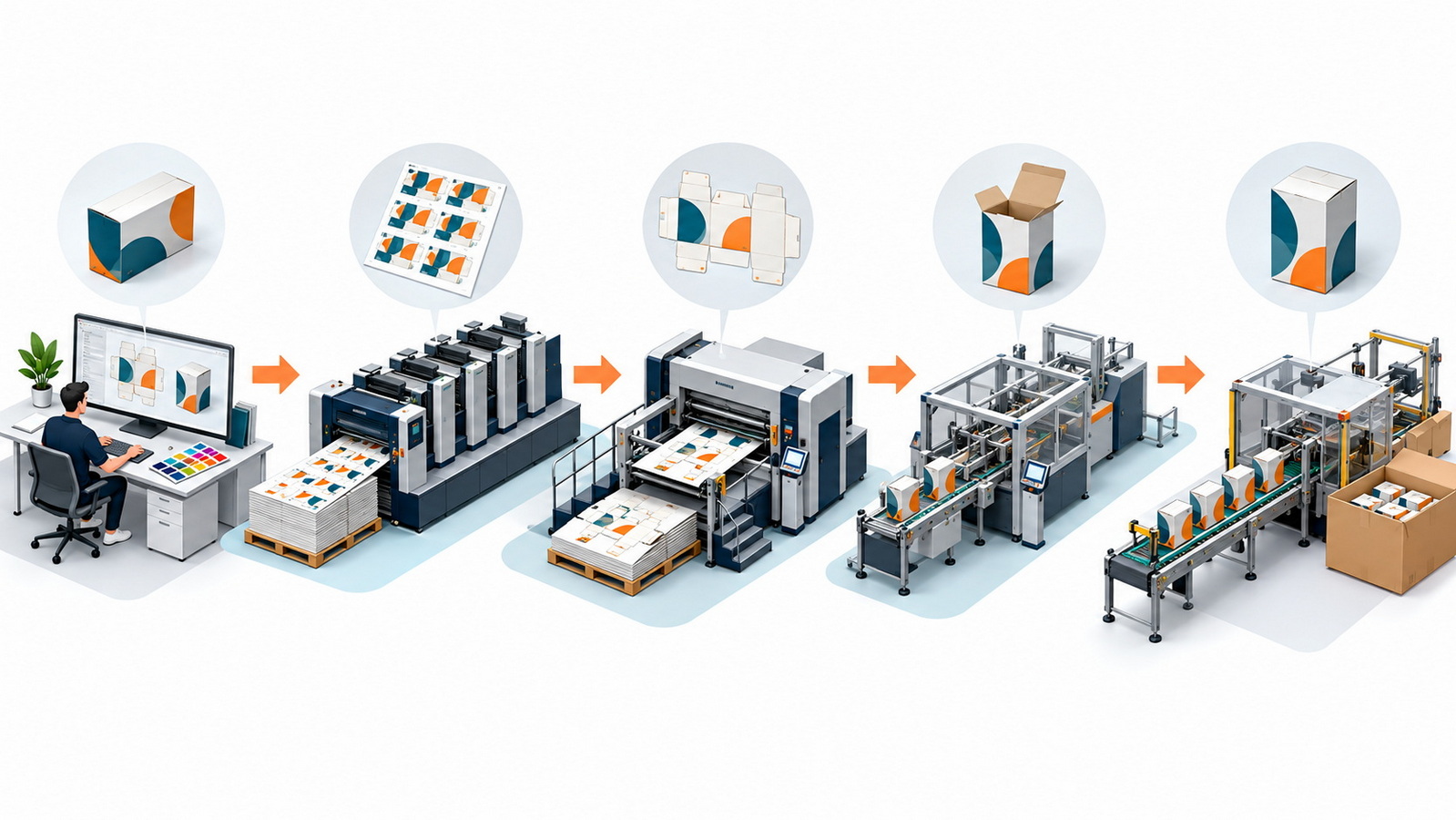
Estimate quantities for each design, language, size, and replenishment period.
A combined requirement of 20,000 cartons may involve ten different designs. That production pattern differs from 20,000 identical cartons.
Provide the dieline, board, print coverage, color requirements, coatings, finishing, and intended application.
Without a shared specification, competing quotations may describe different products.
Ask suppliers to price offset and digital against the same requirements where both are technically suitable.
Request separate visibility into setup, production, finishing, tooling, and delivery.
Confirm whether the sample uses the proposed production process, stock, and finishing.
A digitally printed prototype can help validate structure, but it may not reproduce an offset production result exactly.
Check appearance, dimensions, folding, adhesive performance, and equipment behavior.
Record approval criteria and retain a reference sample. For repeat orders, specify how material substitutions or process changes will be communicated.
A complete brief reduces delays and makes supplier comparisons more meaningful.
Include:
- Carton dimensions and dieline.
- Board type, grammage, and preferred caliper.
- Quantities per artwork version.
- Expected reorder frequency.
- Process and spot-color requirements.
- Coating, lamination, embossing, or foil requirements.
- Food-contact or other application constraints.
- Delivery location and required date.
- Relevant packaging-machine requirements.
Also clarify whether a quoted production schedule starts after artwork approval, sample approval, or material availability.
The best printing method is the one that supports the complete packaging job: appearance, cost, delivery, converting, and equipment performance.
For stable repeat designs, investigate offset economics. For changing artwork and smaller version quantities, investigate digital flexibility. Where appropriate, compare a combined workflow that separates fixed graphics from variable information.
Share your dieline, order quantities, artwork versions, board preferences, finishing requirements, and packaging-line details with HLun Pack. These inputs provide a practical starting point for discussing paper packaging and integrated packaging solutions.
Not universally. Offset can suit stable designs and larger repeat quantities. Digital can suit smaller runs and frequent changes. Compare the actual specification, finished samples, and total delivered cost.
There is no universal threshold. Setup charges, carton size, sheet layout, artwork versions, and finishing affect the crossover. Request matched quotations at several quantities to identify your project's break-even point.
It can reproduce many brand colors, but capability depends on the press and substrate. Some systems offer extended colors or spot inks. Approve a physical sample and agree on acceptable variation before production.
Not necessarily. Durability depends on ink or toner adhesion, stock, curing, coating, and handling. Assess rub resistance and folded samples under conditions relevant to the actual package.
Yes, provided the finished carton meets the equipment's requirements. Board stiffness, dimensions, creases, glue bonds, and surface behavior matter. A representative machine trial is advisable for new specifications.
Neither method establishes suitability by itself. The complete construction must be assessed for its intended use, including inks, coatings, substrate, potential migration, and relevant market requirements.
1. OXO Packaging — "Pros and Cons of Offset and Digital Printing," attributed to Waqas Khan Pitafi, dated January 2, 2026. The supplied article provided the initial comparison framework. Its absolute claims about ink, durability, cost, and environmental performance were not retained as general conclusions. [oxopackaging]
2. HEIDELBERG — "Digital Printing." Manufacturer information describing digital presses, specialty-color capabilities, hybrid workflows, and short-run finishing. Used to support the distinction between general printing categories and system-specific capabilities. [heidelberg]
3. HP — "HP Indigo Folding Cartons Printing Solutions." Manufacturer information on folding-carton applications, substrate ranges, specialty inks, and spot-color capabilities. Used to qualify claims about digital packaging flexibility and color limitations. [hp]
4. HP — "HP Indigo 35K Digital Press." Technical information identifying supported paperboards, additional substrate options, and interchangeable ink stations. Used as evidence that digital substrate and specialty-color capabilities vary by press. Manufacturer specifications are not guarantees for every packaging application. [hp]
5. European Printing Ink Association — "EuPIA Principles." Industry guidance covering food-contact printing inks, good manufacturing practices, supplier information, and Statements of Composition. Used for the food-packaging documentation discussion. [eupia]
6. European Printing Ink Association — "EuPIA Guideline on Printing Inks Applied to Food Contact Materials," May 18, 2023. Guidance addressing direct and non-direct food-contact inks, migration risk assessment, and circumstances requiring testing. Used to distinguish ink suitability from finished-packaging compliance. [eupia]
7. Cost-model and editorial disclosure — The pricing example is hypothetical and illustrates a break-even calculation; it is not a market benchmark, supplier quotation, or HLun Pack price. The purchasing workflow and inspection checklist are editorial recommendations, not claims of independently verified HLun Pack capabilities. No customer reviews were supplied or invented.


