


close
Choose Your Site
Global
Social Media
Views: 269 Author: HLun PACK Publish Time: 2026-09-14 Origin: Site


Content Menu
● Why Mango Packaging Matters for Fresh-Fruit Supply Chains
● The Mango Packaging System: More Than a Corrugated Box
>> Primary Packaging for Individual Mango Protection
>> Secondary Packaging: Ventilated Corrugated Mango Cartons
>> Reusable Crates and Wooden Containers
● How Mangoes Should Be Packed for Export
>> 1. Harvest at the Correct Maturity
>> 2. Sort, Grade, and Remove Defective Fruit
>> 3. Wash, Treat, and Dry the Fruit
>> 4. Pre-Cool Before Final Packing or Shipment
>> 5. Apply Internal Protection and Arrange Fruit Correctly
>> 6. Seal, Label, and Palletize the Cartons
● Cold Chain and Atmosphere: The Real Shelf-Life Strategy
● Choosing the Right Mango Carton Design
● Expert Checklist Before You Order Mango Packaging
● Paper Packaging and Equipment Solutions from HLun Pack
● Build a Better Mango Packaging System
>> 1. What is the best packaging material for mangoes?
>> 2. Why do mango cartons need ventilation holes?
>> 3. What temperature should mangoes be stored at during export?
>> 4. Can paper-based packaging protect mangoes effectively?
>> 5. Should mangoes be packed in plastic bags?
>> 6. How can exporters reduce mango bruising during transit?
Mangoes are highly sensitive to bruising, heat buildup, dehydration, and premature ripening. For growers, exporters, wholesalers, and retailers, effective mango packaging is therefore not simply a box-selection decision—it is a coordinated system that combines fruit maturity, protective materials, carton design, ventilation, cold-chain handling, traceability, and pallet stability.
At HLun Pack, we approach mango packaging as part of a complete paper packaging and packaging-equipment solution. The goal is to help fresh mango businesses move fruit from packhouse to destination with lower damage rates, better shelf presentation, more reliable logistics performance, and packaging that supports both commercial branding and environmental objectives.
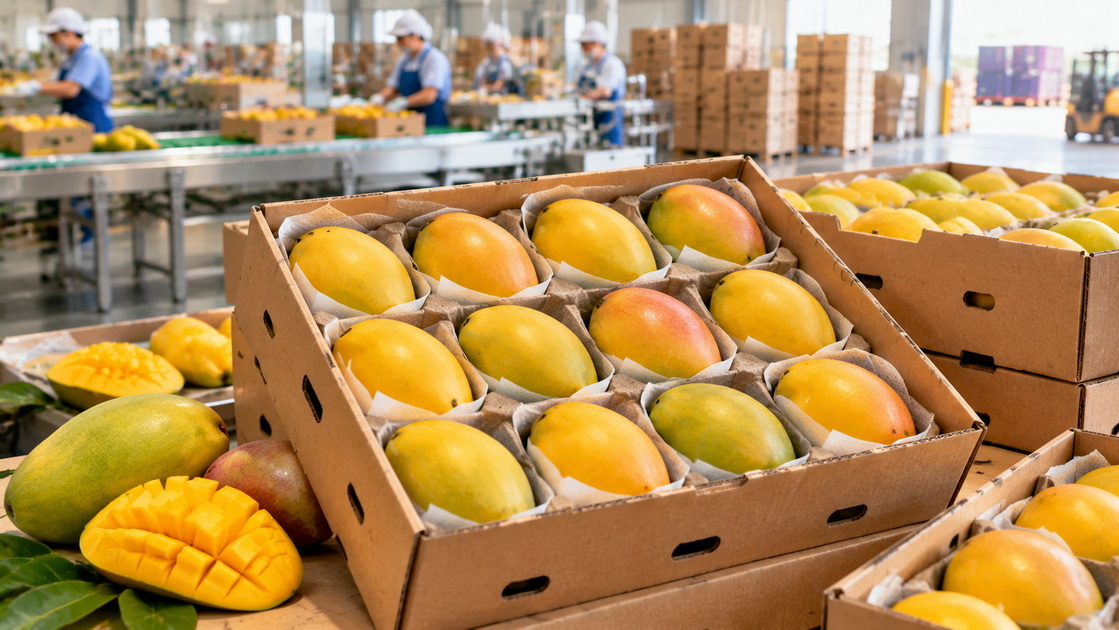
Mangoes continue to respire and ripen after harvest. Their quality can decline quickly when fruit is exposed to pressure, vibration, excess heat, poor airflow, condensation, or unsuitable storage temperatures. A mango may look perfect when packed but arrive with bruising, shriveling, skin damage, decay, or uneven ripening if the packaging and cold chain are poorly designed.
The right mango export packaging should perform several functions at once:
- Protect each mango from compression, vibration, and fruit-to-fruit abrasion.
- Allow sufficient airflow during cooling, storage, and refrigerated transport.
- Support stacking strength during warehousing and palletized shipment.
- Help control moisture loss without trapping excessive condensation.
- Provide a clean, food-contact-appropriate packing environment.
- Carry labels, handling marks, product details, and traceability information.
- Create a professional retail and export presentation.
Packaging is especially important because global mango trade continues to expand. OECD–FAO data reported that global imports of fresh mangoes, mangosteens, and guavas reached 2.4 million metric tonnes in 2024, up 4% year over year. Mangoes represented approximately 85% of global shipments within that combined product group.
For exporters, this growing market creates opportunity—but also raises buyer expectations. Importers increasingly expect consistency in carton strength, presentation, labeling, cleanliness, and temperature management.
A dependable packaging program should be designed as a system rather than as an individual packaging item. The box, liner, divider, fruit arrangement, closure method, pallet pattern, and handling process must work together.
Primary packaging refers to the materials that directly touch or separate the fruit. Its main purpose is to prevent impact damage and rubbing during transit.
Common options include:
- Paper wraps or tissue paper: Used to separate mangoes, reduce surface abrasion, and create a clean premium presentation.
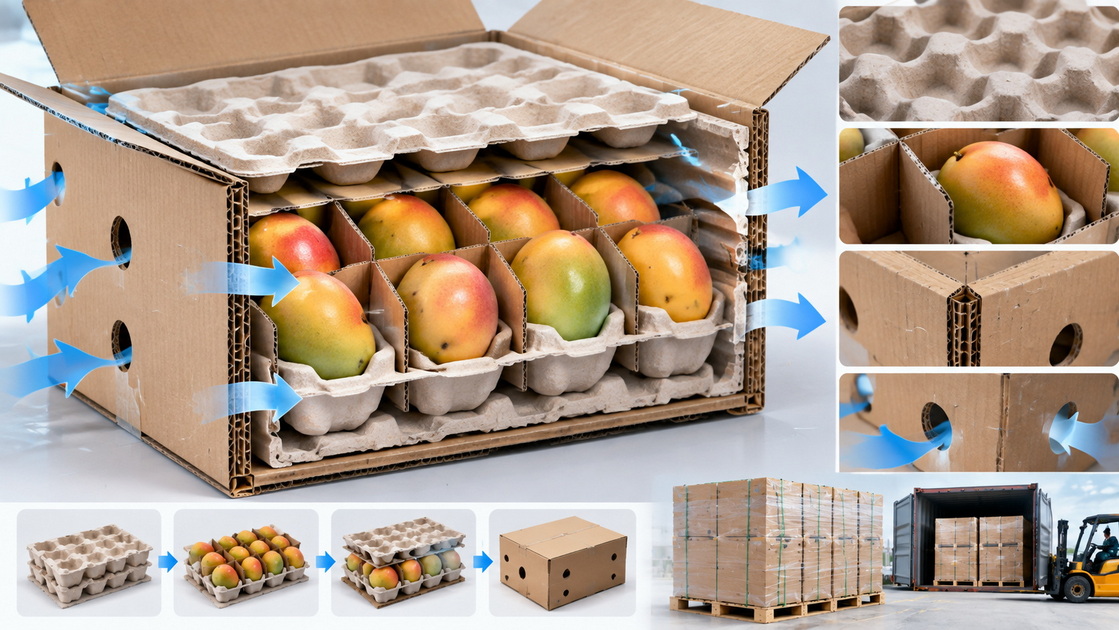
- Molded pulp trays: Formed paper-fiber trays that hold fruit in dedicated cavities and reduce fruit movement inside cartons.
- Corrugated paper dividers: Internal partitions that create individual cells or rows for mangoes.
- Paper cushioning pads: Placed at the top, bottom, or sides of a carton to reduce vibration and pressure.
- Perforated polymer liners: May be used selectively to help manage humidity, but must be matched carefully to the fruit, carton ventilation, and storage conditions.
- Foam net sleeves: Still common in some supply chains, particularly for high-value fruit, although paper-based protective alternatives may better align with plastic-reduction targets.
From a paper-packaging perspective, molded pulp trays, corrugated dividers, and tissue or paper wraps provide an opportunity to reduce plastic dependency while maintaining physical protection. The best option depends on fruit size, variety, degree of ripeness, shipping duration, destination requirements, and target price point.
For most commercial export and wholesale applications, ventilated corrugated boxes for mangoes are the leading choice. Corrugated fiberboard offers a practical balance of strength, printability, stackability, availability, and recyclability.
A well-designed mango carton should include:
- Adequate board strength for the planned stacking height and humidity exposure.
- Vent holes positioned to support airflow through the packed carton.
- Hand holes that do not weaken critical load-bearing areas.
- Internal dimensions matched to fruit count, fruit size, and tray or divider design.
- A secure top closure for manual or automated packing lines.
- Compression-resistant corners and panels.
- Clear handling instructions, such as "Keep Refrigerated," "Do Not Drop," and "This Side Up."
- Space for brand graphics, country of origin, variety, pack date, grower code, and lot number.
FAO guidance notes that cartons or fiberboard boxes for mangoes should include side ventilation holes and may use a vertical divider to help prevent heat buildup inside the carton.
However, ventilation is not simply a matter of cutting more holes. Too little ventilation can restrict cooling and encourage heat accumulation. Too much ventilation can reduce carton compression strength and contribute to moisture loss. The correct design requires a balance between airflow, structural performance, fruit protection, and the conditions of the actual cold chain.
Plastic crates and wooden crates can also be used in local distribution or specific handling systems. Their benefits may include reusability and rigidity. However, they may require extra internal cushioning, may offer limited branding space, and may be less convenient for one-way export shipments.
For premium export programs, corrugated cartons are often preferred because they can be printed, sized for pallets, designed for ventilation, and supplied flat for efficient storage before use.
The following workflow provides a practical framework for packing fresh mangoes safely. Individual protocols should still be adapted to the cultivar, maturity stage, importing country, phytosanitary treatment, buyer specification, and transport route.
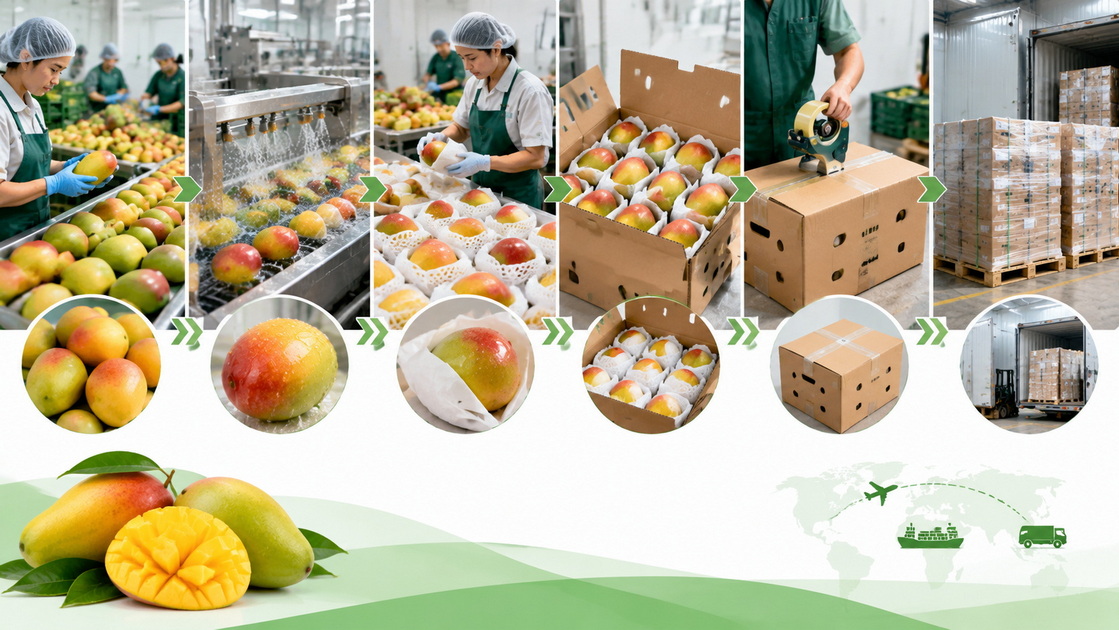
Start with mature-green mangoes that meet the target market's quality and maturity requirements. Fruit packed too early may not ripen properly. Fruit packed too late may soften too quickly and become vulnerable to bruising during shipment.
Avoid harvesting during excessively hot conditions whenever possible. Move harvested mangoes out of direct sunlight quickly to limit field heat buildup.
At the packhouse, inspect mangoes for:
- Cuts, punctures, latex staining, and skin defects.
- Disease symptoms or signs of decay.
- Bruising and soft spots.
- Incorrect size or weight for the intended carton count.
- Fruit that is too ripe for the planned journey.
- Excessive sap residue or dirt.
Packing defective fruit into a high-quality carton does not solve a quality problem. Strong export results begin with disciplined grading and rejection standards.
Depending on destination-market requirements and operational protocols, mangoes may undergo washing, sanitation, hot-water treatment, hot forced-air treatment, or other approved phytosanitary procedures.
USDA materials note that authorized treatments can include high-temperature forced-air treatment or hot-water dip treatment before storage and shipment.
After washing or treatment, fruit must be adequately dried before packing. Surface moisture can contribute to mold growth, staining, weakened cartons, and condensation inside the package.
Removing field heat is one of the most important postharvest controls. Cooling slows physiological activity, reduces water loss, and supports a more stable shelf life.
UC Davis recommends approximately 13°C (55°F) for mature-green mangoes and 10°C (50°F) for partially ripe or ripe mangoes, with relative humidity generally maintained at 90–95%. The correct temperature depends on cultivar and maturity, so exporters should validate the program with their produce specialists and buyer requirements.
Place mangoes into paper wraps, trays, or divider cells so that fruit cannot rub heavily against neighboring fruit or the carton walls.
For best results:
- Use a consistent fruit count per carton.
- Avoid overfilling the carton.
- Keep individual mangoes stable rather than loose.
- Use top pads or cushioning where necessary.
- Match the divider or tray cavity to the mango's size and shape.
- Ensure carton closure does not press directly onto fruit.
A poorly sized carton creates empty space and movement. An overfilled carton creates compression damage. Both conditions can increase claims, waste, and retailer dissatisfaction.
Use a secure closure method appropriate to the box design and distribution environment. Depending on the operation, this may involve tape, hot-melt adhesive, interlocking tabs, or automated carton-closing equipment.
Each carton should carry accurate and legible information, including:
- Product name and mango variety.
- Country of origin.
- Net weight or piece count.
- Grower, packer, or exporter identification.
- Lot code and packing date.
- Storage instructions.
- Traceability data required by the market.
- Retail or importer branding, where applicable.
Stack cartons on pallets using an interlocking pattern designed to preserve airflow and prevent overhang. Avoid blocking ventilation openings. Corner boards, stretch wrap, and pallet straps may be used according to the route and load-stability requirement.
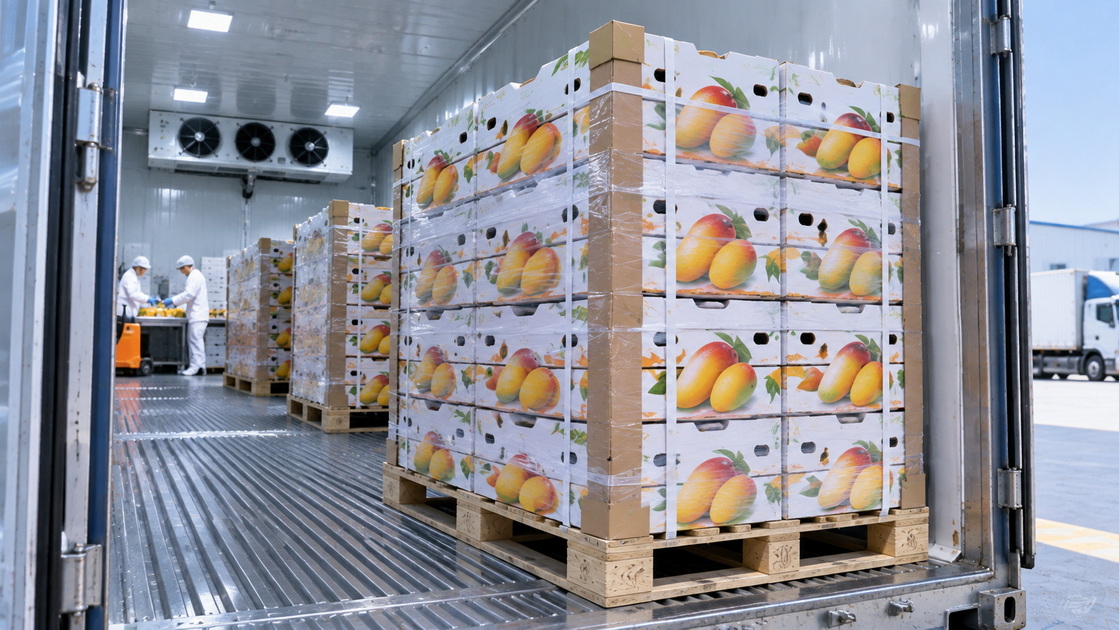
Packaging supports mango quality, but packaging alone cannot compensate for temperature abuse. The cold chain must remain stable from packhouse through refrigerated transport, port operations, customs clearance, distribution centers, and retail back rooms.
For mature-green mangoes, the Mango Quality Project's best-practice manual identifies 12°C (54°F) as the lowest safe temperature for long-term exposure of two weeks or more; it also warns that immature fruit may be injured even above that threshold. It recommends refrigerating marine containers or truck trailers at 10–12°C (50–54°F) and maintaining approximately 85% relative humidity.
Controlled atmosphere and modified atmosphere approaches can extend storage potential, but they require careful validation. UC Davis lists a controlled-atmosphere range of 3–5% oxygen and 5–8% carbon dioxide for mangoes, while warning that exposure below 2% oxygen or above 8% carbon dioxide may cause discoloration, grayish flesh, and off-flavors.
The ideal mango packaging box varies by market. A local wholesale shipment, premium supermarket program, air-freight order, and ocean-freight export route have very different technical requirements.
| Packaging factor | Local distribution | Retail-ready program | Long-distance export |
|---|---|---|---|
| Primary goal | Fast handling and low cost | Appearance and shopper convenience | Protection, airflow, and shelf-life management |
| Typical outer pack | Open-top tray or corrugated carton | Printed corrugated display carton | Heavy-duty ventilated corrugated export carton |
| Internal protection | Basic paper or loose arrangement | Trays, dividers, tissue, or molded pulp | Precision trays/dividers plus top and bottom cushioning |
| Labeling needs | Basic product details | Brand, variety, origin, retail graphics | Full traceability, importer marks, handling instructions |
| Structural requirement | Moderate stacking strength | Moderate to high | High compression strength under cold-chain humidity |
| Best equipment focus | Erecting and closing efficiency | Printing, display conversion, labeling | Carton forming, tray loading, sealing, coding, palletizing |
For example, a premium retailer may prefer clean, branded cartons with molded pulp inserts and consistent fruit count. An exporter shipping by refrigerated container may prioritize board strength, ventilation alignment, traceability, and compatibility with pallet airflow.
Before finalizing a mango packaging design, collect operational details from the grower, packhouse, exporter, logistics provider, and buyer.
Use this checklist:
1. What mango variety, size range, and maturity stage will be packed?
2. How many fruit pieces or kilograms are required per carton?
3. What is the total transit time from packing to retail shelf?
4. Is the product shipped by road, air freight, or refrigerated ocean container?
5. What temperature and humidity conditions will the fruit experience?
6. Does the buyer require individual wrapping, trays, dividers, or plastic reduction?
7. What labeling, language, lot coding, and traceability rules apply?
8. What pallet size, stacking height, and container-loading method will be used?
9. Does the carton need premium retail printing or only transport marks?
10. Which packaging equipment is needed for forming, loading, sealing, labeling, or palletizing?
The answers help determine the most effective carton dimensions, corrugated grade, ventilation pattern, internal protection system, printing method, and automation level.
HLun Pack supports businesses that need more than a standard shipping box. As a paper packaging and packaging-equipment manufacturer, we can help develop integrated systems for fresh-fruit operations.
Our potential solution scope includes:
- Custom corrugated mango cartons with export-oriented ventilation layouts.
- Printed retail-ready fruit packaging.
- Corrugated dividers and paper-based internal supports.
- Molded-pulp fruit trays for premium mango protection.
- Carton erecting and carton sealing equipment.
- Labeling, coding, and traceability workflow support.
- Packaging-line planning for higher-volume fruit packing operations.
- Pallet-ready packaging designs that improve warehouse and transport efficiency.
A better packaging system can reduce unnecessary fruit movement, improve packhouse consistency, create more reliable carton performance, and give your product a stronger presentation in export and retail markets.
High-quality mango packaging protects more than fruit—it protects your margins, brand reputation, buyer relationships, and export potential. The most successful programs combine the right corrugated carton, internal paper protection, ventilation design, cold-chain discipline, labeling system, and packaging equipment.
If you are developing a new mango export carton, upgrading from plastic-heavy protection, or planning a more efficient fruit-packing line, contact HLun Pack to discuss a custom paper packaging and packaging-equipment solution tailored to your mango variety, shipment route, carton count, and market requirements.
For most commercial distribution and export applications, ventilated corrugated fiberboard cartons are a strong option because they combine printability, stacking performance, relative light weight, and recyclability. Internal protection—such as molded pulp trays, corrugated dividers, tissue paper, or other separators—should be selected based on mango size, shipping distance, and buyer requirements.
Mangoes produce heat as they respire. Ventilation openings support airflow during pre-cooling, cold storage, and refrigerated transport, helping reduce heat buildup inside the carton. Vent design must still preserve sufficient box strength and avoid excessive moisture loss.
Temperature depends on mango maturity and cultivar. UC Davis lists approximately 13°C (55°F) for mature-green mangoes and 10°C (50°F) for partially ripe or ripe mangoes. Long-term exposure below the safe threshold can cause chilling injury, so exporters should follow variety-specific and buyer-specific requirements.
Yes. Paper-based solutions such as molded-pulp trays, corrugated dividers, tissue wraps, and cushioning pads can reduce fruit movement and impact damage when engineered correctly. The material, cavity size, carton dimensions, and stacking conditions must be tested as a complete system.
Perforated polymer liners may be useful in some controlled or modified-atmosphere systems because they can help manage humidity. However, liner selection must be compatible with respiration, carton ventilation, temperature control, and transit duration. Incorrect atmospheric conditions can contribute to off-flavors or physiological damage.
Use correctly sized cartons, individual fruit separation, cushioning, suitable fruit counts, strong corrugated board, stable pallet patterns, controlled loading practices, and continuous cold-chain management. Avoid overfilling cartons and prevent cartons from being dropped, crushed, or stacked beyond their design limit.
1. [Oxo Packaging, "A Detailed Guide on How Mangoes Are Packaged Safely"] — Reviewed as the source article for content-gap analysis and topic coverage.
2. [UC Davis Postharvest Research and Extension Center, "Mango: Recommendations for Maintaining Postharvest Quality"] — Storage temperatures, relative humidity, controlled-atmosphere guidance, and postharvest-life information.
3. [FAO, "Post-harvest Management"] — Mango packing guidance, crate handling, corrugated box ventilation, and airflow considerations.
4. [FAO, "Post-harvest Management Procedures That Are Critical to Maintaining the Quality of Horticultural Crops"] — Temperature, humidity, ventilation, and perforated-film packaging principles for perishable produce.
5. [USDA Agricultural Research Service, *The Commercial Storage of Fruits, Vegetables, and Florist and Nursery Stocks*] — Commercial storage and treatment guidance for horticultural commodities.
6. [National Mango Board, *Best Practices Manual*] — Mango handling, cooling, storage, container, pallet, and transport guidance.
7. [OECD–FAO Agricultural Outlook 2025–2034, "Other Products"] — Global fresh mango, mangosteen, and guava import data and trade context.


