


close
Choose Your Site
Global
Social Media
Views: 277 Author: HLun PACK Publish Time: 2026-08-28 Origin: Site


Content Menu
● What Is a Mylar Bag for Food Storage?
● Mylar Bag Food Storage Chart: Which Foods Are Suitable?
● How Long Can Food Last in Mylar Bags?
● Choosing the Right Mylar Pouch Format
>> Stand-Up Pouches for Retail Dry Foods
>> Flat Pouches and Three-Side-Seal Bags
>> Quad-Seal and Side-Gusset Bags
>> Spouted Pouches Are Not for Standard Dry Storage
● Packaging Equipment for Mylar Food Storage
>> Vertical Form-Fill-Seal Machines
>> Premade Pouch Packing Machines
● Step-by-Step Mylar Bag Packaging Process
● Quality Controls That Protect Shelf Life
>> Seal-Area Contamination Control
>> Oxygen and Headspace Management
>> Traceability and Documentation
● Common Mylar Food Storage Mistakes
● Build a Reliable Mylar Packaging Line With HLun Pack
>> 1. Are Mylar bags suitable for all foods?
>> 2. What machine is best for packing rice into Mylar bags?
>> 3. Can a zipper pouch provide long-term storage on its own?
>> 4. Why do Mylar bags fail to maintain product freshness?
>> 5. Do oxygen absorbers replace nitrogen flushing?
>> 6. What food-packaging compliance documents should I request?
>> 7. How can HLun Pack help with a Mylar bag packaging project?
Mylar bag food storage is not simply about choosing a shiny pouch and filling it with dry food. For food brands, co-packers, and emergency-food producers, reliable shelf life depends on a controlled system: the right flexible pouch structure, dry and suitable product, accurately sized oxygen absorber or gas-flush process, repeatable heat sealing, and documented quality checks.
At HLun Pack, we work with flexible packaging operations where the real challenge is consistency at production speed. A Mylar bag food storage chart can be useful for planning products and pack sizes, but it should be paired with a clear equipment and validation strategy. This guide explains which foods suit metallized high-barrier pouches, how to select a packaging machine, and how to build a safer, more scalable food-storage packaging process.
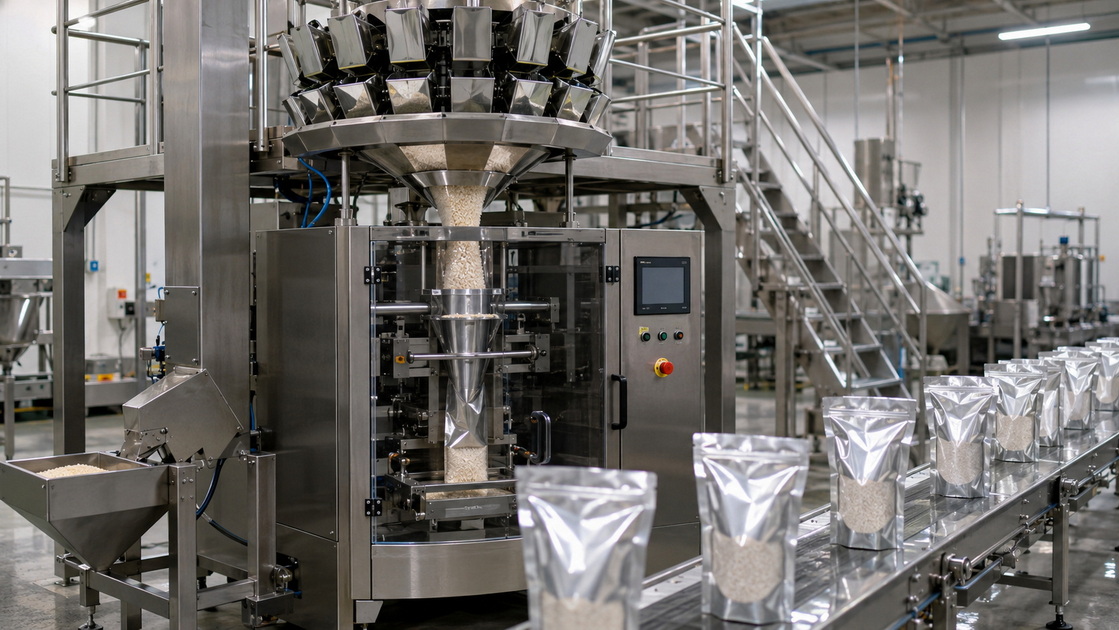
In commercial packaging, "Mylar bag" is commonly used to describe a flexible, high-barrier pouch made with a metallized polyester layer or a foil-based laminate. "Mylar" is a trade name historically associated with polyester film; it should not be treated as a universal material specification.
A food-storage pouch may include several layers designed to perform different jobs:
- Outer layer: Provides printability, scuff resistance, and mechanical strength.
- Barrier layer: Restricts oxygen, water vapor, light, or aroma transfer.
- Sealant layer: Creates a secure heat seal and must be suitable for food contact.
- Optional functional layers: Add puncture resistance, stiffness, resealability, or improved machine performance.
For long-term dry-food applications, the package should be selected based on measurable requirements—not appearance alone. These often include oxygen transmission rate (OTR), water-vapor transmission rate (WVTR), seal strength, puncture resistance, and compatibility with the selected packing machine.
Food packaging and its components can qualify as food-contact substances. In the United States, food-contact substances that are food additives must be authorized for their intended use before marketing.
The practical question is not, "Can this product fit into a Mylar pouch?" It is, "Can this product be safely and consistently packed in a low-oxygen, high-barrier environment?"
Dry, low-fat foods are generally the strongest candidates for long-term storage programs. High-moisture, high-fat, or perishable items require a different preservation plan, such as retort processing, refrigeration, freezing, or validated thermal treatment.
| Food category | Examples | Typical packaging approach | Key operational note |
|---|---|---|---|
| Dry staples | White rice, wheat berries, dry beans, lentils | High-barrier pouch + oxygen absorber + heat seal | Select product with low moisture and control seal integrity |
| Dry pasta and grains | Pasta, oats, cereal, dry corn | High-barrier pouch; absorber sizing depends on headspace | Watch for sharp edges and puncture risk |
| Freeze-dried foods | Freeze-dried vegetables, fruit, meals | High-barrier pouch + absorber; nitrogen flushing may also be used | Prevent crushing during conveying and filling |
| Powdered products | Milk powder, protein powder, soup mixes, seasoning | Auger filler + pouch machine; consider dust control | Use stable dosing and seal-area cleaning |
| High-fat products | Nuts, brown rice, oily snack mixes | Shorter-life strategy; evaluate oxygen and light protection | Fat oxidation can limit useful shelf life |
| Wet or refrigerated foods | Fresh meat, cooked meals, sauces | Do not use standard dry-food storage method | Require process-specific food-safety validation |
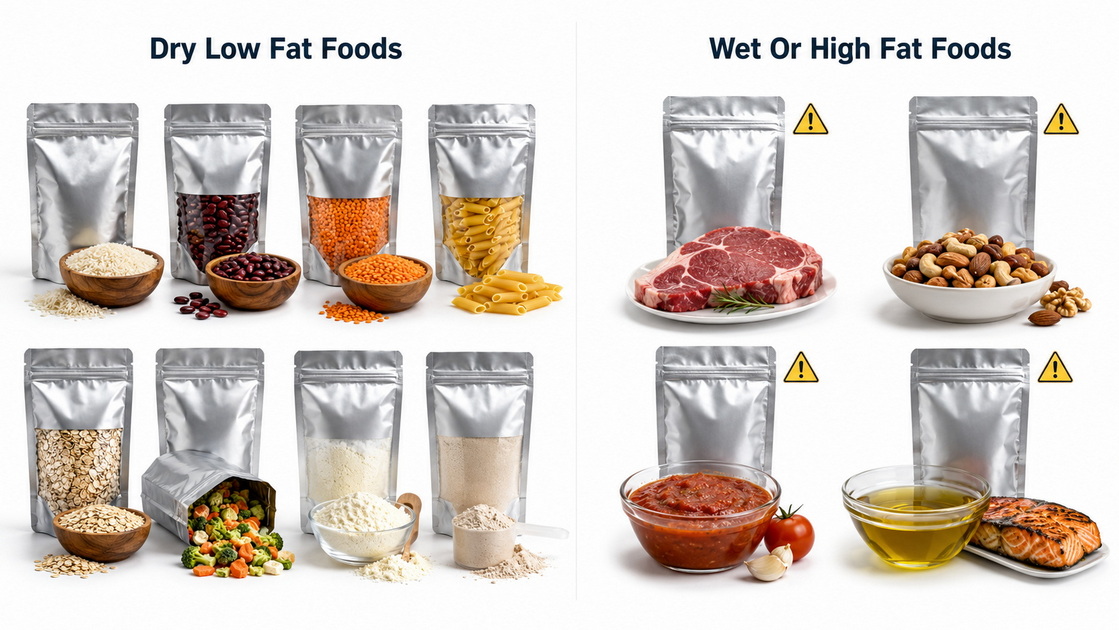
Industry guidance commonly limits oxygen-absorber storage systems to foods that are both low in moisture and low in fat. Moist foods, oily products, jerky, and refrigerated items should not be treated as standard long-term Mylar-storage products.
There is no universal shelf-life number for every food in every Mylar bag. Statements such as "all products last 25 years" are oversimplifications. Shelf life depends on the food formulation, initial moisture, fat content, microbial condition, oxygen level, package barrier, residual headspace, sealing quality, and storage environment.
Under well-controlled conditions, foods such as white rice, dry beans, lentils, pasta, rolled oats, and freeze-dried vegetables may be suitable for very long storage periods. In contrast, foods containing substantial oils or fats can deteriorate sooner because oxidation may cause rancidity even in a high-barrier package. Consumer-oriented storage charts place white rice, lentils, pasta, and rolled oats in a possible 20–30 year category when packaging and storage conditions are appropriate, while nuts, brown rice, and chocolate are generally much shorter-life products.
For food producers, the correct commercial approach is to establish shelf life with a documented validation plan:
1. Define the product's target moisture, water activity, and fat level.
2. Select pouch materials based on barrier and mechanical requirements.
3. Determine oxygen-absorber capacity or nitrogen-flush parameters.
4. Validate sealing temperature, pressure, and dwell time.
5. Run package-integrity and retained-sample testing.
6. Conduct real-time or accelerated shelf-life studies under defined storage conditions.
Expert insight: The packaging machine is not just a production asset. It is part of the food-preservation system. A small variation in seal contamination, jaw temperature, fill weight, or headspace can undermine the performance of an otherwise high-quality barrier pouch.
The pouch format should match the product flow characteristics, shelf presentation needs, filling method, and expected consumer use.
Stand-up pouches are suitable for grains, snacks, freeze-dried meals, granola, pet treats, and powdered food products. Their bottom gusset helps them stand on shelf, while zipper closures can improve consumer convenience after opening.
For long-term storage packs, a zipper should not be treated as the primary hermetic closure. The top of the pouch should typically receive a consistent heat seal above the zipper.
Flat pouches are efficient for single-use portions, sample packs, seasoning, powdered beverages, dehydrated ingredients, and compact emergency-food rations. They offer simple geometry and can be easier to run at high speed with suitable packaging equipment.
These bags provide a more structured appearance and can accommodate larger volumes of coffee, grains, powders, and premium dry-food products. Their multiple seals require careful machine setup and routine seal inspections.
Spouted pouches are useful for sauces, purees, gels, and other viscous products. However, wet products require a separate safety and preservation strategy. A high-barrier pouch alone is not a substitute for retort, hot-fill, aseptic, or refrigerated process validation.
For scalable production, choose equipment according to the product's physical characteristics—not only pouch shape. HLun Pack can help integrate filling, pouch handling, sealing, inspection, and secondary packaging into a complete flexible-packaging solution.
| Product type | Recommended filling system | Suitable packaging machine | Essential feature |
|---|---|---|---|
| Rice, beans, lentils, grains | Multihead weigher or volumetric cup filler | Preformed pouch packing machine or VFFS machine | Stable weight accuracy and gentle product handling |
| Flour, milk powder, protein powder | Auger filler | VFFS machine or rotary premade pouch machine | Dust extraction and seal-area cleaning |
| Pasta, snacks, freeze-dried foods | Multihead weigher | VFFS or premade pouch machine | Low-drop filling to reduce breakage |
| Spice sachets and small portions | Auger or volumetric dosing system | Sachet packing machine | High-speed dosing and precise sealing |
| Oxygen absorber insertion | Automatic or semi-automatic inserter | Integrated pouch packaging line | Accurate insertion timing and low exposure time |
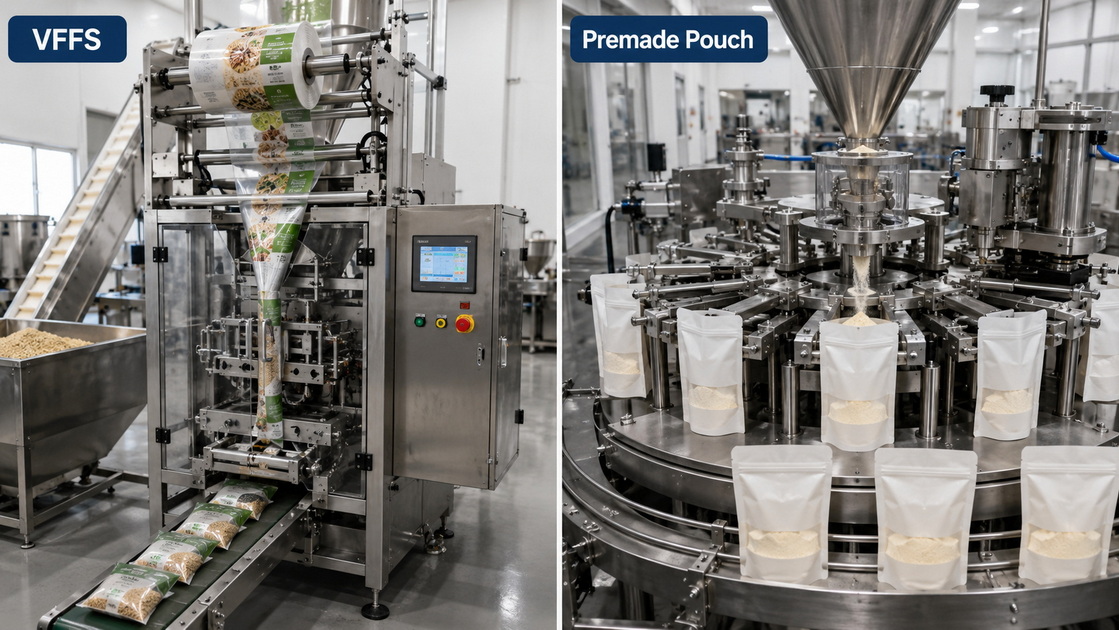
A vertical form-fill-seal (VFFS) machine creates bags from roll film, fills them, and seals them in one continuous process. It is often a practical choice for high-volume dry-food applications because it combines forming, filling, and sealing in a compact footprint.
VFFS systems work particularly well with powders, granules, grains, and snack products. They can be connected to multihead weighers, auger fillers, volumetric cup fillers, metal detectors, checkweighers, and case-packaging equipment.
A premade pouch machine is a strong option for brands using printed stand-up pouches, zipper pouches, flat pouches, or complex pouch styles. The machine opens, fills, and seals preformed bags, supporting premium shelf presentation and format flexibility.
This option is often preferable when the package needs a zipper, spout, handle, special shape, or high-quality preprinted graphics.
A repeatable process protects both product quality and brand reputation. The following workflow is a practical reference for dry-food packaging projects.
1. Confirm product suitability. Measure moisture and water activity, review fat content, and define the desired shelf-life target.
2. Choose the pouch structure. Select a food-contact-compliant laminate with the required barrier, sealability, puncture resistance, and print performance.
3. Set the fill weight and headspace. Avoid excessive air volume. Consistent fill height also supports stable sealing.
4. Dose product accurately. Match the filler to the product: auger filling for powders, multihead weighing for irregular solids, and cup filling for free-flowing granules.
5. Insert oxygen absorbers where appropriate. Use a controlled process that minimizes the time absorbers remain exposed before final sealing. Absorbers begin working when exposed to air and should not be reused.
6. Heat-seal the pouch. Validate temperature, pressure, and dwell time for the exact pouch structure and product condition.
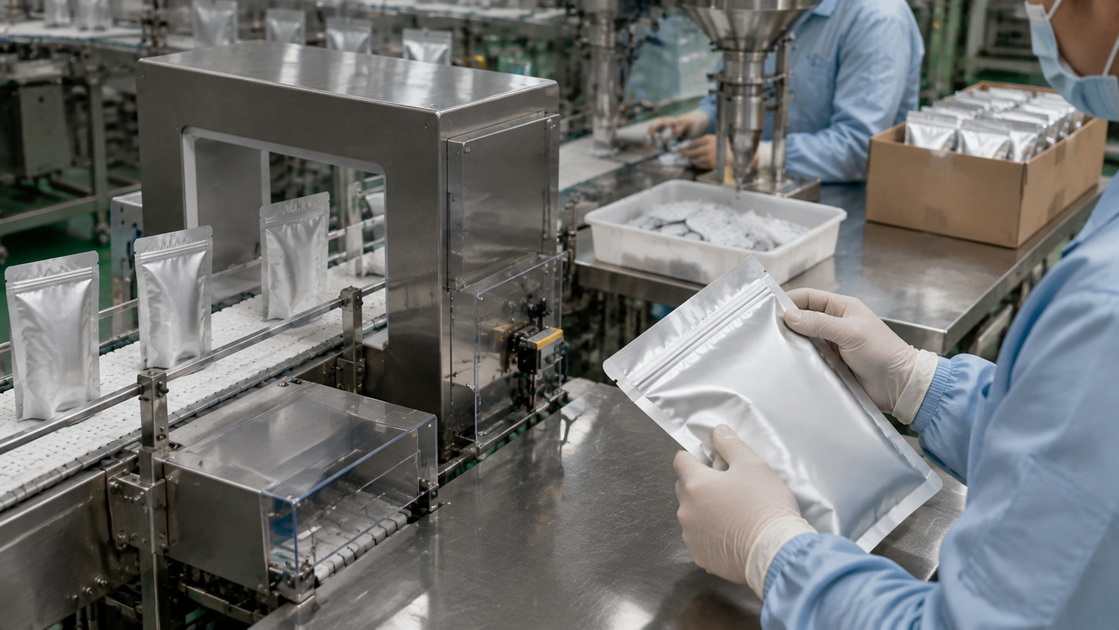
7. Inspect every critical package attribute. Check seal appearance, leak performance, fill weight, code readability, metal contamination, and pouch dimensions.
8. Label and store correctly. Record product name, lot code, packaging date, storage conditions, and recommended use-by information based on the validated shelf-life program.
The best material cannot compensate for inconsistent machine settings. A robust Mylar bag food-storage operation uses preventive controls at every stage.
Use a documented seal-validation process. Depending on the product and operation, this may include visual checks, burst testing, vacuum-decay testing, dye penetration, or other validated methods.
Powder, crumbs, granules, and product dust can enter the seal area. This creates channel leaks that may be difficult to see but can allow oxygen or moisture ingress over time.
Practical controls include:
- Product settling or vibration before sealing
- Dust extraction near the fill zone
- Seal-area cleaning devices
- Correct pouch fill height
- Routine inspection of sealing jaws and PTFE covers
Oxygen absorbers remove residual oxygen after sealing, but they are not a substitute for an intact pouch. Absorber capacity should be calculated according to package headspace, product characteristics, and production conditions. Consumer-oriented guides commonly suggest 300–500 cc absorbers for one-gallon dry-food bags, but commercial users should validate their own package system rather than treating this as a universal formula.
Every production batch should be traceable. Maintain records for film and pouch specifications, supplier declarations, machine parameters, oxygen-absorber lot numbers, fill-weight checks, seal-test results, inspection data, and finished-product release decisions.
Avoid these frequent errors when designing a high-barrier flexible-food packaging line:
- Using a "Mylar" label as a substitute for a verified barrier specification.
- Packing foods with excessive moisture or fat for long-term oxygen-absorber storage.
- Relying on a zipper closure instead of applying a final heat seal.
- Selecting a filler without accounting for powder dust, product breakage, or weight variation.
- Allowing product to contaminate the seal area.
- Installing a packaging machine without validating sealing settings for the actual pouch laminate.
- Promising a shelf-life duration without retained samples, testing, and documented evidence.
- Ignoring food-contact documentation for films, inks, adhesives, seals, and closures.
HLun Pack provides flexible packaging machinery and integrated packaging solutions for manufacturers that need more than a standalone machine. Whether you are packaging rice, dried beans, food powders, snacks, freeze-dried ingredients, or single-serve sachets, the right solution should be engineered around your product, pouch format, output target, quality controls, and future expansion plans.
Our team can help you assess:
- The best packaging-machine configuration for your product.
- Suitable filling and weighing systems.
- Pouch formats for retail, bulk, and long-term storage applications.
- Heat-sealing and inspection requirements.
- Integration of oxygen-absorber insertion, metal detection, checkweighing, conveying, and secondary packaging.
Talk to HLun Pack about your Mylar bag food-storage project. Share your product type, target pouch size, fill weight, desired output, and market requirements, and we will recommend a practical flexible-packaging line designed for reliable sealing, efficient production, and scalable growth.
No. They are most suitable for dry, low-fat foods when paired with an appropriate barrier pouch, correct sealing process, and—in relevant applications—oxygen absorbers. Wet, oily, fresh, or refrigerated foods require different preservation and safety controls.
A VFFS machine paired with a volumetric cup filler or multihead weigher is often effective for high-volume rice packaging. A premade pouch machine may be preferable for branded zipper pouches or premium stand-up formats.
A zipper improves resealability after opening, but it should not be considered the primary long-term hermetic closure. Apply a validated heat seal above the zipper for unopened storage packs.
Typical causes include poor pouch barrier performance, seal leaks, contaminated sealing areas, wrong sealing settings, damaged pouches, insufficient oxygen management, unsuitable food moisture, and inappropriate storage temperature.
Not always. Oxygen absorbers and nitrogen flushing serve different process objectives and may be used separately or together depending on the product, headspace, package structure, and validated shelf-life target.
Request documentation confirming the suitability of relevant food-contact materials, including films, adhesives, inks, coatings, and sealant layers, for the intended market and conditions of use. In the United States, food-contact substances are regulated according to their intended use.
HLun Pack can configure an integrated flexible-packaging solution that combines product feeding, weighing or dosing, pouch filling, oxygen-absorber insertion where needed, heat sealing, inspection, conveying, and secondary packaging.
1. OXO Packaging. "[Guide to Mylar Bag Food Storage Chart]." Original reference article reviewed for this content restructuring and gap analysis.
2. U.S. Food and Drug Administration. "[Food Packaging & Other Substances that Come in Contact with Food]." Guidance on food-contact substances and regulatory authorization principles.
3. Mylar Shop. "[Which Foods Can You Store in Mylar Bags?]." Consumer-oriented comparison of food categories and possible storage durations under suitable conditions.
4. Cubit Packaging. "[Mylar Bags + Oxygen Absorbers: Size Chart for 20+ Foods]." Reference for oxygen-absorber handling, general capacity ranges, and sealing workflow concepts.
5. Protocol Survival. "[Mylar Bags and Oxygen Absorbers: Food Storage Chart]." Reference for the distinction between suitable dry, low-fat products and unsuitable moist or oily foods.


