


close
Choose Your Site
Global
Social Media
Views: 267 Author: HLun PACK Publish Time: 2026-11-17 Origin: Site


Content Menu
● What Makes an Aluminum Foil Bag Safe for Boiling?
● Aluminum Foil Bags vs. Metallized Bags: Know the Difference
>> How Multilayer Foil Pouches Work
>> Why "Mylar Bag" Does Not Mean Boil-Safe
● Does Aluminum Leach into Food During Boiling?
>> Acidic and Salty Foods Need Particular Attention
>> Food-Contact Suitability Covers More Than Aluminum
● Boil-in-Bag Pouches vs. Retort Pouches
>> Why Boiling Is Not Commercial Sterilization
● How to Boil Food in an Approved Foil Pouch
>> A Practical Heating Checklist
>> Avoid Unapproved Heating Methods
● How to Validate Boil-in-Bag Packaging on a Production Line
>> 1. Define the Product and Heating Conditions
>> 2. Establish a Repeatable Sealing Window
>> 3. Check Packages Before and After Heating
● What Documentation Should Packaging Buyers Request?
● Common Buying Mistakes to Avoid
● Plan Your Packaging System with HLun Pack
>> Can I boil any aluminum foil bag?
>> Are aluminum foil bags safe for tomato sauce?
>> How long can I boil a foil pouch?
>> Is a retort pouch automatically microwave-safe?
>> Can boiling a sealed pouch make homemade food shelf-stable?
>> Can I reuse a boil-in-bag pouch?
>> What should I do if a pouch leaks during heating?
It is safe to boil food in aluminum foil bags only when the complete pouch is specifically designed and validated for that use. A silver finish, a food-grade description, or a strong seal does not prove boiling suitability. The material structure, food-contact layer, heating duration, and package integrity all matter.
For food manufacturers, the question extends beyond whether a bag survives hot water. The package must remain suitable for food contact, maintain its seals, and protect the product throughout its intended processing and handling conditions.
From a packaging-system perspective, I would evaluate the pouch, food, sealing equipment, and heating instructions together—not treat the aluminum layer as a standalone safety guarantee.
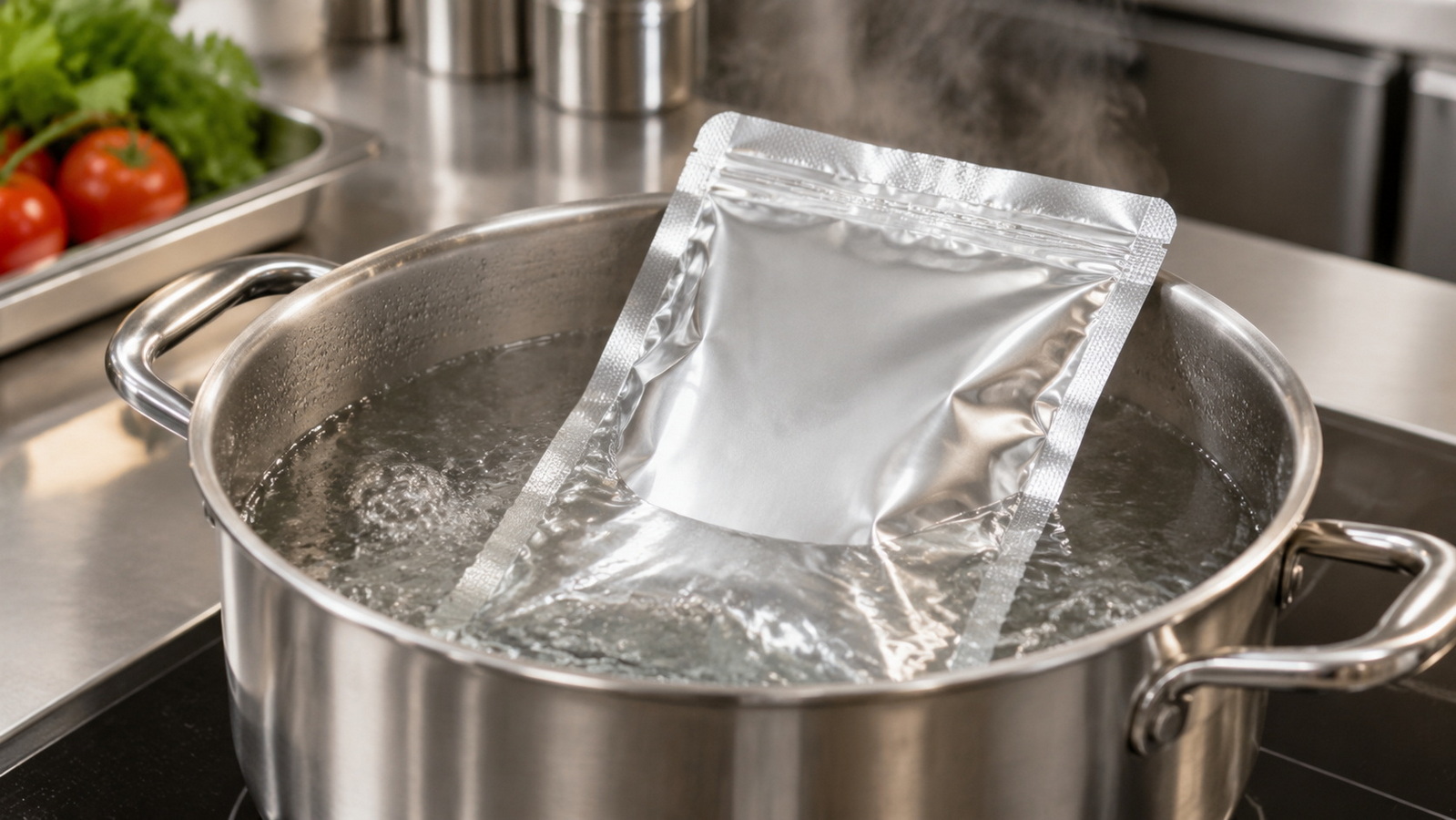
The key requirement is validated suitability for the intended food and heating conditions.
A pouch suitable for dry snacks may not be suitable for reheating soup. Likewise, a vacuum bag intended for refrigerated storage is not automatically a boil-in-bag cooking pouch.
Before boiling a packaged product, confirm:
- The manufacturer explicitly permits boiling or water-bath heating.
- The permitted temperature and duration cover the intended use.
- The packaging is suitable for the food's acidity, fat, and salt content.
- The pouch and seals remain undamaged.
- The instructions explain whether to heat the package sealed or opened.
If those details are unavailable, transfer the food to suitable cookware.
For commercial buyers, "heat resistant" should begin a technical discussion—not end one.
Silver-colored flexible packaging can use different constructions. Appearance alone cannot establish its performance.
An aluminum foil pouch typically combines several materials. Each layer performs a different function.
| Component | Typical purpose | What buyers should verify |
|---|---|---|
| Outer film | Printing support and handling resistance | Suitability for the heating environment |
| Aluminum foil | Barrier against light, oxygen, and moisture | Resistance to damage during intended use |
| Adhesive layers | Bonding the laminate together | Suitability for thermal processing |
| Inner sealant | Food contact and heat sealing | Food compatibility and validated sealing conditions |
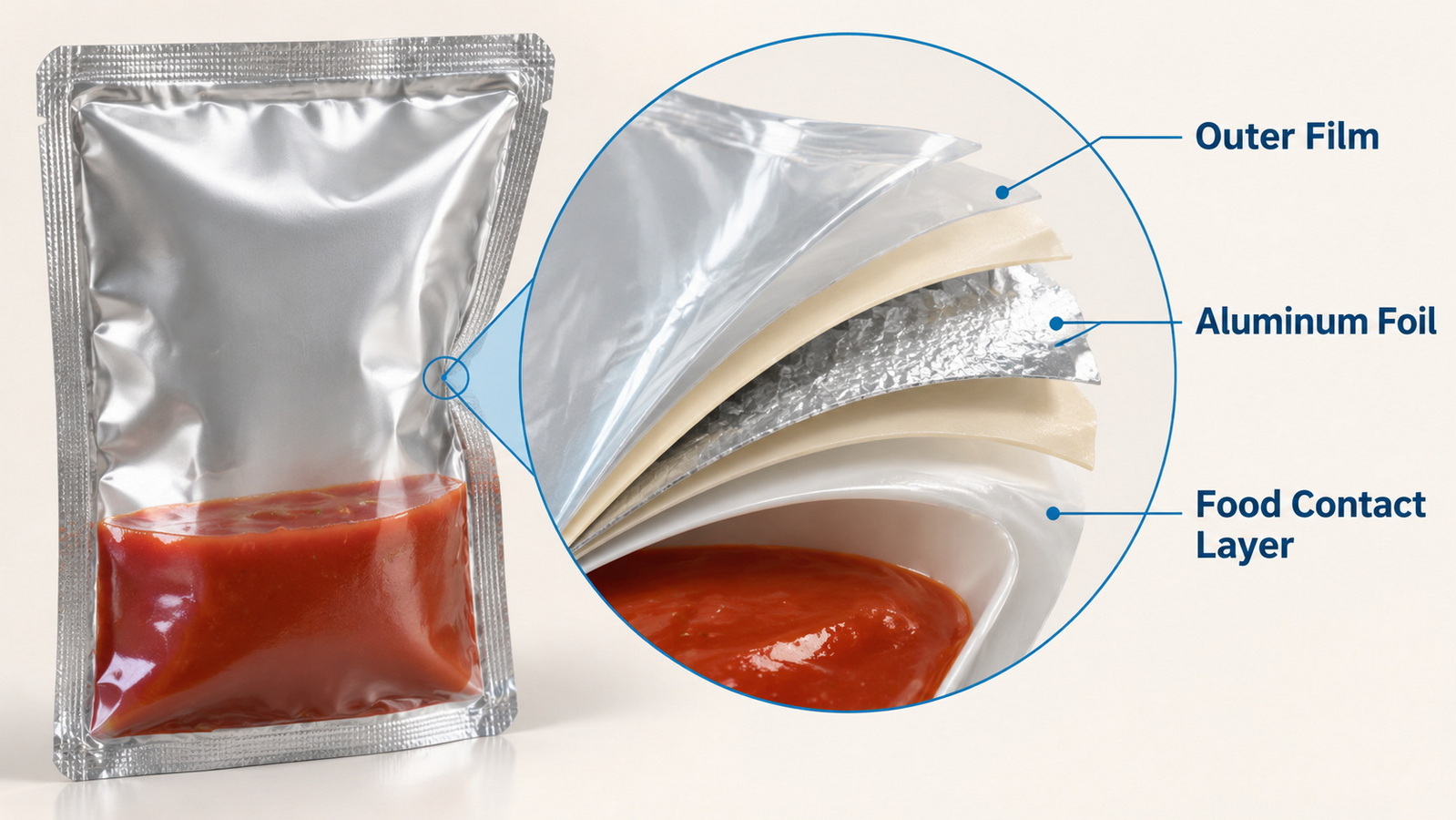
In a correctly designed laminate, food normally contacts the inner sealant rather than the aluminum foil.
That distinction matters: research about food touching bare aluminum cannot automatically describe food inside an intact, multilayer pouch.
"Mylar bag" is often used loosely in commercial descriptions. It does not identify a complete laminate or establish a cooking rating.
Metallized film carries a thin deposited metal layer; aluminum foil is a separate metal layer. Either may appear silver, but neither appearance confirms boiling suitability.
Ask for the actual construction and intended-use specification.
Aluminum can transfer into food when food directly contacts uncoated aluminum. Acidity, salt, temperature, and contact time influence that transfer.
This is why broad statements such as "aluminum migration is always negligible" are misleading.
Tomato sauces, citrus-based recipes, and salty marinades warrant careful material selection.
For bare aluminum, acids and salts can increase metal dissolution. In a laminated pouch, the relevant questions also include whether the inner layer remains intact and whether the complete structure is suitable for the recipe.
A practical review should consider:
- Food formulation and expected variations.
- Processing and reheating conditions.
- Contact time before and after heating.
- Laminate integrity after filling, transport, and handling.
A study involving uncoated trays is a reason to understand the contact surface—not proof that every foil laminate is unsafe.
The aluminum layer is only one part of the package.
The sealant, adhesives, and other components must also be appropriate for their intended use. Migration documentation should therefore correspond to the finished structure and relevant conditions, rather than an unrelated raw material.
Avoid using general health reassurance as a substitute for package-specific evidence.
These terms describe different applications, although some packaging systems may support both.
| Packaging category | Intended application | Important limitation |
|---|---|---|
| Storage pouch | Protecting food during storage | Storage suitability does not establish boiling suitability |
| Boil-in-bag pouch | Heating food in boiling water as directed | Time and temperature limits still apply |
| Retort pouch | Withstanding a specified commercial thermal process | The food process also requires validation |
| Vacuum pouch | Removing air before sealing | Vacuum capability does not establish cooking suitability |
Water boils at approximately 100°C at sea level. Commercial retort processing commonly uses higher temperatures under pressure; typical temperatures cited for retort foods are approximately 116–121°C.
These figures explain the distinction. They are not a processing recipe.
Boiling a homemade meal inside a sealed pouch does not establish that it is safe for room-temperature storage. Low-acid shelf-stable foods require an appropriately established process and controlled package integrity.
For a new shelf-stable product, involve a qualified thermal-processing specialist before finalizing packaging or equipment.
For consumers and food-service operators, the safest approach is to follow the product's specific instructions.
There is no universal boiling time for aluminum foil bags.
1. Check the label. Confirm that water-bath heating is explicitly permitted.
2. Inspect the package. Do not use pouches showing leakage, unexplained swelling, punctures, or separated layers.
3. Follow preparation instructions. Keep the pouch sealed only when directed; do not improvise venting.
4. Use the specified method. Follow the stated water level, heating duration, and starting condition.
5. Handle carefully. Use suitable utensils and protect against hot water and steam.
6. Open as directed. Keep your face and hands away from escaping steam.
7. Follow storage instructions. Heating does not reset the product's storage requirements.
Do not taste food from a suspect swollen or leaking package. Reheating is not a reliable way to make compromised packaged food safe.
Boiling suitability does not establish suitability for microwaves, ovens, pressure cookers, or direct flame.
Do not microwave a foil-containing pouch unless its instructions explicitly authorize that use. Similarly, do not put it into a pressure cooker simply because it is described as "retortable."
Each method creates different conditions.
For manufacturers, a pouch specification is only the starting point. Filling and sealing must consistently produce packages that retain their intended performance.
My recommended approach is to qualify the material and equipment as one system.
Document the conditions before requesting samples:
- Recipe, including acidity, salt, fat, and particulates.
- Fill weight and filling temperature.
- Pouch dimensions and product thickness.
- Refrigerated, frozen, or ambient starting condition.
- Maximum intended heating time and temperature.
- Storage and distribution conditions.
These details make supplier recommendations more meaningful and prevent comparisons between unsuitable samples.
Seal integrity depends on more than selecting a high temperature.
Sealing temperature, pressure, and dwell time must work together. Excessive heat or pressure can damage a seal, while insufficient conditions may leave incomplete bonding.
The filling process also matters. Oil, sauce, or particles in the sealing area can interfere with closure.
When evaluating equipment, consider:
- Filling accuracy and nozzle control.
- Pouch positioning and mouth opening.
- Protection of the sealing area from contamination.
- Repeatable jaw pressure and dwell time.
- Cooling requirements.
- Reject handling and production records.
Do not copy settings from another laminate without verification.
A pouch that looks acceptable immediately after sealing may perform differently after thermal exposure.
A practical qualification plan should include visual examination, appropriate seal-strength testing, and suitable leak or integrity testing.

Check for:
- Channels or wrinkles crossing the seal.
- Product trapped in the seal.
- Seal creep or partial opening.
- Delamination, fractures, and punctures.
Strength and leak tests answer different questions. A strong section of seal does not prove that the entire package is leak-free.
Set acceptance criteria with the packaging supplier, food-safety team, and relevant specialists.
A technical purchasing checklist helps separate a credible proposal from a vague "boil-proof" claim.
| Document or evidence | What it should clarify |
|---|---|
| Laminate specification | Materials, construction, and controlled identification |
| Food-contact compliance information | Applicable market and intended-use limitations |
| Relevant migration evidence | Relationship to the food and heating conditions |
| Thermal-use specification | Permitted temperature, duration, and restrictions |
| Seal recommendations | Starting parameters and qualification requirements |
| Traceability information | Identification of material and production lots |
| Change-control agreement | Notification of relevant material or process changes |
Treat a generic certificate as supporting information, not automatic approval for every recipe and process.
If a supplier cannot connect the documentation to your actual pouch, request clarification before ordering production quantities.
Three shortcuts frequently weaken packaging decisions.
First, equating thickness with safety. A thicker pouch may still use unsuitable adhesives or sealants.
Second, assuming every retort pouch suits every process. Product geometry, fill weight, and processing conditions affect the complete system.
Third, judging success only by whether the bag bursts. Visible survival does not establish food-contact suitability, absence of small leaks, or adequate heating of the food.
The more useful purchasing question is: "What evidence supports this package for our exact application?"
HLun Pack focuses on flexible packaging equipment and integrated packaging solutions. A useful project discussion should connect pouch requirements with filling, sealing, inspection, and downstream handling.
Share your product formulation, target pack size, filling temperature, intended heating method, and production capacity with HLun Pack.
Request a project-specific review of material compatibility and equipment requirements before committing to production. This provides a clearer basis for trials, acceptance criteria, and investment decisions.
No. Use only a pouch explicitly specified for the intended boiling conditions. A silver appearance, food-grade description, or vacuum seal does not establish suitability.
They may be suitable when the finished laminate is validated for that acidic food and its processing conditions. Avoid assuming that bare aluminum and an intact, protective laminate behave identically.
Follow the product or packaging manufacturer's instructions. There is no universal safe duration because structures, foods, fill sizes, and intended uses differ.
No. Retort suitability does not establish microwave suitability. Follow explicit product instructions, particularly when the pouch contains aluminum.
No. Boiling alone does not establish commercial sterility or safe ambient storage. A suitable pouch cannot replace a validated food-preservation process.
Do not assume it is reusable. Unless the manufacturer explicitly provides reuse instructions, treat it as single-use packaging.
Stop using it and discard the affected food. Do not assume continued boiling will correct possible contamination or compromised packaging.
1. YLTPACK. "Is It Safe to Boil Food with Aluminum Foil Bags?" March 16, 2024. Original article used to identify the topic, existing coverage, and claims requiring qualification; not treated as primary safety evidence. [yltpacking]
2. German Federal Institute for Risk Assessment. "FAQs About Aluminium in Food and Products Intended for Consumers." July 20, 2020. Supports the discussion of direct aluminum contact, acidity, salt, temperature, contact duration, and protective coatings. [bfr.bund]
3. German Federal Institute for Risk Assessment. "BfR Research: Proof of the Transfer of Aluminium from Menu Trays to Food." June 9, 2017. Research concerns uncoated aluminum trays; its findings are not presented as direct measurements of multilayer pouches. [bfr.bund]
4. U.S. Department of Agriculture, Food Safety and Inspection Service. "Glossary of Packaging Terms." Definitions of boil-in-bag packaging, flexible containers, and retort packaging. [fsis.usda]
5. U.S. Department of Agriculture, Food Safety and Inspection Service. "Shelf-Stable Food Safety." Supports the explanation of retort-pouch construction, pressure processing, and typical commercial sterilization temperatures. [fsis.usda]
6. U.S. Department of Agriculture, Food Safety and Inspection Service. "Microbiology of Commercially Sterile and Shelf-Stable Products." Technical reference supporting sealing variables, package examination, and flexible-container defects. [fsis.usda]
7. U.S. Department of Agriculture, Food Safety and Inspection Service. "FSIS Directive 9900.2: Import Reinspection of Meat, Poultry, and Egg Products." Supports examples of pouch defects, including seal contamination, channels, seal creep, and delamination. [fsis.usda]
8. U.S. Department of Agriculture, Food Safety and Inspection Service. "Meat and Poultry Packaging Materials." Supports disposal guidance for swollen or leaking retort packages. [fsis.usda]


