


close
Choose Your Site
Global
Social Media
Views: 217 Author: Tom Publish Time: 2026-10-14 Origin: Hlunpack


When a packaging line is upgraded to a higher speed, one of the first questions is often: should the packaging film or sealing technology also change? Sometimes the answer is yes. But machine speed alone should never determine the sealing system.
A packaging line running at 100 packs/min does not automatically require cold seal. Likewise, a slower line does not automatically mean that conventional heat sealing is sufficient.
The more useful engineering question
How much thermal exposure can the product tolerate while the film still forms a reliable seal?
For products such as chocolate, ice cream, confectionery, protein bars, cereal bars and certain coated bakery products, localized heat near the seal area can affect product appearance, texture or dimensional stability. For other products, the same sealing conditions may have little practical effect.
This means sealing technology should be selected according to Machine Condition + Film Response + Package Geometry + Product Thermal Sensitivity, rather than machine speed alone.
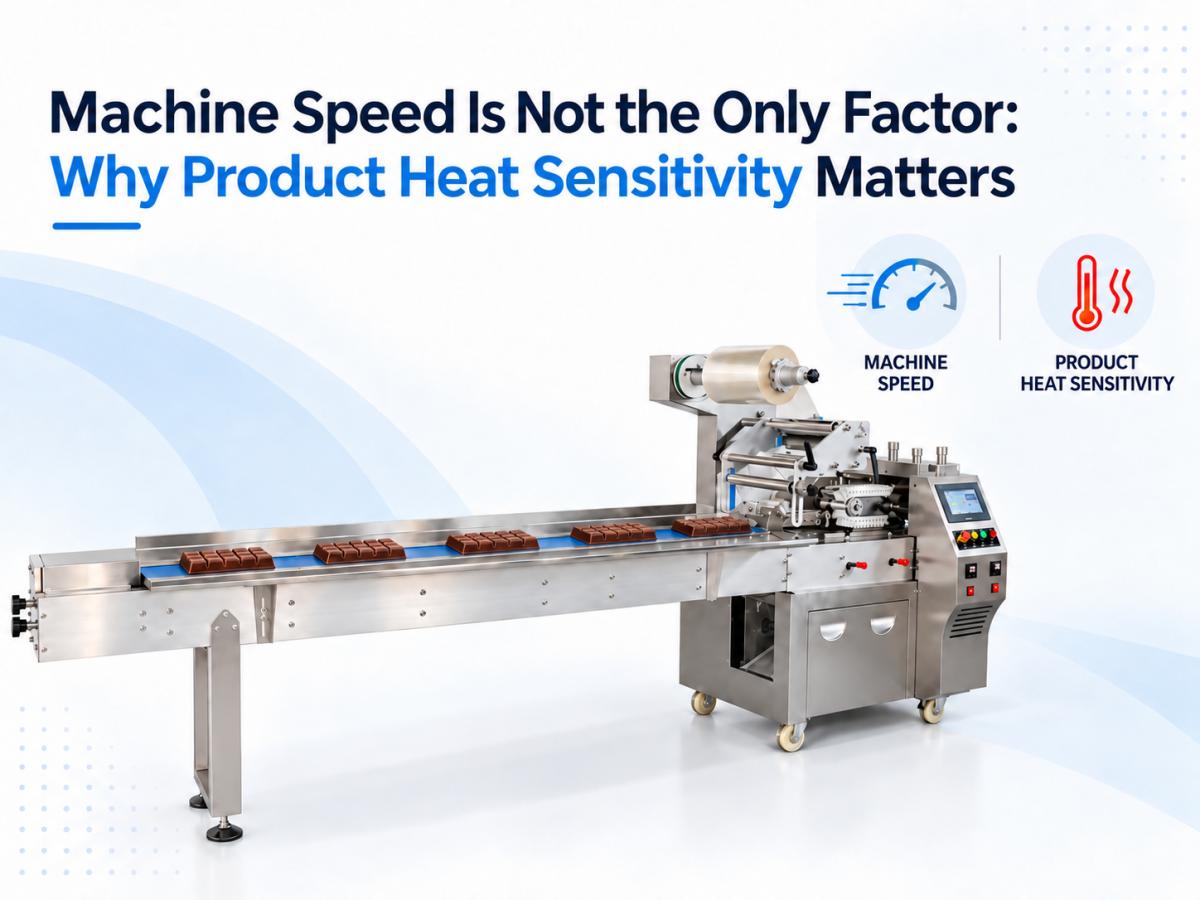
Packaging speed is often expressed as packs per minute. This is useful for production planning, but it does not completely describe what happens during sealing.
Two machines can both run at 100 packs/min while creating very different sealing conditions. The actual effective sealing time depends on web speed, pack pitch, sealing motion, jaw geometry and effective dwell time.
For example, a reciprocating cross-seal system and a continuous rotary sealing system may operate at the same package output while applying heat and pressure to the film in very different ways.
Engineering principle
Packs per minute is a production metric, not a complete sealing metric. When evaluating film performance, the more important question is how much effective contact time the sealing system provides.
As line speed increases, the time available for seal formation usually decreases. The film must still develop sufficient seal strength within this shorter cycle.
For a conventional heat-sealing system, the sequence can be simplified as Thermal Transfer -> Sealant Activation -> Seal Formation -> Initial Stabilization.
If the sealant responds too slowly, the result may be weak seals, partial seal formation, seal opening before cooling, leakage, film distortion or a narrow machine operating window.
Higher speed does not automatically mean that operators should simply increase temperature. Depending on machine design, compensation may instead involve a faster-responding sealant, pressure optimization, jaw geometry, cooling and controlled thermal input.
High-speed packaging is usually discussed as a productivity issue. But for heat-sensitive products, it is equally a thermal-management problem.
The packaging system must deliver enough thermal energy to create a reliable film seal without exposing the nearby product to an unacceptable amount of heat.
Two simultaneous requirements
The film needs enough energy to seal, while the product must stay within its thermal tolerance. The best condition is where both requirements can be satisfied at the same time.
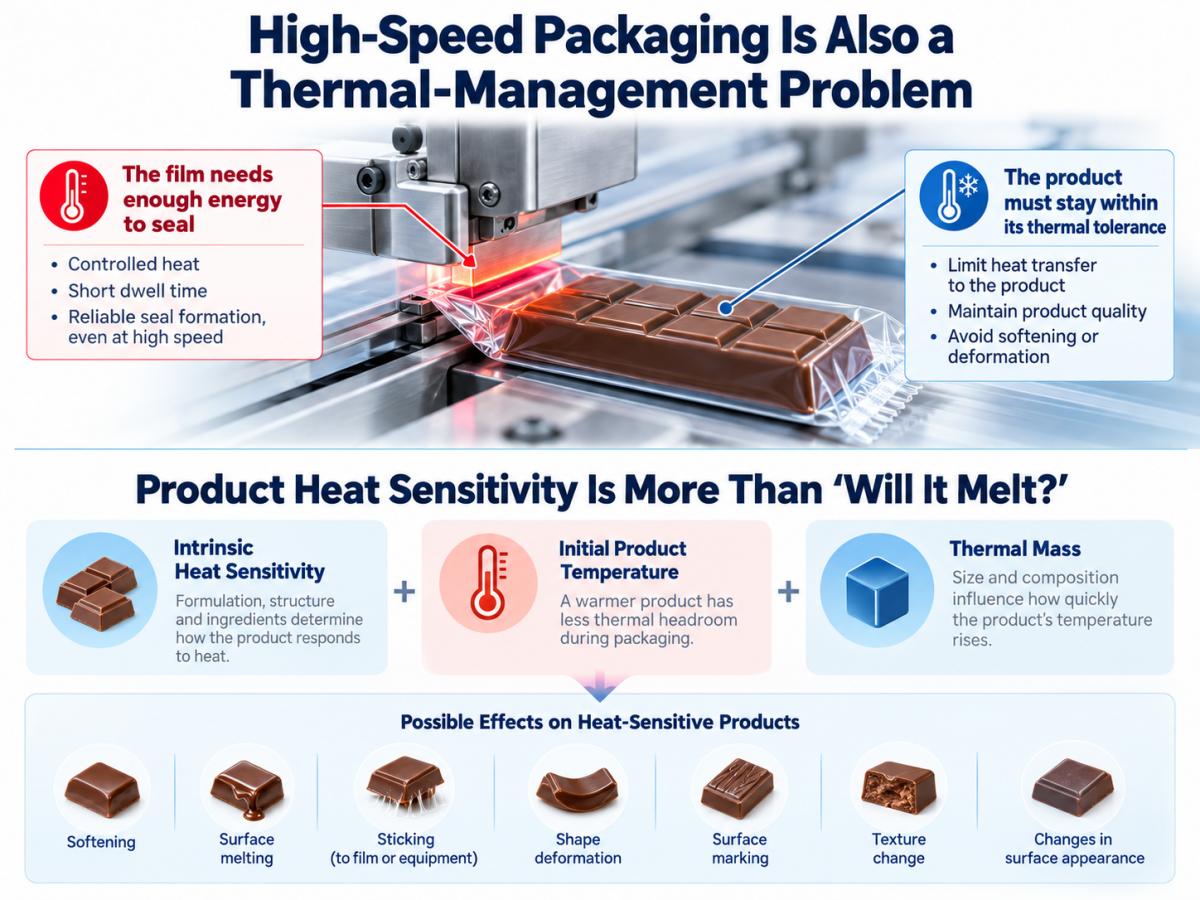
A heat-sensitive product is one whose quality, shape, texture, surface condition or process stability may change when exposed to heat.
Softening
Surface melting
Sticking
Shape deformation
Surface marking
Texture change
Changes in surface appearance
For chocolate-based products, unsuitable localized thermal exposure may also contribute to surface changes or fat migration under certain conditions.
Heat sensitivity should therefore not be treated as a simple sensitive / not sensitive classification. A more useful engineering model is Intrinsic Heat Sensitivity + Initial Product Temperature + Thermal Mass.
Two products made from similar ingredients can respond differently to sealing heat. A thin 10 g chocolate piece and a thick 100 g chocolate bar do not have the same mass, thickness, surface area or heat capacity.
Coatings, fillings and inclusions can also change local thermal behavior. The product response therefore depends on product mass, geometry, surface area, composition and initial temperature.
This is why actual packaging trials are more reliable than selecting a sealing technology solely from the product category.
The temperature of the product before it reaches the packaging machine is an important process variable. Consider two identical chocolate bars: one enters the line after adequate cooling, while the other enters already close to its softening range.
Even with the same film, machine, speed and sealing temperature, the warmer product may have a higher risk of softening, sticking, surface marking or deformation.
Thermal condition to evaluate
Initial Product Temperature + Packaging Thermal Exposure - not jaw temperature alone.
Product thermal risk cannot be evaluated from sealing temperature alone. Thermal exposure depends on both temperature and time.
A high jaw temperature applied for a very short effective dwell time is not necessarily equivalent to a lower temperature applied for a longer period. The thermal effect is also influenced by film thermal conductivity, film thickness, distance from the seal, air gap and product geometry.
Product heat sensitivity should therefore be evaluated against both temperature and exposure time, not sealing temperature alone.
Heat-sealing jaws normally act on the seal zone rather than directly heating the entire product. However, localized thermal energy can still reach nearby product through packaging film, trapped air, adjacent package surfaces and close physical proximity.
This is particularly important in horizontal flow wrapping, where the product edge may sit close to the cross-seal zone.
The practical question
How close is the product to the heated seal zone, and how much thermal energy can reach it during the available sealing cycle?
In HFFS and flow-wrap applications, the distance between the product edge and the cross-seal zone can significantly influence thermal exposure. A shorter distance increases the possibility of heat affecting the product, while a larger distance provides additional thermal separation.
Packaging engineers should therefore evaluate product length, bag pitch, headspace, cross-seal position and product registration. Sometimes a problem that appears to require a new film can be partly improved through better package geometry.
Machine speed and product heat sensitivity should not be treated as independent variables. As effective dwell time decreases, the film must develop seal strength faster.
One possible response is to increase thermal input. But for a heat-sensitive product, higher thermal input can also increase product thermal risk.
The engineering conflict
The film needs faster seal formation, while the product needs controlled thermal exposure. This is where different sealing routes must be evaluated.
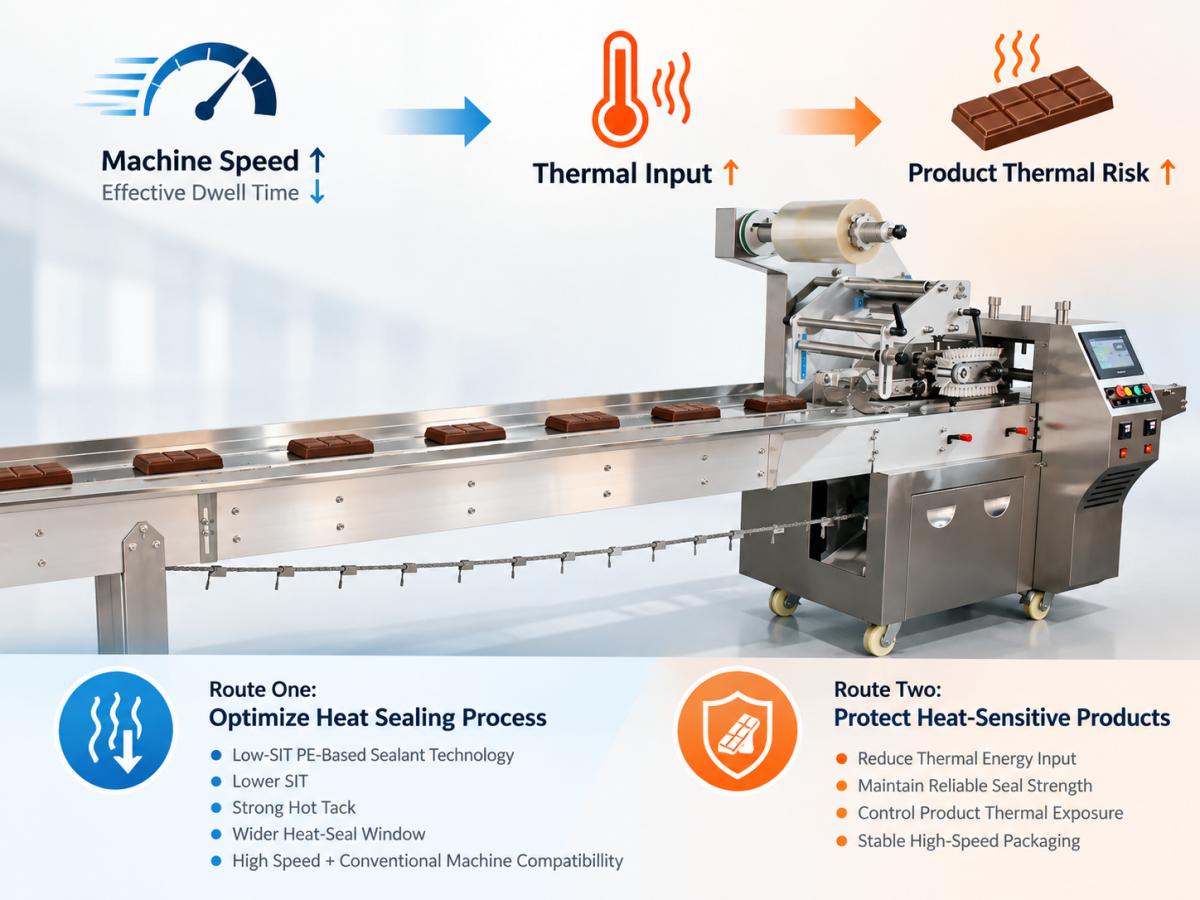
If the product can tolerate some thermal exposure, it may not be necessary to eliminate heat sealing. Instead, the system can be optimized using Low-SIT PE-based sealant technology.
The objective is not simply to reduce the temperature displayed on the machine. The real objective is to reduce the thermal energy required to develop sufficient seal strength within the available sealing cycle.
A high-performance sealant system may provide Lower SIT + Strong Hot Tack + Wider Heat-Seal Window. This can create a practical balance between high speed, conventional machine compatibility and controlled thermal exposure.
Low-SIT PE should not be judged only by its Seal Initiation Temperature. High-speed performance also depends heavily on hot tack because a newly formed seal may experience tension or product load before it has fully cooled.
It also depends on the heat-seal window because real packaging machines do not operate under perfectly constant conditions.
More meaningful technical target
Fast Seal Development + Strong Hot Tack + Broad Process Tolerance - rather than the lowest possible sealing temperature.
When product heat sensitivity becomes a dominant constraint, cold seal may become more attractive. Cold-seal packaging uses a self-sealing cold-seal coating plus pressure to form the primary package closure.
This largely bypasses the need to melt a thermoplastic sealant during package formation. Cold seal is particularly established in high-speed horizontal flow-wrap applications for chocolate, confectionery, ice cream, protein bars and cereal bars.
Its value comes from combining high throughput with reduced thermal exposure rather than speed alone.
A highly heat-sensitive product may justify evaluating cold seal, but the complete process must still be considered. Cold-seal systems require good control of coating contact, pressure, registration, film tension, release performance and machine compatibility.
Seal contamination can also reduce effective contact between cold-seal-coated surfaces. Heat sensitivity may justify cold-seal evaluation, but heat sensitivity alone does not guarantee that cold seal is the best final solution.
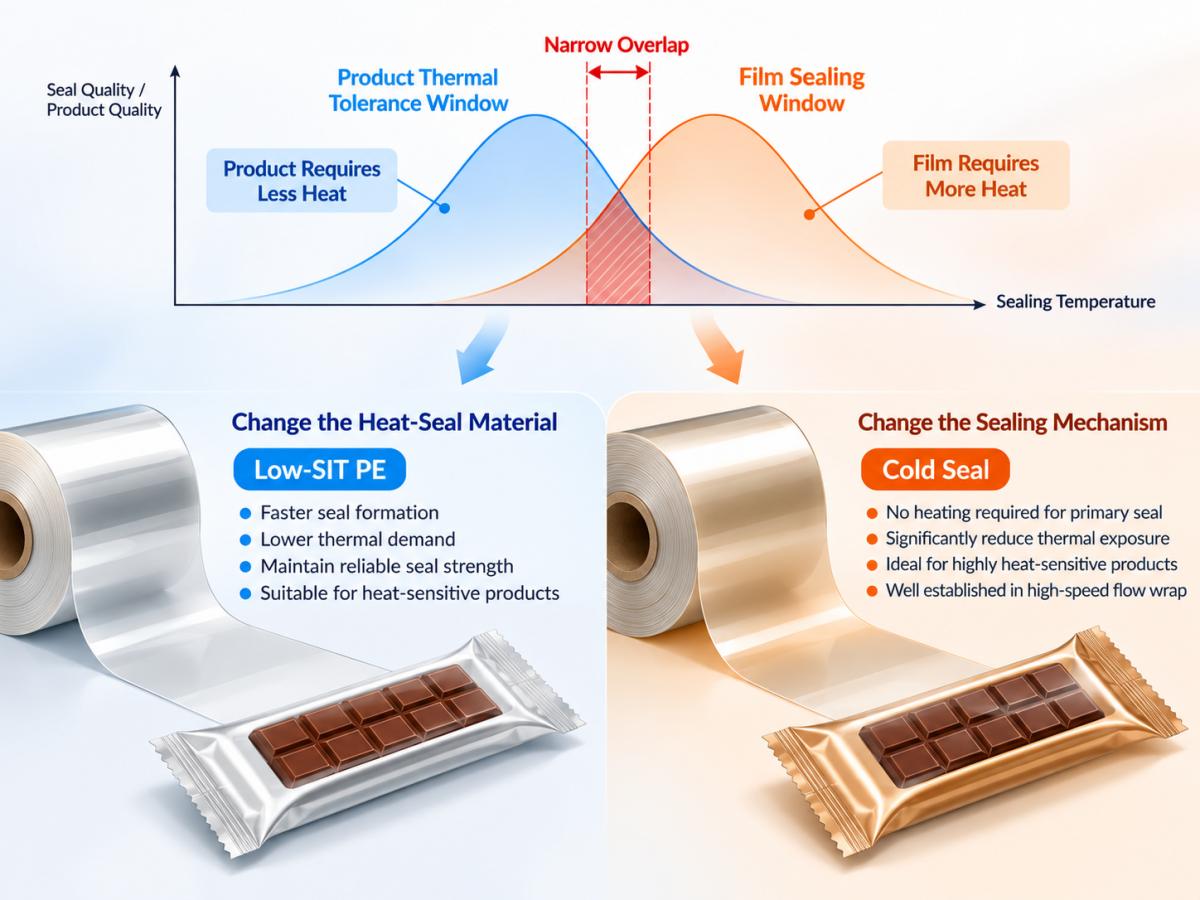
A high-speed packaging system effectively operates with two important windows.
Film Sealing Window: the range of process conditions in which the film can form an acceptable seal.
Product Thermal Tolerance Window: the range of thermal exposure within which the product remains physically and visually acceptable.
Target operating condition
The best packaging condition exists where Film Sealing Window and Product Thermal Tolerance Window have sufficient overlap.
If the overlap is wide, production is easier to control. If the overlap is narrow, small process variations may result in either weak seals or product heat damage.
Consider a chocolate product. The film requires relatively high thermal input to form a stable seal. At the same time, the chocolate sits very close to the cross-seal area and begins to soften under similar thermal conditions.
The system becomes: Film Requires More Heat, while Product Requires Less Heat. The usable process window becomes narrow.
There are two main engineering routes: change the heat-seal material by using a faster-responding system such as Low-SIT PE, or change the sealing mechanism by using cold seal.
Low-SIT PE moves the film sealing requirement toward lower thermal demand. Cold seal significantly reduces dependence on thermal seal formation. This is the deeper technical difference between the two approaches.
A more useful engineering model is to evaluate four groups of variables together.
System | Key Variables |
Machine | Web speed, effective dwell time, sealing motion, jaw geometry, pressure, cooling |
Film | SIT, hot tack, sealing window, laminate structure, thickness |
Package | Product-to-seal distance, bag pitch, headspace, seal location |
Product | Heat sensitivity, thermal mass, initial temperature, composition |
Consider two machines both operating at 100 packs/min. Machine A uses reciprocating sealing jaws, while Machine B uses continuous rotary sealing.
Even at the same package output, they may have different effective dwell times, pressure profiles, thermal-transfer behavior, jaw geometry and cooling conditions.
Therefore, simply saying "our film can run at 100 packs/min" provides incomplete technical information. A more meaningful statement is that the film should be evaluated under the actual machine speed, sealing geometry, temperature, pressure and effective dwell conditions.
From an engineering perspective, heat sensitivity is better treated as a spectrum rather than a simple binary classification.
Lower heat sensitivity: an optimized conventional heat-seal structure may be sufficient.
Moderate heat sensitivity: Low-SIT PE, improved cooling and package geometry optimization may be appropriate.
High heat sensitivity: even localized heat near the sealing zone may create product-quality risk, and cold seal deserves serious evaluation.
Application Condition | Technical Direction to Evaluate |
High speed + low heat sensitivity | Optimized heat seal / Low-SIT PE |
High speed + moderate heat sensitivity | Low-SIT PE + cooling + geometry optimization |
Very high speed + high heat sensitivity | Evaluate cold seal |
Product very close to cross seal | Reduce thermal load or increase seal distance |
High product inlet temperature | Improve upstream cooling and reassess sealing conditions |
Strong seal-contamination risk | Test actual seal-through-contamination performance |
Existing conventional heat-seal equipment | Low-SIT PE may offer easier implementation |
Dedicated cold-seal flow wrapper | Cold seal becomes more practical |
A successful packaging trial should not only answer "Did the film seal?" It should also answer "Did the product remain acceptable?"
Validation should therefore evaluate seal strength, seal appearance, product shape, product surface, sticking and package integrity. For heat-sensitive foods, product appearance after packaging is part of sealing validation.
This is an important difference between laboratory film testing and real packaging engineering.
Packaging equipment is often promoted according to maximum packs/min, but theoretical maximum speed does not necessarily represent useful production capacity.
If increasing speed causes seal instability, product deformation, film sticking, higher reject rates or increased downtime, the system is no longer operating efficiently.
More meaningful production target
Stable Production Speed = Throughput + Seal Integrity + Product Quality + Machine Stability.
At HLunPACK, we do not evaluate high-speed flexible packaging from film properties alone. For heat-sensitive applications, we consider product heat sensitivity, initial product temperature, thermal mass, product-to-seal distance, machine speed, effective dwell time, sealing mechanism, film structure, cooling and machine design.
The objective is to determine whether the packaging system should optimize thermal sealing through a Low-SIT sealant, strong hot tack and a wider heat-seal window, or reduce dependence on thermal sealing through cold seal.
The final solution should match Product + Package + Film + Packaging Machine.

Machine speed is an important part of high-speed packaging, but it is not the complete engineering problem. The real question is whether the film can form a reliable seal within the available cycle without exceeding the product's thermal tolerance.
That depends on four interacting systems: Machine + Film + Package + Product.
A product with relatively low heat sensitivity may perform very well with an optimized Low-SIT PE heat-seal system. A highly heat-sensitive product, particularly in high-speed horizontal flow wrapping, may benefit more from cold seal.
Core technical principle
High-speed packaging is a thermal-management problem as much as it is a sealing-speed problem. Stable production exists where the film sealing window and the product thermal tolerance window have sufficient overlap to provide Speed + Product Protection + Seal Integrity + Machine Compatibility.
No. Packs/min alone does not define effective dwell time or thermal exposure. Machine motion, jaw geometry, film response, product temperature and product-to-seal distance also matter.
Low-SIT PE optimizes thermal sealing so the film can develop seal strength with lower thermal demand and strong hot tack. Cold seal changes the sealing mechanism by relying primarily on a self-sealing coating plus pressure.
A product positioned close to the cross-seal zone can receive more localized thermal exposure. Increasing this distance can provide additional thermal separation and may improve process stability.
Effective dwell time is the period during which the film is actually exposed to the sealing conditions needed to form a seal. It depends on machine design, sealing motion, pack pitch and web speed.
The trial should evaluate both film and product: seal strength, seal appearance, leakage, product shape, surface condition, sticking and overall package integrity under actual production speed and temperature conditions.
HLunPACK | Flexible Packaging Materials + Packaging Machinery Solutions


