


close
Choose Your Site
Global
Social Media
Views: 226 Author: Tom Publish Time: 2026-10-21 Origin: Hlunpack


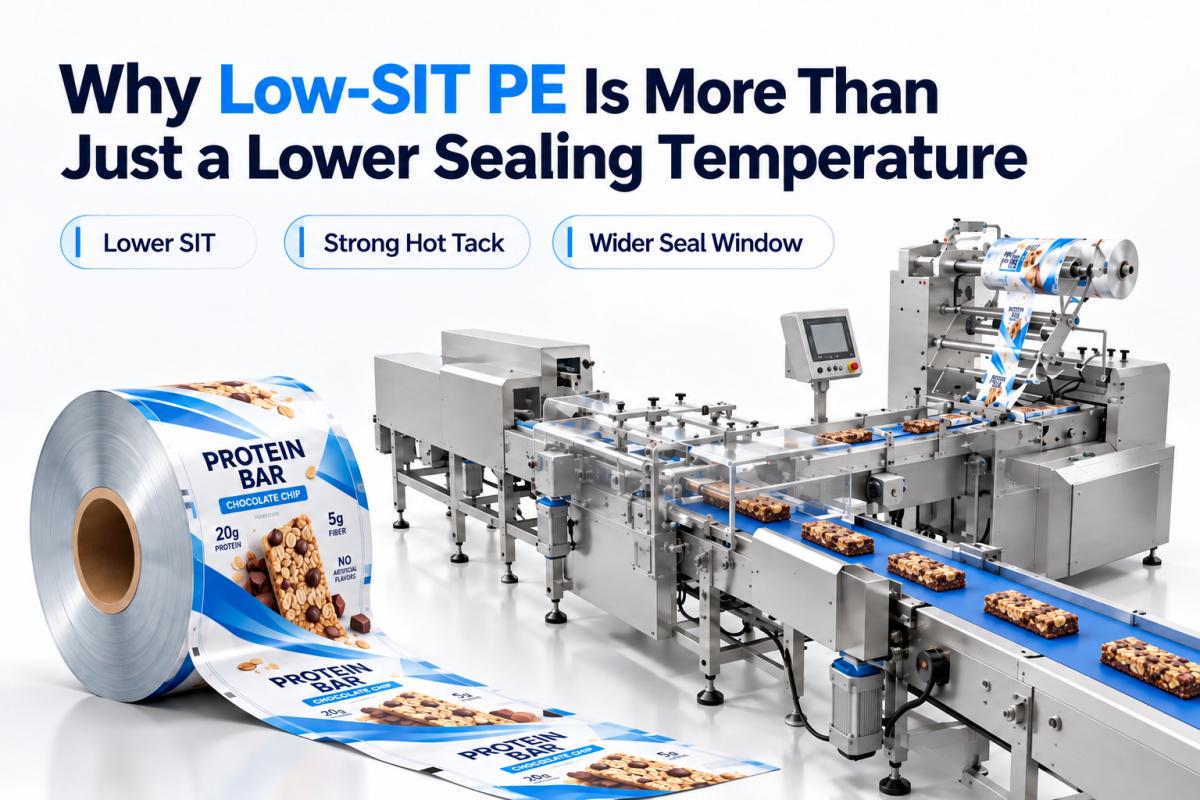
When packaging engineers hear the term Low-SIT PE, the first thing that usually comes to mind is a lower sealing temperature. That is technically correct, but it does not fully explain why Low-SIT PE is valuable in high-speed flexible packaging.
For a fast packaging line, the real challenge is not simply whether a film can begin sealing at a lower temperature. The more important question is whether the sealant can develop reliable seal strength quickly and consistently within the machine's actual operating window.
Core engineering principle
Low-SIT PE performance should be evaluated through Seal Initiation Temperature + Seal Development Rate + Hot Tack + Heat-Seal Window + Machinability + Seal Integrity.
A better definition is therefore: a sealant system designed to develop reliable sealing performance faster and across a wider usable operating window - not simply a PE layer that seals at a lower temperature.
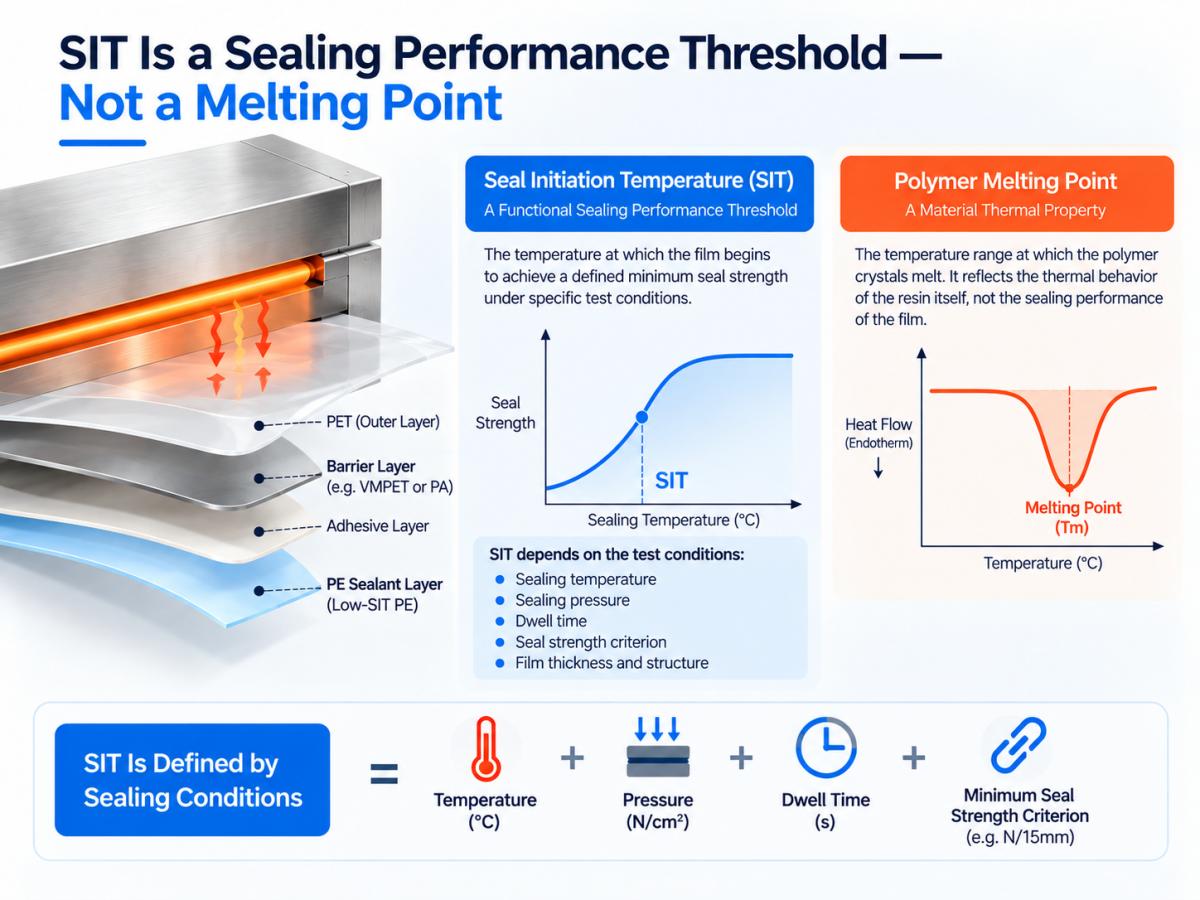
Seal Initiation Temperature, or SIT, is the temperature at which a film begins to achieve a defined minimum seal strength under specified test conditions.
Those conditions normally include temperature, pressure, dwell time and a seal-strength criterion. SIT is therefore not a universal fixed number that can be interpreted without context.
· Dwell time and sealing pressure used in the test
· Film thickness and laminate structure
· The minimum seal-strength threshold used to define initiation
· The test method, jaw surface and conditioning procedure
Two laboratories can report different SIT values for the same material if they use different test conditions. Any SIT value should therefore be read together with the test method and acceptance criterion.
One of the most important distinctions is that Seal Initiation Temperature is not the same as polymer melting point.
Polymer melting behavior is related to resin structure and crystallinity. SIT, by contrast, is a functional sealing-performance threshold: it indicates when the sealing surfaces begin to develop a defined bond under a specified combination of heat, pressure and time.
A PE-based sealant does not need to reach a simple full melting point before useful sealing can begin. Real seal development depends on softening, surface wetting, interfacial contact and the evolution of bond strength.
Technical distinction
SIT is a performance threshold measured under defined sealing conditions. It should not be interpreted as the melting point of the polymer.
A common assumption is that the lower the SIT, the better the film. That is too simple for real high-speed packaging.
A low SIT can be useful when effective dwell time is short or product heat exposure must be controlled. However, the sealant still needs stable surface properties, reliable hot tack, sufficient final seal strength, good machinability and adequate process tolerance.
An early-activating sealant also has to maintain appropriate anti-blocking behavior, slip performance and roll-storage stability. These properties depend on the overall sealant formulation rather than on the SIT value alone.
Engineering target
The objective is not the lowest possible SIT. The objective is the right SIT combined with the right overall sealing and machine-running performance.
As packaging speed increases, the effective time available for seal formation often decreases. Within that shorter cycle, the sealant must still receive heat, soften, wet the opposing surface and develop enough interfacial bond strength to survive downstream handling.
If seal development is too slow, the line may experience weak seals, partial seals, seal opening before cooling, leakage or an increasingly narrow operating window.
Low-SIT PE is valuable because the sealant can begin responding earlier in the cycle. Its practical benefit is therefore faster seal development within limited time, not simply a lower temperature number.
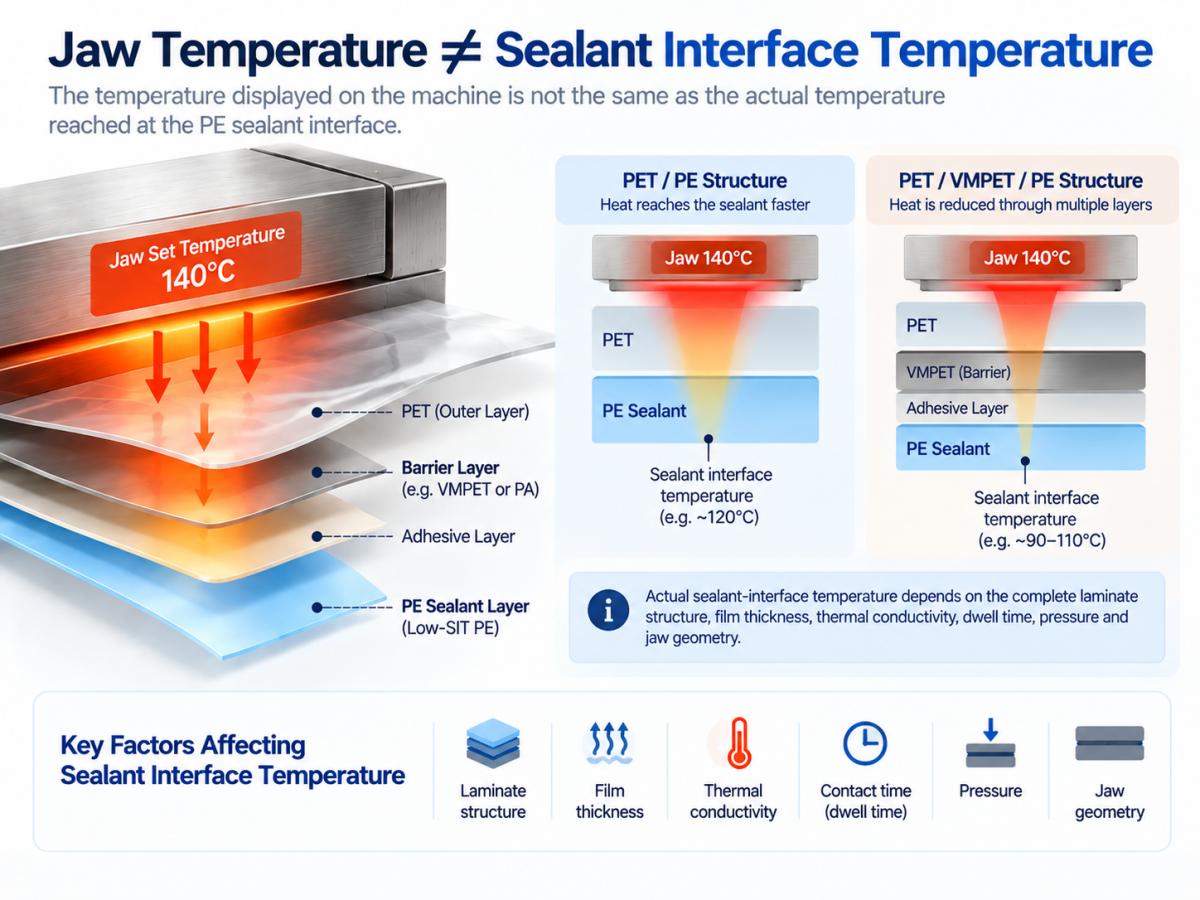
If a machine displays 140°C, that does not mean the PE-to-PE sealing interface instantly reaches 140°C. Heat must travel through the laminate before it reaches the sealant interface.
Actual interface temperature is influenced by the outer layer, barrier layers, adhesive layers, total thickness, thermal conductivity, pressure, jaw geometry and effective dwell time.
The same PE sealant can therefore behave differently in PET/PE and PET/VMPET/PE structures because the thermal path through the laminate is different.
Important
Machine set temperature is a control setting; sealant interface temperature is the thermal condition that actually drives seal development.
A single SIT value only tells us where measurable sealing begins. It does not show how quickly seal strength develops or how broad the stable sealing region becomes.
Consider two sealants. Film A may begin sealing at a slightly higher temperature but then develop strength rapidly and reach a broad, stable plateau. Film B may technically initiate at a lower temperature but develop strength more slowly and operate across a narrower stable range.
If only the first initiation temperature is compared, Film B may appear superior. On a high-speed machine, Film A may actually provide the more stable process.
Better evaluation
Compare the initiation point, the rate of strength development and the stable seal plateau - not just the first measurable SIT value.
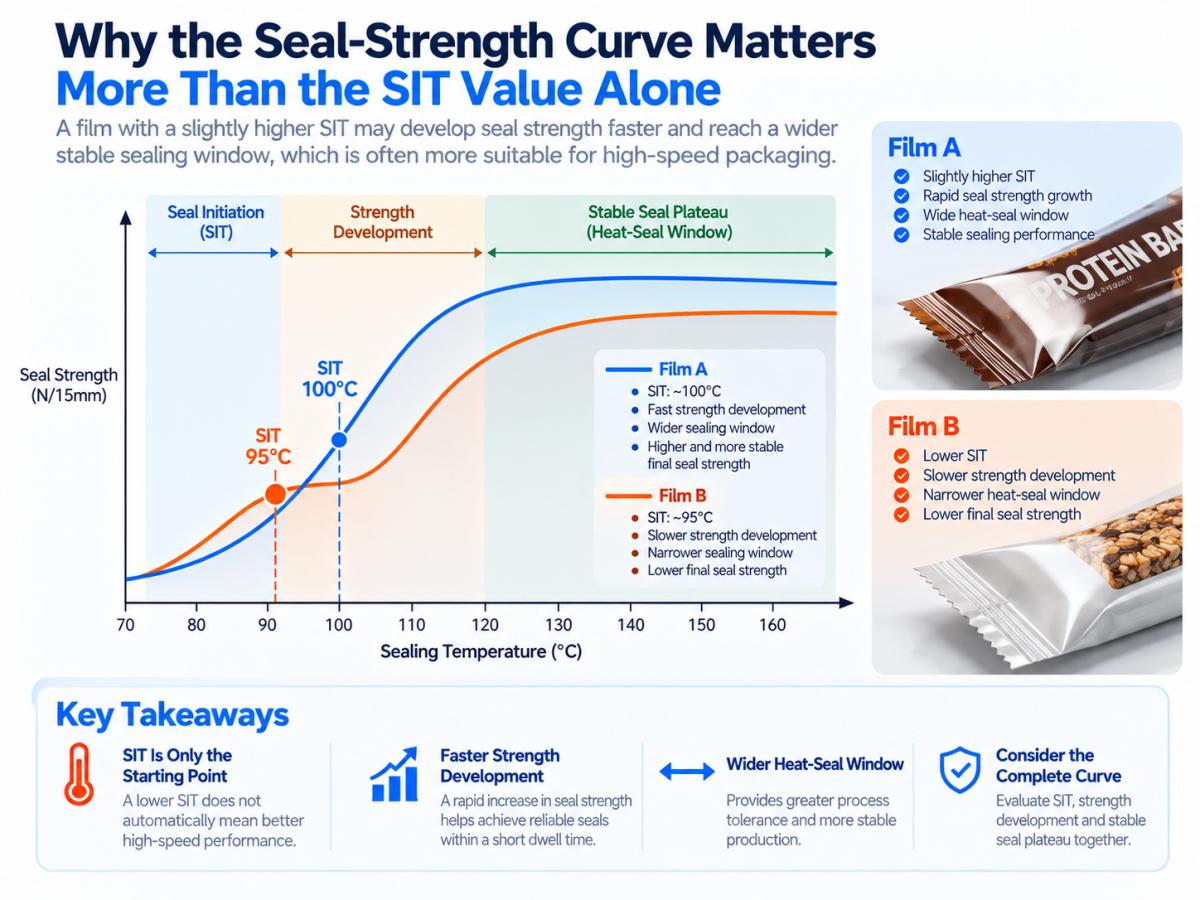
Note: numerical values shown in the technical graphics are illustrative examples for explaining sealing behavior. They are not universal material specifications and should not replace laboratory or production-line validation.
A seal does not immediately reach its final cooled strength. Immediately after leaving the sealing jaws or rollers, the seal is still hot and mechanically vulnerable.
During this period, the package may already experience web tension, product weight, internal pressure, pulling force or downstream conveying loads. The ability of the hot seal to resist opening is known as hot tack.
As line speed rises, cooling time decreases and mechanical stress can arrive sooner. Strong hot tack therefore becomes increasingly important for stable high-speed packaging.
Hot tack describes the strength of the seal while it is still hot. Final seal strength describes performance after the seal has cooled and stabilized.
A film can show excellent final seal strength but weak hot tack. In that situation, a laboratory peel test performed after cooling may look acceptable while the real machine still experiences seal opening, stretching or partial separation immediately after sealing.
Hot tack should also be viewed dynamically. Hot-tack strength can change with sealing temperature and with the short cooling interval after the sealing station.
The heat-seal window is the range of process conditions in which the film can form an acceptable seal. A wider window generally gives the production line greater tolerance to normal process variation.
Real packaging machines experience small variations in temperature, pressure, speed, web tension, film thickness and heating uniformity. A narrow window makes production sensitive; a wider window makes it more robust.
For actual production, the width and stability of the usable seal window can be more valuable than achieving the absolute lowest possible SIT.
These three properties should not be treated as automatic consequences of one another. A material can have a low SIT but weak hot tack, or a low SIT but a narrow heat-seal window.
A well-designed high-speed sealant system should therefore aim to combine earlier seal initiation, strong hot-state strength and sufficient process tolerance.
High-speed sealant target
Lower SIT + Strong Hot Tack + Wider Heat-Seal Window = a more robust starting point for stable high-speed packaging.
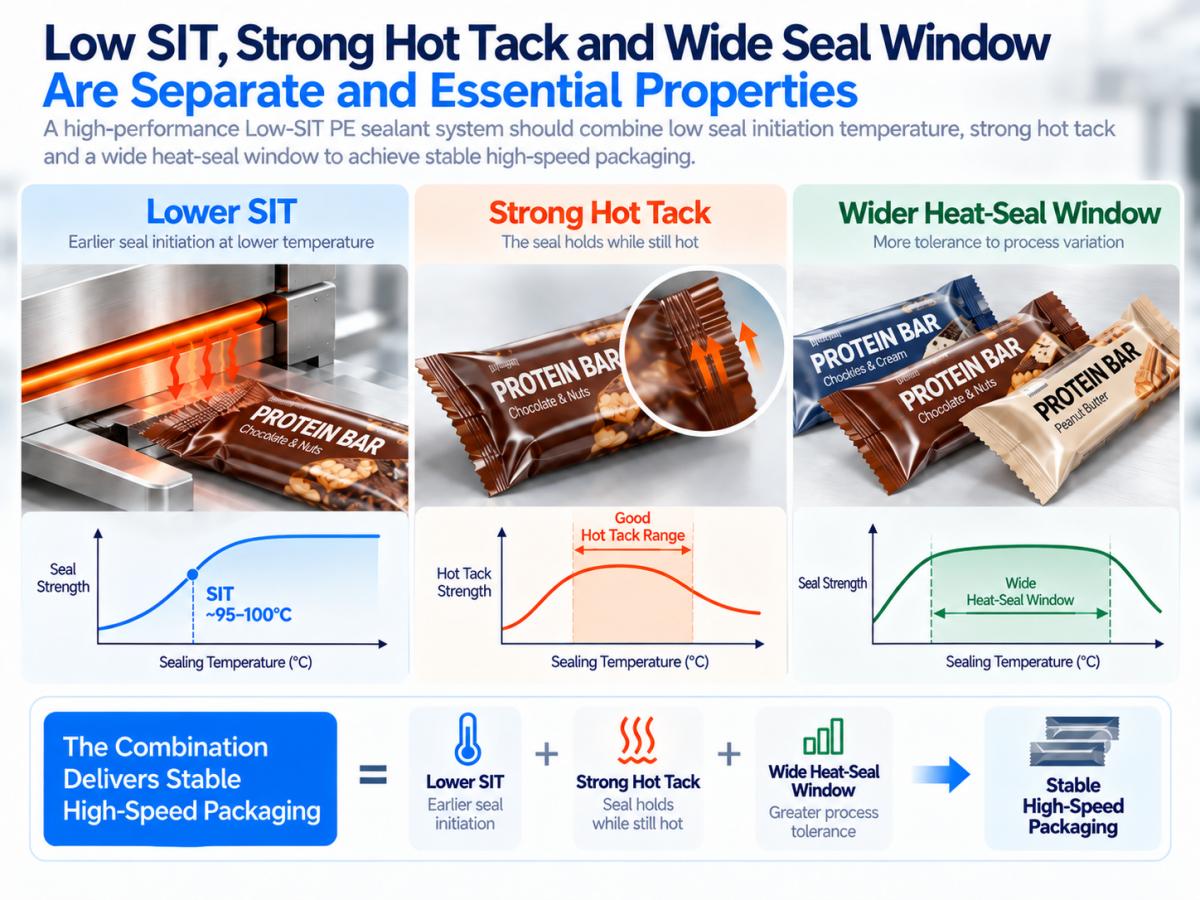
A film may show an attractive sealing range under controlled laboratory conditions, but the production line operates with many additional variables.
The actual machine operating window depends on the film, machine design, product, pressure, dwell time, cooling, jaw or roller geometry, web tension and contamination conditions.
Laboratory heat-seal data is valuable for material screening, but the final structure should be verified under the actual production process whenever possible.
Switching to Low-SIT PE does not necessarily mean that the machine set temperature must be reduced dramatically. The benefit may instead appear as more seal strength at the same jaw temperature, similar seal strength at a shorter dwell time, or more stable sealing at a higher machine speed.
The technical objective is better described as reducing the thermal demand required to develop sufficient seal strength within the available sealing cycle.
Heat sealing is controlled by the interaction of temperature, pressure and dwell time. When speed increases and effective dwell time falls, the system may need compensation through faster material response, thermal input, pressure optimization or jaw design.
More pressure is not always better. Excessive pressure can contribute to molten sealant squeeze-out, seal thinning, film distortion and local stress. The objective is appropriate and uniform pressure matched to the film and sealing geometry.
The same Low-SIT PE film may perform differently on reciprocating jaws, rotary sealing rollers, flat sealing bars or serrated jaws because each geometry creates a different combination of contact time, pressure distribution and heat transfer.
High-speed continuous rotary sealing is a particularly demanding case because it can combine short effective contact time, continuous pressure, continuous thermal input and rapid downstream movement.
If the sealant responds too slowly, operators may compensate with excessive heat or pressure, which can increase the risk of surface sticking, distortion or sealant squeeze-out. A faster-response system can help create a wider usable operating range.
A good sealant must not only seal; it must also run properly through the packaging machine. One important parameter is the coefficient of friction, or COF.
Film surface friction can influence feeding, forming, web tracking, product loading, jaw release and attainable machine speed. A formulation that improves sealing but creates poor slip behavior may cause drag, tracking instability, sticking or reduced throughput.
System view
High-speed film development should balance sealing performance and machinability. A sealant that works in the laboratory but runs poorly on the machine is not a complete solution.
Real production does not always provide perfectly clean seal areas. Powder, oil, seasoning, sauce, moisture or product particles can interfere with seal formation in different ways.
A low SIT does not automatically guarantee good seal-through-contamination performance. One sealant may initiate early but still perform poorly through oil or powder, while another with a slightly higher SIT may provide better contamination tolerance.
Seal-through-contamination performance should therefore be validated using the actual product and the actual contamination mechanism.
Not every package requires the strongest possible permanent seal. Some applications require a permanent hermetic seal, while others require peelable or easy-open behavior.
Seal evaluation should therefore consider strength, peel behavior and failure mode. Possible failure modes include adhesive failure, cohesive failure, film tearing, sealant separation and laminate delamination.
The technically strongest seal is not always the functionally correct seal. The correct profile depends on the final package requirement.
Low-SIT PE should not be treated as one single resin type. In practical flexible packaging, the sealant layer may use combinations of mLLDPE, LLDPE, LDPE, specialty PE, coextruded sealants or modified PE blends.
Final performance depends on polymer design, layer distribution, thickness and processing conditions. Low-SIT PE is therefore better understood as a performance category than as one single resin.
Sealant thickness influences heat response, flow behavior, final strength, mechanical resistance and contamination tolerance. If it is too thin, mechanical robustness may decrease; if it is unnecessarily thick, cost, stiffness and thermal response may change.
The outer and middle layers also affect sealing behavior. PET/PE and PET/VMPET/PE can use similar PE sealants but show different thermal response because the complete laminate changes heat transfer, stiffness and dimensional stability.
A well-designed high-speed laminate therefore balances outer-layer thermal stability with fast inner-layer seal response.
Low-SIT PE is generally optimized for efficient thermal sealing in conventional flexible-packaging conditions. Retort packaging, such as 121°C sterilization, creates a different material requirement.
Depending on the product and process, retort applications may require RCPP, retort-grade CPP or other specialty retort sealants. A sealant that performs well on a high-speed flow wrapper should not automatically be assumed to be suitable for retort sterilization.
Low-SIT PE and cold seal solve different engineering problems. Low-SIT PE improves thermal-sealing efficiency and still relies on heat, pressure and time. Cold seal changes the sealing mechanism and relies mainly on a self-sealing cold-seal coating plus pressure.
Simple distinction
Low-SIT PE optimizes thermal sealing. Cold seal reduces dependence on thermal sealing. Neither technology is universally better.
Low-SIT PE is especially useful when the existing line already uses thermal sealing and the objective is to increase stable production speed without completely changing the sealing mechanism.
· Effective dwell time is limited at target speed
· The product can tolerate controlled thermal exposure
· Hot tack needs to be improved
· The heat-seal window needs to be widened
· Existing heat-seal equipment should be retained
Improving the sealant alone may not be enough when the product is extremely heat-sensitive, the product-to-seal distance is very small, the machine geometry creates excessive thermal concentration, or the equipment is already designed around cold-seal technology.
Performance Area | Engineering Question |
SIT | How early does useful sealing begin under defined conditions? |
Seal-Strength Curve | How quickly does strength develop after initiation, and how stable is the plateau? |
Hot Tack | How strong is the seal while it is still hot? |
Hot Tack Curve | How does hot-state strength change with sealing temperature or cooling time? |
Heat-Seal Window | How tolerant is the film to normal process variation? |
Final Seal Strength | Is the cooled seal strong enough for distribution and use? |
Seal-Through-Contamination | Can the sealant handle the actual product environment? |
COF / Machinability | Can the film run smoothly at the target machine speed? |
Laminate Thermal Response | How quickly does heat reach the sealant interface through the full laminate? |
Machine Compatibility | Does the film match the actual jaw, roller, pressure and dwell system? |
Laboratory testing is valuable for understanding SIT, the seal-strength curve, hot tack and the heat-seal window. However, laboratory equipment cannot reproduce every production variable.
Actual machine trials should verify speed, pressure, effective dwell time, jaw temperature, cooling, film tension, contamination and product behavior. Final film selection should be validated under production conditions whenever possible.
At HLunPACK, we do not evaluate high-speed sealants according to the lowest advertised sealing temperature alone. We evaluate the complete packaging system: machine speed, effective dwell time, jaw or roller geometry, pressure, product characteristics, seal contamination, film structure, hot tack, heat-seal window and COF.
For one project, the key improvement may be lower SIT. For another, the priority may be stronger hot tack, a wider machine operating window or better film-running stability at high speed.
HLunPACK objective
Build the most stable sealing system for the actual packaging line - matching Material + Machine + Product + Packaging Process.
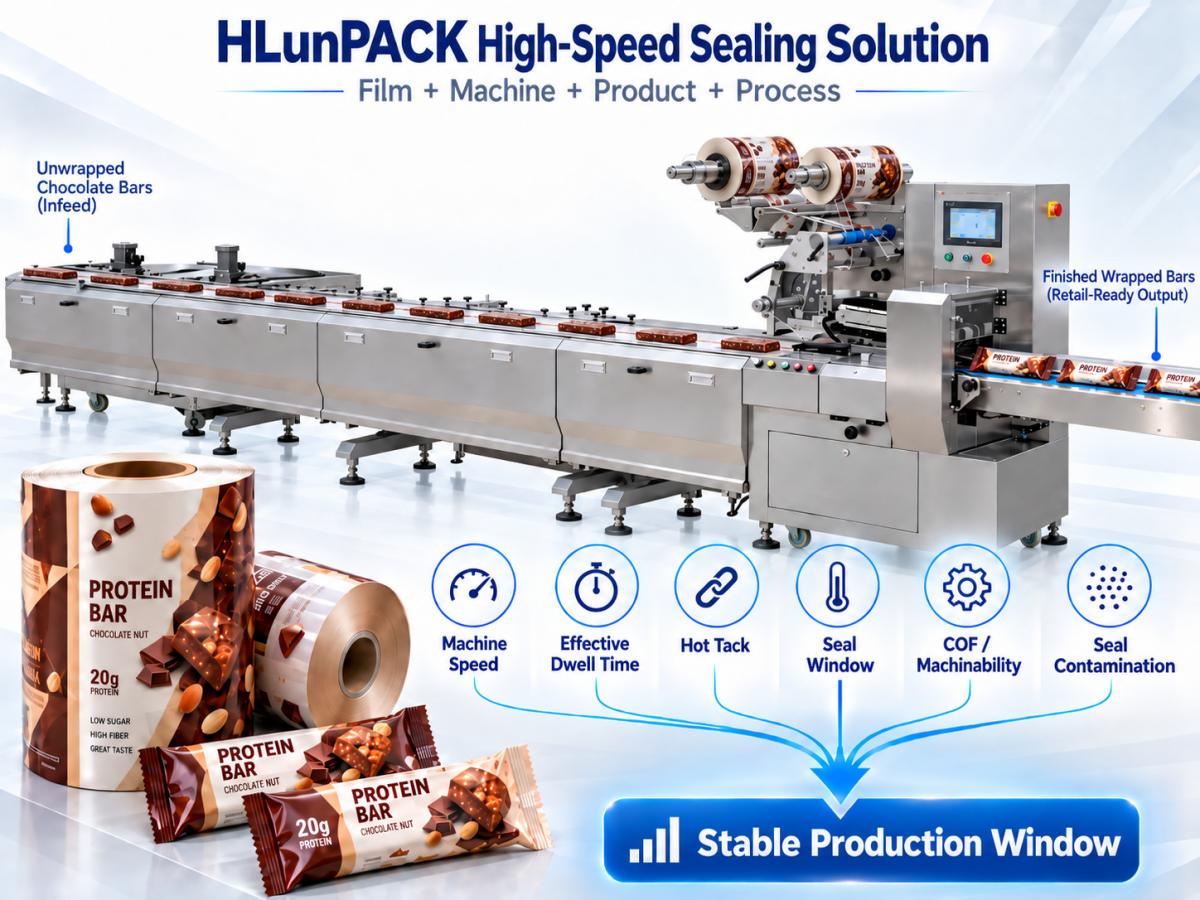
Low-SIT PE is often described as a low-temperature heat-seal material, but that definition does not fully explain its value in high-speed flexible packaging.
A complete evaluation should consider SIT, the seal-strength curve, hot tack, the heat-seal window, machinability and seal-through-contamination performance. The central question is not simply how low sealing can start, but how quickly and consistently a reliable seal can develop within the machine's real operating window.
Key takeaway
The best Low-SIT PE is not necessarily the material with the lowest sealing temperature. It is the sealant system that forms a reliable seal fast enough, remains strong while hot, tolerates process variation and runs stably on the actual packaging machine.
When these properties are balanced correctly, Low-SIT PE can support higher stable speed, reliable seal integrity, better process tolerance and improved machine compatibility.
Low-SIT PE is a PE-based sealant system designed to begin developing useful seal strength at relatively low thermal demand. Its high-speed performance also depends on hot tack, the seal-strength curve, the heat-seal window and machinability.
No. SIT is a functional sealing-performance threshold measured under defined temperature, pressure, dwell time and strength criteria. Polymer melting behavior is a material thermal property.
No. A slightly higher SIT material may perform better if it develops seal strength faster, has stronger hot tack or offers a wider and more stable machine operating window.
The package can experience tension and downstream handling before the seal fully cools. Strong hot tack helps the newly formed seal resist opening during this hot, mechanically vulnerable stage.
Not necessarily. The benefit may appear as stronger sealing at the same set temperature, equivalent strength at shorter dwell time, or more stable sealing at higher speed.
Cold seal may deserve evaluation when the product is highly heat-sensitive and the goal is to reduce dependence on thermal seal formation rather than only optimize the heat-seal material.


