


close
Choose Your Site
Global
Social Media
Views: 255 Author: HLun PACK Publish Time: 2026-11-26 Origin: Site


Content Menu
● What Is Rigid Stock in Paper Packaging?
● Rigid Stock vs. Folding Cartons and Corrugated Packaging
● How to Specify Rigid Stock Materials
>> Separate Board Thickness from Grammage
>> Match the Wrap to the Board
>> Specify the Finished Internal Dimensions
● Choosing the Right Rigid Box Style
● How Rigid Boxes Are Manufactured
>> 1. Develop the Structure and Artwork
>> 2. Prepare the Board Components
>> 3. Print and Finish the Covering
>> 4. Form, Position, and Wrap
● Matching Rigid Box Design to Packaging Machinery
>> Evaluate Sustained Output, Not Just Rated Speed
● A Practical Rigid Box Validation Plan
>> 1: Approve Appearance and Fit
>> 2: Test Production Repeatability
>> 3: Validate the Complete Shipping Configuration
>> 4: Record Acceptance Criteria
● Troubleshooting Common Rigid Box Defects
● Are Rigid Stock Boxes Sustainable and Recyclable?
● Compare Total Cost per Accepted Box
● Plan Your Rigid Packaging Project with HLun Pack
>> What Is Rigid Stock Made Of?
>> Is Rigid Stock the Same as Cardstock?
>> What Thickness Should a Rigid Box Use?
>> Are Rigid Stock Boxes Waterproof?
>> Can Rigid Boxes Be Shipped Without an Outer Carton?
>> Can One Machine Produce Every Rigid Box Style?
Rigid stock is the dense paperboard used to create sturdy packaging such as luxury gift boxes, presentation cases, and premium product boxes. Understanding rigid stock means looking beyond appearance: the board, decorative wrap, adhesive, insert, and manufacturing process must work together.
For businesses sourcing paper packaging or planning production, the important question is not simply whether a box feels expensive. It is whether the structure protects the product, meets presentation requirements, and can be manufactured consistently.
At HLun Pack, our perspective connects packaging design with machinery and integrated packaging solutions. This guide explains rigid stock materials, box construction, production considerations, and the checks buyers should complete before ordering.
In commercial packaging, "rigid stock" generally refers to the substantial paperboard used to build rigid boxes. It is a purchasing term rather than one universally standardized material grade.
A typical wrapped rigid box combines:
- Structural board, often called greyboard or chipboard.
- Printed or specialty paper covering the board.
- Adhesive bonding the covering to the structure.
- Optional liners, inserts, closures, and decorative elements.
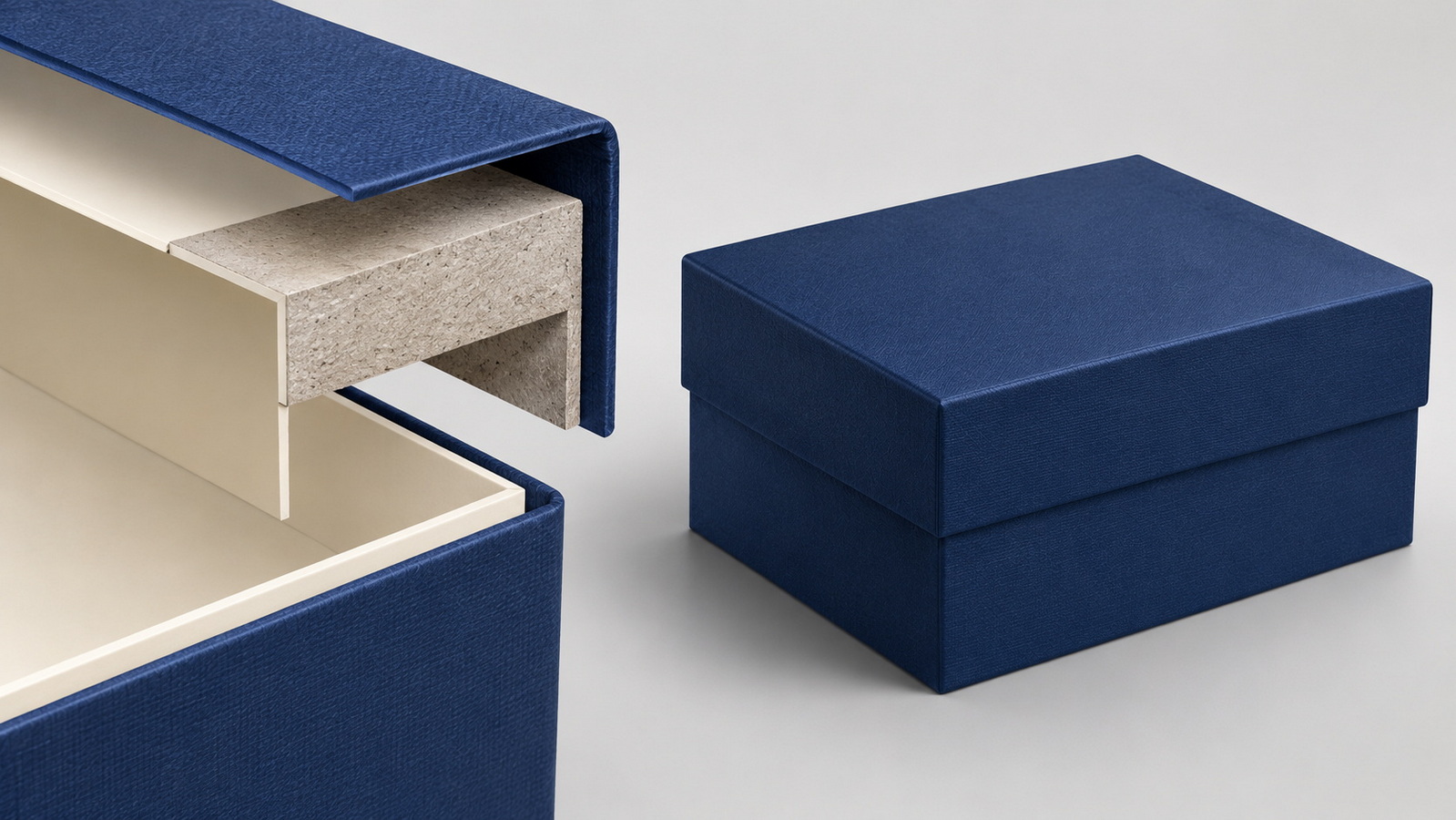
The board provides shape and stiffness. The outer paper carries graphics, texture, and surface treatments.
This distinction matters because attractive printing cannot compensate for an unsuitable structure. Equally, strong board does not guarantee clean corners, accurate artwork alignment, or smooth opening.
Buyers should therefore specify the complete construction rather than request "premium rigid stock" without measurable requirements.
These materials serve different purposes. None is automatically the best choice for every product.
| Packaging type | Typical construction | Main advantage | Important limitation |
|---|---|---|---|
| Wrapped rigid box | Dense board with a separate covering | Structured presentation and substantial feel | Conventional set-up boxes occupy considerable storage space |
| Folding carton | Printed paperboard, creased and folded | Efficient flat storage and retail presentation | May need reinforcement for demanding applications |
| Corrugated packaging | Fluted paper between liners | Transport protection and structural versatility | Standard constructions offer a different presentation aesthetic |
Rigid boxes are often selected for cosmetics, jewelry, electronics, and gift sets.
However, a presentation box should not automatically be treated as a shipping container. A suitable outer carton and protective inserts may still be necessary.
Some engineered rigid-box designs can collapse for storage. These require different construction and assembly considerations from conventional permanently assembled boxes.
Board thickness, or caliper, is measured in millimeters. Grammage is measured in grams per square meter, commonly abbreviated as gsm.
They describe different properties. Two boards with the same grammage can have different thicknesses and stiffness because their fiber composition and manufacturing differ.
Commercial rigid-box constructions commonly use board around 1.5–3.0 mm, but this is a starting range, not a universal specification.
Selection depends on:
- Product weight and fragility.
- Unsupported panel size.
- Box geometry and closure design.
- Insert support.
- Handling and distribution conditions.
A compact jewelry box and a large presentation set may need different constructions even when their contents weigh the same.
Wrap paper affects more than color.
Its thickness, grain direction, surface texture, coating, and folding behavior influence corner quality and adhesion. A heavily decorated paper may behave differently from an uncoated stock on the same equipment.
Request a physical sample using the intended board, wrap, adhesive, and finish. A digital rendering cannot reveal corner cracking, trapped air, or uneven edges.
Define usable internal dimensions after wrapping and insert installation.
External measurements alone can cause fit problems because board, wrap, liners, and inserts consume space.
Agree tolerances with the supplier and test actual products, including normal dimensional variation.
The opening experience should support product access and protection, not merely decoration.
| Box style | Suitable application | Main design check |
|---|---|---|
| Two-piece lid and base | Gifts and product sets | Lid clearance and removal effort |
| Drawer box | Accessories and curated kits | Sliding resistance and tray retention |
| Book-style magnetic box | Presentation packaging | Hinge alignment and closure consistency |
| Shoulder-and-neck box | Premium display | Alignment between lid, neck, and base |
| Collapsible rigid box | Space-sensitive logistics | Assembly reliability and hinge durability |
A magnetic closure holds a lid shut, but it is not inherently tamper-evident. Products requiring evidence of opening need a separately designed feature.
Likewise, a snug lid is not always better. Excessive resistance can make the package frustrating to open or pull the product upward unexpectedly.
Rigid-box production converts structural board and covering materials into a finished package. It should not be confused with manufacturing paperboard itself.
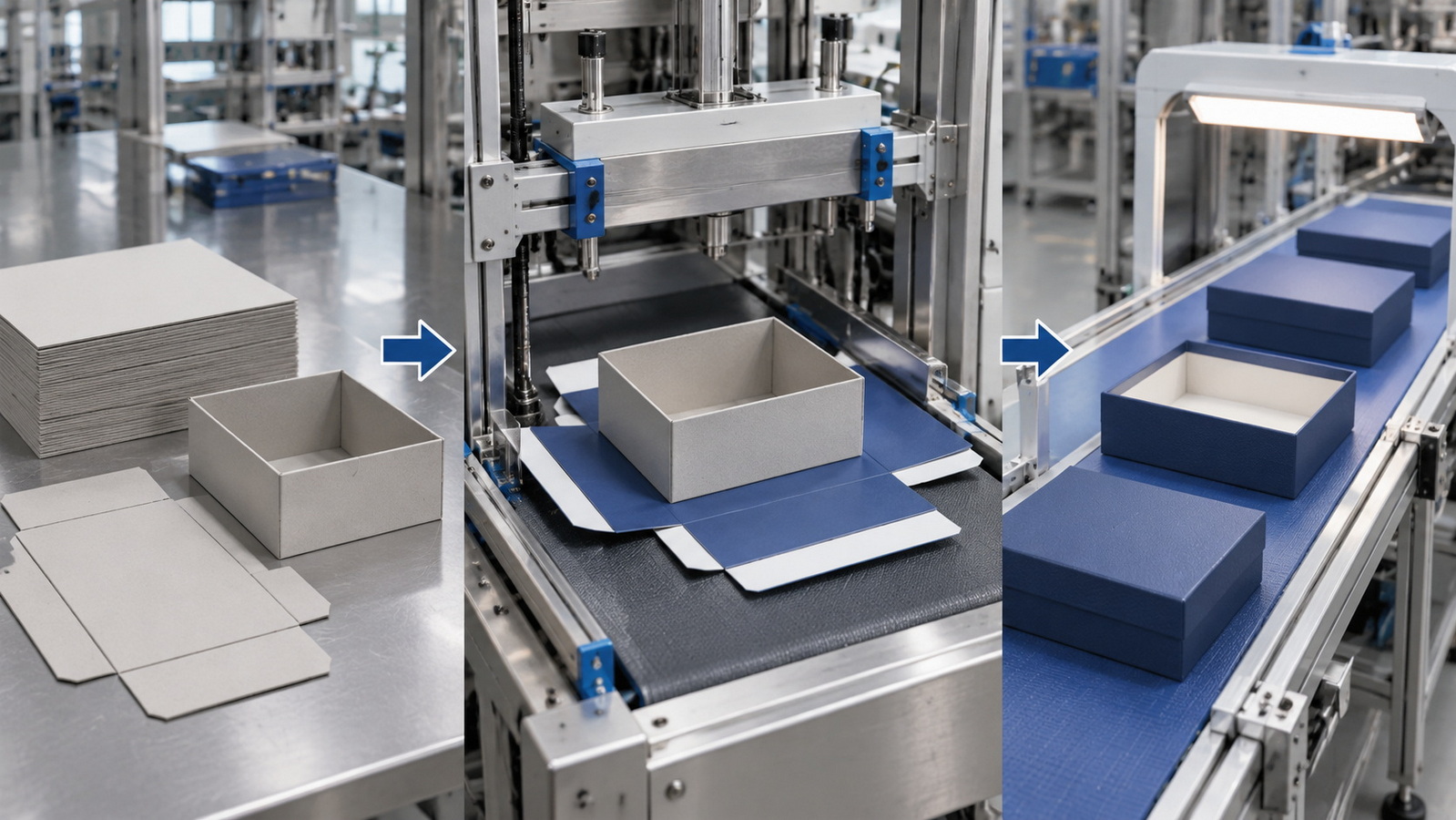
Begin with the product, insert, opening method, and required clearances.
Create coordinated drawings for the board components, wrap sheets, liners, and inserts. Allow for board thickness, turn-ins, and assembly.
Keep critical artwork away from folds and wrapped edges where positioning variation may become visible.
Cut the board to the approved dimensions.
Depending on the construction, production may involve separate panels, grooving, or other forming methods. The aim is a square, stable structure with controlled corner geometry.
Material consistency is important because dimensional variation can carry through every later operation.
The covering may be printed, foil-stamped, embossed, coated, or otherwise decorated.
The sequence depends on the design and production method. Lamination is optional rather than an essential feature of every rigid box.
Approve finish samples on the actual paper, especially when texture or dark colors make imperfections more visible.
The structure is formed, adhesive is applied, and the box is positioned against the prepared covering.
The paper is wrapped around the outside and turned over the edges. Controlled positioning and pressure help achieve consistent corners and smooth surfaces.
Liners, inserts, and closures are added as required by the construction.
Allow the adhesive system to set under suitable conditions before final assessment and packing.
Inspect dimensions, squareness, adhesion, lid fit, surface appearance, and insert retention. Retain approved samples as production references.
A box that works as a handmade sample may not run efficiently on a production line.
Before selecting rigid box making equipment, define the production envelope:
- Minimum and maximum finished dimensions.
- Board thickness range.
- Wrap dimensions and material characteristics.
- Required box styles.
- Expected order quantities.
- Changeover frequency.
- Decoration and insert requirements.
Commercial equipment includes manual-support workstations and automatic rigid-box production lines. Capability varies by machine and configuration.
Do not assume one machine handles every magnetic, drawer, cylindrical, and two-piece construction.
The useful production measure is accepted output: finished boxes that meet the agreed specification.
A fast cycle rate offers limited value if operators must repeatedly correct alignment or remove defective boxes.
Request trials using representative materials and challenging formats. Record good boxes produced, stoppages, rejects, operator involvement, and changeover time.
Also distinguish individual components from completed sets. Producing a lid or base is not necessarily equivalent to producing one complete sellable package.
The following workflow is a recommended purchasing framework, not a universal testing standard.
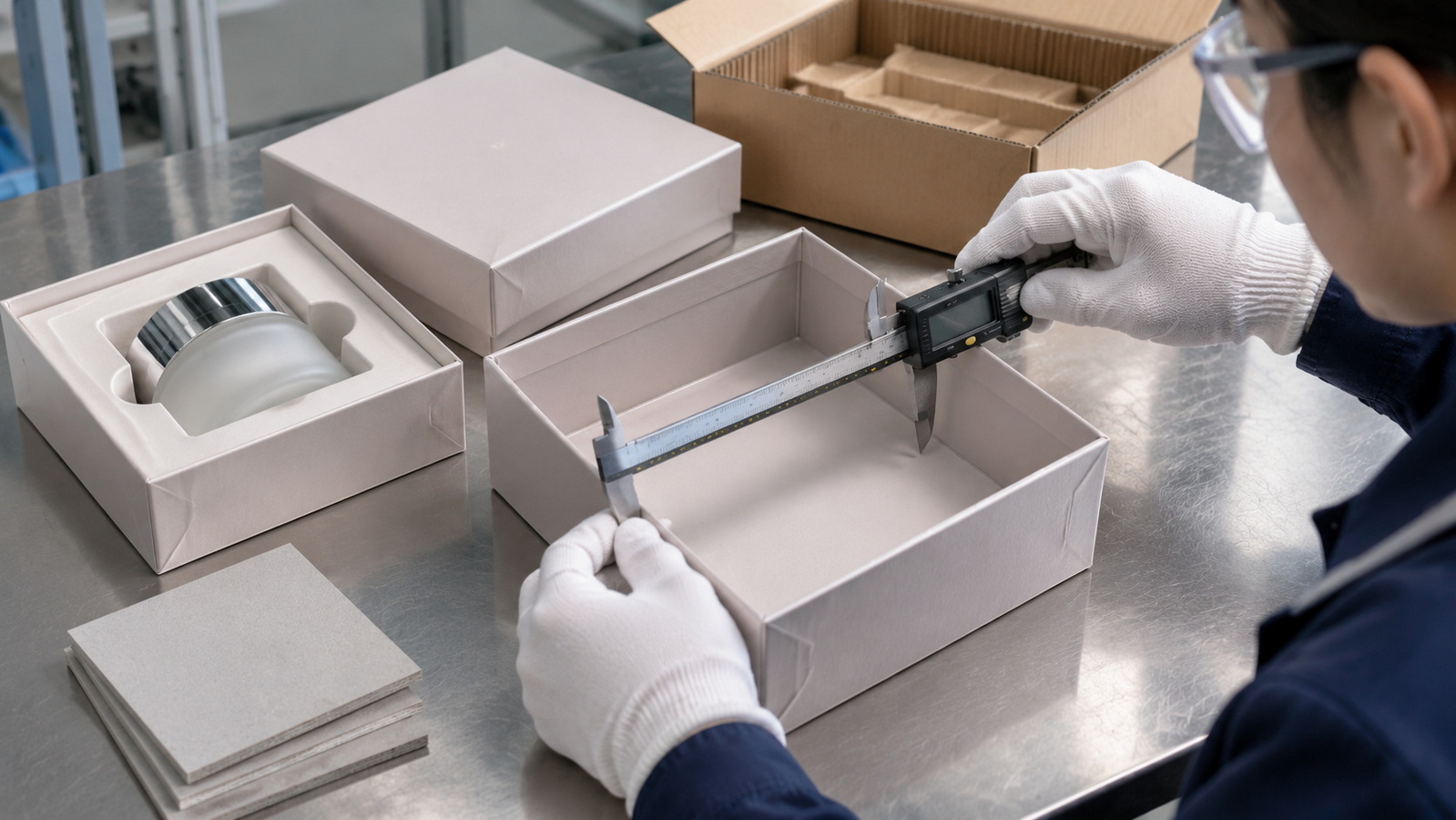
Use actual products and final inserts.
Check removal effort, finger access, product movement, graphics alignment, visible glue, corner finish, and closure behavior.
Define acceptable variation before production begins.
Run more than a few demonstration pieces.
Sample boxes from different points in the trial. Compare dimensions, wrap position, adhesion, and opening behavior.
Include representative material batches where practical. A process that works only with carefully selected sheets may struggle during routine production.
Test the product, rigid box, insert, outer carton, and cushioning together.
Select a distribution test appropriate to the actual transport route. For example, ISTA Procedure 3A addresses individual packaged products shipped through parcel delivery systems.
Testing only the empty presentation box does not establish protection for the finished shipment.
Document the approved materials, drawings, reference samples, inspection methods, and defect limits.
This creates a shared basis for purchasing, production, and quality decisions.
Avoid relying on descriptions such as "luxury quality" without supporting criteria.
| Observed problem | Possible contributors | Practical investigation |
|---|---|---|
| Wrinkled corners | Wrap allowance, paper behavior, positioning | Review the dieline and trial the actual paper |
| Bubbles or lifting | Adhesive application, contamination, pressure | Check bonding conditions and surface compatibility |
| Tight or loose lid | Dimensional variation and accumulated tolerances | Measure finished components across the run |
| Bowed panels | Material imbalance, moisture, adhesive conditions | Compare board, covering, and conditioning |
| Product movement | Insert geometry or excessive clearance | Test the loaded package through handling |
These are diagnostic starting points, not definitive causes.
Change one variable at a time and record the result. Increasing adhesive or board thickness without identifying the cause can add cost while leaving the underlying problem unresolved.
Paper-based construction does not make every finished rigid box equally recyclable.
Recovery depends on the complete material combination, local collection, sorting, and the receiving recycling process.
Plastic laminates, adhesives, coatings, magnets, ribbons, and foam inserts can affect separation or recycling performance.
A practical design review should ask:
1. Can unnecessary components be removed?
2. Can the insert use a compatible paper-based construction?
3. Can non-paper parts be separated easily?
4. Is decorative coverage proportionate to its purpose?
5. Are disposal instructions appropriate for the destination market?
Current industry guidance emphasizes evaluating material compatibility and testing uncertain combinations.
Recycled content, recyclability, and reusability are separate claims. Substantiate each rather than combining them into a general "eco-friendly" promise.
The lowest board price does not necessarily deliver the lowest packaging cost.
Compare quotations using the same construction and include:
- Board, wrap, inserts, and closures.
- Printing and decoration.
- Tooling and setup.
- Labor and inspection.
- Waste and rework.
- Storage and freight.
- Changeover losses.
For equipment investment, add maintenance, training, utilities, and spare-parts support.
Divide the relevant production cost by accepted finished boxes, not the theoretical number of machine cycles.
This approach makes material and machinery comparisons more meaningful.
A successful rigid-stock package combines presentation, protection, manufacturability, and cost control.
Share your product dimensions, weight, preferred box style, artwork, expected order quantities, destination markets, and production targets with HLun Pack.
Request a coordinated review of the packaging structure, material specification, equipment requirements, and trial acceptance criteria before committing to production.
It generally uses dense structural paperboard, often greyboard or chipboard, combined with a separate decorative covering. Liners, adhesives, inserts, and closures depend on the box design.
Not usually in packaging purchasing. Cardstock often describes lighter printable paperboard. Rigid-box construction typically uses a substantial structural board and a separate wrap. Confirm specifications rather than relying on terminology.
Many commercial constructions use approximately 1.5–3.0 mm board. The appropriate thickness depends on panel size, product weight, structure, and testing. Thicker board is not automatically the best solution.
Standard paper-based rigid boxes are not waterproof. Certain coverings or coatings may improve resistance to moisture, but edges, seams, and exposure conditions still require evaluation.
Only when the complete package has been designed and validated for that distribution method. Many presentation boxes require an outer shipper and protective cushioning.
No. Supported formats, dimensions, materials, and processes vary. Confirm compatibility through technical review and trials using your intended construction.
1. [OXO Packaging — "What is Rigid Stock and Why it Matters? A Detailed Guide"]. Waqas Khan Pitafi, June 5, 2025. Original article reviewed for topic coverage and restructuring; unsupported guarantees and imprecise technical descriptions were not retained. [oxopackaging]
2. [BMPACK — "Rigid Box Dieline Guide: Greyboard & 4 Styles"]. Supports the distinction between structural board, wrap paper, liners, and separate component drawings, including the effect of board thickness on wrap dimensions. [bmpack]
3. [Pack Your Brand — "Greyboard Thickness Guide for Rigid Boxes"]. Commercial manufacturing guidance on board selection, dimensional considerations, and application-dependent thickness. Thickness ranges are presented as starting points, not mandatory standards. [packyourbrand]
4. [Emmeci — "Solutions: Box Making"]. Primary equipment-manufacturer information demonstrating different rigid-box machine categories, format capabilities, and gluing workstations. These examples do not establish HLun Pack machine specifications. [emmeci]
5. [International Safe Transit Association — "Test Procedures"]. Official explanation of distribution-test categories and Procedure 3A for individual parcel-delivery shipments weighing 70 kg or less. Test selection must reflect the intended distribution environment. [ista]
6. [4evergreen — "Circularity by Design Guideline for Paper-Based Packaging," Version 4, February 2026]. Industry guidance covering recycling compatibility, adhesives, decorative components, and testing where material behavior is uncertain. [4evergreenforum]


