


close
Choose Your Site
Global
Social Media
Views: 242 Author: Hlunpack Publish Time: 2026-08-21 Origin: Hlunpack


From 130 mm Film to 150/170 mm Rollstock, Nitrogen-Flushed Pouches and One Shared Carton
PROJECT AT A GLANCE
Brazil nuts up to approximately 45 mm long | 2-piece pack: 150 mm film, 65 x 90 mm pouch | 4-piece pack: 170 mm film, 75 x 100 mm pouch | One shared carton: 17.5 x 16 x 12 cm | 2-piece configuration: 200 g / 25 pouches | 4-piece configuration: 250 g / 15 pouches
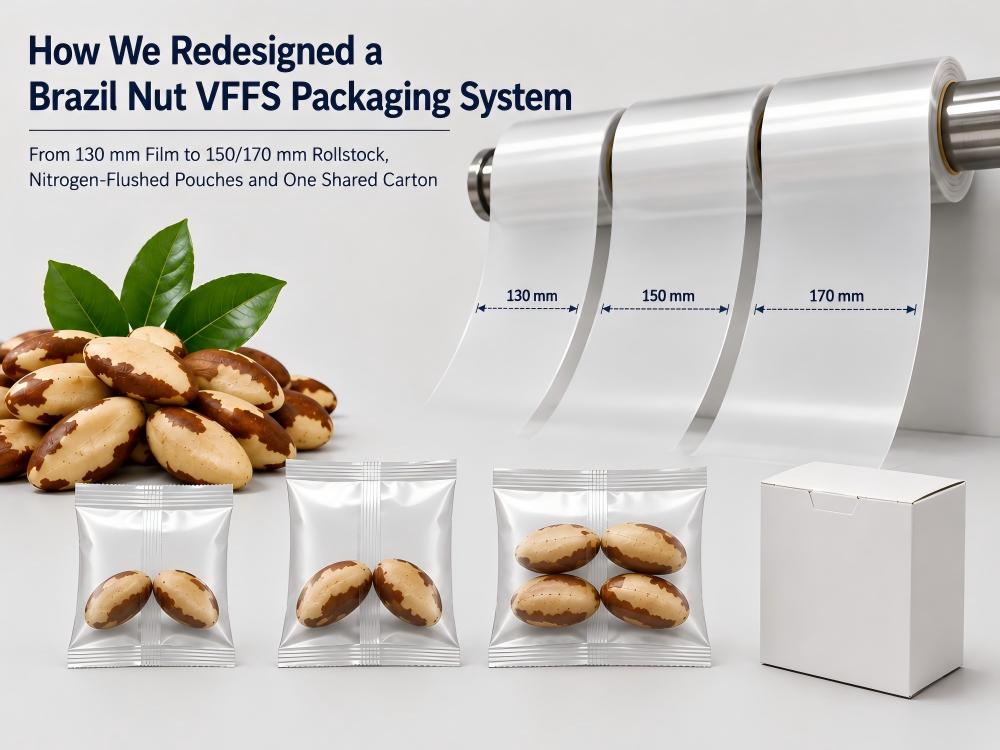
A customer approached HLunPACK looking for a complete packaging solution for Brazil nuts, including printed rollstock film, a VFFS vertical packaging machine and printed outer paper cartons.
The customer planned to produce two retail formats: 2 Brazil nuts per pouch and 4 Brazil nuts per pouch. Before contacting us, the customer had limited experience with automatic packaging and had already followed a recommendation to use 130 mm wide rollstock for the 2-piece pack. The film had already been printed.
KEY ENGINEERING LESSON
A product fitting inside the finished pouch does not necessarily mean the film width is suitable for a VFFS machine. Product dimensions, film width, bag geometry, forming-tube clearance, sealing space and machine stability have to be evaluated together.
The customer's Brazil nuts could reach approximately 45 mm in length. The original 130 mm rollstock was intended to form a back-seal pouch of approximately 55 mm wide x 60 mm long for two kernels.
From a simple volume perspective, two Brazil nuts could fit inside the pouch. But the pouch was extremely compact for kernels approaching 45 mm in length, leaving very little free space for product orientation, sealing tolerance and nitrogen flushing.
The machine also used approximately 8 mm transverse sealing areas. These sealing zones further limited the usable internal length of an already compact pouch. The issue was therefore not whether two kernels could be placed inside by hand, but whether the package could be produced reliably in continuous automatic operation.
The main technical issue was the effective feeding clearance inside the VFFS forming tube. On a VFFS machine, the forming set shapes flat rollstock into a tubular back-seal package, while the forming tube also becomes the passage through which the product must travel before entering the pouch.
This is particularly important for Brazil nuts because they are relatively large, elongated, irregular in shape and naturally variable in size.
THE RIGHT QUESTION
Does the forming tube provide enough effective feeding clearance for a kernel approaching 45 mm in length when the product enters vertically, diagonally or almost horizontally?
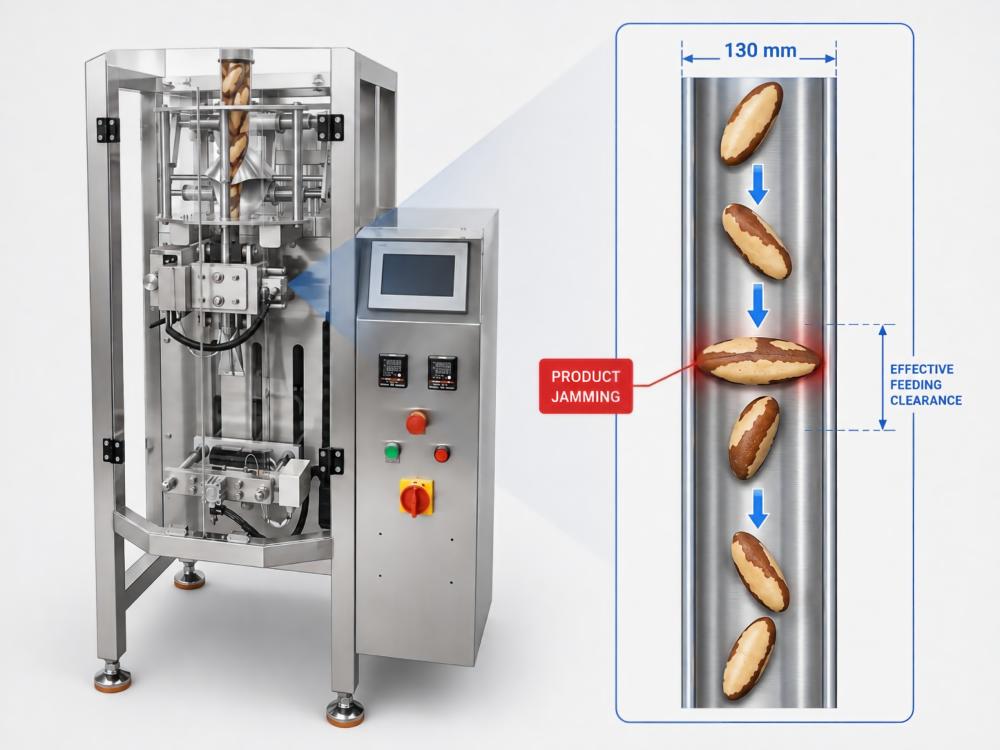
Why a narrow forming tube can create a bridging and jamming risk for elongated Brazil nuts.
A narrower film width normally requires a smaller forming set. With the original 130 mm rollstock, the available product passage was too restricted for reliable feeding of longer Brazil nuts.
The kernels do not always fall through the tube in the same orientation. If a long kernel enters the passage at an unfavorable angle, it can bridge across the tube. Once one kernel becomes stuck, following product can accumulate above it.
· Interrupted product flow
· Underfilled or empty pouches
· Machine stops and manual clearing
· Production downtime
· Reduced line efficiency
Rather than simply recommending a wider film based on experience, we tested the customer's actual Brazil nuts together with the VFFS configuration.
Our objective was to identify the smallest practical film width that could satisfy three requirements:
1. Sufficient Feeding Clearance
The forming tube needed enough effective clearance for kernels approaching 45 mm, including allowance for random orientation during free fall.
2. Better Pouch Proportion
The finished pouch needed enough space for the product, seals and nitrogen flushing without looking excessively compressed.
3. Controlled Film Consumption
The film should not be unnecessarily wide because every increase in web width increases printed material consumption over long production runs.
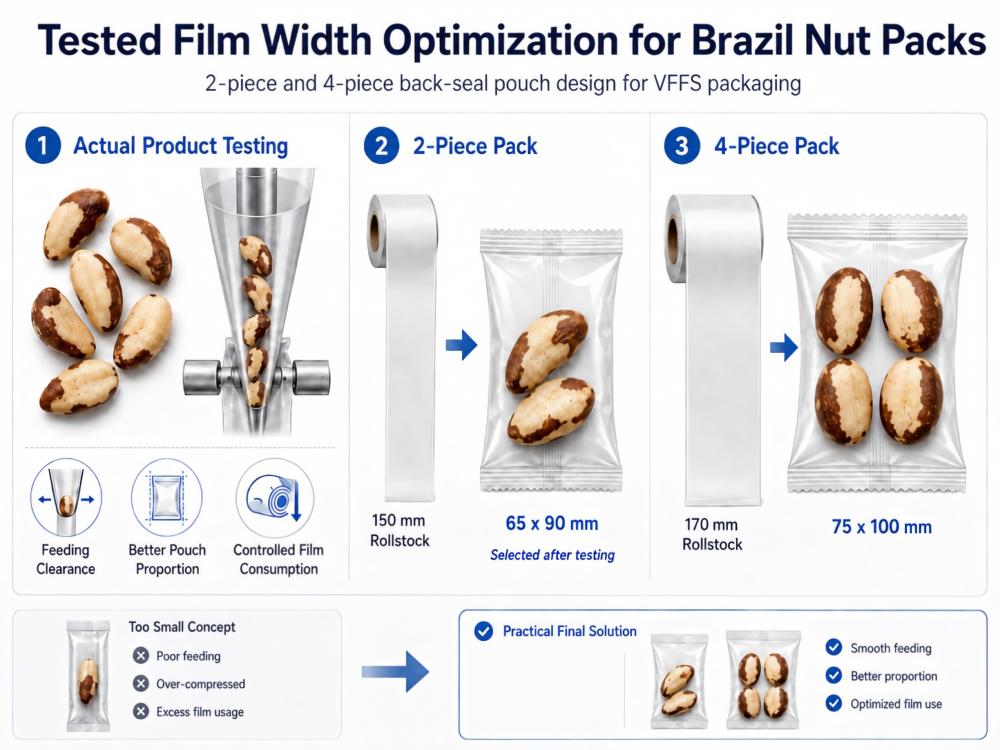
Actual-product testing led to 150 mm rollstock for the 2-piece pack and 170 mm rollstock for the 4-piece pack.
Moving from 130 mm to 150 mm film may appear to be a small adjustment, but it allowed us to use a forming set with a more suitable product passage.
The resulting 65 x 90 mm back-seal pouch provided a better balance between Brazil nut dimensions, feeding clearance, internal free space, seal allowance, nitrogen-flushing volume and final pack appearance.
DESIGN PRINCIPLE
The target was not the smallest bag that could physically hold two Brazil nuts. The target was the smallest practical pouch that could hold the product and run reliably on the packaging machine.
The customer also required a four-piece pouch. With twice as many Brazil nuts per package, product volume and feeding requirements increased. After evaluating the product and forming-set requirements, we selected 170 mm rollstock and a finished pouch of approximately 75 x 100 mm.
Pack Format | Rollstock Width | Finished Pouch Size | Bag Style |
2 Brazil nuts | 150 mm | 65 x 90 mm | Back-seal pouch |
4 Brazil nuts | 170 mm | 75 x 100 mm | Back-seal pouch |
Making the pouch significantly wider would provide more feeding space, but it would also increase film consumption per pouch, printing cost, package volume, secondary packaging size and shipping volume.
MATERIAL-EFFICIENCY TARGET
Maximum film width was not the goal. The goal was the minimum practical film width for reliable production: 150 mm for the 2-piece pack and 170 mm for the 4-piece pack.
Once the primary packaging had been confirmed, the customer asked another important question: What size should the outer paper carton be?
A conventional folding-carton supplier may request pouch width, pouch length, quantity per carton and product weight, then estimate the carton volume. That approach can work for many products, but this project introduced another important factor: nitrogen flushing.
Once nitrogen is introduced, the finished pouch no longer behaves like a flat empty bag. It develops a measurable three-dimensional volume. That changes actual pouch thickness and stacking volume.
A flat drawing showing 65 x 90 mm does not tell us how thick the pouch becomes after filling and nitrogen flushing. A carton designed only from flat pouch dimensions may therefore be too tight or too loose.
Because HLunPACK works with both flexible packaging and packaging machinery, we were able to evaluate the real finished pack rather than only its drawing.
After confirming the pouch dimensions, we produced physical sample packs and arranged them according to the customer's final packing requirements.
· Actual pouch thickness
· Gas-flushed volume
· Pouch deformation during stacking
· Required internal carton clearance
· Packing density
· Transport stability
THE CARTON FOLLOWED THE REAL PACK
The carton was designed around the real filled and nitrogen-flushed package, not only the nominal two-dimensional pouch dimensions.
The customer wanted to avoid excessive movement inside the carton during long-distance transportation. Repeated movement can cause packaged kernels to rub and collide, increasing the risk of surface skin flaking and reducing product presentation after opening.
At the same time, the carton should not be unnecessarily oversized. The target was compact enough for transport stability while still efficient enough to control carton material and shipping volume.
Instead of developing two independent cartons, we tested the actual arrangement of both pouch formats and identified one shared carton specification.
2-Piece Pack | 25 pouches per carton | approximately 200 g total |
4-Piece Pack | 15 pouches per carton | approximately 250 g total |
Shared Carton Size | 17.5 cm (L) x 16 cm (W) x 12 cm (H) |
Carton Structure | Retail folding carton with a top tuck flap and bottom insert-lock structure |
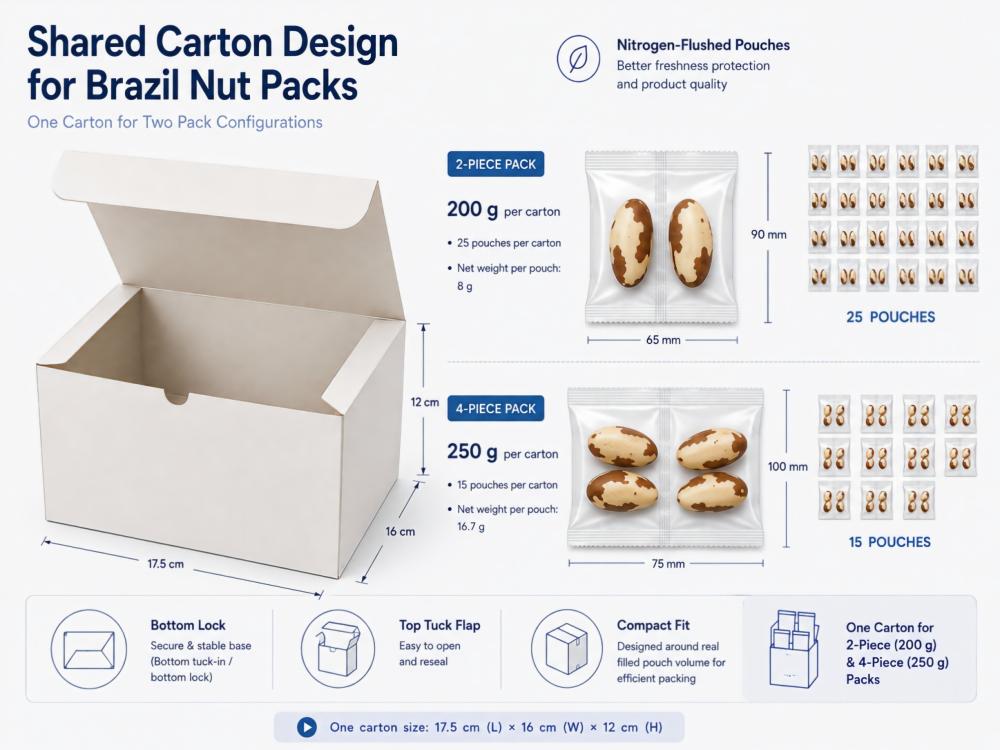
One shared retail carton was tested for both the 2-piece/200 g and 4-piece/250 g product configurations.
Using one common carton specification helps reduce:
· Carton SKUs
· Printing and tooling management
· Minimum-order pressure
· Warehouse inventory
· Purchasing complexity
· Changeover requirements
SHARED-CARTON TARGET
The objective was the most compact common carton that could reliably accommodate both nitrogen-flushed pouch configurations.
This project shows why packaging components should not always be designed independently. If the project had been divided among separate suppliers, the film supplier might only ask what pouch size the customer wanted, the machine supplier might only check film width and target weight, and the carton supplier might only calculate volume from pouch dimensions.
The real packaging chain was:
Printed Rollstock Film > VFFS Forming Set > Brazil Nut Feeding > Back-Seal Pouch > Nitrogen Flushing > Actual Filled Pouch Volume > Outer Paper Carton
A change at the beginning of this chain can affect every stage that follows.
Product | Brazil Nuts |
Maximum Kernel Length | Approximately 45 mm |
Packaging Equipment | VFFS Vertical Form Fill Seal Machine |
Bag Style | Back-Seal Pouch |
Freshness Protection | Nitrogen Flushing |
2-Piece Pack | 150 mm rollstock | 65 x 90 mm finished pouch |
4-Piece Pack | 170 mm rollstock | 75 x 100 mm finished pouch |
Shared Outer Carton | 17.5 x 16 x 12 cm |
2-Piece Carton Configuration | 25 pouches | approximately 200 g |
4-Piece Carton Configuration | 15 pouches | approximately 250 g |
When the customer first contacted us, the issue appeared simple: Which film width should we use? But film width affected much more than the finished pouch appearance.
It influenced forming-set size, feeding clearance, product flow, packaging stability, printed film consumption and eventually outer carton design.
The original 130 mm film could physically contain two Brazil nuts, but it did not provide enough practical tolerance for reliable automatic production. After testing the actual product on the VFFS system, we redesigned the primary packaging as 150 mm film to a 65 x 90 mm pouch for the 2-piece pack, and 170 mm film to a 75 x 100 mm pouch for the 4-piece pack.
Then, instead of calculating the carton only from flat pouch dimensions, we evaluated actual filled and nitrogen-flushed sample packs. This led to one shared 17.5 x 16 x 12 cm paper carton for both retail configurations.
Once the final specifications were approved, printed rollstock, packaging equipment and paper cartons could move into production in parallel, reducing repeated communication between separate suppliers and helping shorten the overall project development cycle.
COMPLETE PACKAGING SYSTEM DESIGN
The better question is not simply whether the product fits inside the pouch. The real question is whether the product can pass through the machine reliably, enter the pouch consistently, be sealed correctly, maintain the required freshness protection and fit efficiently into its final carton.
For HLunPACK, this Brazil nut project integrated Flexible Packaging + Packaging Machinery + Paper Packaging into one coordinated solution.
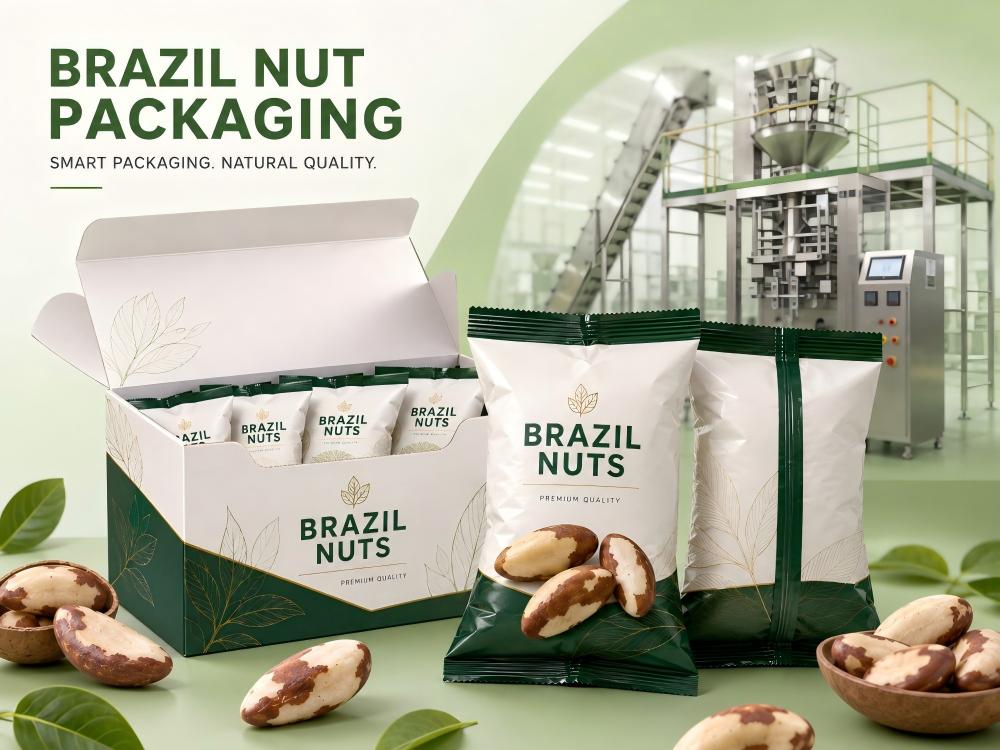
Integrated Brazil nut packaging concept combining flexible packaging, paper packaging and automated equipment.
Film width should not be selected only according to finished pouch capacity. Product dimensions, forming-set clearance, seal allowance, pouch proportion and production stability should be considered together. In this project, 130 mm rollstock could physically contain two Brazil nuts, but testing showed that 150 mm rollstock was more suitable for reliable production.
Because the product must pass through the forming tube before entering the pouch. Long and irregular Brazil nuts can fall in different orientations. If the minimum effective feeding clearance is too small, a kernel can bridge across the tube and interrupt product flow.
Nitrogen changes the actual three-dimensional thickness of the finished pouch. Flat pouch dimensions alone cannot accurately represent the stacking volume of a filled and gas-flushed package, so physical sample testing provides a more reliable basis for carton design.
Yes, if the actual pouch configurations are physically tested. In this project, 25 two-piece pouches (approximately 200 g total) and 15 four-piece pouches (approximately 250 g total) were designed around one shared 17.5 x 16 x 12 cm carton.
NEED TO MATCH YOUR PRODUCT, FILM WIDTH, VFFS MACHINE AND OUTER CARTON?
HLunPACK develops packaging around the actual product and production process - from rollstock width and forming-set compatibility to nitrogen-flushed sample testing and final carton sizing.
HLunPACK | Flexible Packaging · Paper Packaging · Packaging Machinery


