


close
Choose Your Site
Global
Social Media
Views: 269 Author: HLun PACK Publish Time: 2026-09-04 Origin: Site


Content Menu
● What Is a Baby Food Spout Pouch?
>> Why Brands Choose Baby Food Spout Pouches
● What Is a Glass Baby Food Jar?
>> Why Brands Continue to Use Glass Jars
● Baby Food Spout Pouch vs Glass Jar: Side-by-Side Comparison
● Food Safety: Packaging Matters, but Process Matters More
>> Food-Contact Compliance for Spout Pouches
>> Safety Considerations for Glass Jars
>> Important Consumer-Use Insight
● Shelf Life and Product Protection
>> When a Spout Pouch May Be Better
>> When a Glass Jar May Be Better
● Avoid Simple "Eco-Friendly" Claims
>> A Better Sustainability Decision Framework
● Packaging Engineering Checklist for Baby Food Brands
>> 1: Define the Product Profile
>> 2: Match the Package to the Process
>> 3: Validate Real-World Performance
>> 4: Design Consumer Instructions Carefully
● Choosing the Right Format for Your Brand
● How HLun Pack Supports Baby Food Packaging Projects
● FAQ
>> 1. Are baby food spout pouches safer than glass jars?
>> 2. Are glass baby food jars more environmentally friendly than pouches?
>> 3. Can baby food spout pouches be hot-filled?
>> 4. Why do some parents prefer glass jars for baby food?
>> 5. What is the best spout size for baby food pouches?
>> 6. Can flexible baby food pouches be recycled?
>> 7. Which format is better for e-commerce baby food sales?
Choosing between a baby food spout pouch and a glass jar is not simply a material decision. It affects food safety validation, product shelf life, filling-line efficiency, shipping cost, user convenience, recycling outcomes, and brand perception.
For baby-food manufacturers, the right package depends on the product formula, sterilization process, target market, distribution model, and consumer-use scenario. At HLun Pack, we view the decision through a complete packaging-system lens: the packaging material, pouch or jar format, closure, filling method, thermal process, secondary packaging, logistics, and end-of-life pathway must work together.
A baby food spout pouch is often the stronger choice for portable, single-serve, convenience-led products. A glass baby food jar can remain a compelling format for premium, spoon-fed, heat-processed products where transparency, rigidity, and traditional shelf presence matter most.
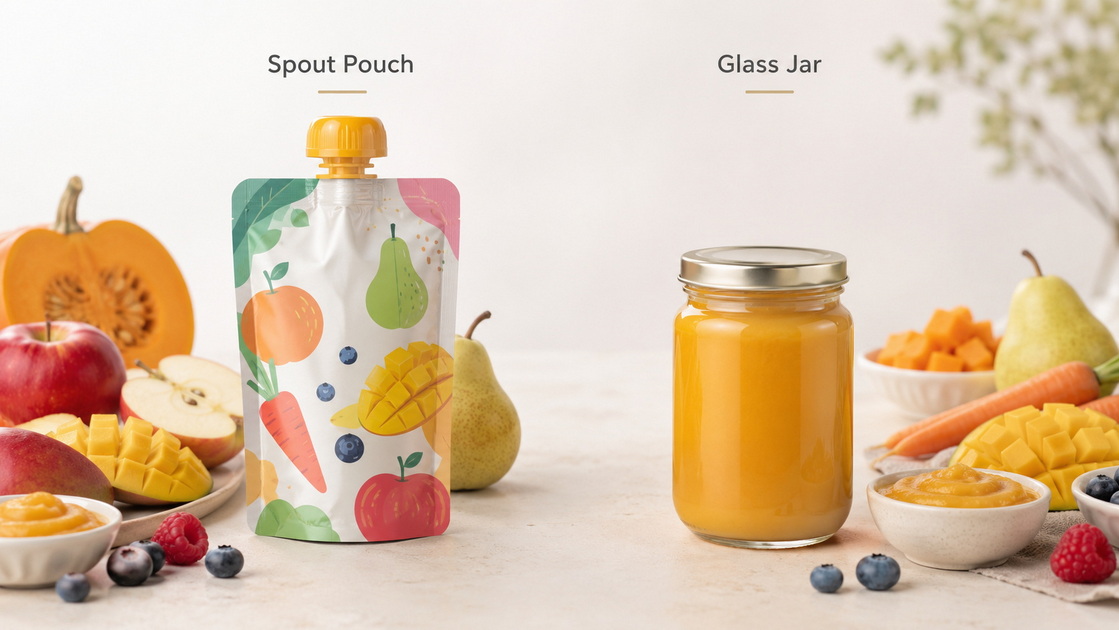
A baby food spout pouch is a flexible, sealed package designed for semi-liquid or puréed products such as fruit purée, vegetable blends, yogurt, smoothies, and toddler snacks. It usually includes a resealable plastic spout and cap.
Most commercial baby food pouches use a multi-layer flexible packaging structure. The layers may combine materials that provide:
- Oxygen barrier to protect flavor, color, and nutrients.
- Moisture barrier to maintain product consistency.
- Heat resistance for hot filling, pasteurization, or retort processing where applicable.
- Seal integrity to prevent leaks and contamination.
- Printability for high-impact retail branding.
- Puncture resistance during transport and handling.
For a packaging manufacturer, the critical engineering task is not merely making a pouch. It is matching the laminate, spout fitment, seal geometry, pouch dimensions, and filling process to the food's acidity, viscosity, oil content, processing temperature, shelf-life target, and distribution conditions.
Baby food spout pouches have become popular because they are easy to carry, lightweight, and convenient for on-the-go feeding. They can also be designed as stand-up pouches, which creates stronger shelf visibility than flat sachets.
Key commercial advantages include:
- Lower pack weight than glass.
- Reduced breakage risk during shipping and household use.
- Lower freight cost per unit in many distribution models.
- Resealable spout and cap for controlled dispensing.
- Large printable surface for branding, nutrition claims, and usage instructions.
- Convenient single-serve format for travel, daycare, and outdoor use.
- Potentially lower material use than rigid glass packaging.
A packaging industry case study comparing stand-up pouches with glass jars reported that glass used substantially more material and was associated with higher water use, fossil-fuel consumption, and greenhouse-gas emissions in that particular comparison. However, environmental results always depend on pack size, transport distance, recycled content, local recycling systems, food-waste rates, and whether glass is reused.
A glass baby food jar is a rigid, usually transparent container that is commonly paired with a metal twist-off lid. It has long been associated with traditional shelf-stable baby food, including puréed vegetables, fruits, meats, and mixed meals.
Glass is chemically inert in many food-contact applications and provides a robust barrier against oxygen and moisture. Unlike flexible packaging, a glass jar lets consumers directly see the food inside, which can strengthen perceptions of product authenticity and quality.
Glass jars remain commercially relevant because they offer several benefits that are difficult to replicate fully with flexible packaging:
- High product visibility because consumers can see the purée or meal.
- Rigid protection for products that need crush resistance.
- Strong premium and heritage positioning.
- Excellent barrier properties against gases and moisture.
- Established use with thermal processing in many traditional baby-food operations.
- Widely recognized recycling route in locations with glass-collection infrastructure.
- Familiarity for spoon-feeding routines.
The U.S. Food and Drug Administration advises caregivers not to use jarred food if the lid does not "pop" upon opening, because the vacuum indicator helps signal whether a sealed jar may have been compromised.
| Comparison Factor | Baby Food Spout Pouch | Glass Jar |
|---|---|---|
| Package weight | Very light; lowers shipping and handling weight | Heavy relative to product capacity |
| Breakage resistance | Excellent; flexible structure will not shatter | Lower; glass can break during transport or use |
| Portability | Excellent for travel, strollers, lunch bags, and daycare | Less convenient due to weight and fragility |
| Product visibility | Limited unless a clear window is used | Excellent; consumers can view the product directly |
| Barrier performance | Depends on laminate structure and seal quality | Naturally strong barrier against oxygen and moisture |
| Closure convenience | Resealable spout offers controlled dispensing | Twist-off lid is familiar but generally requires spoon-feeding |
| Child self-feeding | Convenient, but should be used responsibly and under supervision | Better aligned with spoon-feeding habits |
| Filling-line requirements | Requires pouch filling, spout handling, seal validation, and flexible-packaging controls | Requires jar handling, capping, vacuum control, and breakage management |
| Transport efficiency | Strong due to lightweight, compact form | Lower due to heavier glass and protective secondary packaging |
| Retail positioning | Modern, portable, active-lifestyle, convenience-led | Traditional, premium, transparent, spoon-fed |
| Recycling pathway | Can be challenging for multi-material laminates | Often easier for consumers to identify as recyclable where collection exists |
| Material efficiency | Typically uses less material per unit than glass | Requires more material weight per package |
| Risk management priority | Seal integrity, cap security, migration compliance, pouch durability | Breakage control, closure integrity, vacuum verification, lid-liner compliance |
When comparing a baby food pouch vs glass jar, brands should avoid making simplistic safety claims. A package cannot compensate for poor ingredient sourcing, poor sanitation, insufficient process validation, or weak quality control.
Food safety is a system. It includes raw-material quality, formulation, filling conditions, thermal treatment, microbial validation, package integrity, storage, transport, and consumer handling.
The FDA's guidance on lead action levels for processed foods intended for babies and young children applies across formats, including food sold in jars, pouches, tubs, and boxes. The packaging format does not exempt a manufacturer from controlling contaminants in ingredients and finished food. The FDA's stated action levels include 10 parts per billion for many fruits, vegetables, mixtures, yogurts, custards, puddings, and single-ingredient meats, and 20 parts per billion for single-ingredient root vegetables and dry infant cereals.
For a baby food spout pouch, the brand and packaging supplier should validate:
1. Food-contact compliance for every layer, ink, adhesive, spout, and cap.
2. Overall and specific migration performance under realistic use conditions.
3. Compatibility with product acidity, fat content, and processing temperatures.
4. Seal strength and leak resistance after filling and throughout shelf life.
5. Spout-and-cap security, including torque and pull-off resistance where relevant.
6. Odor and taste neutrality so packaging does not alter sensory quality.
7. Ink and adhesive placement, ensuring they are not on the food-contact side.
Research published in *Environmental Pollution* has examined chemical migrants from baby-food pouch packaging, underscoring why brands should treat migration testing and material selection as core quality-control activities rather than optional paperwork.
Glass itself is generally valued for its inertness, but the total system also includes the closure. Manufacturers must assess the metal lid, coating, gasket or plastisol liner, vacuum performance, and corrosion resistance.
For glass jar operations, practical quality controls include:
- Vacuum and closure-torque checks.
- Container and lid visual inspection.
- Glass-fragment prevention and foreign-body controls.
- Thermal shock management during filling and cooling.
- Breakage detection procedures on the production line.
- Distribution testing to assess impacts, vibration, compression, and pallet stability.
A pouch should not automatically replace responsive spoon-feeding. A 2018 review of novel baby-food pouches and feeding devices noted that experimental studies had not yet established the health, nutrition, or safety effects of these formats in complementary feeding.
For brands, that creates a clear communication responsibility: market convenience, but also provide age-appropriate feeding guidance. For example, include messaging such as:
Both formats can support shelf-stable baby food when they are properly designed and matched with a validated preservation process.
A glass jar provides a rigid and highly stable barrier. It is a natural fit for many hot-filled or retorted foods. A flexible pouch can also deliver excellent protection, but performance depends heavily on the chosen film structure, seal quality, and processing compatibility.
A baby food spout pouch may be the better option when your product needs:
- A lightweight, portable format.
- Single-serve or small portion sizes.
- High-volume retail distribution.
- E-commerce-friendly packaging.
- Reduced shipping weight.
- Strong graphics for shelf differentiation.
- A resealable dispensing feature.
- Lower breakage exposure.
For brands selling fruit purées, blended snacks, and active-family products, flexible pouches can create a more modern and convenient consumer experience.
A glass baby food jar may be more suitable when your product needs:
- A visible product presentation.
- A premium, clean-label, or traditional positioning.
- A spoon-fed consumer experience.
- High rigidity and shelf stability.
- Strong compatibility with an established jar-filling operation.
- A format that consumers readily recognize for recycling.
Glass is especially effective when consumers want to inspect food color, texture, and fill level before purchase.
The sustainability debate between baby food pouches and glass jars is more complex than "plastic is bad" or "glass is green."
Glass is recyclable and can be repeatedly remelted, but it is heavy. Its production and transportation can require significant energy. Flexible pouches are lightweight and can reduce transport-related impacts, but many high-barrier pouches are constructed from multiple materials, making them difficult to sort and recycle in conventional curbside systems.
The European Union's Packaging and Packaging Waste Regulation entered into force on February 11, 2025, and generally applies from August 12, 2026. The regulation is intended to reduce packaging waste and advance recyclability requirements, including the goal that all packaging be recyclable by 2030.
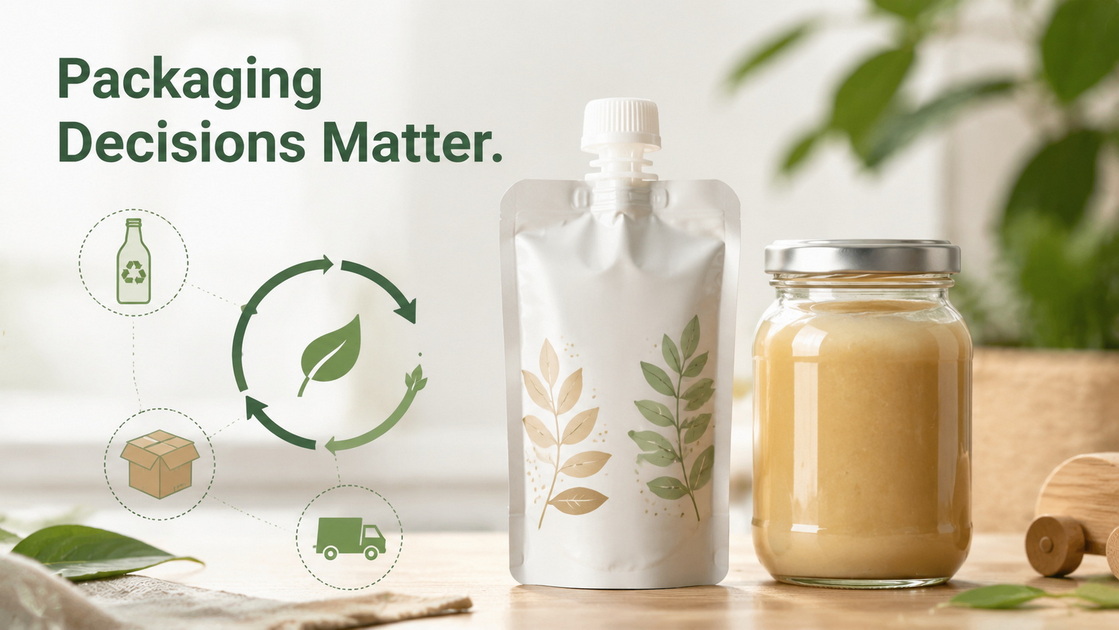
Instead of using generic environmental claims, evaluate the full packaging system:
| Sustainability Question | Why It Matters |
|---|---|
| How much packaging material is used per serving? | Material reduction can lower resource demand |
| How far will the product travel? | Heavy glass can increase freight-related impacts |
| Can local consumers recycle the package? | Practical recyclability is more meaningful than theoretical recyclability |
| Is the pouch mono-material or multi-material? | Material design affects sorting and recycling potential |
| Does the format reduce food waste? | Preventing wasted food can outweigh packaging differences |
| Is recycled content technically and legally suitable? | Food-contact applications require strict compliance |
| Could the glass format be reused in a real return system? | Reuse only helps when collection, washing, and refill loops exist |
Before selecting a baby food spout pouch or glass jar, conduct a structured packaging qualification process.
Document the product's:
- pH level.
- Viscosity.
- Fat content.
- Particle size.
- Filling temperature.
- Required shelf life.
- Storage conditions.
- Target age group.
- Serving size.
- Expected consumer-use behavior.
A thick vegetable-and-protein blend may require a different spout diameter and pouch structure than a smooth apple-and-pear purée.
Ask these questions:
- Will the product be hot-filled, pasteurized, retorted, or cold-filled?
- Does the pouch laminate tolerate the required temperature and pressure?
- Can the jar withstand thermal shock?
- Does the product require high oxygen protection?
- Is aseptic filling commercially viable for the production scale?
- What package-integrity tests will be performed after processing?
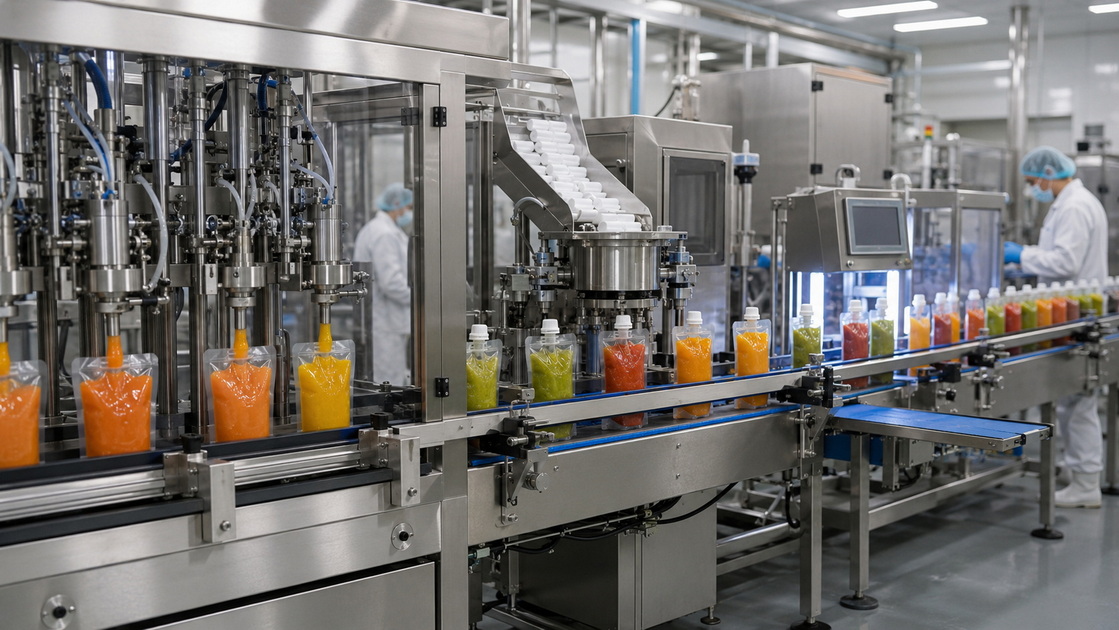
Do not approve a package only from a sample roll or catalog specification. Validate it under actual operating conditions.
Recommended tests include:
- Seal-strength testing.
- Burst and creep testing for pouches.
- Leak testing.
- Drop testing.
- Compression testing.
- Distribution simulation.
- Spout-and-cap opening-force testing.
- Jar vacuum and torque testing.
- Migration and sensory testing.
- Shelf-life studies.
- Consumer usability trials.
Include clear, legible instructions covering:
- Appropriate age or developmental stage.
- Adult supervision.
- Storage before and after opening.
- Refrigeration requirements after opening.
- Disposal or recycling guidance.
- Warnings against using damaged packaging.
- Feeding suggestions where applicable.
Choose a baby food spout pouch if your primary goals are portability, lower transport weight, high-impact branding, e-commerce resilience, and convenient single-serve feeding.
Choose a glass jar if your priority is premium presentation, transparent product visibility, a conventional spoon-feeding experience, rigid product protection, and compatibility with local glass-recycling infrastructure.
For many baby-food portfolios, the best strategy is not choosing only one format. It is using a dual-format packaging architecture:
- Use spout pouches for travel-friendly fruit purées, snack blends, and convenience-focused SKUs.
- Use glass jars for premium meals, spoon-fed recipes, and products where visible texture supports consumer trust.
This approach gives brands a way to serve different retail channels, price tiers, and feeding occasions without forcing every product into one packaging format.
HLun Pack provides flexible packaging equipment and integrated packaging solutions for brands and manufacturers developing modern food packaging systems.
For a baby food spout pouch project, the right solution may include:
- Pouch filling and sealing equipment.
- Spout pouch filling systems.
- Cap application and tightening solutions.
- Product-feeding and dosing systems.
- Quality-inspection integration.
- Secondary packaging equipment.
- Line layout planning.
- Packaging-material compatibility support.
- Production-efficiency optimization.
Our recommendation is to evaluate product + packaging material + filling process + distribution environment as one connected system. This reduces avoidable leakage, seal failures, line downtime, product waste, and consumer complaints.
Ready to develop a reliable baby food pouch packaging line? Contact HLun Pack to discuss your product characteristics, pouch dimensions, filling volume, process requirements, target output, and automation goals. Our team can help you assess whether a spout pouch format, glass jar format, or hybrid packaging strategy best supports your market plan.
Neither format is automatically safer. Both can be safe when the food, food-contact materials, closure system, filling process, and package-integrity controls are properly validated. A pouch requires strong control of laminate migration, seals, spouts, and caps, while a jar requires vacuum, closure, breakage, and lid-liner controls.
Not always. Glass is widely recyclable where collection systems exist, but it is heavier and may require more energy to manufacture and transport. Flexible pouches use less material and reduce shipping weight, but multi-layer structures can be difficult to recycle. A full life-cycle assessment is the most credible way to compare the formats.
Yes, some spout pouch structures are designed for hot filling or retort processing. However, the pouch laminate, spout, cap, seals, inks, adhesives, and filling equipment must all be compatible with the required temperature, pressure, and product chemistry.
Parents may prefer glass because it is transparent, rigid, familiar, and often associated with premium or minimally processed products. Glass also lets consumers see the food before purchase. However, it is heavier and can break.
The best spout size depends on the product viscosity, particle size, intended dispensing method, child age, and filling-line capability. Smooth fruit purées may use a smaller outlet, while thicker blends with particles may require a larger opening to prevent dispensing issues.
It depends on the pouch structure and local recycling system. Many high-barrier pouches use multiple materials, which can limit curbside recyclability. Brands should investigate recyclable mono-material options where feasible and provide recycling claims only when supported by local collection and processing capability.
Spout pouches are often better suited to e-commerce because they are lightweight, less fragile, and less likely to break in parcel delivery. Glass jars may require more protective secondary packaging, which can increase shipping weight and material use.
1. U.S. Food and Drug Administration. "Guidance for Industry: Action Levels for Lead in Processed Food Intended for Babies and Young Children." Covers packaged foods in jars, pouches, tubs, and boxes, and provides recommended lead action levels for relevant food categories. (https://www.fda.gov/regulatory-information/search-fda-guidance-documents/guidance-industry-action-levels-lead-processed-food-intended-babies-and-young-children)
2. U.S. Food and Drug Administration. "Once Baby Arrives: Food Safety for Moms-to-Be." Includes consumer guidance not to use jarred food when the lid does not pop upon opening.(https://www.fda.gov/food/people-risk-foodborne-illness/once-baby-arrives-food-safety-moms-be)
3. European Commission. "Packaging Waste." Explains the EU Packaging and Packaging Waste Regulation, which entered into force on February 11, 2025 and generally applies from August 12, 2026.(https://environment.ec.europa.eu/topics/waste-and-recycling/packaging-waste_en)
4. European Commission. "Facts About the New EU Rules on Packaging and Packaging Waste." Describes the policy direction toward waste reduction and recyclable packaging by 2030. (https://environment.ec.europa.eu/topics/waste-and-recycling/packaging-waste/facts-about-new-eu-rules-packaging-and-packaging-waste_en)
5. Tang, C. et al. "Evaluation and Identification of Chemical Migrants Leached from Baby Food Pouch Packaging." *Environmental Pollution*, 2023. Discusses chemical migration assessment in baby-food pouch packaging. (https://www.sciencedirect.com/science/article/pii/S0045653523020258)
6. Almeida, A. et al. "Novel Commercial Packaging and Devices for Complementary Feeding: A Review." *Nutrients*, 2018. Reviews the rise of baby-food pouches and notes the limited experimental evidence on related health, nutrition, and safety effects. (https://pmc.ncbi.nlm.nih.gov/articles/PMC6140442/)
7. D. Humbert et al. "Life Cycle Assessment of Two Baby Food Packaging Alternatives: Glass Jars vs. Plastic Pots." *The International Journal of Life Cycle Assessment*, 2009. Compares life-cycle impacts of baby-food packaging systems using ISO 14040 and ISO 14044 methods. (https://link.springer.com/article/10.1007/s11367-008-0052-6)
8. Perfect Packaging. "Benefits of Baby Food Packaged in Stand-Up Flexible Pouches." Presents a packaging comparison involving pouches and glass jars; figures should be interpreted in the context of the study's assumptions and package configurations. (https://perfectpackaging.org/life-cycle-assessment-case-study-baby-food-package-comparison/)


