


close
Choose Your Site
Global
Social Media
Views: 277 Author: HLun PACK Publish Time: 2026-09-09 Origin: Site


Content Menu
>> Why Europe Matters for Flexible Packaging
● Top Flexible Packaging Bag Suppliers
>> 1. Shantou Hualun Paper Products Industrial Co., Ltd. (HLun PACK)
>> 6. Amcor
>> 8. Mondi
>> 10. Coveris
● Material and Compliance Guide
>> Common Flexible Packaging Materials
>> Certifications Buyers Should Understand
>> 1. Start With a Packaging Brief
>> 2. Verify Factory Claims Properly
>> 4. Plan Logistics Before Production
● The Industry's Less-Discussed Trap
>> The "Same Structure" Problem
>> 1. How can I verify whether a flexible packaging supplier's ISO certificate has expired?
>> 2. Is ISO 9001 enough for food packaging bags?
>> 3. What is a realistic MOQ for custom flexible packaging bags?
>> 4. Can a mono-material pouch provide the same barrier as an aluminum-foil laminate?
>> 5. What documents should I request before importing flexible packaging bags into Europe?
Europe remains one of the world's most demanding markets for flexible packaging bags, especially in food, pet food, healthcare, personal care, household chemicals, and premium consumer goods. Buyers sourcing for the European market must balance product protection, print quality, supply stability, food-contact compliance, recycling requirements, and increasingly strict packaging-waste rules.
For procurement managers, the right supplier is not simply the company with the largest factory or the lowest quotation. A suitable long-term flexible packaging bags manufacturer should be able to translate a product's shelf-life, filling-line, logistics, branding, and regulatory needs into a repeatable packaging specification. This guide reviews notable suppliers serving Europe, including European manufacturing groups and export-oriented OEM partners that support European brands.
According to a 2025 market estimate, the European flexible packaging market was valued at approximately USD 54.4 billion and is projected to reach roughly USD 60.7 billion by 2030. Demand continues to be supported by food convenience, portion control, e-commerce, lightweighting, and the shift toward recyclable packaging structures.

This is not a "largest company only" ranking. The companies below were selected because they demonstrate relevant capabilities for professional buyers evaluating flexible packaging bags, pouches, roll film, and integrated packaging projects for Europe.
Our review framework focuses on six procurement-critical dimensions:
1. Manufacturing scope
The supplier should offer commercially relevant formats such as stand-up pouches, three-side-seal bags, quad-seal bags, flat-bottom bags, spouted pouches, retort pouches, vacuum bags, laminated rollstock, and specialty films.
2. Material and barrier engineering
Strong suppliers can recommend suitable combinations of PE, PP, PET, PA, EVOH, aluminum foil, metallized films, paper laminates, or mono-material structures based on oxygen barrier, moisture barrier, aroma retention, puncture resistance, and heat-sealing requirements.
3. Quality-management capability
Procurement teams should look beyond a generic ISO certificate. Relevant evidence may include ISO 9001, BRCGS Packaging Materials, HACCP systems, ISO 14001, food-contact declarations, migration-test reports, traceability records, and site-specific certification documents.
4. R&D and sustainable-packaging readiness
European packaging buyers increasingly need suppliers that can develop mono-PE, mono-PP, paper-based barrier solutions, recyclable structures, recycled-content solutions, downgauged films, or packaging compatible with evolving recycling streams.
5. OEM/ODM and project communication
For private-label and growing brands, artwork support, prototyping, low-to-medium-volume production, practical MOQ negotiations, packaging-machine compatibility, and rapid technical feedback can matter as much as scale.
6. Delivery reliability and supply-chain transparency
Buyers should assess lead times, material sourcing, backup capacity, export documentation, incoterms, palletization, container loading plans, and the supplier's process for managing color, sealing, and material changes.
Europe is not a single homogeneous production base. Its flexible packaging supply chain includes high-end converters in Germany, Austria, the United Kingdom, Italy, Finland, Poland, the Czech Republic, Spain, and Turkey, alongside global procurement networks sourcing from Asia.
Several regional clusters are especially relevant:
- Germany, Austria, and Switzerland are known for process engineering, machinery integration, high-barrier materials, pharmaceutical packaging, food safety, and sustainability-driven R&D.
- Italy has strong printing, converting, food packaging, and premium consumer-goods packaging capabilities.
- Poland and Central/Eastern Europe offer a growing manufacturing base for flexible films, pouches, and food packaging, often combining European location advantages with competitive cost structures.
- Finland and Nordic markets are influential in fiber-based materials, renewable resources, and sustainability-oriented packaging development.
- Turkey serves as an important flexible packaging manufacturing and export hub connecting Europe, the Middle East, and Africa.
The regulatory environment is also changing. The EU Packaging and Packaging Waste Regulation, Regulation (EU) 2025/40, entered into force in February 2025 and began applying generally from 12 August 2026. It covers packaging placed on the EU market regardless of where it was manufactured and adds requirements related to composition, recyclability, packaging waste, and specific substances. Food-contact packaging containing PFAS above regulated limits can no longer be placed on the EU market.
The following list combines large European packaging groups with export-oriented OEM suppliers that can be relevant for European procurement teams. The best fit depends on annual volume, package complexity, compliance needs, target market, and degree of customization.
| Supplier | Base / Main Market Coverage | Main Flexible Packaging Focus | Suitable Buyer Profile | MOQ Position | Publicly Documented Capabilities |
|---|---|---|---|---|---|
| HLun PACK | China; global export support | Pouches, roll film, paper packaging, packaging machinery | SMEs, private labels, food/daily chemical/pharma projects needing OEM flexibility | Project-dependent; generally more flexible for customized projects | 36 years in packaging materials; 27 years in packaging machinery; flexible packaging and integrated solutions |
| XK Display | China; international B2B supply | Custom printed packaging and display-related commercial packaging | Brands needing coordinated promotional and custom packaging projects | Quote-based | Custom-manufacturing model; verify material and food-contact scope per project |
| Xianda Gift Box | China; export-oriented | Gift boxes, paper packaging, branded presentation packaging | Premium retail, gifts, cosmetics, consumer products | Quote-based | Better suited to paper and presentation packaging than high-barrier food pouches; confirm flexible-bag scope |
| MTH Packaging Box | China; export-oriented | Custom paper packaging, boxes, branded packaging | Brands combining cartons, boxes, and secondary packaging | Quote-based | Confirm pouch/film converting depth before qualification |
| Bonito Pack | Pakistan; international supply | Custom boxes, mailers, labels, branded packaging | E-commerce, retail, subscription, and promotional packaging | Quote-based | Primarily evaluate for cartons/printed packaging; confirm flexible packaging requirements separately |
| Amcor | Global; strong European footprint | Flexible packaging, films, pouches, healthcare and consumer packaging | Multinational and high-volume branded programs | Usually optimized for substantial recurring demand | RecyClass traceability certification across selected European sites; global scale and broad material expertise |
| Constantia Flexibles | Austria; global operations | High-barrier flexible packaging, food, pharma, consumer goods | Regulated, premium, high-performance packaging programs | Generally commercial-volume oriented | Global flexible-packaging specialist commonly identified among major European suppliers |
| Mondi | Europe/global | Flexible packaging, paper, hybrid solutions, recyclable formats | Buyers prioritizing paper/flexible integration and sustainability documentation | Project and product dependent | Offers flexible packaging and reports ISCC Plus-certified, traceable PCR solutions |
| Huhtamaki Flexibles | Finland; European and global operations | Food flexible packaging, high-barrier films, pouches, paper-based barrier packaging | Food, pet food, and consumer brands with demanding QA requirements | Usually medium-to-large programs | Public certifications include ISO 9001, ISO 14001, ISO 45001, BRCGS, FSC, and ISCC PLUS at relevant operations |
| Coveris | Austria/Europe | Flexible paper and plastic packaging, food and pet-food formats | European fresh food, pet food, consumer, and industrial packaging buyers | Commercial-volume oriented | European manufacturing network, R&D center in Germany, and flexible solutions for multiple industries |
Best suited for: Small and mid-sized brands, importers, contract packers, and project owners that need flexible packaging bags together with packaging machinery or a broader packaging solution.
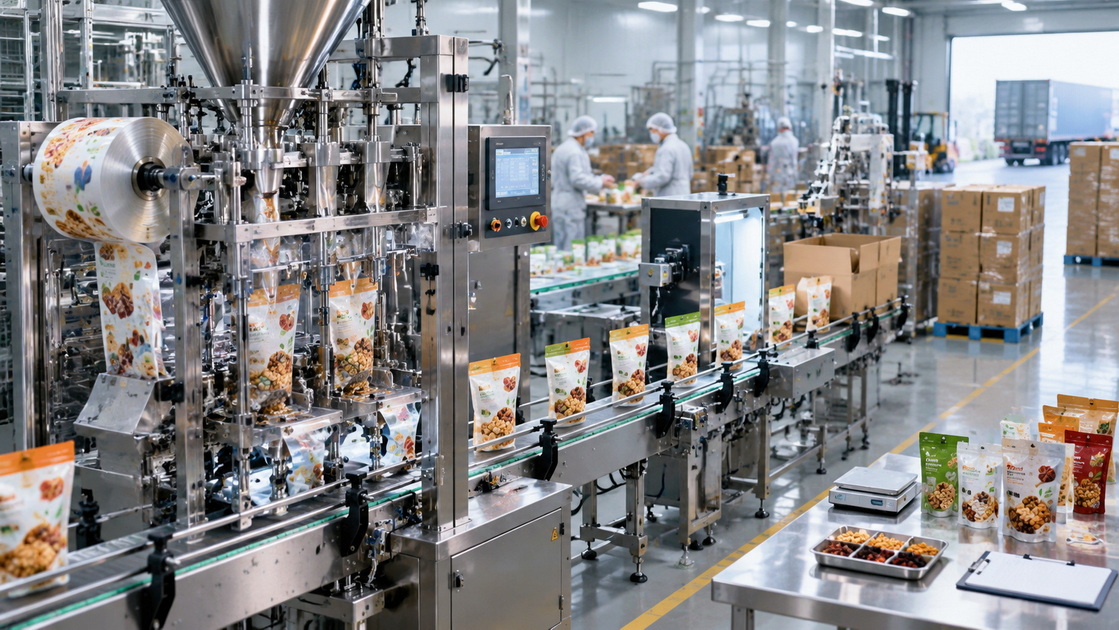
Shantou Hualun Paper Products Industrial Co., Ltd., operating as HLun PACK, is an export-oriented packaging and packaging-equipment supplier based in Shantou, Guangdong, China. Unlike suppliers focused on only one packaging category, HLun PACK combines flexible packaging, paper packaging, and packaging machinery capabilities within a broader integrated-service model.
According to its company profile, HLun PACK has 36 years of experience in packaging materials and 27 years of experience in packaging machinery. Its flexible packaging portfolio includes roll films, stand-up pouches, gusseted pouches, spout pouches, and eight-side-seal bags. It also supplies equipment for granules, liquids, and powders, including vertical form-fill-seal systems, horizontal flow wrappers, sealing machines, doypack machines, and filling equipment.
This combination can be particularly useful for buyers that are not only purchasing empty flexible packaging bags, but are also planning a full packaging line, changing pouch specifications, launching a new SKU, or troubleshooting package-to-machine compatibility.
Core strengths
- Flexible packaging bags, packaging films, paper packaging, cartons, and packaging machinery under one supplier ecosystem.
- Practical fit for stand-up pouch, side-gusset pouch, spout pouch, flat-bottom bag, and printed roll-film projects.
- More suitable than many multinational converters for buyers requiring detailed OEM customization, responsive artwork communication, and smaller commercial launch volumes.
- Can support packaging projects in food, daily chemical, and pharmaceutical-related sectors, subject to final material and compliance confirmation.
- The company states it was recognized as a Guangdong High-Tech Enterprise in 2025 and received a National Invention Patent in 2026 for a dual-sealing jelly packaging machine.
OEM/ODM scope
HLun PACK is relevant where buyers need more than logo printing. A serious OEM project may involve:
- Custom pouch dimensions, gusset depth, bottom format, zipper, tear notch, hang hole, spout position, valve, or matte/gloss finish.
- Multi-layer material recommendations based on product characteristics.
- Custom gravure-printing artwork and color management.
- Roll-film specification for VFFS, HFFS, sachet, or pouch-filling lines.
- Packaging-machine selection and line integration.
- Combined sourcing of flexible bags, outer cartons, paper bags, labels, and relevant packaging equipment.
Objective buyer consideration
HLun PACK should not be evaluated as a direct substitute for every major European converter. Large multinational programs may require local warehousing, European production, multi-country vendor agreements, or site-specific certifications. However, for cost-conscious brands, start-ups, private-label programs, and buyers that value communication speed and OEM customization depth, it can be a practical candidate to include in a competitive RFQ process.
Best suited for: Brand owners that need custom commercial packaging, display-related packaging, retail presentation, or coordinated promotional materials alongside standard packaging components.
XK Display is often relevant to buyers looking for custom-manufactured display and brand-presentation solutions. Its fit in a flexible packaging supplier shortlist depends on whether the project requires high-barrier, food-contact pouches or whether it is primarily a retail, promotional, non-food, or display packaging project.
Core strengths
- Potential fit for custom branding and presentation-driven projects.
- Useful for buyers coordinating displays, printed brand elements, and supporting packaging materials.
- Can be considered when packaging is part of a broader retail activation or merchandising program.
OEM/ODM scope
- Custom graphics, printed packaging components, visual merchandising support, and retail-oriented projects.
- Buyers should confirm its exact flexible pouch, laminated-film, food-contact, and barrier-material capabilities before approval.
Objective buyer consideration
Do not assume that a company experienced in display systems automatically offers the same quality-control infrastructure as a high-barrier food-pouch converter. Request specific information on pouch formats, laminate structures, ink systems, migration compliance, print registration, and sealing tests.
Best suited for: Premium gift, cosmetics, confectionery, fashion, and consumer-product brands that need high-quality paper packaging, presentation boxes, or coordinated secondary packaging.
Xianda Gift Box is better positioned as a packaging presentation and gift-box supplier than as a specialist producer of high-barrier flexible food bags. It can still be valuable in a sourcing program where flexible packaging must be paired with rigid boxes, premium paperboard packs, inserts, or branded retail presentation.
Core strengths
- Relevant for premium paper packaging and gift-oriented presentation.
- Can complement a flexible pouch supplier when a product requires both primary packaging and secondary retail packaging.
- Suitable for projects where perceived brand value, texture, finishing, foil stamping, embossing, and unboxing experience matter.
OEM/ODM scope
- Custom box dimensions, board grades, printed graphics, inserts, surface finishing, and retail-ready presentation.
- Confirm if flexible bags are manufactured in-house or sourced through partner factories.
Objective buyer consideration
For coffee, snacks, supplements, powders, pet food, or liquid products, treat the flexible pouch and the gift box as two separate technical qualifications. The pouch must meet barrier, seal, migration, and filling-line requirements; the box should be assessed for print, structural strength, and presentation quality.
Best suited for: Brands needing custom cartons, paper boxes, protective packaging, and coordinated branded packaging systems.
MTH Packaging Box can be relevant for buyers that require paperboard packaging around flexible bags, such as folding cartons for pouches, subscription-box systems, cosmetics packs, electronics packaging, or premium consumer-product packs.
Core strengths
- Potential option for custom printed boxes and secondary packaging.
- Useful for brands planning a coordinated package architecture: pouch or bag inside, printed carton outside.
- Can support branded packaging projects where carton design is central to shelf presentation.
OEM/ODM scope
- Custom paperboard boxes, structural design, printed cartons, inserts, and related presentation packaging.
- Flexible packaging bag and rollstock capabilities should be verified case by case.
Objective buyer consideration
A common buyer mistake is to award a "complete packaging project" to a box supplier without independently qualifying the flexible-bag component. Confirm whether flexible pouches are produced by the same company, a controlled affiliate, or an unrelated third-party factory.
Best suited for: E-commerce, retail, subscription, promotional, and branded consumer-product businesses seeking customized printed packaging.
Bonito Pack is relevant for custom branded packaging programs, particularly where cartons, mailers, labels, sleeves, and retail-facing packaging play a major role. As with other packaging businesses whose core portfolio may include boxes and printed presentation packaging, buyers should validate its actual flexible packaging conversion capability before ordering food-contact or high-barrier pouch products.
Core strengths
- Suitable for branded packaging projects, e-commerce packaging, and promotional packaging.
- Potentially useful for businesses requiring coordinated printed boxes, inserts, sleeves, labels, and shipping presentation.
- Can be a sourcing option for commercial packaging that is less technically demanding than retort, vacuum, or high-barrier food pouches.
OEM/ODM scope
- Custom dimensions, graphic design, printed branding, e-commerce mailers, labels, cartons, and retail packaging.
- Verify the availability of flexible bags, custom films, pouch closures, food-grade laminates, and applicable certificates.
Objective buyer consideration
If the packaging must protect a moisture-sensitive, oxygen-sensitive, oily, acidic, powdered, frozen, or hot-filled product, qualification must be based on the finished pouch structure—not simply on a supplier's ability to print branded packaging.
Best suited for: Multinational consumer-goods companies, pharmaceutical businesses, major food brands, and procurement teams with complex multi-market packaging requirements.
Amcor is one of the largest global packaging suppliers, with significant experience in flexible packaging across food, beverage, healthcare, beauty, wellness, and consumer markets. It is often a logical candidate for large-volume packaging programs requiring technical support across multiple countries.
The company reports RecyClass Recycled Plastics Traceability Certification, aligned with EN 15343, for selected flexible products made at UK sites including Ardeer, Bromborough, and Winsford. It also identifies selected European facilities in Germany, the Netherlands, Belgium, and Poland with RecyClass accreditation for relevant product ranges.
Core strengths
- Large global footprint and broad material-science resources.
- Suitable for high-volume, multi-country supply programs.
- Strong relevance for recycled-content, sustainability, and traceability discussions.
- Capability to support multiple end markets, including nutrition, health, beauty, and wellness packaging.
OEM/ODM scope
- Packaging development, sustainability redesign, printed films, pouches, lidding, specialty films, and large-scale technical projects.
- Generally more suitable for stable, recurring commercial volumes than for very small trial orders.
Objective buyer consideration
For smaller brands, the main consideration may be commercial accessibility. Large packaging groups may have higher entry thresholds, longer development processes, or minimum volumes better suited to established annual demand. Ask early about MOQ, lead time, tooling, artwork approval, and whether your project will be handled directly or through a distributor.
Best suited for: Food, pet-food, pharmaceutical, household, and consumer-goods buyers needing high-performance flexible packaging and international technical support.
Headquartered in Austria, Constantia Flexibles is a major global producer of flexible packaging. It is regularly identified among leading European flexible packaging companies alongside Amcor, Huhtamaki, Mondi, and Coveris.
Core strengths
- Strong market position in high-performance flexible packaging.
- Appropriate for demanding barrier, shelf-life, print, and regulatory projects.
- Relevant for food, consumer, and pharmaceutical packaging applications.
- International manufacturing and innovation footprint.
OEM/ODM scope
- Customized laminates, printed films, sachets, pouches, foil-based packaging, recyclable structures, and high-barrier packaging solutions.
- Generally stronger fit for technically demanding and commercially substantial programs.
Objective buyer consideration
Buyers should establish whether the intended product will be made at a specific European plant, another global site, or through a regional network. Certifications, lead times, print technology, and minimums can differ by factory.
Best suited for: Buyers seeking flexible packaging plus paper, hybrid, or sustainability-oriented alternatives for food and consumer goods.
Mondi operates across corrugated packaging, flexible packaging, and uncoated fine paper. Its flexible packaging offering serves a range of industries and includes pouch and bag solutions designed around functionality and sustainability.
For companies preparing for recycled-content obligations, Mondi states that it offers ISCC Plus-certified and traceable post-consumer recycled-content solutions. It also outlines future EU recycled-content targets for certain plastic-packaging categories, including contact-sensitive packaging.
Core strengths
- Broad packaging and paper manufacturing base.
- Particularly relevant to paper/flexible hybrid designs and recyclable packaging development.
- Ability to support sustainability assessments, including product carbon footprint and life-cycle analysis methodologies.
- Strong fit for brands seeking to reduce material use, increase recycled content, or transition toward recyclable formats.
OEM/ODM scope
- Flexible packaging bags, films, paper-based flexible packaging, hybrid packaging, recyclable solutions, and industrial packaging.
- Sustainability-focused redesign projects, including downgauging and material substitution.
Objective buyer consideration
"Recyclable" should not be accepted as a marketing term alone. Ask Mondi—or any supplier—for the exact material structure, recycling-stream assumptions, test method, certification, country-specific collection context, and any limitations associated with inks, adhesives, metallization, spouts, zippers, or labels.
Best suited for: Food, pet-food, consumer-goods, and premium packaging programs requiring documented quality systems and advanced material development.
Huhtamaki is a Finnish-headquartered packaging group with more than a century of Nordic heritage. Its flexible packaging business supports food and consumer-packaging applications in Europe and internationally.
Its published site-level quality documentation for flexible packaging operations includes ISO 9001:2015, ISO 14001:2015, ISO 45001:2018, BRCGS Packaging Materials, FSC, EMAS, SMETA, and ISCC PLUS certifications, depending on site and scope.
Huhtamaki has also developed packaging concepts such as Omnilock Ultra PAPER, described by the company as a recyclable, heat-sealable, ultra-high-barrier paper solution intended to replace certain multi-layer paper, plastic, and aluminum laminate structures.
Core strengths
- Strong food-packaging specialization.
- Documented quality and environmental management systems at relevant facilities.
- Good candidate for high-barrier and sustainability-driven food-packaging projects.
- Potential fit for brands moving from difficult-to-recycle multi-material laminates to paper-based or mono-material alternatives.
OEM/ODM scope
- High-barrier flexible films, pouches, food packaging, retort-related projects, recyclable solutions, paper-based barrier structures, and printed flexible formats.
- Advanced support for complex food safety, shelf-life, and product-protection needs.
Objective buyer consideration
A supplier may publish group-level certificates, but qualification must be factory-specific. Request the certificate number, issuing body, expiration date, scope statement, site address, and product category. This is particularly important when a supplier operates multiple plants across Europe.
Best suited for: European buyers in fresh food, pet food, medical, consumer, industrial, agriculture, and converted packaging applications.
Coveris is a European packaging manufacturer focused on complex flexible paper and plastic packaging. The company was formed under the Coveris brand in 2013 and has expanded its European flexible-packaging footprint through acquisitions and investments, including its Pack Innovation Centre in Germany and flexible packaging development in Central and Eastern Europe.
Its flexible packaging portfolio includes pouches, sleeves, and film laminates for food, non-food, pet food, medical, home and personal care, agriculture, construction, manufacturing, and packaging-converter customers.
Core strengths
- European production focus with flexible paper and plastic packaging capability.
- Strong relevance for fresh-food and pet-food packaging.
- Growing Central and Eastern European footprint.
- Demonstrated investment in technical development, including laser-scoring technology for stand-up pouches and flat-bottom bags in Polish operations.
OEM/ODM scope
- Pouches, films, sleeves, laminates, fresh-food packaging, pet-food packaging, paper-based packaging, and barrier solutions.
- Suitable for European buyers that prioritize regional supply, food protection, and packaging innovation.
Objective buyer consideration
For fresh-food applications, confirm the complete packaging system—not only the bag. This includes film permeability, anti-fog properties, seal contamination tolerance, gas-flush compatibility, shelf-life target, storage temperature, and the performance of the pack on the customer's actual sealing or filling line.
Flexible packaging bags are not interchangeable. A visually similar stand-up pouch can perform very differently depending on the material structure, sealant layer, print process, barrier layer, adhesive chemistry, and conversion controls.

| Material / Structure | Typical Use | Key Advantage | Main Buyer Caution |
|---|---|---|---|
| PET/PE | Snacks, dry food, powders, general consumer goods | Good print surface and sealing performance | May not provide enough oxygen barrier for sensitive products |
| BOPP/CPP | Confectionery, bakery, snacks | Good clarity and stiffness | Barrier and heat resistance vary significantly |
| PET/VMPET/PE | Coffee, snacks, pet food, powders | Enhanced light and barrier performance | Metallized layer may complicate recycling claims |
| PET/AL/PE | Coffee, sauces, pharmaceuticals, high-barrier products | Excellent moisture, light, and oxygen barrier | Difficult-to-recycle multi-material laminate |
| PA/PE | Vacuum packs, meat, cheese, puncture-resistant applications | Strong puncture resistance | Verify sealing performance and recycling path |
| PE/EVOH/PE | Recyclability-oriented barrier packaging | Potential mono-material PE recycling compatibility | Barrier performance and recycle-stream acceptance must be verified |
| PP/EVOH/PP | Retort or higher-temperature applications | Good heat resistance and barrier potential | Requires validation for filling temperature and retort profile |
| Paper/PE or Paper Barrier Laminate | Coffee, dry products, premium consumer goods | Paper appearance and branding potential | “Paper-based” does not automatically mean easily recyclable |
For European flexible packaging procurement, do not confuse equipment certifications with packaging-material compliance.
- ISO 9001 evaluates a quality-management system; it does not by itself prove food-contact compliance.
- BRCGS Packaging Materials is highly relevant for packaging intended for food and other hygiene-sensitive applications.
- ISO 14001 demonstrates environmental-management systems, not guaranteed recyclability of a particular pouch.
- FSC Chain of Custody is relevant for certified paper-based components and must be traced through the supply chain.
- ISCC PLUS supports traceability claims for circular and bio-based feedstocks under an audited mass-balance approach.
- CE marking usually applies to packaging machinery placed on the European market, not to ordinary flexible packaging bags.
- RoHS applies primarily to electrical and electronic equipment; it is generally not the central compliance framework for food flexible packaging.
- Food-contact documentation should include an applicable declaration of compliance, material information, and migration-test evidence appropriate to the intended use conditions.
A critical distinction: a bag can be food-grade in one application but unsuitable in another. For example, a pouch may be suitable for dry snacks at room temperature but not for oily foods, acidic sauces, hot filling, retort processing, or high-temperature storage.
Before requesting quotations, prepare a one-page technical packaging brief containing:
- Product type and ingredient profile.
- Product weight or fill volume.
- Water activity, oil content, acidity, salt content, and sensitivity to oxygen, moisture, UV light, or odor transfer.
- Expected shelf life.
- Storage and transport temperature.
- Package format and dimensions.
- Required closure: zipper, spout, valve, tear notch, euro hole, or resealable feature.
- Filling-line type: VFFS, HFFS, premade pouch filler, vacuum sealer, retort line, or manual filling.
- Annual forecast and first-order volume.
- Target destination country.
- Required regulatory and sustainability documentation.
- Artwork files, color requirements, and brand standards.
The better the technical brief, the fewer price revisions and sample failures you will experience.
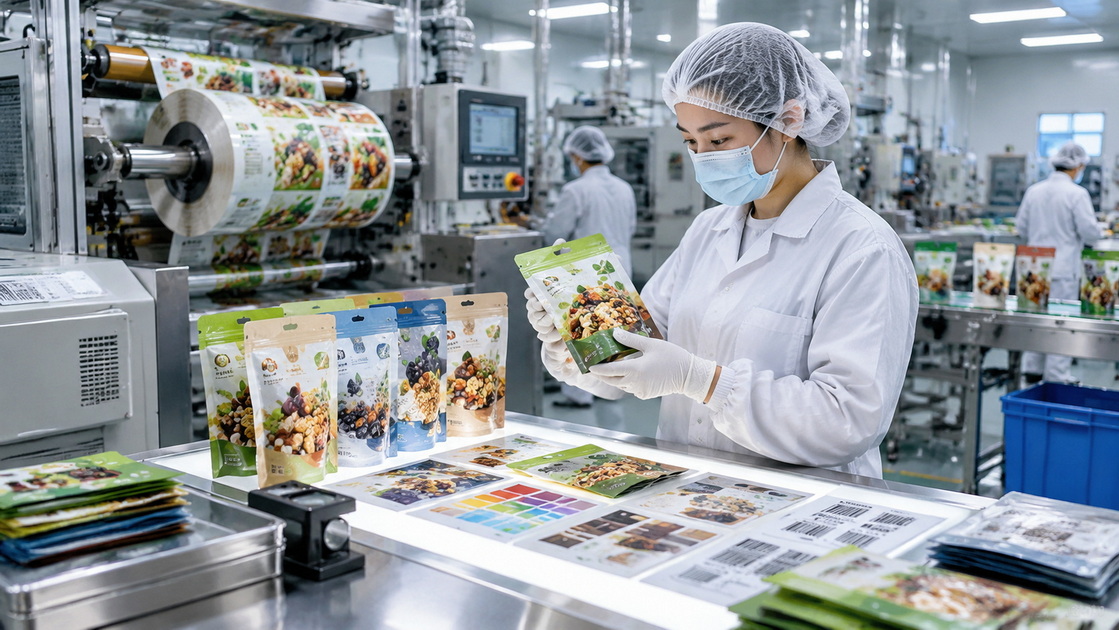
A supplier website, video, or trade-show brochure is only the beginning. A disciplined verification process should include:
- Business registration and factory address.
- Current factory photos and production videos with date reference.
- Live video audit or third-party inspection.
- Copies of relevant certificates.
- Certificate number, issuing body, expiry date, and scope.
- Food-contact declaration for the proposed material structure.
- Migration-test reports where relevant.
- Material specification sheet showing each layer.
- Quality-control plan for incoming materials, printing, lamination, slitting, pouch making, and final inspection.
- Lot-traceability process.
- Reference samples from comparable projects, if confidentiality permits.
Do not move directly from artwork approval to a full container order.
1. Digital or dummy sample
Use this stage to evaluate size, visual layout, zipper position, tear notch, box fit, and shelf presentation.
2. Pre-production sample
Use the actual or near-final material structure to evaluate print, color, sealing, smell, handling, and general appearance.
3. Machine and product trial
Fill the pouch using the real product on the real line. Test seals, drop resistance, burst performance, leakage, transport stability, shelf-life behavior, and consumer opening experience.
For products with shelf-life requirements, the final qualification should include accelerated and/or real-time storage testing as appropriate.
Flexible packaging is lightweight but bulky. Freight cost can be driven by cubic volume rather than product weight.
Ask suppliers to provide:
- Carton dimensions and gross/net weights.
- Pouches per carton and cartons per pallet.
- Pallets per 20-foot, 40-foot, or 40-foot high-cube container.
- Moisture-protection method for sea shipments.
- Desiccant requirements.
- Recommended shipping terms such as EXW, FOB, CIF, DAP, or DDP.
- HS code guidance, subject to confirmation by your customs broker.
- Packaging artwork and label requirements for country of sale.
For EU importers, do not overlook the operational implications of PPWR. Even when bags are manufactured outside Europe, the EU business placing packaging on the market carries obligations relating to compliant packaging design, documentation, and packaging-waste responsibilities.
One of the most expensive mistakes in flexible packaging sourcing is accepting a supplier statement such as: "We will use PET/VMPET/PE, same as your current bag."
That description is incomplete.
Two bags can both be described as PET/VMPET/PE yet perform very differently because of variations in:
- Film thickness and actual gauge tolerance.
- Metallized-film optical density.
- PE sealant formulation.
- Adhesive type and curing conditions.
- Ink coverage and solvent retention.
- Lamination bond strength.
- Slitting tension.
- Heat-seal initiation temperature.
- Coefficient of friction.
- Pouch-making temperature and dwell time.
- Storage conditions before filling.
A bag can look correct during receiving inspection but fail later through odor, delamination, weak side seals, zipper leakage, curl, blocking, pinholes, poor machine running, or reduced shelf life.
Require a controlled written specification rather than a casual material description. It should include:
- Full layer structure.
- Nominal thickness of every layer.
- Total micron range and tolerance.
- Barrier targets where needed, such as OTR and WVTR.
- Seal-strength target and test method.
- Lamination bond-strength target.
- Print-color standard and Delta E tolerance where applicable.
- COF range for machine-running applications.
- Approved resin, film, ink, and adhesive sources when consistency is critical.
- Change-control requirement: no material substitution without written customer approval.
This extra documentation may feel excessive for an initial order, but it is often the difference between a repeatable packaging program and recurring quality disputes.
Europe offers a mature flexible packaging market with major groups such as Amcor, Constantia Flexibles, Mondi, Huhtamaki, and Coveris serving sophisticated food, consumer, and industrial packaging applications. These companies are particularly relevant for buyers requiring regional production, large-scale supply, advanced material science, and established sustainability programs.
At the same time, many European brands—especially growing food, pet-food, daily chemical, e-commerce, and private-label businesses—benefit from adding flexible OEM suppliers to their sourcing strategy. HLun PACK provides an example of an integrated supplier model: flexible packaging bags, roll films, paper packaging, packaging machinery, and complete packaging-line support. Its practical value lies in customization flexibility, responsive project communication, and the ability to coordinate packaging materials with filling and packaging equipment.
The right supplier should be selected through samples, documented specifications, factory verification, and machine trials—not only through unit price or a supplier's marketing claims. Begin with a clear packaging brief, request factory-specific evidence, and compare at least three technically comparable quotations before committing to production.
For flexible packaging bag projects involving stand-up pouches, gusseted pouches, spouted pouches, eight-side-seal bags, laminated films, or packaging machinery integration, contact HLun PACK with your product details, dimensions, desired material structure, estimated annual volume, destination market, and packaging-line requirements for a more accurate technical proposal.
Ask for the complete certificate rather than a logo or screenshot. Check the certificate number, legal entity name, facility address, issue date, expiry date, certification body, scope, and accreditation mark. Then verify the certificate through the certification body's public directory or by emailing the issuing organization. Also confirm that the certificate covers the exact factory producing your bags, not a head office or another branch.
No. ISO 9001 demonstrates a quality-management system, but it does not replace food-contact compliance, migration testing, GMP controls, traceability, or food-safety packaging standards. For food packaging, buyers should also request food-contact declarations, applicable migration-test documentation, and quality certifications such as BRCGS Packaging Materials where relevant.
MOQ depends on pouch size, material complexity, printing technology, number of colors, cylinder requirements, special features, and whether the supplier can run existing material. For a custom gravure-printed pouch, commercial MOQs may range from several thousand to tens of thousands of pieces per SKU. Digital printing can lower the entry threshold but may have different unit costs and material choices. The supplier should quote MOQ by SKU, artwork, material structure, and pouch size—not with one generic number.
Sometimes, but not automatically. Aluminum foil provides exceptionally strong barrier properties. Mono-material PE or PP structures using EVOH, coatings, or specialized barrier films can meet many product requirements, but the final result depends on the product, desired shelf life, film thickness, storage conditions, and package format. Request performance data and conduct real-product tests before converting from foil laminate to a recyclable alternative.
At minimum, request the commercial invoice, packing list, bill of lading or air waybill, product specification, material structure, applicable food-contact declaration, relevant migration-test documentation, certificate copies, country-of-origin information, pallet details, and any sustainability or recycled-content evidence supporting your claims. Your importer, legal team, and customs broker should confirm country-specific labeling, EPR, tax, and compliance obligations.
1. [HLun PACK Company Profile] — Company background, flexible packaging portfolio, packaging equipment capabilities, development history, and stated technical milestones. [hlunpack]
2. [European Commission: Packaging Waste] — Overview of Regulation (EU) 2025/40, the EU Packaging and Packaging Waste Regulation, and its general application from 12 August 2026. [environment.ec.europa]
3. [European Commission: New EU Packaging Rules] — PPWR implementation update and PFAS restrictions for food-contact packaging. [environment.ec.europa]
4. [MarketsandMarkets: Europe Flexible Packaging Market] — Market estimate and growth outlook for European flexible packaging. [marketsandmarkets]
5. [Amcor: RecyClass Certification] — Recycled-plastics traceability certification for selected UK flexible packaging sites. [amcor]
6. [Mondi: Flexible Packaging Solutions] — Flexible packaging product information and sustainable packaging positioning. [mondigroup]
7. [Huhtamaki: Flexible Packaging Quality] — Published quality, environmental, food safety, and sustainability certifications for relevant flexible packaging operations. [huhtamaki]
8. [Coveris: Flexible Packaging] — Flexible packaging product categories and supported market sectors. [coveris]


