


close
Choose Your Site
Global
Social Media
Views: 266 Author: HLun PACK Publish Time: 2026-10-16 Origin: Site


Content Menu
● Food Packaging Bag Types at a Glance
● Common Types of Food Packaging Bags Explained
>> Pillow Bags and Back-Seal Bags
>> Stand-Up and Flat-Bottom Pouches
● Food Packaging Bag Sealing Methods
>> Heat Sealing: Temperature, Pressure, and Dwell Time
>> Impulse and Constant-Heat Sealing
● Match the Bag to the Filling and Packaging Machine
● How to Establish a Reliable Sealing Process
● Seal Testing: Strength Is Not the Same as Integrity
● Troubleshooting Common Food Packaging Seal Problems
>> Product Trapped in the Seal
>> Burned, Brittle, or Distorted Seals
● A Procurement Checklist for Integrated Packaging Solutions
>> What are the most common types of food packaging bags?
>> Which food packaging bag sealing method is best?
>> Are four-side seal bags always more protective?
>> Does a zipper replace the final heat seal?
>> Can one packaging machine run every pouch type?
>> How should manufacturers verify that a pouch is leak-free?
Choosing between different types of food packaging bags and their sealing methods involves more than appearance. The right combination must protect the food, run reliably on your packaging equipment, and remain intact during storage and distribution.
A pouch that looks excellent on a sample table may behave differently when filled with dusty powder, oily nuts, or hot sauce. Its seal must withstand actual production conditions—not just an empty-bag demonstration.
At HLun Pack, our focus is packaging machinery and integrated flexible packaging solutions. Our approach is to consider the product, packaging material, filling system, and sealing process together.
This guide explains common food packaging bag types, how their seals work, and what manufacturers should verify before investing in a packaging line.
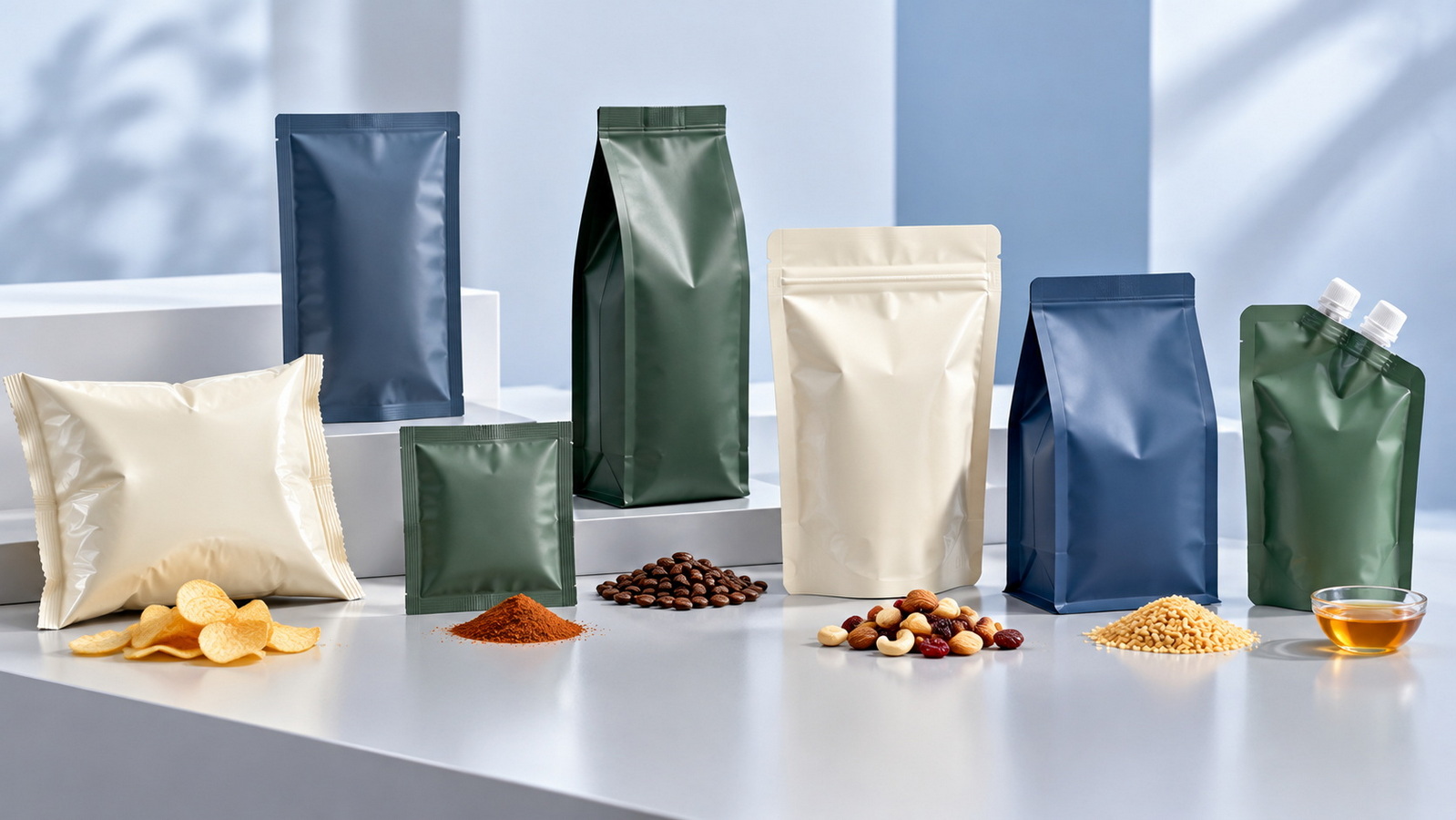
Bag names describe different features. "Pillow" describes the finished shape. "Back-seal" describes the longitudinal seam. "Gusseted" describes expandable folds. These categories can overlap.
| Bag type | Typical construction | Common applications | Main selection consideration |
|---|---|---|---|
| Pillow bag | Longitudinal seam and two end seals | Chips, candy, frozen vegetables | Efficient rollstock production |
| Three-side seal pouch | Three sealed edges, typically with one folded edge | Powders, spices, portion packs | Compact format and filling access |
| Four-side seal sachet | Seals around all four edges | Condiments, sauces, samples | Perimeter seal consistency |
| Side-gusseted bag | Expandable side folds with a longitudinal or alternative seam | Coffee, grains, dry mixes | Capacity and multilayer seal areas |
| Stand-up pouch | Bottom gusset with sealed sides and top closure | Snacks, pet food, sauces | Shelf stability and closure compatibility |
| Flat-bottom pouch | Defined base and multiple panels | Coffee, premium dry foods | Base construction and handling requirements |
| Spouted pouch | Pouch body with a welded fitment | Purees, drinks, liquid foods | Fitment integrity and filling route |
No format automatically provides the best shelf life. Film barrier, seal integrity, food characteristics, and storage conditions determine performance.
A pillow bag is usually formed from rollstock into a tube. A longitudinal seam closes the tube, while transverse seals close the ends.
The longitudinal seam may use a fin seal or lap seal. Consequently, pillow bags and back-seal bags are not necessarily separate product categories.
Vertical form-fill-seal equipment commonly packages loose products such as granules and snacks. Horizontal flow wrappers commonly package individual solid products.
Pillow bags are attractive for efficient production, but achievable output depends on filling speed, film behavior, sealing time, and product handling.
A typical three-side seal pouch uses a folded edge and three sealed edges in its completed construction. Suppliers also use this term for premade pouches supplied with three edges sealed and one opening for filling.
That naming variation matters. A pouch drawing should identify the fold, factory seals, filling opening, and final closure.
These bags suit spices, powdered mixes, and portion packs. Their flat shape supports compact carton packing, although usable capacity depends on pouch dimensions and the product's bulk density.
Four-side seal sachets have seals around the complete perimeter, generally joining two opposing film surfaces.
They are widely used for single portions of sauces, seasonings, and similar products. Consistent seal width and accurate film registration help maintain package quality.
However, four sealed edges do not guarantee superior oxygen resistance or leak prevention. Barrier performance comes primarily from the material structure, while leakage depends on seal continuity and package damage.
Side gussets expand as the bag fills, providing space for coffee, grains, powders, and other bulk products.
The folded areas create changes in film thickness across the seal. Sealing jaws must accommodate those transitions without leaving channels or damaging thinner sections.
Coffee bags may include degassing valves, but valve selection should reflect the product's gas release and packaging requirements. A valve does not compensate for unsuitable barrier film or defective seals.
Stand-up pouches use an expandable bottom construction to support upright display. Common base designs include Doyen-style and K-seal configurations.
Flat-bottom pouches have a distinct base and multiple panels. They should not be treated as interchangeable with every bottom-gusset pouch.
Both formats can incorporate convenience features, including zippers. Nevertheless, standing stability depends on pouch dimensions, product distribution, fill weight, and base design.
For automated filling, confirm how the equipment opens, supports, fills, and transfers the pouch.
Spouted pouches combine a flexible body with a welded fitment and closure.
Depending on the equipment and pouch design, filling may occur through the spout or through an open pouch edge before final sealing.
Potential leakage points include body seals, the fitment weld, and the cap interface. Each requires verification.
Hot-fill, refrigerated, and retort products also impose different requirements on the film, fitment, closure, and processing system.
Heat sealing joins compatible sealant surfaces through a controlled combination of heat, contact pressure, and time.
The important variables are:
- Temperature at the sealing interface.
- Pressure distribution across the jaws.
- Dwell time, meaning how long the surfaces remain under sealing conditions.
- Film structure and sealant compatibility.
- Contamination, wrinkles, and alignment.
There is no universal temperature for food packaging bags. A setting suitable for one laminate may produce weak seals or distortion in another.
The practical objective is a validated sealing window: a range of conditions that consistently produces acceptable seals at the required production speed.
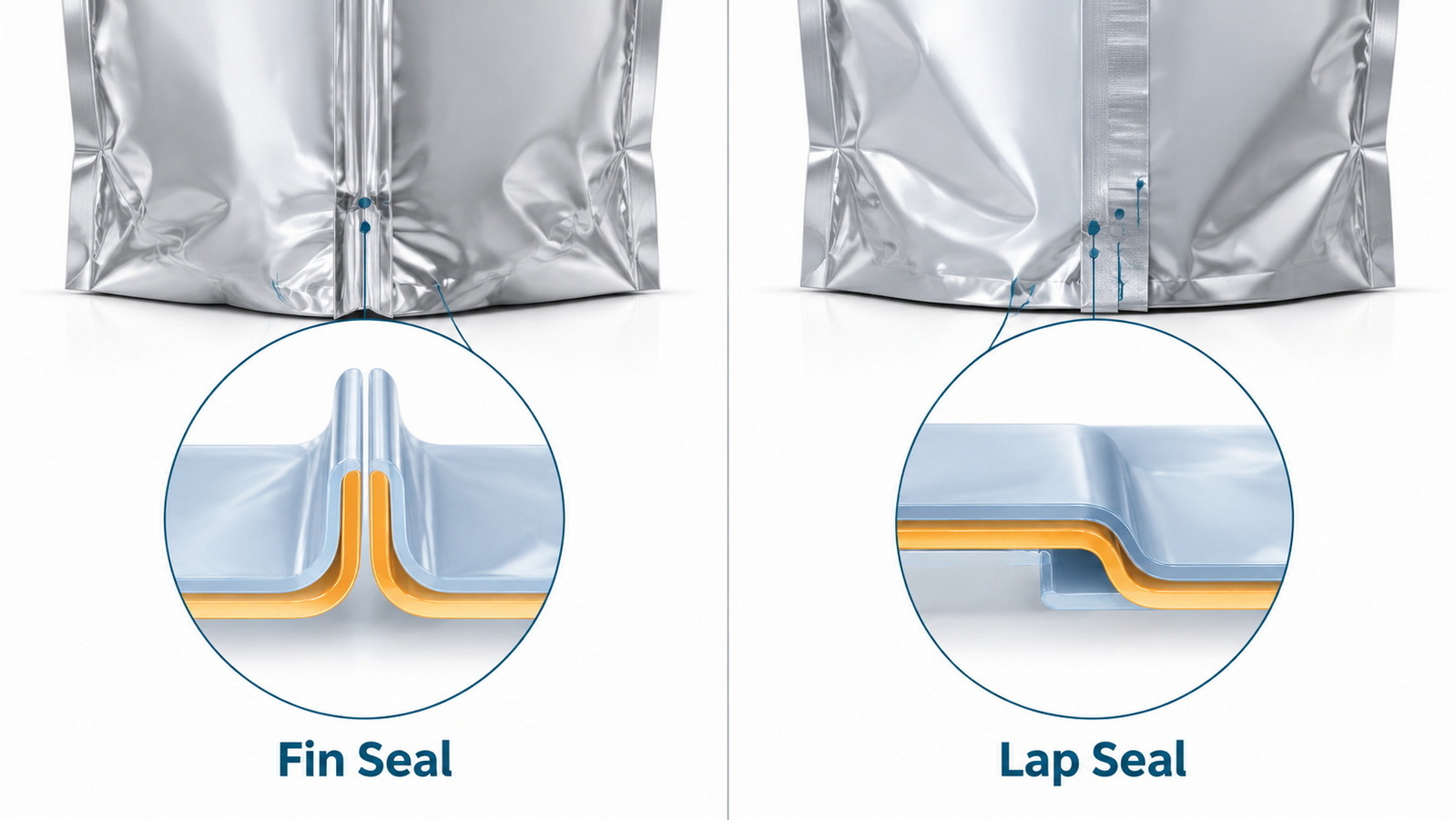
Fin seals join the inner sealant surfaces of two film edges. The resulting seam projects outward and may be folded against the bag.
Lap seals overlap the edges, joining an inner surface to an outer surface. The film must therefore support that particular surface combination.
This distinction affects material selection and machine setup. A film designed only for inner-to-inner sealing cannot automatically be substituted into a lap-seal application.
Specify the seam type before ordering production film.
Impulse sealing applies heat during a controlled sealing cycle, often followed by cooling under pressure.
Constant-heat sealing maintains the sealing tool at a controlled temperature and is widely used in automated packaging equipment.
Neither approach is universally better. Selection depends on the material, package dimensions, cycle requirements, and desired seal characteristics.
Cooling and discharge handling also matter because a newly formed seal may remain vulnerable before it develops sufficient strength.
Ultrasonic sealing uses mechanical vibration to generate localized heat at the joining interface.
It can offer advantages in selected applications where product residue enters the seal area. Equipment suppliers describe applications involving powders, moisture, and liquid contamination.
However, performance remains material- and application-dependent. Ultrasonic sealing should not be presented as a guarantee that every contaminated pouch will seal successfully.
Trials should assess joint quality, acceptable contamination levels, tooling, throughput, and maintenance requirements.
Cold sealing bonds specially coated surfaces under pressure without using heated jaws as the primary bonding mechanism.
It can suit certain heat-sensitive products, including confectionery.
The adhesive coating must match the package design and equipment. Cold-seal materials are not direct substitutes for conventional heat-sealable films, and coating registration requires control.
A packaging line should be selected around the actual product rather than the pouch photograph.
| Product characteristic | Filling system to evaluate | Packaging priority |
|---|---|---|
| Free-flowing granules | Weighing or volumetric dosing | Accuracy and product drop control |
| Fine or dusty powders | Auger filling | Dust management near seals |
| Liquids and viscous foods | Suitable pump or piston filling | Drip prevention and headspace |
| Fragile snacks | Gentle weighing and transfer | Reduced breakage and impact |
| Individual solid items | Horizontal flow wrapping | Product positioning and end-seal clearance |
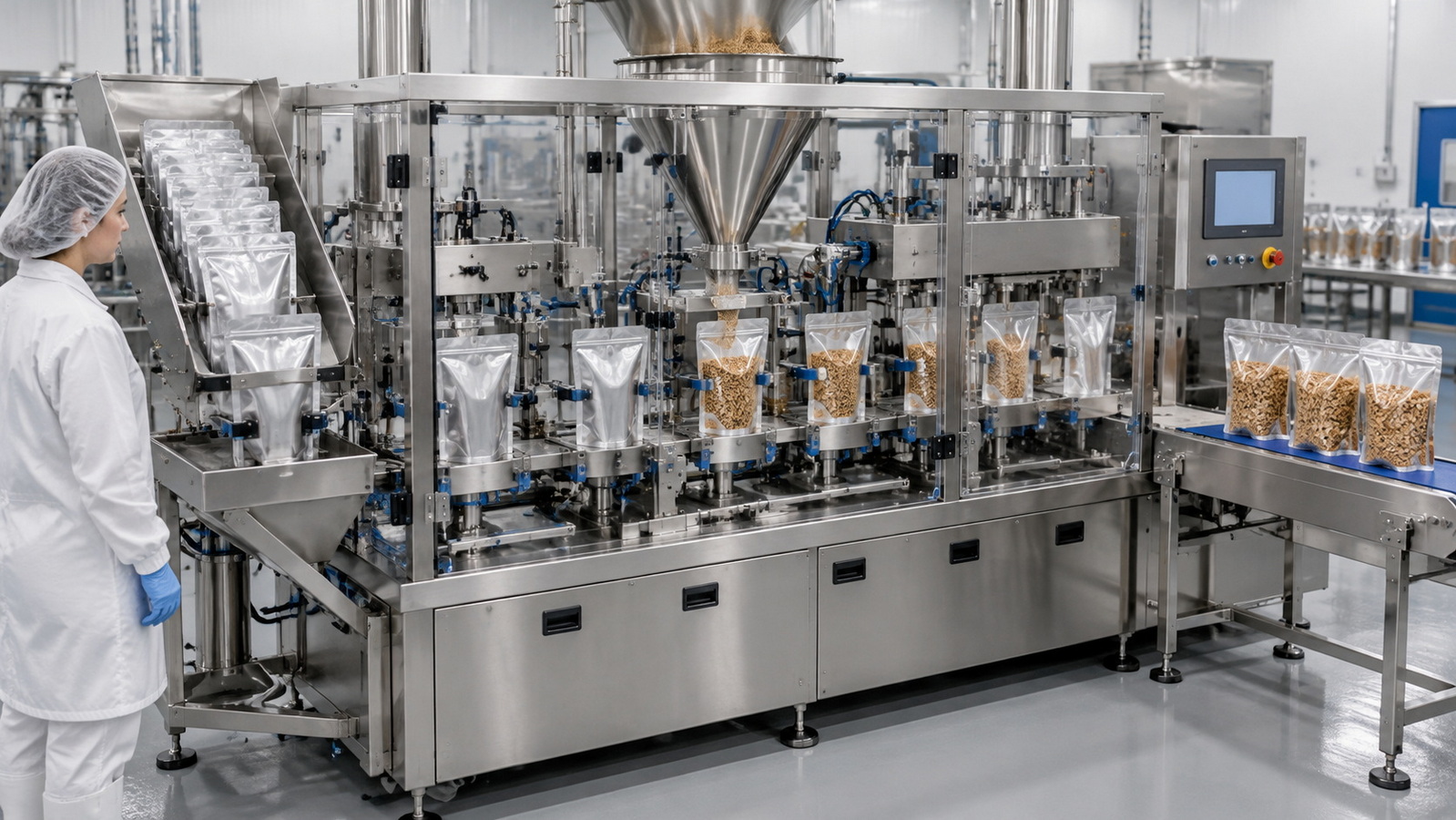
Rollstock systems form bags during production. Premade-pouch systems handle bags manufactured beforehand.
Rollstock may offer an efficient route for established formats and larger production runs. Premade pouches may simplify access to complex shapes and retail features. Neither option is inherently best for every operation.
Compare total operating requirements, including changeovers, rejects, film or pouch costs, cleaning, staffing, and downstream handling.
Ask suppliers to demonstrate your actual product and packaging material whenever possible. An empty-pouch demonstration does not establish filling accuracy or reliable sealing under realistic conditions.
A structured trial is more useful than repeatedly increasing temperature until a pouch appears closed.
1. Confirm the material specification. Obtain the film structure, thickness, sealant information, and recommended processing conditions.
2. Inspect the sealing equipment. Check alignment, cleanliness, pressure distribution, temperature control, and tooling condition.
3. Run controlled trials. Adjust variables systematically and record the results.
4. Test realistic contamination. Evaluate the effects of expected dust, oil, moisture, or product particles.
5. Challenge operating conditions. Include startup, normal speed, maximum intended speed, and restarts.
6. Document approved settings. Record acceptance limits and operator responses when results drift.
Changing several parameters simultaneously makes it difficult to identify the actual cause of improvement.
Also distinguish seal strength from hot tack. Hot tack describes strength while the seal is still hot, which can matter when the filled package places immediate stress on a freshly formed seam.
A seal may resist peeling yet contain a narrow leakage channel. Conversely, a seal without detectable leakage may still lack sufficient mechanical strength for distribution.
Use complementary checks rather than one test alone.
| Evaluation | What it assesses | Important limitation |
|---|---|---|
| Visual inspection | Wrinkles, contamination, incomplete seals, distortion | Hidden defects may remain |
| ASTM F88/F88M | Seal strength under specified test conditions | Does not independently prove leak-free integrity |
| ASTM F2096 | Gross leaks using internal pressurization | Requires a suitable test setup and package |
| ASTM F3039 | Dye penetration in nonporous packaging | Qualitative, destructive method |
| Distribution evaluation | Performance under handling and transport stresses | Conditions must represent the intended route |
Select methods and acceptance criteria with qualified technical personnel. ASTM F1929 addresses porous packaging; it should not automatically replace a method intended for nonporous food films.
For retort foods, evaluate package performance after thermal processing as well as before it. Sealing equipment does not replace a validated food-preservation process.

Inspect filling timing, nozzle withdrawal, dust generation, and product settling.
For powders, reduce dust reaching the closure area. For liquids, evaluate drip control and splash behavior.
Higher jaw temperature cannot reliably correct a seal physically interrupted by product.
Check film tracking, pouch tension, jaw alignment, and gusset positioning.
On premade-pouch lines, verify that the bag opens fully and enters the sealing station consistently.
Pay particular attention to transitions between two-layer and multilayer sections.
Investigate excessive heat, excessive dwell time, unsuitable pressure, or inconsistent temperature control.
Confirm that the material matches the approved specification. Reusing old settings after a film change can create defects even when the replacement film looks similar.
Before requesting a proposal, prepare:
- Product samples and relevant flow characteristics.
- Target fill weights and permitted variation.
- Required output and operating schedule.
- Pouch drawings or rollstock specifications.
- Shelf-life and storage requirements.
- Closure features and printing requirements.
- Cleaning procedures and changeover expectations.
- Destination-market food-contact documentation.
Ask material suppliers for evidence covering the intended food and conditions of use. A generic "food-grade" description does not establish suitability for every temperature, food composition, or processing method.
Send HLun Pack your product details, packaging samples, target output, and closure requirements. Request a coordinated review of the filling system, pouch or film compatibility, sealing arrangement, and trial acceptance criteria before finalizing your equipment specification.
Common formats include pillow bags, three-side seal pouches, four-side seal sachets, side-gusseted bags, stand-up pouches, flat-bottom pouches, and spouted pouches. Some categories overlap because they describe different structural features.
There is no universally best method. Heat sealing is widely used, while ultrasonic and cold sealing suit selected applications. Choose according to film compatibility, product characteristics, equipment requirements, and validated package performance.
No. Four-side construction describes seal geometry, not guaranteed barrier performance. Protection depends on the material, seal quality, storage conditions, and resistance to handling damage.
Usually not. Many resealable food pouches use a separate initial seal above the zipper. The zipper mainly supports reclosure after opening and should not automatically be treated as a hermetic barrier.
Not necessarily. Pouch dimensions, gussets, fitments, opening mechanisms, and seal locations affect compatibility. Format changes may require different tooling, accessories, or an entirely different machine platform.
Use a defined testing plan combining appropriate inspection, seal-strength testing, and integrity testing. Include actual filled packages and relevant processing or distribution conditions rather than relying only on visual appearance.
1. [Yundu — "Types of Food Packaging Bags and Their Sealing Methods"], October 15, 2025. Original article used as the restructuring baseline. Its overlapping classifications and unconditional protection claims have not been carried forward. [yundufillingmachine]
2. [Syntegon — "Sealing and Cutting for Horizontal Flow Wrappers"], February 12, 2026. Supports the discussion of sealing-jaw temperature, pressure distribution, alignment, and dwell time. [syntegon]
3. [Delft University of Technology Repository — "Understanding the Factors Affecting the Seal Integrity in Heat Sealed Flexible Food Packages: A Review"]. Technical background for heat-sealing parameters, fin-seal construction, and the concept of a sealing process window. [repository.tudelft]
4. [RDM Test Equipment — "Heat Seal Parameters of Flexible Polymer Film and Finished Package Seal Integrity"], May 29, 2024. Supports systematic evaluation of temperature, pressure, and dwell time rather than prescribing a universal sealing temperature. [rdmtest]
5. [Herrmann Ultrasonics — "Sealing of Packaging"]. Equipment-manufacturer source describing ultrasonic sealing and potential performance with product residue. Its promotional claims are presented here as application-dependent, not universal guarantees. [herrmannultrasonics]
6. [Herrmann Ultrasonics — "Fewer Rejects with Ultrasonic Sealing"]. Explains vibration-generated frictional heat and examples involving contamination near pouch seals. [herrmannultrasonics]
7. [LSO — "Seal Strength vs. Seal Integrity Testing: ASTM F88 vs. F1929"], June 15, 2026. Supports the distinction between mechanical seal strength and leak integrity, including the roles of F88, F2096, and F3039. [lso-inc]
8. [Packaging Digest — "New Dye Penetration Test Recently Published"]. Explains the application of ASTM F3039 to nonporous film and foil packaging and its distinction from porous-packaging methods. [packagingdigest]
9. [U.S. Food and Drug Administration — "Packaging & Food Contact Substances"]. Official resource for food-contact substance requirements and supporting documentation. [fda]
10. [U.S. Food and Drug Administration — "Food Types & Conditions of Use for Food Contact Substances"]. Supports evaluating food-contact suitability against the actual food type and processing or storage conditions. [fda]
11. [U.S. Food and Drug Administration — "Guide to Inspections of Low Acid Canned Food Manufacturers: Part 3"]. Supports retort-pouch seal examination and complementary mechanical and integrity evaluations. The article does not generalize its inspection frequencies to every food packaging operation. [fda]
12. HLun Pack — company positioning supplied in the project brief. Used for the brand perspective and consultation invitation only. No customer testimonials, measured production results, or independently verified company-performance claims were supplied.


