


close
Choose Your Site
Global
Social Media
Views: 269 Author: HLun PACK Publish Time: 2026-11-15 Origin: Site


Content Menu
● Why Source Flexible Packaging Film from China?
>> Manufacturing Clusters That Matter to Buyers
● How This Shortlist Was Developed
● Top 10 Flexible Packaging Film Manufacturers in China
>> 1. Shantou Hualun Paper Products Industrial Co., Ltd. — HLun PACK
>> 2. Dongguan Huafu Packaging Materials Co., Ltd.
>> 3. LD PACKAGING CO., LTD. — LD PACK
>> 4. Guangdong Danqing Printing Co., Ltd. — DQ PACK
>> 5. Guangdong Bowe Packaging Co., Ltd. — BOWE PACK
>> 6. Guangdong Huihua Packaging Co., Ltd.
>> 7. Dongguan OK Packaging Manufacturing Co., Ltd.
>> 9. Huangshan Novel Co., Ltd.
>> 10. Jiangsu Sunkey Packaging High Technology Co., Ltd.
● Manufacturer Comparison: Capacity, MOQ, and Certification
● Technical Buying Guide: Specify Performance Before Price
>> Define the Application Before Choosing the Laminate
>> Separate Factory Credentials from Product Compliance
● Common Purchasing Problems—and How to Reduce Them
>> 1. A Vague Material Specification
>> 2. A Sample That Does Not Represent Commercial Production
>> 3. An Unrealistic Delivery Promise
>> 4. Comparing Price per Kilogram Without Comparing Usable Output
● An Insider Sourcing Safeguard: Freeze the Approved Construction
● Factory Verification, Sampling, and Logistics Checklist
>> Before Approving Production
● Choose the Supplier That Fits the Packaging System
>> 1. How Can I Verify Whether a Manufacturer's ISO Certificate Is Still Valid?
>> 2. Can One Food-Contact Test Report Cover Every Film Structure We Buy?
>> 3. How Should We Compare MOQ Across Suppliers with Different Printing Processes?
>> 4. Can We Switch to Recyclable Packaging Without Changing Machine Settings?
>> 5. What Should We Do If the Trial Film Works but the First Commercial Shipment Fails?
China offers a broad choice of flexible packaging film manufacturers, but choosing a long-term supplier requires more than comparing printing quality and price per kilogram. Procurement teams need a partner that can maintain material consistency, document food-contact compliance, support packaging-line trials, and deliver repeat orders without unexpected specification changes.
A practical evaluation starts with five questions:
- Does the factory hold relevant, current certifications covering the actual production site?
- Can its technical team explain why a proposed film structure suits your product?
- Does its quality-control system connect incoming materials, production records, and finished rolls?
- Can the supplier demonstrate repeatable performance on your filling equipment?
- Are capacity, production scheduling, and delivery commitments supported by evidence?
This guide compares ten China-based manufacturers, including integrated packaging suppliers and specialist flexible packaging converters. It focuses on custom printed rollstock, laminated films, and related pouch-converting capabilities—not simply companies producing commodity base films.
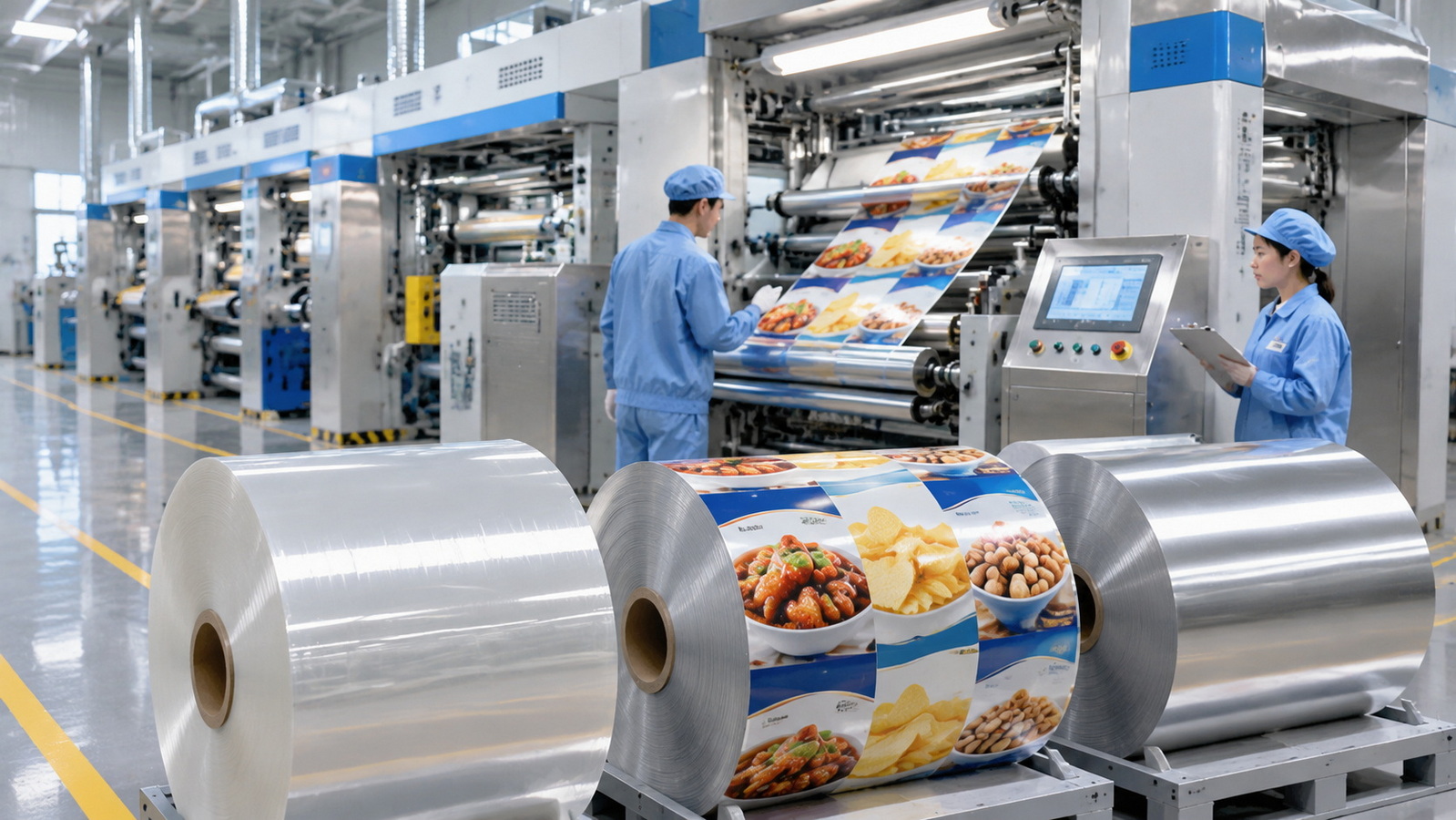
China's supplier landscape includes companies offering printing, lamination, slitting, pouch production, material development, and packaging equipment support. For international buyers, that breadth makes it possible to source both packaging materials and the technical services needed to put them into production. The manufacturers reviewed here illustrate capabilities ranging from integrated machinery-and-material solutions to vertically integrated film and ink production.
Recent market research also shows the scale of demand. Grand View Research's 2026 outlook reports that China's flexible plastic packaging market generated approximately USD 20.96 billion in revenue in 2025 and projects a 5.6% compound annual growth rate from 2026 to 2033. These figures cover flexible plastic packaging broadly, not only printed rollstock film or exports.
The companies in this shortlist show a useful geographic concentration:
- Dongguan and Foshan, Guangdong: Huafu, OK Packaging, and LD PACK provide access to established printing, lamination, and packaging-converting operations.
- Shantou, Chaozhou, and Jieyang, Guangdong: HLun PACK, DQ PACK, and Huihua represent a concentration of flexible packaging and related manufacturing capabilities.
- Shanghai, Jiangsu, and Anhui: PACK MIC, Sunkey, and Huangshan Novel offer additional sourcing options outside southern China.
Geography is useful for planning supplier visits and consolidating technical meetings. It should not substitute for qualifying the factory that will actually manufacture your order.
The shortlist considers six procurement dimensions. It does not assign numerical scores because comparable audited information is unavailable across all ten companies.
| Evaluation dimension | Evidence buyers should request |
|---|---|
| Manufacturing scope | Printing, lamination, slitting, pouch-making, and any subcontracted processes |
| Technical development | Material-selection rationale, trial records, testing capability, and engineering support |
| Quality control | Incoming inspection, in-process controls, finished-product testing, and traceability |
| Compliance | Current site-specific certificates and application-specific food-contact documentation |
| Delivery reliability | Available production slots, material availability, curing requirements, and contingency plans |
| Customization support | Artwork handling, structure development, roll specifications, sample trials, and change control |
Two distinctions are particularly important.
First, a management-system certificate does not establish that every film structure complies with every destination market's food-contact rules. European Commission guidance requires compliance documentation and supporting evidence appropriate to plastic food-contact materials.
Second, factory size, annual tonnage, production-line counts, and pouch output are different measurements. They should not be presented as interchangeable measures of capacity.
Established history: Packaging operations began in 1989; machinery manufacturing followed in 1998; flexible packaging was added in 2012.
Location: Shantou, Guangdong.
Market coverage: The company describes overseas expansion and worldwide service, but its reviewed profile does not disclose a current regional sales breakdown.
HLun PACK's main distinction is its combination of packaging materials and packaging machinery. Its company profile identifies one packaging-materials factory and another factory dedicated to packaging equipment and integrated solutions. Its flexible packaging portfolio includes roll films, stand-up pouches, gusseted pouches, spout pouches, and eight-side-seal bags.
For small and midsized brands, that combination makes HLun PACK worth evaluating when packaging development and filling-line requirements need to be discussed together. Rather than treating rollstock as an isolated purchase, buyers can explore how the film, sealing system, product characteristics, and equipment settings interact.
The company emphasizes in-house design, development, production, cross-department coordination, and responsive technical support. These are relevant indicators for buyers seeking close communication and substantial OEM customization. Its profile also reports Guangdong High-Tech Enterprise recognition in 2025 and a 2026 invention patent relating to a dual-sealing jelly packaging machine. Those machinery-related credentials should not be interpreted as film food-contact certification.
OEM/ODM discussion scope: Custom rollstock and pouch formats, packaging development, machinery configuration, and integrated material-and-equipment projects.
Procurement perspective: Consider HLun PACK as a value-oriented development candidate, particularly where engineering coordination matters. Validate cost competitiveness, minimum order quantity, response times, film testing, and production capacity through a project-specific quotation rather than assuming them from the company profile.
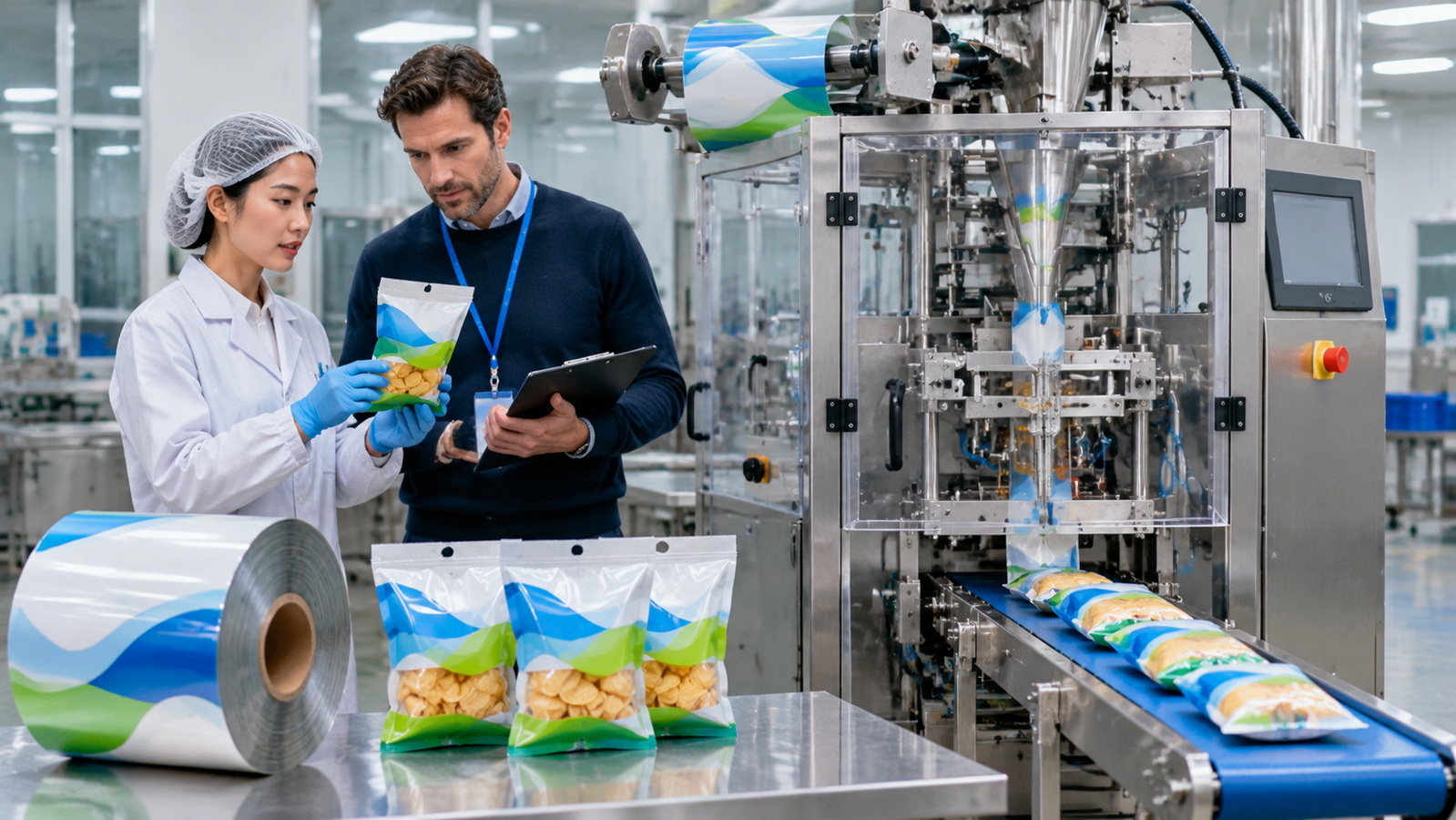
Established history: The predecessor factory began in 1995; the business adopted its current name in 2006.
Location: Zhangmutou, Dongguan, Guangdong.
Reported markets: More than 20 countries and regions, including the United States, Europe, and Southeast Asia.
Huafu offers printed packaging films alongside bags, blister packaging, and color boxes. Its development history records a transition into printing, lamination, slitting, and bag-making in 2006. Its homepage reports a 35,000-square-meter plant with eight- and ten-color printing presses, solvent-free laminators, and automated bag-making lines.
Its broader packaging portfolio may suit brands that want coordinated flexible packaging, trays, and secondary packaging rather than separate suppliers for every format.
OEM/ODM discussion scope: Customized materials, dimensions, printing, bag construction, and packaging features for different temperature and product-protection requirements.
The company reports ISO 9001 and ISO 14001 systems, FSC and RCS credentials, and social-audit-related information. Buyers should verify the current documents and their applicable product scope rather than treating the website's credential list as universal approval.
Procurement perspective: A relevant candidate for multi-format packaging programs. Request separate technical and compliance files for film, trays, and paper packaging.
Established: 1990.
Location: Foshan, Guangdong.
Reported markets: Domestic and international brand customers; the reviewed information does not provide a current regional revenue split.
LD PACK describes itself as a flexible packaging enterprise integrating research, development, production, and sales. Its published application range includes beverages, dairy, pet food, fresh-food packaging, condiments, and household products.
The company reports annual flexible packaging capacity exceeding 25,000 tonnes and manufacturing processes covering printing, lamination, pouch-making, and automated spout insertion. It also describes a packaging technology research institute.
OEM/ODM discussion scope: Custom laminated films, pouches, spouted formats, lidding applications, and application-led packaging development.
Its product information lists ISO 9001, ISO 14001, BRC Packaging, and halal credentials. Current certificates must be checked against the producing site and contracted product.
Procurement perspective: Particularly relevant to recurring programs needing established converting scale and product-development support.
Established history: Predecessor operations began in 1991; Guangdong Danqing Printing Co., Ltd. was registered in 1993.
Location: Chaozhou, Guangdong.
Reported markets: Domestic and international packaging customers; the reviewed profile does not disclose a current regional sales breakdown.
DQ PACK's published history distinguishes its operating roots from its later company registration. That distinction matters when procurement teams compare supplier age with legal-entity records.
The company reports six automatic packaging and printing lines, six solvent-free lamination lines, seven slitting machines, and twenty pouch-making lines. Its profile gives both 30,000-square-meter facilities and a 35,000-square-meter usable workshop figure; buyers should clarify the measurement basis instead of combining them.
OEM/ODM discussion scope: Custom printed flexible packaging, laminated rollstock, and converted pouches.
Procurement perspective: A useful candidate for buyers assessing integrated printing-to-pouch production. Confirm which operations and quality controls apply specifically to rollstock orders.
Established history: The company states that its flexible packaging manufacturing history began in 1997.
Location: Xinxing County, Yunfu, Guangdong.
Reported markets: International brands of different sizes; leading export destinations are not specified in the reviewed company profile.
BOWE PACK offers custom flexible packaging bags, stand-up pouches, sustainable packaging options, and rollstock films. Its published positioning covers food, daily-use products, and chemicals, with customized printing and packaging consultation.
OEM/ODM discussion scope: Printed rollstock, pouch structures, custom bag formats, and packaging development for different brand sizes.
Its homepage carries BRC, ISO, and FDA-related claims. Buyers should request the precise certificates and regulatory basis: these terms do not describe equivalent forms of approval.
Procurement perspective: Relevant to brands comparing coordinated pouch and film supply. Confirm rollstock-specific capacity, sample procedures, and production minimums.
Established history: Operations began in Jieyang in 1993; a Guangzhou production base followed in 2003; the businesses merged under Guangdong Huihua Packaging in 2019.
Location: Jieyang, Guangdong.
Reported markets: Export services began in 2003; a current destination-market breakdown is not disclosed in the reviewed profile.
Huihua reports more than 30,000 square meters of production area, over 400 employees, and annual capacity exceeding 10,000 tonnes. Its company profile describes integrated packaging design, manufacturing, and service.
OEM/ODM discussion scope: Packaging design, custom printing, laminated film, and converted flexible packaging.
The company's published development information reports ISO 9001 and FSSC 22000 certification. Buyers should confirm the current certificate scope, site address, and status before supplier approval.
Procurement perspective: Worth considering for repeat custom packaging programs where documented production scale and design support are priorities.
Established: 1996.
Location: Dongguan, Guangdong.
Reported markets: The company states that its products reach more than 50 countries.
OK Packaging describes research and development, quality-control teams, laboratory equipment, and integrated printing, lamination, and shape-design capabilities. Its portfolio includes coffee bags, stand-up pouches, and other customized laminated packaging.
OEM/ODM discussion scope: Printed laminated packaging, pouch formats, closure selection, valve-equipped coffee packaging, and customized shapes.
The company displays BRC, ISO, Sedex, and SGS references. Procurement teams should establish whether each refers to certification, an audit, inspection, or a particular test report.
Procurement perspective: A candidate for buyers sourcing both rollstock and finished packaging. Ask the supplier to demonstrate the exact film structure and equipment compatibility required for the project.
Established history: Published pages are inconsistent: the homepage states 2009, while an "About Us" page describes custom printed packaging manufacturing since 2003.
Location: Shanghai.
Reported customers: Supermarkets, retailers, food factories, and wholesalers; a current regional sales split is not established.
PACK MIC offers customized flexible packaging and reports more than 10,000 square meters of factory area. Its reviewed company page describes eighteen production lines for pouches and rolls and lists ISO, BRC, and Sedex-related credentials.
OEM/ODM discussion scope: Custom printed rolls, stand-up pouches, flat-bottom formats, and application-led packaging specifications.
Procurement perspective: The discrepancy in published dates is a reason to request the business license and clarify operating history—not, by itself, evidence of poor manufacturing. Buyers should reconcile the contracting entity, factory name, certificate holder, and payment beneficiary before ordering.
Established: 1992.
Location: Huangshan, Anhui.
Reported markets: China and international customers, supported by overseas offices and warehouses.
Huangshan Novel offers a vertically integrated model. Its published profile describes six subsidiaries and in-house production of base films, inks, and injection-molded components alongside printed and laminated flexible packaging.
That production model makes the company relevant to buyers assessing upstream material control and broader packaging development capabilities.
OEM/ODM discussion scope: Customized printed and laminated packaging, functional film development, and coordinated material components.
Procurement perspective: A candidate for structured, long-term sourcing programs. Request plant-specific capacity allocation, current certification documents, and minimum economic order quantities rather than relying on group-level scale.
Established history: Sunkey's published company history dates registration to 2002.
Location: Wuxi, Jiangsu.
Reported markets: Domestic and international industrial and consumer-product customers; a current geographic revenue split is not disclosed.
Sunkey describes technical development and production of flexible packaging for food, electronics, medical, and chemical applications. Its official profile reports six high-speed automatic production lines and displays GRS and BRC certification claims.
OEM/ODM discussion scope: Custom flexible films and laminated packaging, including application-specific structures for different product categories.
Procurement perspective: Relevant to buyers needing technical packaging development beyond a single consumer-food category. Avoid treating its published monetary production-capability figure as directly comparable with another supplier's tonnes per year.
The following table separates reported output from facility size and equipment counts. Figures are manufacturer-published claims, not audited findings from this article.
| Manufacturer | Published capacity or scale indicator | MOQ position | Published certification information |
|---|---|---|---|
| HLun PACK | One materials factory and one machinery factory; comparable annual film output not disclosed | Request by structure, print design, and trial requirements | Film-specific certificate details require confirmation. hlunpack |
| Huafu Packaging | 35,000 m² plant; printing, lamination, and bag-making equipment | Request by material and artwork | ISO 9001/14001, FSC, RCS, and audit-related claims. dghuafupackaging+1 |
| LD PACK | More than 25,000 tonnes annually | Request by application and production run | ISO 9001/14001, BRC Packaging, and halal claims. ldpack+1 |
| DQ PACK | Six printing lines, six solvent-free lamination lines, seven slitters, twenty pouch lines | Request by roll specification and artwork | Request current site-specific certificates. dqpack |
| BOWE PACK | Comparable annual film output not established from reviewed official pages | Request by structure and printing method | BRC, ISO, and FDA-related website claims; documents require clarification. bowepack |
| Huihua Packaging | More than 10,000 tonnes annually; over 30,000 m² | Request by product specification | ISO 9001 and FSSC 22000 claims. huihua-pack+1 |
| OK Packaging | Laboratory and integrated converting capabilities described; comparable annual output not established | Request by material, format, and design | BRC, ISO, Sedex, and SGS references. gdokpackaging |
| PACK MIC | More than 10,000 m²; eighteen pouch-and-roll production lines | Request by printing method and SKU | ISO, BRC, and Sedex-related claims. packmic |
| Huangshan Novel | Six subsidiaries and vertically integrated materials production | Request plant-specific commercial terms | Request current certificates for the nominated plant. novelpkg |
| Sunkey | Six high-speed automatic lines reported | Request by application and structure | GRS and BRC claims. sunkeypackaging |
No defensible, comparable rollstock MOQ was established across all ten manufacturers. Publishing invented minimums would make the table more complete-looking but less useful.
For meaningful quotations, specify kilograms or square meters per SKU, roll width, thickness, print repeat, number of colors, and acceptable order tolerance.
The purchasing specification should identify:
- Product composition, including fat, acidity, moisture, and aroma sensitivity.
- Intended shelf life and storage conditions.
- Filling temperature and any subsequent heat treatment.
- Required oxygen and water-vapor protection.
- Packaging format and filling-machine configuration.
- Destination markets and food-contact requirements.
Food-contact compliance depends on intended use, not merely the supplier's description of a material as "food grade." European requirements address composition, permitted substances, migration, and the conditions under which packaging is used.
A supplier's technical proposal should explain the function of each layer and identify the relevant material grade. For example, Sunkey's retort-packaging information distinguishes print-carrier, barrier, structural, and heat-sealing layers rather than treating total thickness as the complete specification. Such structures remain application-specific and require validation.
Use certificates to answer specific questions:
- ISO 9001: What quality-management processes are covered?
- BRCGS Packaging Materials: Does the manufacturing site operate within the relevant packaging safety and quality scope?
- Food-contact declaration and supporting documentation: Is this particular material suitable for the stated food and use conditions?
- Recycling-related documentation: What precisely is certified, and which supplied products fall within that scope?
BRCGS Packaging Materials addresses product safety, quality, and operational criteria for packaging manufacturing. It does not replace the separate composition and migration evidence required for food-contact compliance.
For EU projects, request a Declaration of Compliance supported by appropriate documentation under the relevant food-contact framework, including Regulation (EU) No 10/2011 where applicable. Do not accept a generic certificate logo as a substitute.

"Printed laminated film, 100 microns" leaves important variables undefined.
Ask for an approved specification identifying individual layers, thickness tolerances, material grades, functional requirements, and permitted substitutions. The European Commission's industry compliance material highlights the importance of defined structures, specific grades and sources, and intended-use conditions.
An attractive sample proves little about repeat-order consistency.
Use a staged approval process:
1. Review the proposed structure and compliance file.
2. Approve artwork and a physical appearance standard.
3. Test representative film on the intended filling line.
4. Inspect the first commercial batch against the approved specification.
5. Retain samples and production records for future comparisons.
Require the delivery plan to distinguish artwork approval, material procurement, printing, lamination, any necessary curing, slitting, testing, and shipment.
A quoted production window is more useful when its starting point and dependencies are written into the order confirmation.
Ask suppliers to quote against the same structure, width, thickness tolerances, and order quantity. Also compare usable meters, printing setup costs, freight basis, and expected production waste.
The lowest kilogram price is not necessarily the lowest cost per accepted finished package.
A useful but often underemphasized safeguard is formal change control.
Do not approve only the artwork, total thickness, and general laminate name. Agree on a controlled construction record that identifies the critical film grades, adhesive system, ink system, and approved alternatives.
Then require written notification before changes to those critical inputs or to manufacturing arrangements.
The reason is straightforward: compliance evidence is linked to material composition and production conditions. European Commission guidance states that a Declaration of Compliance must be renewed when substantial composition or production changes alter migration, or when relevant new scientific information becomes available.
A practical purchase agreement can therefore require:
- Advance notification of critical material or process changes.
- Technical review before substitution.
- Updated compliance documentation where necessary.
- Repeat line trials or testing when the change affects performance.
- Traceability between retained samples and commercial production lots.
This protects both buyer and manufacturer by making "same as the approved sample" a documented requirement rather than an assumption.
- Match the business license, quotation, contract, certificate holder, and payment beneficiary.
- Confirm the address of the actual producing factory.
- Ask which processes are performed in-house.
- Request a live factory walkthrough or an independent audit where appropriate.
- Review current certificates and product-specific compliance evidence.
Record roll width, core dimensions, maximum roll diameter and weight, unwind direction, print repeat, registration-mark position, splice requirements, and labeling.
Test the film at the intended line speed using the actual product. Define acceptance criteria before the trial, including seal integrity, appearance, registration, and production stability.
Agree on protective packing, roll identification, pallet configuration, storage instructions, and handling requirements. Make sure the packing list and batch labels connect the delivered rolls to inspection records.
For the first commercial order, retain enough time between arrival and the launch date to inspect and trial the material before committing the full batch to production.
The right flexible packaging film manufacturer is the one that can repeatedly supply your approved construction, support the intended production process, and maintain a verifiable compliance file.
HLun PACK merits consideration when a project combines custom flexible packaging with machinery coordination and integrated technical support. Huafu offers a broad multi-format packaging portfolio, while LD PACK, DQ PACK, Huihua, and the other manufacturers provide different combinations of converting scale, customization, and material-development capabilities. Final selection should follow documentation review, representative trials, and commercial qualification—not list position alone.
To start a technical discussion with HLun PACK, prepare your product details, destination market, desired shelf life, packaging dimensions, estimated annual consumption, artwork status, and filling-machine information. Request a structure proposal, sampling plan, compliance-document checklist, and quotation based on those requirements.
Obtain the complete certificate rather than a website logo or cropped image.
Check the legal entity, factory address, standard, scope, certificate number, issuing body, and expiry information. Verify current status through the issuing certification body and, where available, an accredited-certification database such as IAF CertSearch. Its documented purpose includes checking whether certificates are active, suspended, withdrawn, or expired.
If the record cannot be found, ask the issuing body directly. An unsuccessful database search should trigger further verification rather than an automatic conclusion that the certificate is fraudulent.
Do not assume so.
Check whether the report and supporting compliance file cover the supplied composition, relevant substances, food types, and time-temperature conditions. A report for a different construction or less demanding use may not establish suitability for your application.
European Commission guidance links compliance documentation to identifiable materials and supporting test conditions, and requires review when substantial composition or production changes affect migration.
Request two separate minimums: the technical minimum the factory can produce and the economic minimum at which pricing becomes reasonable.
Have each supplier state the minimum per artwork, structure, width, and SKU, along with setup charges and order tolerances. Compare the total landed cost of the launch order and likely repeat orders—not just the advertised minimum.
For this shortlist, no consistent public MOQ basis was established, so minimums should be confirmed directly for the proposed construction.
Treat the change as a new qualification project rather than a simple purchasing substitution.
Ask the supplier to demonstrate the proposed film's sealing behavior, stiffness, friction, barrier performance, and line stability against your existing construction. Approve the material only after trials on the intended equipment and verification of the required shelf-life and compliance evidence.
Also keep recyclability claims separate from food-contact suitability. European rules apply to plastic food-contact materials, including recycled-plastic materials, through specific compliance requirements.
Quarantine the affected rolls and compare them with retained approved samples.
Review batch records, material inputs, thickness measurements, printing and slitting records, storage conditions, and filling-line settings. Request a documented root-cause investigation and corrective action before accepting replacement material.
The investigation becomes much more effective when both parties have agreed on the construction, acceptance criteria, retained samples, and batch traceability before production. EU food-contact guidance also emphasizes traceability throughout production and distribution.


