


close
Choose Your Site
Global
Social Media
Views: 266 Author: HLun PACK Publish Time: 2026-11-24 Origin: Site


Content Menu
● What Does Stand Up Pouch Volume Actually Mean?
● How to Measure Stand Up Pouch Dimensions Correctly
● Stand Up Pouch Volume Formula: Useful, but Limited
>> Why the rectangular formula overstates certainty
>> Should you apply a correction factor?
● Calculate Required Fill Volume from Product Weight
>> Use bulk density for powders and granules
>> Worked example: a 500 g powder pouch
● How to Measure Actual Pouch Capacity
>> 1: Define the working fill boundary
>> 2: Run a controlled water-fill check
>> 3: Repeat with the actual product
● How Much Headspace Does a Stand Up Pouch Need?
● Match Pouch Capacity to Packaging Equipment
>> Check opening and product delivery
>> Test at the intended operating conditions
● A Practical Pouch Approval Checklist
● Common Stand Up Pouch Sizing Mistakes
● Build a Pouch Specification That Works in Production
>> Can I calculate stand up pouch capacity from dimensions alone?
>> How many milliliters does a 250 g pouch hold?
>> Can I use water to test a powder pouch?
>> Is a round-bottom pouch a cylinder?
>> Why does my pouch fit when filled manually but fail on the machine?
>> Should I always choose the smallest pouch that holds the product?
To calculate the volume of a stand up pouch, start with the product's required fill volume, then verify that a sample pouch accommodates it with enough room for filling, closure, and sealing. Multiplying width, height, and bottom gusset gives a rough geometric reference—not guaranteed usable capacity.
My recommendation is to treat pouch sizing as a product-and-process decision rather than a calculator exercise. A bag that holds the target weight on a laboratory bench may still fail when filled automatically.
This guide explains stand up pouch volume calculation, product density, gusset measurements, and practical testing so you can select packaging that works beyond the drawing.
Before comparing pouch specifications, distinguish three different measurements.
| Measurement | Meaning | Practical use |
|---|---|---|
| Geometric estimate | A simplified calculation based on dimensions | Initial comparison between candidate designs |
| Measured internal capacity | Volume held under a defined test condition | Physical evaluation of a sample |
| Working fill volume | Product volume compatible with filling, closure, and sealing | Production approval |
These values are not interchangeable.
A pouch filled to its open rim may hold considerably more than one filled below a zipper with a clean top-seal area. Neither result is meaningful unless the test condition is recorded.
Similarly, a "500 g pouch" is not a universal size. The same package may accommodate 500 g of one product but not another because their densities and packing behavior differ.
Most suppliers describe a stand-up pouch using width, height, and bottom gusset. However, dimension conventions can differ.
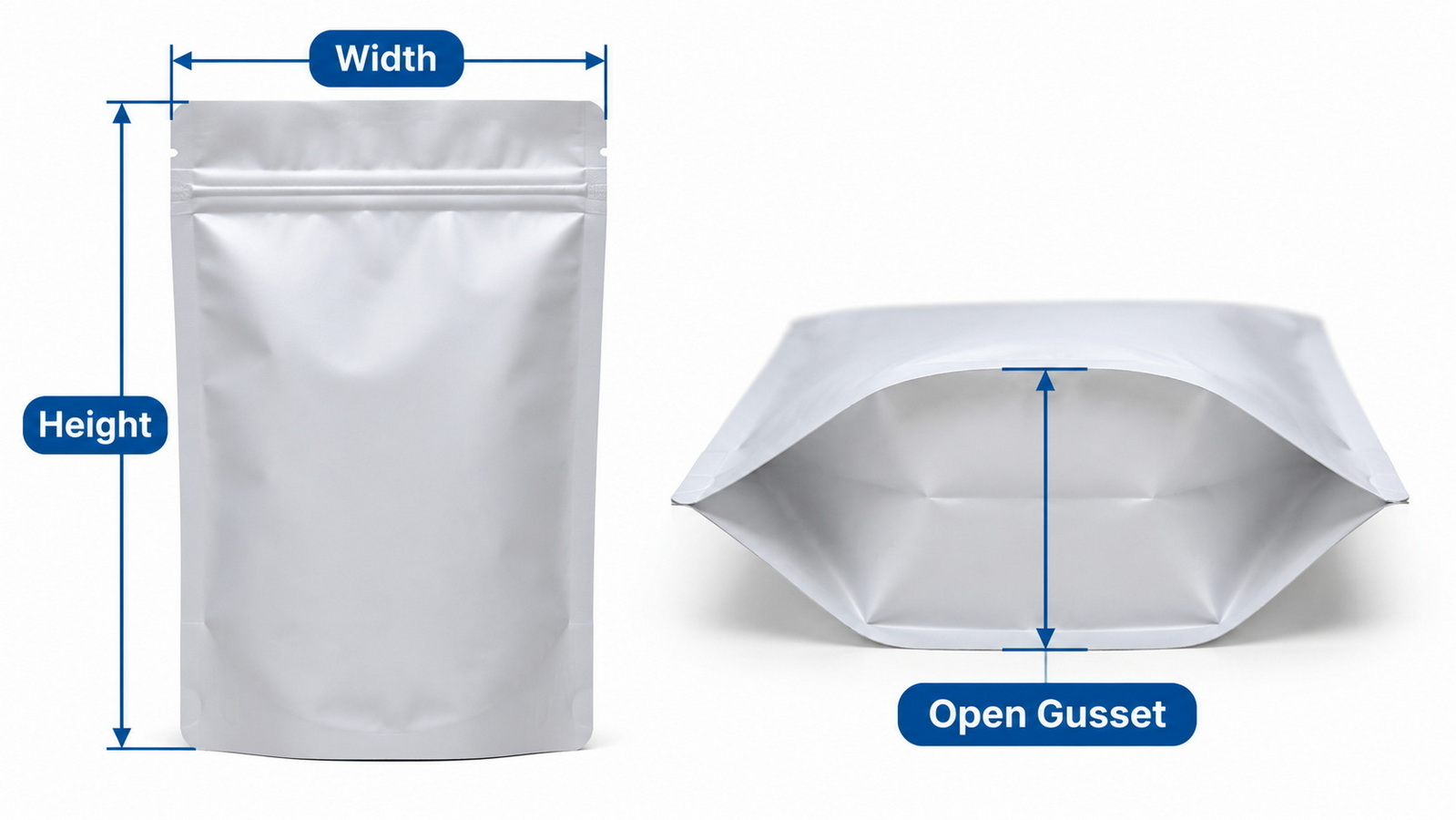
Measure the empty pouch flat:
- Width: outside edge to outside edge.
- Height: bottom outside edge to top outside edge.
- Side seals: record their widths separately.
- Closure position: record the zipper, spout, and intended final seal location.
External dimensions are useful for ordering, but seals and closures reduce the available interior.
Do not assume that overall pouch height equals fillable height.
The bottom gusset is the folded section that expands to form the base.
Ask whether the supplier's gusset dimension represents:
- One folded panel.
- The full opened gusset depth.
- A specific measurement shown on the production drawing.
A notation such as "40 + 40 mm" may describe an 80 mm opened gusset, but the drawing must confirm this.
My first checkpoint would be a dimensioned sketch. Resolving the convention before comparing quotations prevents an avoidable sizing mistake.
A common preliminary calculation is:
Vreference=W×H×G
Where:
-W = pouch width.
-H = pouch height.
-G = fully opened bottom gusset depth.
With dimensions in centimeters, the result is in cubic centimeters.
For a pouch measuring 15 cm × 23 cm × 8 cm:
Vreference=15×23×8=2,760 cm3
That equals 2,760 mL as a rectangular calculation. It does not establish a 2,760 mL pouch capacity.
A conventional stand-up pouch is not a rigid rectangular container. Its walls curve, its base contains sealed areas, and its upper section changes shape when closed.
Moreover, lay-flat width is not necessarily the width of a filled rectangular cross-section.
A flat-bottom pouch may resemble a box more closely, but external dimensions still include areas that do not hold product.
Only when that factor has been established for a defined pouch family and test procedure.
A universal multiplier such as 0.65 or 0.75 cannot reliably account for every structure, zipper position, laminate, product, and filling method.
If a supplier uses a calculator, ask what physical tests support it. Treat an unvalidated result as a sample-selection aid, not a production specification.
For products sold by weight, begin with:
Vproduct=m /
Where m is target product mass and is the relevant density.
Using grams and grams per milliliter gives volume in milliliters.
For powders, bulk density includes the spaces between particles. Particle density alone therefore gives the wrong basis for pouch sizing.
Loose and tapped bulk densities also differ. A powder may occupy more space immediately after filling than after vibration or transport.
Measure the condition that represents your process. Do not size a pouch from a tightly settled sample if the filling line delivers an aerated powder.
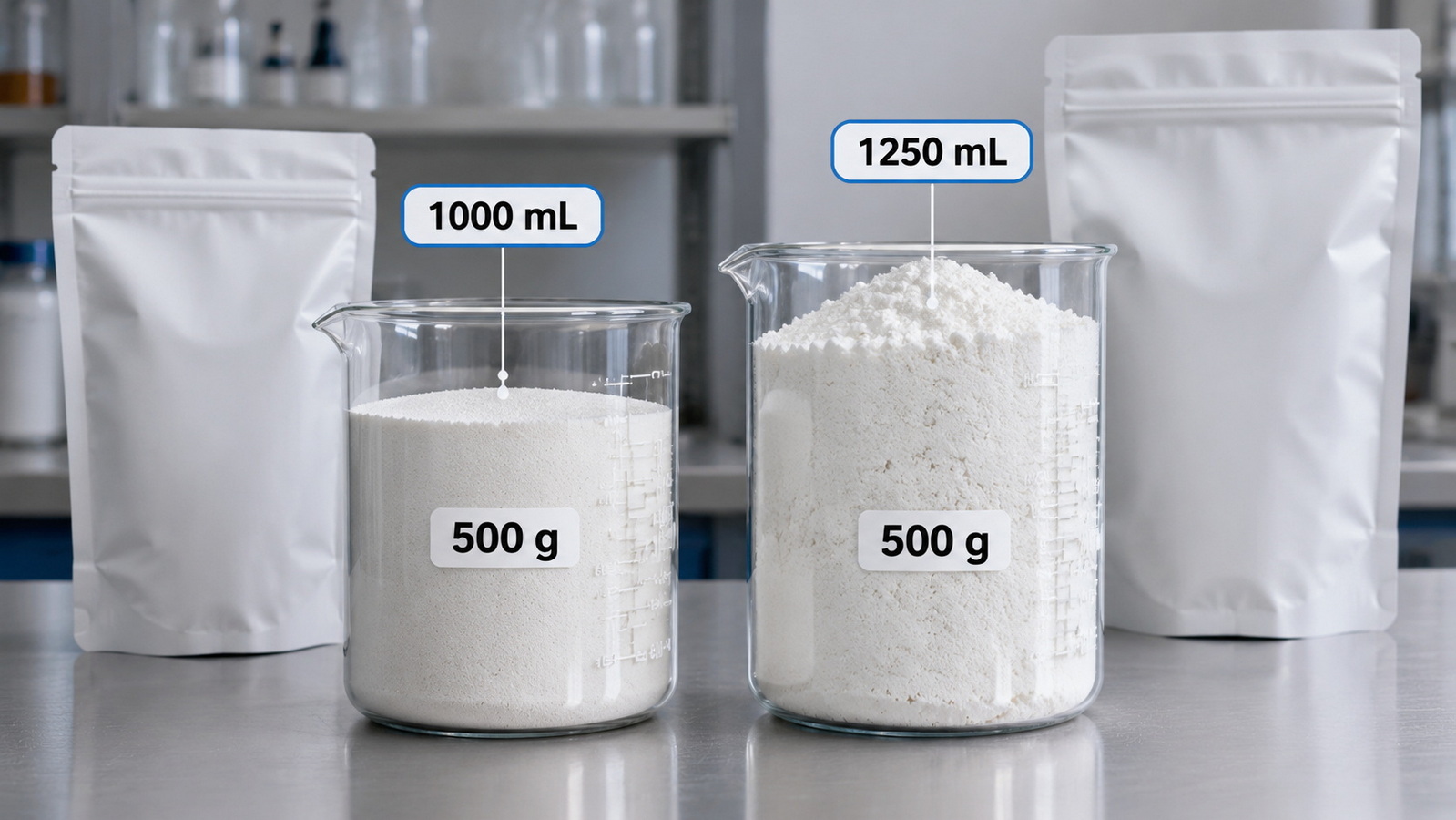
Assume, for illustration:
- Target fill weight: 500 g.
- Measured loose bulk density: 0.50 g/mL.
- Product volume: 1,000 mL.
If a candidate design is evaluated at an assumed 85% working occupancy:
Vcandidate=1,000 / 0.85≈1,176 mL
The result suggests a starting sample capacity, not an approved pouch size. The 85% assumption is illustrative, not a universal recommendation.
Now consider the same product at 0.40 g/mL:
Vproduct=0.40 / 500=1,250 mL
The same weight now occupies 25% more volume. This is why product measurement matters more than a generic weight-capacity chart.
Physical testing turns an estimate into useful evidence.
Identify the highest acceptable product level while preserving:
- Clean top-seal space.
- Zipper operation.
- Filling nozzle clearance.
- Required closure geometry.
For spouted pouches, define the filling and closing conditions with the supplier.
Where water is compatible with the sample:
1. Weigh the empty, dry pouch.
2. Open the gusset without stretching the material.
3. Support it consistently without forcing an artificial shape.
4. Fill to the defined boundary.
5. Weigh again and subtract the empty-pouch mass.
6. Convert water mass to volume using its density at the test temperature.
For a rough room-temperature check, one gram of water is approximately one milliliter.
This is a direct fill-and-weigh test, not a displacement test. Record the temperature and pouch support method.
Water does not reproduce powder aeration, particle bridging, foam, or viscous product behavior.
Use fresh, production-representative samples for final trials. Record the pouch construction, fill weight, fill level, closure performance, and standing stability.
Repeat the test to reveal variation rather than relying on one successful sample.
There is no single headspace percentage suitable for every application.
Headspace must serve the product and the packaging process.
| Product behavior | What to evaluate |
|---|---|
| Dusty powder | Air release, dust control, and seal-zone cleanliness |
| Granules or pieces | Uneven filling, bridging, and particle entrapment |
| Foaming liquid | Temporary foam height and time before sealing |
| Viscous product | Nozzle clearance, stringing, and drips |
| Hot-filled product | Qualified thermal process, cooling behavior, and package compatibility |
Also distinguish geometric losses from deliberate operating headspace.
If a supplier's stated capacity already represents a practical fill level, subtracting another arbitrary allowance may produce an unnecessarily large pouch.
Ask exactly how the quoted capacity was measured.
For hot-fill or thermally processed products, a general volume calculation cannot replace a qualified package and process assessment.
The working fill volume must be compatible with the machine, not just the package.
At HLun Pack, our focus is packaging machinery and integrated packaging solutions. For that reason, the useful specification includes both the pouch dimensions and the conditions under which the pouch will be filled.
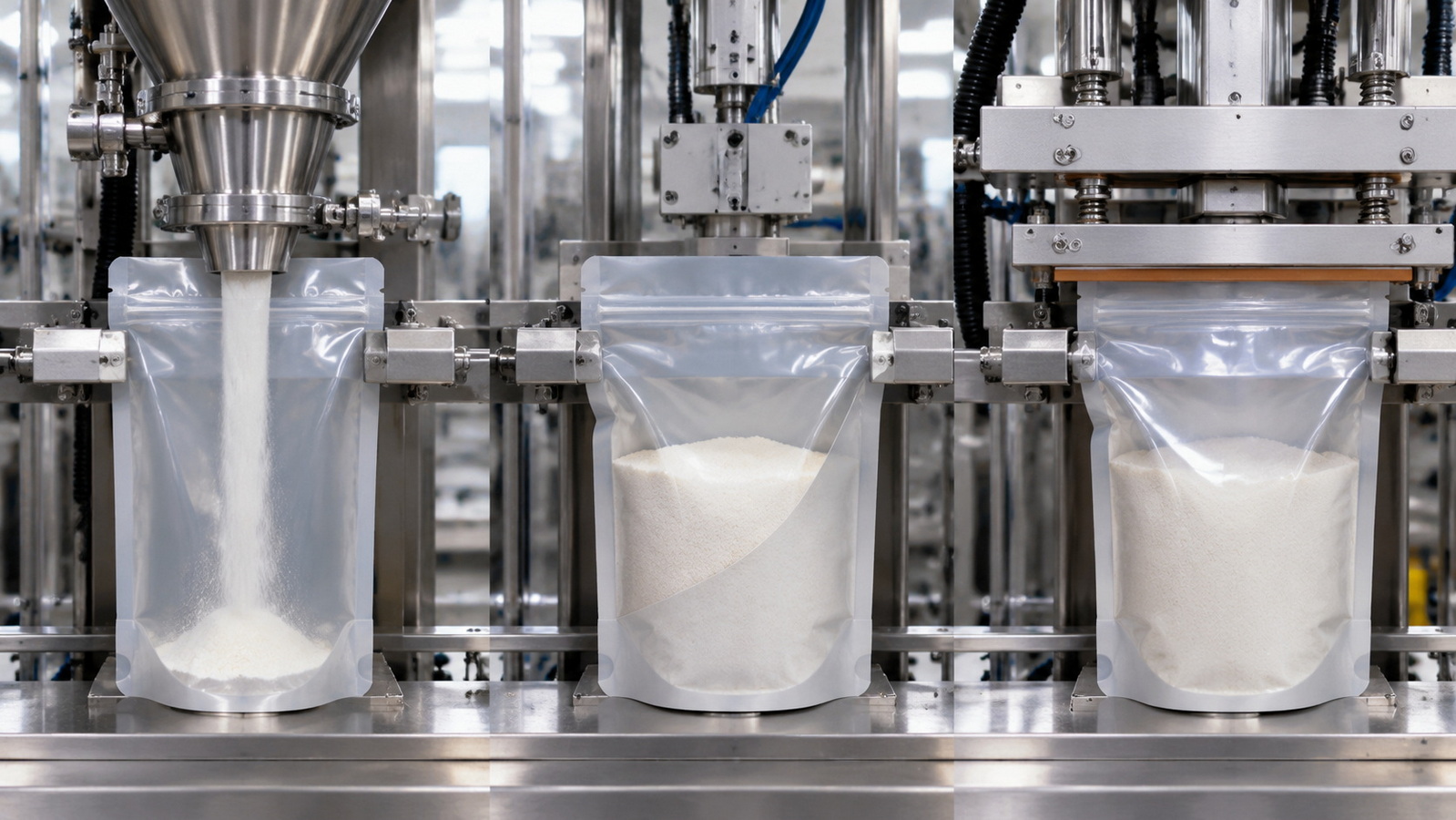
Evaluate:
- Whether the machine opens the pouch consistently.
- Whether the filling nozzle fits without contacting the closure.
- Whether the gusset expands during filling.
- Whether product reaches the base without bridging.
- Whether air, dust, or foam needs management.
A suitable pouch can appear too small if it is not fully opened.
A bag that accommodates the dose but leaves product in the sealing area is not correctly sized for that process.
Powder, oil, liquid, or trapped particles can interfere with seal formation. Check filling cutoff, nozzle withdrawal, product settling, and jaw clearance together.
More volume is not always the answer. The underlying problem may require a different filling arrangement or pouch-opening setup.
Approve the combination of product, pouch, and machine—not an empty sample alone.
Run trials at the proposed speed, with representative product and the agreed fill variation. Check whether acceptable filling and sealing remain consistent throughout the run.
Before ordering printed production quantities, document the acceptance criteria.
| Checkpoint | What to record |
|---|---|
| Product condition | Density, temperature, particle characteristics, or foam behavior |
| Pouch specification | Dimensions, gusset convention, laminate, seals, and closures |
| Filling performance | Dose consistency, opening reliability, and product flow |
| Closure performance | Clean seal area, zipper function, and visible defects |
| Finished-pack behavior | Standing stability, bulging, handling, and carton fit |
| Verification | Applicable strength and integrity tests with agreed limits |
Seal strength and leak integrity are different properties.
A peel-strength test evaluates the force required to separate a seal. A suitable leak test evaluates package openings under its defined detection conditions. One does not automatically establish the other.
Choose methods and acceptance criteria appropriate to the package and its risks.
My recommendation is to retain approved samples and the signed specification together. Future material or dimension changes can then be assessed against a clear baseline.
Avoid these shortcuts:
- Treating a supplier's gram rating as product-independent.
- Confusing a folded gusset measurement with full opened depth.
- Using tapped density for a product filled in a loose condition.
- Applying one correction factor to every pouch style.
- Approving samples without checking the filling machine.
- Selecting a larger pouch before investigating poor opening or product flow.
Keep units explicit, too. Grams and ounces describe mass; milliliters and fluid ounces describe volume. US and imperial fluid ounces also differ.
A useful quotation states both target product weight and the basis of the volume estimate.
The most reliable calculation follows a simple sequence: measure the product, estimate its volume, select candidate pouches, and validate the complete filling process.
HLun Pack provides packaging machinery and integrated packaging solutions. When planning a stand-up pouch project, share your product type, target net weight, measured density, preferred pouch drawing, filling temperature, and required output.
Ask our team to review the pouch and equipment requirements together before you finalize the packaging specification.
Only approximately. External width, height, and gusset dimensions do not fully describe the filled internal shape. Use them to compare candidates, then verify working capacity physically.
There is no universal answer. A 250 g product at 0.50 g/mL occupies 500 mL before operating allowances. A different product density changes the required volume.
Water can provide an initial internal-capacity reference if compatible with the sample. It cannot reproduce powder aeration, bridging, or dust generation, so actual-product testing remains necessary.
Not generally. "Round bottom" describes the base construction; it does not establish a circular cross-section throughout the pouch. A cylinder formula can therefore misrepresent capacity.
Manual filling may allow extra time for opening, settling, or foam collapse. Automated filling introduces nozzle-clearance, cycle-time, gripping, and sealing requirements that must be tested together.
No. The smallest physically possible pouch may restrict filling or contaminate the seal zone. Select the smallest size that consistently satisfies filling, closure, handling, and presentation requirements.
1. YLTPACK. "How To Calculate The Volume Of a Stand Up Pouch." Published October 30, 2025. Original article reviewed for its measurement guidance, geometric formulas, correction factors, capacity tables, and filling recommendations. Its universal capacity assumptions are not adopted as validated specifications here. [yltpacking]
2. United States Pharmacopeia. "〈616〉 Bulk Density and Tapped Density of Powders." Authoritative basis for distinguishing bulk density from particle density and for explaining the influence of interparticle voids and packing arrangement. [doi.usp]
3. United States Pharmacopeia. "〈616〉 Bulk Density of Powders," harmonization document incorporating changes marked May 1, 2024. Supports the distinction between untapped and tapped measurement conditions and the mass-to-volume calculation. [usp]
4. YLTPACK. "How to Measure and Select Gusset Size for Stable Stand Up Pouches." Published April 1, 2026. Used for the physical explanation of gusset expansion and the distinction between folded-panel depth and total gusset depth. Its generalized sizing ratios are not treated as universal requirements. [yltpacking]
5. LDPACK. "How to Calculate the Right Size for a Recyclable Stand-Up Pouch." Supports the product-first sizing workflow linking bulk density, dimensions, headspace, filling method, and sample testing. [cn.ldpack]
6. Nelson Labs. "Packaging Integrity & Strength Test." Supports the distinction between seal-peel strength testing and package-integrity testing, including gross-leak detection by internal pressurization. [nelsonlabs]
7. PM Packaging USA. "Pouch Seal Integrity & Leak Testing Guide." Published July 26, 2026. Supplementary technical guidance on contamination risks, complementary test methods, documentation, and application-specific acceptance criteria. [pmpackaging-usa]


