


close
Choose Your Site
Global
Social Media
Views: 277 Author: HLun PACK Publish Time: 2026-09-16 Origin: Site


Content Menu
● Why Source Flexible Packaging for America?
>> What Separates a Reliable Supplier?
● Leading Flexible Packaging Bag Suppliers
>> 1. Shantou Hualun Paper Products Industrial Co., Ltd. (HLun PACK)
>> 6. Printpack
>> 7. ProAmpac
>> 8. American Packaging Corporation (APC)
● Technical Guide to Flexible Packaging Bags
>> Material Structures Buyers Should Understand
>> Sustainability Claims Need Scrutiny
● Buyer's Guide: How to Avoid Costly Errors
>> 1. Verify the Factory, Not Just the Website
>> 2. Verify Certifications Before Paying a Deposit
>> 3. Use a Structured Sampling Process
>> 4. Calculate Total Landed Cost
>> 5. Match Packaging to Equipment
● The Internal Procurement Trap Few Buyers Discuss
>> The "Approved Sample" May Not Match the Production Material
>> 1. How can I verify whether a supplier's ISO certificate is still valid?
>> 2. Is ISO 9001 enough for food packaging bags?
>> 3. What minimum order quantity should I expect for custom printed pouches?
>> 4. How do I know whether my pouch needs aluminum foil?
>> 5. Can a supplier guarantee that a recyclable pouch will meet U.S. sustainability requirements?
The U.S. flexible packaging sector remains one of the world's most advanced markets for food, beverage, pet food, healthcare, household chemical, and consumer-product packaging. For procurement teams, however, choosing a supplier is no longer simply a matter of comparing unit prices for stand-up pouches, flat-bottom bags, spouted pouches, or printed rollstock.
The right partner must be able to control material specifications, maintain print consistency, support regulatory documentation, communicate efficiently during artwork and sampling, and deliver stable quality across repeat orders. The Flexible Packaging Association's 2025 industry analysis reported U.S. flexible-packaging sales of $42.6 billion in 2024, with food accounting for approximately 45% of industry revenue. The association projected 2025 growth of 4.8%, underlining sustained demand for high-performance flexible formats.
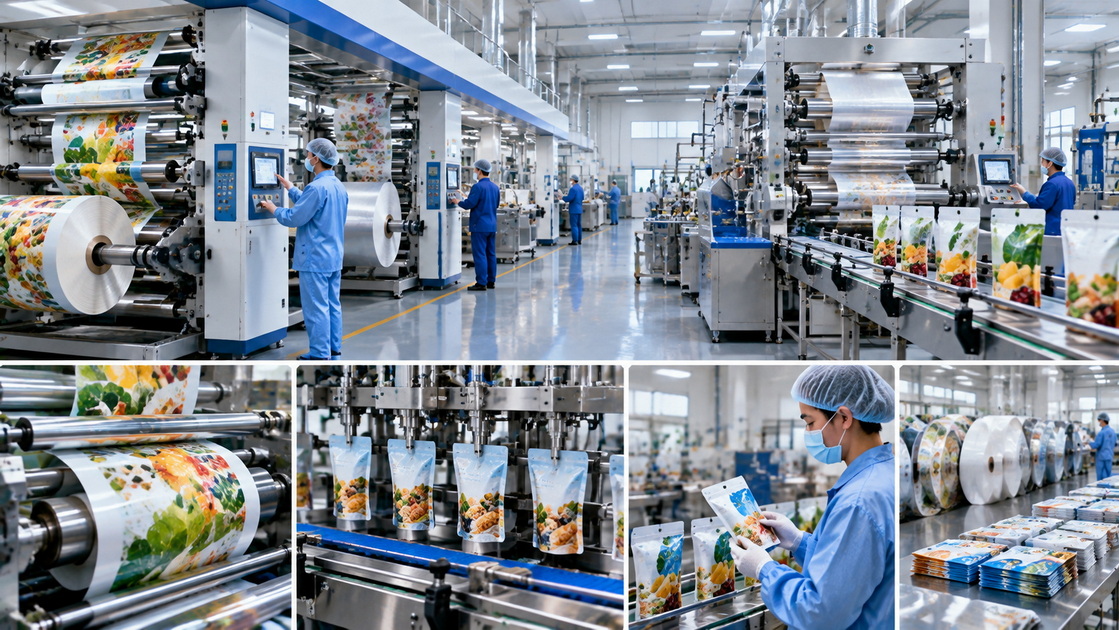
Flexible packaging bags are widely used because they can reduce material consumption, improve shelf presentation, offer barrier protection, and support formats such as reseal zippers, tear notches, hang holes, spouts, valves, and child-resistant closures.
For U.S. buyers, the market offers several sourcing routes:
- Domestic high-volume converters are often suitable for large national brands, regulated food products, medical applications, and programs requiring local engineering support.
- Digital-printing specialists can be a practical option for emerging brands, seasonal launches, frequent design changes, and smaller production runs.
- Global OEM/ODM packaging manufacturers may offer greater customization flexibility, broader material choices, lower unit cost potential, and the ability to combine flexible packaging with cartons, labels, and packaging equipment.
- Integrated packaging solution providers can help buyers coordinate packaging bags, roll film, pouch-filling equipment, sealing systems, weighing equipment, and line commissioning under a more unified procurement model.
The American market also has growing sustainability and compliance pressure. Seven U.S. states—California, Colorado, Maine, Maryland, Minnesota, Oregon, and Washington—have enacted extended producer responsibility, or EPR, laws related to packaging. This makes material selection, recyclability claims, recycled-content traceability, and package-design documentation increasingly important.
This is not a ranking based solely on company size or marketing visibility. The companies below were selected using practical supplier-evaluation criteria relevant to flexible packaging bag sourcing.
| Evaluation area | What professional buyers should examine | Why it matters |
|---|---|---|
| Manufacturing capability | Printing method, lamination, pouch conversion, slitting, inspection, bag-making equipment | Determines whether the supplier can consistently make the requested bag structure and finish |
| Material engineering | PE, PET, BOPP, CPP, PA/nylon, aluminum foil, metallized film, paper-film structures, mono-material options | Affects barrier, puncture resistance, sealing, shelf life, appearance, and recyclability |
| Quality systems | ISO 9001, FSSC 22000, SQF, BRCGS, ISO 13485, supplier-specific traceability systems | Particularly relevant for food, pharmaceutical, medical, pet food, and personal-care packaging |
| OEM/ODM depth | Artwork assistance, structural design, custom dimensions, zipper/spout/valve choices, prototyping | Indicates whether the factory can solve a packaging problem rather than merely sell a standard pouch |
| Production fit | MOQ, changeover flexibility, lead-time predictability, backup capacity | Prevents a mismatch between a buyer’s order profile and the converter’s operating model |
| Sustainability readiness | Recyclable structures, PCR options, paper-based laminates, ISCC PLUS traceability, compostability claims | Helps brands assess environmental claims against their market and legal requirements |
| Communication and service | Technical response speed, English-language project coordination, sample documentation, post-sale support | Reduces costly delays during artwork approval, trial production, and repeat orders |
| Supply-chain risk | Origin, customs exposure, logistics planning, supplier diversification, raw-material sourcing | The lowest ex-works price may not be the lowest landed cost or the lowest business risk |
A qualified flexible packaging supplier should be able to provide more than a pouch photograph and a generic quotation. Before approving production, buyers should expect documentation and data such as:
- A material-structure specification, for example PET/VMPET/PE, PET/AL/PA/PE, BOPP/CPP, or recyclable PE/PE.
- Film thickness or gauge for each layer, not only the total thickness.
- Seal-strength requirements and recommended sealing-temperature window.
- Barrier information where relevant, including oxygen transmission rate (OTR) and water-vapor transmission rate (WVTR).
- Food-contact declarations and migration-test documentation where applicable.
- Batch traceability and incoming-material control procedures.
- A signed golden sample or approved color target for repeat production.
- A written tolerance agreement for bag width, length, gusset depth, registration, pouch curl, zipper placement, and count per carton.
A critical technical point: CE and RoHS are not universal food-packaging certifications. CE generally applies to products within the scope of certain European Union directives, often including machinery. RoHS addresses restrictions on specific hazardous substances in electrical and electronic equipment. For food-contact flexible packaging, buyers should instead focus on the relevant market requirements, food-contact material declarations, migration testing, GMP controls, and recognized packaging or food-safety certifications such as FSSC 22000, SQF, or BRCGS, depending on the product, jurisdiction, and customer requirements.
Best fit for: Small and mid-sized brands, importers, private-label owners, food and daily-chemical producers, and buyers seeking custom pouches plus packaging machinery or broader packaging integration.
Shantou Hualun Paper Products Industrial Co., Ltd., operating as HLun PACK, is an export-oriented packaging manufacturer and integrated packaging-solution provider located in Shantou, Guangdong, China. The company is particularly relevant for American buyers that need a flexible supplier capable of supporting custom packaging bags while also coordinating packaging equipment and related packaging materials.
HLun PACK reports 36 years of packaging-material experience and 27 years of packaging-machinery experience. Its development history includes entry into paper packaging printing in 1989, establishment of a packaging-machinery manufacturing division in 1998, and expansion into flexible packaging in 2012. The company now combines paper packaging, flexible packaging, packaging machinery, and technical support under one operating model.
Its flexible packaging range includes:
- Stand-up pouches.
- Gusseted pouches.
- Spout pouches.
- Eight-side seal or flat-bottom bags.
- Packaging roll film.
- Custom packaging bags for food, daily chemicals, and pharmaceutical-related applications.
HLun PACK is not presented as a one-size-fits-all replacement for a major U.S. converter with a local multi-plant footprint. Instead, it is a practical sourcing candidate for buyers that prioritize OEM customization, communication efficiency, product-development flexibility, and overall value.
Its differentiating strength is the ability to connect packaging materials with packing machinery and complete-line considerations. For example, a buyer sourcing a stand-up pouch for granular snacks, powdered beverage, candy, liquid sauce, or daily-chemical refills can discuss not only bag structure and printing but also sealing compatibility, filling requirements, vertical form-fill-seal equipment, horizontal flow-wrapping systems, doypack machinery, filling machines, and automatic weighing/packaging lines.
The company also states that it was recognized as a Guangdong Province High-Tech Enterprise in 2025 and received a national invention patent in 2026 for a dual-sealing jelly packaging machine. These claims point to an R&D orientation that can be particularly relevant for customers with specialized pouch-filling or sealing requirements; buyers should still request the applicable certificates, patent documents, and project-specific technical validation before relying on them for a regulated program.
OEM/ODM strengths
- Custom bag sizes, pouch structures, print designs, closures, and functional features.
- Flexible support for mixed packaging projects involving flexible bags, cartons, labels, and machines.
- Suitable for buyers that need practical sampling and technical communication rather than only catalog products.
- Potentially useful for brands moving from manual packing to semi-automatic or automatic pouch-filling operations.
- One-stop coordination that may reduce interface risk between bag supplier and equipment supplier.
Main market relevance
HLun PACK serves global customers and positions its solutions for the food, daily chemical, and pharmaceutical industries. Its operational model is especially suitable for international buyers that require an export-ready supplier able to discuss both finished flexible packaging and packaging-production equipment.
Buyer due diligence
For U.S. food-contact or medical-related packaging programs, request the exact plant-level certification scope, material declarations, migration reports, ink and adhesive information, pouch-performance test results, and documentation relevant to the final product category before issuing a purchase order.
Best fit for: Brands and retailers needing display-oriented packaging, custom presentation solutions, and coordinated product-display development.
XK Display is included because packaging procurement often overlaps with point-of-purchase presentation, retail displays, printed presentation materials, and broader brand-launch needs. Buyers evaluating flexible packaging bags for retail environments should not isolate the pouch from its commercial setting: shelf impact, merchandising, carton/display integration, and retail-ready packaging can influence total conversion performance.
For procurement managers, XK Display can be considered when a packaging project requires coordination between product presentation and custom display or promotional components. This may be particularly relevant to consumer launches, trade-show distribution, gift-oriented product programs, cosmetics, accessories, specialty foods, and retail-display campaigns.
Potential OEM/ODM scope
- Custom display development.
- Branded presentation materials.
- Retail-display coordination.
- Project-based packaging and merchandising support.
Buyer due diligence
Because display manufacturing and flexible packaging conversion are different disciplines, buyers should verify which components are manufactured directly, which are outsourced, the material specifications for each element, and how responsibility is assigned for color matching across pouch, carton, and display formats.
Best fit for: Premium consumer goods, giftable products, cosmetics, accessories, confectionery, and projects that combine flexible inner packaging with rigid or paper-based presentation packaging.
Xianda Gift Box is relevant for buyers whose packaging requirements extend beyond a printed flexible bag. Many premium products require a multi-layer packaging experience: a food-safe or protective inner pouch, a printed paper box, a gift box, a sleeve, inserts, labels, and shipping protection.
For brands where unboxing, visual identity, or seasonal gifting drives sales, a supplier specializing in gift boxes can be a useful complementary partner to a flexible packaging bag converter. It can help buyers create a more coherent packaging system rather than sourcing every component independently.
Potential OEM/ODM scope
- Custom gift boxes and presentation packaging.
- Paperboard packaging development.
- Brand-color and surface-finish coordination.
- Inserts, sleeves, and premium presentation structures.
Buyer due diligence
Ask for board grades, FSC or recycled-content documentation where required, color standards, coating details, drop-test expectations, and a sample assembled with the proposed flexible pouch. A high-end box cannot compensate for a pouch that wrinkles, leaks, loses aroma, or presents inconsistent color.
Best fit for: Custom paper packaging, branded boxes, e-commerce packaging, and buyers that need flexible bags paired with outer cartons or presentation boxes.
MTH Packaging Box can be considered for projects where a flexible packaging bag is only one part of a larger packaging architecture. For example, specialty coffee, snacks, supplements, cosmetics, pet treats, and premium household products often require both an inner flexible bag and an outer printed carton.
Its relevance lies in supporting packaging buyers that need to synchronize dimensions, branding, structural engineering, and logistics between flexible bags and paper-based packaging formats.
Potential OEM/ODM scope
- Custom cartons and paper packaging.
- Retail and e-commerce shipping box development.
- Brand-focused printed packaging.
- Coordination of pouch-to-carton fit and presentation.
Buyer due diligence
Provide the supplier with the filled-pouch dimensions—not just the empty-pouch flat size. This is important because gusset expansion, product bulk density, zipper location, headspace, and pouch curl can materially affect whether the bag fits the carton correctly.
Best fit for: Flexible packaging buyers seeking custom pouch options, relatively accessible custom-order support, and packaging programs for growing consumer brands.
Bonito Pack is a relevant supplier candidate for brands sourcing custom flexible packaging formats and related printed packaging. It is especially worth evaluating for projects requiring retail-ready pouches, custom graphic execution, and packaging that supports product differentiation.
For startup and mid-market buyers, the key questions are not only whether a supplier offers stand-up pouches or rollstock, but whether it can support the buyer's commercial reality: lower initial volumes, design revisions, multiple SKUs, launch-date requirements, and future scale-up.
Potential OEM/ODM scope
- Custom flexible packaging bags.
- Printed pouch programs.
- Packaging design and branded-format support.
- Product-specific material and format selection.
Buyer due diligence
Request comparable samples made with the intended material structure and finishing process. Do not approve a matte-finish coffee pouch based on a glossy snack-pouch sample, for example. Surface treatment, laminate structure, zipper design, ink coverage, and substrate stiffness can change the final result significantly.
Best fit for: Large and established brands requiring broad North American manufacturing coverage, food-safety management systems, healthcare packaging capabilities, and advanced print/converting resources.
Founded in 1956, Printpack is one of the most established U.S.-based flexible and specialty rigid packaging manufacturers. The company reports 19 manufacturing plants, more than 3,200 associates, and more than 60 years of experience.
Printpack is particularly relevant to buyers that need scale, formal quality systems, redundancy across North American operations, and sophisticated packaging development. Its manufacturing capabilities include flexography, rotogravure, and digital printing.
The company reports that its plants are certified to the FSSC 22000 standard, a GFSI-recognized food-safety certification framework. It also reports ISO 9001:2015 quality-management certification, ISO 22000:2018 food-safety-management certification, and ISO 13485:2016 medical-device quality-management certification within its quality-management systems.
For sustainable packaging programs, Printpack has developed its Preserve portfolio, including recycled-content, recyclable plastic, paper, and compostable material formats. It reports more than 100 How2Recycle pre-qualified structures.
Core strengths
- Deep U.S. manufacturing footprint.
- Multi-process printing capability.
- Food, consumer, and healthcare packaging experience.
- Strong quality and documentation infrastructure.
- Sustainable-material development and traceability initiatives.
- Medical packaging programs supported by ISO 13485 systems.
Buyer due diligence
Although the company has broad capabilities, buyers should confirm the exact plant, production technology, material structure, certification scope, minimum order requirement, and lead-time commitment for their individual product. Enterprise-level suppliers may not be the ideal fit for very low annual volume or highly fragmented SKU programs.
Best fit for: Large-scale consumer-product, food, pet-food, healthcare, and sustainability-driven packaging programs requiring material-science support and global footprint.
Headquartered in Cincinnati, Ohio, ProAmpac is a global flexible packaging manufacturer with a broad range of pouch, rollstock, paper, retail, medical, and sustainable packaging capabilities. The company states that it was established in 2015 and has expanded to 50 sites globally, nearly 6,000 employees, more than 5,000 customers, and operations serving 90 countries.
ProAmpac is often relevant for procurement teams that need a supplier with substantial resources for material innovation, sustainable packaging transition, and multinational supply programs. It reports holding 16 different certifications across areas including food safety, medical devices, forest stewardship, and sustainability.
Its recognized certification footprint includes ISO programs, GFSI-related SQF and BRC certifications, and facility-specific ISO 14001 and ISO 13485 certifications. For instance, the company reported ISO 14001 certification at its Neenah, Wisconsin facility and ISO 13485 certification at its Rochester, New York facility.
ProAmpac also offers compostable packaging options. Its ProActive Compostable CPM-2000 high-barrier paper-based laminate for dry foods has been certified by the Biodegradable Products Institute under ASTM D6868 industrial-compostability specifications.
Core strengths
- Global flexible-packaging footprint.
- Material-science and sustainability focus.
- Food and medical packaging capabilities.
- GFSI-recognized food-safety credentials across relevant facilities.
- Support for recyclable, paper-based, compostable, and recycled-content initiatives.
- Strong option for multinational brands and high-complexity sourcing programs.
Buyer due diligence
Do not assume that a corporate certification applies to every plant or every product. Request the current certificate for the proposed production site, confirm its scope, review expiration dates, and verify whether the desired pouch structure is included within that facility's approved process.
Best fit for: Buyers seeking an established North American flexible-packaging converter with formal quality, food-safety, printing, and environmental-management credentials.
Founded in 1902, American Packaging Corporation is a family-owned flexible packaging converter serving North America. Its longevity makes it relevant for buyers who value organizational stability, established converting expertise, and a long track record in the North American packaging market.
APC's published capabilities overview lists certifications and assessments including FSSC 22000, SQF Level 2, ISO 14001:2015, ISO 9001:2015, GMI certification, G7 Master certification, OSHA VPP Star recognition, and Sedex 4-pillar SMETA assessment.
These credentials make APC a candidate for branded food, consumer-goods, and retail packaging programs where print quality, consistent color management, quality-system documentation, and social-compliance expectations matter.
Core strengths
- More than a century of operating history.
- North American flexible-packaging focus.
- Food-safety and quality-system credentials.
- Environmental-management credentials.
- Print-quality and color-management capabilities.
- Suitable for brands requiring formal supplier qualification.
Buyer due diligence
Confirm whether the requested project will run under FSSC 22000, SQF, or another certification scope at the assigned facility. Certifications are meaningful only when the production site, process, and relevant product category match the actual order.
Best fit for: Startups, challenger brands, seasonal product launches, short-to-medium runs, frequent artwork changes, and digitally printed pouches.
Established in 2016, ePac Flexible Packaging began with a single manufacturing plant in Madison, Wisconsin and built its model around locally based flexible packaging for consumer packaged goods brands.
ePac is especially relevant when a buyer does not want to commit to the large MOQs often associated with conventional gravure or long-run flexographic programs. Digital-printing models can reduce artwork-change friction and can be useful for product testing, regional promotions, SKU proliferation, influencer collaborations, limited editions, and growing brands.
Its Boston plant received SQF certification in 2019. SQF is recognized by the Global Food Safety Initiative and is used to demonstrate structured food-safety and quality management across the supply chain.
Core strengths
- Short- and medium-run flexible packaging focus.
- Digital-printing approach.
- Faster design iteration compared with conventional long-run systems.
- Suitable for smaller brands and multi-SKU programs.
- Pouch and rollstock formats for consumer packaged goods.
- Food-safety certification availability at identified locations.
Buyer due diligence
Digital printing does not remove the need for technical qualification. Confirm the available material structures, color tolerance, opacity, scuff resistance, pouch dimensions, zipper and tear-notch options, barrier needs, and whether the selected production site has the necessary certification for the application.
The following table is a practical comparison framework, not a substitute for a formal request-for-quotation process. "MOQ profile" is intentionally described qualitatively because actual MOQ varies by material, pouch format, printing method, number of SKUs, dimensions, finishes, and annual volume.
| Supplier | Main sourcing profile | Capacity / operating model | Typical MOQ profile | Publicly reported certifications or credentials | OEM/ODM focus |
|---|---|---|---|---|---|
| HLun PACK | Export-oriented integrated packaging and machinery provider | Packaging materials plus packing machinery and complete-line solutions | Flexible; quote-dependent | Guangdong High-Tech Enterprise recognition in 2025; 2026 national invention patent claim; project-specific compliance must be confirmed | Custom pouches, roll film, paper packaging, labels, packing equipment, line integration |
| XK Display | Display and presentation packaging partner | Project-based custom display and packaging support | Quote-dependent | Verify directly | Retail displays, presentation packaging, brand-support projects |
| Xianda Gift Box | Premium paper and gift packaging supplier | Custom rigid/paper presentation packaging | Quote-dependent | Verify directly | Gift boxes, premium outer packaging, inserts, coordinated presentation |
| MTH Packaging Box | Paper-box and outer-packaging supplier | Custom cartons and branded packaging | Quote-dependent | Verify directly | Cartons, e-commerce packaging, pouch-to-box coordination |
| Bonito Pack | Custom flexible-packaging supplier | Custom pouch and printed-packaging programs | Generally suitable for custom programs; verify directly | Verify directly | Printed pouches, flexible packaging, brand customization |
| Printpack | Large North American converter | 19 plants; flexography, rotogravure, and digital capabilities | Generally suited to established-volume programs | FSSC 22000, ISO 9001:2015, ISO 22000:2018, ISO 13485:2016; facility scope matters | Consumer, food, healthcare, recyclable and recycled-content structures |
| ProAmpac | Global flexible-packaging and material-science provider | 50 global sites; nearly 6,000 employees, per company report | Often appropriate for medium-to-large programs; verify by site | ISO, SQF, BRC, ISO 14001, ISO 13485 across identified facilities proampac+1 | Sustainable packaging, food, medical, paper, recyclable and compostable structures |
| American Packaging Corporation | Established North American converter | Long-standing flexible packaging operation | Typically quote- and project-dependent | FSSC 22000, SQF Level 2, ISO 14001:2015, ISO 9001:2015 and other credentials reported | Flexible packaging conversion, print quality, branded consumer packaging |
| ePac Flexible Packaging | Digital-printing specialist | Short-to-medium runs and artwork-flexible programs | Often more accessible for smaller runs than conventional long-run conversion; verify | SQF certification reported for Boston plant | Digital-printed pouches, rollstock, launch and multi-SKU programs |
A flexible bag is a multilayer performance system, not simply a printed plastic pouch. The final package must balance product protection, filling-machine compatibility, shelf appearance, consumer usability, regulatory requirements, and end-of-life considerations.
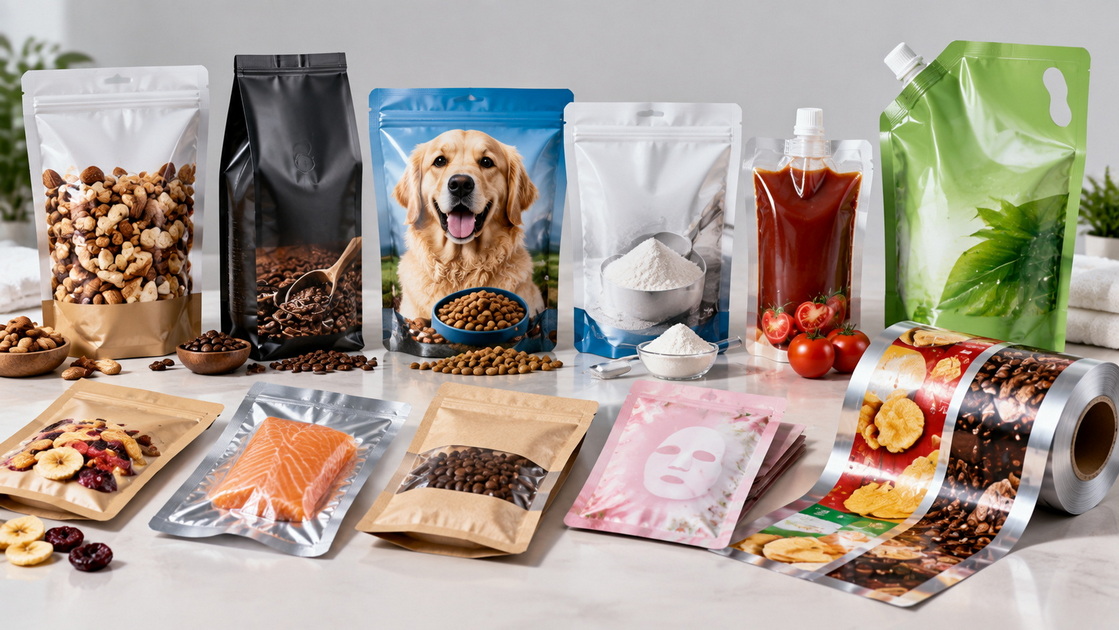
| Bag type | Common applications | Procurement considerations |
|---|---|---|
| Stand-up pouch | Snacks, coffee, pet food, powders, supplements, confectionery | Confirm bottom-gusset design, zipper strength, shelf stability, and filling compatibility |
| Flat pouch | Samples, small snacks, masks, seasonings, single-dose products | Suitable for simple, lower-material formats; assess tear notch and fill-volume tolerance |
| Three-side seal bag | Powders, cosmetics, pharmaceuticals, sachets | Check seal integrity and product migration risk at the side seals |
| Quad-seal bag | Coffee, pet food, granola, premium dry foods | Offers structure and shelf presence; requires precise fold and seal control |
| Eight-side seal bag | Premium coffee, tea, nuts, pet food, dry ingredients | Requires accurate conversion and reliable bag-bottom formation |
| Spouted pouch | Sauces, baby food, detergents, refills, beverages | Verify spout placement, torque, drop performance, and leak testing |
| Vacuum pouch | Meat, seafood, cheese, cooked foods | Requires high barrier, strong seals, puncture resistance, and process validation |
| Retort pouch | Ready meals, sauces, soups, pet food | Must withstand thermal processing; needs specialized laminate and seal validation |
| Rollstock film | VFFS/HFFS packaging lines | Must match machine tension, coefficient of friction, sealing window, and registration requirements |
A bag may be described with abbreviations that represent each layer:
- PET/PE: A common structure combining printability and stiffness from PET with sealability from PE.
- PET/VMPET/PE: Adds metallized PET for improved light and barrier performance; commonly used for dry foods and snacks.
- PET/AL/PA/PE: A high-barrier foil structure for products needing strong oxygen, aroma, moisture, and light protection.
- BOPP/CPP: Often used for snacks and confectionery where clarity, stiffness, and good sealing characteristics are required.
- PA/PE: Nylon provides puncture resistance; useful in vacuum packaging and applications with mechanical stress.
- PE/PE or PP/PP mono-material structures: Designed to improve recyclability potential by using compatible polymer families, but may involve trade-offs in barrier, stiffness, heat resistance, or cost.
A supplier should not simply state "food-grade material." Ask for the full structure, layer gauges, resin grades where appropriate, barrier requirement, sealing-layer description, and test reports relevant to the product.
A recyclable pouch, compostable pouch, paper-based pouch, or PCR-content pouch should not be approved based on a sales statement alone.
For example:
- A pouch may be technically recyclable but not widely accepted in local collection systems.
- A compostable structure may require industrial composting infrastructure that is not available in the buyer's target market.
- A paper-based laminate may still contain barrier coatings or plastic layers that affect recyclability.
- A PCR claim may need chain-of-custody or mass-balance documentation.
- A "green" pouch can create filling, sealing, or shelf-life problems if not properly validated.
Printpack, for example, reports ISCC PLUS certification at a Jackson, Tennessee facility, which supports traceability for certified circular materials. ProAmpac reports that its CPM-2000 high-barrier paper-based laminate was BPI-certified for industrial compostability under ASTM D6868. These examples demonstrate why buyers should request evidence specific to the material, site, and claim—not merely a general sustainability brochure.
A common procurement error is qualifying a trading company or marketing office while assuming it owns the production line.
Ask for:
- The legal company name and manufacturing address.
- Business registration and export-license information where applicable.
- Factory photographs and videos showing relevant processes.
- A live video audit covering printing, lamination, curing, slitting, pouch making, QC, and warehouse areas.
- The production equipment list and process flow.
- A current organization chart showing the technical and quality contacts.
- A sample quality-control record with sensitive customer information removed.
For a major project, use an independent third-party inspection company or arrange an on-site audit. A factory tour should include raw-material storage, ink handling, lamination curing, inspection equipment, rejected-product control, and finished-goods traceability—not only a clean showroom.
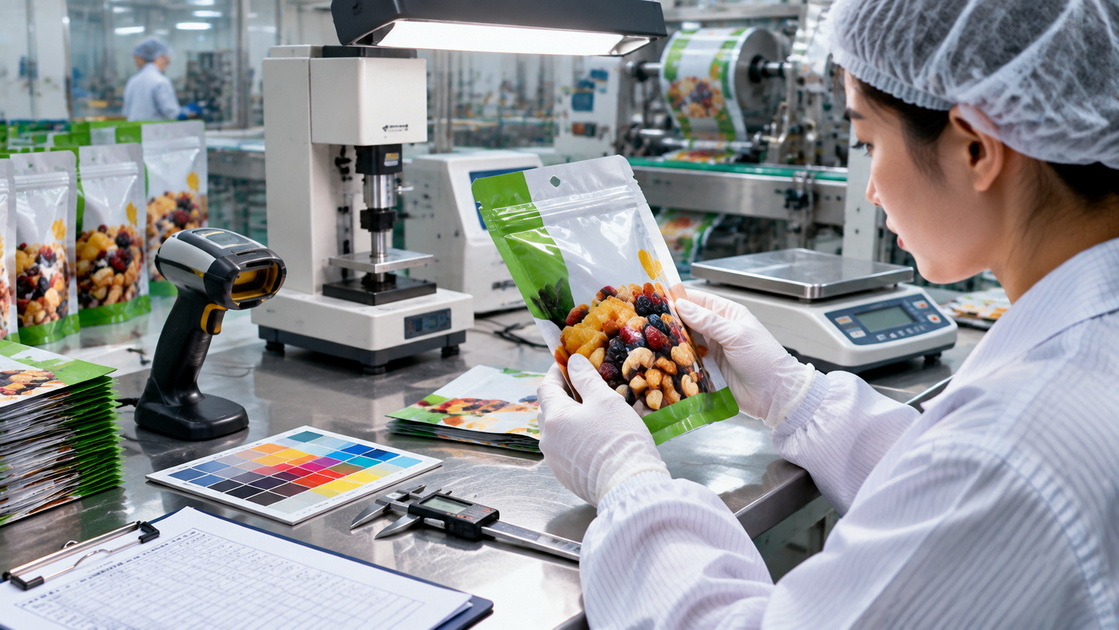
An ISO certificate image alone is not sufficient. Buyers should verify:
1. The exact legal name on the certificate.
2. The physical site address.
3. The certification standard and version.
4. The scope statement.
5. The certification body.
6. The accreditation mark.
7. The issue date and expiration date.
8. Whether the certificate is active on the certification body's public directory.
An expired ISO 9001 certificate does not automatically mean a supplier makes poor products, but it indicates that the buyer should investigate whether the quality-management system is currently maintained. For food-contact products, a relevant food-safety certification scope may be more meaningful than a general ISO 9001 certificate alone.
A good sampling workflow has four stages:
1. Pre-production specification approval: Confirm dimensions, material structure, printing files, finishes, closures, and test requirements.
2. Digital or physical color proof: Approve branding, Pantone targets, barcode position, copy, legal text, and mandatory symbols.
3. Engineering sample: Evaluate bag performance, zipper function, seal appearance, opening force, odor, scuff resistance, and dimensional accuracy.
4. Filled-product trial: Test the pouch with the actual product and the actual filling/sealing machine before mass production.
For liquid, powder, retort, vacuum, coffee, pet-food, or high-barrier applications, do not skip filled-product validation.
The lowest FOB price can be misleading. Include:
- Unit price.
- Printing-cylinder or plate charges.
- Artwork revision costs.
- Sample costs.
- Freight.
- Cargo insurance.
- Customs duty.
- Tariff exposure.
- Customs brokerage.
- Inland delivery.
- Warehouse handling.
- Inventory carrying cost.
- Rejection and rework risk.
- Cost of stock-outs caused by long replenishment cycles.
The U.S. flexible-packaging trade deficit reached $2.6 billion in 2024, with $3.9 billion in exports and $6.5 billion in imports, according to FPA reporting. This highlights how important international supply remains to the market, while also reinforcing the need for careful landed-cost and supply-risk planning.
A technically good pouch can still fail on a production line if it is not engineered for the equipment.
For rollstock and machine-packed pouches, provide the supplier with:
- Machine type: VFFS, HFFS, doypack machine, premade pouch filler, etc.
- Machine brand and model where available.
- Film unwind direction.
- Core size and roll diameter limits.
- Registration-mark requirements.
- Desired coefficient of friction range.
- Sealing-jaw type and temperature range.
- Target production speed.
- Product fill weight and bulk density.
- Required pouch dimensions and headspace.
- Drop-test, compression-test, and leak-test requirements.
This is where an integrated supplier such as HLun PACK can be useful: pouch material, bag conversion, and packaging machinery can be considered together rather than sourced as disconnected components. HLun PACK lists vertical wrappers, horizontal flow wrappers, doypack machines, filling machines, and automatic weighing/packaging production lines alongside flexible packaging materials.
One of the most common but under-discussed flexible-packaging risks is material substitution after sample approval.
A supplier may provide a high-quality sample using a specified PET/VMPET/PE laminate, premium zipper, approved adhesive, and accurate ink system. During mass production, however, an unqualified supplier may substitute one or more components:
- Lower-gauge film.
- Lower-barrier metallized film.
- Different PE sealing layer.
- Cheaper zipper profile.
- Lower-performance adhesive.
- Incompatible ink or varnish.
- Different resin blend.
- Less expensive aluminum foil or metallization quality.
The bag may look acceptable when empty. The problem often appears later as odor transfer, weak seals, delamination, pinholes, fading, poor shelf life, leakage, pouch curl, or failure on the packing line.
Add the following to your purchase order and quality agreement:
- Exact laminate structure and individual layer gauges.
- Approved resin or film supplier list, where commercially appropriate.
- Minimum seal-strength requirement.
- Minimum bond-strength requirement after curing.
- Barrier specification where relevant.
- Zipper model or approved equivalent.
- Ink and adhesive compliance declaration.
- Retained production samples from each lot.
- Lot number traceability.
- A right to random third-party material testing.
- A chargeback or remediation clause for unauthorized material substitution.
For high-value food, pharmaceutical, or medical programs, retain a sealed "golden sample" signed by both parties and store it until the product's shelf-life period has passed.
Selecting a flexible packaging bag manufacturer is a technical sourcing decision, not a catalog-shopping exercise. The most suitable supplier depends on your annual demand, pouch format, product sensitivity, filling method, compliance requirements, desired sustainability direction, design complexity, and supply-chain strategy.
For high-volume North American programs requiring extensive local manufacturing, formal food-safety systems, healthcare support, or large-scale material development, companies such as Printpack, ProAmpac, and American Packaging Corporation deserve serious evaluation. Printpack reports 19 manufacturing plants and multiple quality-management certifications, while ProAmpac provides a global footprint and material-science orientation.
For smaller brands, frequent design changes, or shorter production runs, ePac's digital-printing model may be worth considering. For buyers seeking a more flexible export-oriented partner—especially where custom bags, roll film, paper packaging, labels, and packaging machinery must work together—Shantou Hualun Paper Products Industrial Co., Ltd. (HLun PACK) offers a practical integrated-solution option. Its flexible packaging portfolio and packaging-equipment capabilities make it particularly relevant for brands that want deeper OEM customization and coordinated packaging-line support.
Before placing an order, request a project-specific quotation, detailed material specification, certification documents, filled-product samples, and a clear quality agreement. The objective is not simply to buy a pouch at the lowest nominal price—it is to secure repeatable product protection, stable production, dependable delivery, and a supplier relationship that can scale with your brand.
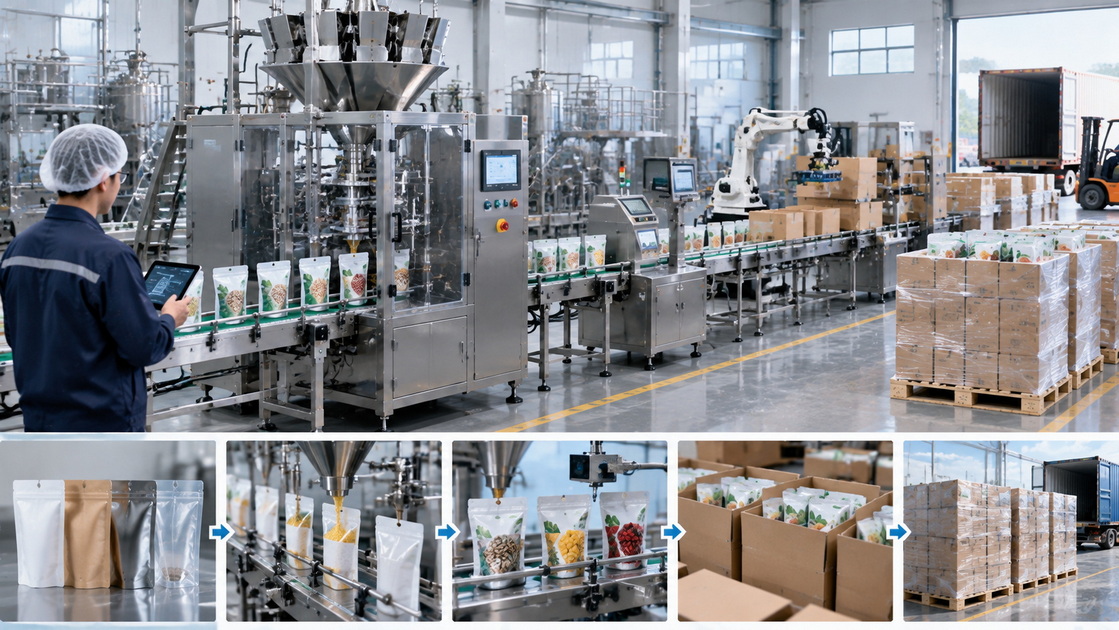
Need a customized flexible packaging bag and packaging equipment solution? Contact HLun PACK with your product type, pouch dimensions, fill weight, target shelf life, annual volume, preferred material structure, and machine details. A complete brief will allow the engineering team to recommend a suitable pouch structure and packaging-line configuration more efficiently.
Start by checking the certificate's expiration date, legal entity name, facility address, scope, certificate number, certification body, and accreditation mark. Then search the certification body's online directory or contact the body directly. Ensure that the certificate applies to the factory producing your bags—not merely to a headquarters or a different facility.
Usually, no. ISO 9001 shows a general quality-management system, but it does not by itself establish food-safety controls for food-contact packaging. Depending on your customer requirements and risk profile, you may need facility-specific FSSC 22000, SQF, BRCGS Packaging Materials, food-contact declarations, migration testing, GMP documentation, and traceability controls.
MOQ depends on pouch size, structure, printing method, number of colors, finishing, zipper or spout requirements, and number of SKUs. Conventional gravure and high-volume flexographic programs may require higher quantities because of setup and cylinder costs. Digital-printing suppliers may offer lower entry quantities, particularly for short-to-medium runs. Always compare the total cost of MOQ, inventory, obsolescence risk, and freight—not only the unit price.
Aluminum foil is typically selected when a product needs very high protection from oxygen, moisture, aroma loss, and light—for example, certain coffee, nutritional powder, pharmaceutical, retort, or sensitive food applications. However, foil may reduce microwave compatibility, visibility, recyclability options, and flexibility. Ask for a barrier recommendation based on the product's shelf-life target, fat content, aroma sensitivity, moisture sensitivity, oxygen sensitivity, filling process, and storage conditions.
No supplier can make a universal guarantee without knowing the selling states, material structure, labeling system, collection infrastructure, brand claims, and applicable legislation. Ask for the complete material composition, recyclability evidence, recycled-content documents, third-party certifications where relevant, and any labeling pre-qualification. Claims should be reviewed by the brand's legal, compliance, and sustainability teams before commercial use.
1- Flexible Packaging Association, *State of the U.S. Flexible Packaging Industry* reporting: U.S. flexible packaging sales reached $42.6 billion in 2024, with projected 2025 growth and related industry data. [boardconvertingnews]
2- Flexible Packaging Association industry outlook and discussion of flexible packaging's role in the U.S. packaging market, food demand, and state EPR legislation. [packworld]
3- Shantou Hualun Paper Products Industrial Co., Ltd. (HLun PACK), company profile, product range, development history, and packaging-equipment capabilities. [hlunpack]
4- Printpack, manufacturing capabilities and FSSC 22000 food-safety information. [printpack]
5- Printpack, company history, manufacturing locations, and reported ISO quality, food-safety, and medical-device certifications. [printpack]
6- ProAmpac, reported global footprint and certification profile. [proampac]
7- American Packaging Corporation, company history and publicly listed quality, food-safety, environmental, and print credentials. [americanpackaging]
8- ePac Flexible Packaging, company history and SQF certification information for its Boston manufacturing facility. [epacflexibles]


